When it comes to motorcycle safety, most riders focus on helmet construction, certifications, and fit—but the color of your helmet plays a surprisingly crucial role in preventing accidents.
While understanding helmet types, safety standards, and proper fit is essential (all covered in this Ultimate Guide to Motorcycle Helmets), visibility is often the most overlooked safety factor.
Multiple studies have shown that helmet visibility can significantly reduce the risk of collisions, with certain colors making riders up to 24% less likely to be involved in crashes.
The right helmet color can be the difference between being instantly noticed by distracted drivers—or blending into the background at the worst possible moment.
In this in-depth guide, we’ll explore the nine best motorcycle helmet colors for safety, analyzing each through the lens of scientific research, human visual perception, and real-world riding conditions. Each color has been evaluated based on:
- Daytime and nighttime visibility
- Performance in rain, fog, and low-light conditions
- Contrast against urban and natural backgrounds
- Psychological impact on other road users
- Supporting accident and visibility research
Whether you’re a daily commuter weaving through traffic or a weekend rider exploring open roads, choosing the right helmet color is one of the simplest and most cost-effective safety upgrades you can make.
1. White – The Classic Safety Champion
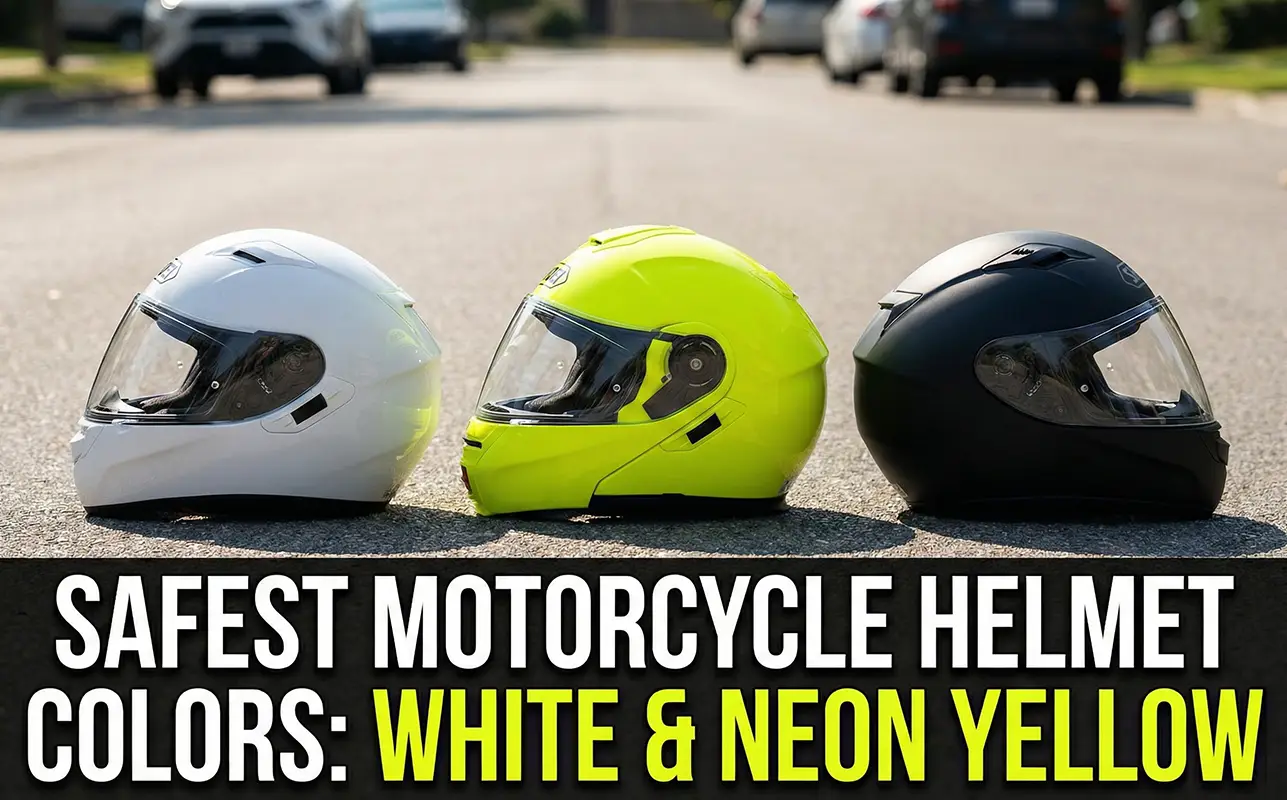
White helmets have long been considered the gold standard for motorcycle safety, and for good reason. This timeless color choice has consistently proven its worth in visibility studies and real-world accident prevention.
Overview
White helmets reflect the maximum amount of light, making them highly visible in virtually all lighting conditions. Research conducted by the Monash University Accident Research Centre found that white helmets are associated with a 24% lower crash risk compared to black helmets.
The reflective properties of white also help keep the helmet cooler in hot weather. Additionally, white helmets show dirt and damage more readily, encouraging riders to maintain their gear properly. For more on maintenance, read our guide on when to replace your motorcycle helmet.
Key Features
- Max Light Reflection: Visible in low and bright light.
- Heat Management: Reflects sunlight to keep the head cool.
- Damage Detection: Cracks and scratches are easily visible.
- Background Contrast: Stands out against dark asphalt and urban clutter.
Pros and Cons
Pros:
- Highest overall visibility rating across all lighting conditions.
- Reflects heat effectively, keeping riders cooler during summer months.
- Statistically proven to reduce accident risk by up to 24%.
- Usually the most affordable “solid” color option.
Cons:
- Shows dirt, bugs, and road grime quickly.
- Can become yellowed or discolored over time with UV exposure.
- May lack personality or style appeal for some riders.
Pricing White is typically the “base” color for most helmet models, often costing $10-$50 less than graphic versions.
Best For Commuters and touring riders who prioritize maximum safety and heat reflection.
2. Fluorescent Yellow – The High-Visibility Powerhouse
Fluorescent yellow, often called hi-vis yellow or safety yellow, is the color of choice for emergency responders and safety-conscious professionals worldwide. Its eye-catching properties make it impossible to ignore on the road.
Overview
Fluorescent yellow helmets utilize special pigments that absorb ultraviolet light and re-emit it as visible light, creating an almost glowing appearance. This color is scientifically engineered for maximum human eye detection, as our eyes are naturally most sensitive to yellow-green wavelengths.
Studies have shown that fluorescent yellow is particularly effective in low-light conditions like dawn and dusk. It is often the go-to color for best motorcycle modular helmets used by police forces.
Key Features
- UV Conversion: Converts UV light to visible light for a “glow” effect.
- Peak Sensitivity: Matches the human eye’s most sensitive spectrum.
- Adverse Weather Performance: Cuts through fog and rain.
- Immediate Recognition: Associated with caution/emergency.
Pros and Cons
Pros:
- Scientifically proven to be the most attention-grabbing color.
- Exceptional performance in low-light, dawn, and dusk conditions.
- Highly effective in adverse weather including fog and rain.
- Creates psychological urgency in other drivers.
Cons:
- Can fade more quickly than standard colors due to UV pigments.
- Some riders find the bright appearance too bold.
- May not match with all motorcycle color schemes.
Pricing Often priced similarly to solid colors, though some brands charge a small premium for Hi-Vis paint.
Best For All-weather riders and daily commuters in heavy traffic.
3. Fluorescent Orange – The Emergency Response Standard
Fluorescent orange combines the visibility benefits of fluorescent technology with a warm, energetic hue that stands out in virtually any environment. This color has earned its reputation in safety-critical industries worldwide.
Overview
Fluorescent orange helmets offer visibility characteristics similar to fluorescent yellow but with distinct advantages in rural settings. The color is particularly effective against green natural backgrounds like forests and fields, making it an excellent choice for dual sport vs. dirt bike helmets.
Research indicates that orange is highly visible to peripheral vision. The color maintains its visibility across a wide range of lighting conditions and is especially effective during the “golden hours.”
Key Features
- Peripheral Detection: Easily spotted “out of the corner of the eye.”
- Nature Contrast: Pops against green and brown backgrounds.
- Rescue Visibility: Standard color for search and rescue gear.
- Warm Hue: High energy visual impact.
Pros and Cons
Pros:
- Excellent contrast against natural green backgrounds and rural environments.
- Highly detectable in peripheral vision.
- Performs exceptionally well during sunrise and sunset.
- More stylistically versatile than fluorescent yellow.
Cons:
- Fluorescent pigments may fade with prolonged sun exposure.
- Can blend slightly with autumn foliage in certain environments.
- Less effective than white in nighttime conditions without reflective tape.
Pricing Typically priced as a solid color or mid-tier graphic option.
Best For Adventure riders and those riding in rural or forested areas.
4. Red – The Attention-Demanding Classic
Red has been associated with warning signals and danger for centuries, making it a psychologically powerful choice for motorcycle helmet safety. This bold color commands attention through both visibility and cultural conditioning.
Overview
Red helmets leverage both physiological and psychological factors. Red has the longest wavelength in the visible spectrum, making it one of the first colors the human eye processes. Culturally, we associate red with stop signs and brake lights.
Standard red performs well in urban environments and against neutral backgrounds. While it doesn’t have the “glow” of fluorescents, it maintains vibrancy well. It is a popular choice for best full-face motorcycle helmet for the money picks in the sport category.
Key Features
- Psychological Trigger: instinctively signals “stop” or “caution.”
- Long Wavelength: Fast processing by the human eye.
- Fade Resistance: Generally retains color better than neons.
- Urban Contrast: Stands out against grey concrete.
Pros and Cons
Pros:
- Triggers automatic warning response due to cultural conditioning.
- Maintains color vibrancy longer than fluorescent colors.
- Excellent visibility in urban environments.
- Offers strong style appeal for sport riders.
Cons:
- Can blend with brake lights in heavy traffic situations.
- Less effective than fluorescent colors in fog.
- May not stand out as effectively in rural environments (red clay/rocks).
Pricing Standard solid color pricing.
Best For Sportbike riders who want high visibility without sacrificing aggressive style.
5. Silver – The Reflective All-Rounder
Silver helmets occupy a unique middle ground in the visibility spectrum, offering excellent reflective properties without the maintenance challenges of pure white. This metallic option has gained popularity among safety-conscious riders seeking a practical compromise.
Overview
Silver helmets provide many of the visibility benefits of white while offering superior durability. The metallic finish reflects light from multiple angles, making silver helmets particularly effective when illuminated by vehicle headlights at night.
Unlike white, silver doesn’t show dirt and road grime as readily. It offers good heat reflection properties and performs well in both urban and rural environments.
Key Features
- Metallic Reflection: Catch headlights and street lamps effectively.
- Low Maintenance: Hides road grime and fingerprints.
- Neutral Aesthetic: Matches almost any bike or gear.
- Night Performance: High reflectivity in the dark.
Pros and Cons
Pros:
- Excellent reflective properties for nighttime and low-light visibility.
- Hides dirt and road grime better than white.
- Provides good heat reflection for rider comfort.
- Neutral, stylish appearance.
Cons:
- Less visible than white or fluorescent colors in bright daylight.
- Can blend with cloudy skies or foggy conditions (grey-on-grey).
- Metallic finishes may show scratches more prominently.
Pricing Standard solid color pricing; sometimes $10 more for metallic finish depending on brand.
Best For Night riders and commuters who want a low-maintenance, classy look.
6. Fluorescent Green/Lime – The Modern Safety Innovation
Fluorescent green, particularly in lime or neon variations, represents the cutting edge of safety color technology. This modern choice has rapidly gained acceptance among safety-focused riders.
Overview
Fluorescent green helmets combine the visibility science of fluorescent technology with a wavelength that’s optimally detected by human vision. The human eye contains more green-sensitive receptors than receptors for any other color.
This color performs remarkably well across diverse environments. Emergency medical services have increasingly adopted fluorescent green because it doesn’t blend with common traffic signals. It is an excellent choice for a best motorcycle helmet for visibility (safety ratings context).
Key Features
- Eye Receptor Match: Targets the eye’s most abundant receptors.
- Signal Differentiation: Distinct from red (stop) and amber (turn) lights.
- All-Condition Pop: High contrast in rain, fog, and sun.
- Modern Look: Associated with high-tech safety gear.
Pros and Cons
Pros:
- Optimally matched to human eye sensitivity for maximum detection.
- Stands out in both natural and urban environments.
- Excellent performance across all weather conditions.
- Doesn’t conflict with traffic signals.
Cons:
- Fluorescent pigments can fade faster than standard colors.
- Bold appearance may not appeal to traditional riders.
- Limited availability compared to yellow or orange.
Pricing Often priced as a solid or specialty graphic.
Best For Urban riders who want to stand out from the sea of red brake lights and amber turn signals.
7. Yellow (Standard) – The Balanced Visibility Option
Standard yellow helmets, while not fluorescent, still offer excellent visibility characteristics that have made them popular among touring riders. This color provides a practical middle ground between extreme visibility and everyday wearability.
Overview
Standard yellow helmets deliver strong visibility performance without the specialized pigments used in fluorescent versions. The color yellow naturally attracts human attention and stands out against most backgrounds, particularly gray roads and blue skies.
Unlike fluorescent yellow, standard yellow maintains its color integrity longer and resists fading. This makes it an economical long-term choice.
Key Features
- Color Stability: Resists UV fading better than neons.
- Sky Contrast: Pops against blue skies and grey asphalt.
- Rain Performance: Cuts through visual noise in wet weather.
- Classic Safety: Traditional color for road machinery.
Pros and Cons
Pros:
- Excellent visibility without the fading issues of fluorescent pigments.
- Strong performance in overcast conditions and light rain.
- More subtle styling than fluorescent alternatives.
- Widely available across helmet brands.
Cons:
- Not as attention-grabbing as fluorescent yellow.
- Can show dirt and discoloration over time.
- Less effective in extremely low-light conditions compared to white.
Pricing Standard solid color pricing.
Best For Long-term owners and touring riders who want visibility that lasts years without fading.
8. Orange (Standard) – The Outdoor Enthusiast’s Choice
Standard orange helmets provide excellent visibility characteristics particularly suited to adventure riding and off-road motorcycling. This color balances safety performance with aesthetic appeal.
Overview
Standard orange helmets offer superior visibility against natural backgrounds while maintaining color stability. The warm hue stands out dramatically against green forests, brown deserts, and blue skies.
Orange is highly visible to both direct and peripheral vision. The color performs well throughout the day, from morning through evening hours. It is a staple color for brands like KTM and often seen in best lightweight carbon fiber helmet designs for off-road use.
Key Features
- High Contrast: Excellent against blue sky and green flora.
- Peripheral Pop: Easily noticed from the side.
- Fade Resistant: Holds color well over time.
- Adventure Ready: Makes rider easy to spot for support teams.
Pros and Cons
Pros:
- Exceptional contrast against natural environments and rural backgrounds.
- Superior color stability compared to fluorescent options.
- Highly visible during dawn and dusk.
- Practical for adventure riding rescue situations.
Cons:
- Less effective than fluorescent orange in heavy fog.
- Can blend with autumn colors/foliage.
- May not provide optimal contrast in brick/terracotta urban settings.
Pricing Standard solid color pricing.
Best For Off-road and adventure riders who need to be seen in the wilderness.
9. Blue (Light/Bright) – The Emerging Safety Alternative
Light or bright blue helmets represent an interesting alternative in the safety color spectrum, offering unique visibility characteristics that perform well in specific conditions.
Overview
Light blue helmets provide visibility advantages that are often overlooked. Bright blue offers excellent contrast against common road surfaces (asphalt), vehicles, and brown/tan landscapes.
Blue is less common than black or dark colors on motorcycles, helping riders stand out. Recent studies suggest light blue performs better than previously assumed, especially in desert or urban construction zones where orange and yellow are common background noise.
Key Features
- Uncommon Hue: Stands out due to rarity on the road.
- Earth Tone Contrast: Pops against brown, tan, and grey.
- Cool Factor: Stylish alternative to traditional “safety” colors.
- Psychological Trust: Associated with authority/police in some regions.
Pros and Cons
Pros:
- Excellent contrast against road surfaces and common vehicle colors.
- Uncommon enough to stand out in typical traffic situations.
- Provides better visibility than dark colors.
- Performs well in desert and construction environments.
Cons:
- Can blend with the sky on clear days.
- Not as universally visible as white or yellow.
- Darker shades (Navy) offer almost no safety advantage over black.
Pricing Standard solid color pricing; specific bright shades may be part of graphic packages.
Best For Riders in desert regions or urban environments who want a unique look.
Conclusion
Choosing the right helmet color is a critical safety decision that extends far beyond personal style preferences. The evidence is clear: high-visibility colors like white, fluorescent yellow, and fluorescent orange can significantly reduce your crash risk by making you more detectable to other road users.
Your choice should balance your typical riding environment and the time of day you ride. Regardless of which color you choose, remember that adding reflective elements and maintaining your helmet’s condition will further enhance your safety.
Frequently Asked Questions
Does helmet color really make a difference in motorcycle safety?
Yes. Research from Monash University found that white helmets reduce crash risk by 24% compared to black helmets. High-visibility colors allow drivers to detect and track your position faster, giving them more time to react.
What is the safest color for a motorcycle helmet?
Fluorescent yellow is generally considered the safest due to its sensitivity match with the human eye and performance in low light. White is a close second and offers better long-term color stability.
Are dark-colored helmets dangerous?
Dark helmets (black, dark grey) absorb light rather than reflecting it, making riders significantly harder to see. While not “dangerous” in terms of impact protection, they measurably reduce your visibility advantage on the road compared to lighter colors.
How can I improve the safety of a dark-colored helmet?
If you prefer a dark helmet, apply high-quality reflective tape or stickers to the sides and rear. Wear high-visibility jackets and ensure your motorcycle’s lighting is upgraded. However, this does not fully replicate the visibility of a naturally bright helmet.
Do fluorescent helmet colors fade quickly?
Yes, fluorescent pigments degrade faster under UV exposure than standard paints. However, quality helmets use UV-resistant clear coats that extend this life. Expect a fluorescent helmet to maintain peak visibility for 3-5 years, which aligns with the recommended replacement interval.