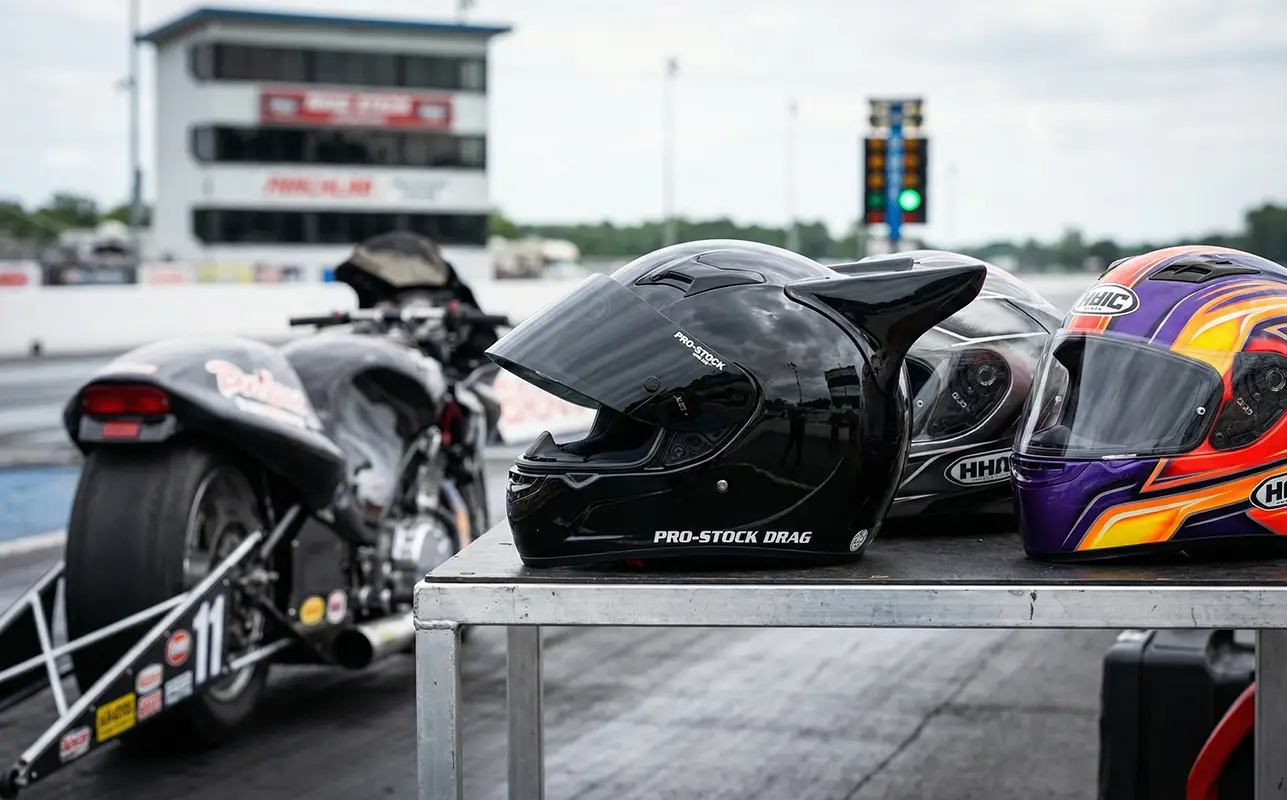
When you’re launching down a quarter-mile strip at speeds exceeding 200 mph, your helmet isn’t just protective gear—it’s your lifeline. Motorcycle drag racing demands specialized equipment that can withstand extreme forces, provide crystal-clear visibility, and meet stringent safety standards.
Unlike street riding or track racing, drag racing subjects helmets to unique stresses including rapid acceleration, intense wind pressure, and the potential for high-speed impacts.
For a deeper understanding of safety standards, check out our Guide to Motorcycle Helmets.
In this comprehensive guide, we’ve analyzed the best helmets specifically designed for drag racing applications.
Our selection criteria focused on several critical factors: SNELL SA2020 or FIM certification (required by most sanctioning bodies), aerodynamic design to minimize drag and buffeting, superior ventilation for those nerve-wracking staging moments, optical clarity for perfect reaction times, and proven construction quality that racers trust with their lives.
Whether you’re a weekend warrior hitting the local strip or a professional chasing records, choosing the right helmet can mean the difference between victory and disaster—or worse.
1. Arai GP-6S
The Arai GP-6S represents the pinnacle of racing helmet technology and has been the choice of professional racers across multiple disciplines for years. This full-face helmet brings decades of Arai’s handcrafted quality and safety innovation to the drag strip.
Overview
The GP-6S features Arai’s proprietary PB-SNC2 shell construction, utilizing a complex laminate of special synthetic fibers that provide exceptional strength while maintaining a relatively light weight. The helmet’s rounded shape follows Arai’s “R75 Shape” philosophy, which distributes impact energy more effectively than angular designs.
It comes equipped with a wide eye port that accommodates tear-offs and provides excellent peripheral vision—crucial for monitoring your opponent and the starting lights. The interior uses Arai’s advanced moisture-wicking fabric that keeps you comfortable during multiple runs.
The GP-6S meets both Snell SA2020 and FIM standards, making it legal for virtually any drag racing organization. The helmet includes provisions for communication systems and hydration tubes, and its shell design has been wind-tunnel tested to minimize lift and buffeting at extreme speeds.
Key Features
- PB-SNC2 Shell: Super Fiber laminate construction.
- Wide Eye Port: Optimized for tear-offs.
- Snell SA2020: Highest safety standard compliance.
- HANS Post Anchors: Ready for neck restraint systems.
Pros and Cons
Pros:
- Exceptional build quality with hand-crafted construction ensuring consistency and reliability.
- Superior impact protection with multi-density EPS liner and advanced shell materials.
- Excellent ventilation system with adjustable intake and exhaust ports for comfort between runs.
- Wide eye port provides outstanding visibility for monitoring lights and opponents.
Cons:
- Premium price point that may exceed $2,000, making it inaccessible for budget-conscious racers.
- Heavier than some carbon fiber alternatives, which may cause fatigue during long race days.
- Limited graphics options compared to more customizable brands.
Pricing
The Arai GP-6S retails for approximately $1,900 to $2,100.
Best For
Professional racers who demand hand-made Japanese quality and maximum safety.
2. Bell GP.3 Sport
Bell Racing has been synonymous with motorsports safety for generations, and the GP.3 Sport continues this legacy with modern technology tailored for drag racing applications. This helmet strikes an excellent balance between professional-grade protection and relative affordability.
Overview
The GP.3 Sport utilizes Bell’s advanced Carbon composite shell construction, resulting in one of the lighter helmets in its class without sacrificing structural integrity. The aerodynamic shell shape has been refined through extensive testing to reduce drag and prevent lift at high speeds—a critical consideration when you’re accelerating from 0 to over 150 mph in under seven seconds.
The helmet features Bell’s proven top-forced air ventilation system with four intake ports and two exhaust channels, ensuring adequate airflow even when you’re sitting at the staging line. The eye port is generously sized and compatible with most tear-off systems.
Interior padding uses Bell’s proprietary Click Release system for easy removal and cleaning. The GP.3 Sport meets Snell SA2020 and FIM 8859-2015 certifications and includes mounting points for communication devices.
Key Features
- Carbon Composite Shell: Lightweight and strong.
- Top Forced Air: Proven cooling system.
- Click Release Interior: Easy maintenance.
- Snell SA2020 Certified: Race-ready protection.
Pros and Cons
Pros:
- Lightweight carbon construction reduces neck strain during repeated runs.
- Excellent ventilation keeps you cool and focused while waiting in staging lanes.
- More affordable than comparable premium helmets while maintaining professional-grade safety.
- Wide compatibility with various communication and hydration systems.
Cons:
- Some users report the interior padding breaks down faster than premium alternatives.
- Limited color and design options in stock configurations.
- Slightly noisier at high speeds compared to more expensive models.
Pricing
The Bell GP.3 Sport retails between $600 and $700.
Best For
Racers looking for a lightweight composite helmet at a mid-range price point.
3. Stilo ST5 F Composite
Italian manufacturer Stilo has built a formidable reputation in motorsports, and the ST5 F Composite brings European design sensibility and cutting-edge safety technology to American drag strips. This helmet is particularly popular among racers who appreciate refined ergonomics and advanced features.
Overview
The ST5 F Composite features a hybrid shell construction combining carbon fiber, Kevlar, and fiberglass in strategic layers to optimize both strength and weight distribution. Stilo’s unique shell geometry was developed using computational fluid dynamics to minimize aerodynamic disturbances.
The helmet incorporates an advanced ventilation system with six adjustable air intakes and four exhaust ports. One standout feature is Stilo’s integrated radio communication system mounting, which is cleaner and more reliable than aftermarket solutions.
The eye port is designed with an anti-fog system and accepts standard tear-off posts. The ST5 F meets Snell SA2020 and FIM standards and includes a fire-resistant lining that exceeds minimum requirements.
Key Features
- Composite Shell: Kevlar/Fiberglass blend.
- Integrated Comms: Built-in mounting ports.
- Two Shell Sizes: Optimized fit.
- Fire Resistant Lining: Enhanced safety.
Pros and Cons
Pros:
- Exceptional aerodynamic performance with minimal buffeting even at speeds exceeding 200 mph.
- Superior comfort with well-designed interior padding that accommodates various head shapes.
- Integrated communication system mounting provides cleaner installation and better reliability.
- Advanced fire-resistant materials offer enhanced protection beyond minimum standards.
Cons:
- Premium pricing places it among the most expensive options available.
- Replacement parts and accessories can be difficult to source in North America.
- Sizing runs slightly smaller than American brands, requiring careful measurement.
Pricing
The Stilo ST5 F Composite retails around $950 to $1,100.
Best For
Racers who need seamless radio integration and European aerodynamics.
4. Simpson Carbon Diamondback
Simpson has been protecting drag racers for decades, and the Carbon Diamondback represents their latest evolution in purpose-built helmet technology. This helmet is designed by racers, for racers, with specific attention to the unique demands of straight-line acceleration.
Overview
The Carbon Diamondback features a full carbon fiber shell that achieves an impressive strength-to-weight ratio, with most sizes weighing under three pounds. It is a top choice for the best lightweight carbon fiber helmet in the drag racing world.
Simpson designed this helmet specifically for drag racing applications, with an aerodynamic profile optimized for straight-line stability rather than cornering performance. The eye port is exceptionally wide, providing unobstructed vision of the starting tree.
Interior comfort is enhanced by Simpson’s M61 fabric, which wicks moisture effectively. The helmet meets Snell SA2020 certification and includes Simpson’s exclusive M6 anchor system for secure shield mounting.
Key Features
- Full Carbon Fiber Shell: Ultra-lightweight.
- Drag-Specific Aero: Optimized for straight lines.
- Wide Eye Port: Clear view of the tree.
- M6 Anchor System: Secure HANS compatibility.
Pros and Cons
Pros:
- Purpose-built for drag racing with aerodynamics optimized for straight-line acceleration.
- Ultra-lightweight construction minimizes fatigue during long competition days.
- Exceptional visibility with wide eye port designed specifically for starting tree monitoring.
- Strong brand reputation and excellent customer service within the drag racing community.
Cons:
- Higher price point due to full carbon fiber construction.
- Limited ventilation compared to multi-discipline helmets may be uncomfortable in hot conditions.
- Aggressive racing aesthetic may not appeal to all users.
Pricing
The Simpson Carbon Diamondback retails between $800 and $1,000.
Best For
Serious drag racers who want a purpose-built, lightweight helmet with aggressive styling.
5. Zamp RZ-70E
Zamp has carved out a niche providing professional-quality racing helmets at more accessible price points. The RZ-70E delivers impressive safety credentials and features without the premium pricing of European brands, making it an excellent choice for sportsman-class racers.
Overview
The RZ-70E utilizes a fiberglass composite shell construction that, while slightly heavier than carbon alternatives, provides excellent impact protection and durability. Zamp designed this helmet to meet Snell SA2020 standards while keeping the price point reasonable.
The aerodynamic shell shape has been tested to remain stable at high speeds, and the helmet includes a good ventilation system with three intake and two exhaust ports. The eye port accommodates standard tear-off systems.
Interior padding uses moisture-wicking fabric that’s removable and washable. The RZ-70E includes mounting provisions for communication systems and features a fire-resistant Nomex interior lining.
Key Features
- Fiberglass Composite Shell: Durable and safe.
- Switch Series Interior: Customizable fit pads.
- Snell SA2020: Certified protection.
- Nomex Lining: Fire resistance.
Pros and Cons
Pros:
- Excellent value proposition with professional safety ratings at mid-range pricing.
- Durable fiberglass construction withstands the rigors of frequent racing.
- Good availability of replacement parts and accessories through racing retailers.
- Meets all major sanctioning body requirements for helmet certification.
Cons:
- Noticeably heavier than carbon fiber alternatives, which may cause neck fatigue.
- Interior comfort and padding quality don’t match premium brands.
- Limited color and graphics options in standard configurations.
Pricing
The Zamp RZ-70E retails for approximately $350 to $450.
Best For
Sportsman class racers and beginners needing Snell SA2020 certification on a budget.
6. Arai SK-6
The Arai SK-6 is specifically designed for karting but has found a dedicated following among motorcycle drag racers who appreciate its lighter weight and excellent visibility. This helmet brings Arai’s legendary quality in a package optimized for different racing applications.
Overview
While technically a karting helmet, the SK-6’s features translate exceptionally well to motorcycle drag racing. It uses Arai’s PB-SNC2 shell construction in a slightly more compact profile than the GP-6S, resulting in reduced weight.
The helmet’s rounder shape and lower profile create less aerodynamic drag. The eye port is massive, providing virtually unobstructed vision—perfect for monitoring starting lights and tracking opponents. Ventilation is excellent with multiple adjustable intake and exhaust ports.
The interior uses Arai’s premium comfort liner materials with fully removable and washable padding. The SK-6 meets Snell K2020 standards. (Note: Always verify your specific racing organization accepts Snell K ratings for motorcycle drag racing, as most require SA).
Key Features
- PB-SNC2 Shell: Super fiber laminate.
- Snell K2020: Karting safety standard.
- Oversized Eye Port: Maximum visibility.
- Compact Profile: Reduced drag.
Pros and Cons
Pros:
- Lighter and more compact than full auto racing helmets, reducing neck strain.
- Exceptional visibility with oversized eye port ideal for drag racing applications.
- Premium Arai build quality and comfort at a lower price than their GP series.
- Excellent ventilation keeps you comfortable during staging and between runs.
Cons:
- Some sanctioning bodies may not accept Snell K certification, requiring verification before purchase.
- Less aerodynamic protection at extreme speeds compared to purpose-built auto racing helmets.
- Smaller shell size may not accommodate all head shapes comfortably.
Pricing
The Arai SK-6 retails around $600 to $700.
Best For
Racers in classes that allow K-rated helmets who prioritize field of view and weight.
7. Pyrotect Pro Airflow
Pyrotect has been a staple in grassroots motorsports for years, offering reliable safety equipment at prices that don’t break the bank. The Pro Airflow is their flagship helmet, designed to provide professional-level protection with features that matter to working racers.
Overview
The Pro Airflow features a fiberglass composite shell that balances durability, protection, and cost-effectiveness. As the name suggests, this helmet prioritizes ventilation with an extensive system of intake and exhaust ports—six intakes and four exhausts. It is a top contender for the best motorcycle helmet for airflow in the auto-racing crossover category.
The helmet meets Snell SA2020 certification and includes a fire-resistant Nomex interior. The eye port is generously sized and accepts standard tear-off posts. Interior padding uses moisture-wicking materials that can be removed for washing.
The Pro Airflow includes mounting points for communication systems and drink tubes. It delivers solid protection and functionality that has earned the trust of countless sportsman racers.
Key Features
- Fiberglass Composite: Strong shell.
- Airflow System: 10 total vents.
- Nomex Interior: Fire protection.
- Snell SA2020: Certified safety.
Pros and Cons
Pros:
- Outstanding ventilation system keeps you cool during hot weather racing conditions.
- Budget-friendly pricing makes professional-grade protection accessible to more racers.
- Proven track record of reliability and protection in real-world racing conditions.
- Wide availability through racing retailers with good parts and accessory support.
Cons:
- Heavier than carbon or advanced composite alternatives.
- Interior comfort and padding quality are adequate but not exceptional.
- Basic aesthetic design lacks the premium appearance of higher-end helmets.
Pricing
The Pyrotect Pro Airflow retails between $300 and $400.
Best For
Racers in hot climates who need maximum ventilation.
8. Bell M.8
The Bell M.8 represents the company’s top-tier offering, incorporating the latest advances in helmet technology and materials. This helmet is designed for professional racers who demand the absolute best in protection, comfort, and performance.
Overview
The M.8 features Bell’s most advanced Carbon construction, utilizing aerospace-grade materials in a proprietary layup that achieves exceptional strength with minimal weight. Most sizes weigh under 3 pounds. The aerodynamic shell has been extensively tested to minimize drag and eliminate lift at any speed.
Bell’s advanced ventilation system includes six intake ports and four exhaust channels with internal channeling. The eye port is designed to accommodate the widest range of tear-off systems.
The interior features Bell’s premium comfort liner with anti-microbial treatment. The M.8 meets both Snell SA2020 and FIM 8859-2015 certifications and includes Bell’s exclusive magnetic shield attachment system.
Key Features
- Aerospace Carbon Shell: Maximum strength/weight ratio.
- Magnetic Shield System: Tool-free changes.
- FIM 8859-2015: Meets international standards.
- Premium Interior: High-density foam fit.
Pros and Cons
Pros:
- Top-tier construction with aerospace-grade materials providing maximum protection.
- Ultra-lightweight design significantly reduces neck fatigue during extended racing.
- Advanced aerodynamics tested at speeds exceeding 250 mph.
- Premium comfort features including superior padding and ventilation systems.
Cons:
- Premium pricing that can exceed $2,500 puts it out of reach for many racers.
- Replacement parts are expensive and may require ordering directly from Bell.
- Complex features may be overkill for entry-level or sportsman-class racing.
Pricing
The Bell M.8 retails for approximately $600 to $700 (Composite) up to $1,200+ (Carbon).
Best For
Racers who want a massive eye port and Bell’s legendary fit in a premium package.
9. G-Force Rift
G-Force has built a reputation providing quality racing safety equipment at competitive prices, and the Rift helmet continues this tradition. This helmet is designed for racers who need legitimate protection without premium pricing.
Overview
The G-Force Rift utilizes a fiberglass composite shell construction that provides solid impact protection while keeping costs manageable. The helmet meets Snell SA2020 certification, ensuring it’s legal for all major drag racing organizations.
The aerodynamic shell shape has been designed to remain stable during straight-line acceleration. Ventilation includes three intake and two exhaust ports that provide adequate airflow. The eye port is sized to accommodate standard tear-off systems.
Interior padding uses basic moisture-wicking fabric that’s removable for cleaning. While the Rift doesn’t offer exotic materials, it delivers honest protection and functionality for weekend racers.
Key Features
- Fiberglass Shell: Cost-effective strength.
- Snell SA2020: Race-legal certification.
- Downforce Chin: Aerodynamic stability.
- CoolTec Liner: Moisture management.
Pros and Cons
Pros:
- Budget-friendly pricing makes it accessible for entry-level and sportsman racers.
- Meets all necessary safety certifications for legitimate racing applications.
- Durable construction withstands regular use and transport abuse.
- Good availability through racing retailers with reasonable replacement part costs.
Cons:
- Heavier than carbon or advanced composite helmets, potentially causing fatigue.
- Basic comfort features and padding don’t match premium alternatives.
- Limited ventilation may be uncomfortable in extremely hot conditions.
Pricing
The G-Force Rift retails between $250 and $300.
Best For
Entry-level drag racers who need a compliant helmet at the lowest possible price.
Conclusion
Selecting the right helmet for motorcycle drag racing is one of the most important decisions you’ll make as a racer. The nine helmets we’ve covered represent the best options across various price points and feature sets, from budget-friendly choices like the G-Force Rift to premium options like the Arai GP-6S and Bell M.8.
Regardless of which helmet you choose, ensure it meets your sanctioning body’s certification requirements (typically Snell SA2020). Remember, your helmet is the last line of defense between you and catastrophic injury. Invest wisely.
Frequently Asked Questions
What safety certifications do I need for drag racing helmets?
Most motorcycle drag racing organizations require helmets to meet Snell SA2020 or SA2015 certification. Some accept FIM 8859-2015. Always check your specific racing organization’s rulebook before purchasing.
How often should I replace my drag racing helmet?
Racing helmets should be replaced every five years from the manufacture date, regardless of impacts. The EPS foam liner degrades over time. If your helmet experiences any significant impact, replace it immediately.
What’s the difference between a drag racing helmet and a regular motorcycle helmet?
Drag racing helmets meet stricter standards (Snell SA) for impact and fire resistance. They often have wider eye ports for starting light visibility and aerodynamics optimized for straight-line speed rather than cornering.
Do I need a full-face or open-face helmet for drag racing?
Full-face helmets are mandatory for virtually all motorcycle drag racing applications due to the extreme speeds and forces involved. Open-face helmets do not provide adequate facial protection.
How should a drag racing helmet fit?
A drag racing helmet should feel snug but not painful. It should not move independently when you shake your head. It should be difficult to pull off when the chin strap is fastened but shouldn’t cause headaches.