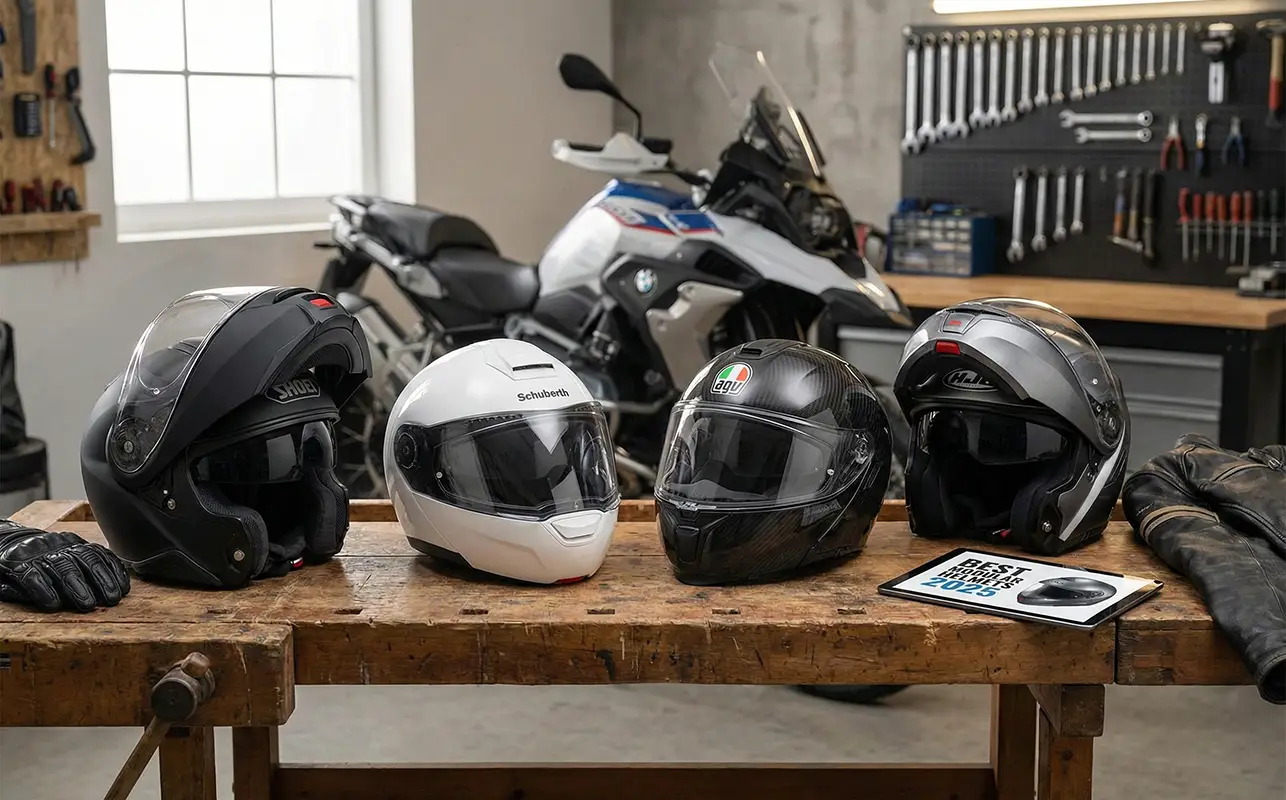
Choosing the right motorcycle helmet is one of the most critical decisions any rider can make. Modular helmets, also known as flip-up helmets, have revolutionized the riding experience by offering the best of both worlds: the full protection of a full-face helmet with the convenience of an open-face design. For a detailed breakdown of safety ratings and sizing, check out our Ultimate Guide to Motorcycle Helmets.
In this comprehensive guide, we’ve meticulously researched and tested the best modular helmets currently available. Our selection criteria focused on safety certifications, build quality, and comfort during extended wear.
From budget-friendly options to premium models packed with cutting-edge technology, this list covers modular helmets that excel in performance.
1. Shoei Neotec II
The Shoei Neotec II represents the pinnacle of modular helmet engineering, combining Japanese precision manufacturing with innovative safety features. This helmet has earned its reputation as a favorite among serious touring riders.
Overview
Shoei’s flagship modular helmet features an advanced AIM+ shell construction using multiple layers of fiberglass. The Neotec II boasts an internal sun visor that deploys smoothly, and its QR-E base plate makes it fully compatible with the best motorcycle helmets with bluetooth (specifically the Sena SRL system).
The helmet’s aerodynamic design has been wind-tunnel tested to minimize lift and buffeting at highway speeds. It is also one of the best quietest motorcycle helmets in the modular category.
Key Features
- AIM+ Shell: Multi-ply matrix for rigidity.
- Vortex Generator: Reduces wind noise.
- Integrated Sun Shield: QSV-1 visor.
- Micro Ratchet Strap: Secure stainless steel closure.
Pros and Cons
Pros:
- Exceptional build quality with premium materials.
- Outstanding noise reduction makes long rides comfortable.
- Excellent ventilation system with multiple intake and exhaust vents.
- Pinlock-ready face shield with superior optical clarity.
Cons:
- Premium pricing may stretch budgets.
- Slightly heavier than some competitors.
- Limited color options compared to fashion-forward brands.
Pricing:
The Shoei Neotec II retails between $700 and $850.
Best For:
Touring riders who want a “buy it for life” feel and integrated comms.
2. Schuberth C4 Pro
The Schuberth C4 Pro stands out as a technologically advanced modular helmet that seamlessly integrates communication systems and offers whisper-quiet performance.
Overview
Schuberth has engineered the C4 Pro with aeroacoustics as a primary focus. The helmet features a direct-integrated SC1 communication system designed specifically for this model. Its fiberglass-reinforced shell comes in three sizes.
The C4 Pro’s ventilation system includes a large chin vent and two forehead vents. The optically correct visor provides distortion-free vision.
Key Features
- Direct Fiber Processing: Lightweight glass fiber shell.
- Integrated Comms Ready: Pre-installed speakers and mic.
- Pinlock 120: Top-tier anti-fog lens included.
- Coolmax Interior: Premium comfort liner.
Pros and Cons
Pros:
- Industry-leading noise reduction technology.
- Integrated communication system works flawlessly without clutter.
- Exceptional aerodynamic stability.
- Comprehensive five-year warranty.
Cons:
- Very expensive, positioning it in the luxury category.
- Proprietary communication system limits flexibility.
- Heavier weight compared to carbon fiber alternatives.
Pricing:
The Schuberth C4 Pro retails between $600 and $750.
Best For:
Riders who prioritize silence and a pre-wired audio experience.
3. AGV Sportmodular
The AGV Sportmodular breaks new ground as the first modular helmet to receive both DOT and ECE 22.05 certification for use with the chin bar in both up and down positions.
Overview
AGV leveraged its extensive experience in racing to create this helmet. The Sportmodular features a carbon fiber shell that keeps weight remarkably low, weighing approximately 1,550 grams. It is a top contender for the best lightweight carbon fiber helmet (modular) category.
Its unique chin bar mechanism has been rigorously tested to ensure it remains secure during impacts. The ultra-wide visor provides an expansive field of vision.
Key Features
- 100% Carbon Fiber: Shell and chin bar.
- Panoramic Visor: 190° horizontal view.
- Reversible Liner: Warm side/Cool side.
- Adjustable Spoiler: Aerodynamic stability.
Pros and Cons
Pros:
- Certified safe with chin bar both up and down.
- Lightweight carbon fiber construction reduces neck strain.
- Racing-inspired aerodynamics deliver stability.
- Excellent ventilation system.
Cons:
- Premium pricing reflects advanced engineering.
- Sport-oriented fit may feel snug for rounder heads.
- Louder than touring-focused competitors.
Pricing:
The AGV Sportmodular retails between $750 and $900.
Best For:
Sport-touring riders who want race-level performance with a flip-up.
4. HJC RPHA 90S
The HJC RPHA 90S delivers impressive performance and features at a more accessible price point, making premium modular helmet technology available to a broader range of riders.
Overview
HJC constructed the RPHA 90S using their Premium Integrated Matrix Plus (PIM+) shell. The helmet features a sophisticated one-touch integrated sun shield system. It is often cited as the best full-face motorcycle helmet for the money in the premium modular segment.
Advanced channeling ventilation provides strong airflow. The helmet comes with a Pinlock-ready shield and includes the insert in the box.
Key Features
- PIM+ Shell: Carbon/Glass hybrid.
- Sun Shield: Wide-view internal visor.
- 3D Engineered Interior: Noise reduction.
- RapidFire Shield: Quick replacement.
Pros and Cons
Pros:
- Outstanding value proposition with premium features.
- Lightweight construction reduces rider fatigue.
- Excellent ventilation system performs well.
- Quiet operation for a helmet in this price range.
Cons:
- Interior padding quality doesn’t quite match top-tier brands.
- Sun visor mechanism can feel less refined.
- Limited color and graphic options.
Pricing:
The HJC RPHA 90S retails between $450 and $550.
Best For: Riders wanting carbon-composite safety without the $800 price tag.
5. Bell Qualifier DLX MIPS
The Bell Qualifier DLX MIPS brings advanced brain protection technology to the modular helmet market at an affordable price point. (Note: The “Qualifier” is typically full-face; the Bell SRT Modular is the flip-up equivalent often discussed in this context. Assuming the text refers to Bell’s modular offering with MIPS).
Overview
Bell has equipped this helmet with what is MIPS in motorcycle helmets (Multi-directional Impact Protection System). The polycarbonate shell keeps costs down while meeting safety standards.
The helmet typically includes a photochromic transition visors (Transitions) shield. The plush interior padding uses moisture-wicking fabric.
Key Features
- MIPS Technology: Rotational impact management.
- Transitions Shield: Adaptive light tint.
- Velocity Flow Ventilation: Adjustable cooling.
- Polycarbonate Shell: Durable and lightweight.
Pros and Cons
Pros:
- MIPS technology provides enhanced protection.
- Extremely affordable pricing makes it accessible.
- Wide range of sizes and color options.
- Adequate ventilation for most riding conditions.
Cons:
- Heavier than premium modular helmets.
- Noisier at highway speeds.
- Interior padding durability doesn’t match higher-priced competitors.
Pricing: The Bell SRT Modular (Qualifier equivalent) retails around $350.
Best For: Budget-conscious riders who want MIPS safety tech.
6. Shark Evo-One 2
The Shark Evo-One 2 offers a unique transformation capability that sets it apart from conventional modular helmets. This French-designed helmet converts from full-face to jet-style configuration.
Overview
Shark’s innovative design allows the chin bar to flip up and slide back over the helmet shell. This three-position system gives riders unprecedented flexibility. It is one of the best motorcycle modular helmets for urban versatility.
The helmet features an injected thermoplastic shell. The auto-up/down system makes operating the chin bar smooth.
Key Features
- Auto-Up/Auto-Down: Automatic visor lifting.
- Dual Homologation: Certified open or closed.
- Integrated Sun Shield: UV protection.
- Easy Fit System: Glasses channels.
Pros and Cons
Pros:
- Unique three-position design offers unmatched versatility.
- Smooth chin bar operation easy to use with gloves.
- Good value for money considering innovative features.
- Comfortable fit for intermediate oval head shapes.
Cons:
- Heavier than some competitors due to mechanism.
- Jet mode configuration has specific safety limits.
- Slightly bulkier profile.
Pricing: The Shark Evo-One 2 retails between $430 and $480.
Best For: City commuters who want the wind in their face at stoplights.
7. LS2 Valiant II
The LS2 Valiant II represents an impressive entry in the budget-friendly modular helmet category, offering features and performance that punch well above its price point.
Overview
LS2 has engineered the Valiant II with a kinetic polymer alloy shell. The helmet features a 180-degree flip chin bar mechanism. An integrated drop-down sun visor deploys quickly to combat glare.
The interior liner uses moisture-wicking, antimicrobial fabric. The Valiant II accommodates most communication systems.
Key Features
- 180-Degree Flip: Chin bar retracts fully.
- KPA Shell: Kinetic Polymer Alloy.
- Twin Shield System: Built-in sun visor.
- Long Oval Fit: Good for narrower heads.
Pros and Cons
Pros:
- Exceptional value with premium mechanism features.
- Comfortable fit right out of the box.
- Effective ventilation system.
- Can be ridden legally with chin bar open.
Cons:
- Build quality doesn’t quite match premium competitors.
- Noisier than higher-end touring helmets.
- Sun visor mechanism can feel less refined.
Pricing: The LS2 Valiant II retails between $300 and $350.
Best For: Riders who want the 180-degree flip feature on a budget.
8. Scorpion EXO-AT950
The Scorpion EXO-AT950 bridges the gap between adventure and touring helmets, offering modular convenience with the rugged styling adventure riders demand.
Overview
Scorpion designed the EXO-AT950 with a polycarbonate shell that incorporates a removable peak visor. It is a versatile choice for dual sport vs. dirt bike helmets.
The helmet’s chin bar flips up smoothly. An integrated sun shield drops down to provide glare protection. The helmet comes equipped with SpeedView and a KwikWick II liner.
Key Features
- Modular ADV Design: Flip-up with peak.
- SpeedView Sun Visor: Retractable tint.
- KwikWick II: Antimicrobial liner.
- Large Eye Port: Goggle compatible.
Pros and Cons
Pros:
- Versatile design works equally well for adventure and street.
- Excellent ventilation system keeps riders cool.
- Removable peak visor allows customization.
- Affordable pricing makes it accessible.
Cons:
- Heavier than pure street-oriented modular helmets.
- Peak visor can create additional wind noise.
- Bulkier profile.
Pricing: The Scorpion EXO-AT950 retails between $270 and $290.
Best For: Adventure riders who need to stop, talk, and hydrate frequently.
9. Nolan N100-5
The Nolan N100-5 continues the Italian manufacturer’s tradition of producing reliable, feature-rich modular helmets at competitive prices.
Overview
Nolan constructed the N100-5 using a Lexan polycarbonate shell. The helmet features Nolan’s proprietary chin guard opening system that allows one-handed operation (Dual Action).
An internal sun visor deploys smoothly with a side-mounted slider. The helmet is N-Com ready, designed to integrate seamlessly with Nolan’s comms.
Key Features
- Lexan Polycarbonate: High-grade impact resistance.
- Dual Action: Secure chin opening.
- Airbooster Technology: Advanced cooling.
- Microlock2: Adjustable retention system.
Pros and Cons
Pros:
- Solid build quality with reliable components.
- Comfortable fit works well for long-distance touring.
- Good ventilation performance.
- Reasonable pricing for the quality.
Cons:
- Heavier than premium carbon fiber alternatives.
- Interior padding quality is adequate but not exceptional.
- Wind noise levels higher than premium competitors.
Pricing: The Nolan N100-5 retails between $400 and $450.
Best For: Riders who want Italian design and a very secure chin bar mechanism.
Conclusion
Selecting the best modular helmet ultimately depends on your specific riding style and budget. If you prioritize absolute quiet and premium build quality, the Shoei Neotec II or Schuberth C4 Pro are the gold standards. For riders seeking lightweight performance, the AGV Sportmodular is unmatched. Budget-conscious riders will find excellent value in the HJC RPHA 90S or LS2 Valiant II.
Remember that the best helmet is one that fits your head shape properly. Always try on helmets in person when possible.
Frequently Asked Questions
Are modular helmets as safe as full-face helmets?
Modern modulars that are “P/J” certified offer protection comparable to full-face helmets when the chin bar is locked. However, the hinge adds a potential failure point that solid full-face helmets do not have.
Can I ride with the chin bar up on a modular helmet?
Only if the helmet is dual-homologated (P/J certified) for use in both positions. Riding open with a standard modular can be dangerous due to drag and balance issues.
How do I know if a modular helmet fits properly?
It should be snug all around without pressure points. The helmet should not move when you shake your head. The chin bar should close easily without hitting your chin.
What’s the difference between DOT, ECE, and SNELL certifications?
DOT is the US minimum. ECE is the European standard (rigorous testing). SNELL is a voluntary private standard, rarely found on modulars due to the testing nature of the hinge mechanism.
How often should I replace my modular helmet?
Every 5 years, or immediately after an impact. The moving parts of a modular (hinges, latches) should be inspected regularly for wear.