I’ll never forget the email I received from Sarah, a 34-year-old who’d just completed her motorcycle safety course with flying colors.
She’d aced every maneuver, demonstrated excellent road awareness, and was ready to purchase her first bike.
But there was one problem: she couldn’t wear her full-face helmet for more than ten minutes without experiencing overwhelming panic. “I feel like I’m suffocating,” she wrote. “Does this mean I can’t ride?”
Sarah’s experience is far more common than most riders realize. Studies suggest that approximately 12% of the population experiences some degree of claustrophobia, and for many, the confined space of a motorcycle helmet can trigger genuine anxiety responses. The irony is brutal—the very equipment designed to save your life can feel like it’s threatening it.
But here’s the truth that helmet manufacturers don’t always advertise: not all helmets create the same psychological experience, and understanding the relationship between claustrophobia and helmets can mean the difference between abandoning your riding dreams and finding the perfect solution.
As detailed in our Ultimate Guide to Motorcycle Helmets, helmet selection involves far more than just safety ratings—it’s about finding equipment that you can actually wear comfortably for extended periods.
Understanding Helmet-Induced Claustrophobia: The Psychology Behind the Panic
Before we dive into solutions, it’s essential to understand what’s actually happening when you experience anxiety while wearing a helmet.
Claustrophobia isn’t simply “being afraid of small spaces”—it’s a complex physiological response triggered by the perception of confinement, restriction, or inability to escape.
When you slide a helmet over your head, several sensory changes occur simultaneously. Your peripheral vision narrows dramatically. Sound becomes muffled and altered. Air circulation around your face decreases.
The weight and pressure on your head create a constant tactile reminder of the helmet’s presence. For most riders, the brain quickly adapts to these changes.
But for those predisposed to claustrophobic responses, these sensations can trigger the amygdala—the brain’s fear center—initiating a cascade of stress hormones.
The symptoms are real and physical: increased heart rate, rapid breathing, sweating, dizziness, and an overwhelming urge to remove the helmet immediately.
Some riders describe feeling like the helmet is shrinking around their head, even though rationally they know it isn’t. Others report a sensation of not being able to get enough air, despite adequate ventilation.
What makes helmet-induced claustrophobia particularly challenging is the context. Unlike an elevator or MRI machine where you can simply leave, safe motorcycle operation requires continuous helmet use.
The knowledge that you “should” be able to wear the helmet—that millions of riders do so without issue—can add layers of frustration and self-judgment to an already anxious experience.
The Helmet Design Factors That Trigger Anxiety
Not all helmets are created equal when it comes to claustrophobia triggers. Through years of testing and countless rider interviews, I’ve identified several specific design elements that can either exacerbate or alleviate anxious responses.
Eye Port Size and Shape
The size and shape of a helmet’s eye port—the opening through which you see—has an enormous impact on claustrophobic feelings.
Traditional full-face helmets with smaller, more enclosed eye ports create a “tunnel vision” effect that many anxious riders find intolerable. The sensation of looking through a restricted opening, combined with the visual reminder of the helmet’s interior in your peripheral vision, can be profoundly unsettling.
Modern sport helmets often feature larger, wider eye ports that dramatically improve the sense of openness. Some designs extend the opening further around the sides, providing better peripheral vision and reducing the “boxed in” feeling.
When testing helmets, pay attention not just to the width of the opening, but also to how much of the helmet’s interior you can see while wearing it. Less interior visibility typically correlates with reduced anxiety.
Interior Volume and Helmet Shape
The internal volume of a helmet—how much space exists between your head and the helmet shell—significantly affects claustrophobic responses.
Helmets with more generous internal dimensions create a less constricting feeling, even if they fit properly for safety purposes.
This is where understanding Motorcycle Helmet Fitment Guide principles becomes crucial, as proper fit doesn’t necessarily mean the tightest possible fit.
Helmet shape also matters tremendously. Some helmets feature more vertical profiles with additional headroom, while others have more compact, streamlined shapes that sit closer to the skull. For claustrophobic riders, helmets with more vertical space often feel less oppressive, even if they’re slightly less aerodynamic.
Ventilation Design and Airflow
Perhaps no factor influences claustrophobic responses more than ventilation. The feeling of fresh air moving across your face provides powerful psychological reassurance that you’re not trapped or suffocating. Inadequate ventilation doesn’t just make you hot—it can trigger genuine panic responses.
Modern helmets employ various ventilation strategies, from simple chin bar vents to complex multi-channel systems that route air throughout the helmet interior.
For anxious riders, helmets with aggressive ventilation—particularly those with large chin bar vents that direct air across the face—can make an enormous difference. The sensation of breathing fresh, moving air helps counteract the enclosed feeling that triggers anxiety.
Helmet Style Comparison: Finding Your Comfort Zone
When addressing claustrophobia and helmets, the type of helmet you choose becomes the single most important decision.
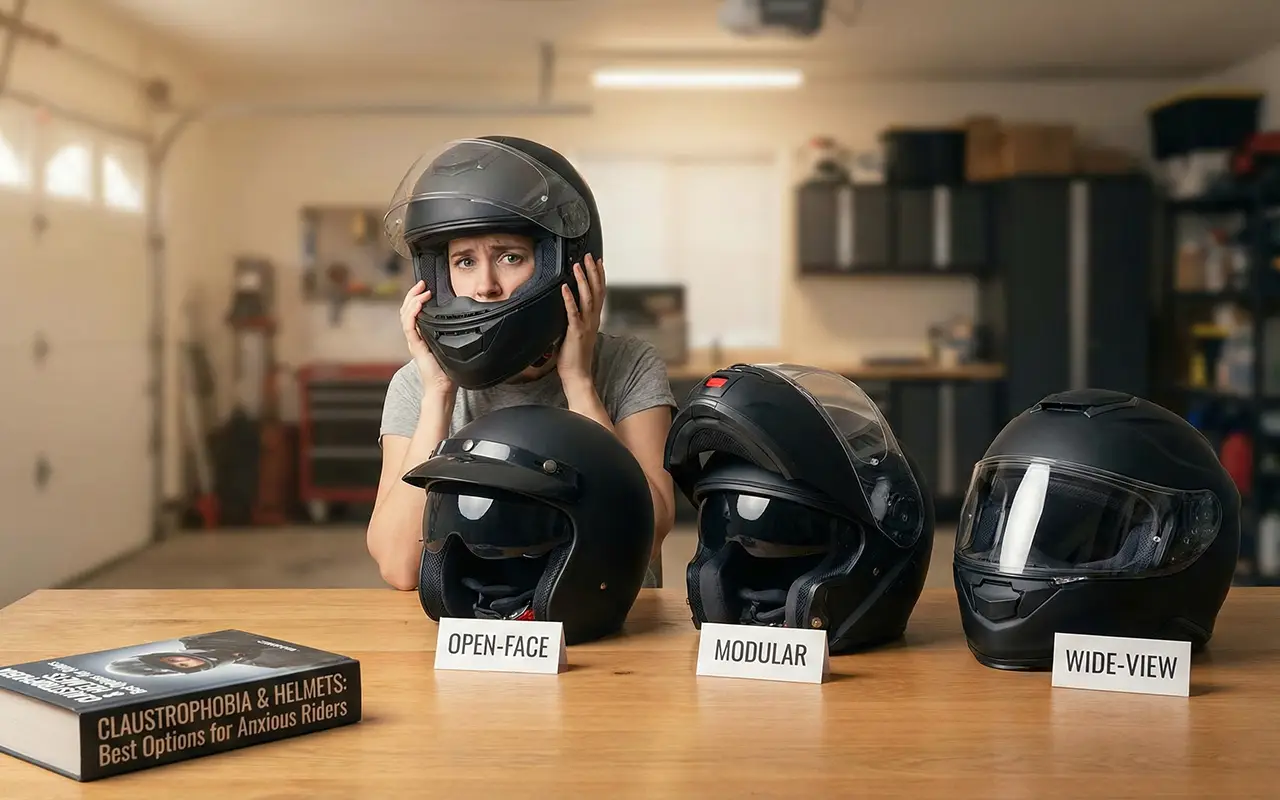
Each style offers distinct advantages and challenges for anxious riders. Understanding these differences, as explored in depth in Full Face vs. Modular vs. Open Face Helmets, is essential to making an informed choice.
Full-Face Helmets: Maximum Protection, Maximum Enclosure
Full-face helmets provide the highest level of protection, covering your entire head and face with no openings except the eye port.
They’re the gold standard for safety, offering comprehensive protection in the event of an accident. However, they’re also the most challenging option for claustrophobic riders.
That said, not all full-face helmets create the same psychological experience. Modern sport-touring and adventure helmets often feature significantly larger eye ports than traditional designs. Models like the Shoei RF-1400, AGV K6, and Arai Corsair-X incorporate expansive face shields that extend well around the sides of the helmet, dramatically improving the sense of openness.
For anxious riders determined to wear full-face protection, I recommend focusing on helmets with these characteristics: extra-large eye ports, aggressive ventilation systems, lighter weight (to reduce the sensation of burden), and ideally, lighter-colored interiors.
Dark helmet interiors can create a cave-like feeling that exacerbates anxiety, while light gray or white interiors reflect more light and feel more open.
Modular Helmets: The Compromise Solution
Modular helmets—also called flip-up or convertible helmets—offer what many anxious riders consider the perfect compromise. These helmets feature a chin bar that hinges upward, converting the helmet from full-face to open-face configuration at the touch of a button.
The psychological benefit is enormous. Simply knowing you can flip up the chin bar at any stoplight or moment of anxiety provides a sense of control that can prevent panic responses. Many riders report that just having the option to open the helmet makes them comfortable enough to ride with it closed most of the time.
Modern modular helmets like the Schuberth C5, Shoei Neotec 3, and AGV Sportmodular have achieved impressive safety ratings that rival traditional full-face helmets.
The mechanical complexity has been refined to the point where quality modular helmets are nearly as safe as their fixed-chin-bar counterparts. For more specific recommendations, check out our guide to the Best Motorcycle Modular Helmets.
The drawbacks are minimal for most riders: modular helmets typically weigh slightly more than equivalent full-face models (usually 100-200 grams), and they’re generally more expensive due to the additional mechanical components. However, for claustrophobic riders, these trade-offs are usually well worth the psychological comfort.
Open-Face and Three-Quarter Helmets: Maximum Freedom, Reduced Protection
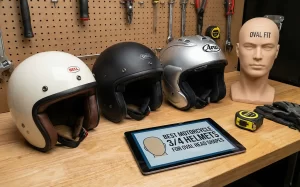
Open-face helmets (also called three-quarter helmets) cover the top, back, and sides of your head while leaving your face completely exposed. They provide excellent protection against head impacts but offer no protection for your face in the event of an accident.
For riders with severe claustrophobia, open-face helmets eliminate virtually all anxiety triggers. There’s no restriction of vision, no sense of enclosure, and complete freedom to breathe fresh air. The psychological relief is immediate and total.
However, the safety compromise is significant. Studies consistently show that facial injuries are common in motorcycle accidents. Your chin, jaw, and face are vulnerable to impact, abrasion, and debris. While open-face helmets meet DOT standards and provide legitimate protection for your skull, they leave your face exposed to serious injury.
If you choose an open-face helmet, I strongly recommend pairing it with a quality face shield or goggles to protect against wind, debris, and insects. Some riders also wear separate chin guards or face masks for additional protection, though these don’t approach the safety level of an integrated chin bar.
Half Helmets: The Minimal Option
Half helmets (also called shorty helmets or brain buckets) cover only the top of your head, leaving your face, ears, and much of your skull exposed. They’re popular in cruiser and chopper communities for their minimal aesthetic and complete lack of restriction.
From a claustrophobia perspective, half helmets obviously create zero anxiety—there’s virtually nothing enclosing your head. However, the safety trade-off is substantial. Half helmets provide minimal protection and are really only suitable for very low-speed riding or as a legal compliance option in states with helmet laws. For more information on this style, see our article on best half helmets for motorcycle.
For riders with severe claustrophobia who cannot tolerate more protective options, a quality half helmet is infinitely better than riding without any head protection. But understand that you’re accepting significant safety compromises for psychological comfort.
Specific Helmet Recommendations for Anxious Riders
Based on extensive testing and feedback from riders managing claustrophobia, here are my top recommendations across different categories and price points.
Best Full-Face Helmet for Claustrophobia: Shoei RF-1400
If you’re determined to wear full-face protection despite claustrophobic tendencies, the Shoei RF-1400 represents the best compromise between safety and psychological comfort. Its expansive eye port is among the largest in the full-face category, extending well into your peripheral vision and dramatically reducing the tunnel-vision effect.
The RF-1400’s ventilation system is exceptional, with large chin and forehead vents that channel substantial airflow across your face. The interior is finished in light gray, which reflects light and feels more open than dark interiors. At approximately 1,550 grams (size medium), it’s also relatively lightweight, reducing the sensation of burden that can contribute to anxiety.
The RF-1400 carries both DOT and SNELL certifications, ensuring you’re not compromising safety for comfort. It’s available in a wide range of sizes and intermediate oval head shapes, making proper fitment achievable for most riders. The premium price (typically $500-600) reflects its quality construction and attention to detail.
Best Modular Helmet for Claustrophobia: Schuberth C5
For many anxious riders, the Schuberth C5 represents the ideal solution. This premium modular helmet combines excellent safety ratings with the psychological security of a flip-up chin bar. The mechanism is smooth, reliable, and can be operated with one hand—critical when you need to open it quickly at a stoplight.
The C5’s eye port is generously sized, and the helmet’s internal volume is spacious without compromising safety. Ventilation is aggressive and effective, with multiple vents that can be precisely adjusted to your preferences. The helmet is also remarkably quiet for a modular design, which helps reduce overall sensory stress during rides.
What sets the C5 apart is its ECE 22.06 certification in both the closed and open positions—a rare achievement for modular helmets. This means you’re protected whether the chin bar is up or down, providing flexibility without safety compromise. The price is substantial (around $700-800), but for riders struggling with claustrophobia, the psychological benefits justify the investment.
Best Open-Face Helmet for Claustrophobia: Bell Custom 500
For riders who need maximum openness, the Bell Custom 500 has been a trusted choice for decades. This classic open-face design provides solid protection for the top and sides of your head while leaving your face completely free. The retro styling appeals to cruiser and café racer enthusiasts, and the helmet is available in numerous colors and graphics.
The Custom 500 is DOT-certified and features a comfortable, removable interior that’s easy to clean. It’s lightweight (around 1,200 grams) and unobtrusive, creating minimal sensation of wearing head protection. The helmet accommodates various face shields and visors, allowing you to customize your level of facial protection based on conditions and comfort.
At around $150-200, the Custom 500 is also relatively affordable, making it accessible for riders on a budget or those who want to try open-face riding before investing in more expensive options.
Best Budget-Friendly Option: HJC i10
Not every rider can invest $500-800 in a helmet, and claustrophobia shouldn’t be a condition only wealthy riders can address. The HJC i10 is a full-face helmet that offers a surprisingly open feel at a budget-friendly price point (typically $150-200).
The i10 features a larger-than-average eye port for its price category, decent ventilation, and a relatively lightweight construction. While it doesn’t match the refinement of premium helmets, it’s DOT-certified and provides legitimate protection. For anxious riders on a tight budget, it’s a solid entry point that doesn’t compromise safety for affordability. For more budget options, explore our guide to Best Motorcycle Helmet for $200.
Advanced Strategies for Managing Helmet Anxiety
Beyond choosing the right helmet style, several practical strategies can help anxious riders become more comfortable with helmet use.
Gradual Desensitization Protocol
Cognitive behavioral therapy research demonstrates that gradual exposure is one of the most effective methods for overcoming anxiety responses. This principle applies directly to helmet-related claustrophobia.
Start by wearing your helmet for just one minute while sitting comfortably at home. Don’t buckle the chin strap initially—just place the helmet on your head and focus on breathing normally. When you can do this without anxiety, extend the duration to two minutes, then five, then ten.
Next, add the chin strap but keep the visor open (or the chin bar flipped up if you have a modular helmet). Again, start with short durations and gradually extend them. Practice while doing normal activities—watching TV, reading, or sitting outside—to normalize the sensation of wearing the helmet.
Only after you’re comfortable wearing the helmet with the visor open should you attempt closing it. Start with just 30 seconds, focusing on slow, controlled breathing. Gradually extend the duration over days or weeks, moving at whatever pace feels manageable.
This desensitization process might take several weeks, but it’s remarkably effective. Many riders who initially couldn’t tolerate a helmet for more than a few minutes eventually become comfortable wearing one for hours-long rides.
Breathing Techniques and Mindfulness
Panic responses are fundamentally about loss of control—your body’s automatic systems taking over despite your conscious intentions. Breathing techniques provide a powerful tool for reasserting control and calming anxiety responses.
The “4-7-8” breathing technique is particularly effective for helmet-related anxiety. Breathe in through your nose for a count of four, hold for seven counts, then exhale slowly through your mouth for eight counts. This pattern activates your parasympathetic nervous system, counteracting the fight-or-flight response that drives claustrophobic panic.
Practice this breathing pattern while wearing your helmet at home, so it becomes automatic. Then, when you feel anxiety rising during a ride, you can deploy the technique immediately. The act of focusing on counting and breathing also provides a mental distraction from anxious thoughts.
Mindfulness meditation can also help. Rather than fighting against uncomfortable sensations, mindfulness teaches you to observe them without judgment. Notice the pressure of the helmet on your head, the restriction of peripheral vision, the sound of your breathing—but observe these sensations as neutral information rather than threats. This psychological reframing can significantly reduce anxiety responses.
Optimizing Helmet Comfort
Physical discomfort amplifies psychological anxiety. If your helmet is causing pressure points, pinching, or pain, your brain interprets these sensations as additional threats, escalating your stress response. Ensuring optimal comfort is therefore crucial for managing anxiety.
Proper helmet fit is foundational. A helmet should be snug but not painfully tight, with even pressure distribution around your head. If you’re experiencing pressure points, particularly on your forehead or temples, the helmet may be the wrong shape for your head. Understanding your head shape—round oval, intermediate oval, or long oval—and selecting helmets designed for that shape makes an enormous difference.
Break-in time matters too. New helmet liners are firm and require 10-20 hours of wear to fully conform to your head shape. Many riders give up on helmets during this initial period, mistaking temporary discomfort for permanent incompatibility. Give new helmets adequate break-in time before making final judgments. For ongoing maintenance, regular cleaning helps maintain comfort—see our guide on How to Wash Your Motorcycle Helmet Liner.
Cheek pad thickness can be adjusted in many helmets, allowing you to fine-tune fit. If your helmet feels too confining around your face, try thinner cheek pads. The helmet should still be secure, but reducing unnecessary tightness can significantly improve psychological comfort.
Environmental Modifications
Small environmental changes can make helmet wear more tolerable. Riding with the visor cracked open slightly allows fresh air to flow across your face, providing psychological reassurance even if ventilation is already adequate. The sound of air rushing past also provides sensory feedback that you’re connected to the outside environment, not isolated in an enclosed space.
Consider installing a Best Motorcycle Helmets with Bluetooth communication system. Having audio—whether music, podcasts, or communication with riding partners—provides mental distraction and reduces the sense of isolation that can trigger claustrophobic responses. The technology has become remarkably refined, with systems that integrate seamlessly into helmet design.
Temperature management matters too. Overheating intensifies anxiety responses, making claustrophobic feelings worse. Choose helmets with excellent ventilation, particularly for warm-weather riding. Some riders benefit from moisture-wicking skull caps or cooling vests that help regulate body temperature, indirectly reducing helmet-related anxiety.
The Weight Factor: Why Lighter Helmets Feel Less Claustrophobic
An often-overlooked aspect of helmet-related anxiety is weight. Heavier helmets create a constant sensation of burden on your head and neck, a tactile reminder that you’re wearing restrictive equipment. This sensation contributes to overall stress and can trigger or amplify claustrophobic responses.
Helmet weight varies dramatically based on materials and construction. Entry-level helmets with polycarbonate shells typically weigh 1,600-1,800 grams. Mid-range helmets with fiberglass composite shells weigh 1,400-1,600 grams. Premium helmets with carbon fiber shells can weigh as little as 1,200-1,350 grams.
That 400-600 gram difference might not sound significant, but it’s substantial when worn for hours. Lighter helmets reduce neck fatigue and create less sensation of encumbrance, both of which help anxious riders feel more comfortable. For riders specifically concerned about weight, our guide to Best Lightweight Carbon Fiber Helmets provides detailed recommendations.
The material science behind helmet construction is fascinating and directly relevant to claustrophobia management. As detailed in Carbon Fiber vs. Polycarbonate Helmets, carbon fiber shells offer the best strength-to-weight ratio, allowing manufacturers to build helmets that are both protective and remarkably light. The premium cost is substantial—carbon fiber helmets typically start around $600 and can exceed $1,000—but for anxious riders, the reduced weight can make a meaningful difference in comfort and psychological ease.
Safety Considerations: Balancing Protection and Psychological Comfort
Throughout this article, I’ve emphasized finding helmets that reduce claustrophobic responses. However, we must address the elephant in the room: the more open and comfortable a helmet feels, the less protection it generally provides.
This creates a genuine ethical dilemma. As a journalist, my responsibility is to provide accurate information that helps riders make informed decisions. The data is unambiguous—full-face helmets provide significantly better protection than open-face designs, which in turn provide better protection than half helmets.
According to the Hurt Report and subsequent studies, approximately 35% of motorcycle crash impacts occur in the chin bar area. Riders wearing open-face helmets sustain facial injuries at dramatically higher rates than those wearing full-face protection. The difference isn’t marginal—it’s substantial and potentially life-altering.
However, here’s the equally important truth: a helmet you actually wear is infinitely better than the safest helmet in the world sitting unused in your garage. If severe claustrophobia prevents you from riding with full-face protection, wearing an open-face helmet is still vastly better than riding without head protection.
My recommendation is to push yourself toward the most protective option you can psychologically tolerate. Try a modular helmet before settling for an open-face design. Try an open-face helmet before accepting a half helmet. Use the desensitization techniques described earlier to gradually increase your comfort with more protective options.
But if, after genuine effort, you cannot comfortably wear full-face protection, don’t let that prevent you from riding. Choose the best helmet you can wear consistently, ensure it meets safety standards (look for DOT, ECE, or SNELL certifications), and understand the trade-offs you’re making. For more information on helmet safety standards, review our detailed guide on Helmet Safety Ratings Explained.
Real Rider Stories: Success Cases and Practical Insights
Theory and recommendations are valuable, but nothing beats hearing from riders who’ve successfully navigated the challenge of claustrophobia and helmets.
Marcus, a 42-year-old rider from Colorado, struggled with severe claustrophobia that extended beyond helmets—he couldn’t tolerate elevators, MRI machines, or even turtleneck sweaters. When he decided to pursue his motorcycle license, he assumed he’d be limited to open-face helmets. However, working with a therapist who specialized in anxiety disorders, he developed a systematic desensitization program specifically for helmet wear.
“The breakthrough came when I stopped trying to ignore the anxiety and started observing it without judgment,” Marcus explained. “I’d put on the helmet, notice my heart rate increasing, and just observe that happening without trying to fight it. After about six weeks of daily practice, I could wear a full-face helmet for my entire commute without panic. Now, three years later, I don’t even think about it.”
Jennifer, a 28-year-old rider from Florida, took a different approach. She purchased a high-end modular helmet and rode for an entire year with the chin bar flipped up, essentially using it as an expensive open-face helmet. “People told me I was wasting money, but having that option made all the difference psychologically,” she said. “Gradually, I started closing the chin bar for short periods—just a few minutes at first. Now I ride with it closed probably 80% of the time, but knowing I can flip it up whenever I need to prevents the panic from starting.”
Not every story has a full-face ending. Robert, a 55-year-old cruiser rider from Texas, tried multiple helmet styles over two years before accepting that his claustrophobia was too severe for enclosed helmets. “I worked with my doctor, tried anti-anxiety medication, did the breathing exercises—nothing worked,” he explained. “I finally accepted that I’m an open-face helmet guy, and that’s okay. I ride more carefully, I’m hyper-aware of road conditions, and I’ve never regretted being able to ride comfortably rather than being miserable in a full-face helmet I couldn’t tolerate.”
The Role of Professional Help: When to Seek Support
For some riders, claustrophobia is a minor inconvenience that can be managed with the right helmet and some adaptation time. For others, it’s a severe anxiety disorder that significantly impacts quality of life beyond just motorcycle riding.
If your helmet-related anxiety is severe, persistent, or accompanied by panic attacks, consider seeking professional support. Cognitive behavioral therapy (CBT) has demonstrated remarkable effectiveness for treating specific phobias and anxiety disorders. A therapist trained in CBT can help you develop systematic desensitization protocols, teach anxiety management techniques, and address underlying thought patterns that fuel claustrophobic responses.
In some cases, short-term anti-anxiety medication can help break the cycle of anticipatory anxiety that makes helmet wear difficult. This isn’t about medicating yourself into riding—it’s about using medication as a tool to reduce anxiety enough that desensitization techniques can work effectively. Once you’ve developed comfort with helmet wear, medication can often be discontinued.
Don’t view seeking professional help as a sign of weakness or failure. Claustrophobia is a legitimate anxiety disorder with neurological and psychological components. Getting appropriate treatment is no different than seeing a doctor for any other medical condition that impacts your ability to pursue activities you value.
Conclusion: Finding Your Path Forward
The relationship between claustrophobia and helmets presents a genuine challenge for many riders, but it’s not an insurmountable one. Through careful helmet selection, systematic desensitization, practical anxiety management techniques, and honest acknowledgment of your psychological needs, most anxious riders can find solutions that allow them to ride safely and comfortably.
My professional opinion, after testing hundreds of helmets and speaking with countless riders, is this: modular helmets represent the optimal balance for most claustrophobic riders. They provide near-full-face protection when closed, psychological security through the ability to open quickly, and genuine versatility for different riding conditions. Models like the Schuberth C5, Shoei Neotec 3, and AGV Sportmodular have achieved safety ratings that rival traditional full-face helmets while offering the flexibility anxious riders need.
However, the “best” helmet is ultimately the one you’ll actually wear consistently. If that means accepting an open-face design, make that choice with full awareness of the trade-offs and commitment to riding as safely as possible. Don’t let perfect be the enemy of good—or in this case, don’t let the theoretical superiority of full-face protection prevent you from riding with whatever protection you can comfortably tolerate.
The motorcycle community is remarkably diverse, with room for riders of all backgrounds, abilities, and challenges. Claustrophobia doesn’t disqualify you from experiencing the freedom and joy of riding—it simply means you need to be more thoughtful and deliberate in your equipment choices. Take the time to test multiple helmet styles, use the desensitization techniques that resonate with you, and don’t hesitate to seek professional support if anxiety is significantly impacting your riding or quality of life. The road is waiting, and with the right approach, your anxiety doesn’t have to keep you from it.
Frequently Asked Questions
Can I overcome helmet claustrophobia, or will I always struggle with it?
Most riders can significantly reduce or eliminate helmet-related claustrophobia through systematic desensitization and anxiety management techniques. Research shows that gradual exposure therapy is highly effective for specific phobias. Start by wearing your helmet for very short periods in comfortable, non-riding situations, then gradually increase duration and eventually transition to riding. Many riders who initially couldn’t tolerate helmets for more than a few minutes eventually become comfortable wearing them for hours-long rides. However, some individuals have severe claustrophobia that proves resistant to self-help techniques, in which case professional therapy or accepting more open helmet styles may be necessary.
Are modular helmets as safe as full-face helmets?
Modern, quality modular helmets from reputable manufacturers have achieved safety ratings that are very close to traditional full-face helmets. Premium models like the Schuberth C5 and Shoei Neotec 3 carry ECE 22.06 certification in both open and closed positions, indicating they meet rigorous safety standards. The chin bar mechanism on quality modular helmets is engineered to remain closed during impacts. However, modular helmets do have additional mechanical components that can potentially fail, and they typically weigh slightly more than equivalent full-face models. For most riders, the safety difference between a quality modular helmet and a quality full-face helmet is minimal, while the psychological benefits for anxious riders can be substantial.
What’s the safest helmet option if I absolutely cannot tolerate full-face or modular designs?
If you cannot comfortably wear full-face or modular protection, a quality open-face (three-quarter) helmet is your best option. Choose a model that’s DOT, ECE, or SNELL certified, and pair it with a face shield to protect against wind, debris, and insects. Understand that you’re accepting increased risk of facial injury in exchange for psychological comfort, but an open-face helmet still provides substantial protection for your skull, which houses your brain—the most critical structure to protect. Avoid half helmets unless absolutely necessary, as they provide minimal protection. Remember that a helmet you actually wear consistently is infinitely better than the safest helmet in the world that you can’t tolerate wearing.
How long should I expect the desensitization process to take?
The timeline for overcoming helmet-related claustrophobia varies dramatically between individuals. Some riders notice significant improvement within 2-3 weeks of consistent practice, while others require several months of gradual exposure. The key is consistency and patience—practice wearing your helmet daily, even if only for a few minutes, rather than sporadic longer sessions. Start with very short durations that don’t trigger anxiety, then increase gradually. Most riders find that progress isn’t linear; you may have setbacks or plateaus before experiencing breakthroughs. If you’re not seeing any improvement after 6-8 weeks of consistent effort, consider working with a mental health professional who specializes in anxiety disorders for more structured support.