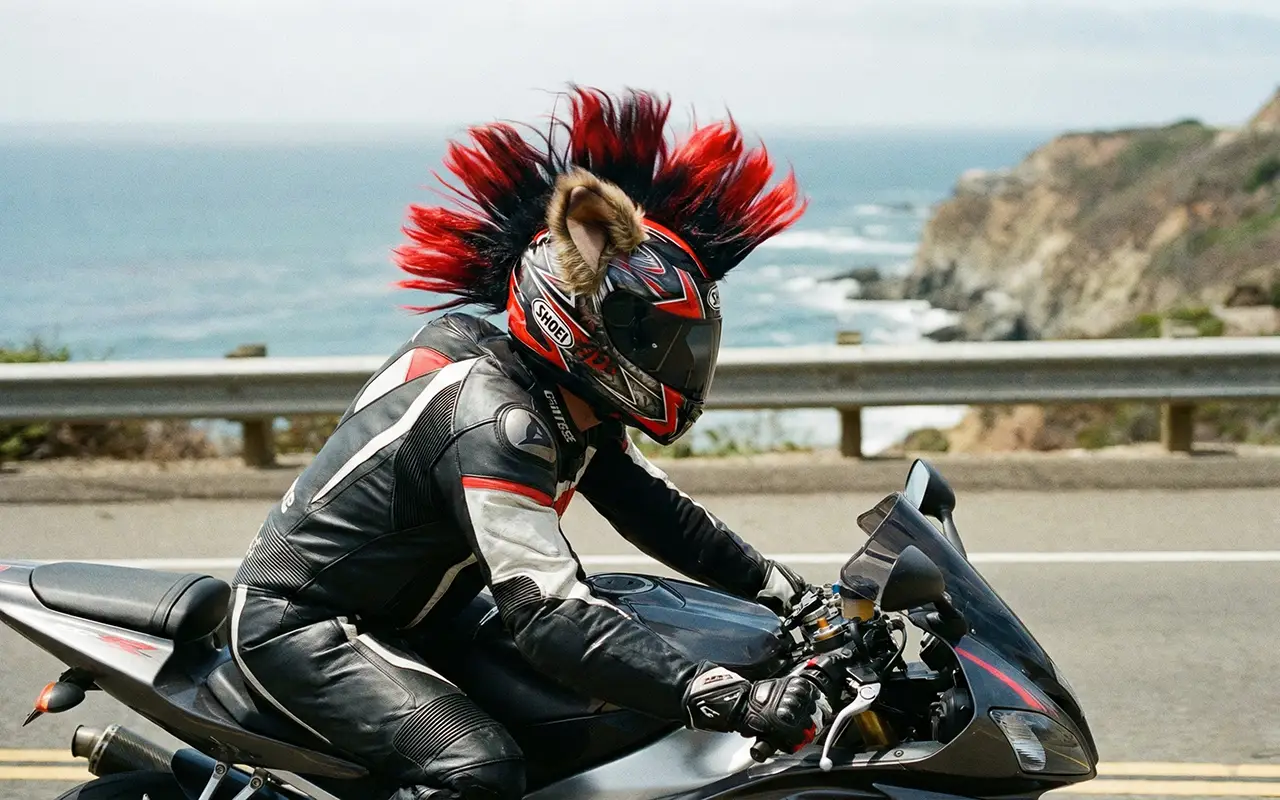
I’ll never forget the day I pulled up next to a rider at a stoplight sporting a fluorescent green mohawk attached to his helmet. The thing was massive—at least eight inches tall—and swaying in the breeze like a palm tree in a hurricane.
As the light turned green and we both accelerated, I watched in my mirror as his head began jerking violently side to side. By the time we hit 60 mph, he’d moved to the slow lane, hunched over his tank, fighting what looked like an invisible opponent trying to rip his head clean off his shoulders.
That image stayed with me, and it sparked a question that’s been debated in parking lots, forums, and rider groups for years: Do helmet mohawks and ears affect aerodynamics?
Helmet customization has exploded in recent years. What started as simple pin-striping and decals has evolved into a full-blown subculture of personalization. Riders attach everything from cat ears and devil horns to full mohawk crests and animal tails to their helmets.
Walk through any motorcycle rally, and you’ll see a menagerie of decorated lids that would make a Mad Max prop designer jealous.
But while these accessories undoubtedly add personality and help riders express their individuality, they also fundamentally alter the aerodynamic profile of what helmet manufacturers spend millions of dollars engineering to perfection.
As covered in our Ultimate Guide to Motorcycle Helmets, modern helmet design is a delicate balance of safety, comfort, ventilation, and aerodynamic efficiency—a balance that can be disrupted by seemingly innocent additions.
The Science of Helmet Aerodynamics: Why Shape Matters
Before we can understand how mohawks and ears affect helmet performance, we need to understand what manufacturers are trying to achieve with helmet aerodynamics in the first place. Modern helmet design isn’t just about looking sleek—it’s about managing airflow in ways that directly impact rider safety, comfort, and fatigue.
At highway speeds, your helmet is essentially a blunt object moving through a fluid medium (air). The shape of that object determines how air flows around it, which in turn affects several critical factors: drag force, lift force, turbulence, buffeting, and noise generation.
Engineers use computational fluid dynamics (CFD) software and wind tunnel testing to optimize helmet shapes that minimize these negative effects while maximizing ventilation efficiency.
The ideal aerodynamic helmet shape features smooth, continuous curves that allow air to flow over and around the shell with minimal separation. When airflow remains attached to the helmet surface (laminar flow), drag is minimized and stability is maximized. When airflow separates from the surface (turbulent flow), it creates low-pressure zones that generate drag, lift, and the buffeting forces that cause neck fatigue on long rides.
The Drag Coefficient Reality
Different Full Face vs. Modular vs. Open Face Helmets have dramatically different drag coefficients. A well-designed full-face sport helmet might have a drag coefficient around 0.45-0.55, while a round, retro-styled helmet could be as high as 0.70-0.85. For context, a flat plate perpendicular to airflow has a drag coefficient of about 1.28.
These numbers might seem abstract, but they translate to real forces on your head and neck. At 70 mph, a helmet with a drag coefficient of 0.50 experiences approximately 8-10 pounds of drag force. Increase that coefficient to 0.70, and you’re looking at 12-15 pounds. That difference—sustained for hours during a long ride—is the difference between arriving fresh and arriving with a screaming neck ache.
How Helmet Mohawks Disrupt Airflow: The Physics of Protrusions
Now let’s add a mohawk to that carefully engineered shape. Regardless of whether it’s made from foam, rubber, or fabric, a mohawk creates what aerodynamicists call a “protrusion” or “discontinuity” in the helmet’s surface. This protrusion fundamentally changes how air interacts with your helmet in several ways.
Increased Frontal Area and Form Drag
The most obvious effect is increased frontal area. A typical helmet mohawk adds 1-3 inches of height and runs 8-12 inches along the helmet’s centerline. This directly increases the cross-sectional area presented to oncoming air, which increases form drag proportionally. If your mohawk adds 20% to your helmet’s frontal area, you can expect roughly a 20% increase in drag force at any given speed.
But the real problem isn’t just the added area—it’s where that area is located. Mohawks typically run along the helmet’s centerline, the highest point of the structure. This is precisely where airflow velocity is highest (due to the Bernoulli principle) and where any protrusion creates maximum disturbance.
Flow Separation and Pressure Drag
More critically, mohawks cause premature flow separation. As air hits the leading edge of a mohawk, it can’t smoothly follow the contour because the angle is too steep. The flow separates, creating a turbulent wake behind the mohawk. This wake is a low-pressure zone that effectively “pulls” backward on your helmet, creating pressure drag in addition to form drag.
Think of it like sticking your hand out a car window. When your hand is flat and parallel to the ground, air flows smoothly over it with minimal force. Rotate your hand perpendicular to the airflow, and suddenly you feel significant force trying to push your hand backward. A mohawk creates a similar perpendicular surface—or series of surfaces—along your helmet’s centerline.
Vortex Generation and Buffeting
Perhaps most annoying for riders, mohawks generate vortices—swirling columns of turbulent air that shed alternately from either side of the protrusion. These vortices create oscillating side forces that cause the head-shaking buffeting that plagues riders with heavily decorated helmets.
The frequency of this buffeting depends on the mohawk’s size and shape, as well as your speed. At certain speeds, the vortex shedding frequency can match the natural resonance frequency of your head-neck system, creating particularly violent shaking. This is why some riders report that buffeting is worse at specific speeds—they’ve hit a resonance condition.
Helmet Ears, Horns, and Other Protrusions: Different Shapes, Similar Problems
While mohawks create problems primarily through centerline disruption, helmet ears and other side-mounted accessories create their own unique aerodynamic challenges. Cat ears, devil horns, animal ears, and similar decorations typically mount on the sides or top-sides of the helmet, creating asymmetric or paired protrusions.
Asymmetric Loading and Head Pull
One of the most significant issues with side-mounted accessories is asymmetric aerodynamic loading. If accessories aren’t perfectly symmetrical (and most aren’t, due to manufacturing tolerances or installation variations), they create unequal drag forces on either side of your helmet. This results in a constant pull to one side, forcing you to continuously correct your head position.
I’ve tested this personally with a set of rubber cat ears borrowed from a friend. At speeds below 40 mph, the effect was barely noticeable. Between 40-60 mph, there was a definite pull to the left (where one ear was slightly larger). Above 60 mph, maintaining a centered head position required constant conscious effort, leading to neck fatigue within 20 minutes.
Yaw Sensitivity and Crosswinds
Side-mounted accessories also dramatically increase your helmet’s sensitivity to yaw angle—the angle between your heading and the relative wind direction. When riding in a crosswind or when passing large vehicles, the relative wind angle changes rapidly. Accessories that protrude from the sides catch this angled airflow and create sudden, unpredictable forces.
This is particularly dangerous when passing semi-trucks. As you enter the truck’s wind shadow, the relative wind shifts suddenly. With a clean helmet, this creates a momentary reduction in drag. With side-mounted accessories, it can create a sudden twisting moment that jerks your head sideways just as you’re alongside several tons of moving metal.
Real-World Testing: What the Numbers Actually Show
While manufacturers don’t typically publish aerodynamic data for helmets with aftermarket accessories (for obvious liability reasons), independent testing has been conducted by various motorcycle publications and university engineering departments. The results are consistent and striking.
Drag Force Measurements
Testing conducted by a European motorcycle magazine using a calibrated force sensor and a test track showed that a medium-sized mohawk (approximately 10 inches long, 2 inches tall) increased drag force by 35-45% at 70 mph compared to the same helmet without accessories. A larger mohawk (12 inches long, 3 inches tall) increased drag by 55-65%.
To put this in perspective, the drag increase from adding a mohawk is roughly equivalent to the drag increase from switching from a modern sport helmet to a vintage open-face helmet. You’re essentially negating decades of aerodynamic development with a $15 accessory.
Buffeting and Stability Testing
More concerning than pure drag are the stability implications. Using accelerometers mounted inside helmets, researchers measured head movement in response to controlled airflow disturbances. Helmets with mohawks showed 2-3 times greater amplitude of oscillation compared to clean helmets when subjected to the same disturbance.
This has real safety implications. In an emergency maneuver—a sudden swerve to avoid debris, for example—you need stable, predictable head position to maintain visual focus on your path. Excessive head movement during such maneuvers can lead to target fixation, delayed reactions, or complete loss of visual reference.
Speed Thresholds: When Do Accessories Become Problematic?
One of the most common questions riders ask is: “At what speed do these accessories actually matter?” The answer is more nuanced than a simple number, but there are general thresholds where effects become noticeable, uncomfortable, and dangerous.
Below 35 MPH: Minimal Impact
At urban speeds below 35 mph, most riders report that helmet accessories cause minimal noticeable effects. Drag forces are low enough that neck muscles easily compensate, and buffeting frequencies are typically below the threshold for resonance. If you’re primarily a city commuter who rarely exceeds 40 mph, accessories are unlikely to cause significant problems beyond slightly increased wind noise.
35-55 MPH: Noticeable but Manageable
In this speed range—typical for suburban riding and secondary highways—effects become noticeable. Most riders report increased neck fatigue on rides longer than 30 minutes, increased wind noise, and occasional head buffeting, particularly in crosswinds. This is the range where accessories transition from “quirky decoration” to “minor annoyance.”
55-75 MPH: Significantly Uncomfortable
At highway speeds, accessories become significantly problematic. Drag forces increase with the square of velocity, meaning that doubling your speed quadruples the drag force. A mohawk that created 3 pounds of drag at 35 mph creates 12 pounds at 70 mph. This level of force, sustained for hours during a highway trip, causes substantial neck fatigue and can contribute to the overall exhaustion that makes long rides dangerous.
Buffeting also intensifies dramatically in this range, with many riders reporting head shake violent enough to blur vision or make it difficult to maintain a steady line through corners. This is particularly concerning when considering that Helmet Safety Ratings Explained focuses on impact protection, not the rider fatigue and distraction that can lead to crashes in the first place.
Above 75 MPH: Potentially Dangerous
At speeds above 75 mph—typical for sport riding, track days, or high-speed touring—helmet accessories move from uncomfortable to potentially dangerous. The combination of high drag forces, violent buffeting, and increased sensitivity to crosswinds creates a situation where maintaining stable head position requires constant conscious effort. This cognitive load reduces your attention available for other critical tasks like scanning for hazards, monitoring traffic, and executing smooth control inputs.
Several track day organizations explicitly prohibit helmet accessories for these reasons. When you’re leaned over at 45 degrees doing 100 mph through a corner, the last thing you need is your helmet trying to rip itself off your head or buffeting that disrupts your visual focus on the apex.
Material Matters: Flexible vs. Rigid Accessories
Not all helmet accessories are created equal. The material and construction method significantly affect aerodynamic impact. Understanding these differences can help riders make more informed decisions if they’re determined to customize their helmets.
Rigid Plastic and Resin Accessories
Hard plastic horns, rigid mohawk structures, and resin-cast decorations create the most significant aerodynamic disruption. These accessories maintain their shape regardless of airflow, creating consistent protrusions that generate maximum drag and turbulence. They’re also the heaviest option, adding not just aerodynamic load but also static weight that contributes to neck fatigue.
The one advantage of rigid accessories is predictability. They behave consistently across all speed ranges, so riders can at least adapt to their characteristics. There are no surprises from accessories changing shape or position at different speeds.
Flexible Rubber and Silicone Accessories
Rubber cat ears, silicone spikes, and similar flexible accessories are the most popular option, and they do offer some aerodynamic advantages over rigid alternatives. At low speeds, they stand upright and create maximum visual impact. As speed increases, they begin to flex and streamline, reducing their effective height and frontal area.
However, this flexibility creates its own problems. The flapping and oscillation of flexible accessories generates additional turbulence and can create annoying vibration and noise. Some riders report a constant “fluttering” sensation that’s more distracting than the steady pull of a rigid accessory. Additionally, the speed at which these accessories begin to streamline varies with material stiffness, so different products behave differently.
Fabric and Foam Accessories
Fabric mohawks—the type that look like a strip of synthetic hair or fur—are the lightest option and generally create the least aerodynamic disruption at high speeds. The individual fibers streamline completely in airflow, reducing effective frontal area significantly compared to rigid alternatives.
However, fabric accessories are also the noisiest. The turbulence generated by hundreds of individual fibers fluttering in the wind creates a roar that can increase helmet noise levels by 5-10 decibels. Given that wind noise is already a significant concern for riders—as discussed in our article on Best Quietest Motorcycle Helmets—adding a noise-generating accessory seems counterproductive for anyone concerned about long-term hearing health.
The Neck Fatigue Factor: Long-Term Comfort Implications
Beyond immediate handling and stability concerns, helmet accessories have cumulative effects on rider comfort and fatigue that manifest over longer rides. This is where the “it’s fine for short trips” argument falls apart for anyone planning serious touring or day-long rides.
The Biomechanics of Neck Strain
Your neck muscles are designed to support your head’s weight (typically 10-12 pounds including helmet) and provide controlled movement. They’re not designed to continuously counteract sustained horizontal forces. When aerodynamic drag creates a constant backward pull on your helmet, your neck muscles must contract continuously to maintain head position.
This isometric muscle contraction—holding position against resistance—is far more fatiguing than dynamic movement. It’s the difference between holding a weight at arm’s length (exhausting within minutes) versus repeatedly lifting and lowering it (sustainable for much longer). A helmet accessory that creates even 3-5 pounds of additional drag force requires continuous isometric contraction of your neck extensors, leading to premature fatigue, soreness, and potentially long-term strain injuries.
Fatigue and Safety
Rider fatigue is a significant safety concern that doesn’t get enough attention in the motorcycle community. As you become physically tired, reaction times slow, decision-making degrades, and attention wanders. A rider who arrives at their destination with a screaming neck ache and exhausted muscles is a less safe rider than one who arrives fresh.
This is particularly relevant for touring riders covering hundreds of miles per day. The difference between arriving at your destination tired versus exhausted can be the difference between safely completing your journey and making a fatigue-induced error in the final miles. Considering that proper Motorcycle Helmet Fitment Guide emphasizes comfort for long-term wearability, it seems contradictory to then add accessories that undermine that comfort.
Noise Generation: The Hidden Cost of Customization
While most discussions about helmet accessories focus on drag and buffeting, noise generation deserves serious consideration. Prolonged exposure to excessive noise causes permanent hearing damage, and motorcycle riding already exposes us to significant wind noise even with the best helmets.
How Accessories Generate Noise
Helmet accessories generate noise through several mechanisms. Turbulent airflow around protrusions creates broadband noise—a roaring or rushing sound across a wide frequency range. Vortex shedding creates tonal noise—whistling or howling at specific frequencies. Flexible accessories add fluttering and vibration noise as they oscillate in the airflow.
Measurements using in-helmet microphones show that a typical mohawk increases noise levels by 3-7 decibels at highway speeds compared to a clean helmet. This might not sound significant, but decibels are logarithmic—a 6-decibel increase represents a doubling of sound pressure. For a helmet that measures 95 dB at 70 mph (typical for a mid-range helmet), adding a mohawk that increases noise by 6 dB brings you to 101 dB—well into the range where hearing damage occurs with extended exposure.
Long-Term Hearing Health
The Occupational Safety and Health Administration (OSHA) sets exposure limits for workplace noise: 85 dB for 8 hours, 90 dB for 4 hours, 95 dB for 2 hours, and so on. By these standards, a 2-hour highway ride at 95+ dB is pushing the limits of safe exposure. Add accessories that bump noise levels to 100+ dB, and you’re exceeding safe exposure limits on even short highway trips.
Many riders address this with earplugs, which is absolutely the right approach. But if you’re already wearing earplugs to mitigate wind noise, adding accessories that generate even more noise seems counterproductive. Why create a problem you then have to mitigate?
The Visibility Question: Are There Any Safety Benefits?
Advocates of helmet accessories often cite increased visibility as a safety benefit. The argument goes: a distinctive helmet with bright mohawks or prominent ears makes you more visible to other motorists, potentially reducing the risk of “didn’t see the motorcycle” collisions.
There’s some merit to this argument. Research on motorcycle conspicuity consistently shows that distinctive visual features do help motorcycles stand out in traffic. High-contrast colors, unusual shapes, and movement all increase the likelihood that drivers will notice and properly process a motorcycle’s presence.
The Reality Check
However, there are several problems with relying on helmet accessories for conspicuity. First, the visibility benefit is primarily relevant when you’re directly in a driver’s field of view. If a driver isn’t looking in your direction, no amount of decoration will help. The most dangerous “didn’t see you” scenarios—left-turning vehicles violating your right-of-way—typically involve drivers who looked but failed to properly process what they saw, not drivers who never looked at all.
Second, if visibility is your goal, there are far more effective methods than helmet accessories. High-visibility gear, auxiliary lighting, and proper lane positioning all provide conspicuity benefits without the aerodynamic penalties. A bright yellow or orange jacket with reflective striping is visible from all angles and doesn’t create drag, buffeting, or noise.
Third, the visibility benefit of helmet accessories diminishes at highway speeds when accessories streamline or when you’re in a tucked riding position. A mohawk that stands tall at city speeds may flatten completely at 70 mph, providing no visibility benefit precisely when closing speeds and reaction times are most critical.
Track Day Reality: Why Performance Riders Avoid Accessories
If you want definitive proof that helmet accessories affect performance, look at what riders do when performance actually matters. At track days and racing events, you’ll be hard-pressed to find a single helmet sporting a mohawk, ears, or any other decorative protrusion. This isn’t coincidence—it’s because riders who are focused on extracting maximum performance understand that helmet aerodynamics directly impact lap times and safety.
Aerodynamics at Racing Speeds
At track speeds—often exceeding 100 mph on straightaways—aerodynamic forces dominate the riding experience. Drag directly affects top speed and acceleration. Lift affects stability and can actually reduce effective weight on the front tire, affecting steering precision. Buffeting affects visual stability and can disrupt the smooth, precise head movements necessary for hitting apexes consistently.
Professional racers work with helmet manufacturers to optimize aerodynamics, often testing multiple shell shapes to find the one that works best with their riding position and bike aerodynamics. The idea of intentionally disrupting this optimization with decorative accessories would be laughable in a racing context. If you’re interested in the cutting-edge materials that racing has brought to street helmets, check out our comparison of Carbon Fiber vs. Polycarbonate Helmets.
The Trickle-Down Effect
What works on the track eventually influences street riding. Many modern sport helmets incorporate design features developed in racing: aerodynamic spoilers, carefully shaped vents, and optimized shell profiles. These features provide real benefits for street riders in terms of stability, comfort, and reduced fatigue. Negating these benefits with accessories seems particularly wasteful if you’ve invested in a premium helmet specifically for its aerodynamic properties.
Installation Methods and Their Impact
How you attach accessories to your helmet matters almost as much as what you attach. Different mounting methods have different aerodynamic and safety implications that deserve consideration.
Adhesive Mounting
Most helmet accessories use adhesive strips or pads for mounting. This method is simple, doesn’t require drilling or permanent modification, and allows relatively easy removal. From an aerodynamic standpoint, adhesive mounting typically creates the smoothest attachment with minimal additional protrusions.
However, adhesive mounting raises safety concerns. If an accessory detaches during riding—due to adhesive failure, wind forces, or impact with debris—it becomes a projectile or hazard. More concerning, the adhesive can damage helmet shells when removed, particularly with polycarbonate shells that are more susceptible to chemical damage from adhesive solvents. Given that we recommend knowing When to Replace Your Motorcycle Helmet, adding accessories that might necessitate premature replacement seems unwise.
Suction Cup and Clip Mounting
Some accessories use suction cups or clips that attach to helmet vents or trim pieces. These methods avoid adhesive damage but create their own problems. Suction cups are notoriously unreliable at high speeds, and clips can stress or break vent mechanisms. Additionally, mounting points like vent edges create even worse aerodynamic discontinuities than smooth adhesive mounting.
Integrated Design
A few helmet manufacturers have experimented with integrated decorative elements—mohawks or crests that are part of the helmet shell itself rather than aftermarket additions. These designs at least allow the manufacturer to account for aerodynamic effects during development and testing. However, they’re rare and typically found only on youth or novelty helmets rather than serious protective gear.
The Insurance and Liability Question
Here’s an angle that rarely gets discussed: helmet accessories may have implications for insurance claims and product liability in the event of an accident. While I’m not an attorney and this isn’t legal advice, the concerns are worth understanding.
Helmet Certification and Modification
When a helmet receives DOT, ECE, or Snell certification, it’s certified in its stock configuration. Any modification—including adding adhesive-mounted accessories—technically voids that certification. Now, realistically, a mohawk isn’t going to affect impact protection in any meaningful way. But in the event of a serious accident with head injury, opposing counsel in a lawsuit might argue that helmet modification contributed to the injury.
Similarly, if an accessory detaches and causes an accident (imagine a mohawk flying off and hitting a following rider’s visor), questions of liability arise. Did the accessory manufacturer adequately warn about high-speed use? Did the rider use the product as intended? These are murky legal waters that most riders probably haven’t considered when slapping cat ears on their helmet.
The “Cool Factor” vs. Practical Riding: Finding Balance
Let’s acknowledge the elephant in the room: helmet accessories are fun. They let riders express personality, make a statement, and stand out from the crowd. There’s legitimate value in enjoying your motorcycle and making it—and your gear—reflect your individual style. The question isn’t whether customization has value, but rather how to balance that value against practical considerations.
Context-Appropriate Customization
The solution, for many riders, is context-appropriate customization. If you’re primarily riding at low speeds in urban environments—commuting, running errands, or cruising around town—the practical downsides of helmet accessories are minimal. The aerodynamic penalties don’t significantly impact comfort or safety at 35 mph, and the fun factor might outweigh the minor inconveniences.
Conversely, if you’re planning a 500-mile highway day or a spirited run through mountain twisties, leaving the accessories at home makes sense. This approach acknowledges both the legitimate appeal of customization and the real limitations it imposes at higher speeds or during demanding riding.
Alternative Customization Methods
For riders who want distinctive helmets without aerodynamic penalties, paint and graphics offer unlimited customization possibilities without adding protrusions. Custom paint jobs, vinyl wraps, and high-quality decals can create stunning, unique helmets that maintain the manufacturer’s aerodynamic design. Yes, these options are typically more expensive than stick-on accessories, but they’re also more durable and don’t compromise performance.
Some riders also customize other aspects of their gear—jackets, bikes, or luggage—to express personality while keeping helmets optimized for their primary function: protection and comfort. Your jacket doesn’t need to be aerodynamic, so it’s the perfect canvas for patches, pins, or other decorations that would be problematic on a helmet.
What Manufacturers Won’t Tell You
Helmet manufacturers are in an awkward position regarding aftermarket accessories. They invest heavily in aerodynamic development, but they’re reluctant to explicitly criticize accessories because they don’t want to alienate customers or appear judgmental about personal expression. However, if you read between the lines of manufacturer statements and documentation, their position is clear.
Warranty Language
Check your helmet’s warranty documentation, and you’ll typically find language about modifications voiding the warranty. While this is primarily aimed at preventing people from drilling holes or cutting into shells, it technically applies to adhesive-mounted accessories as well. Manufacturers include this language because they can’t guarantee their product’s performance once it’s been modified, even superficially.
Wind Tunnel Testing Disclaimers
When manufacturers tout their wind tunnel testing and aerodynamic optimization, there’s always a disclaimer (usually in fine print) noting that results apply to stock configuration. They’re covering themselves legally, but they’re also making a technical point: their aerodynamic claims don’t apply once you’ve added accessories.
The Environmental Angle: Disposable Accessories and Waste
Here’s an angle that rarely enters the conversation but deserves mention: most helmet accessories are cheaply made, short-lived products that end up in landfills. They’re typically manufactured from non-recyclable plastics or rubber compounds, produced overseas with minimal quality control, and designed to be disposable rather than durable.
The adhesives used to attach them often fail within months, particularly when exposed to sun, rain, and temperature extremes. The accessories themselves fade, crack, or tear with use. The result is a steady stream of waste from products that provide minimal functional value. For riders concerned about environmental impact—and many motorcyclists are, given our connection to the outdoors—this disposable accessory culture is worth questioning.
Conclusion: The Verdict on Helmet Mohawks and Ears
So, do helmet mohawks and ears affect aerodynamics? Absolutely, unequivocally, yes. The physics is unambiguous: any protrusion from a carefully shaped helmet shell increases drag, generates turbulence, creates buffeting, and increases noise. The magnitude of these effects varies with accessory size, shape, material, and riding speed, but the direction of the effects is always negative from a performance standpoint.
Does this mean you should never use helmet accessories? That depends on your priorities and riding context. For low-speed urban riding where you rarely exceed 40 mph, the practical downsides are minimal, and the fun factor might justify the minor penalties. For highway riding, touring, or any situation where you’ll sustain speeds above 55 mph for extended periods, accessories create real comfort, fatigue, and potentially safety issues that outweigh the aesthetic benefits.
My personal recommendation, after years of testing gear and talking with riders: skip the accessories. If you want a distinctive helmet, invest in custom paint or graphics that don’t compromise the engineering that went into your helmet’s design. Your neck, your ears, and your long-term comfort will thank you. Save the mohawks and cat ears for your Halloween costume, and keep your helmet optimized for what it’s supposed to do: protect your head while keeping you comfortable and focused on the road ahead. Motorcycle riding is challenging enough without adding unnecessary complications. Every bit of drag, every moment of buffeting, every decibel of extra noise adds to your fatigue and reduces your margin for error. In a pursuit where small advantages can mean the difference between a great ride and a dangerous situation, why handicap yourself with accessories that work against you?
Frequently Asked Questions
Will a small mohawk or cat ears really make that much difference on my helmet?
At low speeds (under 40 mph), the effects are minimal and most riders won’t notice significant issues. However, once you reach highway speeds (55+ mph), even small accessories create measurable increases in drag (typically 20-35%), buffeting, and noise. The effects compound over time, leading to increased neck fatigue on rides longer than 30-60 minutes. If you rarely ride on highways or take long trips, small accessories are unlikely to cause major problems. But if highway riding is a regular part of your routine, even small accessories will create noticeable discomfort over time.
Are flexible rubber accessories better than rigid plastic ones for aerodynamics?
Flexible accessories do offer some aerodynamic advantages because they streamline at higher speeds, reducing their effective frontal area. However, they create their own problems: they generate more noise due to fluttering, they can create unpredictable forces as they flex and change shape, and the speed at which they streamline varies by product. Rigid accessories at least behave predictably across all speeds. Neither option is ideal from an aerodynamic standpoint, but if you must choose, flexible accessories are marginally better for high-speed riding, while rigid accessories are more predictable. The best choice is neither—keeping your helmet clean provides optimal aerodynamics.
Can helmet accessories affect my safety in an accident?
The direct impact protection of your helmet is unlikely to be affected by surface-mounted accessories like mohawks or ears. However, accessories can indirectly affect safety in several ways:
- Snagging: In a slide, a rigid accessory could theoretically snag on the ground, twisting your neck violently. Most adhesive accessories are designed to break away under force, but it remains a risk factor.
- Fatigue: By increasing drag and wind noise, accessories increase rider fatigue, slowing reaction times and potentially contributing to an accident before it even happens.
- Distraction: Buffeting or excessive wind noise can be distracting, pulling your focus away from the road.
Do helmet mohawks increase wind noise?
Yes, significantly. A typical helmet mohawk can increase wind noise by 3-7 decibels at highway speeds. Since decibels are logarithmic, a 6 dB increase represents a doubling of sound pressure. If your helmet normally exposes you to 95 dB at 70 mph, adding a mohawk could push that to over 100 dB, dramatically reducing the safe exposure time for your hearing and necessitating the use of high-quality earplugs.
Will adding accessories void my helmet’s warranty?
Technically, yes, many manufacturers include clauses stating that any modification to the helmet shell or exterior voids the warranty. While attaching something with adhesive is less invasive than drilling holes (which definitely voids the warranty and compromises safety), manufacturers cannot guarantee the helmet’s performance once you have altered its aerodynamic profile.
Are there any helmet accessories that improve aerodynamics?
Generally, no. Aftermarket accessories like spoilers or fins sold separately are rarely wind-tunnel tested with your specific helmet model. While some high-end helmets come with factory-designed spoilers to stabilize the helmet at track speeds, sticking a generic aftermarket fin on your lid often creates more turbulence and drag than it solves. The helmet’s original shape was engineered for optimal airflow; adding to it usually degrades that performance.
At what speed do helmet accessories become a problem?
- 0-35 mph: Negligible effect. Fine for city putting.
- 35-55 mph: Noticeable increase in wind noise and slight drag. Manageable for short distances.
- 55-75 mph: Significant drag and buffeting. Neck fatigue sets in quickly.
- 75+ mph: Potentially dangerous. Violent buffeting can blur vision and destabilize your head during shoulder checks.