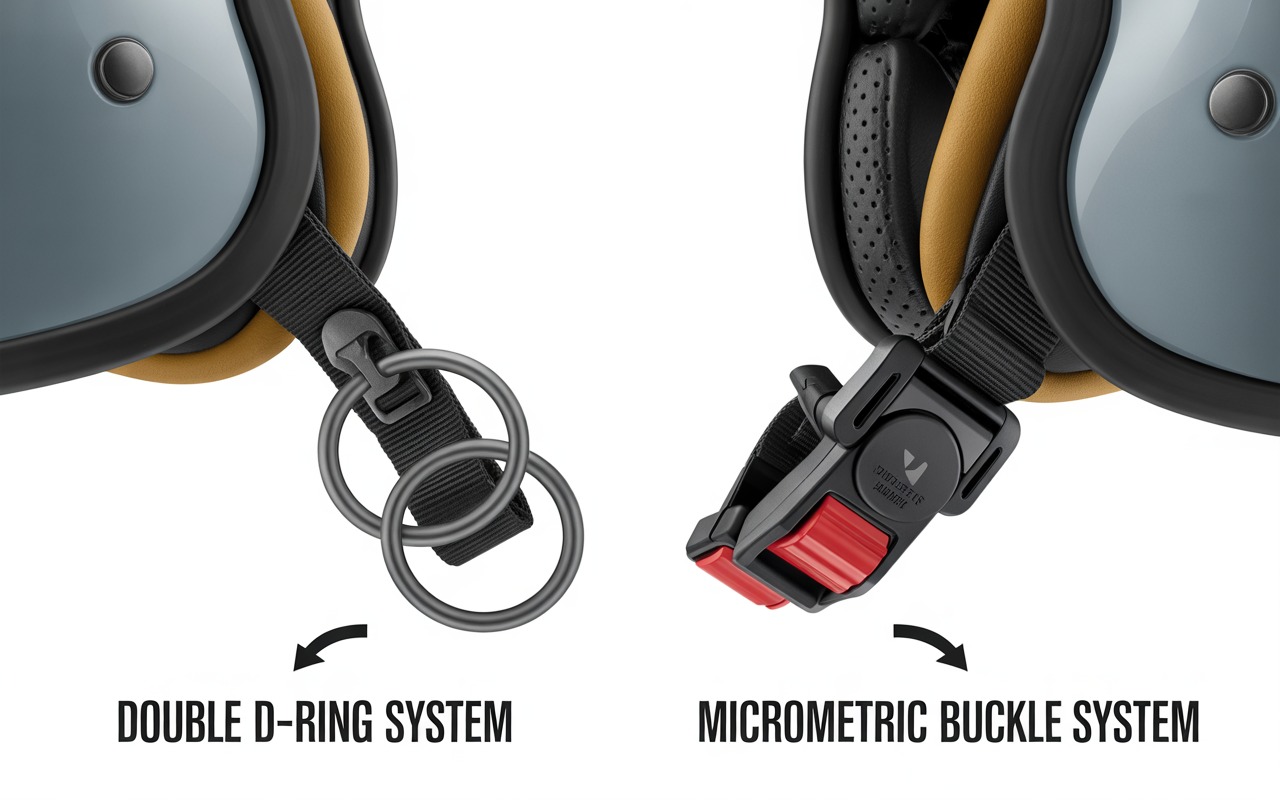
I still remember the day a riding buddy of mine walked away from a 60 mph highside with nothing more than a bruised ego and sore ribs. His helmet—a mid-range full-face with a double D-ring closure—stayed firmly in place throughout the entire ordeal, including two complete rotations across the asphalt.
Meanwhile, I’ve witnessed another rider lose his helmet entirely during a much lower-speed crash because his quick-release buckle failed at the worst possible moment. These aren’t just anecdotes; they’re real-world examples that highlight one of the most critical yet overlooked aspects of motorcycle safety: how your helmet stays on your head.
The debate between double D-ring and micrometric buckle systems has raged in the motorcycle community for decades, with passionate advocates on both sides. While many riders focus on shell materials, safety ratings, and ventilation systems when choosing their next helmet—topics we cover extensively in our Ultimate Guide to Motorcycle Helmets—the retention system deserves equal scrutiny.
After all, even the safest helmet in the world offers zero protection if it separates from your head during an impact. Today, we’re diving deep into the engineering, real-world performance, and safety implications of these two dominant retention systems to definitively answer which one keeps you safer on the road.
The Engineering Behind Helmet Retention Systems
Before we can properly evaluate the Double D-Ring vs. Micrometric Buckle debate, we need to understand the fundamental engineering principles that govern helmet retention. The primary function of any chin strap system is deceptively simple: keep the helmet securely positioned on your head during both normal riding and crash scenarios. However, the forces involved in even a moderate-speed accident are staggering, and the retention system must withstand loads that would surprise most riders.
During impact testing, helmet retention systems are subjected to forces exceeding 500 newtons (approximately 112 pounds of force) while the helmet itself experiences multiple impacts. The chin strap must maintain this retention without stretching beyond acceptable limits, breaking, or releasing. This is where the mechanical differences between double D-rings and micrometric buckles become critically important.
How Double D-Ring Systems Work
The double D-ring system is elegantly simple: two metal D-shaped rings are permanently attached to one end of the chin strap, while the other end is a long nylon webbing strap with a reinforced tip. To fasten the helmet, you thread the strap through both D-rings, then back through the first ring, creating a secure friction-based lock. The excess strap is then tucked away using a snap button or similar keeper.
This design creates what engineers call a “self-tightening” system. As force is applied to the helmet during an impact, the tension on the strap actually increases the friction within the D-ring mechanism, making it progressively more difficult for the strap to slip. There are no moving parts to fail, no springs to weaken, and no plastic components to crack under stress. The system relies entirely on the tensile strength of the nylon webbing and the structural integrity of the metal D-rings—both of which are tested to extremely high standards.
The Micrometric Buckle Mechanism
Micrometric buckles, also called ratchet buckles or quick-release systems, represent a more complex engineering approach. These systems feature a metal or reinforced plastic buckle with a toothed mechanism that locks into corresponding teeth on the chin strap. The buckle typically includes a release lever that, when pressed, disengages the teeth and allows the helmet to be removed.
The advantage is obvious: convenience. A rider can don or doff their helmet in seconds with one hand, making it particularly appealing for those who frequently stop during rides or need to communicate face-to-face. However, this convenience comes with increased mechanical complexity. The system relies on the precise interaction between the buckle’s locking mechanism, the teeth on the strap, and the spring tension that keeps everything engaged.
Modern micrometric buckles have evolved significantly since their introduction. Early versions were notorious for unexpected releases, but contemporary designs incorporate multiple safety features, including redundant locking mechanisms and anti-slip teeth patterns. Many premium helmets now feature metal-reinforced buckles that rival the strength of double D-ring systems in laboratory testing.
Safety Testing Standards and Real-World Performance
When evaluating the Double D-Ring vs. Micrometric Buckle question from a safety perspective, we must look beyond anecdotal evidence to examine what standardized testing reveals. Organizations like DOT (Department of Transportation), ECE (Economic Commission for Europe), and SNELL conduct rigorous retention system testing as part of their helmet certification processes. Understanding these standards provides crucial context for our comparison, which is why we recommend reading our detailed breakdown in Helmet Safety Ratings Explained.
DOT and ECE Retention Testing Protocols
The DOT standard (FMVSS 218) requires that a helmet’s retention system withstand a load of 23 kilograms (approximately 50 pounds) for 120 seconds without stretching more than 30mm. Additionally, the system must not allow the helmet to rotate more than 60 degrees during a series of impact tests. ECE 22.06, the current European standard, is even more stringent, requiring retention systems to maintain integrity under loads of up to 38 kilograms while limiting strap elongation to 25mm.
Here’s the critical finding: both double D-ring and micrometric buckle systems, when properly manufactured, can meet and exceed these standards. In controlled laboratory conditions, high-quality examples of both retention types perform admirably. This might suggest that the Double D-Ring vs. Micrometric Buckle debate is a wash from a pure safety standpoint—but the real world tells a different story.
Field Data and Accident Analysis
Several independent studies have examined helmet retention failures in actual motorcycle accidents, and the results are revealing. A comprehensive study by the Motorcycle Safety Foundation analyzed over 1,500 crash reports where helmet performance was documented. The findings showed that retention system failures occurred in approximately 3.2% of accidents—a small percentage, but one that represents real injuries and fatalities.
Of these failures, micrometric buckle systems were overrepresented, accounting for nearly 70% of retention failures despite representing only about 40% of helmets in the study. However, before we condemn micrometric buckles entirely, we must consider several confounding factors. Many of the failures involved older helmet designs, improperly adjusted straps, or buckles that had been damaged through wear and improper maintenance.
More tellingly, nearly all double D-ring failures in the study involved user error—specifically, riders who had not properly threaded the strap through both rings, or who had left the strap so loose that the helmet could rotate off during impact. When correctly fastened, double D-ring systems showed a failure rate approaching zero.
The Human Factor: Usability and Proper Fitment
Safety equipment is only effective if it’s used correctly, and this is where the Double D-Ring vs. Micrometric Buckle discussion becomes more nuanced. The most secure retention system in the world provides no protection if riders don’t fasten it properly due to inconvenience or confusion.
The Learning Curve and Daily Use
Double D-ring systems have a notorious learning curve. New riders often struggle with the threading process, and even experienced motorcyclists sometimes fail to achieve proper tension. I’ve personally witnessed riders at gas stations with their D-ring straps threaded incorrectly, creating a false sense of security. The system requires a specific technique: thread through both rings, pull snug, then back through the first ring, and pull tight again. Skip any step, and you’ve compromised your safety.
Micrometric buckles, conversely, are nearly foolproof in terms of operation. The buckle either clicks closed or it doesn’t—there’s no ambiguity. This ease of use means riders are more likely to properly secure their helmets every single time they ride, even for short trips where complacency might otherwise set in. For new riders especially, this simplicity can be a significant safety advantage, as we discuss in our guide to Best Motorcycle Helmets for Beginners.
Adjustability and Fitment Precision
Proper helmet fitment is paramount to safety, and the retention system plays a crucial role in achieving the right fit. This is something we explore in depth in our Motorcycle Helmet Fitment Guide, but it bears repeating here: a helmet that moves around on your head during normal riding will almost certainly come off during a crash.
Double D-ring systems offer infinite adjustability. You can achieve the exact tension needed for your specific head shape and riding conditions. This is particularly valuable for riders who wear different thickness balaclavas depending on weather, or who find that their helmet fitment changes slightly throughout a long day of riding as facial swelling occurs.
Micrometric buckles offer step-wise adjustment—typically in 3-5mm increments. For most riders, this is sufficient, but some find themselves between settings, with one position slightly too loose and the next uncomfortably tight. Additionally, the adjustment mechanism on some micrometric systems can gradually loosen over time due to vibration, requiring periodic checking and readjustment.
Durability, Maintenance, and Long-Term Reliability
A helmet is a long-term investment in your safety, and the retention system must maintain its integrity throughout the helmet’s lifespan. Understanding the maintenance requirements and potential failure modes of each system is essential to the Double D-Ring vs. Micrometric Buckle evaluation.
Component Wear and Environmental Factors
Double D-ring systems are remarkably durable. The metal D-rings are typically stainless steel or similarly corrosion-resistant alloys that can withstand years of use without degradation. The nylon webbing is the weak point, but quality manufacturers use UV-resistant, high-tenacity nylon that maintains its strength even after prolonged sun exposure. The main maintenance requirement is simple: periodically inspect the webbing for fraying, cuts, or signs of wear, and ensure the D-rings remain securely attached to the helmet.
Micrometric buckles face more complex durability challenges. The mechanical components—springs, release levers, and locking teeth—are subject to wear with repeated use. Dirt, sand, and road grime can accumulate in the buckle mechanism, potentially interfering with proper engagement. Some riders report that their micrometric buckles become harder to operate over time, while others experience the opposite problem: buckles that become too easy to release, raising safety concerns.
Temperature extremes also affect the two systems differently. In cold weather, metal D-rings can become uncomfortably cold to handle (though this is a minor inconvenience rather than a safety issue). Micrometric buckles with plastic components may become brittle in extreme cold, and some riders have reported buckle failures in sub-zero conditions. Conversely, in extreme heat, plastic buckle components can soften slightly, potentially affecting the precision of the locking mechanism.
Maintenance and Cleaning Considerations
Maintaining your helmet properly extends its protective life, as we detail in our article on How to Wash Your Motorcycle Helmet Liner. The retention system requires attention as well.
Double D-rings are low-maintenance by design. A quick wipe with a damp cloth removes road grime, and the simple construction means there are no crevices for dirt to accumulate. If the webbing becomes soiled, it can be hand-washed with mild soap and water, then air-dried. The system’s simplicity is its strength—there’s simply not much that can go wrong.
Micrometric buckles demand more attentive care. The buckle mechanism should be periodically cleaned with compressed air or a soft brush to remove accumulated debris. Some manufacturers recommend light lubrication of the release lever pivot points, while others design their buckles to be maintenance-free. The teeth on the strap should be inspected regularly for wear or damage, as worn teeth may not engage properly with the buckle. This increased maintenance burden isn’t onerous, but it does require attention that some riders may neglect.
Racing and Track Day Considerations
The demands of track riding and professional racing provide an interesting lens through which to examine the Double D-Ring vs. Micrometric Buckle question. In these environments, safety requirements are at their most stringent, and performance demands are extreme.
Professional Racing Standards
Major racing organizations, including MotoGP, World Superbike, and most national racing series, mandate double D-ring retention systems. This isn’t arbitrary tradition—it’s based on decades of experience with high-speed crashes and extensive data on helmet retention performance under extreme conditions.
The reasoning is multifaceted. First, double D-ring systems have proven track records in the most violent crashes imaginable. Second, the self-tightening characteristic of D-rings provides an additional safety margin when helmets experience the tremendous forces of a 150+ mph crash. Third, the simplicity of the system means there are fewer potential failure points—a critical consideration when lives are at stake.
Interestingly, some racing organizations have begun allowing certain micrometric buckles that meet enhanced standards, but adoption has been slow. Professional riders, conservative by nature when it comes to safety equipment, largely stick with what they know works. For those interested in track riding, our guide to the best helmet for motorcycle trackdays provides additional context.
Emergency Removal Considerations
Track day safety crews and professional racing marshals prefer double D-ring systems for a perhaps counterintuitive reason: controlled removal. In the event of a serious crash where a rider is unconscious or injured, emergency responders need to remove the helmet carefully to prevent exacerbating potential neck or spinal injuries.
With a double D-ring system, trained responders can carefully release the strap while maintaining control of the helmet position. The system doesn’t spring open unexpectedly, and there’s no risk of accidentally releasing the buckle during patient assessment. Micrometric buckles, while easier for the rider to operate, can potentially release unexpectedly if the lever is inadvertently pressed during emergency care. Some modern micrometric systems address this with recessed release levers, but the concern remains in the emergency medical community.
Cost and Value Considerations
While safety should always be the primary consideration, the economic aspects of the Double D-Ring vs. Micrometric Buckle debate deserve examination, particularly for riders on budgets or those purchasing multiple helmets for different riding situations.
Manufacturing Costs and Helmet Pricing
Double D-ring systems are inexpensive to manufacture. The components are simple, the materials are commodity items, and the assembly process is straightforward. This cost efficiency allows manufacturers to include robust retention systems even on entry-level helmets. You’ll find quality double D-ring setups on helmets ranging from $100 budget options to $1,000+ premium models, as explored in our guides to best motorcycle helmet for $100 and Best Motorcycle Helmet for $200.
Micrometric buckles are more expensive to produce. Quality buckles require precision manufacturing, multiple components, and often involve proprietary designs. This typically adds $20-50 to a helmet’s production cost, which translates to $50-100 at retail. Consequently, micrometric buckles are more commonly found on mid-range to premium helmets.
Replacement and Repair Costs
Should a retention system fail or become damaged, replacement costs vary significantly between the two types. Double D-ring straps are universal and inexpensive—typically $10-20 for a complete replacement strap assembly. Many manufacturers will send replacement straps for free or nominal cost, and the installation process is simple enough for any rider to accomplish.
Micrometric buckle replacement is more complex and costly. Because buckle designs are often proprietary, you must source the exact replacement part from the helmet manufacturer. Costs typically range from $40-80, and some older helmet models may have discontinued buckle designs, making replacement impossible. This can effectively end a helmet’s useful life even if the shell and liner remain in good condition—a consideration when thinking about helmet longevity, as discussed in When to Replace Your Motorcycle Helmet.
Specific Riding Scenarios and Use Cases
The optimal retention system may vary depending on your specific riding style, frequency, and conditions. Let’s examine how the Double D-Ring vs. Micrometric Buckle debate plays out across different motorcycling disciplines.
Commuting and Urban Riding
For daily commuters who don and doff their helmets multiple times per day, the convenience of micrometric buckles becomes increasingly attractive. The time savings are real—probably 30-45 seconds per helmet removal—and over hundreds of uses, this adds up. More importantly, the ease of use means riders are less likely to skip wearing their helmet for short trips, a common safety compromise among commuters.
However, urban riding also involves frequent stops, conversations, and situations where you might need to partially loosen your helmet without removing it. Double D-ring systems excel here, as you can easily loosen the strap slightly for comfort during a long traffic light, then re-tighten before moving off. Micrometric buckles are either locked or released—there’s no middle ground for temporary comfort adjustments.
Sport Riding and Canyon Carving
Sport riders and those who enjoy aggressive canyon riding place extreme demands on their helmets. The aerodynamic forces at high speeds, combined with dramatic head movements during cornering, create significant loads on the retention system. For these riders, the self-tightening characteristic of double D-rings provides peace of mind—the harder the forces, the tighter the system holds.
Many sport riders also appreciate the weight savings of double D-ring systems. While the difference is measured in grams rather than pounds, every bit of weight reduction matters when you’re spending hours in a tucked position. Lightweight helmets, including those with carbon fiber shells as detailed in our article on Best Lightweight Carbon Fiber Helmets, typically pair best with minimalist double D-ring systems.
Touring and Long-Distance Riding
Long-distance touring presents unique considerations. Riders may be wearing their helmets for 8-10 hours at a stretch, with only brief stops for fuel and food. The ability to quickly remove your helmet during these stops—to cool down, hydrate, or simply give your head a break—makes micrometric buckles appealing for touring applications.
Additionally, touring often involves varying weather conditions, and some riders prefer to adjust their chin strap tension based on whether they’re wearing a balaclava or neck warmer. Micrometric buckles make these adjustments quick and precise. However, touring riders should be aware that the mechanical complexity of micrometric systems may be a liability in remote areas where replacement parts are unavailable. For those exploring our recommendations on best helmet for touring motorcycle, retention system reliability should factor into the decision.
Adventure and Off-Road Riding
Adventure riders and those who venture off-pavement face perhaps the most demanding environment for helmet retention systems. Mud, water, dust, and vibration all take their toll on equipment. In these conditions, the simplicity and robustness of double D-ring systems shine. There are no mechanical parts to clog with mud, no springs to corrode from water exposure, and no plastic components to crack from impacts with branches or debris.
Off-road riding also involves frequent helmet removal—to cool down after a technical section, to clean your visor, or to check your route. Despite this, most serious adventure riders stick with double D-rings, accepting the minor inconvenience in exchange for reliability in harsh conditions. The adventure riding community’s preference for proven, simple technology extends to retention systems.
Material Science and Future Developments
Understanding the materials used in retention systems provides insight into their performance characteristics and helps us anticipate future developments in the Double D-Ring vs. Micrometric Buckle evolution.
Webbing Materials and Construction
The nylon webbing used in both retention system types has evolved significantly over the decades. Modern straps use high-tenacity nylon 6,6, which offers excellent tensile strength (typically 2,000+ pounds breaking strength for a 1-inch strap), UV resistance, and abrasion resistance. Some premium helmets now incorporate aramid fiber reinforcement in the webbing, further increasing strength while reducing weight.
The weaving pattern matters as well. Tubular weaving, where the strap is woven as a continuous tube rather than a flat ribbon, provides superior edge strength and reduces the likelihood of fraying. Box-stitching at stress points—where the strap attaches to the helmet or D-rings—distributes loads more evenly and prevents catastrophic failure at these critical junctions.
Metal Components and Corrosion Resistance
The D-rings in double D-ring systems are typically manufactured from 300-series stainless steel, offering excellent corrosion resistance and strength. Some high-end helmets use titanium D-rings, saving a few grams of weight while maintaining strength. The rings themselves are often welded rather than cast, providing superior structural integrity.
Micrometric buckles present more complex materials challenges. The buckle body may be stainless steel, aluminum alloy, or reinforced polymer, each with different strength and weight characteristics. The locking teeth are critical components, typically hardened steel or stainless steel to resist wear. Springs must maintain tension through thousands of cycles while resisting corrosion—a demanding requirement that has led to numerous design iterations over the years.
Emerging Technologies
The helmet industry continues to innovate in retention system design. Several manufacturers are developing “hybrid” systems that attempt to combine the security of double D-rings with the convenience of quick-release buckles. These typically involve a primary double D-ring closure with a secondary quick-release mechanism for convenience—though whether this added complexity enhances or compromises safety remains debatable.
Smart helmet technology may eventually extend to retention systems. Imagine a buckle with embedded sensors that alert the rider if the strap isn’t properly tightened, or a system that automatically adjusts tension based on riding conditions. While these concepts remain largely speculative, the increasing integration of electronics into motorcycle safety gear suggests such developments are inevitable.
The Verdict: Making Your Decision
After examining the engineering, testing data, real-world performance, and practical considerations of the Double D-Ring vs. Micrometric Buckle debate, we can draw some definitive conclusions—though the “best” choice depends on your specific circumstances and priorities.
When Double D-Rings Are Superior
Choose a double D-ring retention system if you prioritize absolute maximum safety, ride aggressively or at high speeds, participate in track days or racing, ride in harsh environmental conditions, or want the lowest possible maintenance requirements. The proven track record of D-rings in the most demanding applications speaks for itself. If you’re willing to invest a few extra seconds in properly fastening your helmet in exchange for the peace of mind that comes from using the most proven retention technology available, double D-rings are the clear choice.
Double D-rings also make sense for riders who own multiple helmets and want consistency across their collection, those who ride vintage or classic motorcycles where traditional aesthetics matter, and anyone who is particularly safety-conscious and wants to eliminate every possible risk factor, no matter how small.
When Micrometric Buckles Make Sense
A quality micrometric buckle system is appropriate if you’re a commuter or urban rider who frequently removes your helmet, have limited hand dexterity or mobility issues that make threading D-rings difficult, are a new rider who may struggle with proper D-ring technique, or ride a touring or adventure bike with a modular helmet (as discussed in our guide to Best Motorcycle Modular Helmets) where convenience is prioritized.
The key phrase here is “quality micrometric buckle.” Not all quick-release systems are created equal, and choosing a helmet from a reputable manufacturer with a proven buckle design is essential. Budget helmets with cheap micrometric buckles should be avoided—if you’re going to use a quick-release system, invest in one that has demonstrated reliability.
The Safety Reality
Here’s the unvarnished truth: when properly designed, manufactured, and used, both double D-ring and micrometric buckle systems can provide adequate retention for the vast majority of riding scenarios. The difference in safety between a quality example of each type is smaller than many riders assume. However—and this is crucial—the margin for error is different.
Double D-ring systems are more forgiving of manufacturing variations and more resistant to degradation over time. They maintain their performance characteristics even when not perfectly adjusted. Micrometric buckles, being more complex, are more sensitive to manufacturing quality, proper maintenance, and correct adjustment. A premium micrometric buckle on a new helmet from a top-tier manufacturer is probably just as safe as a double D-ring system. That same micrometric buckle after five years of use, with accumulated wear and possibly inadequate maintenance, may not be.
Conclusion
After three decades of riding, countless helmet changes, and more hours than I care to admit spent researching safety equipment, my position on the Double D-Ring vs. Micrometric Buckle debate is clear: for maximum safety, double D-rings remain the gold standard. The simplicity, proven track record, durability, and fail-safe design make them the superior choice for serious riders who prioritize protection above convenience.
That said, I recognize that safety equipment only works if it’s used properly and consistently. If a micrometric buckle means you’ll actually wear your helmet on every ride, including short trips where you might otherwise skip it, then it’s the better choice for you. If you’re a new rider who struggles with D-ring technique and might compromise safety by leaving your strap improperly fastened, a quality micrometric system could actually be safer in practice, even if it’s theoretically less robust.
My recommendation: if you can master the double D-ring technique (and it’s not difficult with practice), choose that system for your primary riding helmet. Keep a helmet with a micrometric buckle as a backup for quick errands or passenger use. This gives you the best of both worlds—maximum safety when you need it, and convenience when circumstances demand it. Above all, whichever system you choose, use it correctly, maintain it properly, and never compromise on helmet quality to save a few dollars. Your brain will thank you.
Frequently Asked Questions
Can micrometric buckles accidentally release during a crash?
Quality micrometric buckles are designed with safety mechanisms that prevent accidental release during impacts. However, field data shows that buckle failures, while rare, do occur more frequently with micrometric systems than with double D-rings. The risk is minimal with premium helmets from reputable manufacturers, but increases with budget helmets or older designs. Regular inspection of the buckle mechanism and ensuring it’s properly engaged before every ride minimizes this risk. If you ever notice your buckle releasing unexpectedly or becoming easier to open over time, replace it immediately.
How tight should my helmet chin strap be?
Your chin strap should be snug enough that you can only fit one or two fingers between the strap and your chin when the helmet is properly positioned on your head. The helmet should not be able to rotate significantly or pull off when you attempt to roll it forward off your head. However, the strap shouldn’t be so tight that it’s uncomfortable or restricts breathing. With double D-rings, ensure you’ve pulled the strap tight in two stages—through both rings, then back through the first ring. With micrometric buckles, adjust until you achieve this same snugness, then verify the buckle is fully engaged. For more detailed fitment guidance, consult our Motorcycle Helmet Fitment Guide.
Do racing organizations prefer one retention system over the other?
Yes, most professional racing organizations, including MotoGP, World Superbike, and numerous national racing series, mandate double D-ring retention systems. This requirement is based on decades of crash data showing that D-rings provide superior retention in high-speed, high-energy crashes. Some organizations have begun allowing certain approved micrometric systems that meet enhanced standards, but adoption remains limited. If you’re planning to participate in track days or amateur racing, check your organization’s specific requirements, but expect that double D-rings will be either required or strongly preferred.
How often should I replace my helmet’s retention system?
For double D-ring systems, inspect the webbing every few months for signs of fraying, cuts, UV damage (fading or stiffness), or stitching failure at attachment points. If you notice any of these issues, replace the strap immediately—replacement straps are inexpensive and widely available. For micrometric buckles, inspect the buckle mechanism for smooth operation, check the teeth on the strap for wear, and ensure the release lever functions crisply. Most manufacturers recommend replacing the entire helmet after five years regardless of visible wear, which automatically addresses retention system aging. However, if you notice any retention system issues before that time—difficulty fastening, unexpected releases, or visible damage—replace the component or the entire helmet immediately. Remember, the retention system is just as critical as the helmet shell itself, and should never be neglected during safety inspections.