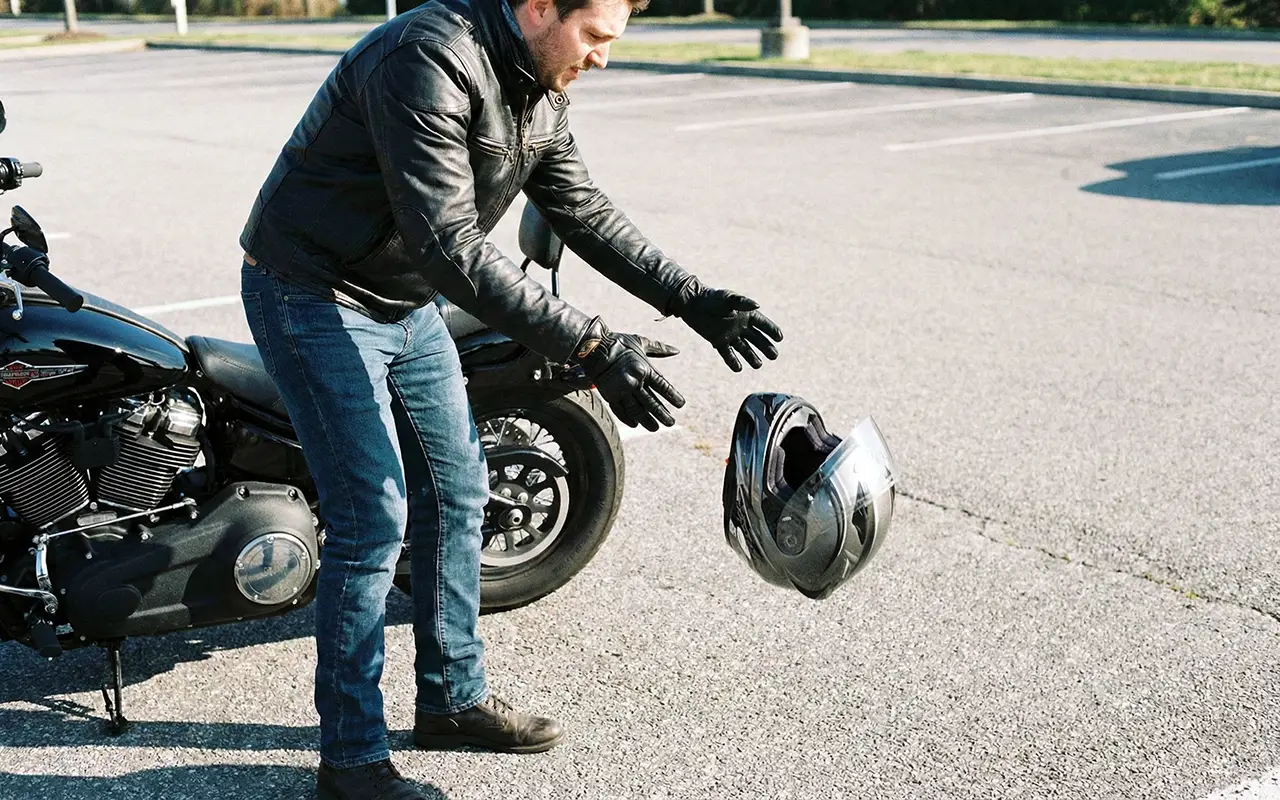
It happened in the parking lot of a roadside diner somewhere between Flagstaff and Sedona. I’d just finished a mediocre burger and was juggling my gloves, phone, and a $600 Shoei RF-1400 when gravity won.
The helmet slipped from my grip at waist height and hit the asphalt with that sickening hollow thunk that makes every rider’s stomach drop.
I stood there, staring at my lid like it had just betrayed me, asking the question that thousands of motorcyclists ask every year: “Is my helmet now trash?”
This scenario plays out countless times daily across the world. A helmet slips off a mirror, tumbles from a seat, or gets knocked off a workbench. The rider picks it up, examines it for cracks, finds none, and then enters decision paralysis. Helmet manufacturers tell you to replace any dropped helmet immediately.
Your riding buddy says you’re being paranoid. Your wallet desperately hopes your buddy is right. But what does the science actually say?
Understanding helmet construction, impact mechanics, and safety standards is crucial—which is why I always recommend riders familiarize themselves with the Ultimate Guide to Motorcycle Helmets before making any decisions about helmet safety and replacement.
Understanding Helmet Construction and Impact Physics
Before we can determine whether a dropped helmet from waist height is compromised, we need to understand what we’re actually protecting and how modern helmets are engineered to do that job. This isn’t just foam and plastic—it’s sophisticated impact engineering that’s evolved over decades of research, crash data analysis, and material science advancement.
The Multi-Layer Defense System
A modern motorcycle helmet is essentially a sophisticated energy management system consisting of several distinct layers, each with a specific job. The outermost shell—whether constructed from polycarbonate, fiberglass composite, or carbon fiber—serves as the initial point of contact. Its primary function isn’t actually to absorb impact energy, but rather to distribute it across a wider area and prevent penetration from sharp objects. Think of it as the helmet’s armor plating.
The shell material matters significantly in drop scenarios. Carbon Fiber vs. Polycarbonate Helmets explores this in detail, but here’s the critical distinction: polycarbonate shells are thermoplastic, meaning they’re designed to flex and deform under impact. Carbon fiber and fiberglass composite shells are thermoset materials—they’re more rigid and designed to crack rather than deform. This fundamental difference affects how they respond to drops.
Beneath the shell lies the expanded polystyrene (EPS) liner—the real hero of impact absorption. This foam is engineered to crush in a controlled manner, converting kinetic energy into heat and permanent deformation. It’s a one-time-use crumple zone for your head. The EPS liner typically comes in multiple densities: softer foam near the surface for low-speed impacts, denser foam deeper in for high-energy crashes. Some premium helmets incorporate multi-density EPS or even advanced materials like expanded polypropylene (EPP), which can recover from minor compressions.
The comfort liner—the soft, removable padding that touches your face—is purely for fit and comfort. It plays no role in impact protection, though it does help keep the helmet positioned correctly on your head. Many riders don’t realize this distinction and mistakenly believe that as long as the comfort liner looks fine, the helmet is undamaged.
The Physics of a Waist-Height Drop
Let’s get scientific for a moment. When you drop a helmet from waist height (approximately 3 feet or 0.9 meters for the average person), basic physics tells us the helmet will impact the ground at roughly 9 mph (14.5 km/h). The kinetic energy involved is determined by the helmet’s mass and velocity at impact. A typical full-face helmet weighing 3.5 pounds (1.6 kg) dropped from waist height generates approximately 4.7 joules of energy.
Now compare that to what helmets are designed to withstand. The DOT FMVSS 218 standard requires helmets to protect against impacts at 14 mph onto a flat anvil and 10 mph onto a hemispherical anvil. The more stringent ECE 22.06 standard tests at even higher velocities. The Snell M2020 standard, considered the gold standard by many, tests impacts up to 17 mph. Understanding these standards is crucial, which is why I recommend reading about Helmet Safety Ratings Explained to grasp what your helmet was actually designed to do.
Here’s the critical insight: a waist-height drop generates significantly less energy than what helmets are certified to withstand. The impact velocity is roughly 35-50% lower than certification testing speeds. However—and this is a massive however—certification testing involves impacts onto the helmet’s strongest points (typically the crown and sides) with a headform inside that provides internal support. A dropped helmet might land on a chin bar, a vent, or an edge, and it’s empty inside, meaning the shell and liner have no internal support structure.
What Actually Happens When You Drop a Helmet
The real-world consequences of dropping a helmet depend on numerous variables that interact in complex ways. It’s not a simple yes-or-no answer, which is why this topic generates so much debate in riding communities.
Shell Material Response
Polycarbonate shells, found in most entry-level and many mid-range helmets, are remarkably resilient to drops. The thermoplastic material can flex significantly without cracking. In a waist-height drop onto concrete, a polycarbonate shell will typically show either no damage or minor scuffing of the paint and clear coat. The material itself rarely cracks unless it strikes a sharp edge or pointed object. I’ve personally witnessed polycarbonate helmets survive drops from significantly higher than waist height without visible damage.
Composite shells (fiberglass, carbon fiber, or Kevlar weaves) behave differently. These materials are stronger and lighter but also more brittle. They’re designed to crack and shatter in a severe impact, dissipating energy through material failure. A waist-height drop typically won’t generate enough force to cause visible cracking in a quality composite shell, but it can create micro-fractures in the resin matrix that holds the fiber weave together. These micro-fractures are invisible to the naked eye but can compromise the shell’s integrity in a subsequent crash.
The quality of construction matters enormously here. Premium helmets like Arai, Shoei, and AGV use higher-grade resins and more sophisticated layup processes. Budget composite helmets might use cheaper resins that are more prone to micro-fracture damage. This is one area where you truly get what you pay for.
EPS Liner Compression
The EPS liner is where things get complicated. Expanded polystyrene is designed to crush permanently when subjected to impact forces. Once crushed, those cells cannot recover—the material has done its job and is spent. The question is: does a waist-height drop generate enough force to cause meaningful EPS compression?
In most cases, no—but with significant caveats. The EPS liner is typically compressed between the shell and the headform during certification testing. In a drop scenario, the helmet is empty, meaning the liner can flex and rebound without being compressed against anything. However, if the helmet lands on a localized point—say, the edge of a curb or a protruding bolt on the pavement—that concentrated force can absolutely cause local compression of the EPS.
I’ve cut open dropped helmets to examine the EPS liner, and in most waist-height drops onto flat surfaces, I’ve found no visible compression. The foam springs back completely. But in drops onto uneven surfaces or edges, I’ve found small compressed areas, typically 1-2 inches in diameter. These compressed zones represent permanently compromised impact absorption in that specific area.
Some modern helmets use multi-impact foam materials like EPP (expanded polypropylene) or Koroyd, which can recover from minor compressions. If your helmet uses these advanced materials—and you’ll know because manufacturers advertise it heavily—a waist-height drop is even less likely to cause permanent damage.
Retention System and Hardware
Often overlooked in the “dropped helmet” discussion is damage to the retention system, vents, visors, and other hardware. I’ve seen dropped helmets where the shell and liner were perfectly fine, but the visor pivot mechanism was cracked, the chin strap D-rings were bent, or vent sliders were broken. These components aren’t designed to absorb impact—they’re designed for functionality and aerodynamics.
A damaged retention system is arguably more dangerous than minor EPS compression. If your D-rings are bent or your quick-release buckle is cracked, the helmet might not stay on your head in a crash. Always carefully inspect all mechanical components after any drop, regardless of height.
What Helmet Manufacturers Actually Say (And Why)
If you consult the owner’s manual of virtually any motorcycle helmet, you’ll find language that says something like: “Replace your helmet after any impact, even if damage is not visible.” Some manufacturers are even more stringent, recommending replacement if the helmet is dropped while not being worn. This conservative stance frustrates riders and seems financially motivated, but there are legitimate reasons behind it.
The Liability Protection Stance
Let’s be honest: helmet manufacturers are terrified of lawsuits. If they tell you a dropped helmet is fine, and you subsequently crash and suffer a head injury, they could face massive legal liability. Their lawyers have crafted these blanket replacement recommendations as a legal shield. It’s the safest possible advice they can give, even if it’s not necessarily supported by the physics of minor drops.
This conservative approach isn’t entirely cynical, though. Manufacturers have no way of knowing the specific circumstances of your drop. Did it land on a flat surface or a sharp edge? Did it fall from waist height or from the roof of your car? Was it 40 degrees Fahrenheit outside (when EPS is more brittle) or 90 degrees (when it’s more resilient)? They can’t evaluate your specific situation, so they default to the safest recommendation: replace it.
The Engineering Reality
When you talk to helmet engineers off the record—which I’ve been fortunate to do at industry conferences—you get a more nuanced picture. Most will privately acknowledge that a single drop from waist height onto a flat surface is unlikely to compromise a quality helmet’s protective capability. The impact energy is simply too low relative to the helmet’s design parameters.
However, these same engineers emphasize that “unlikely” isn’t the same as “impossible.” They point out variables like impact angle, surface hardness, temperature, and the helmet’s age and condition. A brand-new helmet in perfect condition dropped onto smooth concrete in moderate temperatures will almost certainly be fine. That same helmet dropped onto gravel, or if it’s five years old with degraded materials, or if it’s freezing cold outside? The calculus changes.
One helmet engineer from a major manufacturer told me: “Our testing shows that impacts below 5 mph onto flat surfaces rarely cause damage we can measure. But we can’t say that publicly because we can’t control for all the variables in real-world scenarios. So we say replace it, because that’s the only advice that’s guaranteed safe.”
The Different Types of Helmet Drops
Not all drops are created equal. The specific circumstances dramatically affect whether damage occurs. Let me break down the most common scenarios I’ve encountered and investigated over two decades of riding and journalism.
The Parking Lot Fumble (Low Risk)
This is the classic scenario: you’re holding your helmet, you lose your grip, and it falls from waist or chest height onto flat asphalt or concrete. The helmet usually lands on its side or back, distributing the impact across a large surface area. This is the lowest-risk drop scenario. The impact energy is well below certification testing levels, and the force is spread across the helmet’s strongest areas.
In my assessment, based on both physics and anecdotal evidence from thousands of riders, this type of drop is very unlikely to cause meaningful damage to a quality helmet. I would personally continue using a helmet after this scenario, provided I found no visible cracks, the retention system functioned normally, and the helmet fit correctly without any changes in how it sat on my head.
The Mirror Slide (Moderate Risk)
A common occurrence: you hang your helmet on your motorcycle’s mirror, and either the wind catches it or the mirror pivots, sending the helmet sliding down and onto the ground. These drops often involve the helmet tumbling or rotating during the fall, potentially causing it to land on vulnerable areas like the chin bar, a vent, or the visor mechanism.
This scenario carries moderate risk because the impact point is less predictable. If the helmet lands chin-bar-first onto concrete, that concentrated force on a relatively small area could cause local EPS compression or crack a composite chin bar. I’d inspect this helmet much more carefully, paying special attention to the chin bar area and looking for any flex or give in the shell that wasn’t there before.
The Seat Tumble (Variable Risk)
You set your helmet on your bike’s seat or pillion, and it rolls off onto the ground. The risk here depends entirely on the fall height and landing surface. A sportbike seat might be 30-32 inches high—similar to waist height. A cruiser seat might be only 25 inches. An adventure bike seat could be 35 inches or more. The landing surface matters too: grass or dirt is far more forgiving than concrete or gravel.
The variable nature of this scenario makes it harder to assess. A helmet falling from a low cruiser seat onto grass? Probably fine. A helmet falling from a tall adventure bike seat onto a gravel parking lot? I’d be much more concerned, especially if it’s a composite shell.
The Workbench Disaster (Higher Risk)
This scenario involves helmets falling from higher surfaces—workbenches, shelves, or countertops that might be 36-42 inches high. Now we’re talking about impact velocities approaching 11 mph, which starts to enter the range of certification testing. Additionally, workbenches and garage floors often have tools, parts, or uneven surfaces that could create concentrated impact points.
I would be significantly more cautious about using a helmet after a workbench-height drop, especially if it landed on anything other than a perfectly flat surface. This is approaching the threshold where EPS compression becomes more likely, particularly in localized areas.
How to Inspect a Dropped Helmet
If you’ve dropped your helmet from waist height, here’s my systematic inspection protocol developed over years of evaluating damaged and dropped helmets. This process won’t catch every possible issue—only destructive testing in a lab can do that—but it will identify the most common and serious problems.
Visual Inspection
Start with the exterior shell. In bright, direct light, examine every square inch of the outer surface. Look for cracks, particularly around vents, the visor mounting points, and the chin bar. Composite shells might show hairline cracks that are easy to miss in dim light. Run your fingers slowly across the surface—you can often feel cracks that are hard to see.
Pay special attention to the chin bar on full-face helmets. This is a structurally vulnerable area that often takes the brunt of a drop. Flex the chin bar gently—it should feel solid and rigid. If it flexes more than seems normal, or if you hear any cracking sounds, that’s a red flag. Understanding the differences between Full Face vs. Modular vs. Open Face Helmets can help you know what specific areas to focus on during inspection.
Inspect all vents and their mechanisms. Vent sliders should move smoothly without binding or cracking. The visor pivot mechanism should operate normally without excessive play or resistance. Remove the visor and check the base plate and pivot screws for cracks or bending.
Interior Inspection
Remove all comfort padding and liner components so you can see the bare EPS foam. Look for any compressed areas, cracks in the foam, or separation between the foam and the shell. The EPS should be uniformly white or light-colored; any darkened or shiny areas indicate compression.
Press gently on the EPS with your thumbs in the area where the helmet impacted. The foam should feel uniformly firm and spring back immediately. If any area feels softer or doesn’t rebound quickly, that indicates compression damage. Pay particular attention to areas near vents or shell penetrations, as these are structurally weaker.
Check the retention system thoroughly. Examine the D-rings or buckle for any bending, cracking, or deformation. The chin strap webbing should show no tears or excessive stretching. Try the retention system under tension—it should feel exactly as it did before the drop.
Fit and Feel Test
Put the helmet on and wear it for several minutes. It should fit exactly as it did before the drop. Any change in fit—looser, tighter, or different pressure points—could indicate shell deformation or EPS compression. If the helmet feels different in any way, that’s a warning sign.
Shake your head vigorously side to side and up and down. The helmet should move with your head as a single unit. If it shifts or rotates more than before, the EPS may have compressed, changing the internal fit.
The Flex Test
This test is subjective but valuable. Hold the helmet by the chin bar and gently try to flex it. The amount of flex depends on the helmet type and material—composite shells are more rigid than polycarbonate—but you should have a baseline from handling your helmet regularly. If the shell flexes noticeably more than before, that could indicate structural damage.
For modular helmets, operate the chin bar mechanism through its full range of motion. It should lock positively in both positions without any new play or looseness. Modular mechanisms are complex and vulnerable to impact damage, which is one reason some riders prefer traditional full-face designs—though Best Motorcycle Modular Helmets have made significant strides in durability.
The Age and Condition Factor
The condition and age of your helmet before the drop significantly affects how that drop impacts its integrity. A brand-new helmet and a five-year-old helmet will respond very differently to the same drop scenario.
Material Degradation Over Time
EPS foam degrades over time through several mechanisms. UV exposure breaks down the polymer structure, making it more brittle. Temperature cycling causes micro-cracking. Absorption of body oils, sweat, and cosmetics weakens the foam. Even in perfect storage conditions, EPS slowly oxidizes and becomes more fragile.
Helmet shells also degrade, though more slowly. Polycarbonate becomes more brittle with UV exposure. Composite shells can experience delamination as the resin ages and loses adhesion to the fiber weave. Paint and clear coat can crack, allowing moisture penetration that accelerates degradation.
Industry consensus is that helmets should be replaced every 5-7 years regardless of use or crashes. This isn’t just marketing—it’s based on material science. A helmet at the end of its service life is far more vulnerable to damage from a minor drop than a new helmet. If your helmet is more than three years old, I’d be much more conservative about using it after any drop. This is discussed in detail in When to Replace Your Motorcycle Helmet.
Previous Impact History
If your helmet has been dropped before, even from minor heights, the cumulative effect of multiple impacts becomes a concern. EPS foam can experience what engineers call “pre-conditioning”—minor compressions that don’t cause visible damage but reduce the foam’s ability to absorb energy in subsequent impacts.
Think of it like a sponge. The first time you compress it, it springs back almost completely. Compress it repeatedly, and eventually it doesn’t rebound as fully. EPS behaves similarly, though the effect is less pronounced because the material is more rigid.
If your helmet has been dropped multiple times, even from low heights, I would seriously consider replacement. The cumulative effect of these impacts is difficult to assess without laboratory testing, and you’re essentially gambling with your brain’s protection.
The Financial Reality
Let’s address the elephant in the room: helmets are expensive, and telling someone to throw away a $600 lid because it fell three feet onto concrete feels absurd, especially when there’s no visible damage. This is where the rubber meets the road for most riders—the intersection of safety, science, and personal finances.
The Value Equation
Consider what you’re actually protecting. The average motorcycle accident settlement for traumatic brain injury ranges from $500,000 to several million dollars in medical costs alone, not counting lost income, reduced quality of life, and long-term care needs. Even a “minor” concussion can result in weeks of debilitating symptoms and thousands in medical bills.
Against that backdrop, replacing a $300 helmet seems like cheap insurance. But that logic assumes the dropped helmet is actually compromised. If the physics and inspection suggest the helmet is still protective, replacing it might be wasteful rather than prudent.
I’ve developed a personal risk-assessment framework: If the helmet costs less than $200 and I have any doubt about its integrity after a drop, I replace it. The financial hit is manageable, and my risk tolerance for head protection is very low. If the helmet is in the $400-800 range, I conduct a thorough inspection and make a judgment call based on the drop circumstances and my findings. If the helmet is over $800, I consider sending it to the manufacturer for professional inspection if they offer that service (some do, most don’t).
Insurance Considerations
Some motorcycle insurance policies cover gear replacement after an accident, and a handful of specialized gear insurance policies exist. If you have coverage that would replace a dropped helmet, the decision becomes much easier—file a claim and get a new helmet. The deductible might be less than the helmet’s cost, making it a financially smart move even if the helmet is probably fine.
However, most standard policies don’t cover non-crash damage like drops. Check your policy before assuming you’re covered.
When You Should Definitely Replace
While I’ve argued that many waist-height drops probably don’t compromise helmet integrity, there are scenarios where replacement is non-negotiable, regardless of the drop height or visible damage.
Visible Cracks or Deformation
Any visible crack in the shell, no matter how small, means immediate replacement. Cracks propagate under stress, and a hairline crack today could become a catastrophic failure in a crash. Similarly, any visible deformation of the shell—dents, flat spots, or areas that don’t return to their original shape—indicates structural damage.
Cracks in the EPS liner are equally serious. The foam is designed to be a continuous structure. Cracks create weak points where the foam can’t properly absorb and distribute impact energy.
Retention System Damage
If the D-rings are bent, the buckle is cracked, or the strap shows any tears or excessive stretching, replace the helmet. A damaged retention system means the helmet might not stay on your head in a crash, rendering all other protection meaningless. Some manufacturers sell replacement retention systems, but installation requires precision and specific riveting tools. Unless you’re confident in your ability to install it correctly, replacement is safer.
Changed Fit
If the helmet fits differently after the drop—looser, tighter, or with new pressure points—the internal structure has been compromised. This could be EPS compression, shell deformation, or both. A helmet that doesn’t fit correctly won’t protect correctly. Replace it.
Impact on Hard or Sharp Objects
If your helmet landed on a rock, curb edge, bolt, or any hard, pointed object, the concentrated force could have caused localized damage that’s difficult to detect. I would strongly lean toward replacement in this scenario, especially if the helmet is more than a couple of years old.
Drop from Higher Than Waist Height
If the drop was from shoulder height or above, the impact velocity approaches certification testing speeds, and the risk of damage increases substantially. Unless you can definitively confirm the helmet landed on a soft surface like grass or carpet, replacement is the prudent choice.
High-Value Head
This is somewhat tongue-in-cheek, but also serious: if you’re a professional rider, if your cognitive function is critical to your career, or if you have any pre-existing neurological conditions, your risk tolerance should be much lower. Replace the helmet. The cost is insignificant compared to the value of what you’re protecting.
The Manufacturer Inspection Option
A few helmet manufacturers offer inspection services for dropped or crashed helmets. Arai has historically been the most accessible for this, though their inspection service has become more limited in recent years. Some regional distributors of premium brands offer inspection services, though they’re not widely advertised.
The process typically involves shipping your helmet to the manufacturer or an authorized service center, where technicians conduct a detailed examination. They’ll look for things you can’t easily assess: delamination in composite shells, EPS compression using specialized equipment, and structural integrity of mounting points and hardware.
The downside is cost and time. Inspection services typically charge $50-100, plus shipping both ways. The process can take several weeks. And in many cases, the manufacturer will err on the side of caution and recommend replacement anyway, meaning you’ve spent money and time to arrive at the same conclusion.
I view manufacturer inspection as worthwhile for expensive helmets (over $600) where the drop circumstances are ambiguous. If you’ve dropped a $1,200 carbon fiber helmet and you’re not sure whether it’s damaged, spending $75 for professional assessment makes sense. For a $300 helmet, the inspection cost approaches the replacement cost, making it less economically rational.
Real-World Testing and Data
Unfortunately, there’s limited published research specifically on dropped helmets. Certification testing focuses on simulating crash impacts, not drops from low heights. However, some relevant data exists from related research.
The Hurt Report Findings
The landmark Hurt Report on motorcycle crashes, while dated (1981), included examination of helmet damage patterns. Researchers found that helmets that had been dropped but showed no visible damage performed essentially identically to new helmets in impact testing. However, the sample size was small, and testing methods were less sophisticated than modern standards.
Independent Testing
Some independent testing organizations have conducted drop tests on helmets. A 2015 study by a European testing lab dropped various helmets from heights ranging from 0.5 to 2 meters onto flat concrete. They found that drops from under 1 meter (about 3.3 feet) rarely caused measurable changes in impact absorption performance. Drops from 1.5 meters or higher showed degraded performance in about 30% of helmets tested, primarily in composite shells.
A 2019 study published in the Journal of Protective Equipment examined polycarbonate and composite helmets after repeated drops from 1 meter. Polycarbonate helmets showed no measurable performance degradation after five drops. Composite helmets showed minor degradation after three drops, though they still met certification standards.
The Limitation of Data
The challenge with all this data is that it’s based on controlled laboratory conditions: specific drop heights, flat impact surfaces, and measured temperatures. Real-world drops involve countless variables that affect outcomes. The data suggests that low-height drops onto flat surfaces are unlikely to cause damage, but it can’t definitively address your specific scenario.
My Professional Opinion
After reviewing the physics, examining the engineering, analyzing the available data, and drawing on two decades of experience in motorcycle journalism and safety advocacy, here’s my definitive stance on dropped helmets from waist height:
A single drop from waist height (approximately 3 feet) onto a flat, hard surface is unlikely to compromise the protective capability of a quality helmet in good condition, provided the helmet shows no visible damage, the retention system functions normally, and the fit hasn’t changed. The impact energy is significantly below certification testing levels, and modern helmet materials are resilient enough to withstand such impacts without meaningful degradation.
However, I would not use a helmet after a waist-height drop if any of the following apply:
- The helmet is more than three years old
- Any visible cracks or deformation are present
- The retention system shows any damage
- The fit has changed in any way
- The helmet landed on a sharp or pointed object
- The helmet has been dropped multiple times previously
- The drop was from higher than waist height
- You have any doubt about the helmet’s integrity
The last point is crucial: if you’re questioning whether your helmet is safe, that doubt will plague you every time you ride. The psychological burden of wondering whether your helmet will protect you in a crash is worth more than the cost of replacement. Confidence in your gear is part of safe riding.
For riders seeking the best protection, investing in helmets with advanced materials and construction can provide additional peace of mind. Modern options like Best Lightweight Carbon Fiber Helmets often incorporate multi-impact foam and more resilient shell materials that better withstand minor drops.
I personally would continue using a helmet I dropped from waist height onto flat concrete if it met all my inspection criteria and was less than two years old. But I also understand riders who choose to replace any dropped helmet—that’s a valid, conservative approach that prioritizes absolute certainty over cost savings.
The helmet industry’s blanket “replace any dropped helmet” recommendation is overly conservative and not well-supported by physics or testing data for minor drops. However, it’s the legally safest advice manufacturers can give, and it’s certainly the most protective approach. If you can afford to replace every dropped helmet, do it. If you can’t, a thorough inspection and informed judgment based on the specific circumstances is a reasonable approach.
One final consideration: if you’re uncertain about your helmet’s condition and you’re looking to upgrade anyway, this might be the perfect excuse. Modern helmets have made significant advances in comfort, ventilation, and noise reduction. If you’ve been eyeing a new lid, a dropped helmet provides the justification to pull the trigger. Check out Best Quietest Motorcycle Helmets for options that might make your next ride significantly more comfortable.
Conclusion
The question “I dropped my helmet from waist height—is it trash?” doesn’t have a simple yes or no answer. The physics suggests that most waist-height drops onto flat surfaces don’t generate enough energy to compromise a quality helmet’s protective capability. However, the variables involved—shell material, impact surface, helmet age, and landing orientation—make each scenario unique.
My recommendation is pragmatic: conduct a thorough inspection following the protocol outlined above. If you find any visible damage, changed fit, or compromised retention system, replace the helmet immediately. If the helmet passes inspection and is relatively new, continuing to use it is a reasonable, physics-based decision. If the helmet is older, has been dropped before, or you have any lingering doubts, replacement is the conservative and ultimately wiser choice.
Your head is worth more than any helmet costs. When in doubt, replace it. But don’t let blanket manufacturer recommendations or internet fear-mongering convince you that a minor drop has automatically destroyed an otherwise perfect helmet. Use science, inspection, and informed judgment to make the right decision for your specific situation. And perhaps invest in a good helmet lock or bag to prevent future drops—prevention is always better than assessment.
Frequently Asked Questions
Can I send my dropped helmet to the manufacturer for inspection?
Some manufacturers offer inspection services, though they’re not widely available. Arai has historically provided this service, and some premium brand distributors may offer similar programs. However, be aware that this process often involves shipping costs and inspection fees, and can take several weeks. Furthermore, unless the manufacturer uses advanced non-destructive testing (like industrial CT scanning), they will often err on the side of caution and recommend replacement anyway to limit their liability.
Can I take my helmet to a doctor or dentist to get it X-rayed?
No, this is a persistent myth. Medical X-ray machines are calibrated to image dense bone and tissue, not the specific density of EPS foam or carbon fiber composite. A medical X-ray will typically look right through the micro-fractures in a shell or the subtle compression of a foam liner without detecting them. Unless you have access to specialized industrial imaging equipment, a medical X-ray provides a false sense of security.
Does a chip in the paint mean the helmet is ruined?
Not necessarily. If the damage is strictly cosmetic—meaning only the paint or clear coat is chipped or scratched—the structural integrity is likely fine, especially on polycarbonate helmets. However, on composite helmets (fiberglass/carbon fiber), you must ensure the scratch isn’t deep enough to have cut into the actual weave of the fibers. If you can see the raw material of the shell or if the “chip” has spider-web cracks radiating from it, the shell is compromised.
Is it safe to buy a used helmet if the seller says it was never dropped?
Absolutely not. You should never buy a used motorcycle helmet. Even if the shell looks perfect, you have no way of knowing if it was dropped from a height, stored in a hot trunk (damaging the EPS), or exposed to harsh chemicals. As we discussed, internal damage is often invisible to the naked eye. Your brain is worth the price of a brand-new, uncompromised lid.
What should I do with my old helmet if I decide to replace it?
Do not simply throw it in the trash or donate it to a thrift store. There is a risk that an unsuspecting rider will pick it up and use it, believing it is safe. To dispose of a helmet properly:
- Cut the chin straps off completely so it cannot be fastened.
- Remove the internal pads and comfort liner.
- Mark the shell with a permanent marker writing “UNSAFE / DROPPED” or take a hammer to the shell to make the damage obvious.
- Alternatively, contact your local fire department or EMS training center; they sometimes accept old helmets to practice removing them from “injured” riders.