I’ll never forget the first time I took a rock to the chin at 45 mph. I was testing a new dual-sport bike through the Angeles National Forest, carving through a technical section when the rider ahead kicked up a baseball-sized stone.
It ricocheted off my helmet’s extended chin bar and visor peak—exactly where my face would have been in a standard dirt bike helmet. That afternoon changed my perspective on helmet design forever, and it’s a conversation I’ve had countless times since with riders standing in dealerships, torn between these two distinct helmet philosophies.
The debate between dual sport and dirt bike helmets isn’t new, but it’s become increasingly relevant as adventure riding has exploded in popularity. What started as a niche category has transformed into one of motorcycling’s fastest-growing segments, with manufacturers investing millions in R&D to perfect these specialized designs.
Yet despite this evolution, confusion persists about the fundamental differences between these helmets and whether that prominent visor—the most visually distinctive feature—serves any real purpose beyond aesthetics. As we explore in our Ultimate Guide to Motorcycle Helmets, understanding helmet design philosophy is crucial to making the right choice for your riding style.
Understanding the Fundamental Design Philosophies
Before we dive into the visor debate, we need to understand why these two helmet types evolved so differently. Dirt bike helmets and dual sport helmets emerged from distinct riding environments, each solving specific problems that riders faced in their respective disciplines.
The Pure Dirt Bike Helmet: Built for Intensity
Dirt bike helmets—also known as motocross or MX helmets—represent one of the most specialized pieces of protective equipment in motorcycling. Their design hasn’t changed dramatically in decades because they’ve already solved the core challenges of off-road racing: maximum ventilation, compatibility with separate goggles, and aggressive aerodynamics for high-speed whoops and jumps.
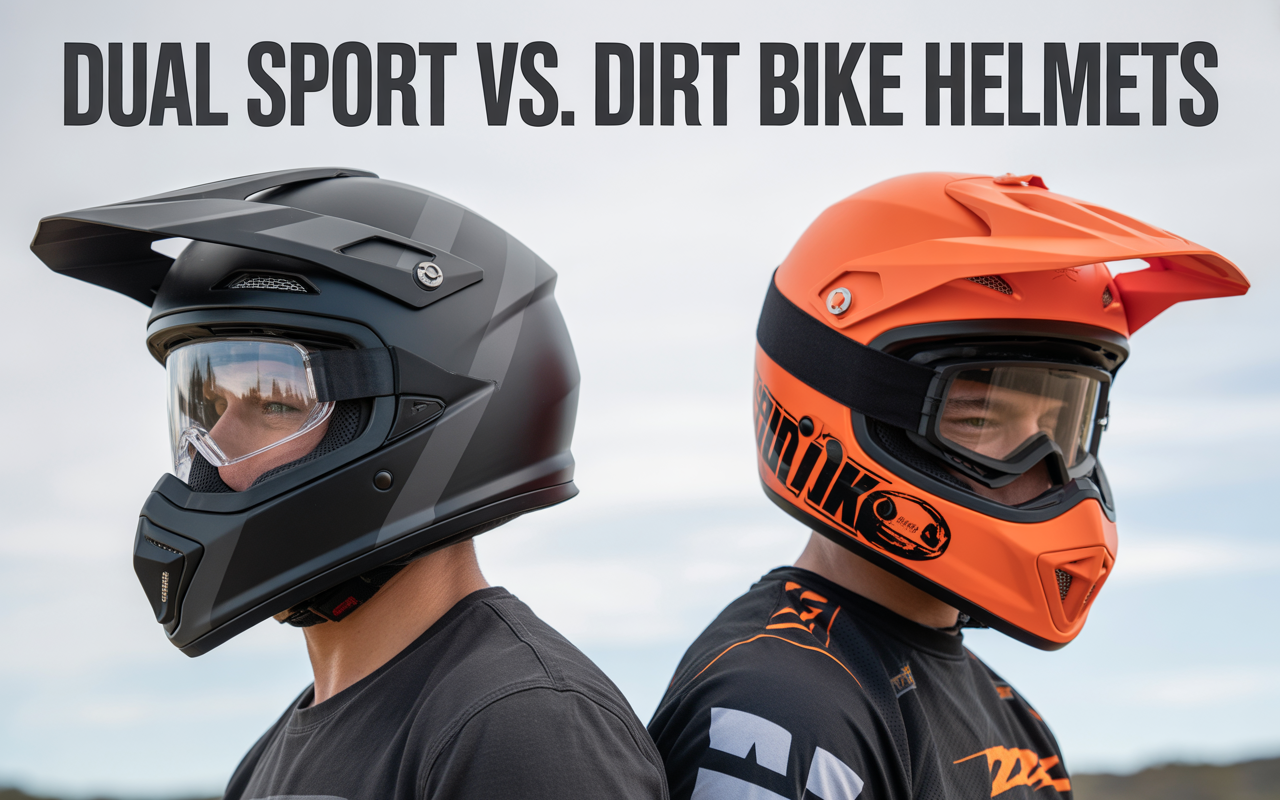
The typical MX helmet features an elongated chin bar that extends several inches beyond your face, creating a large air scoop that forces cooling air through the helmet’s interior. This design serves dual purposes: it provides exceptional ventilation during the physically demanding work of riding off-road, and it creates space for your face to move within the helmet during hard landings without your nose or chin contacting the shell.
The absence of a face shield isn’t an oversight—it’s intentional. Dirt bike helmets are designed to work exclusively with goggles, which offer several advantages in pure off-road environments. Goggles sit closer to your face, creating a better seal against dust and debris. They’re also easier to clean mid-ride; you can simply reach up and wipe the lens or tear off a disposable film. The large eye port of an MX helmet accommodates oversized goggles with foam that seals against your face, keeping roost and mud from reaching your eyes.
The Dual Sport Helmet: Compromise or Evolution?
Dual sport helmets—sometimes called adventure or ADV helmets—take a different approach. These helmets acknowledge that riders will spend time on pavement, gravel roads, and occasionally venture onto technical trails. This versatility demands compromises, but modern designs have turned those compromises into genuine innovations.
The defining feature of a dual sport helmet is its integrated face shield combined with a sun visor peak. This combination allows you to ride on highways at 75 mph without the wind fatigue of goggles, then transition to dirt roads where the visor provides sun protection and deflects roost. Most dual sport helmets feature a flip-up face shield, allowing you to swap between the shield and goggles depending on conditions.
The ventilation in dual sport helmets typically isn’t as aggressive as pure MX helmets. The face shield creates a sealed environment that requires carefully engineered intake and exhaust vents to prevent fogging and maintain airflow. This makes them generally warmer than dirt bike helmets in slow-speed technical riding, but far more comfortable at highway speeds where MX helmets create tremendous buffeting and wind noise.
The Visor Question: Form, Function, or Both?
Now we arrive at the heart of our discussion: that prominent visor extending from the brow of a dual sport helmet. Riders often dismiss it as purely aesthetic—a styling cue borrowed from motocross to make adventure bikes look more capable. The reality is far more nuanced.
The Aerodynamic Reality
Let’s address the elephant in the room: at highway speeds, a visor creates lift. This is simple physics. That extended peak catches wind and tries to pull your helmet backward and upward. On a sport bike in a tucked position, this effect is minimal. On an adventure bike with an upright seating position, it becomes significant above 60 mph.
I’ve tested dozens of dual sport helmets over the years, and the aerodynamic penalty varies wildly between designs. Some manufacturers have invested heavily in wind tunnel testing, creating visors with subtle curves and venting that dramatically reduce lift. Others seem to have bolted on an afterthought. The difference becomes painfully obvious on a three-hour highway stint.
Premium helmets like the Arai XD4 and Shoei Hornet X2 incorporate aerospace-inspired visor designs with multiple adjustment positions. When set correctly for your riding position, these visors actually channel air over the helmet more efficiently than you might expect. Budget options often feature fixed visors that act like small sails, creating neck fatigue on long rides.
Here’s what manufacturers rarely advertise: most experienced ADV riders remove the visor entirely for highway-heavy trips. Every dual sport helmet I’ve tested includes tool-free visor removal for exactly this reason. The visor screws into place with simple thumb screws or quick-release mechanisms, allowing you to configure your helmet for the day’s riding.
Sun Protection: The Underrated Benefit
Beyond aerodynamics, the visor serves a genuinely useful purpose: sun management. If you’ve never ridden in harsh sunlight without a visor, you might not appreciate this benefit. The human eye struggles with the extreme contrast between bright sky and shadowed terrain, especially when riding through forests or canyons where you’re constantly transitioning between light and dark.
A properly designed visor extends your face shield’s sun-blocking capability by several degrees of arc. This matters most during dawn and dusk riding, when the sun sits at that perfect angle to blast under a car’s sun visor but above your face shield’s tinted upper edge. The helmet visor fills this gap, keeping that blinding light out of your eyes without requiring you to crane your neck downward.
I’ve ridden extensively in the Southwest desert, where summer temperatures regularly exceed 110°F and the sun feels like a physical weight on your head. In these conditions, the visor provides measurable relief by shading your face shield and reducing the greenhouse effect inside the helmet. Dark-colored face shields absorb solar radiation and transfer that heat to your face; a visor interrupts this process by casting shade on the shield itself.
Roost and Debris Protection
In off-road riding, “roost” refers to the rocks, dirt, mud, and debris that rear tires kick backward. If you’ve ever followed another rider on a dirt trail, you understand the constant barrage of projectiles heading toward your face. This is where the visor earns its keep.
The visor doesn’t stop debris—that’s the face shield’s job. Instead, it deflects the trajectory of incoming roost, causing rocks and dirt to glance upward and over your helmet rather than impacting your face shield directly. This serves two purposes: it reduces the frequency of face shield impacts (which can crack or scratch the shield), and it decreases the amount of mud accumulation on your visor area.
I’ve tested this extensively by riding with and without the visor on identical trail sections. With the visor installed, my face shield stays noticeably cleaner, requiring fewer stops to wipe mud away. Without the visor, debris impacts the shield at a more perpendicular angle, causing more material to stick rather than deflect away.
However—and this is important—the visor’s effectiveness depends entirely on the face shield being down. If you’re riding with goggles and the face shield flipped up, the visor provides minimal protection. The gap between the visor and your goggles creates a scoop that actually channels debris toward your face. This is why serious off-road riders often remove the visor entirely when running goggles exclusively.
Safety Considerations: What the Standards Don’t Tell You
Both dirt bike and dual sport helmets must meet the same basic safety certifications—DOT in the United States, ECE in Europe, and increasingly, the more rigorous SNELL standards. You can learn more about these in our comprehensive guide on Helmet Safety Ratings Explained. However, these tests don’t capture the real-world differences in how these helmets protect you.
Impact Protection: The Shell Design Matters
Dirt bike helmets typically feature more aggressive shell shaping with pronounced ridges and venting channels. This design optimizes for the most common dirt bike crashes: forward impacts from over-the-bars ejections and side impacts from sliding through turns. The elongated chin bar provides exceptional protection for your jaw and face in frontal impacts.
Dual sport helmets often use rounder, more traditional shell shapes that perform better in the varied impact scenarios of street riding. The addition of a face shield and visor creates more potential failure points—attachment mechanisms that could break away in a crash. Premium manufacturers address this with break-away visor mounts designed to shear off rather than transmit impact forces to your head.
Material composition varies significantly between price points. As we discuss in our article on Carbon Fiber vs. Polycarbonate Helmets, shell construction dramatically affects both safety and comfort. High-end dual sport helmets often use composite fiber shells that provide excellent impact protection at lower weight, while budget options typically use polycarbonate or ABS plastic shells that weigh significantly more.
The Visor as a Liability
Here’s an uncomfortable truth that manufacturers downplay: in certain crash scenarios, a visor can increase injury risk. If you impact an object at the perfect angle, the visor can act as a lever, transmitting rotational forces to your neck. This is why many racers and serious off-road riders remove visors entirely.
The European ECE 22.06 standard, implemented in 2021, includes specific testing for helmet projections like visors. Helmets must demonstrate that these projections either break away cleanly or don’t significantly increase impact forces. However, this testing uses controlled laboratory conditions that don’t perfectly replicate real-world crash dynamics.
I’m not suggesting visors are dangerous—millions of riders use them safely every day. But it’s important to understand that any protrusion from your helmet creates additional complexity in crash scenarios. This is why professional off-road racers almost universally choose pure MX helmets without visors for competition.
Practical Performance: Real-World Testing
Over the past fifteen years, I’ve logged more than 200,000 miles on adventure bikes, from the Dalton Highway in Alaska to the Carretera Austral in Patagonia. I’ve tested both helmet types in conditions ranging from desert heat to alpine cold, on everything from smooth tarmac to boulder-strewn trails. Here’s what actually matters in daily use.
Highway Riding: Where Dual Sport Helmets Dominate
For any significant highway mileage, a dual sport helmet with a face shield provides a dramatically better experience than a dirt bike helmet with goggles. The sealed environment blocks wind noise (though you’ll still want earplugs), prevents insects from hitting your face, and eliminates the eye fatigue that comes from wind constantly buffeting your eyeballs.
Modern dual sport helmets have made enormous strides in noise reduction. While they’ll never match the quietest street helmets covered in our Best Quietest Motorcycle Helmets guide, premium ADV helmets now achieve respectable noise levels even at highway speeds. The key is proper fit—as we explain in our Motorcycle Helmet Fitment Guide, gaps between the helmet and your head create wind noise regardless of the helmet’s design.
The visor’s aerodynamic penalty becomes most noticeable above 70 mph. At these speeds, even well-designed visors create lift that requires you to tense your neck muscles to maintain head position. On a four-hour interstate slab, this translates to genuine fatigue. Many riders solve this by removing the visor for highway trips, which takes about 30 seconds with most designs.
Technical Off-Road: The MX Helmet’s Home Turf
When the pavement ends and serious trail riding begins, dirt bike helmets demonstrate their purpose-built advantages. The superior ventilation makes an enormous difference when you’re wrestling a 500-pound adventure bike through tight singletrack. Your heart rate spikes, you’re breathing hard, and you’re generating tremendous body heat. An MX helmet’s massive air channels exhaust this heat efficiently.
Dual sport helmets struggle in these conditions. The sealed face shield environment traps heat and humidity, causing fogging even with anti-fog treatments. You can flip the shield up, but then you’re riding with an open face and minimal eye protection. Switching to goggles helps, but most dual sport helmets don’t provide the same goggle accommodation as pure MX helmets—the eye port is smaller, and the goggle strap often conflicts with the face shield mounting hardware.
The visor’s utility in technical terrain is situation-dependent. In dusty conditions following other riders, the visor with face shield down provides excellent protection. In muddy conditions, the visor actually accumulates mud that blocks your vision, requiring frequent stops to clear it away. Many experienced off-road riders remove the visor for mud riding.
The Versatility Middle Ground
For riders who genuinely split their time between pavement and dirt—say, a 100-mile highway ride to reach trailheads, followed by 50 miles of fire roads and moderate trails—dual sport helmets make practical sense. The ability to use a face shield on the highway, then switch to goggles for the dirt, provides genuine versatility that a pure MX helmet can’t match.
The visor becomes useful in this mixed-use scenario primarily for sun management during the highway portions. It’s less critical for the off-road sections, where you’re typically moving slower and dust/roost protection matters more than sun shade. Most riders in this category learn to quickly remove and reinstall the visor based on the day’s planned route.
Weight and Comfort: The Long-Ride Reality
Helmet weight might not seem critical when you’re trying on helmets in a showroom, but it becomes the dominant comfort factor on rides exceeding a few hours. Your neck muscles must support not just the helmet’s static weight, but also the dynamic forces created by acceleration, braking, and wind pressure.
The Weight Penalty of Versatility
Dual sport helmets typically weigh 3.5 to 4.5 pounds, while pure MX helmets range from 2.8 to 3.5 pounds. That difference seems minor until you multiply it by hours of riding. The additional weight comes from the face shield mechanism, the visor mounting hardware, and typically more substantial shell construction to accommodate the face shield attachment points.
Premium dual sport helmets using carbon fiber or advanced composite shells can achieve weights comparable to MX helmets while maintaining the versatility of a face shield. However, these helmets command premium prices—often $600 to $900 compared to $200 to $400 for quality MX helmets. For riders considering lightweight options, our guide to the Best Lightweight Carbon Fiber Helmets provides detailed recommendations.
The visor itself typically adds 2-4 ounces, which seems negligible. However, because the visor extends forward from your head’s center of gravity, it creates a moment arm that amplifies its effective weight. This is why visor removal makes such a noticeable difference in neck fatigue on long highway rides.
Pressure Points and Fit Dynamics
Dual sport helmets often feature more padding and a more enveloping fit than MX helmets. This provides better noise isolation and stability at highway speeds, but it can feel claustrophobic during hard off-road riding when you’re breathing heavily and generating heat. The additional padding also means dual sport helmets typically take longer to break in to your head shape.
MX helmets use less padding and looser tolerances, allowing your head to move slightly within the helmet. This seems counterintuitive for safety, but it actually provides a measure of protection during the repeated small impacts and jolts of off-road riding. The helmet can absorb some movement without transmitting all forces directly to your skull.
For riders struggling with helmet comfort, understanding these fit differences is crucial. What feels perfect in a five-minute showroom test might become uncomfortable after an hour of riding. This is why we always recommend borrowing or renting helmets for a full day of riding before committing to a purchase.
Vision and Situational Awareness
Your helmet’s primary job is protecting your head, but its secondary job—providing clear vision and situational awareness—directly affects your safety by helping you avoid crashes in the first place.
Face Shield vs. Goggles: The Vision Trade-Off
Face shields offer superior optical clarity compared to goggles. A quality face shield provides distortion-free vision across your entire field of view, with no frame interference at the edges. Modern face shields incorporate anti-fog coatings, anti-scratch treatments, and pinlock systems that create a double-pane effect to prevent fogging.
Goggles, by contrast, create a visible frame around your peripheral vision. The foam seal against your face creates a slight tunnel vision effect. However, goggles sit closer to your eyes, which actually increases your effective field of view compared to a face shield that sits an inch or more from your face. For riders concerned about peripheral vision, our article on the Best Motorcycle Helmets for Peripheral Vision explores this topic in depth.
The visor’s impact on vision is mostly positive. By shading your face shield from direct sunlight, it reduces glare and improves contrast in bright conditions. However, the visor can create a slight shadow line across your upper field of view, which some riders find distracting. This effect varies significantly between helmet designs—some visors are nearly invisible in your peripheral vision, while others create a noticeable dark bar.
Fogging: The Persistent Challenge
Fogging represents the single biggest vision complaint with dual sport helmets. When you’re working hard off-road, your breath and body heat create humidity that condenses on the inside of your face shield. Anti-fog coatings help, but they degrade over time. Pinlock systems work better, but they’re not universal and add cost.
The visor actually contributes to fogging by blocking some of the airflow that would naturally ventilate the face shield. In cold weather riding, this effect intensifies—the visor traps a layer of still air that allows condensation to form more readily. Many riders crack their face shield open slightly in cold weather, which defeats the purpose of having a face shield in the first place.
MX helmets with goggles largely avoid fogging issues because goggles sit closer to your face and most modern goggles use dual-pane lenses with better ventilation. However, goggles create their own vision problems: they accumulate mud and dust that requires frequent cleaning, and the foam seal can become saturated with sweat, causing the goggle to slip down your face.
Maintenance and Longevity
The complexity of dual sport helmets compared to MX helmets affects not just their initial cost, but their long-term ownership experience.
Face Shield Replacement and Care
Face shields scratch, crack, and degrade from UV exposure. Replacement shields for dual sport helmets typically cost $40 to $100, and you’ll likely need to replace them every year or two depending on use. Some manufacturers offer quick-change shield systems that allow tool-free swaps; others require small screws that are easy to drop and lose.
The visor adds another maintenance point. The mounting screws can vibrate loose, and the visor itself can crack from impacts or stress. Replacement visors cost $20 to $60 depending on the helmet brand. Premium helmets often include multiple visor positions that require periodic adjustment to maintain proper tension.
For detailed guidance on keeping your helmet in top condition, including proper liner care that affects both comfort and longevity, check out our guide on How to Wash Your Motorcycle Helmet Liner.
Goggle Maintenance: Simpler but Not Maintenance-Free
Goggles require their own care regimen. Lenses scratch easily and need replacement every season for serious off-road riders. Foam seals degrade from sweat and sunscreen, losing their ability to seal against your face. Goggle straps stretch and fray. However, quality goggles with replacement lenses typically cost less than replacement face shields, and the maintenance is more straightforward.
MX helmets themselves require less maintenance than dual sport helmets. With fewer moving parts and attachment mechanisms, there’s simply less to break or wear out. The liner padding does compress over time, but replacement liners are widely available and inexpensive.
When to Replace: The Five-Year Rule and Beyond
Both helmet types should be replaced every five years regardless of visible wear, as the EPS foam liner degrades over time from UV exposure, temperature cycling, and absorption of body oils and sweat. For detailed guidance on helmet replacement timing, including specific factors that might shorten or extend this timeline, see our comprehensive article on When to Replace Your Motorcycle Helmet.
Dual sport helmets often show wear sooner than MX helmets because of their additional complexity. Face shield mechanisms develop play in their mounting points, causing rattling and poor sealing. Visor mounts crack from repeated removal and installation. These issues don’t necessarily compromise safety, but they degrade the user experience and can indicate it’s time for replacement.
The Cost Analysis: Initial Investment and Total Ownership
Price represents a significant factor in the dual sport vs. dirt bike helmet decision, and the comparison isn’t as straightforward as comparing initial purchase prices.
Entry-Level Options
Quality MX helmets start around $150, with excellent options available in the $200 to $300 range from brands like Bell, Fly Racing, and Fox. At this price point, you’re getting solid safety, good ventilation, and reliable construction. Adding quality goggles (another $50 to $150) brings your total investment to $200 to $450.
Dual sport helmets start higher—around $200 for basic models—with quality options beginning at $300 to $400. Budget dual sport helmets often compromise on weight, ventilation, and face shield quality. The sweet spot for dual sport helmets is typically $400 to $600, where you get composite shells, quality face shields, and refined aerodynamics. For riders shopping in specific price ranges, our guide to the Best Motorcycle Helmets for $200 provides targeted recommendations.
Premium Performance
At the high end, both categories reach similar price points. Premium MX helmets like the Arai VX-Pro4 or Bell Moto-10 cost $600 to $800. Top-tier dual sport helmets like the Arai XD4, Shoei Hornet X2, or Klim Krios Pro command $700 to $900. At these prices, you’re paying for advanced materials, superior comfort, refined aerodynamics, and extensive safety certifications.
The total cost of ownership tilts slightly in favor of MX helmets due to simpler maintenance and lower replacement part costs. However, if you’re riding primarily on pavement, the dual sport helmet’s versatility justifies its higher initial cost and ongoing expenses.
Special Considerations: Weather, Terrain, and Riding Style
Your specific riding conditions should heavily influence your helmet choice, and the visor’s utility varies dramatically based on where and how you ride.
Hot Weather Riding
In temperatures above 85°F, particularly in humid climates, ventilation becomes critical. MX helmets dominate in these conditions with their massive air channels and open design. Dual sport helmets, even with their vents fully open, trap more heat around your head. For riders in consistently hot climates, our guide to the Best Motorcycle Helmets for Hot Weather provides specific recommendations for maximum cooling.
The visor’s role in hot weather is mixed. It provides valuable sun shading that reduces heat buildup on your face shield and face. However, it also blocks some airflow that would otherwise ventilate the helmet. In desert riding, where temperatures exceed 100°F but humidity stays low, the visor’s sun protection outweighs its ventilation penalty. In humid tropical climates, the visor’s interference with airflow makes it a liability.
Cold Weather and Rain
Cold weather riding favors dual sport helmets decisively. The sealed face shield environment provides crucial protection from wind chill, and the reduced ventilation that’s a liability in summer becomes an advantage in winter. The visor helps shed rain and keeps precipitation from accumulating on your face shield.
Riding in rain with an MX helmet and goggles ranges from uncomfortable to dangerous. Goggles quickly become obscured by water, and the open helmet design allows rain to run down your face and neck. Some riders use tear-offs or goggle wipes, but these provide only temporary relief. For comprehensive guidance on wet-weather riding, including helmet selection and anti-fog strategies, see our article on the Best Motorcycle Helmets for Riding in the Rain.
Terrain-Specific Optimization
Your primary terrain type should drive your decision more than any other factor. If you ride 80% pavement with occasional gravel roads and easy trails, a dual sport helmet makes obvious sense. If you ride 80% technical singletrack with minimal pavement, an MX helmet is the clear choice.
For true 50/50 riding—significant time on both pavement and challenging off-road terrain—you face a genuine dilemma. Neither helmet type excels in both environments. Many serious adventure riders solve this by owning both: an MX helmet for off-road focused trips and a dual sport helmet for mixed-surface touring. This isn’t just gear obsession; it’s practical optimization for dramatically different riding demands.
The Verdict: Making Your Decision
After thousands of miles testing both helmet types across every conceivable condition, here’s my definitive take: the visor on a dual sport helmet serves genuine functional purposes, but its value depends entirely on your riding style and conditions.
If you ride primarily on pavement with occasional dirt roads and you value the convenience of a face shield for weather protection and highway comfort, a dual sport helmet with visor makes sense. The visor provides useful sun management and roost deflection without significant downsides in this use case. Plan to remove the visor for extended highway trips above 70 mph to reduce neck fatigue.
If you ride serious off-road terrain—technical singletrack, deep sand, rocky trails, or competitive enduro—choose an MX helmet without a visor. The superior ventilation, lighter weight, and better goggle accommodation outweigh any benefits the visor provides. The visor becomes a liability in these conditions, adding weight and creating potential failure points without meaningful benefits.
For true adventure riding that splits time equally between pavement and dirt, a dual sport helmet with a removable visor offers the best compromise. Learn to quickly remove and reinstall the visor based on your route. Use the face shield for highway sections and switch to goggles for technical off-road riding. This approach maximizes versatility while minimizing each helmet type’s weaknesses.
The dirty secret that manufacturers won’t tell you: most experienced adventure riders eventually buy both types of helmets. They use dual sport helmets for touring and mixed-surface riding, and they switch to MX helmets for dedicated off-road trips. This isn’t excessive—it’s recognizing that no single helmet design can truly excel in both environments.
Don’t let marketing or aesthetics drive your decision. The “adventure” look of a dual sport helmet with its prominent visor appeals to many riders, but style should never trump function. Test both types in your actual riding conditions before committing. Borrow helmets from friends, rent them if possible, or buy from retailers with generous return policies.
Your helmet represents your most critical piece of safety equipment. Choose based on where you actually ride, not where you imagine riding. If you’re honest about spending 90% of your time on pavement, admit it and choose accordingly. If you’re truly heading into serious off-road terrain, respect those demands and select the right tool for the job.
The visor isn’t a gimmick, but it’s not essential either. It’s a specialized tool that provides specific benefits in specific conditions. Understanding those conditions and honestly assessing your riding style will lead you to the right decision—one that might not match the helmet on your favorite adventure rider’s Instagram feed, but will serve you better in the real world where safety, comfort, and performance actually matter.
Frequently Asked Questions
Can I use goggles with a dual sport helmet if I remove the visor?
Yes, but with limitations. Most dual sport helmets accommodate goggles when you flip up the face shield, but the eye port is typically smaller than on pure MX helmets, which can restrict your field of view and make goggle fit less comfortable. The face shield mounting hardware can also interfere with goggle straps. If you plan to use goggles frequently, test the specific helmet model with your goggles before purchasing. Some dual sport helmets like the Klim Krios and Arai XD4 are specifically designed for better goggle compatibility, but they still don’t match the goggle accommodation of dedicated MX helmets.
Will removing the visor affect my helmet’s safety certification?
No. Helmets are tested and certified with their visors installed, but removing the visor doesn’t invalidate the certification. The visor is considered an accessory component, not a structural element of the helmet’s protective system. All reputable dual sport helmets are designed with tool-free or simple visor removal specifically because manufacturers expect riders to remove them for certain conditions. However, never modify the visor mounting points or drill additional holes in your helmet shell, as this could compromise structural integrity.
How much does a visor actually affect neck fatigue on long rides?
The effect varies significantly based on the visor design, your riding position, and speed. At highway speeds above 65 mph, a poorly designed visor can create noticeable lift that requires active neck muscle engagement to counteract, leading to measurable fatigue on rides exceeding two hours. Well-designed visors with aerodynamic shaping and proper angle adjustment minimize this effect. Upright riding positions (typical on adventure bikes) experience more visor-induced lift than forward-leaning sport positions. Most riders report that removing the visor for highway-heavy days makes a noticeable comfort difference, particularly on rides exceeding four hours.
Are there any hybrid helmet designs that truly excel at both street and dirt riding?
Several manufacturers have attempted to create the perfect hybrid, but physics and design constraints prevent any single helmet from truly excelling in both environments. The closest compromises come from premium models like the Arai XD4, Shoei Hornet X2, and Klim Krios Pro, which offer aerodynamic peaks and sealing visors suitable for adventure touring. However, even these top-tier options remain a compromise, often proving too heavy for technical dirt riding and noisier than dedicated street helmets on the highway.