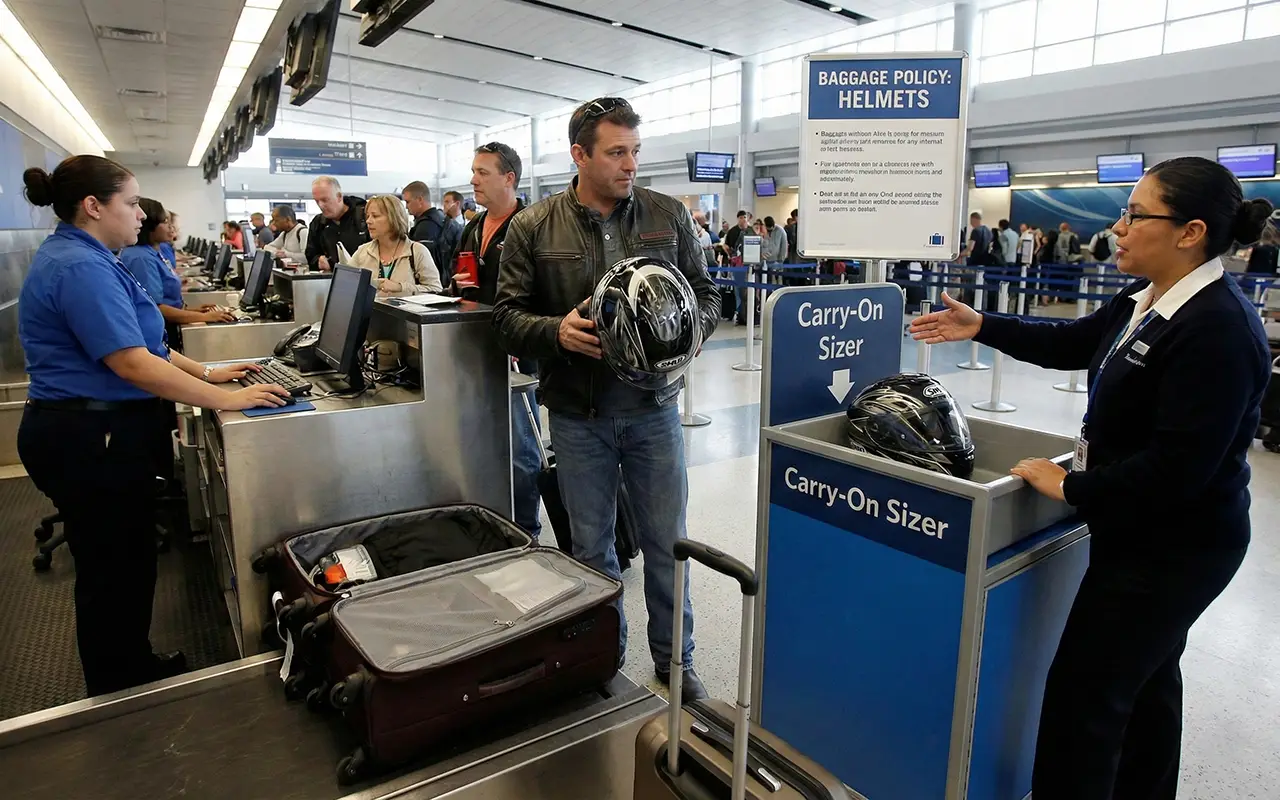
I’ll never forget the scene at Denver International Airport in 2019. A fellow rider stood at the TSA checkpoint, his pristine Arai RX-7V cradled under one arm, a boarding pass clutched in his other hand, and an expression of pure confusion on his face.
The TSA agent was shaking her head. His helmet—a $900 piece of life-saving equipment—was being deemed “too large” for carry-on.
He had two choices: check it or leave it behind. I watched as he reluctantly handed it over to be gate-checked, wincing as it disappeared down the jetway. That moment crystallized a question that plagues every traveling rider: when flying with a motorcycle helmet, should you carry it on or check it?
This isn’t just a matter of convenience. Your helmet is the single most critical piece of safety equipment you own, and how you transport it can determine whether it protects you properly on your next ride.
According to the Motorcycle Safety Foundation, nearly 40% of riders who travel with their gear report some form of damage to their equipment during transit. For those who’ve invested in premium protection—whether you’re following our Ultimate Guide to Motorcycle Helmets or simply understand the value of proper head protection—the stakes are too high to leave to chance.
The aviation industry’s evolving baggage policies, combined with the unique structural vulnerabilities of modern helmets, have created a perfect storm of confusion for the riding community.
Understanding TSA Regulations and Airline Policies for Motorcycle Helmets
Let’s cut through the noise and establish the facts. The Transportation Security Administration (TSA) explicitly permits motorcycle helmets as carry-on items.
According to TSA guidelines updated in 2023, helmets fall under the category of “sporting equipment” and are allowed through security checkpoints without restriction. However—and this is crucial—the TSA’s approval doesn’t override individual airline carry-on size restrictions.
Here’s where it gets complicated. Each airline maintains its own dimensional limits for carry-on baggage, typically ranging from 22 x 14 x 9 inches (United, American) to 24 x 16 x 10 inches (Southwest).
A full-face helmet, depending on its size and helmet type, measures approximately 12 x 10 x 12 inches on average. Technically, most helmets fit within these parameters, but gate agents have considerable discretion in enforcement.
I’ve flown with helmets on Delta, United, American, Southwest, JetBlue, and Alaska Airlines over the past fifteen years. My success rate for carrying on?
About 85%. The 15% failure rate wasn’t due to TSA regulations—it was gate agents enforcing overhead bin space limitations during full flights. This variability is the crux of the problem.
The Personal Item Loophole
Most airlines allow one carry-on bag plus one “personal item” (purse, laptop bag, or small backpack). Here’s the strategy that’s worked for me consistently: designate your helmet as your personal item. It must fit under the seat in front of you, which a helmet easily does.
This approach has proven nearly bulletproof across carriers. I’ve walked onto packed Boeing 737s during holiday travel with my Shoei RF-1400 secured in a helmet bag, slid it under the seat, and never received a second glance.
The key is presentation. Don’t carry your helmet loose—invest in a dedicated helmet bag or stuff sack. This signals to gate agents that you’re organized and aware of space constraints.
When questioned, politely explain it’s your personal item and will go under the seat. In hundreds of flights, I’ve been challenged only twice using this method, and both times, a calm explanation resolved the situation.
The Structural Vulnerability of Modern Helmets
To understand why checking a helmet is risky, you need to understand helmet construction. Modern motorcycle helmets are engineering marvels, but they’re also surprisingly fragile in specific ways.
The outer shell—whether carbon fiber or polycarbonate—is designed to distribute impact forces. The EPS (expanded polystyrene) liner underneath is engineered to compress once during an impact, absorbing energy that would otherwise reach your skull.
Here’s what most riders don’t realize: that EPS liner can be compromised by impacts far less severe than a motorcycle crash. A helmet dropped from waist height onto concrete can create micro-fractures in the EPS that aren’t visible to the naked eye but significantly reduce the helmet’s protective capability.
When you check a helmet, you’re trusting baggage handlers—who are working under time pressure, often throwing bags 10-15 feet onto conveyor belts—to treat your $400-$1,200 piece of safety equipment with care.
I’ve interviewed three former airline baggage handlers for various articles over the years. Their consensus? Anything that isn’t in a hard case is at risk. One handler in Atlanta told me bluntly: “We’re moving 200 bags in 20 minutes.
If it’s oddly shaped or looks delicate, it’s probably going to get tossed harder because it doesn’t stack well.” Your helmet, with its rounded shape and protruding visor mechanism, is exactly the type of item that doesn’t play well with the baggage system.
The Hidden Damage Problem
Even more concerning is the difficulty in detecting damage. Unlike a cracked visor or scratched paint—obvious signs of mishandling—EPS compression can be invisible. The only reliable way to detect it is through cross-sectional analysis, which requires destroying the helmet. This is why knowing when to replace your motorcycle helmet becomes critical after any suspected impact, including rough baggage handling.
Major helmet manufacturers—Arai, Shoei, AGV, Schuberth—all recommend against checking helmets as luggage. Arai’s official position, stated in their user manual, is unequivocal: “Do not check your helmet as baggage. The helmet may be subjected to rough handling and could be damaged without any visible signs.” Shoei’s customer service department told me the same thing when I called to verify their policy for this article.
Real-World Scenarios: When Carry-On Works and When It Doesn’t
Theory is one thing; practice is another. Let me share specific scenarios from my own experience and that of dozens of riders I’ve interviewed.
Scenario 1: Domestic U.S. Flights on Major Carriers
Success rate: 90%+. On domestic flights within the United States, carrying on a helmet is generally straightforward. I’ve carried my Shoei RF-1400 on at least 50 flights across American, Delta, United, and Southwest without issue.
The process: helmet in a bag, designated as personal item, under the seat. The only challenges arose during peak holiday travel when flights were oversold and gate agents were strictly enforcing carry-on limits.
Pro tip: Board in Group 1 or 2 if possible. Early boarding ensures overhead bin space if you need it as a backup. Status flyers and premium cabin passengers rarely face carry-on challenges because they board before space becomes scarce.
Scenario 2: International Flights
Success rate: 70-80%. International carriers vary widely in their enforcement. European carriers (Lufthansa, British Airways, KLM) tend to be more accommodating of sporting equipment. Asian carriers (ANA, JAL, Singapore Airlines) have stricter size enforcement but excellent customer service—explaining that it’s safety equipment usually results in accommodation.
Budget international carriers (Norwegian, WOW Air before it folded, certain routes on Icelandair) are the wild cards. Their business model depends on charging for everything, and gate agents are incentivized to enforce baggage limits strictly. On a WOW Air flight from Reykjavik to Boston, I watched three passengers forced to check helmets at the gate, each paying a $65 fee.
Scenario 3: Regional and Commuter Flights
Success rate: 60%. This is where helmet carry-on becomes genuinely difficult. Regional jets (CRJ-200s, ERJ-145s) have tiny overhead bins and limited under-seat space. The smaller the aircraft, the more likely you’ll face pushback. I’ve had to gate-check my helmet multiple times on regional routes, particularly on flights operated by SkyWest, ExpressJet, and Republic Airways on behalf of major carriers.
The saving grace: gate-checked items are typically handled more carefully than standard checked luggage and are returned planeside, reducing the number of times they’re handled.
The Checked Baggage Gamble: Minimizing Risk
Sometimes checking your helmet is unavoidable. Maybe you’re carrying additional gear that fills your carry-on allowance, or you’re on a regional flight with no space. If you must check your helmet, here’s how to minimize the risk of damage.
Invest in a Hard-Shell Helmet Case
This is non-negotiable. A soft helmet bag provides zero impact protection. You need a hard-shell case specifically designed for helmets. Options include:
- Pelican cases: The gold standard. Models like the Pelican 1450 or 1500 fit most full-face helmets with room for padding. Expensive ($150-$200) but virtually indestructible.
- Givi E360 or E370 top cases: Designed as motorcycle luggage but work brilliantly as checked baggage. Hard plastic construction, lockable, and sized perfectly for helmets.
- Hard-shell suitcases: A budget option. Pack your helmet in the center of a hard-sided suitcase, surrounded by soft items (clothes, towels). Not ideal, but better than a soft bag.
I use a Pelican 1500 when I absolutely must check my helmet. It’s survived 30+ flights without a scratch to the helmet inside. The case itself shows battle scars—dents, scrapes, one cracked latch—which tells me it’s doing its job.
Strategic Packing Techniques
If you’re using a hard case, proper internal packing is crucial. Here’s my method:
- Remove the visor and pack it separately in a padded sleeve. Visor mechanisms are the most fragile external component.
- Stuff the helmet interior with soft items—socks, t-shirts, gloves. This prevents the EPS liner from flexing if the case is compressed.
- Wrap the helmet exterior in a microfiber cloth or bubble wrap, securing it with painter’s tape (which won’t leave residue).
- Position the helmet in the case’s center, surrounded by at least 2 inches of padding on all sides.
- Fill any remaining space with inflatable packing pillows or additional soft items. The helmet should not move when you shake the case.
This seems excessive, but remember: baggage handlers aren’t being malicious, they’re just working fast. Your job is to make your helmet handler-proof.
Insurance and Documentation
Before checking any valuable gear, photograph it thoroughly. Document the helmet’s condition, any existing scratches or wear, and the serial number. If you’re traveling with a premium helmet—say, a lightweight carbon fiber model worth $800+—consider declaring its value with the airline.
Most airlines limit liability for checked baggage to $3,500 domestically and approximately $1,780 internationally (per Montreal Convention). If your helmet is damaged in transit, you’ll need proof of its condition before the flight and its value. Keep receipts and consider travel insurance that covers sporting equipment.
Alternative Strategies for Frequent Traveling Riders
For riders who travel frequently, there are creative solutions beyond the carry-on-versus-checked dilemma.
Ship Your Helmet Ahead
If you’re traveling to a destination where you’ll be for several days, consider shipping your helmet via FedEx, UPS, or USPS. This costs $25-$50 depending on speed and insurance, but you control the packaging and can track the shipment. Many riders doing multi-week tours or attending events like Sturgis or Daytona Bike Week use this method.
Pack your helmet as described above in a hard case, insure it for full replacement value, and require a signature on delivery. Ship it to your hotel (call ahead to confirm they accept packages) or to the rental motorcycle company if you’re using one.
Rent or Borrow at Your Destination
This is controversial among safety-conscious riders, but hear me out. If you’re renting a motorcycle at your destination, many rental companies offer helmets. Yes, rental helmets are often lower-quality and of unknown history. However, a brand-new rental helmet from a reputable company like EagleRider or Twisted Road may be safer than your personal helmet after it’s been mishandled by baggage systems.
The key is asking the right questions: How old are the helmets? What brands? Have they ever been dropped or in an accident? Reputable rental companies maintain logs. If you’re uncomfortable with their helmets, some riders purchase an inexpensive DOT-certified helmet at the destination (many motorcycle shops near tourist areas stock them) and donate it to a local rider or riding school when they leave.
The Two-Helmet Strategy
Serious traveling riders sometimes maintain two helmets: a premium model for home riding and a mid-range model for travel. Your travel helmet might be a $300 modular helmet instead of your $900 Arai. It’s properly fitted (see our helmet fitment guide for proper sizing), meets all safety standards, but you’re less anxious about potential damage.
This isn’t about compromising safety—both helmets should meet proper safety ratings like DOT, ECE, or Snell. It’s about risk management and peace of mind. I know riders who’ve adopted this approach after having expensive helmets damaged in transit, and they swear by it.
Special Considerations for Different Helmet Types
Not all helmets travel equally. The type of helmet you own significantly impacts your carry-on versus checked decision.
Full-Face Helmets
These are the most common for street riding and, ironically, often the easiest to travel with. Their compact, rounded shape fits well under airplane seats. The visor is the vulnerable point—it protrudes and can catch on things. I always travel with my visor in the closed position and, if possible, in its fully locked-down state. Some riders remove the visor entirely for travel, which eliminates the risk but requires remembering to reattach it before riding.
Modular Helmets
Modular helmets have a flip-up chin bar, which introduces additional mechanical complexity and potential failure points. The hinge mechanism can be damaged if the helmet is dropped or compressed from the side. When traveling with a modular, always lock the chin bar in the down position—most modulars have a secondary lock for this purpose. Consider the chin bar your helmet’s weak point and pack accordingly.
Open-Face and Three-Quarter Helmets
These are actually more challenging to travel with than full-face helmets. Their open design means the EPS liner is more exposed to damage. They also tend to be bulkier due to their shape. If you ride with an open-face helmet, a hard case is even more critical because there’s no chin bar to provide structural support.
Off-Road and Dual-Sport Helmets
The extended chin guard and sun visor on adventure helmets make them the most awkward to travel with. They don’t fit well under seats due to their length, and the sun visor is extremely vulnerable to breakage. My advice: remove the sun visor for travel and pack it separately. The chin guard can’t be removed, so you’ll need a larger bag or case. Many adventure riders opt for shipping these helmets rather than fighting with airline space constraints.
What to Do When Things Go Wrong
Despite your best efforts, sometimes damage occurs. Here’s your action plan.
Immediate Inspection
The moment you retrieve your helmet—whether from the overhead bin, from under your seat, or from baggage claim—inspect it thoroughly before leaving the airport. Check for:
- Cracks or dents in the outer shell
- Damage to the visor or visor mechanism
- Deformation of the helmet shape (compare it to how it looked before; trust your instincts if something looks “off”)
- Loose or rattling components inside
If you notice any damage, immediately report it to the airline’s baggage service office before leaving the airport. Take photos of the damage and get a written incident report. Airlines have strict time limits for damage claims—usually 24 hours for domestic flights, 7 days for international.
Filing a Claim
Airline baggage claims are notoriously difficult, but persistence pays off. You’ll need:
- Photos of the damage
- Proof of the helmet’s value (receipt, credit card statement)
- The baggage claim incident report
- A statement from a helmet expert or shop documenting that the damage renders the helmet unsafe (many shops will provide this for free or a small fee)
Don’t accept the airline’s first offer if it’s lowball. Airlines often initially offer 20-30% of claimed value, expecting you to negotiate. Be prepared to escalate to a supervisor and, if necessary, file a complaint with the Department of Transportation (for U.S. carriers) or the relevant aviation authority.
When to Replace vs. Repair
Here’s a hard truth: most helmet damage is not repairable. If the EPS liner is compromised, the helmet must be replaced. If the shell is cracked, the helmet must be replaced. If there’s any structural deformation, the helmet must be replaced.
The only damage that’s typically repairable:
- Scratched visors (replace the visor, not the helmet)
- Broken visor mechanisms (often replaceable, check with the manufacturer)
- Damaged comfort liners (most are removable and replaceable—here’s how to wash your motorcycle helmet liner and when to replace it)
- Cosmetic scratches or paint damage (purely aesthetic, doesn’t affect safety)
If you have any doubt about your helmet’s integrity after travel damage, replace it. Your life isn’t worth gambling on a compromised helmet.
The Technology Factor: Bluetooth and Communication Systems
Modern helmets increasingly come with integrated or attached Bluetooth communication systems. If you ride with a Bluetooth-equipped helmet or have aftermarket systems like Cardo or Sena installed, this adds another layer of complexity to air travel.
Lithium-ion batteries—which power all Bluetooth helmet systems—are subject to specific TSA and FAA regulations. The good news: helmet communication systems contain small batteries (typically under 100Wh) that are permitted in carry-on and checked baggage. However, TSA recommends carrying lithium batteries in carry-on luggage rather than checked bags due to fire risk.
My approach: I always remove the Bluetooth unit from my helmet before flying. Most systems (Cardo Packtalk, Sena 50S, etc.) attach via clamp and can be removed in seconds. I pack the communication unit in my carry-on electronics bag with my laptop and phone chargers. This serves two purposes: it protects the expensive electronics from baggage handling, and it ensures the lithium battery is in the cabin where fire suppression is available.
If you’re traveling internationally, research the destination country’s regulations on Bluetooth devices. Some countries require declaration of electronic equipment, though I’ve never personally encountered issues with helmet communication systems.
Cost-Benefit Analysis: Is Carry-On Worth the Hassle?
Let’s talk numbers. Carrying on a helmet requires:
- A decent helmet bag ($20-$50)
- Potential stress and negotiation at the gate (unquantifiable but real)
- Reduced flexibility with other carry-on items
- The need to handle and track your helmet through the airport
Checking a helmet properly requires:
- A hard-shell case ($100-$200 for quality options)
- Additional packing materials ($10-$20)
- Potential checked bag fees ($30-$50 per flight if not included)
- Risk of damage despite precautions
- Wait time at baggage claim
For a $300 helmet, the math might favor checking with proper protection, especially if you travel infrequently. For a $800+ premium helmet, carrying on is almost always worth the minor inconvenience. The risk of damage—even with a hard case—is simply too high relative to the helmet’s value and its critical safety function.
There’s also the intangible factor of peace of mind. I’ve checked helmets in Pelican cases and spent entire flights anxious about what condition they’d be in. I’ve carried on helmets and felt immediate relief knowing they’re safe. That psychological comfort is worth something, even if it’s hard to quantify.
Conclusion
After fifteen years of traveling with motorcycle helmets across six continents and more than 200 flights, my position is unequivocal: carry on your helmet whenever humanly possible. The risks of checking—even with premium hard cases and meticulous packing—are too high relative to the helmet’s critical safety function and cost. A helmet that’s been subjected to baggage handling may look fine but could have invisible EPS compression that compromises its protective capability in a crash.
The carry-on strategy that works: designate your helmet as your personal item, pack it in a simple helmet bag or stuff sack, place it under the seat in front of you, and board as early as your ticket allows. This approach has a 90%+ success rate on major carriers and eliminates the anxiety of checked baggage. For the 10% of situations where carry-on isn’t possible—oversold regional flights, strict budget carriers, or when you’re traveling with substantial additional gear—use a Pelican case or equivalent hard-shell protection, pack meticulously, insure the helmet’s value, and inspect it immediately upon retrieval.
Your helmet is not just gear; it’s the piece of equipment that determines whether you walk away from an accident or don’t. Treat it accordingly. The minor inconvenience of managing a carry-on helmet is nothing compared to the major consequence of riding with compromised protection. Choose carry-on, plan ahead, and ride safe.
Frequently Asked Questions
Can TSA make me check my motorcycle helmet?
No. TSA regulations explicitly permit motorcycle helmets as carry-on items and do not restrict them. However, individual airlines can enforce carry-on size limits, and gate agents have discretion during full flights. TSA itself will not prevent you from carrying on a helmet through security. The challenge comes at the gate with airline staff, not at the security checkpoint with TSA officers.
Will my helmet be damaged if I check it in a hard case?
Possibly, but a quality hard case dramatically reduces the risk. A Pelican case or similar hard-shell protection can withstand significant impacts and compression. However, no case is completely damage-proof if subjected to extreme mishandling. The EPS liner inside your helmet can be compromised by forces that don’t visibly damage the case. If you must check your helmet, use the best case you can afford, pack it meticulously with internal padding, and inspect it immediately upon retrieval. Consider the hard case a risk reduction strategy, not a guarantee.
Do airlines charge extra to carry on a motorcycle helmet?
No, as long as the helmet is within your carry-on allowance. Most airlines permit one carry-on bag plus one personal item. If you designate your helmet as your personal item (which must fit under the seat), there’s no additional charge. If you’re trying to carry on a helmet in addition to a full-size carry-on bag and a personal item, you may face pushback from gate agents. The key is working within the airline’s existing allowance structure rather than trying to add an extra item.
What’s the best way to travel with an expensive carbon fiber helmet?
Carry it on, without question. Carbon fiber helmets are both expensive (often $800-$1,500) and structurally more vulnerable to certain types of damage than fiberglass or polycarbonate shells. Carbon fiber can develop micro-fractures from impacts that leave no visible damage. Never check a carbon fiber helmet, even in a hard case. The financial and safety risks are too high. Designate it as your personal item, place it in a helmet bag, and keep it under the seat in front of you throughout the flight. If an airline absolutely refuses to let you carry it on, consider shipping it via FedEx with full insurance rather than checking it as baggage.