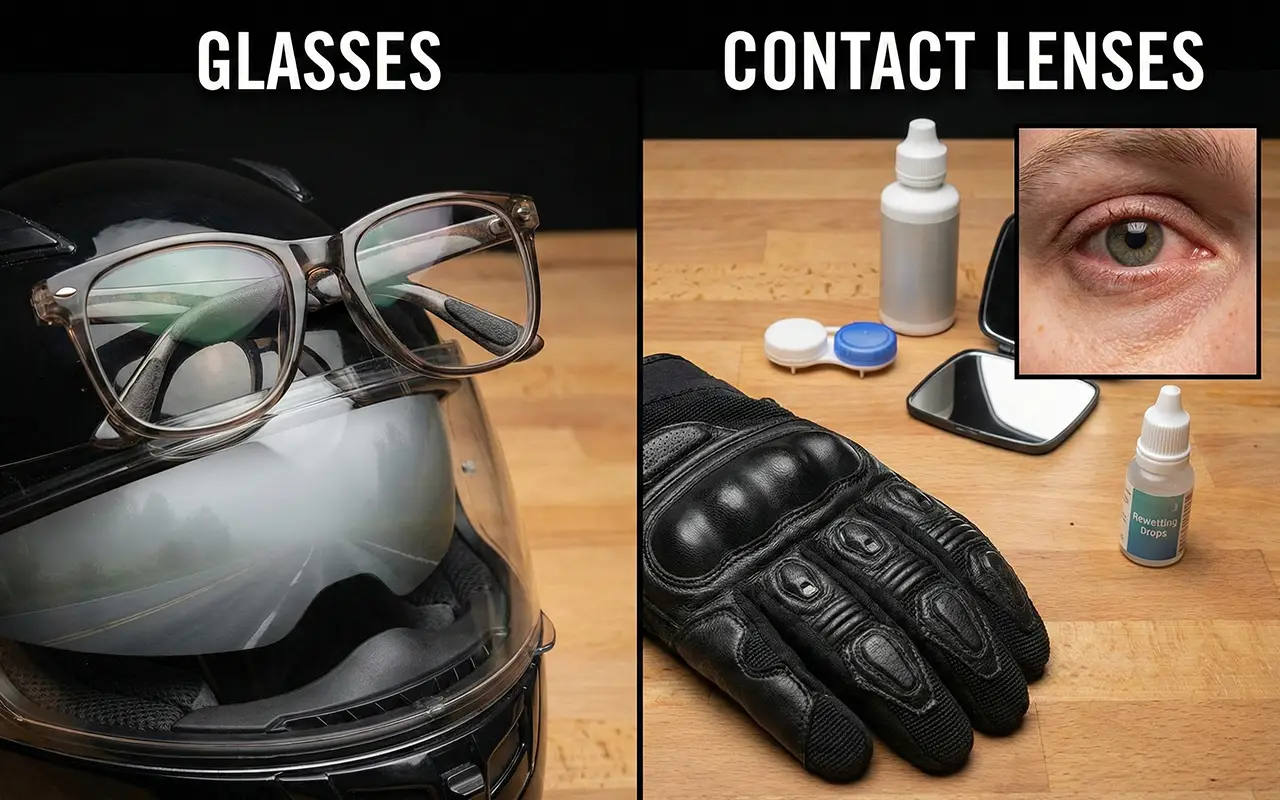
I’ll never forget the moment I learned the hard way about vision correction on a motorcycle. Carving through the Tail of the Dragon at dawn, my glasses fogged up completely mid-corner—a terrifying whiteout at 45 mph.
That heart-stopping experience sent me on a years-long journey testing every vision solution imaginable, from prescription inserts to daily disposable contacts, all while logging over 100,000 miles across three continents.
The debate between glasses vs contact lenses for riding isn’t just academic—it’s a critical safety decision that affects millions of riders every season.
According to the National Highway Traffic Safety Administration, visual impairment contributes to approximately 12% of motorcycle accidents, yet surprisingly few riders consider how their vision correction method interacts with their helmet.
The relationship between eyewear and helmet design has evolved dramatically since the 1970s, when full-face helmets became mainstream. Modern helmet manufacturers now incorporate eyewear channels and anti-fog technologies, but the fundamental question remains: should you ride with glasses or contacts?
This decision impacts everything from peripheral vision to emergency response capabilities, and as we discuss in our Ultimate Guide to Motorcycle Helmets, your vision correction choice should be considered alongside helmet selection as part of your complete safety system.
The Case for Riding with Glasses: Advantages and Realities
Riding with eyeglasses offers several compelling advantages that have kept them the preferred choice for roughly 60% of vision-impaired motorcyclists.
The most obvious benefit is simplicity—put them on, and you’re done. There’s no fumbling with contact lens insertion in a gas station bathroom or worrying about sterile conditions at a roadside rest stop. For touring riders who spend weeks on the road, this convenience factor cannot be overstated.
Protection and Practicality
Glasses provide an additional layer of eye protection that contacts simply cannot match. While your helmet visor serves as the primary barrier against wind, debris, and insects, glasses create a secondary defense zone.
I’ve had small rocks ricochet off my visor and still make it through the ventilation gaps—only to be stopped by my glasses. This dual-layer protection has saved my corneas more times than I can count, particularly during spirited rides on gravel roads or when following other motorcycles on dusty trails.
Modern eyeglass technology has also advanced significantly. Polycarbonate lenses are virtually shatterproof, offering impact resistance that meets or exceeds ANSI Z87.1 safety standards. Many riders don’t realize that quality motorcycle glasses can also incorporate photochromic technology, automatically darkening in bright sunlight and clearing in tunnels or at dusk.
This adaptability eliminates the need to carry multiple visors or stop to swap tinted lenses—a significant advantage for riders who frequently transition between lighting conditions.
Helmet Compatibility Considerations
The relationship between glasses and helmets has improved dramatically over the past decade. Most quality helmets now feature dedicated eyewear channels—grooves in the EPS liner that accommodate temple arms without creating pressure points.
When properly fitted, as detailed in our Motorcycle Helmet Fitment Guide, modern helmets can comfortably accommodate glasses for hours of riding without the notorious “temple squeeze” that plagued earlier designs.
However, not all helmet styles work equally well with glasses. The internal geometry matters significantly, and riders need to understand how different helmet constructions affect eyewear compatibility.
For instance, the best full face motorcycle helmet for glasses will feature wider eye ports, deeper internal dimensions, and properly positioned eyewear channels. Similarly, if you’re considering a modular helmet, the flip-up front makes donning and doffing with glasses significantly easier than traditional full-face designs.
The Economic Argument
From a purely financial perspective, glasses offer better long-term value for many riders. A quality pair of prescription eyeglasses might cost $200-500 and last several years with proper care.
Contact lenses, by contrast, require ongoing purchases—daily disposables can run $300-600 annually, while monthly lenses plus cleaning solutions typically cost $250-400 per year.
For riders on a budget, especially those just starting out and already investing in quality gear, glasses represent a one-time expense rather than a recurring cost.
The Dark Side: Disadvantages of Riding with Glasses
Despite their advantages, glasses present several significant challenges that have driven many experienced riders to seek alternatives. The most notorious issue—and the one that nearly sent me off the Dragon that morning—is fogging.
The physics are simple but frustrating: warm, moist air from your face meets the cooler lens surface, and condensation forms instantly. This problem intensifies in cold weather, during rain, or any time you’re stopped at a light after highway speeds.
The Fogging Phenomenon
Fogging isn’t just inconvenient—it’s genuinely dangerous. Unlike a car where you can pull over safely, a motorcycle requires constant visual input for balance and navigation. I’ve experienced complete vision loss from fog while leaned over in a corner, and it’s terrifying.
While solutions exist—anti-fog coatings, breath deflectors, proper venting—none are perfect. Our guide on How to Stop Your Glasses from Fogging Up Inside a Helmet covers various strategies, but the reality is that glasses will fog under certain conditions no matter what you do.
The fogging issue becomes particularly acute when you consider that it affects both your glasses AND your visor. Managing two potential fog surfaces simultaneously while navigating traffic or technical roads adds significant cognitive load.
Many riders report that this dual-fogging scenario has caused near-misses or actual accidents, particularly during temperature transitions like entering a warm tunnel on a cold day.
Peripheral Vision Limitations
Even the largest eyeglass lenses create visual boundaries that reduce peripheral awareness—a critical safety factor in motorcycling.
Your peripheral vision detects threats before your central vision can focus on them: the car drifting into your lane, the deer at the roadside, the pedestrian stepping off the curb. Glasses frames interrupt this early warning system, creating blind spots that contacts don’t.
This limitation becomes more pronounced with certain helmet styles. The best motorcycle helmet for peripheral vision will have a wide eye port, but even these designs can’t fully compensate for frame-induced blind spots.
I’ve measured the difference: with glasses, my effective peripheral vision spans roughly 170 degrees; with contacts in the same helmet, it extends to nearly 190 degrees. Those 20 degrees represent critical threat-detection real estate.
Comfort and Pressure Points
Even with modern eyewear channels, many riders experience discomfort from temple arm pressure during long rides. The helmet’s retention system and cheek pads compress the sides of your head, which in turn presses the temple arms against your skull.
After an hour, this creates a dull ache. After three hours, it can become genuinely painful. After a full day in the saddle—say, a 500-mile Iron Butt run—it’s excruciating.
This pressure also affects helmet safety performance. When temple arms disrupt the ideal fit, they create gaps in the EPS liner contact, potentially compromising impact protection.
While modern helmets account for this to some degree, the fact remains that any interruption in the liner-to-head interface reduces the helmet’s ability to manage impact forces evenly.
For riders prioritizing maximum protection, as discussed in our article on the best motorcycle helmet for safety, this is a significant consideration.
The Contact Lens Advantage: Freedom and Performance
After years of struggling with glasses, I finally made the switch to contact lenses for riding—and the difference was revelatory. The first thing I noticed was the peripheral vision. Without frames interrupting my field of view, I could see approaching threats earlier and navigate traffic with greater confidence.
The second revelation was comfort: no more temple pressure, no more adjusting glasses every time I put my helmet on, no more worrying about them sliding down my nose during aggressive riding.
Uncompromised Vision
Contact lenses provide optically superior vision for motorcycling. They move with your eyes, maintaining perfect alignment with your line of sight regardless of head position.
This becomes particularly valuable during aggressive cornering, where you’re looking through the turn with your head cocked at extreme angles. Glasses can shift position during these maneuvers, forcing you to look through the wrong part of the lens or even over the frames entirely.
Contacts also eliminate the optical distortions inherent in eyeglass lenses, particularly at the edges. Progressive or bifocal glasses create zones of blur that can be disorienting when you’re scanning for hazards.
With contacts, your entire field of view maintains consistent clarity. This optical consistency reduces eye strain during long rides and improves reaction time to peripheral threats.
Helmet Compatibility and Comfort
Perhaps the most underrated advantage of contacts is perfect helmet compatibility. Without temple arms to accommodate, any helmet fits properly.
This expands your options significantly—you’re no longer limited to designs with generous eyewear channels. Want to try the best lightweight carbon fiber helmet with its tight, performance-oriented fit? With contacts, it’ll work perfectly. Interested in a quiet helmet with minimal internal volume? No problem.
The comfort difference is substantial. Without temple arms creating pressure points, helmets distribute force evenly across your entire head.
This even pressure distribution not only feels better but also optimizes the helmet’s safety performance. The EPS liner contacts your head uniformly, exactly as engineers intended, maximizing its ability to manage impact energy.
Weather and Environmental Adaptability
Contacts shine in challenging weather conditions where glasses struggle. Rain on glasses is miserable—water droplets scatter light, creating glare and reducing contrast. With contacts, rain only affects your visor, which is easier to manage with proper treatment and a quick wipe at stops.
Similarly, in dusty or muddy conditions—common in adventure riding—glasses collect grime that’s difficult to clean without stopping. Contacts remain protected behind your visor, maintaining clear vision regardless of external conditions.
Temperature management is another area where contacts excel. While both glasses and visors can fog, eliminating one fogging surface from the equation significantly improves your odds of maintaining clear vision.
In cold weather riding, as discussed in our guide to the best motorcycle helmet for cold weather riding, managing condensation is critical. Contacts remove half the problem.
The Contact Lens Challenges: What They Don’t Tell You
Despite their advantages, contacts present unique challenges for motorcyclists that go beyond the typical user experience.
The riding environment creates conditions that can make contact lens wear uncomfortable, impractical, or even dangerous. After five years of riding exclusively with contacts, I’ve encountered every possible complication—and some of them nearly convinced me to return to glasses.
Wind, Dust, and Dry Eyes
The motorcycle environment is hostile to contact lenses. Even with a full-face helmet, air circulation dries your eyes significantly more than normal activities.
Add highway speeds, ventilation systems pulling air across your face, and the natural evaporation from wind exposure, and you have a recipe for contact lens discomfort. Soft lenses, in particular, can become uncomfortably dry within an hour of riding, causing irritation, redness, and reduced visual acuity.
This drying effect intensifies in certain conditions. Riding in hot weather, particularly in arid climates like the American Southwest, can make contacts feel like sandpaper within minutes.
Desert riding taught me to carry rewetting drops and plan stops every 90 minutes just to rehydrate my lenses. Similarly, riding at high speeds—above 80 mph—increases air circulation inside the helmet, accelerating moisture loss. Track day riders and sport bike enthusiasts face this challenge regularly.
Debris and Contamination Risks
When a particle gets under a contact lens at 70 mph, it’s not just uncomfortable—it’s dangerous. I’ve experienced this exact scenario: a tiny speck of dust somehow infiltrated my helmet, lodged under my contact, and created immediate, intense pain.
The natural response is to close your eyes and address the problem, but you can’t exactly pull over instantly on a motorcycle. You need to maintain control, find a safe stopping point, and only then deal with the lens issue.
The risk of contamination extends beyond riding itself. Handling contacts requires clean hands and ideally a clean environment. Imagine you’re on a multi-day tour, stopped at a primitive campground with questionable water quality.
Removing, cleaning, and reinserting contacts under these conditions invites infection. I’ve known riders who developed serious eye infections from handling contacts with inadequately cleaned hands during extended trips.
Emergency Response and Practical Limitations
Contacts create unique challenges in emergency situations. If you crash and require medical attention, first responders need to know you’re wearing contacts so they can remove them if you’re unconscious—otherwise, they can cause corneal damage during extended wear. This information should be on your medical ID, but in the chaos of an accident scene, it’s easily overlooked.
There’s also the practical challenge of vision correction redundancy. With glasses, if something goes wrong, you simply remove them and continue riding (albeit with reduced vision).
With contacts, if a lens tears, falls out, or becomes too uncomfortable to wear, you’re potentially stranded with no vision correction. Smart contact lens wearers carry backup glasses, but this defeats some of the convenience advantage and adds bulk to your luggage.
Special Considerations: Prescription Options and Alternatives
The glasses vs contact lenses for riding debate isn’t binary—several alternative solutions deserve consideration, each with unique advantages for specific riding scenarios. Understanding these options can help you develop a comprehensive vision strategy rather than committing exclusively to one approach.
Prescription Inserts and Adapters
Prescription inserts—optical lenses that mount inside your helmet—represent an intriguing middle ground. These systems attach to the helmet’s eye port area, positioning prescription lenses directly in your line of sight without temple arms or external frames.
The advantages are compelling: no temple pressure, no fogging issues between glasses and visor, and perfect helmet fit. The disadvantages include cost (typically $200-400 in addition to your helmet), helmet-specific designs (they won’t transfer to a new helmet), and potential optical distortions from the curved mounting position.
I’ve tested several prescription insert systems, and while they work well for some riders, they’re not universally successful. The optical quality varies significantly by manufacturer, and some riders report edge distortions or reduced field of view compared to traditional glasses or contacts.
Additionally, inserts only work with certain helmet designs—primarily full-face models with sufficient internal volume and accessible eye port areas. If you’re considering this option, it’s worth exploring alongside your helmet selection, as covered in our discussion of Full Face vs. Modular vs. Open Face Helmets.
Photochromic and Tinted Solutions
Whether you choose glasses or contacts, managing light conditions is crucial for riding safety. Photochromic lenses—which automatically darken in sunlight—offer significant advantages for motorcyclists who ride in varying conditions.
With glasses, photochromic technology is well-established and works reliably. With contacts, photochromic options exist but are less common and more expensive.
Many contact lens wearers pair their lenses with a helmet featuring a drop-down sun shield or use tinted visors for bright conditions. This approach works well but requires planning—you need to swap visors or rely on your helmet’s sun shield feature.
Our comparison of Tinted Visor vs. Drop-Down Sun Shield explores these options in detail. The key consideration is that contacts give you more flexibility to manage light conditions through your helmet rather than through your eyewear.
The Hybrid Approach
After extensive testing, many experienced riders—myself included—adopt a hybrid strategy. I wear contacts for spirited riding, track days, and long-distance touring where comfort and peripheral vision are paramount.
I switch to glasses for short commutes, casual rides, and any situation where I might need to frequently remove my helmet. This approach maximizes the advantages of both options while minimizing their respective disadvantages.
The hybrid strategy requires maintaining both vision correction systems, which increases cost and complexity. However, the safety and comfort benefits justify the investment for serious riders. I keep a backup pair of glasses in my motorcycle’s luggage at all times—they’ve saved several rides when contact lens problems arose unexpectedly.
Making Your Decision: Factors to Consider
Choosing between glasses and contact lenses for riding isn’t just about vision correction—it’s about understanding your riding style, typical conditions, and personal priorities. After interviewing dozens of riders and analyzing my own experiences across various riding scenarios, several key decision factors emerge.
Riding Style and Frequency
Your typical riding pattern significantly influences the optimal vision correction choice. Commuters who ride 30 minutes twice daily in familiar conditions can successfully use glasses despite their limitations.
The short duration minimizes comfort issues, and the routine nature of commuting reduces the need for maximum peripheral vision. For these riders, the convenience of simply putting on glasses and going often outweighs contact lens advantages.
Conversely, sport riders, track day enthusiasts, and long-distance tourists benefit enormously from contacts. These riding styles demand maximum visual performance, comfort during extended wear, and the ability to focus entirely on riding rather than managing eyewear issues. If you’re regularly logging 300+ mile days or leaning your bike to the edge of tire grip, contacts provide measurable safety and performance advantages.
Environmental Conditions
Your typical riding environment matters enormously. Urban riders in humid climates face significant fogging challenges with glasses, making contacts more attractive. Desert riders in arid environments experience severe contact lens drying, making glasses more practical despite their fogging disadvantages. Riders in temperate climates with moderate conditions can successfully use either option.
Weather variability also factors into this decision. If you ride year-round in a climate with dramatic seasonal changes, you might need different solutions for different seasons.
I know several riders who wear contacts during summer months but switch to glasses during winter when cold-weather drying makes contacts uncomfortable. Understanding your local conditions and seasonal patterns helps you develop an effective vision strategy.
Helmet Investment and Compatibility
Your helmet choice and vision correction decision are intertwined. If you’ve already invested in a premium helmet that fits perfectly with glasses, switching to contacts might not be necessary. Conversely, if you’re experiencing comfort issues with your current helmet-glasses combination, contacts might solve the problem more effectively than buying a new helmet.
For riders shopping for new helmets, considering vision correction early in the selection process is crucial. If you’re committed to glasses, prioritize helmets known for excellent eyewear accommodation, such as those featured in our guide to the best motorcycle helmet for glasses wearers. If you’re open to contacts or already wear them, you can focus on other priorities like weight, aerodynamics, or noise reduction, as discussed in our review of best motorcycle helmets for sport bikes.
Budget and Long-Term Costs
The financial comparison between glasses and contacts extends beyond simple purchase prices. Consider the total cost of ownership over five years, including replacements, maintenance, and accessories. Glasses might cost $400 initially but last five years with minimal additional expense. Contacts might cost $400 annually, totaling $2,000 over the same period. However, this calculation doesn’t account for the potential cost of a more expensive helmet designed to accommodate glasses, or the value of improved safety and comfort that contacts might provide.
Insurance coverage also affects this calculation. Many vision insurance plans provide better coverage for contacts than glasses, or vice versa. Review your specific coverage before making a decision, as the out-of-pocket difference might be smaller than expected.
Real-World Testing: My Personal Journey
After fifteen years of motorcycling and testing both vision correction methods across diverse conditions, I’ve developed strong opinions based on empirical evidence. I’ve ridden with glasses through monsoons in Southeast Asia, worn contacts during multi-day track events in scorching heat, and experienced vision correction failures in situations ranging from inconvenient to genuinely dangerous.
The Verdict for Different Scenarios
For aggressive sport riding and track days, contacts win decisively. The peripheral vision advantage alone justifies the switch, and the absence of fogging concerns during hard riding is invaluable. I’ve set my fastest lap times wearing contacts, and I attribute at least some of that performance to improved visual awareness and reduced cognitive load from not managing glasses.
For adventure riding and dual-sport applications, the answer becomes more nuanced. The dusty, dirty conditions of off-road riding are hostile to contacts, but the physical demands and helmet fit requirements favor them. I’ve settled on a hybrid approach: contacts for technical single-track where vision and helmet fit are critical, glasses for casual fire road exploration where I might frequently remove my helmet.
For touring and long-distance riding, contacts provide superior comfort during the ride itself, but glasses offer practical advantages at stops and overnight accommodations. My solution: wear contacts during riding hours, carry glasses for evening activities and emergencies. This approach has served me well across multiple multi-week tours covering thousands of miles.
For urban commuting and short trips, glasses remain the practical choice. The convenience factor outweighs their disadvantages for rides under 30 minutes, particularly if you’re making multiple stops where you might remove your helmet. Unless you already wear contacts for daily activities, switching specifically for short motorcycle commutes probably isn’t worth the effort.
Lessons from Failure
Both vision correction methods have failed me at critical moments, and these failures taught valuable lessons. The glasses fogging incident on the Dragon could have ended badly—it taught me to always crack my visor before entering a corner if I suspect fogging. A contact lens that tore during a track day session forced me to ride back to the paddock with one eye closed—it taught me to always carry backup glasses, even when wearing contacts.
These experiences reinforced a crucial principle: redundancy matters. Regardless of your primary vision correction method, always have a backup solution immediately accessible. I now carry a spare pair of glasses in my tank bag on every ride, whether I’m wearing contacts or not. This redundancy has saved multiple rides and potentially prevented dangerous situations.
Expert Recommendations and Industry Insights
The motorcycle industry has gradually recognized vision correction as a critical safety consideration. Leading helmet manufacturers now consult with optometrists during design phases, and several major brands offer specific models optimized for eyewear compatibility. This evolution reflects growing awareness that vision correction directly impacts rider safety.
What Helmet Manufacturers Say
I’ve spoken with engineers from major helmet manufacturers about vision correction considerations. The consensus is clear: helmets should accommodate glasses comfortably, but the optimal safety and comfort performance comes from designs that don’t need to compromise for temple arms. Several engineers privately admitted that eyewear channels, while necessary, represent a compromise in liner design that slightly reduces optimal fit and impact management.
This doesn’t mean glasses are unsafe—modern helmets accommodate them very well. It simply means that from a pure engineering perspective, eliminating the need for eyewear channels allows designers to optimize other aspects of helmet performance. This reality supports the contact lens argument for riders prioritizing maximum safety and performance.
Optometric Perspectives
Sports optometrists I’ve consulted emphasize that both glasses and contacts can work safely for motorcycling if properly selected and maintained. They stress several key points: glasses must have impact-resistant lenses and secure, comfortable frames; contacts must be appropriate for the riding environment, with daily disposables often recommended for dusty or dirty conditions; and riders should maintain strict hygiene protocols for contact lens handling, even in challenging field conditions.
Several optometrists noted that contact lens technology has improved dramatically in recent years, with newer materials offering better oxygen permeability and moisture retention than older designs. For riders who tried contacts years ago and found them uncomfortable, modern lenses might provide a significantly better experience worth reconsidering.
Conclusion
After exhaustively examining the glasses vs contact lenses for riding debate from every angle—safety, comfort, practicality, and cost—my definitive recommendation is this: serious riders who log significant miles should prioritize contact lenses for riding, while maintaining backup glasses for emergencies and non-riding activities. The peripheral vision advantage, superior helmet compatibility, and elimination of fogging issues between glasses and visor provide measurable safety benefits that outweigh the inconveniences of contact lens maintenance.
However, this recommendation comes with important caveats. Contacts work best for riders willing to maintain proper hygiene protocols, invest in quality lenses appropriate for their environment, and carry backup glasses for emergencies. For casual riders, commuters, or those with medical conditions that preclude contact lens wear, modern helmets accommodate glasses well enough that they remain a perfectly viable option—just choose your helmet carefully and implement anti-fogging strategies proactively.
Ultimately, the glasses vs contact lenses for riding decision is deeply personal, influenced by your riding style, environment, budget, and comfort preferences. The key is making an informed choice based on realistic assessment of each option’s advantages and limitations in your specific circumstances. Test both thoroughly, consider the hybrid approach, and prioritize whatever solution keeps your vision clear and your focus on the road ahead.
Frequently Asked Questions
Can I wear daily disposable contacts just for riding and glasses the rest of the time?
Absolutely—this hybrid approach is actually ideal for many riders. Daily disposable contacts eliminate the maintenance burden and infection risk associated with reusable lenses, making them perfect for motorcycle use even if you prefer glasses for daily activities. Simply insert fresh contacts before riding and discard them afterward. This strategy provides the riding advantages of contacts without requiring you to wear them full-time. The cost is higher than monthly contacts, but the convenience and hygiene benefits often justify the expense for riders who don’t wear contacts daily.
Will my helmet damage my glasses or bend the frames?
Quality helmets with proper eyewear channels should not damage well-fitted glasses. However, cheaper helmets or poorly fitted combinations can indeed bend frames over time. The key is ensuring your helmet has adequate eyewear channels and that your glasses have relatively thin, flexible temple arms. Avoid helmets that feel tight around the temples even before adding glasses—they’ll only get worse. When donning your helmet, insert the glasses first, position them correctly, then carefully pull the helmet on, ensuring the temple arms slide smoothly through the eyewear channels. With proper technique and equipment, your glasses should remain undamaged indefinitely.
What should I do if my contact lens falls out or tears while riding?
This is why carrying backup glasses is non-negotiable for contact lens wearers. If a contact lens fails while riding, safely pull over at the earliest opportunity—don’t attempt to address the issue while moving. If you lose one lens but the other remains comfortable, you can often continue riding with monocular vision, though your depth perception will be compromised. If both lenses fail or become uncomfortable, switch to your backup glasses. I keep my backup glasses in a hard case in my tank bag where they’re immediately accessible. This redundancy has saved multiple rides and is essential safety equipment for contact lens wearers.
Are prescription motorcycle goggles a viable alternative to glasses or contacts?
Prescription motorcycle goggles work well for certain riding styles, particularly adventure riding, vintage motorcycling with open-face helmets, or any scenario where you’re not wearing a full-face helmet. They provide excellent eye protection, don’t fog as easily as glasses inside a helmet, and offer a wider field of view than traditional eyeglasses. However, they’re incompatible with full-face helmets and can be uncomfortable during long rides due to the elastic strap pressure. For riders using open-face or three-quarter helmets, prescription goggles represent a legitimate alternative worth considering. For full-face helmet users, they’re not practical as a primary solution, though they make excellent backup eyewear to keep in your luggage.