You’re staring at the back of a motorcycle helmet, trying to make sense of a jumble of letters and certifications: DOT, SNELL, ECE. Do these acronyms actually mean something crucial, or are they just marketing jargon designed to justify higher price tags?
The reality is sobering: not all helmets are created equal. Some are designed merely to pass a 50-year-old minimum standard test, while others incorporate cutting-edge technology specifically engineered to protect your brain during modern, real-world crashes. The difference could literally be life-changing in the event of an accident.
In this comprehensive guide, we break down the three major helmet safety standards so you can make an informed decision about which certification sticker you want protecting your most valuable asset—your brain. We’ll cut through the confusion and marketing speak to give you straightforward information about what each standard tests for and what that means for your safety on the road.
This is a deep dive into helmet safety ratings. For a broader look at choosing the right gear, check out our Ultimate Guide to Motorcycle Helmets.
DOT (Department of Transportation) – The Legal Minimum
If you’ve ever shopped for a motorcycle helmet in the United States, you’ve undoubtedly seen the “DOT” sticker on the back. This isn’t just a decorative badge – it’s a legal requirement for any helmet sold for motorcycling in the US. But what exactly does this certification mean for your safety?
The DOT standard, officially known as Federal Motor Vehicle Safety Standard No. 218 (FMVSS 218), represents the minimum safety requirements that all motorcycle helmets must meet to be legally sold in the United States. Established in the 1970s, this standard focuses primarily on a helmet’s ability to absorb impact energy during a crash.
However, there’s a significant catch to the DOT certification process that many riders don’t realize: it operates largely on an “honor system.” Manufacturers essentially self-certify their helmets, declaring they meet the DOT standards without pre-market testing by government officials. The Department of Transportation only conducts random spot-checks after helmets are already on the market. This means that, theoretically, a substandard helmet could be sold for months before being identified and removed.
The DOT testing itself focuses on several key areas:
- Impact attenuation (how well the helmet absorbs crash energy)
- Penetration resistance (preventing sharp objects from piercing the shell)
- Retention system effectiveness (ensuring the helmet stays on during a crash)
- Field of vision requirements (allowing adequate peripheral vision)
While these tests provide a baseline for safety, many experts consider the DOT standard to be relatively lenient compared to other international certifications. The impact tests are conducted at fixed points rather than randomly selected areas, and the pass/fail thresholds aren’t as stringent as those found in other standards.
Perhaps most concerning is the existence of “novelty helmets” – decorative headgear designed to look like motorcycle helmets but offering virtually no protection. These helmets often come with counterfeit DOT stickers, making them appear legitimate to the untrained eye. Remember: if a helmet feels unusually lightweight, lacks substantial padding, or seems too thin, it’s likely not offering adequate protection regardless of what sticker it displays.
The verdict on DOT certification? It’s the absolute minimum standard required by law, and while certainly better than wearing no helmet at all, riders concerned about maximum protection should look for helmets that meet additional safety certifications beyond just DOT.
ECE (Economic Commission for Europe) – The Global Standard
When you see an ECE sticker on a motorcycle helmet, you’re looking at what many consider the gold standard for everyday riders worldwide. The Economic Commission for Europe certification is recognized in over 50 countries and represents a rigorous testing protocol that every helmet must pass before hitting store shelves.
Unlike DOT certification, ECE doesn’t rely on manufacturer self-certification. Instead, every batch of helmets undergoes testing before leaving the factory, ensuring consistent quality control across production runs. This means what you buy is what was actually tested—not just designed to pass a test.
ECE 22.05 vs. 22.06: A Major Safety Evolution
The motorcycle world experienced a significant safety upgrade when the ECE standard evolved from 22.05 to 22.06 in 2022. This wasn’t just a minor update—it represented the first major overhaul of the standard in over 20 years.
The new 22.06 standard introduced several groundbreaking improvements:
- Rotational force testing: For the first time, helmets must now protect against rotational acceleration—the twisting motion your brain experiences during an impact. Research has shown that these rotational forces are a primary cause of traumatic brain injuries in motorcycle accidents.
- High and low-velocity impact tests: The new standard tests impacts at multiple speeds to better simulate real-world crash scenarios.
- Improved impact points: Testing now includes impacts at more points across the helmet, including a new test that specifically targets the face shield area.
- Modular helmet testing: Flip-up helmets must now pass tests in both open and closed positions.
- Sun visor requirements: Integrated sun visors must meet minimum light transmission standards.
Implementation of ECE 22.06 began in January 2021, with a transition period allowing manufacturers to adapt their designs. As of January 2024, all new motorcycle helmets sold in ECE territories must meet the 22.06 standard. This phased approach ensures the industry can adjust while still moving forward with critical safety improvements.
The addition of rotational testing is particularly significant. Traditional testing only measured linear impacts—straight-on collisions. However, most real-world motorcycle crashes involve angled impacts that cause the head to rotate rapidly. This rotation can cause the brain to move within the skull, leading to concussions and more severe brain injuries. The 22.06 standard specifically addresses this critical aspect of crash dynamics that previous standards ignored.
For riders, an ECE 22.06 certified helmet represents the most up-to-date protection available for everyday street riding, incorporating lessons learned from decades of crash research and modern understanding of brain injury mechanisms.
Snell (Snell Memorial Foundation) – The Racing Standard
The Snell Memorial Foundation stands apart in the world of helmet certification as a private non-profit organization rather than a government agency. Founded in 1957, the foundation was established after William “Pete” Snell, a popular amateur race car driver, died from head injuries sustained during a racing accident. His friends created the foundation to promote research, education, and testing to improve helmet safety.
Snell’s testing philosophy is unapologetically rigorous. While other standards focus on meeting minimum safety requirements, Snell deliberately pushes helmets to their absolute limits. Their certification process involves some of the most demanding impact tests in the industry, often requiring helmets to withstand multiple impacts on the same spot—something rarely tested in other standards. This approach reflects their racing heritage, where high-speed crashes can involve multiple impacts in quick succession.
The foundation’s testing facilities subject helmets to brutal conditions. They use anvils of different shapes (flat, hemispherical, and edge anvils) to simulate various impact scenarios. Helmets must maintain structural integrity throughout these punishing tests, with strict limits on the amount of force transmitted to the head form inside.
This intense focus on high-speed accidents makes Snell certification particularly valuable for racing applications. Their M2020 standard (for motorcycles) is designed specifically with track scenarios in mind, where speeds and potential impact forces far exceed typical street riding situations.
The certification process itself is entirely independent. Unlike DOT certification, which relies on manufacturer self-certification, or even ECE which tests batches, Snell individually tests submitted helmet models in their own laboratories. Manufacturers voluntarily submit their helmets for testing and pay certification fees, which fund the foundation’s continued research and testing programs.
This independence and rigor have earned Snell certification tremendous respect in racing circles, but it has also sparked some controversy. Critics argue that the extremely rigid shells required to pass Snell’s multiple-impact tests might be too stiff for lower-speed street accidents, potentially transmitting more force to the rider’s head in certain crash scenarios. Nevertheless, for track day enthusiasts and racers, a Snell certification remains the gold standard for helmet protection.
The Snell Controversy: Too Hard for the Street?
The Snell Memorial Foundation’s rigorous testing standards have earned it a reputation as the gold standard for racing helmets, but a fascinating debate has emerged within the motorcycle safety community: Are Snell-certified helmets actually too rigid for everyday street riding?
At the heart of this controversy lies a fundamental engineering tradeoff. Snell helmets are designed to withstand extreme impacts—the kind you might experience during a high-speed racing crash. To achieve this, they typically use a firmer EPS (expanded polystyrene) liner that excels at preventing penetration and distributing force across multiple impacts.
However, some safety experts argue this same firmness that works so well on the track might be less than ideal for the most common street crashes, which often occur at lower speeds. The concern is that a helmet that’s too rigid might not compress enough during these less severe impacts, potentially transferring more force to the rider’s brain rather than absorbing it.
Dr. Harry Hurt, whose landmark motorcycle accident study revolutionized helmet design, famously suggested that “softer, more energy-absorbent EPS foam” might better protect riders in typical street accidents. This sparked what became known as the “hard liner debate” in motorcycle safety circles.
Proponents of Snell counter that its multi-impact testing ensures the helmet maintains protection even after an initial impact—a scenario that could occur during a tumbling crash. They argue the extra margin of safety is worth it, especially considering the unpredictable nature of motorcycle accidents.
What makes this debate particularly challenging is that different crash scenarios demand different optimal helmet properties. A helmet that performs ideally in a 30 mph impact might not be the best choice for a 70 mph crash, and vice versa.
Many manufacturers have responded by developing “dual-certified” helmets that meet both Snell and ECE standards, attempting to balance the competing priorities of energy absorption and penetration resistance. These helmets often use progressive-density foam—softer near the head for low-speed impacts, firmer toward the outer shell for high-speed crashes.
For street riders, this controversy highlights an important consideration: the “best” helmet isn’t necessarily the one that passes the most rigorous test, but rather the one optimized for the most likely crash scenarios you’ll encounter in your typical riding environment.
New Players: FIM and SHARP
While DOT, ECE, and Snell have dominated helmet safety certification for decades, newer standards have emerged to address specific needs and provide more consumer-friendly information.
FIM: The MotoGP Gold Standard
The FIM (Fédération Internationale de Motocyclisme) certification represents the pinnacle of helmet safety standards, specifically developed for MotoGP racing. Introduced in 2019, it’s the most rigorous testing protocol available today:
- Tests helmets at higher impact velocities than any other standard
- Evaluates 22 impact points across the helmet (compared to 5-7 in other standards)
- Includes advanced rotational acceleration testing
- Requires strict penetration resistance and shell rigidity tests
What makes FIM unique is its focus on the extreme conditions of professional motorcycle racing, where crashes can occur at speeds exceeding 200 mph. Helmets with FIM certification are typically the most expensive on the market, but they offer unparalleled protection for track use.
SHARP: Consumer-Friendly Star Ratings
The SHARP (Safety Helmet Assessment and Rating Programme) system takes a different approach. Developed by the UK government in 2007, SHARP doesn’t just pass or fail helmets—it rates them on a 1-5 star scale:
- Tests impacts at multiple speeds and angles
- Evaluates 32 impact points across the helmet
- Focuses on both linear and oblique impacts
- Provides easy-to-understand comparative ratings
The beauty of SHARP is its consumer-friendly approach. Rather than a simple pass/fail, the star rating allows riders to compare the relative safety performance of different helmet models. A 5-star SHARP-rated helmet provides significantly better protection than a 1-star model, even though both might pass the minimum ECE standard.
How These New Standards Complement Traditional Certifications
These newer systems don’t replace traditional standards—they complement them:
- FIM certification is primarily for professional racers and high-end helmets
- SHARP ratings work alongside ECE certification (all SHARP-tested helmets must first pass ECE)
- Both systems address modern concerns about rotational forces that older standards may not fully account for
For the average rider, a helmet with ECE certification and a high SHARP rating offers excellent protection. Track day enthusiasts might consider FIM-certified helmets for maximum protection, though they come with a premium price tag.
As helmet technology continues to evolve, these newer standards help push manufacturers to develop increasingly safer designs that go beyond the minimum requirements of traditional certifications.
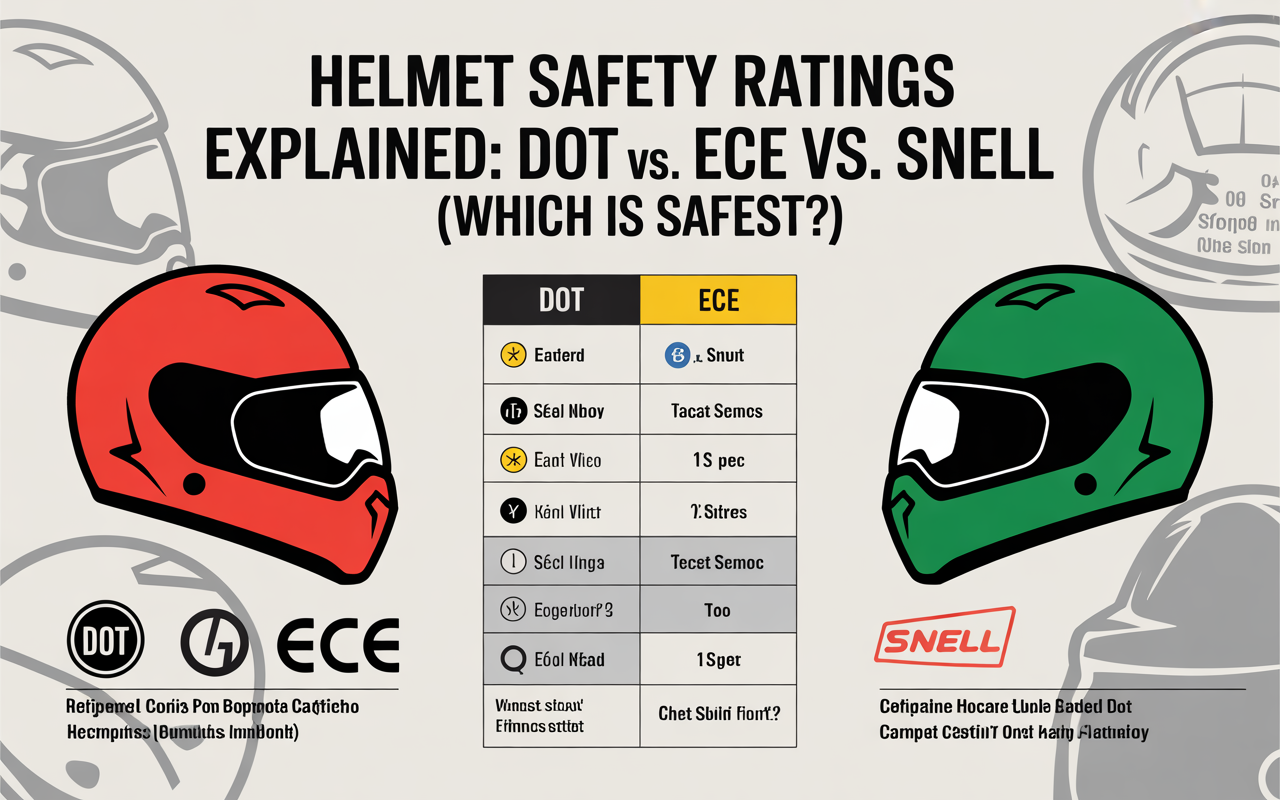
Comparison Table: DOT vs. ECE vs. Snell
When shopping for a helmet, understanding the differences between safety certifications at a glance can save you time and potentially your life. Below, I’ve broken down the key features of each major certification to help you make an informed decision.
| Feature | DOT | ECE 22.06 | Snell (M2020) |
|---|---|---|---|
| Region | USA (Required by law) | Europe/Global (50+ countries) | Voluntary (Worldwide) |
| Testing Method | Self-Certified by manufacturers | Batch Tested before market release | Independent Laboratory Testing |
| Rotational Test? | No | Yes (New in 22.06 version) | Limited (Some tests) |
| Impact Testing | Single impact, moderate force | Multiple impacts, varied angles | Multiple impacts, high force |
| Penetration Test | Yes | No | Yes |
| Retention System Test | Basic | Comprehensive | Rigorous |
| Best For | Legal Minimum in US | Everyday Street Riding | Racing/Track Days |
| Typical Cost Range | $50-300 | $150-600 | $200-1000+ |
The table above highlights why many riders opt for helmets with multiple certifications. A DOT+ECE certified helmet gives you legal compliance in the US while ensuring your helmet meets the more stringent testing requirements of the European standard. Meanwhile, a DOT+Snell certification might be ideal if you split your time between street riding and track days.
Remember that these certifications represent minimum standards—many premium helmet manufacturers exceed these requirements significantly. The certification is just your assurance that the helmet meets a recognized safety threshold.
Which Rating Should You Choose?
With so many safety ratings and certifications to consider, it can be overwhelming to decide which helmet is right for you. The “best” certification largely depends on your riding style, location, and personal priorities.
For the Street Rider
If you’re primarily a street rider, an ECE 22.06 certified helmet offers the best balance of protection, comfort, and modern safety technology. Here’s why:
- ECE 22.06 includes testing for rotational forces, which are a major cause of brain injuries in real-world motorcycle accidents
- The certification ensures consistent quality through batch testing before helmets reach consumers
- These helmets typically strike a good balance between protection and comfort for everyday riding
- They’re designed with real-world street accidents in mind, not just high-speed track crashes
Street riding involves varied speeds, urban environments, and different impact scenarios than track riding. The ECE 22.06 standard accounts for these variables better than other certifications.
For the Track Rider
If you’re hitting the track regularly, prioritize helmets with Snell M2020 or FIM certification:
- Snell certification includes rigorous testing for multiple impacts at high speeds
- The harder shell construction is specifically designed to withstand the extreme forces of racing crashes
- Track riders typically experience different crash dynamics than street riders, with higher speeds and different impact angles
- FIM certification, while newer and less common, represents the absolute pinnacle of racing helmet safety
Track day enthusiasts and racers need the extra protection that comes with these more demanding standards, even if it means a slightly heavier or stiffer helmet.
For the US Rider
If you’re riding in the United States, you legally need a DOT-certified helmet, but that shouldn’t be your only consideration. Look for helmets with dual certification – ideally DOT + ECE or DOT + Snell:
- DOT certification ensures legal compliance for US roads
- The additional certification (ECE or Snell) provides enhanced protection beyond the minimum legal requirement
- DOT + ECE offers excellent all-around protection for most street riding scenarios
- DOT + Snell provides maximum protection for aggressive or sport riding
Dual certification represents the sweet spot for US riders – you get legal compliance plus the additional safety benefits of more stringent testing protocols.
Remember that fit is just as important as certification. Even the highest-rated helmet won’t protect you properly if it doesn’t fit correctly. Always try on helmets before purchasing, and make sure they’re snug without being uncomfortable.
How to Spot a Fake DOT Sticker
The motorcycle helmet market has a dark side that many riders aren’t aware of: counterfeit certification stickers. As demand for affordable helmets grows, so does the number of manufacturers willing to slap fake DOT stickers on substandard headgear that offers little to no protection in a crash.
The Counterfeit Certification Problem
Counterfeit DOT stickers have become alarmingly common, especially on budget helmets sold online or at swap meets. Since DOT certification operates on an honor system with only occasional spot-checking by authorities, unscrupulous manufacturers exploit this loophole by applying fake DOT labels to helmets that would never pass actual safety testing.
These helmets might look legitimate at first glance, but they lack the critical impact-absorbing materials and structural integrity needed to protect your brain in an accident. Essentially, you’re wearing a plastic shell that provides a false sense of security.
Telltale Signs of a Fake DOT Sticker
Knowing how to identify a counterfeit can save your life. Here’s what to look for:
- Sticker Quality: Authentic DOT stickers are made of durable materials with clear printing. They’re typically reflective and have a professional appearance. Fake stickers often look cheap, may be printed on paper or thin vinyl, and can be easily peeled off.
- Label Information: Legitimate DOT stickers contain the manufacturer’s name, model number, and “DOT FMVSS No. 218” text. Counterfeits may have misspellings, blurry text, or missing information.
- Placement: Real DOT stickers are always placed on the back exterior of the helmet. If you find a supposed DOT sticker elsewhere, be suspicious.
- Suspicious Pricing: If a helmet is priced significantly lower than comparable models from known brands, that’s a major red flag. Quality safety equipment costs money to produce.
Physical Helmet Indicators
Beyond the sticker itself, the helmet’s physical characteristics can reveal its true nature:
- Weight: Properly certified helmets have substantial protective materials inside. A DOT-compliant helmet typically weighs at least 3 pounds (1.4 kg). If your “certified” helmet feels unusually light, it’s likely missing critical protective layers.
- Shell Thickness: Quality helmets have substantial shells. Run your fingers around the bottom edge—it should be at least 3-5mm thick. Novelty or fake helmets often have thin, flimsy shells that would crumple immediately upon impact.
- Liner Thickness: The EPS impact-absorbing liner in a legitimate helmet should be at least 3/4 to 1 inch thick. If the padding feels thin or is made of regular foam rather than EPS (expanded polystyrene), the helmet won’t protect you properly.
- Chinstrap Quality: Authentic helmets have sturdy chinstraps with solid rivets or attachments. Flimsy straps with weak connections are a sign of a substandard helmet.
Remember that your helmet is your most important piece of safety gear. No discount is worth risking your life with a counterfeit product. If you’re unsure about your current helmet’s safety or wondering if it’s time for a replacement, check our guide on When to Replace Your Motorcycle Helmet for more information.
When in doubt, purchase helmets only from reputable dealers and stick with established brands that have their reputation on the line. Your brain is worth the investment.
The Benefits of Multiple Certifications: When More is Better
When it comes to helmet safety, having multiple certifications isn’t just about bragging rights—it’s about comprehensive protection. Helmets that meet multiple standards have been tested against different criteria, essentially giving you the best of each world.
Why Multiple Certifications Matter
A helmet that satisfies both DOT and ECE requirements has proven itself under two different testing philosophies. The DOT standard focuses on high-impact absorption for the severe crashes common on American highways, while ECE testing includes more nuanced assessments like peripheral vision requirements and chin strap integrity. When combined, you’re getting protection that works across various accident scenarios.
Ideal Certification Combinations
The gold standard combination for street riders is DOT + ECE 22.06. This pairing ensures your helmet is both legally compliant in the US and meets the modern rotational impact standards that protect against the brain injuries common in real-world crashes.
For track enthusiasts or those who ride at higher speeds, DOT + Snell provides exceptional protection against the multiple high-energy impacts that can occur during racing scenarios.
The ultimate protection trifecta—DOT + ECE + Snell—is rare but offers the most comprehensive safety profile available. These helmets have satisfied the strictest requirements across all major testing methodologies.
Popular Multi-Certified Helmets
Several manufacturers have risen to the challenge of meeting multiple standards without compromising comfort or breaking the bank:
- Shoei RF-1400: DOT and Snell certified, this premium helmet offers exceptional protection while remaining lightweight
- AGV K6: One of the few helmets meeting DOT, ECE 22.06, and Snell standards
- HJC RPHA 11 Pro: DOT and ECE certified with excellent aerodynamics for sport riding
- Bell Qualifier DLX: An affordable option with DOT and ECE certification
The Cost Consideration
There’s no denying that multi-certified helmets typically cost more, but the price difference isn’t always dramatic. Entry-level DOT+ECE certified helmets start around $150-200, compared to basic DOT-only options at $100-150.
The real price jump comes with Snell certification, where helmets typically start at $300 and can exceed $800 for premium models. This reflects the more rigorous testing requirements and often higher-quality materials needed to pass Snell’s demanding standards.
Remember that amortized over a helmet’s typical 5-year lifespan, the additional cost for better protection amounts to just pennies per day—a small price for the additional safety margin protecting your most valuable asset.
Beyond Certification: Additional Safety Features That Matter
When shopping for a helmet, certification stickers are just the beginning. Modern helmets incorporate innovative safety technologies that go beyond what basic testing standards require.
MIPS Technology: The Anti-Rotation Revolution
MIPS (Multi-directional Impact Protection System) has become one of the most important safety innovations in recent years. This technology consists of a low-friction layer between the helmet shell and liner that allows the helmet to slide relative to your head during impact, reducing rotational forces that can cause brain injuries.
Unlike traditional testing that primarily measures direct impacts, MIPS addresses the reality that most crashes involve angled impacts that create dangerous rotational forces on the brain. A helmet with MIPS typically costs $20-50 more than the non-MIPS version of the same model, but this investment could significantly reduce concussion risk.
Emergency Release Systems
After a crash, first responders often need to remove a rider’s helmet. Traditional helmets can be difficult to remove safely without causing further injury, especially if there’s potential spinal damage.
Modern safety-focused helmets now include emergency cheek pad release systems (like Shoei’s Emergency Quick Release System or Arai’s Emergency Release System) that allow EMTs to gently remove the helmet without putting additional pressure on the neck. Look for pull tabs marked with red “E” symbols on the bottom edge of the helmet.
Enhanced Visibility Features
Safety isn’t just about impact protection—it’s also about being seen:
- Reflective panels: Many premium helmets incorporate reflective materials in strategic locations for better nighttime visibility
- High-visibility color options: While black helmets remain popular, manufacturers now offer high-viz yellow, orange, and green options that dramatically increase daytime visibility
- Integrated lighting: Some newer helmets feature built-in LED lights or light strips that provide active illumination
Improved Field of Vision
A wider field of vision allows riders to spot potential hazards without excessive head movement. Modern helmets designed with safety in mind typically offer:
- Wider eye ports for better peripheral vision
- Optically correct face shields that eliminate distortion
- Anti-fog treatments or pinlock systems that ensure clear vision in all weather conditions
When evaluating helmet safety, remember that certification standards represent minimum requirements. These additional safety features can provide crucial protection in real-world scenarios that standardized tests might not fully capture.
Conclusion: Your Head Deserves the Best Protection
When it comes to motorcycle safety, the sticker on the back of your helmet matters far more than the graphic on top. Throughout this guide, we’ve decoded the alphabet soup of safety certifications and what they truly mean for your protection on the road.
DOT certification represents the bare legal minimum in the US—better than nothing, but hardly the gold standard. ECE 22.06 has emerged as the most comprehensive standard for everyday riders, incorporating critical rotational impact testing that better mimics real-world crashes. Meanwhile, Snell certification offers exceptional protection for high-speed track scenarios, though potentially at the cost of comfort for daily riding.
Remember these key takeaways:
- Always ensure your helmet has at least one legitimate safety certification
- For street riding, prioritize ECE 22.06 certification for the best balance of protection and comfort
- Track riders should look for Snell or FIM certification
- US riders should seek “dual certified” helmets (DOT + ECE or DOT + Snell) for optimal protection
- Be vigilant about spotting counterfeit certification stickers on budget helmets
Your head is worth more than a $50 helmet. When shopping for your next lid, look specifically for ECE 22.06 certification for the best modern protection available. The few extra dollars spent on a properly certified helmet could literally save your life.
Now that you understand what safety ratings to prioritize, check out our Best Helmets for Beginners guide to see our top safety picks that won’t break the bank while providing superior protection.
FAQ About Helmet Safety Ratings
Can I legally ride with just an ECE-certified helmet in the United States?
No, you cannot. United States law requires all motorcycle helmets to have DOT certification. Even though ECE is considered a more rigorous standard, you need at least a DOT sticker to ride legally on US roads. Your best option is to look for helmets with dual certification (DOT + ECE) to meet legal requirements while getting superior protection.
Is a more expensive helmet always safer than a cheaper one?
Not necessarily. Price often reflects features like comfort, ventilation, aerodynamics, and brand reputation rather than pure safety performance. A $200 helmet with ECE 22.06 certification can offer better protection than a $600 helmet with only DOT certification. Always check the safety certifications first, then consider other features and fit within your budget.
How can I tell if my helmet’s DOT sticker is legitimate?
Check the helmet’s weight (should be at least 3 pounds), shell thickness (3-5mm at the edge), and liner thickness (at least 3/4 to 1 inch of EPS foam). Authentic DOT stickers are durable, reflective, and professionally printed with clear manufacturer information. If the helmet feels unusually light, has a thin shell, or the sticker peels off easily, it’s likely counterfeit.
Do I need a Snell-certified helmet for track days?
It depends on the track and organization. Many track day organizers and racing organizations require Snell certification as a minimum standard. Check with your specific track or racing body beforehand. Even if not required, Snell certification provides the highest level of protection for high-speed crashes common in track environments.
What does ECE 22.06 test that older standards don’t?
ECE 22.06 introduced rotational force testing, which measures how well a helmet protects against the twisting motion your brain experiences during angled impacts. This is crucial because rotational forces are a primary cause of traumatic brain injuries in real-world crashes. Previous standards like DOT and ECE 22.05 only tested for direct linear impacts.
Can a helmet have multiple safety certifications?
Yes, and this is actually ideal. Many premium helmets are “dual certified” or even “triple certified,” meeting DOT, ECE, and Snell standards simultaneously. These helmets have been tested against multiple criteria and offer comprehensive protection across different crash scenarios. The most common beneficial combination for street riders is DOT + ECE 22.06.
Is MIPS technology better than having a Snell certification?
They address different aspects of safety and aren’t directly comparable. Snell certification tests the entire helmet against rigorous impact standards, while MIPS is a specific technology that reduces rotational forces during crashes. Ideally, you want both: a helmet with strong certification (like ECE 22.06 or Snell) that also incorporates MIPS or similar rotational protection technology.
Why do some people say Snell helmets are “too hard” for street riding?
Snell helmets use firmer foam to pass multiple high-speed impact tests, which is perfect for racing crashes. However, some safety experts argue this firmness might transmit more force to your brain during lower-speed street accidents, where a softer, more energy-absorbing liner could be better. This remains a debated topic, and many riders choose Snell helmets for street use without issue.
How often are helmet safety standards updated?
It varies by organization. DOT’s FMVSS 218 has remained largely unchanged since the 1970s. ECE updates roughly every 20 years, with the major upgrade from 22.05 to 22.06 happening in 2022. Snell updates approximately every five years (M2015, M2020, M2025). These updates incorporate new research on crash dynamics and brain injury prevention.
What’s the difference between a novelty helmet and a DOT-certified helmet?
Novelty helmets are decorative items designed to look like motorcycle helmets but offer virtually no protection in a crash. They typically weigh less than a pound, have extremely thin shells and minimal padding, and either have no DOT sticker or a counterfeit one. A genuine DOT-certified helmet has substantial protective materials, weighs at least 3 pounds, and has thick EPS foam lining designed to absorb impact energy.