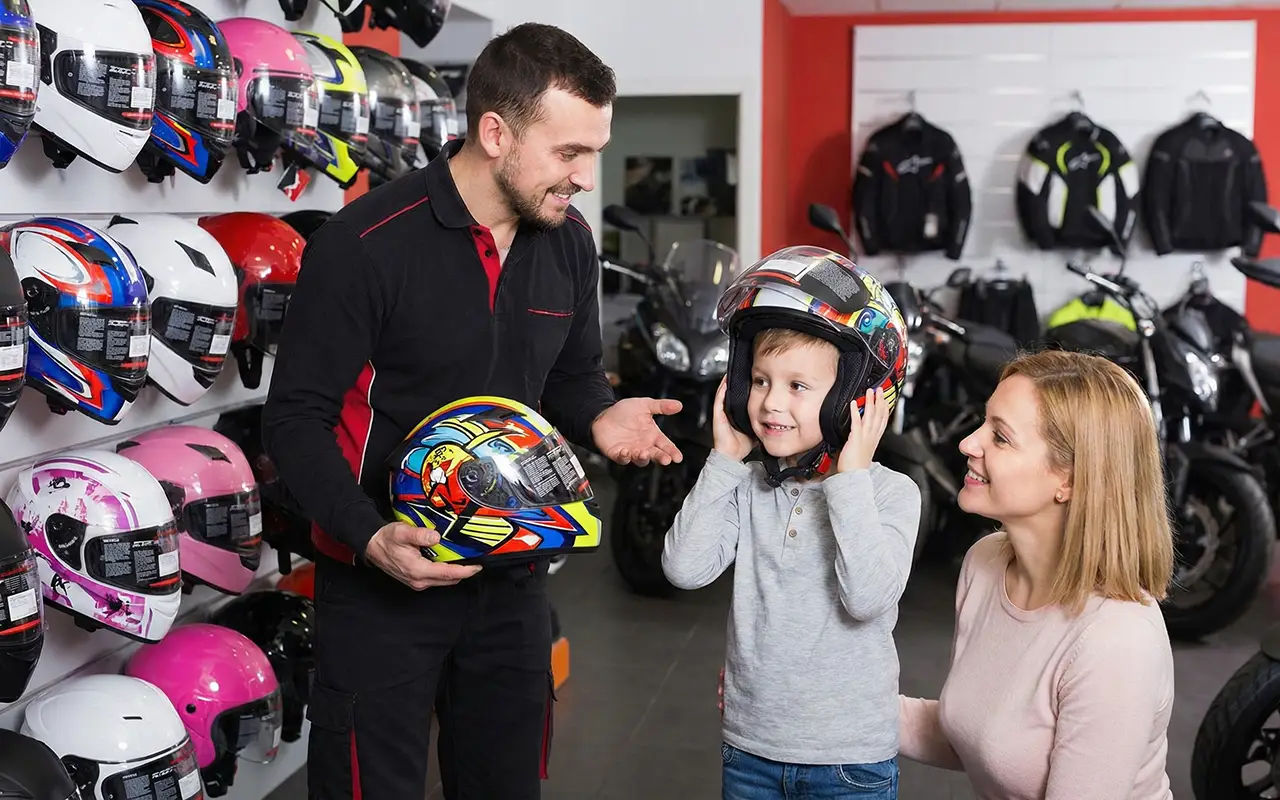
I still remember the first time a father approached me at a bike show, his seven-year-old daughter tugging at his sleeve, eyes wide with excitement about her first ride. “What helmet should I get her?” he asked, holding up a miniature replica of his own Shoei.
It looked perfect—same graphics, same style—except it was completely wrong for a child passenger.
That moment crystallized something I’d observed throughout my two decades covering the motorcycle industry: parents often approach children’s helmets as scaled-down adult gear, missing critical differences that could mean the difference between adequate protection and catastrophic injury.
The sobering reality is that children face unique vulnerabilities as motorcycle passengers. Their developing neck muscles, proportionally larger heads relative to body weight, and different biomechanics demand specialized consideration.
According to NHTSA data, proper helmet use reduces the risk of death by 37% for motorcycle passengers, but that statistic assumes proper fitment and age-appropriate design—something many well-intentioned parents get wrong.
Understanding how to choose a motorcycle helmet for a child isn’t just about finding the smallest size; it’s about comprehending the fundamental differences between adult and pediatric head protection.
Before diving into the specifics, I recommend reviewing our Ultimate Guide to Motorcycle Helmets to understand the foundational principles that apply across all age groups.
The Critical Differences Between Adult and Children’s Helmets
When learning how to choose a motorcycle helmet for a child, the first misconception to dispel is that children’s helmets are simply miniaturized adult models.
The biomechanical reality is far more complex. A child’s head-to-body ratio doesn’t reach adult proportions until approximately age 12-14, meaning their center of gravity sits higher, and their neck muscles must support proportionally more weight during impact scenarios.
Premium manufacturers like Arai, Shoei, and AGV have invested significant research into pediatric helmet design, though the market remains frustratingly limited compared to adult options.
The shell construction must balance impact absorption with weight constraints—a heavier helmet increases the risk of neck injury during deceleration, while insufficient protection obviously compromises safety. This delicate balance requires different EPS foam densities and shell thicknesses than adult helmets.
The interior padding also differs substantially. Children’s facial structures are still developing, with softer bone structures and different pressure point distributions.
A helmet designed for an adult’s fully-formed facial architecture will create improper contact points on a child’s face, potentially causing both discomfort and compromised safety. The cheek pads must be specifically contoured for rounder, fuller faces without the defined bone structure of adults.
Understanding Safety Certifications for Children’s Helmets
The regulatory landscape for children’s motorcycle helmets mirrors adult standards but deserves careful examination when determining how to choose a motorcycle helmet for a child.
In the United States, DOT FMVSS 218 certification is the legal minimum requirement for any helmet used on public roads, regardless of rider age. However, this standard has faced criticism for its relatively lenient testing protocols compared to international alternatives.
The ECE 22.06 certification (the latest European standard) employs more rigorous impact testing across multiple points and includes rotational impact assessment—particularly relevant for children given their biomechanical vulnerabilities.
Snell M2020 certification represents another tier of protection, with more stringent impact absorption requirements and penetration resistance testing. For a comprehensive breakdown of what these certifications actually mean, consult our detailed guide on Helmet Safety Ratings Explained.
Here’s where it gets complicated: not all manufacturers pursue multiple certifications for children’s models due to the smaller market size and testing costs.
You might find an excellent adult helmet line with DOT, ECE, and Snell certifications, but the children’s version only carries DOT approval. This doesn’t necessarily indicate inferior protection—it often reflects economic realities of the children’s helmet market rather than safety compromises.
The SHARP rating system used in the UK provides independent testing results and can be invaluable when evaluating children’s helmets, though coverage of youth models remains limited.
When possible, prioritize helmets that have undergone independent testing beyond manufacturer claims and minimum legal requirements.
Proper Sizing and Fitment for Child Passengers
Getting the fit right represents the most critical aspect of how to choose a motorcycle helmet for a child. I’ve witnessed countless parents purchase helmets based on age recommendations or eyeball estimates, resulting in dangerously improper fitment.
Children’s heads grow rapidly, and sizing charts provide only rough guidelines—actual measurement and fitting remain non-negotiable.
Start by measuring the child’s head circumference at its widest point, typically about one inch above the eyebrows and wrapping around the most prominent part of the back of the head. Use a flexible measuring tape and take multiple measurements to ensure accuracy. Record this measurement in both inches and centimeters, as manufacturers use different standards.
The challenge with children’s helmets is that you’re balancing current fit with anticipated growth. A helmet that fits perfectly today may be outgrown in six months, but purchasing a size too large compromises immediate safety.
The helmet should feel snug without being painfully tight—when you place it on the child’s head and attempt to rotate it, the skin should move with the helmet rather than the helmet sliding over the skin.
The cheek pads should make firm contact without creating pressure points that will become painful during longer rides. Have the child wear the helmet for at least 10-15 minutes during fitting to identify any discomfort that isn’t immediately apparent.
Pay attention to pressure points on the forehead, temples, and crown—these will only intensify during actual riding conditions. Our Motorcycle Helmet Fitment Guide provides detailed techniques that apply equally to children’s fitting, though with the additional consideration of growth patterns.
The retention system deserves special attention. Whether you choose a traditional D-ring closure or a ratchet system, ensure the child can tolerate it comfortably. Some children find D-rings intimidating or uncomfortable against their throat, while others adapt quickly.
The key is that the strap should sit snugly against the chin and throat without restricting breathing or swallowing. When properly secured, you should only be able to fit one or two fingers between the strap and the child’s chin.
Helmet Style Considerations for Child Passengers
The debate over helmet styles takes on additional dimensions when considering how to choose a motorcycle helmet for a child passenger.
Full-face helmets provide the most comprehensive protection, covering the entire head and face—statistically, the chin bar prevents injuries in approximately 35% of impacts. For child passengers, this protection becomes even more critical given their limited ability to brace for impact or react to emergency situations.
However, full-face helmets present challenges for younger children. The enclosed design can feel claustrophobic, potentially causing anxiety or panic during rides.
Ventilation becomes crucial—children generate more metabolic heat relative to their size and may overheat more quickly than adults. The added weight of a full-face design also factors into the neck strain equation, though modern lightweight materials have significantly mitigated this concern.
Modular helmets offer a compromise, allowing the chin bar to flip up for easier communication and reduced claustrophobia when stopped. Yet the added mechanical complexity introduces potential failure points, and modular helmets typically weigh more than comparable full-face designs.
For children, I generally recommend against modular options unless the child has specific needs that justify the trade-offs. If you’re considering this route, review our analysis of Best Motorcycle Modular Helmets to understand the engineering compromises involved.
Open-face and three-quarter helmets leave the face exposed, reducing protection but improving communication and reducing claustrophobia. From a safety standpoint, I cannot recommend these for child passengers.
Children lack the experience to anticipate road hazards, and their reaction times don’t allow for protective responses that might mitigate facial injuries. The marginal comfort benefits don’t justify the substantial safety compromises. For more on this topic, see our comparison of Full Face vs. Modular vs. Open Face Helmets.
Youth-specific designs from manufacturers like Bell, HJC, and Scorpion often incorporate graphics and styling that appeal to children while maintaining safety standards. While aesthetics shouldn’t drive the decision, a helmet that a child actually wants to wear—and will wear properly—provides better protection than a technically superior helmet they resist using.
Weight and Material Considerations
The weight equation for children’s helmets represents one of the most critical factors in how to choose a motorcycle helmet for a child, yet it’s frequently overlooked by parents focused solely on impact protection.
A child’s neck muscles are still developing and cannot safely support the same helmet weights that adults tolerate. Research indicates that helmet weight exceeding 3-4% of total body weight significantly increases neck injury risk during impacts.
For a 60-pound child, this translates to a maximum helmet weight of approximately 2.4 pounds—substantially lighter than most adult helmets, which typically range from 3-4 pounds for full-face designs. This weight constraint drives material selection and design compromises that don’t exist in adult helmet engineering.
Polycarbonate shells dominate the children’s helmet market due to their favorable strength-to-weight ratio and cost-effectiveness. These thermoplastic shells can be injection-molded to precise specifications and offer good impact absorption while maintaining reasonable weight.
However, polycarbonate helmets typically feature thicker shells than composite alternatives, which can affect aerodynamics and increase bulk.
Composite fiber shells—combining fiberglass, carbon fiber, and aramid fibers—offer superior strength with reduced weight but command premium prices.
For children who will outgrow helmets relatively quickly, the cost-benefit analysis often favors polycarbonate unless the child will be a frequent passenger or has specific neck strength concerns.
The material debate extends beyond children’s helmets; our comparison of Carbon Fiber vs. Polycarbonate Helmets provides deeper technical analysis applicable to understanding these trade-offs. The EPS liner density also factors into weight considerations.
Manufacturers must balance impact absorption characteristics with overall helmet mass, sometimes using variable-density foam that’s softer in areas requiring less protection and denser where impact forces concentrate. This optimization becomes more critical in children’s helmets where every gram matters.
Ventilation and Comfort for Young Passengers
A child’s thermoregulatory system operates differently than an adult’s, making ventilation a critical consideration when learning how to choose a motorcycle helmet for a child.
Children have a higher surface-area-to-volume ratio, leading to faster heat gain in warm conditions and faster heat loss in cold conditions. They also have less developed sweating mechanisms, making passive cooling through helmet ventilation more important.
Effective helmet ventilation requires strategically placed intake vents at the front (typically on the chin bar and forehead area) and exhaust vents at the rear. The internal channeling must create airflow across the scalp without creating excessive noise or buffeting.
For child passengers sitting behind the rider, airflow patterns differ from what riders experience—they’re in the rider’s wind shadow, receiving less direct airflow and potentially experiencing more turbulent air.
Adjustable vents allow customization for different weather conditions, though the mechanisms must be simple enough for children to operate (or parents to adjust quickly during stops).
Some premium children’s helmets incorporate the same sophisticated ventilation systems found in adult models, while budget options may feature fixed vents with limited airflow control.
The interior liner plays an equally important role in comfort. Moisture-wicking fabrics help manage sweat and humidity, while antimicrobial treatments prevent odor buildup—particularly important given that children’s helmets often get more “creative” use than adult helmets.
Removable, washable liners are essential for maintaining hygiene; check out our guide on How to Wash Your Motorcycle Helmet Liner for maintenance techniques that extend helmet lifespan.
Comfort padding must be substantial enough to provide cushioning and improve fit, but not so thick that it restricts ventilation or makes the helmet feel claustrophobic.
Children are less likely to tolerate discomfort than adults, and an uncomfortable helmet becomes a safety liability if it distracts the passenger or encourages them to loosen the retention system.
Visibility and Communication Features
Field of view takes on special importance for child passengers, who may already feel anxious about riding. A helmet with restricted peripheral vision can increase anxiety and prevent the child from fully experiencing the ride—potentially making them less engaged and more likely to make sudden movements that affect the bike’s stability.
The face shield should provide a wide, optically correct viewing area without distortion. Anti-fog coatings or Pinlock systems prevent the shield from fogging during temperature transitions or in humid conditions—a child can’t safely remove or adjust their shield while riding, making fog prevention critical. Tinted shields should be avoided for child passengers unless they have a drop-down sun shield that allows quick adjustment; children’s eyes are more sensitive to rapid light changes, and a fixed dark shield can be dangerous when entering tunnels or during dusk riding.
Communication systems designed for children remain a relatively underdeveloped market segment. Adult Bluetooth systems like Cardo and Sena offer scaled-down speakers that can fit children’s helmets, but the helmet must have sufficient space in the ear pockets and appropriate speaker cutouts. The ability to communicate with your child passenger transforms the riding experience, allowing you to warn them about upcoming turns, check on their comfort, and maintain connection during the ride. For recommendations on passenger communication systems, see our review of the best motorcycle intercom for rider and passenger.
Noise protection deserves serious consideration. Children’s developing auditory systems are more vulnerable to hearing damage from prolonged wind noise exposure. While communication systems provide some noise buffering, the helmet’s inherent noise reduction characteristics matter significantly. Quieter helmets reduce fatigue and allow lower communication system volumes, protecting hearing during extended rides. Though focused on adult models, our analysis of the Best Quietest Motorcycle Helmets discusses the acoustic engineering principles that apply to children’s helmets as well.
Age-Appropriate Selection Guidelines
The question of when a child is old enough to be a motorcycle passenger remains contentious, with different jurisdictions setting minimum ages ranging from 5 to 12 years. Beyond legal requirements, physical and cognitive development should guide these decisions. A child must be tall enough to reach the passenger footpegs, strong enough to maintain proper posture during acceleration and braking, and mature enough to follow instructions about holding on and leaning with the bike.
For younger children (ages 5-8), how to choose a motorcycle helmet for a child focuses heavily on weight and comfort. These riders have the least developed neck strength and the highest head-to-body weight ratios. Helmets must be as light as possible while maintaining protection standards, and comfort features become critical since younger children have less tolerance for discomfort. Rides should be shorter, and the helmet must accommodate their limited attention span—an uncomfortable helmet will quickly lead to fidgeting and distraction.
Pre-teens (ages 9-12) represent a transitional category where some may fit into small adult helmets while others still require youth-specific designs. This age group often has strong opinions about helmet appearance and may resist “little kid” designs. Fortunately, manufacturers have responded with more sophisticated graphics and styling for this demographic. The challenge lies in balancing their desire for “cool” helmets with appropriate safety features and fit.
Teenagers (13+) typically transition to adult helmet sizing, though smaller adults may still benefit from youth large sizes. At this age, involving them in the selection process becomes important for ensuring they’ll actually wear the helmet properly. The safety principles remain the same, but the psychological aspects of helmet acceptance become more prominent.
Budget Considerations and Value Assessment
The financial reality of children’s motorcycle helmets presents a unique challenge: you’re purchasing safety equipment that will be outgrown relatively quickly. A child might need a new helmet every 12-24 months during rapid growth periods, making the investment in premium helmets difficult to justify for occasional riders. However, compromising safety for cost savings represents a false economy that could have catastrophic consequences.
Entry-level children’s helmets from reputable manufacturers like HJC, Bell, and Scorpion typically range from $80-150. These helmets meet DOT standards and provide adequate protection for occasional use. The compromises usually appear in comfort features, ventilation sophistication, and weight optimization rather than core safety performance. For families who ride infrequently, these represent sensible choices that balance safety and budget constraints.
Mid-range options ($150-300) from manufacturers like AGV, Shoei’s youth line, and premium HJC models incorporate better ventilation systems, lighter materials, and improved comfort features. These helmets make sense for regular riders or children who will be passengers frequently enough to justify the investment. The improved comfort and reduced weight provide tangible benefits that enhance the riding experience and reduce fatigue.
Premium children’s helmets ($300+) remain relatively rare, with limited options from manufacturers like Arai and high-end AGV models. These helmets incorporate the same advanced materials and engineering found in premium adult helmets, scaled for children’s needs. For families where motorcycling represents a serious hobby or lifestyle, and the child will be a frequent passenger, these investments provide the best possible protection and comfort.
The used helmet market presents tempting cost savings but introduces significant risks. Unlike adult helmets where the history might be verifiable, children’s helmets often experience impacts that parents don’t witness or report—drops while being carried, impacts during play, or other damage that compromises protection. The relatively modest cost of new children’s helmets compared to adult models makes the risk-reward calculation favor new purchases. For a detailed analysis of this topic, see our article on Is It Safe to Buy a Used Motorcycle Helmet?
Replacement Timing and Growth Monitoring
Understanding when to replace a child’s helmet goes beyond the standard five-year replacement guideline that applies to adult helmets. Children’s rapid growth means helmets may become too small long before material degradation becomes a concern. Regular fit checks every 3-4 months during rapid growth periods (typically ages 5-12) help ensure the helmet hasn’t become dangerously small.
Signs that a helmet has been outgrown include: red marks or pressure points that persist after removing the helmet, the helmet sitting too high on the head (more than an inch above the eyebrows), inability to achieve proper retention strap positioning, or the child complaining of headaches or discomfort during rides. When any of these indicators appear, it’s time for a new helmet regardless of how recently it was purchased.
Impact damage requires immediate replacement, even if no visible damage is apparent. The EPS liner is designed to compress during impact, absorbing energy that would otherwise transfer to the skull. Once compressed, it cannot provide the same protection in subsequent impacts. Even drops from relatively low heights—such as falling off a motorcycle seat or being dropped while carrying—can compromise the liner’s integrity. For comprehensive guidance on this topic, consult our article on When to Replace Your Motorcycle Helmet.
Material degradation accelerates in harsh storage conditions. Helmets stored in garages subject to temperature extremes, high humidity, or direct sunlight age faster than those kept in climate-controlled environments. The UV exposure, temperature cycling, and moisture can degrade both the shell materials and the EPS liner, reducing protection even without visible damage.
Maintaining records of purchase dates, any impacts (no matter how minor), and fit check dates helps ensure timely replacement. Given the relatively short service life of children’s helmets due to growth, the five-year replacement guideline often becomes academic—most children will outgrow helmets long before material degradation becomes the limiting factor.
Teaching Proper Helmet Use and Passenger Behavior
Even the best helmet provides inadequate protection if worn improperly. Teaching children correct helmet use and passenger behavior represents an essential component of how to choose a motorcycle helmet for a child—the education matters as much as the equipment. Children must understand that the helmet only works when properly secured, and loosening the retention strap during rides completely defeats its protective function.
Start by making helmet use routine and non-negotiable. The helmet goes on before mounting the motorcycle, and the retention system gets properly secured before the engine starts. This routine establishes the helmet as an integral part of riding rather than an optional accessory. Explain in age-appropriate terms why the helmet matters—children respond better to understanding the “why” rather than just following rules.
Proper passenger behavior extends beyond helmet use. Children must understand the importance of holding on firmly, keeping feet on the pegs, leaning with the bike rather than against it, and avoiding sudden movements. These behaviors directly impact the rider’s ability to control the motorcycle safely. A properly fitted, comfortable helmet helps ensure the child can focus on being a good passenger rather than being distracted by discomfort.
Practice sessions in a controlled environment—such as a parking lot—allow children to become comfortable with the helmet and learn proper passenger techniques before venturing onto public roads. These sessions also provide opportunities to identify any helmet issues that weren’t apparent during static fitting.
Special Considerations and Medical Factors
Some children have specific needs that complicate helmet selection. Children who wear glasses require helmets with sufficient interior space and flexible cheek pads that allow glasses to be worn comfortably without creating pressure points. The helmet must go on and off easily without requiring glasses removal, and the glasses arms shouldn’t be pressed painfully into the sides of the head. While our guide on the best motorcycle helmet for glasses wearers focuses on adult riders, many of the same principles apply to children.
Children with sensory processing disorders or autism spectrum conditions may have heightened sensitivity to the helmet’s fit, weight, or enclosed feeling. For these children, the selection process requires extra patience and potentially compromise between optimal safety and what the child can tolerate. Working with occupational therapists or medical professionals can help identify strategies for gradual helmet acclimation.
Medical conditions affecting neck strength or stability require consultation with healthcare providers before allowing a child to be a motorcycle passenger. Conditions like atlantoaxial instability (common in Down syndrome), previous neck injuries, or muscular disorders may contraindicate motorcycle passenger activity regardless of helmet quality.
Hair considerations also factor into fit. Children with thick, long, or textured hair may require different sizing or interior configurations than helmet manufacturers anticipate. The hair should be managed in a way that doesn’t compromise fit—typically braided or in a low ponytail that doesn’t interfere with helmet positioning. For creative solutions to this challenge, see our article on best motorcycle helmet for big hair.
Manufacturer Recommendations and Model Specifics
The children’s helmet market offers fewer options than the adult segment, but several manufacturers have earned reputations for quality youth helmets. Bell’s youth line provides solid entry-level options with DOT certification and reasonable pricing. Their Qualifier DLX Youth and SRT Youth models offer full-face protection with modern features at accessible price points. These helmets typically weigh between 2.5-3 pounds and include removable, washable liners.
HJC’s youth offerings, particularly the CL-Y and CS-R3 Youth models, provide excellent value with DOT and ECE certification. HJC has invested in youth-specific mold development rather than simply scaling down adult designs, resulting in better fit characteristics for children’s head shapes. The ventilation systems on these helmets rival adult models, and the weight optimization makes them suitable for younger passengers.
Scorpion’s EXO youth helmets bring premium features to mid-range pricing. The EXO-R420 Youth includes an advanced polycarbonate shell, multi-density EPS liner, and sophisticated ventilation. At approximately 2.8 pounds, it represents a good balance between protection and weight for children aged 8-12.
AGV’s K3 SV Youth and K1 Youth models bring Italian styling and engineering to the children’s market. These helmets feature the same attention to aerodynamics and ventilation found in AGV’s adult line, though at a premium price point. The optical quality of the face shields exceeds most competitors, and the fit characteristics suit a wide range of head shapes.
Arai remains the gold standard for premium children’s helmets, though availability is limited and prices are high. The Arai XD4 Youth represents their dual-sport offering, while the Corsair-X Youth (when available) provides track-level protection for young riders. These helmets incorporate Arai’s complex laminate construction and variable-density EPS liners, resulting in exceptional protection at weights below 3 pounds. The investment makes sense only for serious riding families where the child will be a frequent passenger.
The Reality Check: Making the Final Decision
After examining all the technical factors involved in how to choose a motorcycle helmet for a child, the decision ultimately comes down to balancing multiple competing priorities: safety, comfort, fit, weight, cost, and the child’s willingness to wear it properly. Perfect solutions rarely exist—every helmet represents compromises optimized for different priorities.
My recommendation, based on years of evaluating helmets and talking with riding families, is to prioritize fit above all else. A mid-range helmet that fits perfectly provides better protection than a premium helmet that fits poorly. The helmet must be comfortable enough that the child will wear it properly without complaint, but never compromise on proper fit to accommodate comfort preferences.
Start with reputable manufacturers who have invested in youth-specific development rather than simple size scaling. Insist on trying helmets in person rather than ordering online unless you’re replacing a model you already know fits correctly. Budget for replacement every 12-18 months during rapid growth periods rather than trying to extend service life by purchasing oversized helmets.
Choose full-face protection unless specific circumstances justify alternatives. The comprehensive protection of a full-face design outweighs the minor comfort benefits of open-face options, especially for passengers who can’t anticipate or react to road hazards. Select the lightest helmet that meets your safety requirements—weight matters more for children than adults, and reducing neck strain should be a primary consideration.
Involve the child in the selection process to the extent appropriate for their age. A helmet they’re excited about wearing is more likely to be worn properly than one imposed on them. However, maintain firm boundaries around safety requirements—graphics and styling are negotiable, proper fit and safety certifications are not.
Finally, remember that the helmet is just one component of passenger safety. Proper riding technique, appropriate speeds, route selection, and continuous communication matter as much as equipment. The best helmet in the world can’t compensate for irresponsible riding or inadequate passenger instruction. The goal isn’t just protecting your child during a crash—it’s riding in a way that makes crashes unlikely while being prepared if they occur.
Conclusion
Learning how to choose a motorcycle helmet for a child requires understanding that children aren’t simply small adults—their unique biomechanics, developing physiology, and psychological needs demand specialized consideration. The market offers fewer options than adult helmets, but quality choices exist across various price points from manufacturers who understand these requirements. Prioritize proper fit above all else, choose the lightest helmet that meets safety standards, and never compromise on full-face protection for passengers. Budget for regular replacement as children grow, and invest time in teaching proper helmet use and passenger behavior. The helmet represents your child’s most critical piece of safety equipment—choose it with the seriousness that responsibility demands. A properly selected and fitted helmet, combined with responsible riding practices, allows you to share your passion for motorcycling with your child while minimizing the inherent risks. The extra effort required to get it right pays dividends every time you ride together, providing peace of mind that you’ve done everything possible to protect your most precious passenger.
Frequently Asked Questions
At what age can a child safely be a motorcycle passenger?
Legal minimum ages vary by jurisdiction, ranging from 5 to 12 years, but physical capability matters more than chronological age. A child must be tall enough to reach the passenger footpegs with feet firmly planted, strong enough to maintain proper posture during acceleration and braking, and mature enough to follow instructions about holding on and leaning with the bike. Most experts recommend waiting until at least age 8-9 when neck strength and body proportions better support safe passenger activity. Always check your local laws and honestly assess your child’s physical and cognitive readiness before taking them as a passenger.
How often should I replace my child’s motorcycle helmet?
Replace your child’s helmet immediately after any impact, regardless of visible damage, as the EPS liner may be compromised. Beyond impact replacement, children’s helmets typically require replacement every 12-24 months due to growth, well before the standard five-year adult helmet replacement guideline becomes relevant. Conduct fit checks every 3-4 months during rapid growth periods, watching for signs the helmet has been outgrown: pressure points, the helmet sitting too high on the head, or complaints of discomfort. Material degradation from UV exposure, temperature cycling, or moisture may also necessitate earlier replacement if the helmet is stored in harsh conditions.
Can I buy a larger helmet for my child to grow into?
Never purchase an oversized helmet expecting your child to “grow into it.” An improperly fitted helmet that’s too large will shift during impact, potentially causing injury rather than preventing it, and may even come off entirely during a crash. The helmet must fit properly at the time of use—it should feel snug without being painful, and the skin should move with the helmet rather than the helmet sliding over the skin. While children’s helmets represent a recurring expense due to growth, proper fit is non-negotiable for safety. Budget for regular replacement rather than compromising on current fit.
What’s the maximum weight a child’s motorcycle helmet should be?
Helmet weight should not exceed 3-4% of the child’s total body weight to minimize neck strain and injury risk during impacts. For a 60-pound child, this translates to a maximum of approximately 2.4 pounds. Most quality youth helmets weigh between 2.5-3.0 pounds, though premium models using advanced composite materials may achieve weights below 2.5 pounds. Lighter helmets reduce fatigue during longer rides and decrease the risk of neck injury during sudden deceleration. When comparing helmets, weigh them if possible rather than relying solely on manufacturer specifications, and always choose the lightest option that meets your safety and fit requirements.