I’ll never forget the first time I nearly low-sided my Ducati on a rain-soaked mountain pass outside Asheville. It wasn’t the wet pavement that nearly did me in—it was the complete whiteout of fog that erupted across my prescription lenses the moment I accelerated out of a hairpin turn.
For those three terrifying seconds, I was riding blind at 45 mph with nothing but muscle memory and prayer keeping me upright.
If you wear glasses and ride motorcycles, you’ve lived this nightmare. The statistics are sobering: according to rider surveys, approximately 35% of motorcyclists wear prescription eyewear, and nearly 90% of them report fogging as their primary safety concern when riding in variable weather conditions.
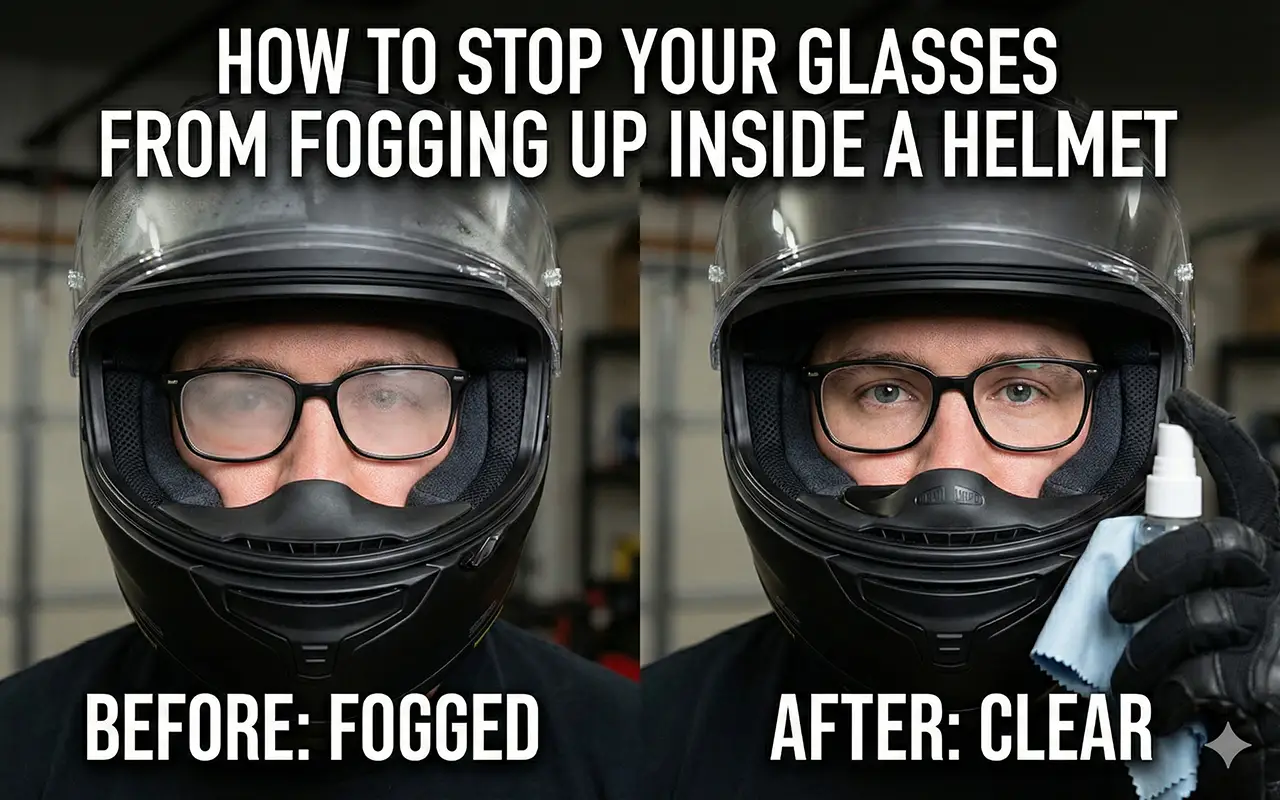
The problem of how to stop your glasses from fogging up inside a helmet has plagued riders since the first bespectacled enthusiast strapped on a full-face lid decades ago.
It’s a perfect storm of thermodynamics—warm, moist breath meets cold lenses in an enclosed environment, creating condensation that can transform from minor annoyance to life-threatening visibility loss in seconds.
While modern helmet technology has evolved dramatically, as detailed in our Ultimate Guide to Motorcycle Helmets, the fundamental challenge of managing moisture and temperature differentials inside a sealed helmet remains one of the most persistent problems facing glasses-wearing riders.
This comprehensive guide will cut through the myths, examine the science, and provide you with battle-tested solutions that actually work.
Understanding the Science Behind Glasses Fogging
Before we dive into solutions for how to stop your glasses from fogging up inside a helmet, we need to understand exactly what’s happening at the molecular level.
Fogging occurs when water vapor in your breath comes into contact with a surface that’s below the dew point—the temperature at which air can no longer hold all its moisture. Your glasses, especially in cold weather, provide that perfect condensation surface.
Inside a motorcycle helmet, you’re creating a microclimate that’s fundamentally hostile to clear vision. Every breath you exhale contains approximately 40 milligrams of water vapor, heated to your body temperature of 98.6°F.
When that warm, moisture-laden air hits your glasses—which are being cooled by ambient air flowing through your helmet vents—condensation forms instantly.
The problem intensifies because helmets, by their very nature, are designed to be sealed environments for safety purposes, which means moisture has nowhere to escape.
The rate of fogging depends on several variables: the temperature differential between your breath and the ambient air, your breathing rate (which increases during spirited riding or physical exertion), humidity levels, and the effectiveness of your helmet’s ventilation system.
Understanding these factors is crucial because the solution to how to stop your glasses from fogging up inside a helmet isn’t one-size-fits-all—it requires a multi-pronged approach targeting each contributing factor.
Helmet Selection and Ventilation: Your First Line of Defense
The foundation of fog prevention starts with choosing the right helmet. Not all helmets are created equal when it comes to managing internal airflow, and this is particularly critical for glasses wearers. Modern helmet design has come a long way, and understanding the differences between helmet types can make or break your visibility strategy.
Full-face helmets, while offering superior protection as discussed in our guide on Full Face vs. Modular vs. Open Face Helmets, present the greatest fogging challenge because they completely enclose your face.
However, premium full-face helmets from manufacturers like Shoei, Arai, and AGV incorporate sophisticated ventilation systems specifically designed to combat fogging. Look for helmets with multiple intake vents (typically at the chin bar and forehead) and exhaust vents (usually at the rear of the helmet).
The key is creating positive pressure inside the helmet that forces moist air out before it can condense on your glasses.
Modular helmets offer a tactical advantage for glasses wearers. The ability to flip up the chin bar at stoplights or in slow traffic provides instant ventilation and pressure relief, preventing the moisture buildup that occurs during idling.
Some riders find that Best Motorcycle Modular Helmets offer the perfect compromise between protection and ventilation control, though you sacrifice some aerodynamic efficiency at highway speeds.
When evaluating helmets for fog prevention, pay attention to chin vent design. The most effective systems channel air upward along the inside of the face shield, creating a “breath box” that diverts exhaled air away from your glasses.
Helmets like the Schuberth C4 Pro and Shoei RF-1400 feature precisely engineered air channels that accomplish this remarkably well.
Additionally, consider helmet materials—Carbon Fiber vs. Polycarbonate Helmets differ not just in weight and impact characteristics, but also in their thermal properties, which affects internal temperature management.
The Breath Deflector Solution
One of the most effective and affordable solutions for how to stop your glasses from fogging up inside a helmet is installing a quality breath deflector, also called a breath guard or chin curtain.
This simple piece of equipment creates a physical barrier that redirects your exhaled breath downward and away from your glasses, preventing the warm, moist air from ever reaching your lenses.
Most modern helmets either include a breath deflector or have mounting points for aftermarket options. The best breath deflectors are made from flexible rubber or silicone that seals against your chin and cheeks without causing discomfort during long rides. Brands like Pinlock, Respro, and helmet-specific OEM options have refined their designs over years of real-world testing.
Installation is critical. A poorly fitted breath deflector is worse than none at all—it can actually trap moisture and create a fog chamber.
The deflector should sit snugly against your face without gaps, but not so tight that it causes pressure points or restricts breathing. I’ve found that taking ten minutes to properly adjust the deflector, including test rides at various speeds, pays dividends in fog-free vision.
Here’s a pro tip from my years of testing: combine your breath deflector with a thin balaclava or neck gaiter that covers your nose and mouth. This creates a double-barrier system where the fabric absorbs initial moisture from your breath, and the deflector redirects what gets through. This combination is particularly effective in cold weather riding, where the temperature differential between your breath and ambient air creates the most aggressive fogging conditions.
Anti-Fog Coatings and Treatments: Chemical Warfare Against Condensation
The second major category of solutions involves treating your glasses with anti-fog compounds. These products work by altering the surface tension of your lenses, causing water molecules to spread into a thin, transparent sheet rather than forming light-scattering droplets. Let me be clear: not all anti-fog products are created equal, and I’ve tested dozens over two decades of riding.
The gold standard in anti-fog technology is hydrophilic coatings, which attract water molecules and spread them evenly across the lens surface. Products like Cat Crap (despite the unfortunate name, it’s remarkably effective), Rain-X Anti-Fog, and FogTech are specifically formulated for eyewear and work by creating a microscopic film that prevents droplet formation.
Application technique matters enormously—clean your glasses thoroughly with isopropyl alcohol first, apply the anti-fog treatment in a thin, even layer, and buff until clear. Most treatments need 10-15 minutes to cure before exposure to moisture.
For permanent solutions, consider glasses with factory-applied anti-fog coatings. Many optical labs now offer permanent hydrophilic treatments that are molecularly bonded to the lens during manufacturing.
While more expensive upfront, these coatings can last the lifetime of the lenses and eliminate the need for repeated applications. I’ve been running Zeiss DuraVision coatings on my riding glasses for three years with zero degradation in performance.
A word of caution: avoid using dish soap, shaving cream, or other home remedies that internet forums love to recommend. While these can provide temporary relief, they often leave residue that distorts vision, attracts dirt, or breaks down quickly under the temperature extremes of riding. The few dollars you save aren’t worth compromising your vision at 70 mph.
For riders who frequently encounter fog issues, I recommend a two-tier approach: permanent anti-fog coating on your primary riding glasses, backed up by a quick-application spray product like FogTech DX in your tank bag for emergency situations. This redundancy has saved my visibility more times than I can count during unexpected weather changes on long tours.
Proper Helmet Fit and Seal Management
Here’s something most riders don’t realize: an improperly fitted helmet is a fogging factory. When your helmet is too loose, it allows excessive air exchange that brings in humid external air while failing to properly channel ventilation. When it’s too tight, it restricts airflow entirely and creates a sealed moisture trap. Getting the fit right is essential for how to stop your glasses from fogging up inside a helmet.
The relationship between helmet fit and fogging is complex and often counterintuitive. You need a snug fit that creates predictable air channels, but with enough space around your glasses to allow air circulation. This is where the expertise covered in our Motorcycle Helmet Fitment Guide becomes critical. Different head shapes require different helmet internal shapes—an intermediate oval head in a round helmet will create gaps that disrupt airflow patterns.
When trying on helmets with your glasses, pay attention to how the cheek pads interact with your frames. The pads should apply even pressure around your face without pressing on your glasses’ temples. If the pads push your glasses against your face, they’ll restrict the crucial air gap between your face and lenses that allows moisture to dissipate. Some helmets, like those featured in our guide on best full face motorcycle helmet for glasses, incorporate specific cutouts in the cheek pads to accommodate glasses temples without compromising overall fit.
The helmet’s chin bar position relative to your mouth is another critical factor. If the chin bar sits too close to your face, your breath has nowhere to go but up toward your glasses. A properly positioned chin bar, combined with an effective chin vent, creates a pressure differential that pulls breath downward and out of the helmet rather than allowing it to rise toward your lenses.
As your helmet ages and the liner compresses, fit changes can introduce new fogging problems. This is one reason why understanding When to Replace Your Motorcycle Helmet matters beyond just safety considerations. A helmet that once managed moisture perfectly can become a fog generator as internal padding deteriorates and air channels collapse.
Strategic Ventilation Techniques While Riding
Even with the perfect helmet and anti-fog treatments, you need to actively manage ventilation while riding. How to stop your glasses from fogging up inside a helmet isn’t a set-it-and-forget-it proposition—it requires awareness and adjustment based on conditions.
The most effective technique I’ve developed over years of riding is what I call “pre-ventilation.” Before putting your helmet on, open all vents fully and store the helmet in a cool, dry location. When you’re ready to ride, put the helmet on with vents open and take 30 seconds to breathe normally, allowing the internal atmosphere to stabilize before you start moving. This prevents the initial moisture burst that occurs when you seal warm, humid air inside the helmet.
While riding, adjust vent positions based on speed and conditions. At low speeds (under 30 mph), you want maximum ventilation—all vents fully open. The reduced air pressure at low speeds means you need larger openings to achieve adequate flow. As speed increases, you can partially close vents because ram air pressure increases flow velocity. At highway speeds, I typically run chin vents at 75% open and forehead vents at 50%, which provides optimal flow without excessive wind noise.
Temperature transitions are fogging danger zones. When you move from cold exterior air into a warm garage, or exit a heated building into freezing temperatures, your glasses will fog almost instantly. The solution is to crack your visor open slightly during these transitions, allowing rapid pressure equalization. Yes, you’ll get some cold air on your face, but it’s a small price for maintaining visibility. In extreme cases, I’ll fully open my visor for 10-15 seconds to completely purge the helmet’s internal atmosphere.
Rain riding presents unique challenges. Your instinct might be to close all vents to keep water out, but this is exactly wrong for fog prevention. Water entering through vents will drain out or evaporate; fog on your glasses won’t. Keep chin vents open even in rain—the water that enters will be minimal and the ventilation benefit is substantial. For heavy rain scenarios, consider helmets specifically designed for wet weather, as covered in our guide on best motorcycle helmet for riding in the rain.
Glasses Selection and Optimization for Riding
Not all glasses are equally prone to fogging, and choosing the right frames and lenses for motorcycle riding can dramatically reduce your fog problems. This is an aspect of how to stop your glasses from fogging up inside a helmet that many riders overlook, but it’s made a significant difference in my own riding experience.
Frame design affects fogging in several ways. Glasses that sit close to your face create less air circulation space, making them more prone to fogging. Conversely, frames that sit too far from your face can catch more of your breath’s upward flow. The sweet spot is frames with adjustable nose pads that allow you to position the lenses approximately 12-15mm from your face—close enough for good optical performance but far enough to allow air circulation.
Lens material matters significantly. Polycarbonate lenses have different thermal properties than high-index plastic or glass lenses. Polycarbonate, while excellent for impact resistance (crucial for riding), tends to fog more readily because it conducts heat poorly and creates greater temperature differentials. High-index plastic lenses with anti-reflective and anti-fog coatings provide the best balance of optical quality and fog resistance for most riders.
Consider dedicated riding glasses with features specifically designed for helmet use. These typically have thinner temples that don’t create pressure points under helmet padding, wrap-around designs that reduce peripheral air currents, and often come with premium anti-fog coatings as standard. Brands like Wiley X, Oakley, and ESS make glasses specifically designed for use under helmets, and while they’re more expensive than standard eyewear, the improvement in comfort and fog resistance is substantial.
For riders who can wear contact lenses, this eliminates the fogging problem entirely—but introduces its own set of challenges. Wind can dry out contacts quickly, especially with partial or modular helmets. Dust and debris become more problematic. If you go this route, carry rewetting drops and have backup glasses in your luggage. I alternate between contacts and glasses depending on the type of riding I’m doing: contacts for sport riding and track days, glasses for touring and commuting.
Prescription inserts for helmets are another option worth considering. Some premium helmet manufacturers offer optical insert systems that mount prescription lenses directly inside the helmet, eliminating the need for glasses entirely. These systems, while expensive and helmet-specific, completely solve the fogging problem because the lenses are positioned in the helmet’s airflow stream and benefit from the same ventilation as your face shield. The Schuberth OptiView system is the most refined version I’ve tested, though it requires commitment to a specific helmet model.
Emergency Fog-Clearing Techniques
Despite your best prevention efforts, you’ll eventually encounter situations where fog develops while riding. Having effective emergency clearing techniques is a critical safety skill. Here’s what actually works when you need to clear fog quickly without pulling over.
The most immediate technique is the “breath hold and vent.” When you notice fogging beginning, take a deep breath, hold it, and fully open your chin and forehead vents. The temporary cessation of moisture input combined with maximum airflow will clear light fog in 3-5 seconds. Obviously, only use this technique when traffic and road conditions allow you to divert attention to vent adjustment.
For more severe fogging, crack your face shield open 1-2 inches while simultaneously opening all vents. The rush of external air will rapidly clear fog, though you’ll sacrifice some aerodynamic stability and face protection. This is a short-term emergency measure—once fog clears, close the shield and manage ventilation to prevent recurrence.
Learn to ride with peripheral vision when center vision is compromised by fog. This is a skill that requires practice in safe conditions, but it can keep you safe when fog develops suddenly. Your peripheral vision is less affected by central lens fogging, and you can maintain basic navigation and hazard awareness while working to clear the fog. Never continue riding with completely fogged glasses—pull over safely if you can’t clear them quickly.
Carry microfiber cloths in an accessible pocket—not in your luggage. When you need to stop and manually clear fog, a clean microfiber cloth is far more effective than your glove or jacket sleeve, which will likely just smear moisture around. I keep a small microfiber cloth in my jacket’s chest pocket specifically for this purpose.
Seasonal Considerations and Weather-Specific Solutions
How to stop your glasses from fogging up inside a helmet requires different approaches depending on the season and weather conditions you’re riding in. What works perfectly on a cool autumn morning may fail completely on a humid summer evening or a freezing winter commute.
Winter riding presents the most challenging fogging conditions. The extreme temperature differential between your warm breath and frigid ambient air creates aggressive condensation. For cold weather riding, layer your anti-fog strategies. Start with permanently coated lenses, add a fresh application of anti-fog spray, install a breath deflector, and consider wearing a thin balaclava that covers your nose and mouth to pre-warm and dehumidify your breath before it reaches your glasses. Some riders swear by helmets with electric shield heating systems, which can also help warm the internal atmosphere and reduce temperature differentials. Our guide on best motorcycle helmet for cold weather riding covers additional winter-specific considerations.
Summer humidity creates different challenges. Even though temperature differentials are smaller, the absolute moisture content in the air is much higher. In humid conditions, ventilation becomes paramount—you need maximum airflow to evacuate moisture faster than it can condense. This is where helmet selection matters enormously. Helmets designed for hot weather, as detailed in our guide on best motorcycle helmet for hot weather, incorporate larger vents and more aggressive internal channeling specifically to manage moisture in humid conditions.
Rain riding combines the worst of both worlds: high humidity and temperature differentials. Your helmet’s interior warms from your body heat while the exterior cools from rain and evaporation. The solution is aggressive ventilation despite the rain, combined with a water-repellent treatment on your glasses’ exterior surface. Products like Rain-X applied to the outside of your lenses will cause rain to bead and blow off, preventing the external water from further cooling your lenses and exacerbating internal fogging.
Spring and fall bring rapid temperature changes that can catch you unprepared. A ride that starts in cool morning air can become warm by afternoon, or vice versa. For variable conditions, I carry a small spray bottle of anti-fog treatment and adjust ventilation frequently. Being proactive about vent adjustment as you notice temperature changes prevents fogging rather than forcing you to react to it.
Maintenance and Long-Term Prevention
Consistent maintenance of your helmet and glasses is essential for long-term fog prevention. Over time, residue from anti-fog treatments, skin oils, sweat, and environmental contaminants build up on lenses and inside your helmet, reducing the effectiveness of your fog prevention strategies.
Clean your glasses thoroughly at least weekly, more often if you ride daily. Use proper lens cleaner—not glass cleaner, which can damage coatings—and microfiber cloths. Pay special attention to the inner surface of your lenses where breath residue accumulates. After cleaning, reapply anti-fog treatment and allow adequate curing time before your next ride.
Helmet interior maintenance is equally important. Removable liners should be washed monthly to remove sweat, skin oils, and bacteria that can affect both hygiene and fog performance. The process is detailed in our guide on How to Wash Your Motorcycle Helmet Liner. A clean liner absorbs less moisture and allows better air circulation, both of which reduce fogging.
Inspect and clean your helmet’s ventilation system regularly. Vents can become clogged with dead insects, road debris, and dust, dramatically reducing airflow effectiveness. Remove vent covers if possible and clean them thoroughly. Use compressed air to blow out internal air channels. This maintenance is particularly important if you ride in dusty or agricultural areas.
Check your breath deflector’s condition and seal regularly. These components wear out faster than other helmet parts because they’re in constant contact with your face and breath moisture. Replace breath deflectors annually or whenever you notice gaps, tears, or loss of flexibility. A degraded breath deflector is worse than none because it can actually channel breath toward your glasses rather than away from them.
Advanced Solutions and Emerging Technologies
The motorcycle industry continues to innovate in fog prevention technology, and several emerging solutions show promise for glasses-wearing riders. While some of these are still expensive or in early adoption phases, they represent the future of how to stop your glasses from fogging up inside a helmet.
Pinlock lens systems, while primarily designed for face shields, have inspired similar technologies for eyewear. Some companies now offer dual-pane prescription inserts that create an insulating air gap between layers, similar to double-pane windows. This dramatically reduces the temperature differential that causes fogging. The technology is still evolving for prescription eyewear, but early results are promising.
Electrically heated glasses are now available from several manufacturers. Thin heating elements embedded in the lens or frame gently warm the lenses above the dew point, preventing condensation. Battery technology has advanced to where these systems can run for several hours on a small rechargeable battery pack. While currently expensive (expect to pay $200-400), the technology is becoming more refined and affordable. For riders who commute year-round in cold climates, heated glasses may be worth the investment.
Active ventilation systems that integrate with helmet designs are another frontier. Some premium helmets now incorporate small, battery-powered fans that create positive pressure inside the helmet, forcing moist air out through exhaust vents. Brands like Forcite and Quin are experimenting with smart helmet systems that automatically adjust ventilation based on internal humidity sensors. These technologies are still in early stages but show significant promise.
Nanotechnology coatings represent the cutting edge of passive anti-fog solutions. Unlike traditional hydrophilic coatings that spread water into a sheet, nanotech coatings create surface structures that prevent water molecules from bonding to the lens at all. Companies like Quantum Coating and NanoFilm are developing permanent coatings that are molecularly bonded to lenses and should last indefinitely. While currently expensive and not widely available, these coatings may become standard in prescription eyewear within the next few years.
The Integrated Approach: Combining Multiple Solutions
After testing virtually every fog prevention method over two decades of year-round riding in climates ranging from Florida humidity to Colorado cold, I’ve concluded that the most effective strategy for how to stop your glasses from fogging up inside a helmet is layering multiple solutions. No single approach is 100% effective in all conditions, but combining complementary methods creates redundancy that keeps your vision clear.
My personal system, which has proven effective across thousands of miles in varied conditions, consists of: prescription glasses with permanent hydrophilic coating and optimized frame design; a premium full-face helmet with excellent ventilation and proper fit; a quality breath deflector properly installed and maintained; quick-application anti-fog spray for emergency situations; and active ventilation management based on conditions. This multi-layered approach means that if one element fails or proves inadequate for extreme conditions, the other layers maintain effectiveness.
The specific combination that works best for you will depend on your riding style, climate, and individual physiology. Riders who generate more body heat or breathe more heavily will need more aggressive ventilation solutions. Those in humid climates will prioritize different solutions than cold-weather riders. The key is experimentation—try different combinations and document what works in various conditions.
Budget considerations matter, but this is one area where investing in quality pays significant safety dividends. A $15 bottle of premium anti-fog treatment and a $30 breath deflector can transform a $150 helmet into a fog-free environment, while a $600 helmet with poor ventilation design will fog regardless of price. Focus your investment on the fundamentals: proper helmet fit and ventilation, quality anti-fog treatments, and good glasses with appropriate coatings.
Conclusion
Learning how to stop your glasses from fogging up inside a helmet is not just a comfort issue—it’s a fundamental safety imperative that every glasses-wearing rider must master. After examining the science, testing countless products, and logging hundreds of thousands of miles in every conceivable condition, I can state definitively that fog is a solvable problem, but only through a comprehensive, multi-faceted approach that addresses the root causes of condensation.
The solution begins with proper helmet selection and fit, ensuring that ventilation systems can function as designed. It continues with strategic use of breath deflectors and anti-fog treatments, both permanent and temporary. It requires active management of ventilation while riding, adjusting to conditions rather than setting and forgetting. And it demands consistent maintenance of both helmet and eyewear to ensure all systems continue functioning optimally.
There is no silver bullet, no single product that will eliminate fogging in all conditions for all riders. Anyone who tells you otherwise is selling something. But by layering multiple proven solutions—proper helmet ventilation, breath deflection, chemical treatments, and active airflow management—you can reduce fogging from a constant safety hazard to a rare, manageable inconvenience. The investment of time and money required is minimal compared to the safety benefit of maintaining clear vision in all riding conditions. Your eyes are your primary safety system on a motorcycle; keeping them clear isn’t optional, it’s essential.
Frequently Asked Questions
Can I use anti-fog spray designed for face shields on my prescription glasses?
While some anti-fog sprays work on both face shields and glasses, many are formulated specifically for one or the other. Face shield sprays can sometimes leave residue or contain chemicals that damage prescription lens coatings, particularly anti-reflective coatings. Always use products specifically labeled as safe for prescription eyewear, or better yet, products designed specifically for glasses. The molecular structure of polycarbonate face shields differs from prescription lens materials, requiring different formulations for optimal performance. When in doubt, test any new product on an old pair of glasses before applying it to your primary riding eyewear.
How often should I replace my helmet’s breath deflector?
Breath deflectors should be replaced annually for riders who use their helmets regularly, or whenever you notice signs of wear such as cracks, tears, loss of flexibility, or gaps in the seal against your face. The constant exposure to moisture, oils from your skin, and temperature extremes degrades the materials over time. A worn breath deflector loses its ability to properly seal and redirect air, actually making fogging worse by creating turbulent airflow patterns inside the helmet. Most replacement breath deflectors cost between $15-30, making annual replacement a worthwhile investment in visibility and safety.
Will a modular helmet solve my fogging problems better than a full-face helmet?
Modular helmets offer the advantage of quick ventilation by flipping up the chin bar, which can help clear fog rapidly at stops or in slow traffic. However, this doesn’t necessarily make them superior for fog prevention during active riding. The best solution depends on helmet quality rather than type—a premium full-face helmet with excellent ventilation design will outperform a poorly ventilated modular helmet. That said, for urban riding with frequent stops, the ability to quickly flip up the chin bar for instant ventilation makes modular helmets attractive for glasses wearers. The trade-off is slightly reduced aerodynamic performance and typically more wind noise at highway speeds.
Is it safe to crack my face shield open while riding to prevent fogging?
Cracking your face shield open 1-2 inches is a common and generally safe technique for managing fogging, particularly at lower speeds or in urban environments. However, it does reduce protection from debris, insects, and in the event of a crash. The safety trade-off is usually acceptable because riding with completely fogged glasses is far more dangerous than riding with a partially open shield. At highway speeds, an open shield creates significant wind buffeting and noise, and increases the risk of debris impact. The better solution is to prevent fogging through proper ventilation, anti-fog treatments, and breath deflection so you can ride with the shield closed. Reserve the open-shield technique for emergency situations or temporary relief until you can properly address the underlying fogging issue.