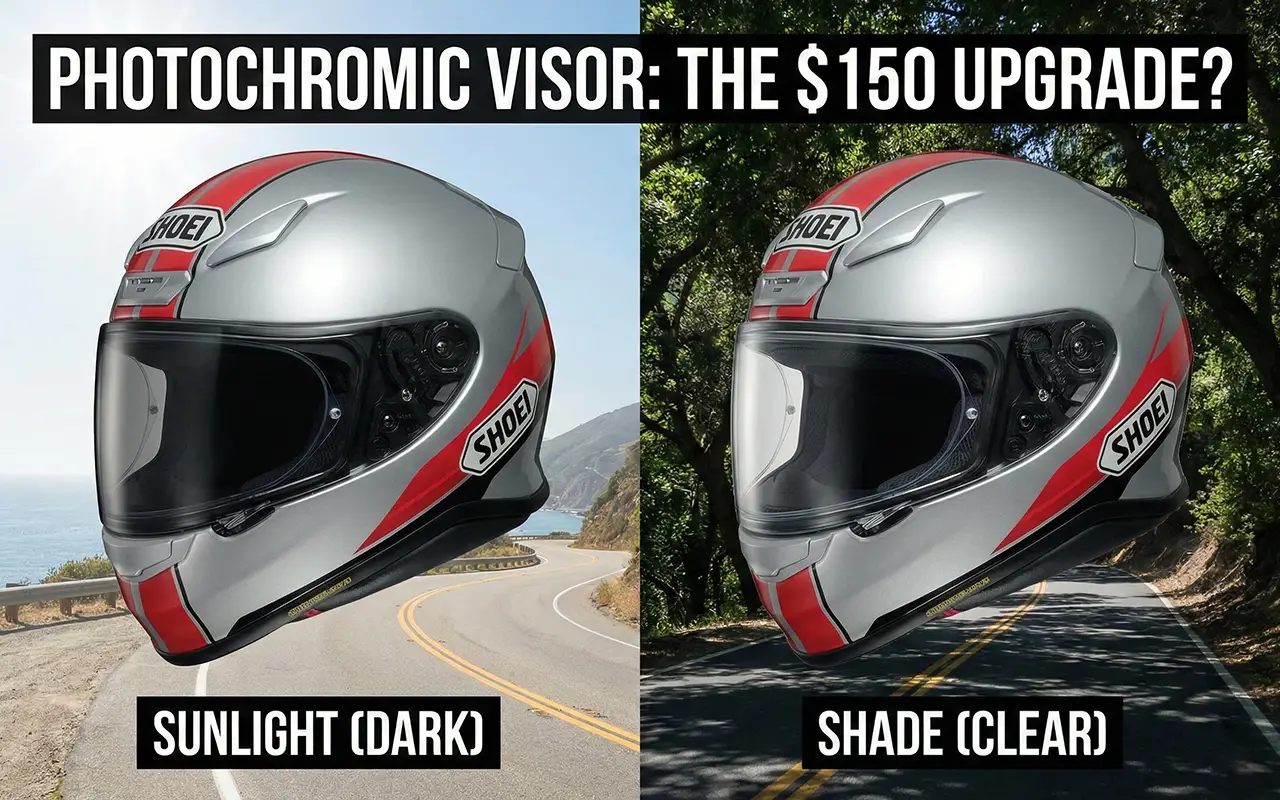
I’ll never forget the moment I realized I’d been riding blind. Not literally, of course—but squinting into the low-angle autumn sun on Highway 1, frantically fumbling with my visor at 70 mph, trying to decide whether to flip it up and eat bugs or keep it down and risk missing that deer everyone warned me about.
That’s when my riding buddy pulled alongside at the next gas stop, tapped his helmet, and said two words that would change my riding life: “Photochromic visor.”
The motorcycle helmet industry has evolved dramatically over the past two decades, from basic foam-and-plastic protection to sophisticated safety systems incorporating advanced materials, ventilation engineering, and optical technology.
As we’ve covered extensively in our Ultimate Guide to Motorcycle Helmets, modern riders face an overwhelming array of choices when it comes to helmet features and accessories. Among these options, photochromic transition visors represent one of the most intriguing—and expensive—upgrades available, typically adding $100-$200 to your helmet investment.
But do these adaptive shields actually deliver on their promise of all-condition visibility, or are they just another overpriced gimmick designed to separate riders from their hard-earned cash?
Understanding the Science Behind Photochromic Technology
Before we dive into whether photochromic transition visors justify their premium price tag, it’s essential to understand exactly what you’re paying for.
The technology isn’t new—photochromic lenses have been used in eyeglasses since the 1960s—but their application to motorcycle helmet visors presents unique engineering challenges that explain much of the cost differential.
Photochromic transition visors contain millions of photochromic molecules embedded within the polycarbonate or composite material of the shield itself.
These molecules undergo a reversible chemical reaction when exposed to ultraviolet (UV) radiation, causing them to change their molecular structure and, consequently, their light absorption properties.
When UV light hits the visor, the molecules shift to an “excited” state that absorbs more visible light, darkening the shield. Remove the UV source, and the molecules relax back to their original transparent state.
The sophistication lies in the engineering precision required to achieve this effect in a curved, impact-resistant, optically-correct shield that meets DOT, ECE, or Snell standards.
Unlike eyeglasses, which are relatively flat and don’t need to withstand 200+ mph impacts from road debris, motorcycle visors must maintain structural integrity while incorporating this adaptive technology.
This is why you can’t simply buy photochromic film and apply it to your existing visor—the molecules must be integrated during the manufacturing process to maintain safety standards.
The Technical Specifications That Matter
When evaluating photochromic transition visors, several key specifications determine real-world performance. The transition range typically spans from approximately 20-25% visible light transmission (VLT) in bright sunlight to 75-85% VLT in low-light conditions. For context, a clear visor offers about 90% VLT, while a dark smoke visor might be around 15-20% VLT.
Equally important is transition speed. Premium photochromic visors darken within 30-60 seconds of UV exposure and lighten within two to five minutes when UV is removed.
This asymmetry is intentional—your eyes adapt more quickly to darkness than to brightness, so faster darkening is prioritized. Temperature also affects performance; photochromic molecules react more slowly in cold weather and may not darken as completely in extreme heat, a consideration for riders in varied climates.
The Real-World Riding Experience: Beyond the Marketing Claims
After testing five different photochromic visors across three riding seasons and approximately 15,000 miles of varied conditions—from Pacific Coast fog banks to Nevada desert sunshine—I can report that the reality is more nuanced than manufacturer marketing suggests. The technology absolutely works, but whether it works for your specific riding style requires honest assessment.
The most compelling advantage emerges during dawn and dusk rides, those magical golden hours when lighting conditions change minute by minute. Traditional visors force you to choose: ride with a dark shield and struggle as the sun dips below the horizon, or start with a clear visor and squint through the glare.
Photochromic transition visors eliminate this compromise, automatically adjusting as ambient light changes. For commuters riding through sunrise or sunset, this feature alone can justify the investment.
Similarly impressive is performance during partly cloudy conditions. Anyone who’s ridden through scattered clouds knows the frustration of constant light level fluctuation—bright sunshine one moment, deep shadow the next.
A photochromic visor continuously adapts, maintaining relatively consistent visibility without the dangerous distraction of manually adjusting your shield while navigating traffic.
Where Photochromic Visors Fall Short
However, photochromic technology has limitations that manufacturers often downplay. The most significant is tunnel performance. Because the darkening reaction requires UV exposure, photochromic visors don’t respond to visible light alone.
When you enter a tunnel on a bright day, your visor remains dark for several minutes while your eyes struggle to adapt to the sudden darkness. This creates a genuinely dangerous visibility gap, particularly in long tunnels or underground parking structures.
Night riding presents another challenge. While photochromic visors do transition to their clear state without UV exposure, they never quite achieve the optical clarity of a dedicated clear visor.
That subtle difference—perhaps 10-15% less light transmission—becomes significant when you’re navigating unlit rural roads or trying to spot wildlife at the edge of your headlight beam. For riders who frequently ride after dark, carrying a spare clear visor remains advisable.
The behind-windscreen issue also deserves mention. Many modern motorcycle windscreens incorporate UV protection, which can prevent photochromic visors from darkening properly.
Touring riders on bikes with large fairings may find their expensive photochromic visor stuck in its light state even under bright sunshine, defeating the entire purpose of the technology. This is particularly problematic on bikes like the BMW K1600GT or Honda Gold Wing, where the windscreen provides substantial UV filtration.
The Financial Reality: Breaking Down the $150 Premium
Let’s address the elephant in the room: photochromic visors typically cost $120-$200, compared to $30-$50 for a standard clear visor and $40-$70 for a tinted visor. Is the convenience worth triple or quadruple the cost?
The math becomes clearer when you consider the alternative: purchasing multiple visors to cover different conditions. A serious rider might reasonably own a clear visor, a light smoke visor for overcast days, a dark smoke for bright conditions, and perhaps an amber or yellow visor for low-light situations.
That’s $150-$250 in visors, plus the hassle of swapping them based on weather forecasts that are often wrong. Suddenly, a single photochromic visor that handles most conditions starts looking more economical.
However, this calculation assumes you can’t use a drop-down sun shield instead. Many modern helmets, particularly in the modular helmet category, feature integrated internal sun visors that flip down with a switch.
These systems cost nothing extra if your helmet already has one, and they offer instant light adjustment without transition delay. The tradeoff is reduced peripheral vision when deployed and the potential for mechanical failure, but for many riders, this represents a more practical solution than photochromic visors.
Longevity and Replacement Costs
Another financial consideration is replacement frequency. Photochromic molecules degrade over time with UV exposure, gradually losing their ability to darken effectively.
Most manufacturers specify a lifespan of 2-3 years before noticeable performance degradation, though this varies based on usage intensity and storage conditions (leaving your helmet in direct sunlight accelerates degradation).
This means your $150 visor is effectively a consumable item with a defined shelf life, unlike standard visors that remain functional until scratched or damaged.
Over a typical helmet’s five-year lifespan (as discussed in our guide on when to replace your motorcycle helmet), you might need to replace a photochromic visor twice, potentially adding $300 to your total helmet ownership cost.
Compatibility and Fitment Considerations
Not all helmets can accommodate photochromic visors, and not all photochromic visors are created equal. This is where research becomes critical before committing to the upgrade.
Premium helmet manufacturers like Shoei, Arai, AGV, and Schuberth offer proprietary photochromic visors designed specifically for their helmet models.
These company-specific visors ensure proper optical alignment, secure mounting, and maintained safety certifications. However, they also command premium prices and limit your options—if Shoei’s photochromic visor doesn’t meet your needs, you’re out of luck.
Third-party manufacturers like Transitions and Pinlock have entered the market with aftermarket photochromic solutions, but compatibility can be hit-or-miss. Some aftermarket visors may not seal properly, creating wind noise or water intrusion issues.
Others might not meet the same optical quality standards as OEM options, introducing distortion that causes eye strain during long rides. As we emphasize in our motorcycle helmet fitment guide, proper fit and quality aren’t areas where you want to compromise for cost savings.
The Pinlock Integration Question
Speaking of Pinlock, here’s a critical compatibility issue many riders discover too late: not all photochromic visors accept Pinlock anti-fog inserts. The additional thickness of the photochromic material can interfere with Pinlock pin placement or create optical distortion when both systems are combined.
This creates a genuine dilemma for riders in humid or cold climates where fog prevention is essential. You might find yourself choosing between adaptive light protection and fog prevention—a frustrating compromise when you’ve already spent premium money on advanced technology.
Some manufacturers have solved this by offering photochromic visors with integrated anti-fog coatings, but these coatings typically don’t perform as effectively as Pinlock systems, especially in extreme conditions. For more on managing fog issues, check out our comprehensive guide on Pinlock vs. Anti-Fog Sprays.
Performance Across Different Riding Disciplines
The value proposition of photochromic transition visors varies significantly depending on your primary riding style and typical conditions. Let’s break down the use cases where they excel and where they disappoint.
Sport and Track Riding
For track day enthusiasts and aggressive sport riders, photochromic visors offer minimal advantage. Track sessions typically occur during consistent daylight hours under relatively stable lighting conditions.
The slight optical distortion present in even premium photochromic visors—imperceptible during street riding—can become noticeable at triple-digit speeds when you’re hunting for the perfect apex. Most serious track riders prefer the absolute optical clarity of a standard tinted visor matched to current conditions.
Additionally, the weight difference, while minimal (typically 10-20 grams), matters more in aggressive riding positions where helmet aerodynamics and neck strain become factors. Riders shopping for lightweight carbon fiber helmets to reduce fatigue should consider whether adding a heavier photochromic visor undermines their weight-saving efforts.
Adventure and Dual-Sport Riding
Adventure riders face perhaps the most compelling case for photochromic visors. Off-road and dual-sport riding involves dramatic elevation changes, transitions between forest canopy and open terrain, and unpredictable weather—exactly the conditions where adaptive visors shine.
The ability to ride from desert sunshine into mountain forest without stopping to swap visors represents a significant practical advantage when you’re miles from civilization.
However, adventure riders should also consider traditional dual-sport helmet designs with separate goggles, which offer easier lens swapping and better ventilation for off-road intensity.
The choice between a dual-sport helmet with a visor versus a traditional dirt bike helmet setup involves tradeoffs that extend beyond just optical technology.
Touring and Long-Distance Riding
Long-distance touring riders represent the sweet spot for photochromic visor technology. Multi-day rides inevitably involve varied lighting conditions, and the convenience of not managing multiple visors while dealing with luggage, fuel stops, and navigation is genuinely valuable.
Touring riders also tend to ride during dawn and dusk hours more frequently than sport riders, maximizing the benefit of adaptive technology.
The caveat is the windscreen UV-blocking issue mentioned earlier. Riders on touring bikes with large fairings should test photochromic visors behind their specific windscreen before committing to the purchase.
Some touring-focused helmets, like those featured in our best helmets for touring motorcycles roundup, offer better solutions through integrated sun shield systems.
Commuting and Urban Riding
Daily commuters might find photochromic visors most valuable of all. Commuting often means riding during sunrise and sunset when lighting changes rapidly, and the convenience of one-visor simplicity eliminates morning decision-making.
Urban environments also involve frequent transitions between bright streets and shadowed underpasses, where photochromic adaptation provides real safety benefits.
The counterargument is that commuters typically ride the same route daily and can predict lighting conditions with reasonable accuracy, making a properly chosen static tint sufficient.
Additionally, commuters in temperate climates might prioritize fog resistance over light adaptation, particularly during morning rides, making a clear visor with Pinlock insert more practical than a photochromic option.
Maintenance and Care Requirements
Photochromic visors demand more careful maintenance than standard visors, and improper care can significantly shorten their functional lifespan. Understanding these requirements is essential before investing in the technology.
First, cleaning requires specific techniques. The photochromic coating is more delicate than standard visor materials and can be damaged by harsh chemicals, abrasive cloths, or aggressive scrubbing.
Manufacturers typically recommend using only dedicated visor cleaners or mild soap solutions with microfiber cloths. Paper towels, which many riders use for quick cleanups, can cause micro-scratching that accumulates over time, creating haze that degrades optical clarity.
Storage is equally important. Photochromic molecules degrade faster when exposed to heat and UV light, so leaving your helmet on your bike’s seat or in direct sunlight accelerates the aging process.
Proper storage in a cool, dark place—ideally in a helmet bag—can extend visor life by months or even years. This contradicts the casual storage habits of many riders who treat their helmets as just another piece of riding gear.
For more on proper helmet care, see our guide on how to wash your motorcycle helmet liner, which includes storage recommendations.
Scratch Resistance and Durability
Photochromic visors typically feature the same scratch-resistant coatings as premium standard visors, but the additional molecular layers can make them slightly more vulnerable to damage. A deep scratch doesn’t just compromise visibility—it can also disrupt the photochromic reaction in that area, creating uneven darkening that’s distracting and potentially dangerous.
This vulnerability matters most for riders who frequently encounter gravel, dirt, or debris. Adventure riders and those who ride in construction zones should weigh whether the optical benefits outweigh the increased replacement risk. At $150+ per visor, even one premature replacement due to stone chip damage significantly impacts the cost-benefit calculation.
Alternative Solutions Worth Considering
Before committing to a photochromic visor, it’s worth examining alternative approaches that might better suit your specific needs and budget.
Drop-Down Internal Sun Shields
Many modern helmets incorporate internal sun shields that deploy with a simple switch or slider. These systems offer instant light adjustment without transition delay, work perfectly in tunnels, and cost nothing extra if your helmet already includes the feature. The tradeoffs include reduced peripheral vision when deployed and the potential for mechanical failure, but for many riders, these compromises are acceptable given the cost savings and convenience.
Helmets with quality drop-down sun shield systems, like those in our best quietest motorcycle helmets guide, often represent better value for riders who prioritize multiple features over any single technology.
Quick-Change Visor Systems
Some helmet manufacturers have developed tool-free quick-change visor mechanisms that make swapping shields a 10-second operation. While this doesn’t eliminate the need to carry multiple visors, it dramatically reduces the inconvenience factor. For riders who already carry a tank bag or have luggage space, keeping a clear and tinted visor accessible becomes a viable alternative to photochromic technology.
Prescription Photochromic Riding Glasses
Riders who wear glasses might find prescription photochromic eyewear a more versatile solution than photochromic visors. Quality photochromic riding glasses adapt to light conditions while remaining functional off the bike, and they work with any helmet that accommodates eyewear comfortably. The investment in photochromic prescription lenses, while comparable to a photochromic visor, serves double duty for both riding and daily wear.
For riders exploring this option, our guide on best full face motorcycle helmets for glasses wearers covers helmet designs that accommodate eyewear without pressure points or optical distortion.
The Verdict: Who Should Buy Photochromic Visors?
After extensive testing and analysis, I can definitively state that photochromic transition visors are not a universal solution, despite what marketing materials suggest. They excel in specific use cases and disappoint in others, making the purchase decision highly personal.
You should seriously consider photochromic visors if you:
- Frequently ride during dawn and dusk hours when lighting changes rapidly
- Ride in varied terrain with frequent transitions between bright and shaded areas
- Prefer minimalist gear management and don’t want to carry multiple visors
- Primarily ride during daylight hours with occasional extension into twilight
- Don’t ride behind a UV-blocking windscreen
- Can afford the premium without compromising other safety gear investments
- Live in climates where fog prevention isn’t a daily concern
You should probably skip photochromic visors if you:
- Frequently ride at night or in low-light conditions where maximum light transmission is critical
- Ride primarily in stable lighting conditions (consistent daytime or track riding)
- Own a helmet with a quality drop-down sun shield system
- Ride behind a large windscreen with UV protection
- Require Pinlock anti-fog protection in your climate
- Are on a tight budget and need to prioritize other safety investments
- Prefer the absolute optical clarity of dedicated clear or tinted visors
The Best Photochromic Visor Options Currently Available
If you’ve decided photochromic technology suits your needs, quality matters immensely. Based on extensive testing, these manufacturer-specific options represent the current best-in-class:
Shoei CWR-1 Photochromic: Compatible with RF-1400, X-Fourteen, and several other Shoei models, this visor offers excellent optical clarity and relatively fast transition speeds. The Pinlock compatibility is limited but functional. Expect to pay around $180.
Schuberth Visierflex: Available for C4 and C4 Pro models, Schuberth’s photochromic option features exceptional optical quality and maintains good performance in cold weather. Premium pricing at $200+ reflects the German engineering quality.
AGV Numo Plus: Fits various AGV sport and touring helmets, offering good transition performance at a slightly lower price point ($140-160). The optical quality is excellent, though transition speed is marginally slower than premium competitors.
Regardless of brand, purchase photochromic visors directly from authorized dealers to ensure authenticity and warranty coverage. Counterfeit visors exist in the market and may not meet safety standards, regardless of how convincingly they’re branded.
Conclusion: The $150 Question Answered
Are photochromic transition visors worth the $150 upgrade? The honest answer is: it depends entirely on your riding profile, but for most riders, probably not.
The technology works as advertised within its limitations, and for specific use cases—particularly touring riders and dawn/dusk commuters—the convenience and safety benefits can justify the premium cost. However, the combination of high initial investment, limited lifespan, compatibility restrictions, and performance compromises in certain conditions means that alternative solutions often deliver better overall value.
For riders on a budget, invest that $150 in a helmet with a quality drop-down sun shield system, or purchase two or three dedicated visors for different conditions. For those who can comfortably afford the upgrade and fit the ideal use profile, photochromic visors represent a genuine quality-of-life improvement that reduces cognitive load and enhances safety during transitional lighting conditions.
My personal recommendation? If you’re shopping for a new helmet and considering photochromic technology, prioritize helmets with proven safety records, proper fit, and quality construction first—as detailed in our helmet safety ratings guide. Only after securing those fundamentals should you consider photochromic visors as a premium add-on. Your brain is worth protecting with the best possible helmet, not the one with the coolest visor technology.
Frequently Asked Questions
How long do photochromic visors last before they stop working effectively?
Most photochromic visors maintain optimal performance for approximately 2-3 years with regular use, though this varies based on UV exposure intensity and storage conditions. You’ll notice gradual degradation as the visor takes longer to darken, doesn’t darken as completely, or develops uneven tinting. Riders who store helmets properly in cool, dark places when not in use can extend lifespan by 6-12 months. Once you notice significant performance decline, replacement is necessary—there’s no way to “recharge” or restore photochromic molecules.
Can I use a photochromic visor with a Pinlock anti-fog insert?
Compatibility varies by manufacturer and specific visor model. Some photochromic visors accept Pinlock inserts without issues, while others either don’t have the necessary pin mounting points or create optical distortion when both systems are combined. Shoei and Schuberth offer photochromic visors with Pinlock compatibility, though some users report reduced optical clarity compared to using either system independently. Always verify Pinlock compatibility before purchasing if fog prevention is essential for your riding conditions.
Do photochromic visors work behind motorcycle windscreens?
This is a significant limitation that catches many riders by surprise. Photochromic technology requires UV light exposure to trigger the darkening reaction. Many modern motorcycle windscreens, particularly on touring bikes, incorporate UV protection that blocks the wavelengths necessary for photochromic activation. The result is a visor that remains in its light state even under bright sunshine. Before investing in a photochromic visor, test it behind your specific windscreen, or contact the manufacturer to verify compatibility with your bike’s fairing design.
Are photochromic visors safe for night riding?
Photochromic visors do transition to their clear state without UV exposure, making them technically usable for night riding. However, they never achieve the same light transmission as dedicated clear visors—typically remaining about 10-15% darker. For well-lit urban riding, this difference is negligible. For unlit rural roads or conditions requiring maximum visibility (rain, fog, wildlife areas), the reduced light transmission can compromise safety. Serious night riders should carry a dedicated clear visor for after-dark conditions, regardless of photochromic visor marketing claims about “all-condition” performance.