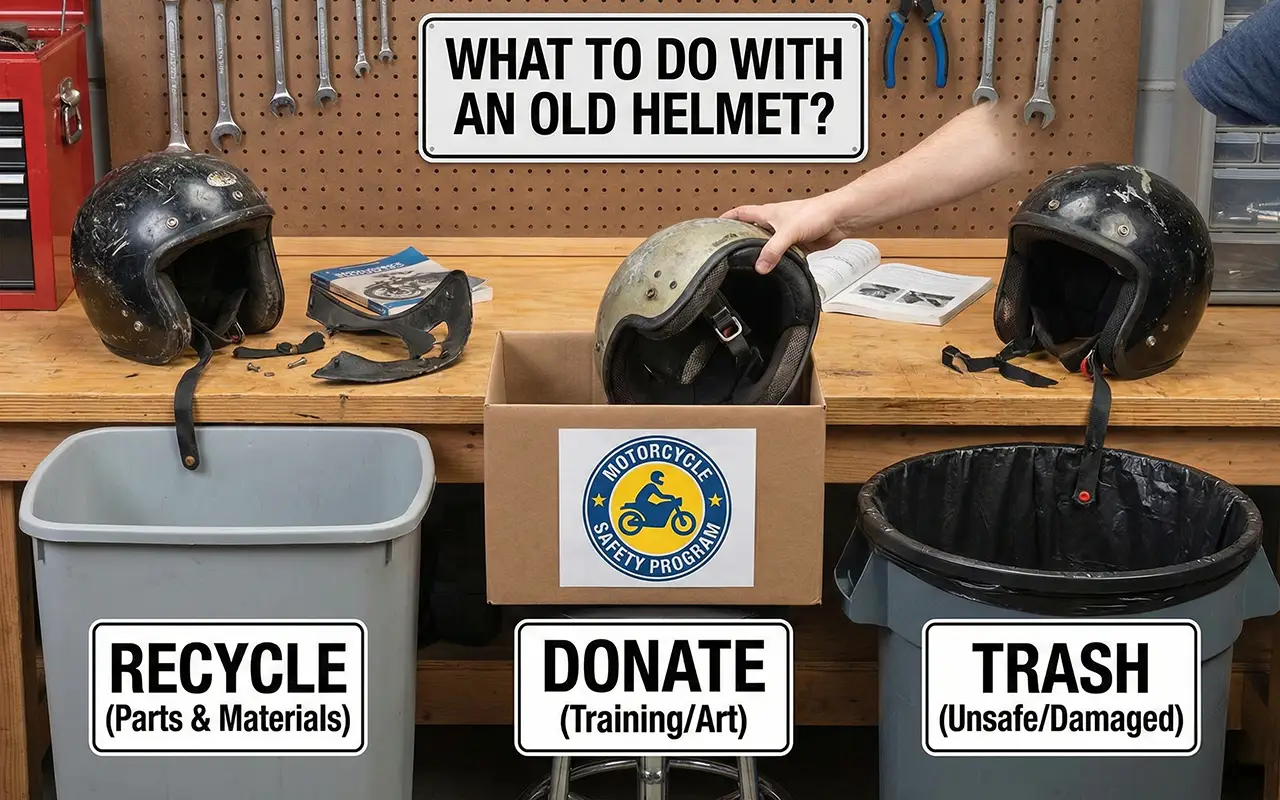
I still remember the day I found my old Shoei RF-1100 buried in the garage, covered in dust and memories from thousands of miles of canyon carving.
It had served me faithfully for seven years, but the foam liner had compressed to the point where it felt like wearing a bucket, and the once-pristine interior smelled like a combination of sweat, old leather, and regret.
Like many riders, I faced a question that seems simple on the surface but carries surprising complexity: what exactly do you do with an old motorcycle helmet?
This isn’t just a matter of decluttering your garage. The global motorcycle helmet market produces millions of units annually, and most riders will go through 3-5 helmets in their riding lifetime.
That’s a staggering amount of expanded polystyrene (EPS) foam, polycarbonate shells, and various composite materials that eventually need disposal.
Yet unlike old tires or batteries, there’s no clear industry standard for helmet disposal, leaving riders to navigate a confusing landscape of safety concerns, environmental considerations, and practical limitations.
As covered in our Ultimate Guide to Motorcycle Helmets, understanding the lifecycle of your helmet—from purchase to disposal—is an essential part of responsible gear ownership.
Understanding Why Your Helmet Needs Retirement
Before we dive into disposal methods, it’s crucial to understand why helmets have a finite lifespan in the first place. This isn’t planned obsolescence or marketing hype—it’s fundamental materials science.
The expanded polystyrene foam that forms the energy-absorbing liner in your helmet undergoes continuous degradation from the moment it’s manufactured.
UV exposure, temperature fluctuations, humidity, body oils, cleaning products, and simple molecular breakdown all conspire to reduce the foam’s ability to compress in a controlled manner during impact.
The shell materials—whether Carbon Fiber vs. Polycarbonate Helmets—also experience material fatigue over time.
Most manufacturers recommend replacement every five years, regardless of visible damage. If you’ve been in an accident—even a minor one where the helmet hit the pavement—immediate replacement is non-negotiable.
The EPS foam is designed for single-impact protection; once compressed, it cannot return to its original protective state. This is precisely why understanding When to Replace Your Motorcycle Helmet is critical for every rider’s safety protocol.
I’ve met countless riders at track days who insist their ten-year-old helmet is “still good” because it looks fine. What they don’t see is the invisible degradation happening at the molecular level.
During a recent conversation with a helmet engineer from a major manufacturer, he showed me microscopic images of five-year-old EPS foam versus new foam.
The difference was startling—the older foam showed significant cell wall breakdown and would compress much faster under impact loads, potentially allowing dangerous levels of G-forces to reach the rider’s brain.
The Environmental Reality of Helmet Disposal
Here’s the uncomfortable truth: motorcycle helmets are environmental nightmares when it comes to disposal. They’re complex assemblies of multiple materials—EPS foam, polycarbonate or composite shells, fabric liners, metal fasteners, plastic visors, and various adhesives—most of which aren’t easily separated for recycling.
EPS foam, the primary material in helmet construction, is technically recyclable but rarely accepted by municipal recycling programs. It’s bulky, contaminated with adhesives and body fluids, and economically unviable to process. The polycarbonate shells fare slightly better in theory, but in practice, they’re bonded to foam and other materials in ways that make separation prohibitively expensive.
According to waste management studies, an estimated 15-20 million motorcycle helmets enter landfills globally each year. Each helmet takes approximately 500 years to break down, releasing microplastics and potentially toxic compounds into soil and groundwater throughout that period. When you consider that a single helmet contains roughly 3-4 pounds of materials, we’re talking about tens of millions of pounds of non-biodegradable waste annually from this single product category.
Some European countries have begun implementing Extended Producer Responsibility (EPR) programs that require helmet manufacturers to fund take-back and recycling programs. However, these initiatives remain rare, and in markets like North America, riders are largely left to their own devices when determining what to do with an old helmet.
Option 1: Recycling Your Old Helmet (The Complicated Reality)
Recycling sounds like the environmentally responsible choice, and in theory, it is. In practice, however, recycling a motorcycle helmet presents significant challenges that most riders don’t anticipate.
Manufacturer Take-Back Programs
A handful of premium helmet manufacturers have established take-back programs, though they’re far from universal. Schuberth, for example, has operated a helmet recycling program in Germany where riders can return old helmets for proper material recovery. The company disassembles helmets, separates materials, and processes the components through specialized recycling streams.
However, these programs typically exist only in specific markets, often require the rider to pay shipping costs, and may only accept the manufacturer’s own brand. I contacted twelve major helmet manufacturers last year to inquire about their recycling programs. Only three had any formal program, and only one (available exclusively in Europe) covered shipping costs.
Specialized Recycling Facilities
Some industrial recycling facilities can process helmets, but they’re rare and geographically limited. These facilities use mechanical separation, chemical processing, or thermal depolymerization to break down complex products into constituent materials. The EPS foam can potentially be reprocessed into insulation or packaging materials, while shell materials might be ground into filler for other plastic products.
The challenge is finding these facilities and determining if they’ll accept consumer drop-offs. Most work exclusively with commercial clients and require minimum volumes that make individual helmet recycling impractical. In my research, I found only seven facilities in the entire United States that would even consider accepting motorcycle helmets from individual consumers, and three of those charged fees that exceeded the original helmet cost.
DIY Material Separation
Some environmentally conscious riders attempt to disassemble helmets themselves to separate recyclable components. While admirable in intent, this approach has limited effectiveness. The EPS liner is typically bonded to the shell with industrial adhesives that require solvents or heat to separate—processes that contaminate the materials and make them less recyclable.
That said, you can salvage certain components for standard recycling streams. Metal D-rings, buckles, and hardware can often go into metal recycling. Fabric liners—if you’ve been diligent about How to Wash Your Motorcycle Helmet Liner throughout the helmet’s life—might be acceptable in textile recycling programs. Visors, if made from clear polycarbonate without coatings, occasionally qualify for plastic recycling, though you should verify with your local facility.
The reality is that even with careful disassembly, you’ll likely only be able to recycle 15-20% of the helmet’s total mass through conventional municipal programs. The bulk—the EPS foam and bonded shell assembly—will still end up in a landfill.
Option 2: Donating Your Old Helmet (Proceed with Extreme Caution)
The idea of donating an old helmet seems generous—giving someone protective gear they might not otherwise afford. However, this option is fraught with ethical and legal concerns that every rider must carefully consider before passing along used safety equipment.
The Safety Liability Question
Here’s the fundamental problem: when you donate a helmet, you’re potentially putting someone’s life at risk with compromised safety equipment. Even if the helmet looks pristine externally, you cannot verify the integrity of the internal EPS foam, the condition of the retention system, or whether the helmet has sustained impacts you’re unaware of (perhaps it was dropped during storage).
Different helmet styles, such as those discussed in our guide to Full Face vs. Modular vs. Open Face Helmets, have varying vulnerabilities to age-related degradation. Modular helmets with moving parts face additional concerns about hinge and locking mechanism wear that may not be immediately apparent.
From a legal standpoint, liability varies by jurisdiction, but you could potentially be held responsible if someone is injured while wearing a helmet you donated, particularly if you didn’t disclose its age, history, or condition. Some legal experts I’ve consulted recommend treating helmet donation similarly to donating expired medications—it’s simply not worth the risk, regardless of good intentions.
When Donation Might Be Acceptable
There are limited scenarios where helmet donation might be appropriate, though they’re narrow and specific. If you have a helmet that’s less than two years old, has never been in an accident, has been stored properly (away from temperature extremes and UV exposure), and still carries current safety certifications, you might consider donation—but only with full disclosure of its history.
Organizations like Riders for Health or motorcycle training schools sometimes accept recent-model helmets for specific programs, but they typically have strict acceptance criteria. They’ll often refuse helmets over three years old or those without complete documentation of their history.
Some riders donate old helmets to art programs, theater departments, or film productions where they’ll be used purely as props, not actual protective equipment. This removes the safety liability while keeping the item out of landfills temporarily. However, you should clearly mark these helmets as “NOT FOR SAFETY USE” with permanent marker or paint to prevent future misuse.
The Developing World Dilemma
Some organizations collect used helmets for distribution in developing countries where helmet use is low due to cost barriers. While the intention is noble, this practice raises serious ethical questions. Are we essentially saying that degraded, potentially unsafe protection is acceptable for riders in other countries when we wouldn’t use it ourselves?
Organizations that do this work responsibly implement strict screening protocols, rejecting helmets over a certain age or with any signs of damage. However, the fundamental question remains: is a five-year-old helmet with degraded foam better than no helmet at all? Safety researchers disagree on this point, with some arguing that compromised protection is better than nothing, while others contend that it creates false security and may fail catastrophically in exactly the situations where protection is most needed.
Option 3: Trash Disposal (The Pragmatic Default)
For most riders dealing with what to do with an old helmet, trash disposal ends up being the practical, if environmentally unfortunate, solution. While this isn’t the answer any of us want to hear, it’s often the most realistic option given the current state of helmet recycling infrastructure.
Proper Disposal Protocol
If you’re going to trash your helmet, at least do it responsibly. First, render the helmet completely unusable to prevent someone from retrieving it and attempting to use it. I use a reciprocating saw to cut through the shell and foam in multiple places, making it obviously damaged and unwearable. Some riders use a sledgehammer or run over the helmet with their vehicle—whatever method you choose, the goal is to make it unmistakably destroyed.
Remove and separately dispose of any components that might be recyclable through standard municipal programs: metal hardware, the face shield (check if your local program accepts polycarbonate), and fabric components. This won’t make a huge environmental difference, but every bit helps.
Check with your local waste management authority about bulk item pickup or special disposal procedures. Some jurisdictions classify helmets as bulky waste requiring special handling, while others allow standard trash bin disposal. A few progressive municipalities have specific protocols for disposing of safety equipment, though these remain rare.
Landfill Reality Check
I won’t sugarcoat this: sending a helmet to a landfill is environmentally problematic. Modern landfills are engineered to contain waste and minimize environmental impact, but they’re still essentially long-term storage facilities for materials that don’t break down within any reasonable timeframe.
The EPS foam in your helmet will persist for centuries, slowly fragmenting into smaller pieces but never truly biodegrading. The shell materials—whether polycarbonate, fiberglass, or carbon fiber—are similarly persistent. If your helmet ends up in an older, less-engineered landfill, there’s potential for chemical leaching into groundwater as adhesives and foam stabilizers break down.
However, given the current lack of viable alternatives for most riders, landfill disposal remains the default option. The key is acknowledging this environmental cost and supporting industry efforts to develop better end-of-life solutions for helmets.
Creative Repurposing Ideas (Use with Caution)
Some riders get creative with old helmets, repurposing them for non-safety applications. While these approaches won’t solve the larger environmental problem, they can extend a helmet’s useful life before eventual disposal.
Decorative and Artistic Uses
Old helmets make interesting decorative pieces for garages, man caves, or motorcycle-themed spaces. Some riders mount them on walls as art, paint custom designs on them, or use them as unique planters for small succulents or herbs. I’ve seen impressive custom paint jobs on old helmets that become conversation pieces, though you should always clearly mark them as non-functional safety equipment.
Artists and craftspeople sometimes use helmet shells for sculpture or mixed-media projects. The curved surfaces and interesting shapes lend themselves to creative work, and this approach keeps the materials out of landfills at least temporarily.
Training and Educational Tools
Motorcycle safety instructors sometimes use old helmets for educational demonstrations—showing proper fit techniques, explaining internal construction, or demonstrating what happens to helmets in crashes. If you’re involved in rider education, an old helmet can serve as a valuable teaching tool.
Some riders cut helmets in half to create cross-section displays that show the internal EPS foam structure, retention system, and shell construction. These make excellent educational props for explaining how helmets work, particularly when teaching new riders about the importance of proper gear selection as outlined in guides like Best Motorcycle Helmets for Beginners.
Practical Secondary Uses
I’ve seen riders repurpose old helmets as storage containers for garage organization—the shell makes a surprisingly effective holder for gloves, cables, or small tools. Others use them as protective covers for delicate items during transport or storage.
Some adventure riders keep an old helmet specifically for extremely dusty or muddy conditions where they don’t want to subject their primary helmet to excessive wear. While this extends the helmet’s useful life, remember that it’s still aging and degrading—this approach only makes sense for helmets that are relatively recent and haven’t reached the end of their protective lifespan.
The Future of Helmet Disposal: What’s Coming
The helmet industry is slowly waking up to the end-of-life disposal problem, driven by both environmental regulations and consumer pressure. Several promising developments suggest that what to do with an old helmet may have better answers in the coming years.
Biodegradable and Sustainable Materials
Research into alternative helmet materials is accelerating. Several companies are developing bio-based foams that could replace traditional EPS while maintaining protective performance. These materials, derived from sources like corn starch, mushroom mycelium, or algae, could potentially biodegrade in industrial composting facilities within months rather than persisting for centuries.
Natural fiber composite shells—using flax, hemp, or other plant fibers instead of fiberglass—are showing promise in laboratory testing. While current versions don’t quite match the performance-to-weight ratio of carbon fiber, they’re getting close, and they offer significantly better end-of-life options.
The challenge is balancing environmental sustainability with the uncompromising safety standards that helmets must meet. Safety certifications like those explained in our Helmet Safety Ratings Explained guide require rigorous testing, and any new materials must match or exceed the protective performance of current technologies.
Design for Disassembly
Some manufacturers are exploring modular helmet designs that facilitate easier disassembly and material separation at end of life. Rather than permanently bonding shells to liners, these designs use mechanical fasteners or snap-together assemblies that can be taken apart with basic tools.
This approach would allow riders to separate shells, foam liners, and other components for appropriate disposal or recycling streams. The challenge is ensuring that these mechanical connections don’t compromise safety performance—the permanent bonding in current helmets contributes to structural integrity during impacts.
Extended Producer Responsibility Programs
As mentioned earlier, some European countries are implementing EPR programs that make manufacturers responsible for end-of-life helmet management. These programs typically work by adding a small fee to each helmet purchase that funds collection and recycling infrastructure.
While EPR programs add to upfront costs, they create the economic incentive and infrastructure needed for viable helmet recycling. As these programs expand and mature, we may see genuine recycling options become available to riders globally rather than remaining limited to specific regions.
Industry Recommendations and Best Practices
Having spent considerable time researching this topic and consulting with industry experts, I’ve developed a set of best practices for responsible helmet disposal that balance safety, environmental, and practical considerations.
The Responsible Disposal Checklist
First, verify that your helmet genuinely needs replacement. Use our guide on When to Replace Your Motorcycle Helmet to make an informed decision. Don’t replace perfectly good helmets prematurely, but don’t cling to compromised safety equipment either.
Second, contact the helmet manufacturer directly to ask about take-back or recycling programs. Even if nothing is advertised, some companies have informal programs or can provide guidance on disposal options. Your inquiry also sends a market signal that riders care about end-of-life solutions, potentially influencing future company policies.
Third, check with local recycling facilities, waste management authorities, and environmental organizations. Occasionally, special collection events or pilot programs exist that aren’t widely advertised. I’ve found that directly calling facilities and explaining what you’re trying to do sometimes yields unexpected solutions.
Fourth, if recycling isn’t available and you must use landfill disposal, at least extract any easily recyclable components first. Remove metal hardware, the face shield, and any removable fabric components. Destroy the helmet’s structural integrity to prevent reuse, then dispose of it according to local regulations.
Finally, make your next helmet purchase with end-of-life considerations in mind. Support manufacturers that offer take-back programs, use more sustainable materials, or design for easier disassembly. Market pressure is ultimately what will drive industry-wide improvements in helmet sustainability.
What Not to Do
Never donate or sell a helmet that’s reached the end of its protective life, regardless of its cosmetic condition. The potential harm far outweighs any benefit. Similarly, don’t pass old helmets to new riders or family members unless they’re recent models with documented history and remaining protective life.
Don’t attempt to recycle helmets through standard municipal curbside programs without verification that they’re accepted. Contaminating recycling streams with non-accepted materials creates processing problems and can result in entire batches being diverted to landfills.
Avoid burning helmets as a disposal method. The combustion of EPS foam, polycarbonate, and various adhesives releases toxic compounds including styrene, benzene, and other harmful chemicals. Beyond the environmental damage, you’re potentially violating local air quality regulations.
The Economic Reality of Helmet Lifecycles
Understanding what to do with an old helmet also means understanding the economics of helmet ownership. When you purchase a quality helmet—whether you’re choosing from options in our Best Lightweight Carbon Fiber Helmets guide or considering Best Motorcycle Modular Helmets—you’re making an investment in safety equipment with a finite lifespan.
A $600 helmet used for five years costs $120 per year or roughly $10 per month. When you factor in the disposal problem, there’s an argument for investing in slightly more expensive helmets from manufacturers with established take-back programs or those using more sustainable materials. The incremental cost difference becomes negligible when amortized over the helmet’s life, and you gain the benefit of responsible end-of-life management.
Some riders try to extend helmet life beyond manufacturer recommendations to maximize their investment. This is false economy. The cost difference between replacing a helmet at five years versus seven years is minimal compared to the potential cost—in both financial and human terms—of helmet failure during a crash.
Personal Responsibility and the Bigger Picture
Ultimately, the question of what to do with an old helmet reflects broader issues about consumer responsibility, product lifecycle management, and the environmental impact of safety equipment. As riders, we’re caught between the non-negotiable requirement for effective protective gear and the environmental consequences of that gear’s disposal.
I’ve gone through this decision process with multiple helmets over my riding career, and each time, I’m struck by the lack of good options. My current approach involves contacting manufacturers first, exhausting any possible recycling options, and then—reluctantly—disposing of helmets in landfills after rendering them unusable. It’s not satisfying, but it’s the most responsible approach given current infrastructure limitations.
The silver lining is that awareness of this problem is growing. More riders are asking manufacturers about sustainability, more companies are researching alternative materials, and more regions are implementing policies that address end-of-life product management. Change is happening, albeit slowly.
In the meantime, we can make informed decisions about helmet purchases, support companies working on sustainable solutions, and properly maintain our helmets to maximize their protective lifespan. Regular cleaning using proper techniques, as outlined in our How to Wash Your Motorcycle Helmet Liner guide, can help extend helmet life within safe parameters.
Conclusion
So what should you do with an old helmet? The honest answer is that none of the current options are ideal. Recycling is the best choice environmentally but remains largely unavailable for most riders. Donation sounds generous but carries serious safety and ethical concerns that make it inappropriate in most situations. Trash disposal is environmentally problematic but often represents the only practical option.
My recommendation is this: exhaust every recycling option available to you, including manufacturer take-back programs and specialized recycling facilities. If those avenues are closed, dispose of the helmet in landfills after rendering it unusable and extracting any recyclable components. Never donate or sell helmets that have reached the end of their protective life.
More importantly, use your purchasing power to drive change. Support helmet manufacturers investing in sustainable materials and take-back programs. Contact companies to inquire about end-of-life options, making it clear that riders care about this issue. The helmet industry will only solve this problem when market pressure makes it economically necessary.
The current state of helmet disposal is unsatisfactory, but it’s not hopeless. With continued pressure from riders, advancing materials science, and evolving regulations, we’ll eventually have better answers to what to do with an old helmet. Until then, make informed decisions, prioritize safety over sentimentality, and do the best you can within the constraints of current infrastructure.
Frequently Asked Questions
Can I recycle my motorcycle helmet through regular curbside recycling?
No, motorcycle helmets should not be placed in standard curbside recycling bins. The complex assembly of materials—EPS foam, polycarbonate or composite shells, fabric, adhesives, and metal components—cannot be processed by standard municipal recycling facilities. Placing helmets in curbside recycling contaminates the stream and may cause entire batches to be diverted to landfills. Instead, contact your helmet manufacturer about take-back programs or search for specialized recycling facilities that can handle complex products. If no recycling options exist in your area, proper landfill disposal after rendering the helmet unusable is the most responsible approach.
Is it safe to donate my old helmet to someone who can’t afford a new one?
In most cases, no. Donating a helmet that’s reached the end of its protective life—typically five years from manufacture date or after any impact—puts the recipient at serious risk. The EPS foam degrades over time regardless of visible condition, compromising protective performance. You also face potential legal liability if someone is injured while wearing a helmet you donated. The only exception might be helmets less than two years old with complete documented history, donated to organizations with strict screening protocols. Even then, clearly disclose the helmet’s age and history. For helmets past their protective life, disposal is more ethical than donation, regardless of cosmetic condition.
How do I know if my helmet manufacturer has a recycling program?
Contact the manufacturer directly through their customer service channels—phone, email, or website contact forms. Ask specifically about helmet take-back or recycling programs, including geographic availability and any costs involved. Check the manufacturer’s website sustainability or environmental responsibility sections, where these programs are sometimes detailed. European and some Asian manufacturers are more likely to offer these programs due to Extended Producer Responsibility regulations in those markets. If your manufacturer doesn’t currently offer recycling, express your interest in such a program—customer feedback influences future company policies. Document any information you receive and share it with other riders in your community.
What’s the most environmentally responsible way to dispose of a helmet if recycling isn’t available?
If genuine recycling options aren’t available, minimize environmental impact through these steps: First, disassemble the helmet to separate recyclable components—remove metal D-rings, buckles, and hardware for metal recycling; extract the face shield if it’s uncoated polycarbonate (verify acceptance with your local facility); and remove fabric liners for textile recycling if they’re clean. Second, render the remaining shell and foam assembly completely unusable by cutting, crushing, or otherwise destroying it to prevent anyone from attempting to use it. Third, dispose of the destroyed helmet according to local regulations—check if your municipality has specific protocols for bulky items or safety equipment. While this approach doesn’t solve the fundamental environmental problem, it represents the most responsible option given current infrastructure limitations.