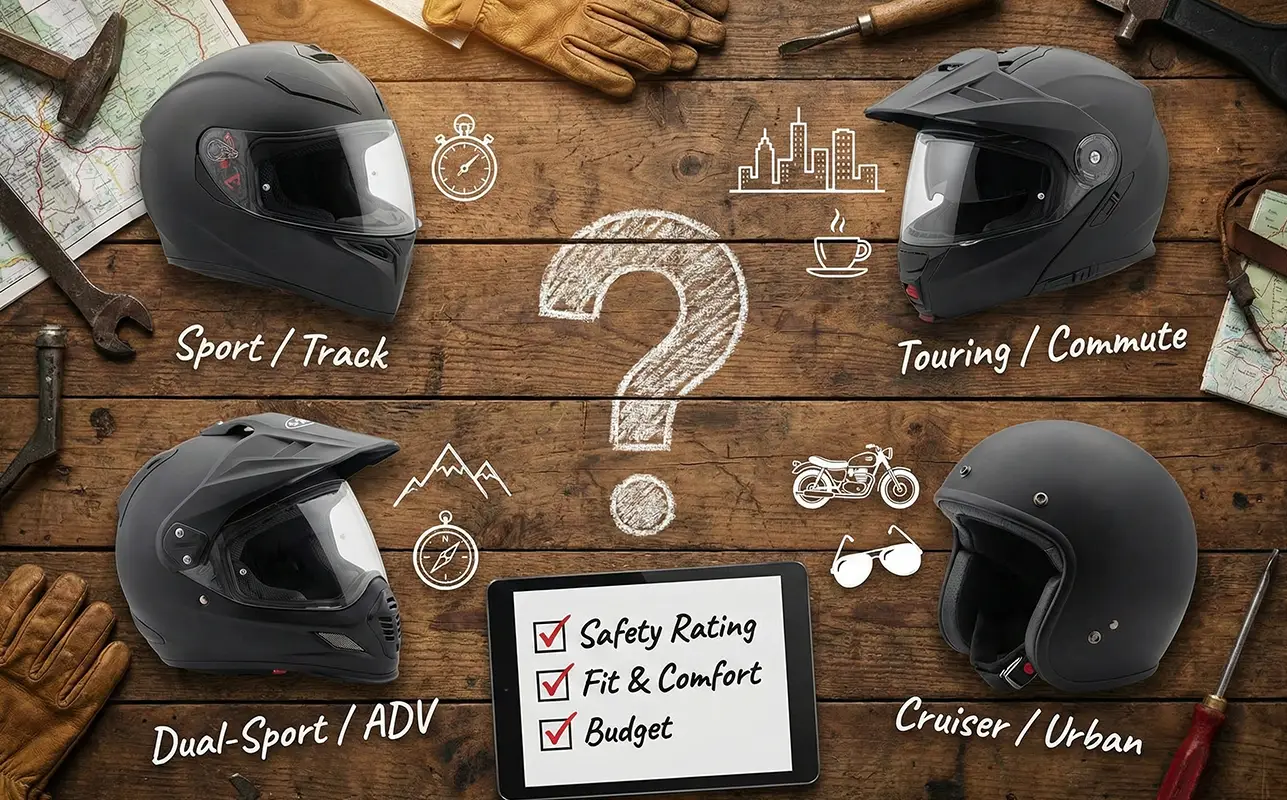
Choosing the right motorcycle helmet isn’t just about style—it’s literally a life-or-death decision. With countless options flooding the market, from full-face to half-shell designs, finding the perfect helmet can feel overwhelming.
For a deep dive into sizing, shapes, and materials, be sure to read our Ultimate Guide to Motorcycle Helmets.
Whether you’re a seasoned rider or just getting your motorcycle license, selecting a helmet that matches your riding style, comfort needs, and safety requirements is crucial.
This comprehensive guide breaks down the nine most popular helmet types to help you make an informed decision.
We’ve evaluated each option based on safety ratings, comfort, versatility, price point, and intended use. By understanding the unique advantages and limitations of each helmet style, you’ll be equipped to choose the one that not only protects your head but also enhances your overall riding experience.
1. Full-Face Helmet
The full-face helmet is the gold standard for motorcycle safety and the most popular choice among serious riders. This comprehensive design offers complete protection for your entire head, face, and jaw.
Overview
Full-face helmets feature a hard outer shell that wraps around your entire head, including a chin bar that protects your jaw and lower face. They come equipped with a flip-down visor that shields your eyes and face from wind, debris, insects, and weather conditions. The enclosed design creates a secure cocoon around your head, distributing impact forces across the entire helmet structure.
Modern full-face helmets incorporate advanced ventilation systems, moisture-wicking liners, and aerodynamic shapes that reduce wind noise and buffeting at highway speeds. They’re available in various materials including polycarbonate, fiberglass composite, and carbon fiber. Most full-face helmets meet or exceed DOT, ECE, and SNELL safety standards. If you are looking for value, check out our list of the best full-face motorcycle helmet for the money.
Pros and Cons
Pros:
- Maximum protection for head, face, and jaw—statistics show 35% of helmet impacts occur in the chin area.
- Superior weather protection keeping you warm in cold conditions and dry in rain.
- Reduced wind noise and fatigue during long rides, especially at highway speeds.
- Best aerodynamics minimize head buffeting and neck strain.
Cons:
- Can feel claustrophobic for new riders or those with anxiety about enclosed spaces.
- Limited peripheral vision compared to open-face designs.
- Heavier than other helmet types, potentially causing neck fatigue on very long rides.
Pricing: $100 – $800+ depending on materials and brand.
Best For: Sportbike riders, track days, and anyone prioritizing maximum safety.
2. Modular (Flip-Up) Helmet
Modular helmets offer the best of both worlds, combining full-face protection with the convenience of an open-face design. These versatile helmets feature a chin bar that flips up, transforming them instantly.
Overview
A modular helmet functions as a full-face helmet but includes a hinge mechanism that allows the entire front section—chin bar and visor—to flip upward. This innovative design lets you communicate easily at gas stations, check your map, or take a drink without removing your entire helmet. The flip-up feature makes these helmets particularly popular among touring riders and those who wear glasses.
When closed, quality modular helmets provide protection comparable to traditional full-face designs, though the hinge mechanism does add slight weight. Many modern modular helmets are dual-certified (P/J homologation), meaning they’re safety-rated in both the closed and open positions. You can find our top picks in our guide to the best motorcycle modular helmets.
Pros and Cons
Pros:
- Incredible convenience for quick stops without removing the helmet completely.
- Easier to put on and take off, especially beneficial for riders with glasses.
- Versatility to ride with chin bar up in parking lots or slow-speed situations.
- Full-face protection when closed with the convenience of open-face access.
Cons:
- Heavier than standard full-face helmets due to the hinge mechanism.
- Generally more expensive than comparable full-face models.
- The hinge represents a potential failure point in severe impacts compared to a solid chin bar.
Pricing: $200 – $900.
Best For: Touring riders, commuters, and delivery riders who need frequent face access.
3. Open-Face (3/4) Helmet
Open-face helmets provide a classic, retro look while offering protection for the top, back, and sides of your head. They’re the choice for riders who prioritize visibility and the feeling of freedom.
Overview
The open-face or three-quarter helmet covers your head from the crown down to the base of your skull and around your ears, but leaves your face completely exposed. This design offers an unobstructed field of vision and the sensory experience of feeling the wind on your face.
Popular among cruiser riders, scooter enthusiasts, and those who ride primarily in urban environments at lower speeds, these helmets evoke a vintage aesthetic that many riders love.
However, the lack of face protection means riders must use separate eye protection like goggles or sunglasses. They are often compatible with best motorcycle helmet for glasses wearers.
Pros and Cons
Pros:
- Maximum visibility with unrestricted peripheral vision.
- Lighter weight reduces neck strain on long rides.
- Superior ventilation keeps you cool in hot weather.
- Easier communication with passengers or other riders.
Cons:
- No face or chin protection—the most vulnerable areas in crashes.
- Minimal weather protection exposes face to rain, cold, and wind.
- Requires separate eye protection like goggles or face shield.
Pricing: $80 – $400.
Best For: Urban commuters, scooter riders, and cafe racer enthusiasts.
4. Half Helmet (Shorty)
Half helmets offer the absolute minimum in head protection while providing maximum freedom and style. These are the smallest, lightest helmets available and popular among cruiser and chopper enthusiasts.
Overview
Half helmets, also called shorty helmets or brain buckets, cover only the top portion of your head from your forehead to the base of your skull. They provide minimal coverage, typically ending just above your ears, leaving your face, ears, and much of your head exposed.
Despite their limited protection, DOT-approved half helmets must meet minimum safety standards. These helmets are incredibly lightweight and provide an almost unrestricted riding experience with maximum airflow. It is crucial to understand helmet safety ratings explained before choosing this style, as they offer the least protection of any legal helmet.
Pros and Cons
Pros:
- Extremely lightweight and comfortable for short rides.
- Maximum freedom and sensory connection to your surroundings.
- Stylish, minimalist aesthetic perfect for cruiser bikes.
- Excellent ventilation and no claustrophobic feeling.
Cons:
- Minimal protection—only covers the top of your head.
- No face, jaw, or ear protection whatsoever.
- Offers no weather protection from rain, wind, or cold.
Pricing: $50 – $200.
Best For: Cruiser riders who want the bare minimum legal coverage.
5. Dual-Sport (Adventure) Helmet
Dual-sport helmets are designed for riders who split their time between paved roads and off-road trails. These versatile helmets combine features from both dirt bike and street helmets.
Overview
Adventure or dual-sport helmets feature a distinctive design with an extended chin bar, a sun visor peak, and a more upright face opening compared to standard full-face helmets. The peak helps deflect sun, rain, and roost (dirt and debris kicked up by other riders).
These helmets are built to accommodate goggles as well as traditional visors, giving riders flexibility based on riding conditions. The larger eye port provides a wider field of vision essential for scanning trails. If you are unsure if you need this or a pure dirt lid, read our comparison on dual sport vs. dirt bike helmets.
Pros and Cons
Pros:
- Versatility for both on-road and off-road riding conditions.
- Excellent ventilation keeps you cool during physical riding.
- Wide field of vision for spotting trail obstacles and hazards.
- Peak visor provides sun protection and deflects debris.
Cons:
- Peak can catch wind at highway speeds causing head buffeting.
- Less aerodynamic than pure street helmets, increasing wind noise.
- May look oversized or awkward on standard street motorcycles.
Pricing: $150 – $700.
Best For: Adventure touring (ADV) riders who tackle both highways and fire roads.
6. Off-Road (Motocross) Helmet
Off-road helmets are purpose-built for dirt bike riding, motocross racing, and trail riding. They prioritize ventilation, light weight, and compatibility with goggles over weather protection.
Overview
Motocross helmets feature an aggressive, distinctive design with an elongated chin bar, large eye port, and prominent sun peak. Unlike street helmets, they don’t include a face shield since riders wear separate goggles that can be easily cleaned or replaced when covered in mud.
The extended chin bar creates space for breathing during intense physical exertion. Large ventilation ports allow maximum airflow. These are often the best lightweight carbon fiber helmet options available because weight reduction is critical for off-road performance.
Pros and Cons
Pros:
- Exceptional ventilation prevents overheating during physical riding.
- Lightweight design reduces neck fatigue on rough terrain.
- Extended chin bar provides excellent breathing room.
- Purpose-built for off-road impacts and conditions.
Cons:
- Not suitable for street riding—poor aerodynamics cause severe buffeting.
- Requires separate goggles which add cost and maintenance.
- No weather protection from rain or cold temperatures.
Pricing: $100 – $600.
Best For: Motocross, Enduro, and pure dirt bike riding.
7. Youth Helmet
Youth helmets are specifically designed for younger riders with smaller head sizes and different safety needs. These helmets ensure proper fit and protection for children and teenagers learning to ride.
Overview
Youth motorcycle helmets aren’t simply scaled-down adult helmets—they’re engineered specifically for younger riders’ anatomical differences. Children have different head proportions, with relatively larger heads compared to their neck strength, requiring helmets with specific weight distributions.
Quality youth helmets come in all the same styles as adult helmets—full-face, open-face, and off-road. Parents should prioritize safety certifications and proper sizing over style. To ensure the right fit, follow our guide on how to measure head for motorcycle helmet specifically for kids.
Pros and Cons
Pros:
- Specifically engineered for youth head sizes and proportions.
- Lighter weight appropriate for developing neck muscles.
- Fun graphics and colors encourage helmet wearing.
- Available in all styles to match young riders’ needs.
Cons:
- Requires frequent replacement as children grow quickly.
- Limited selection compared to adult helmet options.
- Can be expensive given the need for regular replacement.
Pricing: $80 – $200.
Best For: Children and young teenagers starting their riding journey.
8. Bluetooth-Integrated Helmet
Modern Bluetooth helmets come with built-in communication systems, allowing riders to stay connected while keeping their hands on the handlebars. These tech-forward helmets are revolutionizing the riding experience.
Overview
Bluetooth-integrated helmets feature factory-installed communication systems seamlessly built into the helmet’s design. Unlike aftermarket Bluetooth devices that clamp onto your helmet, integrated systems have speakers and microphones precisely positioned for optimal audio quality and minimal bulk.
These helmets allow riders to make phone calls, listen to music, hear GPS navigation instructions, and communicate with other riders. You can explore specific models in our guide to the best motorcycle helmets with bluetooth.
Pros and Cons
Pros:
- Seamless integration looks cleaner than aftermarket systems.
- Stay connected for calls, music, and navigation without stopping.
- Rider-to-rider communication enhances group riding safety.
- Voice command operation keeps hands on handlebars.
Cons:
- Significantly more expensive than standard helmets.
- Technology may become outdated as Bluetooth standards evolve.
- Battery requires regular charging and eventually degrades.
Pricing: $250 – $1,000.
Best For: Tech-savvy commuters and long-distance touring groups.
9. High-Performance Racing Helmet
Racing helmets represent the pinnacle of helmet technology, designed for professional and track-day riders who demand the absolute best in protection, aerodynamics, and weight savings.
Overview
High-performance racing helmets utilize cutting-edge materials and construction techniques to provide maximum protection with minimum weight. They typically feature carbon fiber or advanced composite shells that offer superior strength-to-weight ratios compared to standard helmets.
Racing helmets undergo rigorous testing and often carry multiple safety certifications including SNELL, FIM, and ECE ratings. They are also often candidates for the best quietest motorcycle helmets due to their extreme aerodynamic efficiency.
Pros and Cons
Pros:
- Absolute highest level of protection available using advanced materials.
- Extremely lightweight reduces neck fatigue and improves handling.
- Superior aerodynamics eliminate head movement at high speeds.
- Cutting-edge features like emergency removal systems and advanced ventilation.
Cons:
- Very expensive—premium models can cost $600-$1000+.
- May be overly specialized for casual street riding (tight fit).
- Typically have shorter replacement cycles recommended after any impact.
Pricing: $600 – $1,500+.
Best For: Track day enthusiasts and professional racers.
Finding the “best” helmet depends entirely on how you ride and the shape of your head. There is no single perfect helmet for everyone, but the right choice usually balances three things: Safety, Riding Style, and Fit.
To decide which is best for you, review these three categories.
Choose Based on Your Riding Style
Different helmets are built for different purposes.
| Sport / Track / Highway | Full-Face | Safest option. The chin bar is fixed, offering maximum protection for high-speed crashes. They are aerodynamic and quiet but can be hot in traffic. |
| Touring / Commuting / Glasses Wearer | Modular (Flip-Up) | The chin bar flips up, allowing you to talk, drink water, or get air at stoplights without removing the helmet. slightly heavier and noisier than full-face, but very versatile. |
| Cruiser / Scooter / City | Open-Face (3/4) | Covers top and sides but leaves the face exposed. Great visibility and airflow, but less safe (45% of impacts happen on the face/chin area). |
| Adventure / Dual-Sport | Dual-Sport (ADV) | A hybrid of street and dirt. Has a visor (peak) to block sun/roost and room for goggles, but with a face shield for highway riding. |
| Dirt / Motocross | Off-Road | Maximum airflow and lightweight. No face shield (requires goggles). Not aerodynamic for highway use. |
Check the Safety Ratings
Never buy a “novelty” helmet. Look for a sticker on the back or inside.
- DOT: The legal minimum in the US. (Acceptable, but basic).
- ECE (22.05 or 22.06): The European standard. generally considered safer and more up-to-date than DOT. Highly recommended.
- Snell: A voluntary, rigorous racing standard. If you ride aggressive sport bikes or on the track, look for this.
- FIM: The top-tier racing standard (MotoGP level). Overkill for most street riders but excellent safety.
The “Head Shape” Factor (Crucial!)
A trusted brand helmet will still give you a headache if it’s the wrong shape. Heads generally fall into three shapes:
- Long Oval: Head is longer front-to-back (common in Arai, Icon).
- Intermediate Oval: The most common shape (common in Shoei, HJC, Scorpion).
- Round Oval: Head is wider side-to-side (common in Biltwell, some Bell models).
The “Shake” Test: When you try a helmet on, fasten the strap. Shake your head side-to-side. The helmet should move with your skin, not slide over it. If it slides, it’s too big. If it creates a painful “hot spot” on your forehead within 5 minutes, it’s too small or the wrong shape.
Conclusion
Selecting the right motorcycle helmet ultimately depends on your specific riding style, environment, and priorities.
Full-face helmets offer unmatched protection for sport and touring riders, while modular designs provide convenience for long-distance travelers.
Cruiser enthusiasts might prefer the freedom of open-face or half helmets, accepting the trade-off in protection.
Consider where and how you ride most frequently—your daily commute requires different features than weekend canyon carving or dirt trail exploration. Don’t compromise on proper fit; even the most expensive helmet won’t protect you if it doesn’t fit correctly.
FAQs
How do I know if my motorcycle helmet fits properly?
A properly fitting helmet should feel snug but not painfully tight, with even pressure around your entire head. When you shake your head side to side, the helmet should move with your head rather than sliding around independently. You shouldn’t be able to fit more than one or two fingers between your forehead and the helmet padding.
What safety certifications should I look for in a motorcycle helmet?
At minimum, look for DOT (Department of Transportation) certification. ECE 22.05 (or 22.06) is the European standard and involves more rigorous testing. SNELL certification represents some of the most demanding safety testing available. Helmets with multiple certifications generally offer superior protection.
How often should I replace my motorcycle helmet?
Replace your helmet every five years from the manufacturing date, regardless of use. Helmet materials degrade over time due to UV exposure and sweat. Replace your helmet immediately after any significant impact, even if there’s no visible damage—the impact-absorbing foam may be compromised.
Can I wear a motorcycle helmet that’s been in a crash?
No, you should never wear a helmet that’s been in a crash. Helmets are designed to absorb impact energy by compressing the EPS foam liner. This compression is permanent and internal, meaning the helmet cannot protect you a second time.
What’s the difference between expensive and cheap motorcycle helmets?
Expensive helmets typically use lighter, stronger materials like carbon fiber instead of polycarbonate. They offer superior comfort with better ventilation, refined aerodynamics that reduce noise, and premium moisture-wicking liners. However, even inexpensive DOT-certified helmets meet minimum safety standards.