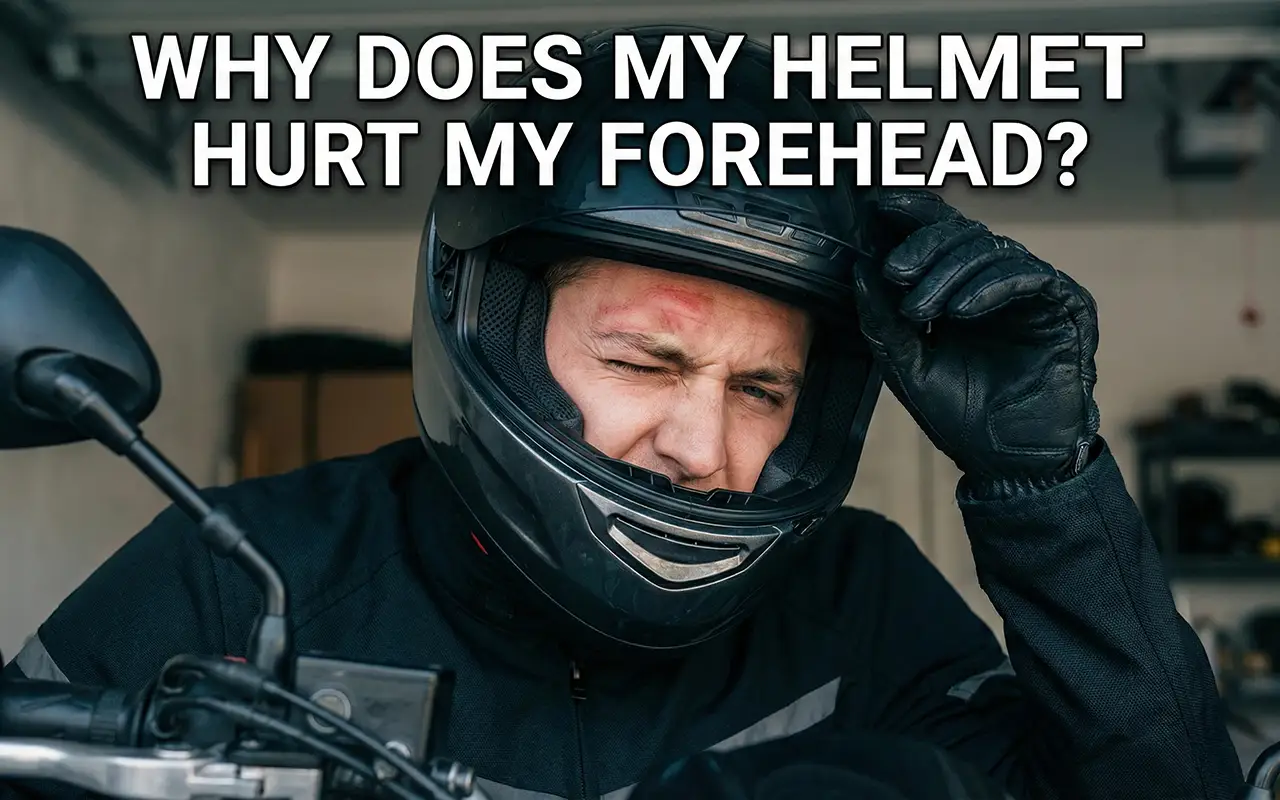
I’ll never forget the look on Jake’s face when he walked into my garage after his first long ride on the Pacific Coast Highway.
He’d just dropped three hundred dollars on a premium full-face helmet—one of those sleek Italian numbers with all the right certifications—and he looked like he’d gone ten rounds with a heavyweight boxer.
“My forehead feels like it’s in a vice,” he groaned, peeling off what should have been his dream helmet. The red pressure marks across his brow told the whole story.
This scene plays out thousands of times every day across the world. You invest in quality head protection, follow all the sizing charts, and yet within thirty minutes of riding, you’re dealing with a throbbing headache that makes you want to pull over and chuck your helmet into the nearest ditch.
The question “why does my motorcycle helmet hurt my forehead?” is one of the most common complaints I hear from riders, from absolute beginners to seasoned veterans switching to new gear.
According to industry surveys, approximately 60% of riders experience some form of helmet discomfort during their first year of ownership, with forehead pressure being the primary complaint.
Understanding helmet fit isn’t just about comfort—it’s fundamentally about safety and your willingness to actually wear proper protection.
As I discuss extensively in my Ultimate Guide to Motorcycle Helmets, a helmet that causes pain is a helmet you’ll be tempted to leave at home, which defeats the entire purpose of investing in quality protective gear. The good news? Forehead pain is almost always solvable once you understand the underlying causes.
The Anatomy of Helmet Pressure: Understanding Why Your Forehead Takes the Hit
Before we dive into solutions, we need to understand the biomechanics of what’s actually happening when your helmet hurts your forehead.
Your skull isn’t a perfect sphere—it’s an irregular ovoid shape with pronounced ridges, particularly around the supraorbital region (that’s the technical term for your brow ridge and forehead area). This region has relatively little soft tissue padding between skin and bone, making it particularly sensitive to sustained pressure.
When a helmet is placed on your head, it needs to distribute force across the entire contact surface. In a properly fitted helmet, this pressure should be even—you should feel consistent, firm contact around your entire head without any specific pressure points. The forehead, temples, and rear occipital region should all share the load equally.
However, helmet manufacturers face a significant challenge: they’re creating a product that needs to fit millions of differently-shaped heads using only a handful of shell sizes and liner configurations.
Most major manufacturers produce three to five different shell sizes across their entire size range (XS through XXL), using progressively thicker comfort liners to accommodate the size variations within each shell. This means an XS and a Small might share the same outer shell but have different thickness liners inside.
The forehead typically bears the brunt of fit issues because of how helmets are designed to stay secure. The retention system (chin strap) pulls the helmet down and back, which naturally drives the front of the helmet—the brow line—into your forehead. If the internal shape doesn’t match your head’s contours precisely, this pressure concentrates into specific points rather than distributing evenly.
The Six Primary Causes of Forehead Pain
1. Incorrect Size Selection
This is the most obvious culprit, yet it’s shockingly common. I’ve tested hundreds of helmets over my career, and I can tell you that helmet sizing is maddeningly inconsistent across manufacturers. A Medium in one brand might fit like a Large in another. European brands tend to run narrower than American brands. Asian-market helmets often have completely different internal dimensions despite matching external size labels.
The fundamental mistake most riders make is measuring their head circumference and then ordering based solely on that number. But circumference is just one dimension—your head shape matters enormously. Two riders with identical 58cm head circumferences might need completely different helmets if one has a round head shape and the other has a long oval shape.
When a helmet is too small overall, the forehead suffers first because it’s the most prominent forward point of contact. The liner compresses against your brow ridge, and unlike the padded sides of your head, there’s nowhere for that pressure to dissipate. As covered in detail in my Motorcycle Helmet Fitment Guide, proper sizing requires understanding both your head’s circumference and its shape profile.
2. Head Shape Mismatch
This is the issue that catches most riders off guard. Even if you’ve selected the correct size based on circumference, you can still experience severe forehead pressure if the helmet’s internal shape doesn’t match your head’s geometry.
Helmet manufacturers generally design their products around three basic head shapes: round oval, intermediate oval, and long oval. A round oval head is nearly circular when viewed from above. A long oval is noticeably elongated from front to back. Intermediate oval falls somewhere in between and is considered the “average” shape that most manufacturers target.
Here’s where it gets problematic: if you have a long oval head and buy a helmet designed for round oval heads, the helmet will be too tight front-to-back and too loose side-to-side. To get the sides snug enough to prevent the helmet from rotating, you’ll need to size down, which then crushes your forehead and the back of your skull. Conversely, a round-headed rider in a long-oval helmet will have gaps at the forehead and rear while experiencing pressure at the temples.
Different manufacturers cater to different head shapes, often based on their primary market. Arai helmets, for instance, are renowned for accommodating rounder head shapes, while Shoei tends toward intermediate oval, and AGV often runs long oval. This is why you might find one premium brand excruciating and another perfectly comfortable despite both being the “correct” size.
3. The Break-In Period Misconception
Let’s address one of the most persistent and dangerous myths in motorcycling: “It’ll break in.” Yes, helmet liners do compress and conform to your head shape over time. The comfort padding will pack down, the cheek pads will soften, and the overall fit will loosen slightly. However—and this is critical—if your helmet is causing significant pain from day one, breaking it in won’t solve the problem.
A properly fitted new helmet should feel snug and firm, but not painful. You should feel even pressure around your entire head. Your cheeks should be compressed slightly, and the helmet should be difficult to put on and take off. But if you’re experiencing sharp, localized pain at your forehead within the first 15-20 minutes of wear, that’s not a break-in issue—that’s a fit issue.
The liners will typically compress about 15-20% over the first few months of regular use. This is why experienced riders often recommend buying a helmet that feels almost too tight initially. But that tightness should be distributed evenly. If you’re already experiencing concentrated pressure points, that 15-20% compression will simply mean the helmet becomes loose everywhere except at those pressure points, which will continue to hurt.
4. Liner Degradation and Compression
On the flip side of the break-in period, we have the opposite problem: helmets that used to fit perfectly but now cause forehead pain. This typically happens with helmets that are several years old or have seen heavy use.
The comfort liner in your helmet is made from materials designed to compress and rebound—usually expanded polystyrene (EPS) foam covered with comfort padding made from open-cell foam or memory foam. Over time and with repeated use, these materials lose their resilience. The comfort padding compresses permanently, and the helmet begins to settle deeper onto your head.
When this happens, the helmet’s internal retention system—the structure that keeps the liner positioned correctly inside the shell—can begin pressing against your forehead. In some designs, there are hard plastic or composite reinforcement structures near the brow line that you never felt when the liner was fresh. As the liner compresses, these structures move closer to your skin, creating new pressure points.
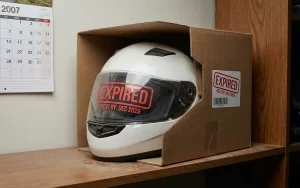
This is one reason why helmet manufacturers recommend replacement every five years, even if the helmet hasn’t been in an accident. It’s not just about the degradation of the impact-absorbing EPS liner (though that’s important); it’s also about the comfort and fit changing over time. If you’re interested in understanding more about helmet longevity, check out my article on When to Replace Your Motorcycle Helmet.
5. Aftermarket Accessories and Modifications
Modern riders often add communication systems, action cameras, and other accessories to their helmets. While these additions seem innocuous, they can significantly alter how a helmet sits on your head and how pressure is distributed.
Bluetooth communication systems that mount to the side of the helmet can create a fulcrum effect, tilting the helmet slightly and changing how the brow line contacts your forehead. Camera mounts on top add weight that pulls the helmet forward, increasing pressure at the front. Even something as simple as adding thicker cheek pads can change the helmet’s angle and cause new pressure points to develop.
I’ve seen riders who were perfectly comfortable with their helmet suddenly develop severe forehead pain after installing a communication system. The added bulk on one or both sides pushed the helmet up slightly, changing the angle of attack at the brow line. If you’re experiencing forehead pain and you’ve recently added accessories, try removing them temporarily to see if the problem resolves.
6. Wearing Position and Adjustment Issues
This might sound too simple, but many riders simply wear their helmets incorrectly. A helmet should sit level on your head with the brow line approximately one finger-width above your eyebrows. If you’re wearing it too far forward (pushed down toward your eyes), you’re driving the brow pad directly into your forehead with excessive force.
Similarly, if your chin strap isn’t properly adjusted, it can pull the helmet into an unnatural position. The strap should be snug enough that you can only fit one or two fingers between the strap and your chin, and it should be centered—not pulled to one side. An off-center or too-tight chin strap will torque the helmet and create uneven pressure distribution, often concentrating at the forehead.
Material Considerations: How Helmet Construction Affects Forehead Comfort
The materials used in helmet construction play a significant role in how pressure is distributed across your forehead. Modern helmets use various shell materials, each with different properties that affect fit and comfort.
Polycarbonate shells, common in budget and mid-range helmets, are injection-molded thermoplastic. These shells tend to be slightly thicker and heavier than composite alternatives, and they typically come in fewer shell sizes—meaning manufacturers rely more heavily on liner thickness variations to achieve different sizes. This can result in less precise fit, particularly around the forehead, in the smaller and larger ends of the size range.
Composite shells—made from fiberglass, carbon fiber, Kevlar, or combinations thereof—can be manufactured in more shell sizes because they’re hand-laid rather than molded. Premium manufacturers often produce five or more distinct shell sizes across their range, allowing for more precise internal geometry. This typically translates to better pressure distribution and fewer forehead issues. For a deeper dive into these material differences, see my comparison of Carbon Fiber vs. Polycarbonate Helmets.
The liner material matters too. Traditional EPS foam is effective for impact absorption but doesn’t conform to individual head shapes as well as more advanced multi-density liners. Some manufacturers now use EPP (expanded polypropylene) or multi-density EPS constructions that provide better comfort while maintaining safety standards. These advanced liners can significantly reduce pressure points, including forehead discomfort.
Solutions: How to Fix Your Forehead Pain
Immediate Adjustments You Can Try Today
Before you throw money at the problem, try these simple adjustments that might resolve your forehead pain immediately:
Reposition your helmet: Take your helmet completely off and put it back on, paying careful attention to how it sits. Make sure it’s level and not tilted forward. The front edge should be about one finger-width above your eyebrows. Many riders unconsciously push their helmets too far forward, which drives the brow pad into the forehead.
Adjust your chin strap: Loosen your chin strap slightly and make sure it’s centered under your chin. An overtightened or off-center strap can pull the helmet into an unnatural position. The strap should be snug but not strangling—you should be able to fit one or two fingers between the strap and your throat.
Check for debris: Remove your liner and inspect both the liner and the inside of the shell for any debris, bunched-up fabric, or manufacturing defects. I once spent an hour troubleshooting severe pressure points only to discover a small plastic tag that hadn’t been removed during manufacturing was digging into the rider’s forehead.
Wear it around the house: Put your helmet on and wear it while watching TV or doing other stationary activities for 30-45 minutes. This removes the variables of wind pressure, vibration, and riding posture. If the pain persists even when you’re sitting still, it’s definitely a fit issue, not a riding position issue.
Liner Modifications and Replacements
If simple adjustments don’t resolve the issue, liner modification is your next step. Most quality helmets have removable and replaceable comfort liners, allowing you to customize the fit.
Replace the brow pad: Many manufacturers sell replacement liner pieces separately. If your forehead is taking excessive pressure, try installing a thinner brow pad. Some riders find that removing the brow pad entirely for the first few weeks of break-in, then reinstalling it once the rest of the liner has compressed, provides the perfect fit.
Add strategic padding: Counterintuitively, sometimes adding padding in other areas can relieve forehead pressure. If you have gaps at the sides or rear of your head, the helmet can rock forward, concentrating pressure at the brow. Adding stick-on foam pads at the temples or rear can stabilize the helmet and distribute pressure more evenly.
Professional liner customization: Some shops offer custom liner services where they’ll heat-form the comfort padding to match your specific head shape. This is particularly useful for riders with unusual head shapes or those who’ve had injuries that created asymmetries.
Wash and fluff your liner: If your helmet is a few months old and the liner has compressed, washing it can help restore some loft to the foam. Use gentle detergent and cool water, and allow it to air dry completely. This won’t work miracles, but it can provide temporary relief. For detailed instructions, see my guide on How to Wash Your Motorcycle Helmet Liner.
When to Accept Defeat and Buy a Different Helmet
Sometimes, despite your best efforts, a particular helmet simply doesn’t match your head shape. This is not a failure on your part—it’s just biomechanical reality. If you’ve tried all the adjustments and modifications above and you’re still experiencing pain after 15-20 minutes of wear, it’s time to accept that this helmet isn’t right for you.
This is an expensive lesson, which is why I always recommend buying from retailers with generous return policies. Many online retailers now offer 30-day comfort guarantees, allowing you to ride with the helmet and return it if it doesn’t work out. Brick-and-mortar shops may have stricter policies, but building a relationship with a good local shop often means they’ll work with you on exchanges.
When shopping for a replacement, focus on brands known for your head shape. If you’ve determined you have a long oval head, research which manufacturers cater to that shape. Try multiple brands in the same size—you’ll be amazed at how different they feel despite being nominally the same size.
Prevention: Buying the Right Helmet the First Time
The best solution to forehead pain is preventing it in the first place through informed helmet selection. Here’s my professional process for ensuring a proper fit:
Measure Correctly
Use a soft measuring tape to measure the circumference of your head at its widest point—typically about one inch above your eyebrows and around the largest part of the back of your head. Measure at least three times and use the largest measurement. If you’re between sizes, start with the smaller size—remember, the helmet will break in.
Determine Your Head Shape
Stand in front of a mirror and look at your head from above (or have someone take a photo from directly overhead). Is your head nearly circular, or is it noticeably longer from front to back? This will help you identify whether you need a round oval, intermediate oval, or long oval helmet.
Try Before You Buy
Whenever possible, try helmets on in person. Put the helmet on and wear it for at least 15 minutes while in the shop. Walk around, look up and down, shake your head vigorously. A properly fitted helmet should stay planted on your head without shifting. You should feel firm, even pressure around your entire head—no specific pressure points, but also no loose spots.
The cheek pads should compress your cheeks slightly, and you should feel slight pressure on the crown of your head. Your forehead should feel contacted but not compressed. If you can feel the hard edge of the helmet’s brow opening pressing against your forehead, the helmet is either too small or not the right shape for your head.
Consider Helmet Type
Different helmet styles have different internal geometries that can affect forehead comfort. Full-face helmets tend to have the most precise fit requirements, while modular helmets often have slightly more forgiving internal dimensions due to their hinged design. Open-face helmets obviously have no brow line at all, eliminating forehead pressure entirely (though at the cost of significantly reduced protection). For more on these differences, check out my comparison of Full Face vs. Modular vs. Open Face Helmets.
If you’re new to motorcycling and unsure where to start, I’ve compiled recommendations in my article on Best Motorcycle Helmets for Beginners, focusing on models with forgiving fit characteristics and good comfort out of the box.
Advanced Considerations: Other Factors That Affect Forehead Comfort
Riding Position and Wind Pressure
Your riding position significantly affects how wind pressure loads your helmet, which in turn affects where pressure concentrates on your head. Sport bike riders in an aggressive tuck experience dramatically different wind forces than cruiser riders sitting upright.
In a tucked position, wind strikes the top of the helmet and tries to pry it backward and upward. This can actually relieve some forehead pressure as the helmet lifts slightly. However, it also means you need a tighter fit overall to prevent the helmet from moving around, which can create pressure points.
Upright riders face wind directly on the front of the helmet, which pushes it backward, potentially driving the brow line into the forehead. This is why cruiser riders often experience different fit issues than sport riders, even in the same helmet.
Wind buffeting—turbulent air that causes the helmet to shake and vibrate—can also exacerbate forehead pain. A helmet that feels fine in still air might become unbearable at highway speeds due to constant pressure fluctuations at the brow line. If you’re experiencing this, consider a helmet designed for better aerodynamics or a windscreen upgrade for your bike. My guide to the Best Quietest Motorcycle Helmets includes models with excellent aerodynamic stability.
Weight Distribution
Helmet weight affects how pressure is distributed on your head. Heavier helmets create more downward force, which can concentrate pressure at the primary contact points—often the forehead and the base of the skull.
This is one area where premium lightweight helmets really shine. A carbon fiber helmet might weigh 1200-1300 grams compared to 1600-1700 grams for a polycarbonate equivalent. That 400-500 gram difference might not sound like much, but over the course of a long ride, it translates to significantly reduced neck fatigue and less pressure on your forehead. If weight is a concern, see my recommendations for the Best Lightweight Carbon Fiber Helmets.
Temperature and Humidity
Environmental conditions affect how your helmet fits and feels. In hot weather, your head swells slightly due to increased blood flow to the skin for cooling. This can turn a helmet that fits perfectly in cool conditions into an instrument of torture on a hot summer day.
Similarly, humidity affects the comfort liner materials. Some foams absorb moisture and swell, while others compress when wet. If you’re experiencing forehead pain only in certain weather conditions, this might be the culprit.
The solution is to account for the worst-case scenario when fitting your helmet. If you primarily ride in hot weather, try the helmet on after you’ve warmed up—do some jumping jacks in the shop to get your blood flowing and your head to its “riding” size. If you ride in varied conditions, you might need to compromise, accepting that the helmet will feel slightly loose in cool weather to ensure it doesn’t become painful in heat.
Medical Considerations: When Forehead Pain Isn’t Just About Fit
While most forehead pain is indeed caused by fit issues, it’s worth considering medical factors that can contribute to or exacerbate discomfort.
Tension Headaches and Migraines
If you’re prone to tension headaches or migraines, helmet pressure can trigger or worsen these conditions. The sustained pressure around your head, combined with the stress of riding, can create a perfect storm for headache development.
If you experience headaches that persist after removing your helmet or that seem disproportionate to the actual pressure you’re feeling, consult with a physician. Some riders find that addressing underlying headache conditions with medication or other treatments dramatically improves their helmet comfort.
Sinus Issues
Sinus congestion or chronic sinusitis can make your forehead and facial bones more sensitive to pressure. If you’re experiencing forehead pain primarily when you’re congested or during allergy season, this might be a contributing factor rather than a pure fit issue.
Temporomandibular Joint (TMJ) Disorders
TMJ problems can create referred pain that manifests as forehead discomfort. The chin strap pressure, combined with jaw clenching (which many riders do unconsciously while riding), can aggravate TMJ issues and create the sensation of forehead pain even when the helmet fit is actually correct.
Previous Injuries
If you’ve had facial fractures, skull injuries, or even dental work that changed your facial structure, these can affect how a helmet fits and where pressure concentrates. Asymmetries from injuries might mean you need custom liner work to achieve a comfortable fit.
Brand-Specific Fit Characteristics: A Professional’s Observations
After testing hundreds of helmets across dozens of manufacturers, I’ve developed a sense of which brands tend to work for which head shapes and sizes. While individual models vary, here are some general observations:
Arai: Tends toward rounder, more spherical internal shapes. Excellent for round oval heads, but can create forehead pressure for long oval riders. Premium comfort liners that break in beautifully.
Shoei: Generally intermediate oval with excellent quality control. Consistent fit across their range. Good starting point for most riders.
AGV: Often runs long oval, particularly in their sport-focused models. Great for riders who find most helmets too tight front-to-back. Can feel loose at the temples for round-headed riders.
Icon: distinctively Long Oval. Their internal shape is narrower side-to-side and longer front-to-back than almost any other major mass-market brand. If you have a “long” head and suffer from forehead pain in almost every other helmet, Icon is often the answer.
HJC: The definition of Intermediate Oval. They aim for the center of the market to fit the maximum number of riders. If you aren’t sure what your head shape is, HJC is often a safe baseline to start testing with.
Scorpion: Generally Intermediate Oval, but they are notorious for running slightly small/snug. Their padding is plush but thick. Many riders find they need to go up one size in Scorpion compared to HJC or Shoei to relieve forehead pressure.
Schuberth: A very specific Round/Short Oval fit. These German touring helmets are incredibly quiet and premium, but they have a shorter front-to-back internal dimension. If you have a long oval head, a Schuberth will almost certainly cause severe forehead pain; however, for rounder heads, they offer unparalleled comfort.
The Bottom Line: Comfort Is Safety
If there is one takeaway I want you to leave with, it’s this: Do not tough it out.
There is a pervasive “tough guy” culture in motorcycling that suggests discomfort is just part of the price of admission. That is nonsense. A helmet that hurts your forehead is a distraction. When you are doing 70mph down the highway, part of your brain shouldn’t be focused on the vice-grip crushing your skull—it should be 100% focused on the road, the traffic, and your controls.
Pain causes fatigue. Fatigue slows reaction times. Therefore, a painful helmet is an unsafe helmet, regardless of how many safety certifications are stamped on the back.
Your forehead pain is trying to tell you something—usually that your helmet is the wrong shape for your head, or occasionally the wrong size. Don’t ignore that signal. Whether it means adjusting your current liner, buying thinner pads, or biting the bullet and switching to a brand that actually matches your head shape, solving this issue will transform your riding experience.
Jake, the rider I mentioned at the start of this article? He ended up swapping that expensive Italian lid for a less expensive, long-oval helmet from a different brand. The price tag was lower, but the fit was perfect. The next time he pulled into my garage, he didn’t look like he’d been in a boxing match—he just looked like a rider who didn’t want the ride to end.
Find the lid that fits, and ride safe.
FAQs About Helmet Fit and Forehead Pain
Is it normal for a new motorcycle helmet to hurt my forehead?
No, sharp pain is never normal. While a new helmet should feel snug and may cause a general sense of “tightness” or “chipmunk cheeks,” it should not cause localized, sharp pain or a throbbing headache. If you feel a distinct pressure point on your forehead within 15 to 20 minutes of wearing the helmet, it is likely the wrong head shape for you, not just a matter of breaking it in.
How long does it take to break in a motorcycle helmet?
A helmet typically breaks in after about 15 to 20 hours of riding time. During this period, the soft comfort liner will compress by approximately 15-20%, conforming better to your face. However, the hard EPS foam (the safety liner) does not break in. If the hard foam is pressing against your forehead bone now, it will likely still be pressing against it 20 hours later.
Can I fix forehead pressure by compressing the foam myself?
Some riders use the “spoon trick”—using the back of a spoon to rub and slightly compress the hard EPS foam at the pressure point. While this is a common forum hack, it is not recommended by manufacturers because it technically compromises the safety liner’s ability to absorb impact in that specific spot. A safer alternative is to replace the soft comfort padding with a thinner version if the manufacturer offers it.
How do I know if I have a “Long Oval” head shape?
The easiest way is to have a friend take a photo of the top of your head, or look in a mirror while holding a second mirror above you. If your head looks significantly longer from front to back than it is wide (like an American football or an egg), you are likely a Long Oval. If your head looks nearly circular (like a soccer ball), you are likely a Round Oval. If you are Long Oval but wear a Round Oval helmet, you will almost certainly experience forehead pain.
Why does my helmet leave a red mark on my forehead?
A red mark indicates concentrated blood flow and pressure. A faint red mark that fades within a few minutes of taking the helmet off is common with a snug fit. However, a deep red indentation that is tender to the touch or takes a long time to fade is a sign of a “hot spot.” This means the helmet is pressing too hard on that specific area, likely due to a shape mismatch.
Can wearing a balaclava or head sock help with forehead pain?
Sometimes. A thin silk or synthetic balaclava can reduce friction and help the helmet slide into a more natural position, preventing the liner from bunching up against your forehead. However, if the helmet is physically too small or the wrong shape, adding a layer of fabric (even a thin one) typically adds more tightness rather than relieving it.
My helmet fit fine in the store, so why does it hurt when I ride?
There are two common reasons for this. First, wind pressure at highway speeds pushes the helmet back against your face, intensifying pressure on the forehead that wasn’t present in a static store environment. Second, “hot spots” often take 30 to 45 minutes to develop into noticeable pain. This is why we recommend wearing the helmet around your house for at least 30 minutes before taking the tags off and riding.