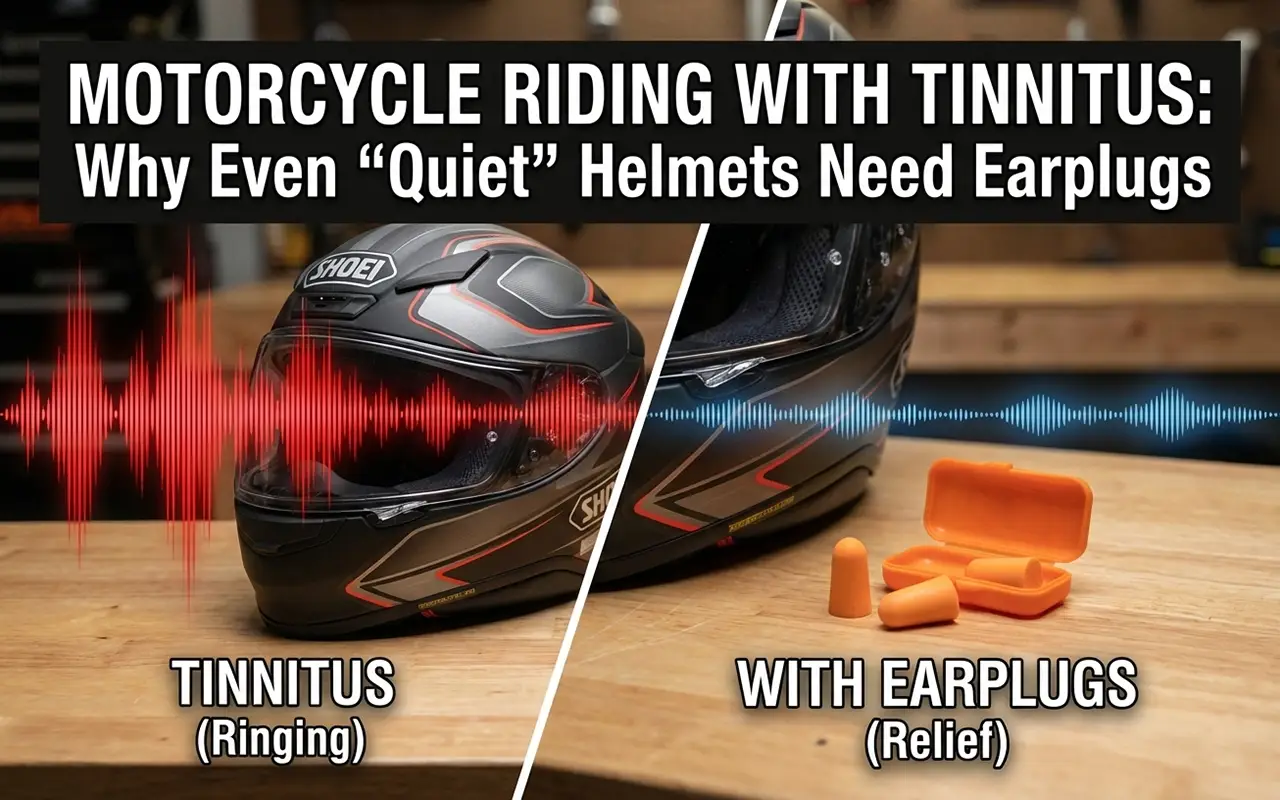
I’ll never forget the day a veteran rider pulled me aside at a track event and asked me to repeat myself—three times. He wasn’t being rude; he simply couldn’t hear me over the constant ringing in his ears.
At fifty-two, after three decades of riding without hearing protection, he’d developed severe tinnitus that no amount of silence could cure.
The irony? He’d just invested in a premium “quiet” helmet, believing it would solve his problem. It was too late for prevention, but his story changed how I approach every ride.
The motorcycle industry has made remarkable strides in helmet noise reduction over the past decade. Manufacturers now tout decibel ratings, aerodynamic shell designs, and advanced sealing systems that promise library-quiet rides.
Yet audiologists who specialize in motorcycle-related hearing damage will tell you a different story: even the Best Quietest Motorcycle Helmets still expose riders to dangerously high noise levels.
This isn’t a failure of engineering—it’s a matter of physics and biology. Understanding why even quiet helmets need earplugs requires diving deep into acoustics, helmet design, and the surprising vulnerability of human hearing.
For comprehensive information on helmet selection and safety features, check out our Ultimate Guide to Motorcycle Helmets.
The Decibel Deception: What “Quiet” Really Means
When helmet manufacturers claim their product is “quiet,” they’re speaking in relative terms that can be dangerously misleading. A premium helmet might reduce wind noise by 5-10 decibels compared to a budget option, which sounds modest until you understand that the decibel scale is logarithmic.
A 10-decibel reduction means the sound intensity is cut in half—a significant achievement in acoustic engineering. However, this still leaves riders exposed to sustained noise levels between 95 and 105 decibels at highway speeds.
To put this in perspective, the National Institute for Occupational Safety and Health (NIOSH) recommends limiting exposure to 85 decibels to no more than eight hours. At 100 decibels—a typical level inside even a “quiet” helmet at 70 mph—the safe exposure time drops to just fifteen minutes.
Your Sunday afternoon ride to the coast? You’ve exceeded safe exposure limits before you’ve left the suburbs. The cumulative effect is what makes this insidious: hearing damage from noise exposure is permanent, progressive, and often unnoticed until it’s too late.
The Three Types of Helmet Noise
Understanding why even quiet helmets need earplugs requires examining the three distinct sources of noise that assault your ears during every ride. First, there’s aerodynamic noise—the whooshing, roaring sound created as air flows over and around your helmet.
This is the noise that manufacturers have made the most progress in reducing through computational fluid dynamics and wind tunnel testing. Modern helmets with optimized shell shapes and spoilers can significantly reduce this turbulent airflow, especially at higher speeds.
Second, mechanical noise from the motorcycle itself—engine vibration, exhaust note, and drivetrain sounds—travels through the bike’s frame, up through your body, and resonates in your skull and helmet cavity. This is why riders of different motorcycle types experience varying noise profiles.
A smooth inline-four sportbike creates different acoustic challenges than a thumping V-twin cruiser, and helmet design alone cannot address mechanical transmission of sound through bone conduction.
Third, and often overlooked, is resonant cavity noise. Your helmet creates an acoustic chamber, and certain frequencies can actually amplify inside this space.
This is why some riders experience that maddening whistle or hum at specific speeds—the helmet’s interior dimensions are creating standing waves at particular frequencies.
Even the best lightweight carbon fiber helmet options, despite their advanced materials and construction, cannot completely eliminate this phenomenon.
The Biology of Hearing Damage: Why Every Decibel Matters
Inside your inner ear, approximately 16,000 hair cells translate sound vibrations into electrical signals your brain interprets as hearing. These microscopic structures are remarkably sensitive and completely irreplaceable.
When exposed to excessive noise levels, these hair cells bend, break, and eventually die. Unlike skin cells or blood cells, they never regenerate. Once they’re gone, they’re gone forever, taking a portion of your hearing with them.
The insidious nature of noise-induced hearing loss is that it typically begins in frequencies you don’t immediately miss. The damage usually starts around 4,000 Hz—the frequency range where consonant sounds like “s,” “f,” and “th” live.
You might not notice you’re losing these frequencies while riding, but you’ll struggle to understand speech in noisy environments. Your partner will complain you’re not listening, when in reality, you literally can’t hear them clearly anymore.
Tinnitus—that persistent ringing, buzzing, or hissing in your ears—often accompanies noise-induced hearing loss. It’s your brain’s response to missing input from damaged hair cells, essentially creating phantom sounds to fill the void.
For some riders, it’s a mild annoyance. For others, it’s a debilitating condition that affects sleep, concentration, and quality of life. I’ve interviewed riders who’ve given up motorcycling entirely because their tinnitus became unbearable, and every one of them wished they’d started wearing earplugs decades earlier.
The “Quiet Helmet” Marketing Myth
The motorcycle helmet industry has latched onto “quiet” as a premium selling point, and with good reason—riders want it. But the marketing often creates unrealistic expectations about what’s actually achievable.
I’ve tested dozens of helmets in controlled environments and on real-world rides, and while there are definitely quieter and louder options, none eliminate the need for hearing protection at typical riding speeds and durations.
Part of the problem is the lack of standardized testing for helmet noise levels. Unlike Helmet Safety Ratings Explained through DOT, ECE, or SNELL certifications, there’s no universally accepted protocol for measuring and reporting helmet noise.
Some manufacturers test in wind tunnels at specific speeds, others use on-bike measurements, and many simply rely on subjective rider feedback. This makes meaningful comparisons between models nearly impossible.
When you see a helmet advertised as “the quietest ever,” dig into the fine print. Often, these claims are based on specific test conditions—perhaps at 60 mph with a particular bike, riding position, and body type. Change any of these variables, and the results change dramatically.
A helmet that’s whisper-quiet on an upright adventure bike might howl like a banshee on a sportbike with an aggressive riding position. The relationship between helmet design and Motorcycle Helmet Fitment Guide principles is critical here—a poorly fitting “quiet” helmet will always be louder than a well-fitted standard helmet.
Premium Materials Don’t Equal Silence
There’s a common misconception that expensive helmet materials automatically mean quieter rides. While Carbon Fiber vs. Polycarbonate Helmets differ in weight, strength, and construction techniques, the shell material has surprisingly little impact on interior noise levels.
What matters far more is the overall shape, the quality of the seal between helmet and rider, the effectiveness of the chin curtain and breath box, and the density and placement of interior padding.
I’ve ridden with $800 carbon fiber helmets that were noticeably louder than $300 polycarbonate models. The difference came down to design details: how well the face shield sealed, whether the vents created turbulence, and how effectively the neck roll blocked air intrusion from below.
These are the unglamorous details that actually determine real-world noise levels, but they don’t make for compelling marketing copy.
The Modular Helmet Noise Penalty
If you’re shopping for Best Motorcycle Modular Helmets, you need to understand that convenience comes with an acoustic cost.
The flip-up mechanism that makes modular helmets so practical for urban riding, glasses wearers, and touring stops creates additional seams and gaps where noise can infiltrate. Even the best-engineered modular helmets struggle to match the noise isolation of a well-designed full-face helmet.
This doesn’t mean modular helmets are bad choices—their benefits for certain riding styles are undeniable. But it does mean that if you’re riding a modular, earplugs become even more critical.
The noise penalty can range from 3 to 8 decibels compared to equivalent full-face models, which translates to significantly increased hearing damage risk over time. When comparing Full Face vs. Modular vs. Open Face Helmets, noise exposure should be a major consideration alongside convenience and safety factors.
Why Earplugs Work (And Which Ones to Choose)
Here’s the beautiful simplicity of earplugs: they reduce all incoming noise by 15-33 decibels, depending on the type and fit. This brings even the loudest helmet at highway speeds down into safe or near-safe exposure ranges. But not all earplugs are created equal, and the cheap foam plugs from the hardware store aren’t optimal for motorcycling.
Foam earplugs provide the highest noise reduction rating (NRR)—typically 32-33 decibels—but they block sound indiscriminately across all frequencies.
This means you lose situational awareness: traffic sounds, sirens, horns, and your bike’s engine note all become muffled. For motorcycle riding, this creates a safety concern that outweighs the hearing protection benefit for many riders.
Motorcycle-specific earplugs use acoustic filters to reduce harmful noise levels while preserving important frequencies. These filtered plugs typically offer 15-20 decibel reduction, which sounds like less protection but is actually more effective for riding.
They attenuate the damaging wind roar and high-frequency noise while allowing you to hear traffic, communication systems, and your motorcycle’s mechanical sounds.
Brands like Alpine MotoSafe, Earpeace, and Pinlock ProSound have designed products specifically for the unique acoustic environment inside a motorcycle helmet.
Custom-molded earplugs represent the gold standard for regular riders. An audiologist takes impressions of your ear canals and creates plugs that fit perfectly, providing consistent protection and all-day comfort.
They’re expensive—typically $150-300—but for riders logging serious miles, they’re worth every penny. The superior seal means more predictable noise reduction, and the comfort means you’ll actually wear them on every ride instead of leaving them in your jacket pocket.
The Bluetooth Helmet Conundrum
The rise of Best Motorcycle Helmets with Bluetooth has created a new wrinkle in the hearing protection discussion. Many riders assume that if they’re listening to music or navigation through helmet speakers, they don’t need earplugs.
This is dangerously backward logic. In fact, Bluetooth-equipped riders often need hearing protection more than anyone else.
Here’s why: to hear your music or GPS directions over wind noise, you’ll naturally increase the volume. Without earplugs, you might crank your system up to 85-95 decibels just to hear it clearly.
Now you’re exposing your ears to both the ambient helmet noise AND loud audio—a double assault on your hearing. With earplugs, you reduce the background noise, which means you can keep your audio at safer, lower volumes and still hear it clearly.
Some communication systems now offer “earbud” style speakers designed to be worn with earplugs, or even integrated earplug-speaker combinations.
These represent the best of both worlds: hearing protection from wind noise plus clear audio at safe volumes. If you’re serious about long-term hearing preservation while staying connected, this is the direction to explore.
The Psychological Barrier: Why Riders Resist Earplugs
Despite overwhelming evidence for their necessity, many riders still refuse to wear earplugs. I’ve heard every excuse: “I need to hear traffic,” “They’re uncomfortable,” “I feel disconnected from my bike,” or simply “I’ve never worn them and I’m fine.” Let’s address these concerns directly, because they’re keeping riders from protecting their irreplaceable hearing.
The “I need to hear traffic” argument is the most common and the most easily disproven. Studies have shown that riders wearing appropriate earplugs actually have better situational awareness than those without. Why? Because they’re not fatigued by constant noise exposure.
Wind roar is mentally exhausting, and it masks the specific sounds you actually need to hear—like an approaching siren or a car’s engine note. Quality earplugs reduce the fatiguing noise while preserving the important audio cues.
The comfort complaint is valid if you’re using the wrong earplugs. Cheap foam plugs can be uncomfortable, especially under helmet pressure. But modern motorcycle-specific earplugs are designed for extended wear under helmets.
They’re low-profile, soft, and many riders forget they’re even wearing them after the first few minutes. If you’ve tried earplugs once and found them uncomfortable, don’t give up—try different types until you find ones that work for your ears.
The “disconnected from my bike” concern reveals something important about motorcycle culture: we romanticize the sensory experience of riding. The sound of the engine, the rush of wind, the mechanical symphony of our machines—these are part of why we ride.
I understand this completely, but here’s the reality: you can enjoy all of these sounds while protecting your hearing. Earplugs don’t eliminate sound; they reduce it to safe levels. You’ll still hear your engine, still feel connected to your bike, but you’ll be able to keep enjoying these sensations for decades to come.
The Real Cost of “I’m Fine”
The most dangerous excuse is “I’ve never worn them and I’m fine.” Hearing damage is cumulative and insidious. You won’t notice it happening until it’s already done.
By the time you realize you’re not fine—when you’re asking people to repeat themselves, when you can’t follow conversations in restaurants, when the ringing in your ears keeps you awake at night—the damage is permanent and irreversible.
I’ve interviewed riders in their forties and fifties who deeply regret not protecting their hearing in their twenties and thirties. Not one has ever told me they wish they’d worn earplugs less.
The regret is universal and profound because hearing loss doesn’t just affect your riding—it diminishes every aspect of your life. Conversations with loved ones become frustrating. Movies and music lose their richness. Social situations become exhausting as you strain to understand speech.
Consider this: even if you’re riding what you consider a quiet helmet, and even if you only ride occasionally, you’re still accumulating hearing damage. It’s not a question of if, but when and how severe. The only variable under your control is whether you choose to protect yourself starting today.
Practical Implementation: Making Earplugs Part of Your Routine
The biggest hurdle to earplug use isn’t finding the right ones—it’s remembering to actually use them. I recommend keeping multiple pairs in strategic locations: one set in each jacket pocket, one in your tank bag or tail bag, one in your helmet bag, and a backup set in your bike’s storage compartment. This redundancy ensures you’re never caught without protection.
Make insertion part of your pre-ride ritual, just like checking your tire pressure or fastening your jacket. Gear up in the same order every time: pants, boots, jacket, earplugs, helmet, gloves. This systematic approach makes it automatic rather than something you have to remember. After a few weeks, you’ll feel as strange riding without earplugs as you would without gloves.
If you wear glasses, the insertion order matters even more. Put your earplugs in before your helmet, and make sure your glasses temples go over the earplug cords if you’re using corded plugs.
This prevents the awkward fumbling of trying to insert earplugs after your helmet and glasses are already in place. Speaking of glasses, riders who need vision correction should also review our guide on best motorcycle helmet for glasses wearers to ensure proper fit and comfort.
The Wind Noise Variables You Can Control
While earplugs are non-negotiable for hearing protection, there are several factors within your control that can reduce baseline noise levels and make your rides more comfortable. Your riding position has an enormous impact on wind noise.
The more upright you sit, the more your helmet acts as a sail catching wind directly. Sportbikes with aggressive, tucked positions often result in quieter helmets because the rider’s head is in the bike’s aerodynamic wake.
Your motorcycle’s windscreen—or lack thereof—dramatically affects helmet noise. A properly sized and positioned windscreen can redirect airflow over or around your helmet, significantly reducing turbulence and noise.
However, a poorly designed or incorrectly adjusted windscreen can actually make things worse by directing turbulent air directly at your helmet. This is why naked bikes sometimes feel quieter than touring bikes with inadequate windscreen design.
Helmet maintenance matters more than most riders realize. A worn or poorly sealing face shield allows wind intrusion that increases noise levels.
Check your shield’s seal regularly, and replace it When to Replace Your Motorcycle Helmet or its components show wear. Similarly, the chin curtain and neck roll—those often-removed pieces that many riders discard—actually serve critical noise reduction functions. Keep them installed and in good condition.
The cleanliness of your helmet’s interior affects both comfort and acoustics. Built-up sweat, oils, and dirt can compress padding and create gaps where noise infiltrates. Regular cleaning using proper techniques—see our guide on How to Wash Your Motorcycle Helmet Liner—maintains the acoustic seal that manufacturers engineered into the design.
Special Considerations for Different Riding Styles
Sport riders and track day enthusiasts face unique hearing challenges. The aggressive riding position combined with high speeds means extreme wind noise, often exceeding 110 decibels. At these levels, even the best earplugs only bring you down to marginally safe exposure levels.
If you’re regularly on track, consider double protection: earplugs plus a helmet specifically designed for best helmet for motorcycle trackdays with superior aerodynamics and noise reduction.
Touring riders accumulate more hours in the saddle than any other group, which means more cumulative noise exposure. For long-distance riders, comfort becomes paramount—you need earplugs you can wear for eight-hour days without discomfort.
This is where custom-molded options really shine. Additionally, touring riders should prioritize best helmet for touring motorcycle options that emphasize noise reduction, comfort, and often include drop-down sun shields to reduce the need for face shield changes.
Adventure and dual-sport riders deal with varying conditions—pavement, dirt, highway, and trails—each with different acoustic challenges. Off-road sections might seem quieter due to lower speeds, but engine noise and impact sounds can still cause hearing damage.
The Dual Sport vs. Dirt Bike Helmets: Do You Really Need a Visor? discussion includes considerations for how visor design affects aerodynamics and noise at highway speeds.
The Future of Helmet Noise Reduction
Helmet manufacturers continue pushing the boundaries of noise reduction technology. Active noise cancellation—similar to what you find in premium headphones—is being explored for motorcycle helmets, though the technical challenges are significant.
The system would need to work across a wide range of frequencies and noise levels while remaining lightweight, durable, and safe in crash scenarios.
Advanced materials and manufacturing techniques promise incremental improvements. Computational fluid dynamics allows designers to optimize shell shapes with unprecedented precision, reducing aerodynamic noise at the source.
New liner materials and construction techniques can better dampen vibrations and absorb sound energy. Some manufacturers are experimenting with variable-density foam that’s softer for comfort but denser in strategic locations for acoustic isolation.
However, the laws of physics impose hard limits on what’s achievable. Air flowing past a helmet at 70 mph will always create noise, and that noise will always be transmitted to the rider’s ears.
The best future helmets might reduce noise by another 5-10 decibels compared to today’s models, which is significant—but still not enough to eliminate the need for earplugs at typical riding speeds and durations.
Conclusion: There’s No Debate, Only Denial
Let me be absolutely clear: if you ride a motorcycle at highway speeds for more than fifteen minutes without hearing protection, you are damaging your hearing. This isn’t opinion or conjecture—it’s established medical fact backed by decades of research.
The “quiet” helmet you just bought, no matter how premium or well-designed, is not quiet enough. It’s quieter than cheaper alternatives, which is valuable for comfort and reducing fatigue, but it’s not protective.
The only riders who don’t need earplugs are those who don’t ride fast enough or long enough to accumulate damaging noise exposure—perhaps urban commuters who never exceed 40 mph and ride less than thirty minutes at a time.
For everyone else, earplugs are as essential as a helmet itself. Your hearing is irreplaceable, and tinnitus is incurable. Once it’s gone or damaged, no amount of money, no medical procedure, and no future technology can restore it.
The resistance to earplugs in motorcycle culture needs to end. We’ve moved past the debates about helmet laws and the value of protective gear. It’s time to add hearing protection to the list of non-negotiable safety equipment.
Buy quality earplugs, make them part of your routine, and protect the hearing you’ll need for the next forty years of riding. Your future self will thank you every time you can still enjoy a conversation, appreciate music, or hear the engine note of your next motorcycle without that constant ringing in your ears.
Frequently Asked Questions
Will earplugs prevent me from hearing important sounds like sirens or horns?
No, quality motorcycle earplugs are specifically designed to reduce harmful wind noise while preserving important audio cues. Filtered earplugs attenuate sound selectively, reducing damaging high-frequency wind roar by 15-20 decibels while allowing sirens, horns, and traffic sounds through at audible levels. Studies have shown that riders wearing appropriate earplugs actually have better situational awareness because they’re less fatigued by constant noise exposure and can better distinguish specific sounds from general wind roar.
How do I know if I already have hearing damage from riding?
Common early signs include difficulty understanding speech in noisy environments, frequently asking people to repeat themselves, ringing or buzzing in your ears (tinnitus) after rides that persists for hours, or noticing that sounds seem muffled after removing your helmet. However, hearing damage often progresses without obvious symptoms because it typically begins in frequency ranges you don’t immediately miss. The only way to know for certain is to get a baseline hearing test from an audiologist, which every regular rider should do regardless of whether they notice problems.
Can I use the same earplugs for multiple rides, or are they single-use?
It depends on the type. Foam earplugs are technically single-use items that lose their expansion properties and collect dirt and ear wax after one use, though many riders reuse them 2-3 times if they’re kept clean. Silicone or filtered motorcycle-specific earplugs are designed for extended reuse and can last months or even years with proper care. Clean them after each ride with mild soap and water, let them dry completely, and store them in their case. Custom-molded earplugs are the most durable and can last several years with regular cleaning and proper maintenance.
Will wearing earplugs affect my balance or spatial awareness while riding?
No, earplugs do not affect your balance or spatial awareness. Your sense of balance comes from your inner ear’s vestibular system, which is completely separate from your hearing mechanism. Earplugs only affect sound transmission through your ear canal; they don’t interfere with the fluid-filled semicircular canals that control balance. Some riders report feeling slightly disoriented during their first ride with earplugs simply because the sensory experience is different, but this adjustment period typically lasts less than 20 minutes and doesn’t represent any actual impairment of balance or spatial awareness.