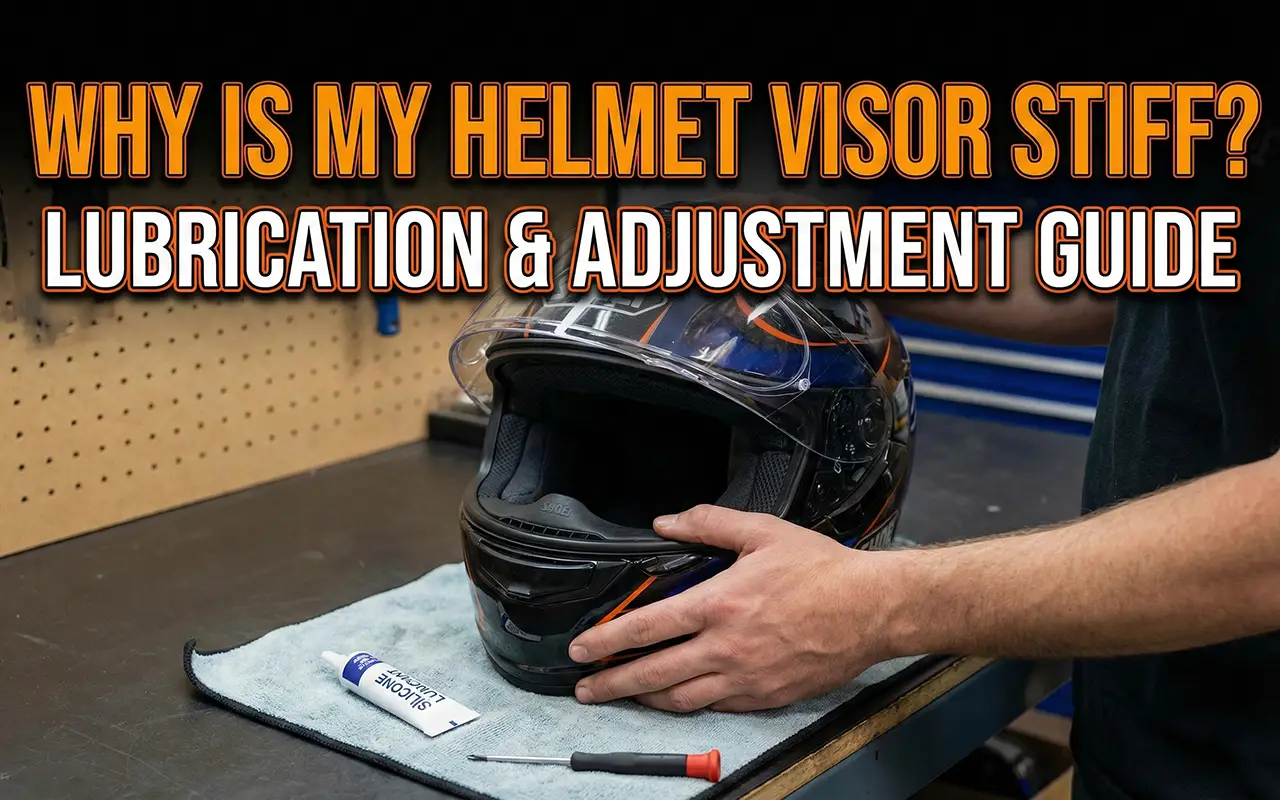
I’ll never forget the morning I nearly crashed my Ducati because I couldn’t flip up my visor at a stoplight. My gloved fingers fumbled with the mechanism while my breath fogged the shield, and I watched in my peripheral vision as the car behind me crept closer.
The visor finally snapped open with a violent jerk that nearly threw me off balance. That moment taught me a critical lesson: a stiff helmet visor isn’t just an inconvenience—it’s a legitimate safety hazard that can compromise your ability to react in critical moments.
Helmet visor mechanisms have evolved significantly since the early days of motorcycling, when riders dealt with crude pivot systems that required both hands to operate. Modern visors incorporate precision-engineered ratchet systems, detent mechanisms, and spring-loaded pivots designed to operate smoothly with a single finger motion.
Yet despite these advances, visor stiffness remains one of the most common complaints among riders, affecting everyone from beginners choosing their Best Motorcycle Helmets for Beginners to experienced riders with premium gear.
Understanding why your helmet visor becomes stiff and how to properly maintain it is essential knowledge covered in our Ultimate Guide to Motorcycle Helmets, because a smoothly operating visor can mean the difference between a safe ride and a dangerous distraction.
Understanding Helmet Visor Mechanisms
Before we can address why your helmet visor is stiff, we need to understand how these mechanisms actually work. Modern helmet visors aren’t simply hinged pieces of plastic—they’re sophisticated assemblies designed to balance several competing demands: smooth operation, secure positioning, tool-free removal, and crash-worthy construction.
The Anatomy of a Visor Pivot System
Most contemporary helmet visors use what’s called a “base plate” or “pivot mechanism” system. This consists of a plastic or metal plate that attaches to the helmet shell, incorporating a ratchet system with multiple detent positions.
The visor blade itself connects to this base plate through a pivot pin or shaft. When you lift or lower your visor, a spring-loaded detent ball or lever engages with notches in the ratchet, creating the distinctive “click” you feel at each position.
The engineering behind this seemingly simple mechanism is remarkably complex. The detent force must be strong enough to hold the visor securely at highway speeds (where aerodynamic forces can exceed several pounds of pressure), yet light enough to operate with a gloved finger.
This delicate balance is why different helmet manufacturers—whether you’re examining Carbon Fiber vs. Polycarbonate Helmets or budget options—often have dramatically different visor feel.
Material Science and Friction Points
The materials used in visor mechanisms directly impact their longevity and smoothness. High-end helmets often use stainless steel pivot pins with bronze or polymer bushings to minimize friction. Budget helmets may use all-plastic construction, which works well initially but degrades faster under UV exposure and temperature cycling.
There are typically four primary friction points in any visor mechanism: the pivot pin itself, the detent engagement surface, the base plate interface where it contacts the helmet shell, and the visor blade where it seats against the helmet’s rubber gasket.
Each of these points can contribute to stiffness, and identifying which is causing your problem is the first step toward resolution.
Common Causes of Visor Stiffness
Understanding why your helmet visor is stiff requires detective work. Through years of testing helmets and speaking with manufacturers, I’ve identified seven primary culprits that account for nearly all visor stiffness issues.
Environmental Contamination
Road grime, dust, and microscopic debris are the silent killers of smooth visor operation. Every ride deposits a fine layer of contamination on your helmet, and this material inevitably works its way into the pivot mechanism. In wet conditions, this contamination combines with water to form an abrasive paste that accelerates wear and increases friction.
Salt is particularly insidious. If you ride in coastal areas or in winter conditions where roads are salted, crystalline salt deposits can form inside the mechanism, creating both corrosion and mechanical interference. I’ve disassembled visors that looked clean from the outside but had visible salt crystals jamming the detent mechanism.
Lubricant Degradation and Contamination
Helmet manufacturers apply lubricant to visor mechanisms during assembly, but this lubricant doesn’t last forever. Exposure to heat, cold, UV radiation, and contamination causes lubricants to break down, thicken, or wash away entirely. What starts as a smooth-operating silicone grease can become a sticky, friction-increasing paste within a single riding season.
Worse yet, many riders unknowingly contaminate their visor mechanisms by using inappropriate lubricants. I’ve seen riders use WD-40 (which is a solvent, not a lubricant), petroleum-based greases (which attack plastic components), and even cooking oil in desperate attempts to restore smooth operation. These well-intentioned mistakes often make the problem worse.
Mechanical Wear and Deformation
Visor mechanisms experience significant stress during normal operation. Each time you open or close the visor, the detent mechanism undergoes a compression and release cycle. Over thousands of operations, this can cause plastic deformation in the detent ball housing, wear on the ratchet teeth, or elongation of the pivot pin holes.
This wear is accelerated by improper operation. Forcing a visor past its designed range of motion, dropping the helmet, or allowing the visor to slam shut repeatedly can cause permanent deformation that increases operating force. This is particularly relevant when considering When to Replace Your Motorcycle Helmet, as mechanical wear can indicate broader helmet degradation.
Temperature-Related Issues
Plastic components expand and contract with temperature changes, and the tight tolerances in visor mechanisms make them particularly susceptible to temperature-induced binding. A helmet stored in a hot garage or left in direct sunlight can develop temporary stiffness as components expand. Conversely, cold weather can cause lubricants to thicken and plastics to contract, creating different but equally problematic stiffness.
I’ve measured temperature-related dimensional changes in helmet components using precision instruments, and the results are striking. A polycarbonate base plate can expand by nearly 0.5mm across its width when heated from 40°F to 140°F—more than enough to cause significant binding in a precision-fitted mechanism.
Manufacturing Tolerances and Quality Control
Not all helmet visor stiffness is caused by use or maintenance issues. Some helmets simply leave the factory with improperly adjusted or assembled visor mechanisms. This is more common in budget helmets where quality control may be less rigorous, but I’ve encountered it even in premium brands.
Manufacturing issues can include over-tightened pivot screws, misaligned base plates, improperly seated detent springs, or burrs on molded plastic components. These problems may not be immediately apparent but become more noticeable as the helmet breaks in.
Helmet Shell Deformation
The helmet shell itself provides the mounting points for the visor mechanism, and any deformation of the shell can misalign these mounting points, causing binding. This deformation can result from impact (even minor drops that don’t seem significant), improper storage (such as hanging the helmet by the chin bar), or simply the natural compression of EPS liner material over time.
Shell deformation is particularly concerning because it may indicate structural damage that compromises the helmet’s protective capability. If you suspect shell deformation is causing your visor stiffness, it’s worth reviewing Helmet Safety Ratings Explained to understand whether your helmet should be replaced rather than repaired.
Gasket and Seal Interference
The rubber gasket that seals the visor against the helmet shell can become compressed, swollen, or displaced over time. When this happens, it can create excessive friction against the visor blade, making operation stiff even if the pivot mechanism itself is functioning perfectly.
This is particularly common after washing the helmet, as water can cause some gasket materials to temporarily swell. It’s also an issue with older helmets where the gasket material has degraded, lost its elasticity, or developed permanent compression set.
Proper Lubrication Techniques
Lubrication is the primary solution for most visor stiffness issues, but it must be done correctly. The wrong lubricant or improper application technique can cause more harm than good, potentially damaging plastic components or attracting contamination that accelerates wear.
Choosing the Right Lubricant
Not all lubricants are created equal, and the unique demands of helmet visor mechanisms require specific lubricant properties. The ideal visor lubricant must be plastic-safe (non-reactive with polycarbonate, ABS, and other helmet plastics), remain effective across a wide temperature range (from below freezing to over 140°F), resist washing away in rain, and not attract excessive dust or dirt.
Silicone-based lubricants are generally the best choice for helmet visors. Pure silicone grease or spray lubricants designed for plastic mechanisms provide excellent lubrication without attacking plastic components. I recommend 100% silicone grease (not silicone-fortified petroleum grease) for pivot points and pure silicone spray for detent mechanisms.
PTFE (Teflon) based lubricants are another excellent option, particularly for riders in dusty environments. PTFE creates a dry, slippery coating that doesn’t attract dirt like wet lubricants can. However, PTFE lubricants typically require more frequent application as they don’t provide the long-lasting lubrication of silicone grease.
What you should absolutely avoid: WD-40 (it’s a solvent and water displacer, not a lubricant), petroleum-based greases (they attack plastics), graphite powder (too abrasive for plastic components), and any automotive lubricants not specifically rated as plastic-safe.
Disassembly and Cleaning
Proper lubrication requires first removing old lubricant and contamination. This means disassembling the visor mechanism—a process that intimidates many riders but is actually quite straightforward on most helmets.
Start by removing the visor from the helmet entirely. Most modern helmets use a tool-free quick-release system, though some require a small screwdriver to remove pivot screws. Consult your helmet’s manual or the manufacturer’s website for specific instructions—this is where understanding different Full Face vs. Modular vs. Open Face Helmets becomes relevant, as each type has different visor removal procedures.
Once removed, disassemble the base plate from the visor blade if possible. Some mechanisms allow complete disassembly; others are sealed units. For mechanisms that can be disassembled, remove the detent spring and ball (or lever), noting their orientation for reassembly.
Clean all components thoroughly with isopropyl alcohol (70% or higher) and cotton swabs or soft cloths. Pay particular attention to the ratchet teeth, detent engagement surfaces, and pivot pin channels. For stubborn contamination, a soft-bristled toothbrush can help dislodge debris without scratching plastic surfaces.
Inspect all components for wear, cracks, or deformation. Look for shiny spots on plastic surfaces (indicating wear), cracks radiating from screw holes, or obvious deformation of detent engagement surfaces. If you find significant wear, the mechanism may need replacement rather than just lubrication.
Application Techniques
With components clean and dry, it’s time to apply lubricant. Less is more—excessive lubricant attracts dirt and can actually increase friction over time as it accumulates contamination.
For pivot pins, apply a thin coating of silicone grease directly to the pin, then work it into the bushing or bearing surface by rotating the pin several times. You should see a thin, even film of lubricant, not globs or drips.
For detent mechanisms, I prefer silicone spray over grease. Spray a small amount into the detent housing, then work the mechanism through its full range of motion several times to distribute the lubricant. Allow excess to drain away, and wipe any drips with a clean cloth.
For the ratchet teeth and engagement surfaces, use either silicone grease or spray depending on your environment. In dusty conditions, spray is preferable as it doesn’t attract as much contamination. In wet conditions, grease provides better water resistance.
Don’t forget the visor gasket. A light application of silicone spray on the gasket can reduce friction significantly. Spray onto a cloth and wipe the gasket rather than spraying directly to avoid overspray on the visor itself.
Reassembly and Testing
Reassemble the mechanism in reverse order, being careful not to over-tighten any screws. Over-tightening is a common cause of visor stiffness and can crack plastic components. Screws should be snug but not torqued down with excessive force—hand-tight plus about a quarter turn is usually sufficient.
Before reinstalling the visor on the helmet, test its operation by hand. The mechanism should move smoothly through its entire range with distinct but not excessive detent clicks. If it feels gritty, sticky, or excessively stiff, disassemble and inspect again—you may have missed contamination or applied too much lubricant.
Once satisfied with the mechanism’s operation, reinstall the visor on the helmet and test it in its mounted position. The feel may be slightly different when mounted due to the gasket friction and any minor misalignment in the mounting points.
Mechanical Adjustments and Fixes
Sometimes lubrication alone isn’t enough to restore smooth visor operation. Mechanical issues may require adjustment or repair to achieve optimal function.
Pivot Screw Adjustment
Many helmet visor mechanisms use adjustable pivot screws that allow you to fine-tune the tightness of the mechanism. These screws typically have a specific torque specification, though it’s rarely published in consumer documentation.
To adjust pivot screws, loosen them completely, then tighten gradually while testing the visor operation. You’re looking for the point where the visor operates smoothly but doesn’t have excessive play or wobble. This is a feel-based adjustment that requires patience and iteration.
Some helmets use nylon-insert lock nuts or threadlocker on pivot screws to prevent them from loosening over time. If your helmet uses threadlocker and you need to adjust the screws, you may need to clean off the old threadlocker and apply fresh compound during reassembly.
Detent Spring Tension Adjustment
The detent spring provides the force that holds the visor in each position. If this spring weakens over time or becomes contaminated, it can cause the visor to feel either too loose or too stiff (counterintuitively, a weak spring can cause stiffness by allowing the detent ball to bind in the ratchet teeth).
On mechanisms where the detent spring is accessible, you can adjust its tension by carefully bending the spring or shimming it with thin washers. This is delicate work that requires caution—springs can be permanently deformed if bent too far, and they can also launch small parts across your workspace if released suddenly.
If the spring appears damaged, corroded, or has lost its temper (the ability to spring back), replacement is the only real solution. Contact the helmet manufacturer for replacement parts, as aftermarket springs rarely have the correct specifications.
Base Plate Alignment
Misaligned base plates are a common but often overlooked cause of visor stiffness. The base plate must sit flush and square against the helmet shell mounting points. If it’s cocked at an angle or doesn’t seat properly, it will bind the pivot mechanism.
To check base plate alignment, remove the visor and examine the base plate mounting. Look for gaps between the base plate and helmet shell, uneven compression of mounting gaskets, or witness marks indicating contact where there shouldn’t be any.
Correcting alignment issues may require shimming (using thin plastic or metal washers to adjust spacing), filing mounting bosses (carefully removing material to improve fit), or in severe cases, replacing the base plate assembly. This is where understanding your helmet’s construction—whether it’s Best Motorcycle Modular Helmets or a traditional full-face—becomes important, as each design has different adjustment possibilities.
Gasket Replacement and Adjustment
If the visor gasket is causing excessive friction, you have several options. The simplest is lubrication with silicone spray, as discussed earlier. If lubrication doesn’t help, the gasket may need adjustment or replacement.
Some helmets allow gasket adjustment by loosening the visor mounting and repositioning the gasket slightly. This can reduce compression and lower friction. However, be careful not to create gaps that allow water or wind intrusion.
Gasket replacement is straightforward on most helmets—the old gasket typically peels away, and a new one presses into place. Replacement gaskets are available from helmet manufacturers and aftermarket suppliers. When installing a new gasket, ensure it’s properly seated along its entire length and doesn’t have any twists or folds that could cause binding.
Dealing with Worn Components
If inspection reveals significant wear—rounded ratchet teeth, elongated pivot holes, or deformed detent engagement surfaces—lubrication and adjustment won’t provide a lasting solution. Worn components need replacement.
Most major helmet manufacturers sell replacement visor mechanisms as service parts. These typically include the base plate, pivot hardware, and detent mechanism as a complete assembly. Installation is usually straightforward, though it may require transferring the visor blade from the old mechanism to the new one.
The cost of replacement mechanisms varies widely, from $20 for budget helmet parts to over $100 for premium helmet assemblies. Before investing in replacement parts, consider the helmet’s age and overall condition. If the helmet is approaching or past its recommended replacement interval (typically 5-7 years), investing in a new helmet may be more sensible than repairing the old one.
Preventive Maintenance
The best solution to visor stiffness is preventing it from developing in the first place. A proactive maintenance routine can keep your visor operating smoothly for the life of the helmet.
Regular Cleaning
Clean your helmet visor mechanism every time you wash your helmet—ideally every few weeks for regular riders, or at least monthly for occasional riders. This doesn’t mean full disassembly each time; a simple wipe-down of visible mechanism components and a light application of silicone spray is usually sufficient for routine maintenance. For comprehensive helmet care, check out our guide on How to Wash Your Motorcycle Helmet Liner, which covers overall helmet hygiene.
When washing the helmet, avoid getting water directly into the visor mechanism. While most mechanisms are designed to tolerate some moisture, excessive water intrusion can wash away lubricant and deposit minerals that cause corrosion and binding.
Proper Storage
How you store your helmet significantly impacts visor mechanism longevity. Store helmets in a cool, dry place away from direct sunlight. UV exposure degrades plastic components and lubricants, while temperature extremes cause expansion and contraction that accelerates wear.
Store helmets with the visor in a neutral position (typically the fully closed position) rather than propped open. This reduces stress on the detent mechanism and prevents the spring from taking a permanent set in the open position.
Avoid hanging helmets by the chin bar or D-rings, as this can cause shell deformation over time. Instead, store helmets on a shelf, in a helmet bag, or on a purpose-built helmet stand that supports the entire helmet shell.
Seasonal Maintenance
Perform thorough visor maintenance at least twice a year—ideally at the beginning and end of the primary riding season. This should include complete disassembly, cleaning, inspection, and relubrication of all visor components.
Seasonal maintenance is also an excellent opportunity to inspect for wear and address minor issues before they become major problems. Replace worn gaskets, tighten loose screws, and replace any components showing significant wear.
Operation Best Practices
How you operate your visor affects its longevity. Always use smooth, controlled motions when opening and closing the visor. Avoid slamming it shut or forcing it past its designed range of motion. Don’t use the visor as a handle to carry the helmet—this puts stress on the mechanism that it wasn’t designed to handle.
When riding in dusty conditions, try to minimize how often you operate the visor, as each operation in contaminated conditions introduces abrasive particles into the mechanism. If you frequently ride in dusty environments, consider a helmet with a drop-down sun visor that you can use instead of opening the main visor.
Helmet-Specific Considerations
Different helmet types and brands have unique visor mechanism designs that require specific maintenance approaches. Understanding your helmet’s particular system is crucial for effective maintenance.
Modular Helmet Visor Systems
Modular helmets like those featured in our Best Motorcycle Modular Helmets roundup present unique visor challenges. The chin bar mechanism adds complexity, and the visor must seal properly in both the closed and chin-bar-up positions. This typically requires more robust visor mechanisms with stronger detents, which can feel stiffer than traditional full-face helmet visors even when properly maintained.
Modular helmet visors also tend to accumulate more contamination in the hinge area where the chin bar pivots, as this creates additional crevices for dirt and grime to collect. Pay particular attention to cleaning these areas during maintenance.
Premium vs. Budget Helmet Mechanisms
High-end helmets typically use superior materials and tighter manufacturing tolerances in their visor mechanisms. This often translates to smoother operation and longer service life, but it also means that when problems do occur, replacement parts can be expensive.
Budget helmets may use all-plastic mechanisms that wear faster and require more frequent maintenance. However, their simpler design often makes them easier to service, and replacement parts are typically more affordable. When considering Best Motorcycle Helmet for $200 options, factor in the long-term maintenance requirements alongside the initial purchase price.
Brand-Specific Quirks
Different manufacturers have different visor mechanism philosophies. Some prioritize security over ease of operation, resulting in stiffer mechanisms that hold position better in high winds. Others prioritize smooth operation, which may result in visors that are easier to move but more prone to lifting at speed.
Shoei helmets, for example, typically use a robust ratchet system with strong detents that can feel stiff when new but break in nicely over time. Arai helmets often use a different approach with a cam-lock system that provides excellent security but requires understanding the proper operation technique. AGV and HJC helmets use various quick-release systems that prioritize tool-free visor changes but may require more frequent adjustment to maintain proper tension.
Research your specific helmet model’s visor system before attempting any maintenance or adjustment. Many manufacturers provide detailed service videos on their websites that demonstrate proper maintenance procedures for their specific designs.
When to Replace vs. Repair
Not every visor problem is worth fixing. Sometimes replacement—either of the visor mechanism or the entire helmet—is the more sensible option.
Cost-Benefit Analysis
Consider the cost of replacement parts and your time investment against the helmet’s overall value and remaining useful life. If you’re looking at $50 in replacement parts for a $150 helmet that’s already four years old, investing in a new helmet might be the smarter choice.
Factor in the helmet’s safety status as well. If the helmet has been dropped, involved in a crash, or is approaching its recommended replacement age, don’t invest significant money in repairs. Instead, use this as an opportunity to upgrade to a newer helmet with improved safety features and better visor mechanisms.
Signs It’s Time for a New Helmet
Certain visor problems indicate broader helmet issues that warrant replacement rather than repair. If the helmet shell shows cracks, deformation, or delamination, the helmet should be replaced regardless of the visor issue. If the EPS liner is compressed, cracked, or shows signs of impact damage, replacement is mandatory.
Age alone is also a valid reason for replacement. Most manufacturers recommend replacing helmets every five to seven years regardless of condition, as materials degrade over time even without obvious wear. For more guidance on this topic, see our article on When to Replace Your Motorcycle Helmet.
If you’re experiencing multiple simultaneous problems—stiff visor, degraded liner, damaged retention system, compromised gaskets—it’s almost certainly time for a new helmet rather than attempting multiple repairs.
Advanced Troubleshooting
If you’ve tried lubrication and basic adjustments without success, more advanced troubleshooting may be necessary to identify and resolve the underlying issue.
Systematic Diagnosis
Approach visor stiffness diagnosis systematically by isolating variables. Remove the visor from the helmet and test its operation in hand. If it operates smoothly when removed, the problem is in the mounting or helmet shell alignment rather than the mechanism itself. If it’s still stiff when removed, the problem is within the mechanism.
For mechanisms that are stiff even when removed, disassemble completely and test each component individually. Check the pivot pin for straightness by rolling it on a flat surface—a bent pin will wobble. Inspect the detent spring for consistent tension by comparing it to a new spring if possible. Examine all plastic components under magnification for cracks, burrs, or deformation that might not be visible to the naked eye.
Temperature Testing
If you suspect temperature-related issues, test the visor operation at different temperatures. Bring the helmet indoors to room temperature and test operation, then place it in a refrigerator (not freezer) for an hour and test again, then leave it in a warm car and test once more. Significant variation in operation across temperatures indicates thermal expansion issues that may require different clearances or different lubricants.
Comparative Analysis
If possible, compare your helmet’s visor operation to an identical new helmet at a dealer. This gives you a baseline for how the mechanism should feel when properly functioning. Significant deviation from this baseline indicates a problem that needs addressing.
Manufacturer Support
Don’t hesitate to contact the helmet manufacturer’s customer service department if you’re unable to resolve the issue. Most major manufacturers have technical support staff who can provide guidance on maintenance and troubleshooting specific to your helmet model. They may also offer warranty coverage if the helmet is relatively new and the problem stems from a manufacturing defect.
Safety Implications of Visor Stiffness
While visor stiffness might seem like a minor inconvenience, it carries genuine safety implications that shouldn’t be dismissed.
Distraction and Control Issues
A stiff visor requires more force and attention to operate, diverting your focus from the road and potentially requiring you to remove a hand from the handlebars for an extended period. This distraction occurs precisely when you need to operate the visor—typically in changing conditions that already demand increased attention.
I’ve witnessed riders wobble, drift out of their lane, or miss important visual cues while wrestling with a stubborn visor. The few seconds you spend fighting with your visor are seconds you’re not fully controlling your motorcycle or monitoring traffic.
Fogging and Visibility
When a visor is too stiff to operate easily, riders often leave it closed in situations where they should crack it open for ventilation, or they leave it open in situations where it should be closed for protection. This compromise leads to fogging issues, inadequate eye protection, or thermal discomfort that reduces concentration and performance. For riders who wear glasses, this compounds with existing challenges discussed in our guide on How to Stop Your Glasses from Fogging Up Inside a Helmet.
Emergency Situations
In an emergency—sudden rain, debris on the road, or a bee entering the helmet—you need to operate your visor immediately and instinctively. A stiff visor that requires deliberate effort and multiple attempts to move can turn a manageable situation into a dangerous one.
Crash Considerations
While less obvious, visor mechanism condition can also affect crash performance. A visor that doesn’t seat properly due to mechanism issues may not provide proper protection in an impact. More critically, a visor mechanism that’s been damaged or improperly repaired may fail during a crash, potentially allowing the visor to detach or the helmet to come apart.
This is why any visor mechanism work should be done carefully, with proper parts and following manufacturer specifications. Improvised repairs or incorrect reassembly can compromise the helmet’s structural integrity and certification status.
Product Recommendations
Having the right tools and supplies makes visor maintenance significantly easier and more effective. Here are my recommendations based on years of helmet maintenance experience.
Lubricants
For general visor maintenance, I recommend pure silicone grease (such as Super Lube Synthetic Grease with PTFE) for pivot points and high-load areas. For detent mechanisms and lighter applications, Tri-Flow Superior Lubricant or a similar PTFE-based spray works excellently. Both products are plastic-safe, temperature-stable, and long-lasting.
Avoid combination products that claim to clean and lubricate simultaneously—they typically do neither job particularly well. Use separate products for cleaning (isopropyl alcohol) and lubrication (silicone or PTFE lubricants).
Tools
Most visor maintenance can be accomplished with basic tools: a set of small screwdrivers (both Phillips and flat-head), cotton swabs, soft cloths, and a small brush. For more advanced work, a set of precision hex keys, a plastic pry tool set (to avoid scratching), and a magnifying glass or jeweler’s loupe for inspection are valuable additions.
Consider investing in a helmet maintenance stand—a simple device that holds the helmet securely while you work on it, freeing both hands and preventing the helmet from rolling around your workbench.
Replacement Parts
Keep a spare visor mechanism kit for your helmet if you ride frequently or in harsh conditions. Having replacement parts on hand means you can address problems immediately rather than waiting for parts to arrive while your helmet is unusable.
Also consider keeping a spare visor blade, as scratched or damaged visors often contribute to perceived mechanism stiffness by binding against the gasket. Replacement visors are relatively inexpensive and can dramatically improve your riding experience.
Environmental Factors and Riding Conditions
Your local riding environment dictates your maintenance schedule more than mileage does. If you primarily ride in arid, dusty, or sandy environments, your visor mechanism is constantly being bombarded with fine particulates that act like a lapping compound, grinding away plastic surfaces. In these conditions, “dry” PTFE lubricants are superior because they don’t trap grit.
Conversely, if you ride in wet climates or coastal areas with salt air, corrosion is your primary enemy. Salt crystals can form inside the pivot mechanism, locking it up solid. For these riders, a heavier silicone grease is necessary to create a water-resistant barrier, and you should make a habit of rinsing your helmet with fresh water after any ride involving sea spray or road salt.
The Verdict: A Smooth Visor Is a Safe Visor
It is easy to dismiss a stiff visor as a minor annoyance—something you just have to “muscle through” at stoplights. But as I learned that day on my Ducati, fighting with your gear takes your focus off the road, and in motorcycling, focus is everything.
A properly maintained visor mechanism should operate almost telepathically. You shouldn’t have to brace your neck muscles or use two hands to crack it open for some air. It should click firmly but smoothly into place with a simple flick of a thumb, allowing you to keep your eyes on the traffic and your hands on the controls.
Take twenty minutes this weekend to sit down with your helmet. Remove the visor, clean the old gunk out of the pivot points, and apply a fresh dab of silicone grease. The difference in your next ride will be immediate, and you’ll wonder why you tolerated that wrestling match for so long.
Ride safe, and keep those pivots moving.
Here is the FAQ section for the article, formatted as requested.
FAQs About Helmet Visor Maintenance
Can I use WD-40 to fix a stiff motorcycle helmet visor?
No. You should avoid using standard WD-40 on helmet mechanisms. WD-40 is primarily a solvent and water displacer, not a long-term lubricant. While it might loosen the mechanism temporarily, it strips away the factory grease and leaves a residue that attracts dust and dirt, eventually making the stiffness worse. Additionally, some chemical solvents can degrade certain types of plastic and rubber gaskets over time.
What is the absolute best lubricant for visor pivots?
The gold standard is 100% Silicone Grease (often found in plumbing or dive shop supplies) or a PTFE (Teflon) Dry Lubricant. Silicone is safe for all plastics and rubber, creates a water-resistant seal, and doesn’t dry out. PTFE sprays are excellent for dusty environments because they dry to a non-sticky film that won’t trap grit.
Why is my visor harder to open after I washed my helmet?
This is a common phenomenon caused by the rubber eye-port gasket. When you wash your helmet, the rubber gasket often absorbs a small amount of water and swells slightly, creating a tighter seal and more friction against the visor. Once the gasket dries completely (which can take 24 hours), it should return to normal. Applying a thin film of silicone fluid to the gasket can prevent this sticking.
Can I adjust the tension to make my visor stay open at high speeds?
On many helmets, yes. If your visor keeps slamming shut at highway speeds, you can often tighten the pivot screws slightly to increase friction. However, do this carefully—turn the screws only 1/8th to 1/4th of a turn at a time. If you over-tighten them, you risk cracking the plastic base plate or stripping the threads.
My visor makes a loud cracking noise when I open it. Is it broken?
Not necessarily, but it is a sign of dry friction. That “crack” or “pop” sound usually happens when the plastic detent mechanism binds before suddenly releasing. It indicates that the grease has dried up or washed away. If you clean and lubricate the mechanism and the noise persists, inspect the plastic ratchet teeth for physical damage or chipping.
How often should I lubricate my helmet visor?
For a daily commuter, a quick clean and lube every 3 to 4 months is ideal. If you ride in rain frequently, you may need to do it more often as road spray washes away lighter lubricants. If you are a weekend warrior, a thorough maintenance session once a year (typically at the start of the riding season) is usually sufficient.
Is Vaseline safe for helmet visors?
It is generally not recommended. Vaseline (petroleum jelly) is petroleum-based. While it is less aggressive than some solvents, petroleum products can eventually cause premature aging or swelling in the rubber gaskets and certain soft plastics used in helmet mechanisms. Stick to silicone-based products to be safe.