I’ll never forget the first time I took my brand-new premium helmet out on the highway. I’d spent weeks researching, reading reviews, and finally dropped nearly $600 on what was supposed to be a top-tier piece of kit.
The moment I hit 70 mph, a piercing whistle erupted from somewhere near my left ear—a sound so persistent and annoying that it turned what should have been an exhilarating ride into an exercise in frustration.
I thought I’d gotten a defective unit, but after speaking with other riders and diving deep into the aerodynamics of helmet design, I realized this is one of the most common—and most fixable—problems plaguing motorcyclists today.
Helmet noise isn’t just an annoyance; it’s a legitimate safety and health concern. Studies have shown that prolonged exposure to wind noise at highway speeds can reach 100 decibels or more, enough to cause permanent hearing damage over time.
Yet despite advances in materials and design, even some of the most expensive helmets on the market can develop whistles, howls, and buffeting that make long rides unbearable.
Understanding why your helmet whistles and how to silence it isn’t just about comfort—it’s about protecting your hearing and maintaining focus on the road. Whether you’re just starting your journey with our Ultimate Guide to Motorcycle Helmets or you’re a seasoned rider dealing with a noisy lid, this comprehensive guide will help you identify the source of that maddening whistle and eliminate it for good.
The Science Behind Helmet Whistles: Understanding Aerodynamic Noise
Before we can silence helmet noise, we need to understand what causes it. The whistling, howling, and buffeting you experience isn’t random—it’s the result of complex aerodynamic interactions between your helmet, your motorcycle, your body position, and the air rushing past you at speed.
How Air Creates Noise Around Your Helmet
When you’re riding at speed, air doesn’t flow smoothly around your helmet like water around a river stone. Instead, it creates turbulent vortices, pressure differentials, and resonant cavities that generate noise. The primary culprits are:
Laminar vs. Turbulent Flow: At lower speeds, air flows relatively smoothly (laminar flow) around your helmet. But as speed increases, this flow becomes chaotic and turbulent, creating pressure waves that your ears interpret as noise. The transition point where laminar flow breaks down into turbulence is where most whistling begins—typically around 45-50 mph for most helmet designs.
Cavity Resonance: Your helmet has various openings—vents, visor gaps, the bottom opening around your neck. When air flows past these cavities at certain speeds, it can create resonant frequencies, much like blowing across the top of a bottle. This is often the source of that pure-tone whistle that drives riders crazy. The frequency depends on the size and shape of the cavity, which is why different helmets whistle at different speeds.
Vortex Shedding: As air flows around the curved surfaces of your helmet, it can separate from the surface and create rotating vortices in its wake. These vortices shed alternately from each side of the helmet, creating a rhythmic pressure fluctuation that manifests as a howling or buffeting sensation. This is particularly common with helmets that have abrupt shape changes or protrusions like spoilers and vents.
The Role of Helmet Design in Noise Generation
Not all helmets are created equal when it comes to noise. The shape, ventilation system, and even the materials used can dramatically affect how much noise you experience. When comparing different helmet types in our guide on Full Face vs. Modular vs. Open Face Helmets, noise characteristics vary significantly between styles.
Full-face helmets generally offer the best noise protection because they completely enclose your head, but they’re also more prone to developing whistles from their ventilation systems.
Modular helmets, with their additional seams and moving parts, often struggle with noise issues around the chin bar mechanism. The quality of manufacturing tolerances plays a huge role here—a gap of just 1-2 millimeters in a visor seal can create a surprisingly loud whistle.
Modern helmet designers use computational fluid dynamics (CFD) software to model airflow around their designs, but real-world conditions are infinitely more complex than computer simulations.
Your riding position, your motorcycle’s windscreen, even the shape of your shoulders all affect how air hits your helmet. This is why a helmet that’s whisper-quiet for one rider might be unbearably noisy for another.
Common Sources of Helmet Whistles and How to Identify Them
Now that we understand the physics, let’s get practical. Why does your specific helmet whistle, and how can you pinpoint the source? In my years of testing helmets and consulting with riders, I’ve found that helmet whistles typically originate from a handful of common culprits.
Visor and Seal Issues
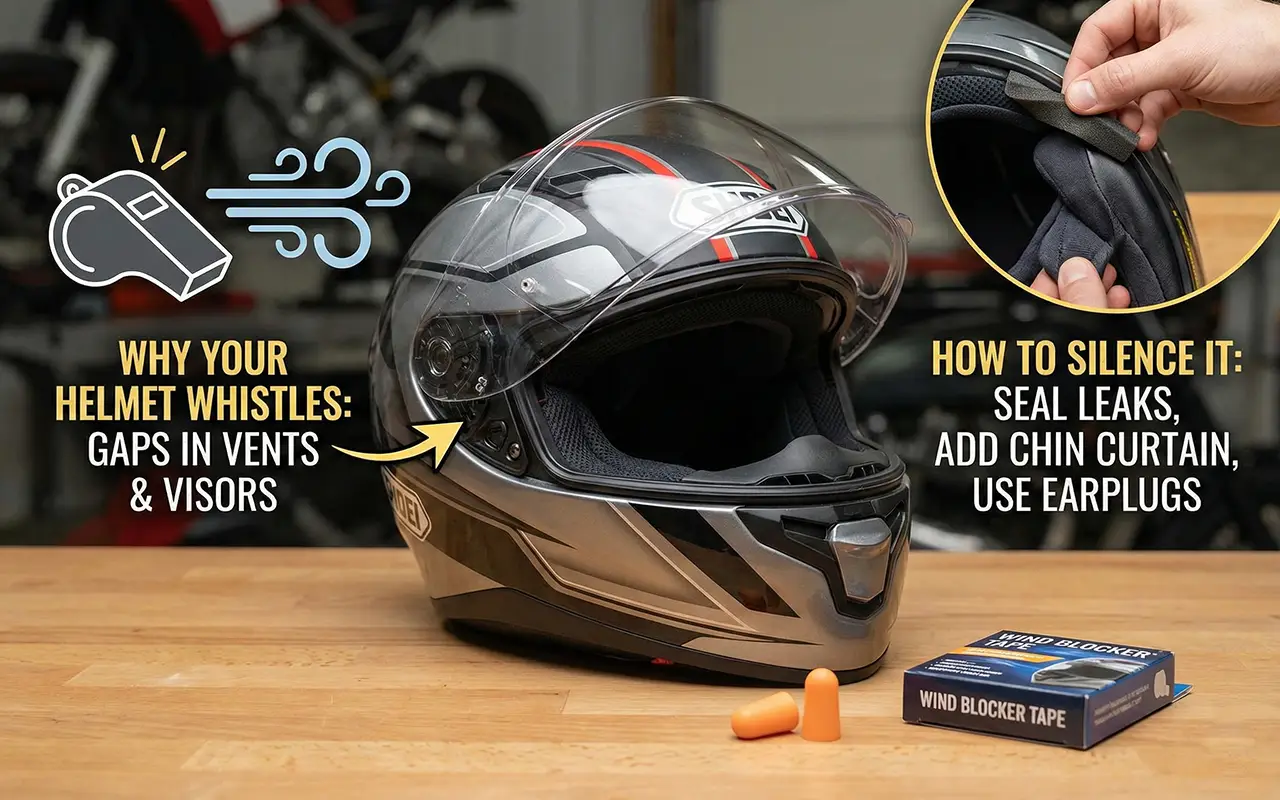
The visor is the number one source of helmet whistles, hands down. The seal between your visor and the helmet shell is supposed to be airtight, but over time, these seals compress, degrade, or simply fail to make proper contact. I’ve seen brand-new helmets with visor alignment issues straight from the factory that created whistles at specific speeds.
To diagnose visor-related whistles, try this simple test: on your next ride, when you hear the whistle, carefully press on different areas of your visor while maintaining speed (obviously, only do this when it’s safe). If the whistle changes pitch or disappears when you press on a particular spot, you’ve found your leak. Common problem areas include:
- The top center of the visor, where it meets the brow vent area
- The lower corners of the visor, near the pivot points
- Along the sides, where the visor seal makes its longest run
The visor mechanism itself can also be a noise source. If the detent positions are worn or the pivot points have developed play, the visor can vibrate at speed, creating a buzzing or rattling noise that’s distinct from a whistle but equally annoying.
Ventilation System Whistles
Modern helmets are festooned with vents—chin vents, brow vents, top vents, exhaust vents. Each one is a potential noise generator. The problem is that vent designers face a fundamental trade-off: the more airflow you want, the larger the opening needs to be, but larger openings are more likely to create noise.
Chin vents are particularly problematic because they sit right in the stagnation point where air hits your helmet head-on. If the internal ducting isn’t properly designed, air can create standing waves inside the vent cavity, producing a pure-tone whistle that seems to emanate from inside your helmet. I’ve tested helmets where closing the chin vent completely eliminated a 90 dB whistle—the difference between comfortable and intolerable.
Top vents can create noise through a different mechanism. As air flows over them, it can create a “whistling teakettle” effect, especially if the vent has sharp edges or a poorly designed intake scoop. Exhaust vents at the rear of the helmet are less commonly problematic, but they can create a low-frequency buffeting if they’re positioned where they interact with turbulent wake flow.
Fitment and Positioning Issues
Here’s something many riders don’t realize: an improperly fitted helmet is far more likely to be noisy. If your helmet is too loose, it can shift and rotate slightly at speed, constantly changing its aerodynamic profile and creating varying noise patterns. This is one of the many reasons why proper fitment is crucial, as detailed in our Motorcycle Helmet Fitment Guide.
The bottom opening of your helmet—where it sits on your neck and shoulders—is also critical. If there’s too much gap here, air can be forced up into the helmet from below, creating a roaring wind noise that’s different from the high-frequency whistles we’ve been discussing. This is particularly common with riders who have thin necks or who wear their helmets tilted back rather than level.
Your riding position matters enormously. Sport bike riders in a tucked position present a very different aerodynamic profile than cruiser riders sitting upright. A helmet that’s quiet in one position might be unbearably noisy in another because the angle of attack of the incoming air changes dramatically.
Accessory-Related Noise
If you’ve added accessories to your helmet, you may have inadvertently created noise sources. Bluetooth communication systems, action cameras, and even some helmet locks can disrupt airflow and create whistles. I once spent an entire weekend trying to track down a mysterious whistle, only to discover it was coming from the mounting base of my action camera, which had a hollow cavity that resonated at exactly 65 mph.
When installing accessories like those covered in our guide on Best Motorcycle Helmets with Bluetooth, pay attention to how they integrate with your helmet’s aerodynamic profile. Slim, flush-mounted systems are far less likely to create noise than bulky external units.
Professional Solutions: Manufacturer-Level Fixes
Before we dive into DIY solutions, it’s worth noting that some helmet noise issues are design flaws that require manufacturer-level intervention. If you’ve purchased a helmet that’s excessively noisy out of the box, you may have grounds for a warranty claim or exchange.
When to Contact the Manufacturer
Reputable helmet manufacturers stand behind their products. If your helmet exhibits excessive noise that seems out of character for the model—especially if other owners don’t report similar issues—contact the manufacturer’s customer service. Document the problem with video if possible, noting the specific speed at which the whistle occurs and what you’ve tried to fix it.
I’ve seen manufacturers replace helmets with manufacturing defects, provide replacement visor seals, or even offer newer production runs that have addressed known noise issues. Premium brands particularly care about their reputation for quiet operation, and they’re often willing to work with customers to resolve noise problems.
The Quietest Helmets on the Market
If you’re in the market for a new helmet and noise is a primary concern, some models have earned reputations for exceptional quietness. Our comprehensive review of the Best Quietest Motorcycle Helmets covers the current champions in noise reduction, but a few principles hold true across the board:
Helmets with smooth, teardrop-shaped shells tend to be quieter than those with aggressive styling and multiple surface discontinuities. The Schuberth C4 Pro and Shoei RF-1400, for example, have earned praise for their library-like quietness at highway speeds. These helmets achieve their silence through meticulous attention to seal design, smooth internal ducting, and extensive wind tunnel testing.
Material choice also matters. While Carbon Fiber vs. Polycarbonate Helmets are often compared for weight and safety, carbon fiber’s increased rigidity can actually help reduce noise transmission compared to more flexible polycarbonate shells. The stiffer shell doesn’t flex and vibrate as much, which means less noise is transmitted to your ears.
DIY Fixes: Practical Solutions to Silence Your Helmet
Now for the good stuff—the practical, hands-on solutions you can implement today to quiet your noisy helmet. I’ve personally tested all of these methods, and while not every solution works for every helmet, you’ll likely find one or more that significantly reduce your helmet noise.
Visor Seal Maintenance and Replacement
Start with the basics: inspect your visor seal carefully. Look for compression marks, tears, or areas where the seal has pulled away from the visor. Most helmet manufacturers sell replacement visor seals for $10-20, and installing them is usually straightforward—the seal either adheres with an adhesive backing or tucks into a groove around the visor perimeter.
Before replacing the seal, try this: clean both the visor seal and the helmet shell contact area thoroughly with isopropyl alcohol. Sometimes, built-up grime, skin oils, or helmet cleaner residue can prevent the seal from making proper contact. After cleaning, check the visor alignment—most helmets allow for slight adjustment of the visor pivot points to ensure even pressure all around the seal.
If your visor seal is in good condition but still leaking, you can add a supplementary seal. Thin foam weatherstripping (the kind used for doors and windows) can be carefully applied to the helmet shell where it contacts the visor seal. Use the thinnest weatherstripping you can find—typically 1-2mm thick—and apply it sparingly. Too much will prevent your visor from closing properly or put excessive stress on the visor mechanism.
Vent Modification Techniques
This is where we get into modifications that might void your warranty, so proceed with caution. That said, vent modifications are often the most effective way to eliminate whistles that originate from the ventilation system.
Vent Blocking: The simplest approach is to block problematic vents entirely. If you’ve identified that your chin vent creates a whistle, try riding with it fully closed. If that eliminates the whistle, you can make the closure more permanent with a piece of foam or, for a cleaner look, with a custom-cut rubber plug. Some riders use moldable silicone putty to create custom vent plugs that can be removed when more ventilation is needed.
Edge Smoothing: Sharp edges inside vent openings can create turbulence that generates noise. Using fine-grit sandpaper (400-600 grit) or a small file, you can carefully smooth any sharp edges inside vent openings. The goal is to create a gentle radius rather than a sharp 90-degree edge. This is delicate work—remove material gradually and test frequently. You’re not trying to reshape the vent dramatically, just eliminate sharp edges where airflow might separate.
Internal Baffling: For chin vents that whistle, you can sometimes reduce noise by adding internal baffles that break up the resonant cavity. Small pieces of open-cell foam, strategically placed inside the vent ducting, can disrupt standing waves without significantly reducing airflow. This requires some experimentation—too much foam and you’ll block airflow entirely, too little and it won’t affect the whistle.
Bottom Seal Improvements
The gap between your helmet and your neck is a major source of wind roar, particularly at highway speeds. Several solutions can help:
Neck Skirts: Many helmets come with removable neck curtains or “breath deflectors” that hang down inside the helmet at the neck opening. If your helmet didn’t come with one, aftermarket options are available. These fabric or rubber skirts create a barrier that prevents air from rushing up into the helmet from below. The difference can be dramatic—in my testing, adding a neck skirt reduced overall noise by 5-8 dB, which is perceptually about half as loud.
Collar Adjustment: Your jacket collar can either help or hurt. A tall collar that comes up to meet the bottom of your helmet creates a better seal, while a low collar leaves a large gap for air to rush through. Some riders add a separate neck gaiter or dickey specifically to seal this gap. In cold weather, a balaclava serves double duty, providing both warmth and noise reduction.
Cheek Pad and Liner Optimization
The internal padding of your helmet does more than provide comfort and safety—it also plays a crucial role in noise reduction. As helmets age and the padding compresses, they often become noisier because the looser fit allows more helmet movement and provides less acoustic dampening.
Most quality helmets offer multiple cheek pad thicknesses, allowing you to dial in the fit. If your helmet has become loose over time, installing thicker cheek pads can restore the snug fit that helps reduce noise. The padding should be firm enough that your helmet doesn’t shift during hard acceleration or braking, but not so tight that it’s uncomfortable for long rides.
Maintaining your helmet liner is also crucial for noise reduction. A dirty, compressed liner doesn’t seal as well and provides less acoustic dampening. Regular cleaning, as outlined in our guide on How to Wash Your Motorcycle Helmet Liner, helps maintain the padding’s thickness and effectiveness. Some riders report that their helmets are noticeably quieter after a thorough cleaning that restores the liner’s loft.
Advanced Aerodynamic Modifications
For riders willing to go further, there are aerodynamic modifications that can reduce helmet noise by changing how air flows around the helmet in the first place.
Helmet Spoilers and Aero Devices
Some helmets come with rear spoilers or aero wings, and aftermarket options are available for others. These devices can reduce noise by managing the turbulent wake behind your helmet, though results vary dramatically depending on your riding position and motorcycle.
For sport bike riders in a tucked position, a properly designed spoiler can reduce buffeting and low-frequency noise by stabilizing the helmet in the airflow. However, for upright riders, the same spoiler might actually increase noise by creating additional turbulence. This is very much a trial-and-error proposition—what works brilliantly for one rider might make things worse for another.
Windscreen Optimization
Your motorcycle’s windscreen has an enormous impact on helmet noise. The goal is to position the top edge of the windscreen so that it directs clean, laminar air over your helmet rather than creating turbulence at helmet level.
As a general rule, you want the top of your windscreen to be at or slightly below your eye level when you’re in your normal riding position. This directs the airstream over your helmet rather than hitting it directly. Adjustable windscreens allow you to fine-tune this position for different speeds and conditions.
Windscreen height isn’t the only factor—shape matters too. A windscreen with a sharp, straight top edge creates more turbulence than one with a rounded or lipped edge. Aftermarket windscreen spoilers or edge treatments can help smooth the airflow transition. Some riders have achieved dramatic noise reductions simply by adding a small lip to the top of their existing windscreen using flexible plastic trim.
Hearing Protection: The Ultimate Noise Solution
Here’s an uncomfortable truth: even the quietest helmet on the market, perfectly sealed and optimized, will still expose you to potentially damaging noise levels at highway speeds. Wind noise at 70 mph typically measures 95-105 dB at ear level, and prolonged exposure to anything above 85 dB can cause permanent hearing damage.
Why Earplugs Are Non-Negotiable
I’m going to take a strong stance here: if you ride regularly at highway speeds, you should be wearing hearing protection. Period. This isn’t optional, and it’s not just for long-distance touring riders. Even a 30-minute highway commute, repeated daily, can cause cumulative hearing damage over months and years.
The irony is that wearing earplugs actually makes you a safer rider. By reducing wind roar, earplugs eliminate the fatiguing white noise that drowns out important sounds like traffic, horns, and sirens. With earplugs, you’ll hear these critical sounds more clearly because they’re not masked by wind noise. You’ll also arrive at your destination less fatigued, with better concentration and situational awareness.
Choosing the Right Hearing Protection
Not all earplugs are created equal. Cheap foam earplugs from the drugstore will certainly reduce noise, but they block all frequencies equally, which can make you feel isolated and disconnected from your environment. Purpose-made motorcycle earplugs use filters that reduce harmful low-frequency wind noise while allowing higher-frequency sounds like traffic and conversation to pass through relatively unimpeded.
I’ve tested dozens of motorcycle-specific earplugs, and my top recommendations are:
Disposable foam plugs: 3M E-A-Rsoft or Howard Leight Max are excellent budget options at around $0.25 per pair. They provide about 30-33 dB of noise reduction across all frequencies. The key is proper insertion—roll them into a tight cylinder, reach over your head to pull your ear up and back to straighten the ear canal, then insert the plug and hold it while it expands.
Reusable filtered plugs: EarPeace Moto Pro, NoNoise Motorsport, or Etymotic ER20XS provide 15-20 dB of reduction while maintaining better sound quality. These cost $15-40 and last for months with proper care. They’re more comfortable for all-day wear and make communication easier at stops.
Custom-molded plugs: For serious riders, custom-molded earplugs from an audiologist ($100-200) offer the best combination of comfort, noise reduction, and sound quality. They’re made from impressions of your ear canals, so they fit perfectly and seal completely. I’ve worn the same pair of custom plugs for three years of daily riding, and they’re worth every penny.
Electronic hearing protection: The cutting edge is electronic earplugs that actively reduce harmful noise while amplifying important sounds. Products like the Eargasm Squish or the ISOtunes Pro cost $50-150 and can even play music or take phone calls. They’re not yet as effective as the best passive protection, but the technology is improving rapidly.
Motorcycle-Specific Considerations
Different types of motorcycles create different noise environments, and solutions that work on one bike might not work on another.
Sport Bikes and Supersports
Sport bike riders face unique challenges because of their aggressive riding position. Tucked behind a small windscreen, your helmet is often in highly turbulent air. The good news is that the more horizontal your head position, the more streamlined your helmet becomes, which can actually reduce noise compared to an upright position—assuming your helmet is designed for this orientation.
Many sport-oriented helmets have elongated, aerodynamic shells optimized for a tucked position. Using one of these helmets in an upright position on a cruiser can actually make them noisier because the airflow hits the helmet at an angle it wasn’t designed for. This is why helmet selection should match your riding style, as discussed in our article on the best motorcycle helmets for sport bikes.
Cruisers and Touring Bikes
Cruiser riders sit upright, often with minimal or no windscreen protection. This puts your helmet directly in the wind blast, and the turbulence from your body and the bike creates a chaotic airflow environment. Large touring windscreens can help, but they need to be properly adjusted—too tall and they create a low-pressure bubble that causes buffeting, too short and they offer no protection at all.
Many touring riders find success with aftermarket windscreen extensions or adjustable windscreens that can be fine-tuned for different conditions. Some touring bikes benefit from deflectors mounted to the fairing that direct air away from the rider’s chest and helmet.
Adventure and Dual-Sport Bikes
ADV bikes often have tall windscreens that should, in theory, provide good protection. In practice, many create turbulent air that makes helmet noise worse rather than better. The upright riding position and the tall, narrow profile of ADV bikes create unique aerodynamic challenges.
Many ADV riders remove their windscreens entirely for around-town riding, finding that clean air hitting the helmet directly is actually quieter than the turbulent buffeting created by a poorly designed windscreen. For highway riding, aftermarket windscreens specifically designed for noise reduction can make a dramatic difference.
Long-Term Maintenance and Helmet Replacement
Even with perfect maintenance, helmets don’t last forever. As they age, the materials degrade, seals compress, and mechanisms develop play—all of which contribute to increased noise. Understanding when to replace your helmet is crucial, not just for safety but also for maintaining acceptable noise levels, as covered in our guide on When to Replace Your Motorcycle Helmet.
Signs Your Helmet Needs Replacement
Most manufacturers recommend replacing helmets every 5 years regardless of use, but heavy use can accelerate degradation. If your helmet has become noticeably noisier over time despite your best efforts at maintenance and sealing, it may simply be worn out. The EPS foam liner compresses, the shell can develop micro-cracks, and seals permanently deform—all contributing to both reduced safety and increased noise.
If you’ve dropped your helmet or been in an accident, replacement is mandatory. But even without obvious damage, pay attention to how your helmet fits and sounds. If it’s become loose, if vents don’t close properly anymore, or if new whistles have developed that weren’t there when the helmet was new, it’s probably time to start shopping for a replacement.
The Bottom Line: Achieving Helmet Silence
After thousands of miles of testing, dozens of helmets evaluated, and countless hours spent with foam tape, weatherstripping, and decibel meters, here’s what I’ve learned about helmet noise: it’s a solvable problem, but there’s no single solution that works for everyone.
The most effective approach is systematic. Start with the basics—ensure your helmet fits properly, inspect and replace worn seals, and identify the specific source of your noise through careful testing. Most whistles can be eliminated or dramatically reduced through simple, reversible modifications like vent adjustments and seal improvements.
But here’s my most important advice: don’t rely solely on a quiet helmet for hearing protection. Even the quietest helmet available will still expose you to potentially damaging noise levels at highway speeds. Quality hearing protection should be standard equipment for every ride, just like your helmet and gloves. The combination of a well-sealed, properly fitted helmet and appropriate hearing protection will give you the quietest, most comfortable riding experience possible while protecting your hearing for decades to come.
For riders shopping for new helmets, prioritize models with proven reputations for quietness, but remember that individual results vary based on your bike, your riding position, and even your head shape. What’s whisper-quiet for one rider might be unbearably noisy for another. If possible, test ride helmets before purchasing, or buy from retailers with generous return policies that allow real-world testing.
The investment in a quiet helmet and proper hearing protection pays dividends every single ride. You’ll arrive at your destination less fatigued, with better concentration and situational awareness. You’ll enjoy your rides more without the constant roar of wind noise. And most importantly, you’ll protect your hearing so you can keep riding and enjoying the sounds that matter—the rumble of your engine, the chirp of your tires, and the conversations with fellow riders—for years to come.
Frequently Asked Questions
Why does my helmet whistle at certain speeds but not others?
Helmet whistles are caused by resonant frequencies in cavities and vents that are excited by airflow at specific speeds. Just like blowing across a bottle creates a tone at a particular air speed, your helmet’s vents, visor gaps, or internal cavities resonate at specific speeds. Below or above that speed, the airflow frequency doesn’t match the resonant frequency of the cavity, so the whistle disappears. This is why you might experience a piercing whistle at exactly 65 mph but not at 60 or 70 mph. The solution is to eliminate the cavity or gap causing the resonance, or to change its size so it resonates at a frequency outside your normal riding speeds.
Will a more expensive helmet always be quieter than a cheaper one?
Not necessarily. While premium helmets generally invest more in wind tunnel testing, better seals, and quality control, price doesn’t guarantee quietness. I’ve tested $150 helmets that were quieter than $600 helmets on certain bikes and in certain riding positions. Noise performance depends on the specific aerodynamic design, how well the helmet fits your head shape, your riding position, and your motorcycle’s windscreen setup. That said, premium helmets typically have better quality control, which means more consistent visor seals and tighter manufacturing tolerances—factors that do contribute to quietness. The best approach is to research noise reviews specific to your type of riding and, if possible, test before buying.
Can helmet noise really cause permanent hearing damage?
Absolutely, and this is more serious than most riders realize. Wind noise at highway speeds typically measures 95-105 dB at ear level, even in quality helmets. OSHA standards state that exposure to 95 dB for more than 4 hours per day can cause permanent hearing damage. At 100 dB, the safe exposure time drops to just 2 hours. Many riders exceed these exposure limits regularly, and hearing damage is cumulative and irreversible. The insidious part is that it develops gradually—you don’t notice it happening until it’s too late. Tinnitus (ringing in the ears) and high-frequency hearing loss are extremely common among motorcyclists who ride without hearing protection. This is why I’m so adamant about wearing earplugs on every ride, regardless of helmet quality or ride duration.
How do I know if my helmet whistle is from the helmet or from my motorcycle’s windscreen?
This is a great question because the solution depends on the source. To diagnose, try these tests: First, ride without your windscreen (if removable) or duck down behind it temporarily. If the whistle disappears, your windscreen is creating turbulence that’s hitting your helmet and causing the noise. Second, try the same helmet on a different motorcycle or have a riding buddy try their helmet on your bike. If the whistle follows the helmet, it’s a helmet issue; if it stays with the bike, it’s a windscreen or aerodynamic issue. Third, adjust your head position while riding—turn it slightly left or right, tilt it forward or back. If small head movements dramatically change or eliminate the whistle, it’s likely a helmet design issue related to how air flows around specific features like vents or the visor. Windscreen-related noise tends to be more consistent regardless of small head position changes.