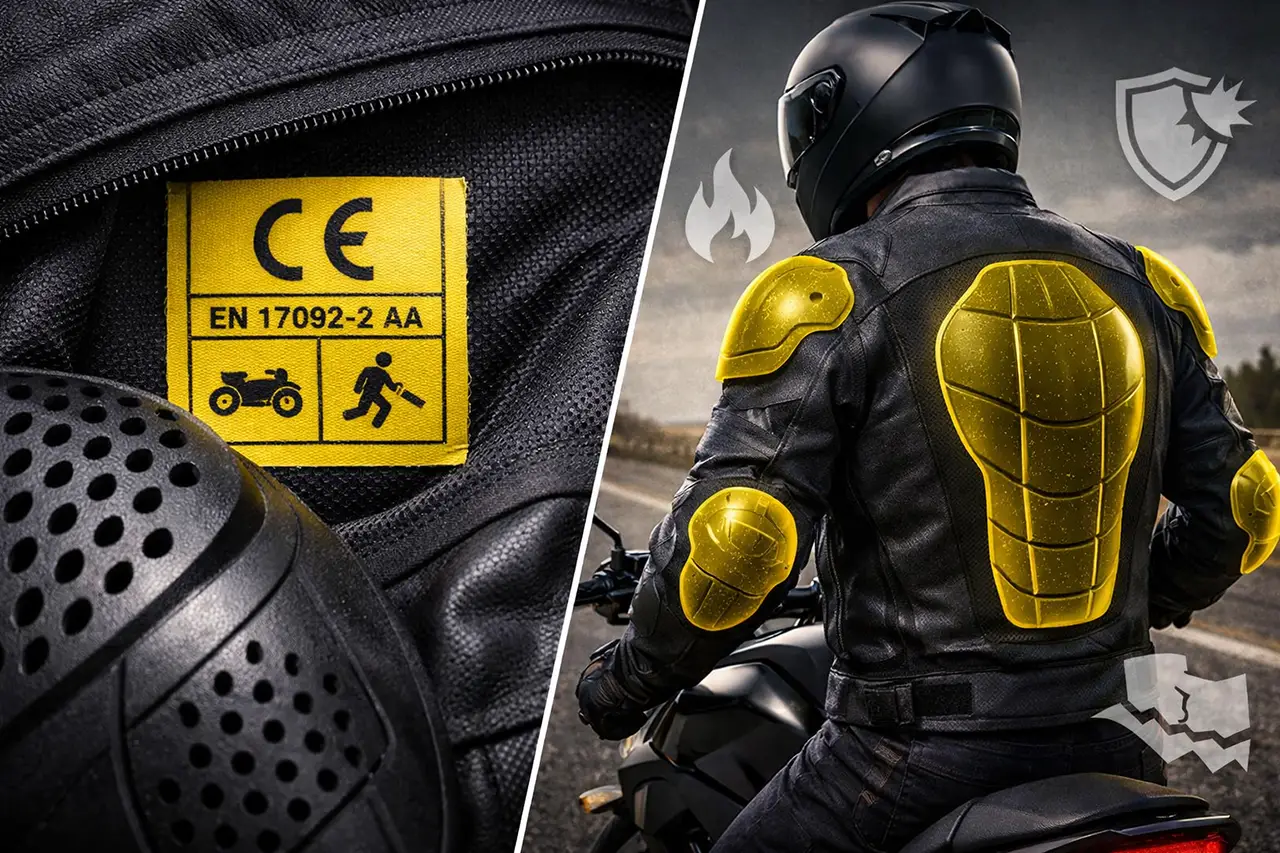
Shopping for motorcycle gear can feel like trying to decode a secret language. You are looking for a jacket to keep your skin intact and your bones in one piece, but instead, you are hit with a wall of acronyms: CE Level 1, EN 1621, Level 2, and AAA ratings. What does it all actually mean for your safety on the road?
Understanding motorcycle CE ratings isn’t just about passing a European safety standard—it is about knowing exactly how much impact energy your shoulder, elbow, and back armor can absorb in a crash.
In this guide, I am cutting through the marketing fluff to explain exactly what these armor levels mean, the critical difference between Level 1 and Level 2, and how to choose the right protection for your riding style.
For a broader look at everything else that goes into choosing the perfect gear, be sure to check out my Ultimate Guide to Motorcycle Jackets.
| TL;DR — Quick Summary • CE ratings are Europe-wide safety certifications for motorcycle armor — not marketing fluff. • CE Level 1 is the minimum standard; CE Level 2 absorbs significantly more impact energy and is the gold standard for serious riders. • The certification covers five body zones: shoulders, elbows, hips, knees, and back. • Back protectors are graded separately — always look for EN 13158 Level 2 or higher. • A jacket’s overall safety is only as good as its worst-rated armor piece. • Armor degrades over time — replace it every 5 years or after any significant impact. |
Why I Became Obsessed With CE Ratings
Let me be honest with you: I didn’t always care about CE ratings. When I bought my first proper motorcycle jacket eight years ago, I picked it based on how it looked. Black leather. Asymmetric zip. It looked like the kind of thing Marlon Brando would’ve worn. I barely glanced at the armor.
Then I low-sided at about 40 mph on a wet roundabout. Nothing catastrophic — I walked away with a bruised ego and a gravel rash on my hip.
But the armor in that jacket? It barely cushioned anything. When I pulled it out afterward and actually read the label, it said CE Level 1 for the shoulders and elbows, and the back protector slot had a thin foam insert that I’m fairly confident couldn’t protect a sandwich.
That experience sent me down a rabbit hole of research that took weeks to fully understand. The terminology is confusing. The standards have changed over the years.
Brands use the CE logo liberally without always making it clear what level their armor has achieved. And most buying guides either oversimplify or go so deep into the regulatory weeds that your eyes glaze over.
This post is my attempt to explain CE ratings the way I wish someone had explained them to me — clearly, honestly, and with the real-world context that actually matters when you’re choosing a jacket that might one day save your life.
What Does CE Even Stand For?
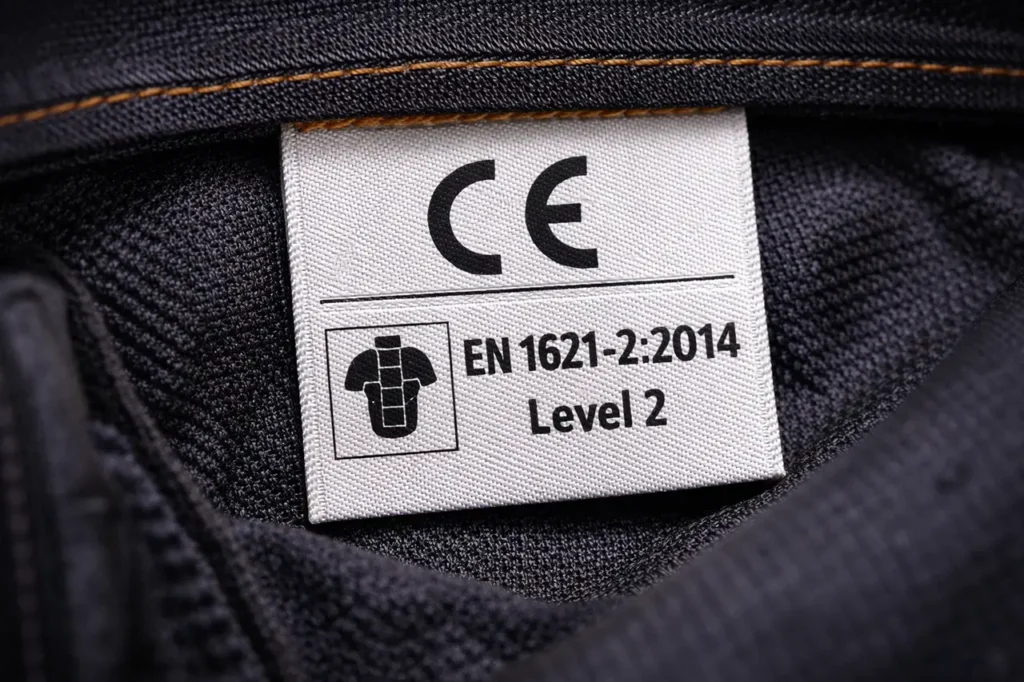
CE certification label close-up showing EN 1621-2 Level 2 standard on back protector
CE stands for Conformite Europeenne, which is French for European Conformity. At its core, it means a product has been tested and meets the safety standards required by the European Union.
You’ll see the CE mark on everything from children’s toys to electrical equipment — it’s a broad certification, not specific to motorcycling.
But here’s where it gets specific: for motorcycle protective gear, CE certification is governed by a set of EN (European Norm) standards that define exactly how armor must perform under controlled impact testing.
The ones you’ll encounter most often on jackets are:
- EN 13594:2015 — Gloves for motorcycle riders
- EN 1621-1:2012 — Limb protectors (shoulders, elbows, hips, knees)
- EN 1621-2:2014 — Back protectors
- EN 1621-3:2018 — Airbag protectors (if your jacket includes that system)
The jacket you’re looking at might reference any or all of these. When a brand says their jacket is CE certified, they should be telling you which standard applies to which armor zone, and at which level. If they’re vague about it — that’s your first red flag.
CE Level 1 vs CE Level 2: The Difference That Matters
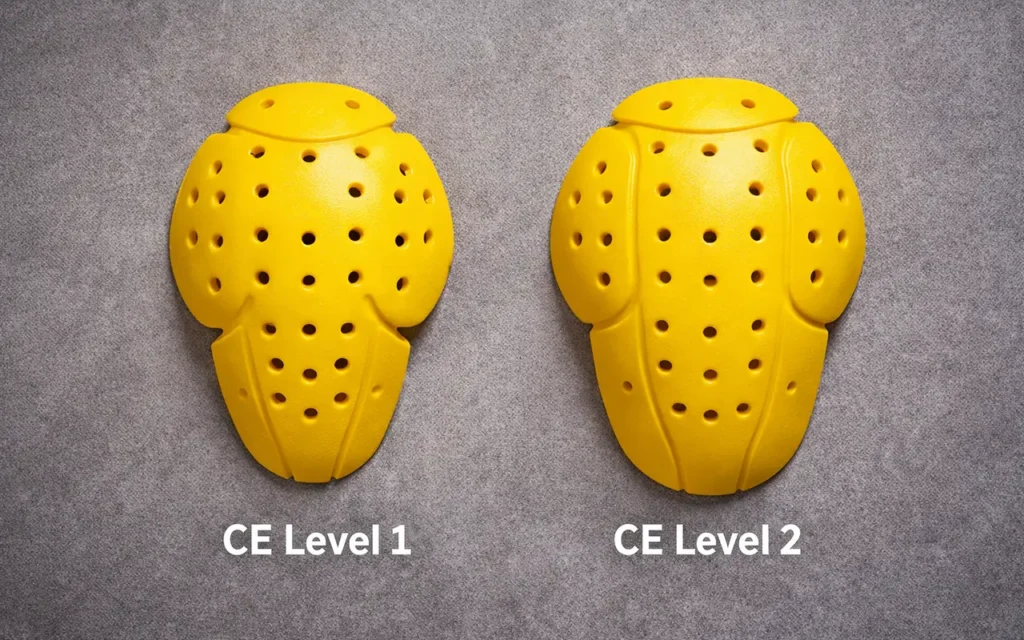
Side-by-side comparison of CE Level 1 and CE Level 2 shoulder armor pads
This is where most riders get confused, and understandably so. Let me break it down as plainly as I can.
Both Level 1 and Level 2 use the same EN 1621 testing methodology. A drop weight is released onto the armor from a fixed height, and the transmitted force is measured on the other side. The question is: how much force passes through?
| CE Level | Protection Standard | Impact Energy | Best For |
| Level 1 | EN 13594 / EN 1621 | Up to 35 kN | Casual / commuting |
| Level 2 | EN 13594 / EN 1621 | Up to 20 kN | Sport / track days |
CE Level 1 vs Level 2 — simplified comparison. Lower transmitted force = better protection.
CE Level 1 Armor
Level 1 armor must transmit no more than 35 kN of force on average, with no single reading exceeding 50 kN. To put that in layman’s terms: it offers a decent baseline of protection for everyday riding and commuting. It’s not inadequate — it’s just the minimum bar.
The upside of Level 1 armor is that it can be made lighter and more flexible. Many Level 1 pads use viscoelastic foam that’s genuinely comfortable to wear all day. If you’re primarily commuting in urban traffic at moderate speeds, Level 1 is a reasonable choice.
The downside? At higher impact energies — the kind you experience in a highway slide or a significant crash — Level 1 armor transmits more force to your body. It’s the difference between a bruise and a break.
CE Level 2 Armor
Level 2 armor must transmit no more than 20 kN on average. That’s nearly half the force allowed through compared to Level 1. The no-single-reading limit is 30 kN.
This is what I now insist on for every jacket I buy, and it’s what I’d recommend to anyone who rides regularly, especially at speed or on motorways.
The materials required to hit Level 2 tend to be denser — often D3O or similar impact-absorbing polymers — which can make the armor slightly stiffer.
However, the technology has improved dramatically in recent years. Many modern Level 2 pads are only marginally less comfortable than Level 1.
Here’s my honest take: if a brand is selling a jacket at a premium price but only includes Level 1 armor, I’d question their commitment to your safety. Level 2 certification costs more to achieve, but it exists for good reason.
The Five Protection Zones in a Motorcycle Jacket
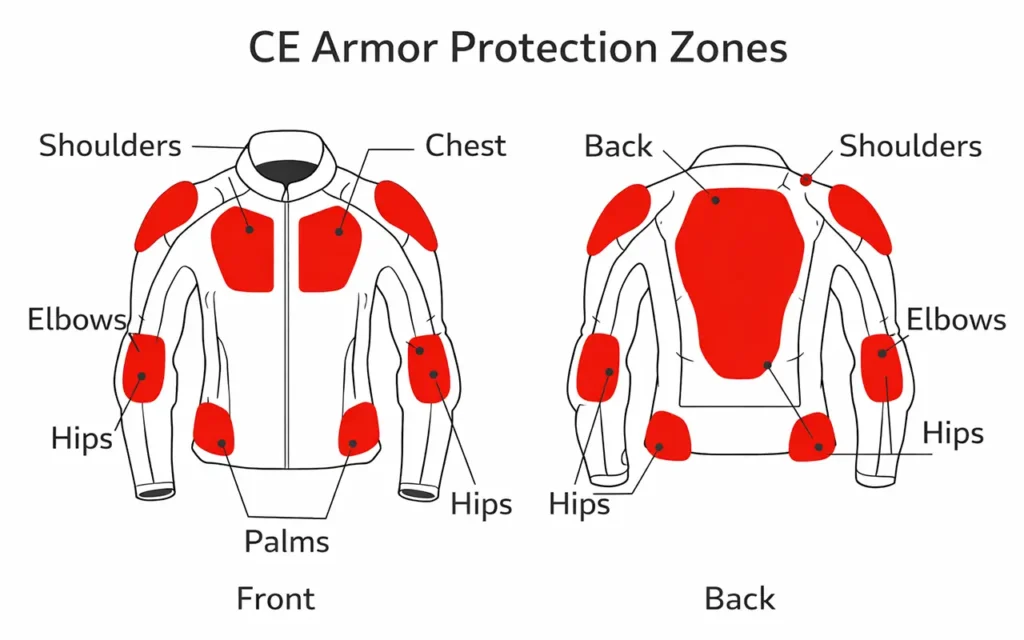
Diagram showing five CE armor protection zones on a motorcycle jacket
Not all armor is created equal, and a jacket doesn’t just protect one area. Understanding the five zones will help you evaluate any jacket you’re considering — and notice when a brand is cutting corners.
1. Shoulders
Shoulder armor (EN 1621-1) is one of the most important pieces in a jacket. When you go down, your shoulders often hit the ground first.
Good shoulder armor should sit flush against your shoulder cap — not hovering an inch above or below it. I always try on jackets and reach upward to check that the armor doesn’t slide off my shoulder.
Look for Level 2 here if possible. Many budget jackets include Level 1 shoulder pads and hope you won’t notice.
2. Elbows and Forearms
Elbow armor (also EN 1621-1) protects one of the most vulnerable joints in a slide. Your instinct is to put your arms out when you fall — meaning elbows take tremendous punishment.
Same standard as shoulders, but the fit is slightly different. Check that the pad sits over the bony point of your elbow, not above or below it.
3. Hips
Hip armor is the most inconsistently implemented protection in the industry. Some jackets have dedicated CE-certified hip armor pockets.
Others have a thin layer of foam — or nothing at all. Hips are critical because a hip fracture can change your life.
If your jacket doesn’t have CE-rated hip armor, I’d strongly consider adding hip protectors or choosing a different jacket.
This is one area where many otherwise good-looking jackets fall short. Don’t assume hip protection is included just because the jacket looks protective.
4. Back
Back protection deserves its own section — and I’ve given it one below — but it’s worth naming here as the fifth zone.
It’s certified under EN 1621-2, a separate standard, and is absolutely not something you want to compromise on.
5. Chest (Optional but Valuable)
Chest protectors aren’t required for CE jacket certification, but premium jackets often include them. They’re governed by EN 1621-3 when paired with airbag systems, but standalone chest pads typically follow EN 13594.
If your jacket has a chest pocket and comes without a pad, it’s worth buying one. Your sternum and ribs will thank you.
Back Protectors: The Most Misunderstood Piece of Armor
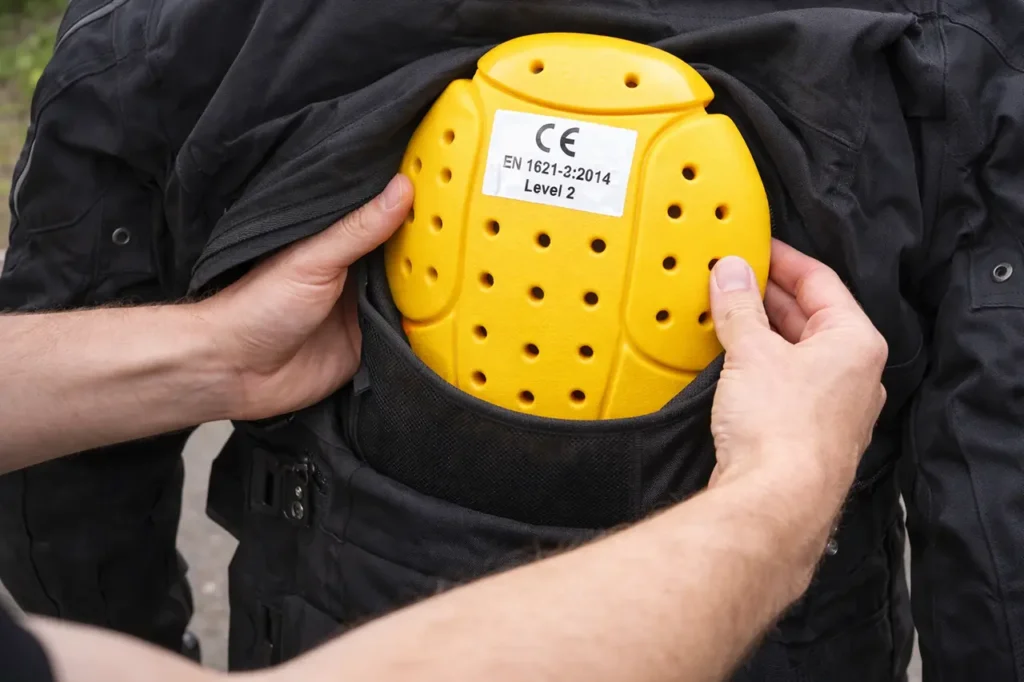
EN 1621-2 Level 2 back protector being fitted into motorcycle jacket back pocket
I want to spend extra time here because back protection is where I see the most confusion — and the most misleading marketing.
Back protectors are certified under EN 1621-2:2014. Like limb armor, they come in Level 1 and Level 2. But the difference in real-world performance is stark.
Level 1 back protectors allow up to 18 kN of transmitted force. Level 2 allows a maximum of 9 kN. That’s half the force.
Your spinal cord has almost no tolerance for traumatic impact — this is the zone where the difference between Level 1 and Level 2 can be the difference between walking away and not.
Here’s the thing that frustrates me: many jackets — even expensive ones — come with a Level 1 back protector or a simple foam insert as standard.
Brands sometimes mention this in tiny print in the spec sheet, knowing that most buyers won’t read it. When you see a jacket listed as CE-certified, always ask specifically about the back protector level.
What to Look For
- EN 1621-2 Level 2 is the gold standard for back protection. Insist on it.
- If your jacket came with a Level 1 pad, you can often purchase and fit a Level 2 upgrade pad separately.
- Some riders prefer a separate back protector vest worn under or over the jacket, which gives you the most flexibility and often better coverage.
- Make sure the back protector actually covers your spine fully — a small pad that covers only your lumbar is not adequate protection for a high-speed crash.
I upgraded my own jacket’s back protector about three years ago — paid around thirty pounds for a Level 2 pad that fit the existing pocket. One of the best small investments I’ve made in my riding gear.
How CE Testing Actually Works
I think understanding the testing process helps you appreciate why the levels are meaningful. It’s not arbitrary bureaucracy — these tests are designed to simulate real crash impacts.
The Drop Test
For limb armor (EN 1621-1), a guided 5 kg striker is dropped from a set height onto the armor, which sits on a foam anvil. Sensors measure the transmitted force in kilonewtons.
The test is repeated multiple times on different points of the armor, and the average and peak readings must fall within the allowed limits.
For back protectors (EN 1621-2), a similar method is used with a larger flat striker to simulate the wider surface area of the back.
Conditioning Tests
Here’s something most people don’t know: armor is also tested after being subjected to aging conditions. This includes testing after exposure to heat, cold, and humidity.
CE-certified armor must perform within the limits even after these conditions — meaning the protection should hold up across different climates and over time.
This is also why I’d caution you to replace your armor if it’s been sitting in a hot car boot for years. The materials can degrade, and the original certification doesn’t guarantee performance after significant environmental stress.
The Independence of Testing
One nuance worth knowing: not all CE-marked products are tested by independent bodies. Some can be self-certified by the manufacturer.
For the EN 1621 motorcycle standards, independent third-party testing is increasingly the norm — but it’s worth looking for jackets that specify independent certification if you want maximum confidence.
Common CE Rating Myths — Busted
Myth 1: All CE-Certified Jackets Are Equally Safe
Absolutely not. A jacket with Level 1 armor in all zones and a foam back insert is CE certified. So is a jacket with Level 2 armor throughout and a full-coverage Level 2 back protector.
They are not the same. The CE mark tells you the gear met the minimum standard — you need to dig into the levels to understand what you’re actually getting.
Myth 2: Leather Is Inherently Safer Than Textile
This is a separate question from CE armor, but worth addressing. Leather has excellent abrasion resistance, which protects your skin in a slide.
Textile can be equally or more protective if it’s built with quality armor and high-quality abrasion-resistant fabrics. The armor level inside matters as much as the outer material.
Myth 3: CE Level 1 Is Adequate for All Riding
It depends on your riding. For low-speed urban commuting, Level 1 is not unreasonable.
But for motorway riding, twisty road riding, or any speed above about 50 mph, the difference in transmitted force at Level 2 becomes very relevant to your outcomes in a crash. I’d push for Level 2 as the standard for anyone riding regularly.
Myth 4: The CE Mark Means the Whole Jacket Was Tested
The CE mark on a jacket’s label usually refers to the armor inside it, not the outer shell. The shell’s abrasion resistance, tear strength, and seam performance are separate considerations (governed by EN 17092 for the full jacket).
A CE-certified jacket should specify both the armor certification and the jacket shell certification if it wants to be fully transparent. Reputable brands do both.
How to Actually Check the CE Rating When Buying a Jacket
Theory is great, but here’s the practical checklist I use whenever I’m evaluating a new jacket:
- Check the swing tag or product spec sheet — it should list the CE standard and level for each armor zone separately.
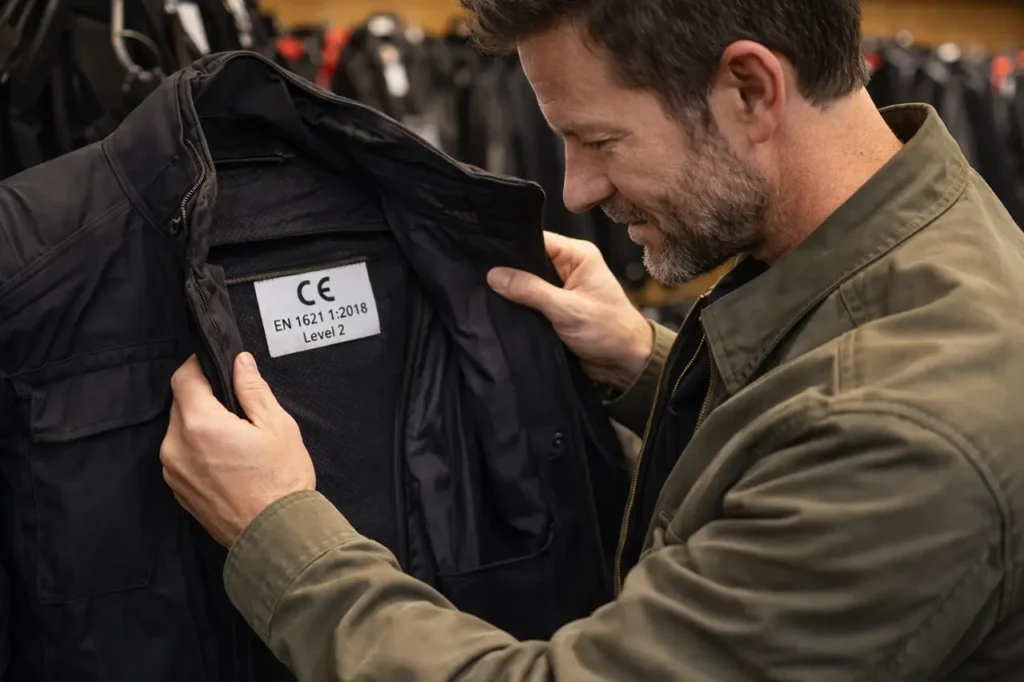
- Look inside the armor pockets — the armor pads themselves should have a label with the EN standard and level number.
- Check the back protector specifically — don’t assume it matches the limb armor level.
- Look for the jacket shell standard (EN 17092) as well — this tells you how the outer material performs.
- If buying online — contact the brand directly if the spec sheet is vague. A brand confident in their safety credentials will answer clearly.
- Try the jacket on with the armor in place — check that all pads sit over the correct anatomical locations before you buy.
This process takes about five minutes and gives you a genuinely informed picture of what you’re buying. It’s five minutes that might save your spine.
When Should You Replace Your Armor?
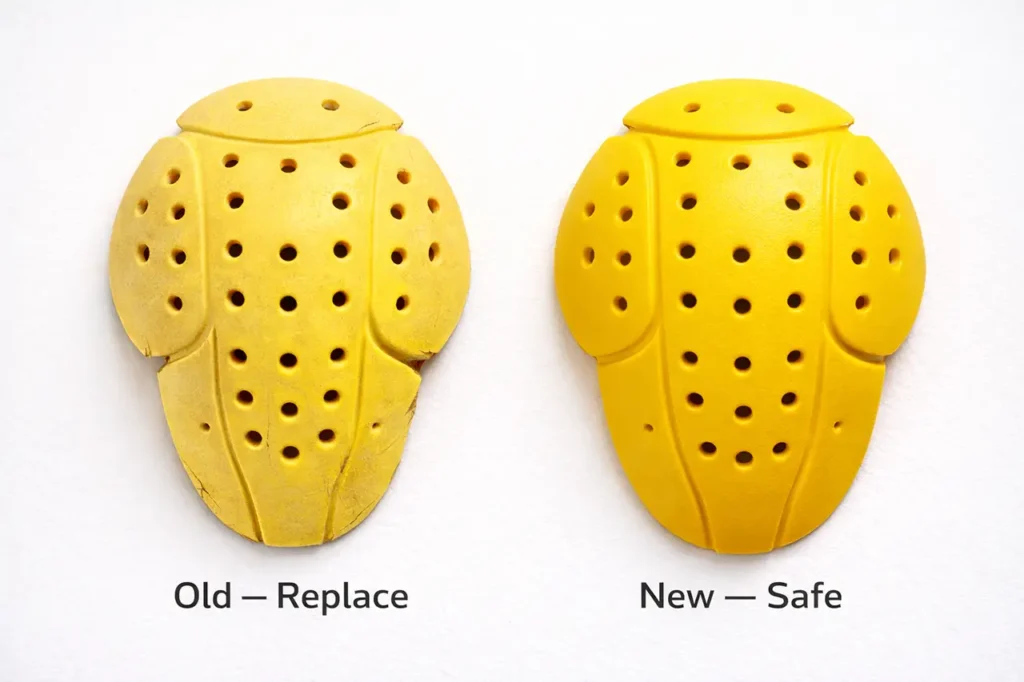
Old vs new motorcycle armor pad comparison showing material degradation
This is something I didn’t think about for years, and I suspect most riders don’t either. CE-certified armor has a functional lifespan.
Most manufacturers recommend replacing armor every five years under normal use. The polymers and foams used in impact absorption can degrade over time — especially with exposure to body heat, sweat, UV light, and cleaning chemicals.
An armor pad that was excellent when new may transmit significantly more force a decade later.
More importantly: replace your armor after any significant impact, even if you can’t see visible damage.
Impact-absorbing materials work by deforming — that deformation may not be reversible. A pad that absorbed a crash may not protect you in the next one.
I check my armor pads once a year. I press on them, flex them, look for cracking or brittleness. If anything feels off, I replace it. Pads are usually inexpensive relative to the cost of a jacket — don’t be penny-wise and pound-foolish here.
The EN 17092 Jacket Standard: A Quick Note
Since we’re already in the weeds, it’s worth briefly mentioning EN 17092, which is the European standard for the motorcycle jacket itself — separate from the armor inside it.
EN 17092 grades the full garment into classes based on abrasion, tear, burst, and seam strength tests:
- Class AAA — Highest level, full body coverage with the most demanding abrasion test. Typical of serious sports and leather jackets.
- Class AA — High level of protection, suitable for most riding conditions.
- Class A — Baseline garment protection. Better than nothing, but less suited to high-speed riding.
- Class B — No impact-related abrasion requirement — essentially a garment certification for visibility or weather protection.
A complete picture of a jacket’s safety includes both its EN 17092 class (for the shell) and the EN 1621 levels (for the armor). The best jackets will clearly state both. If a brand only mentions one or neither, be cautious.
My Personal Armor Setup — And What I’d Recommend
I’ve gone through enough jackets over the years to have some strong opinions, and I’d rather share them plainly than pretend there’s no hierarchy.
My current daily riding jacket has EN 1621-1 Level 2 armor at the shoulders and elbows, CE Level 1 hip protection (a compromise I’m not thrilled about — I’ve ordered a Level 2 upgrade), and a full-length EN 1621-2 Level 2 back protector.
The shell is rated Class AA under EN 17092. It’s not a cheap jacket, but it’s also not the most expensive one I looked at.
For commuters and casual riders on a budget: at minimum, get Level 2 back protection and Level 1 elsewhere. Don’t compromise the back.
For regular road riders and touring: Level 2 across the board — shoulders, elbows, and back. Add hip protection if you can.
For track days and sport riding: Level 2 everywhere, consider a separate back protector vest, and look for the highest EN 17092 shell class you can find.
Whatever your riding style: read the label. Ask the questions. Don’t buy a jacket based on the CE logo alone. The logo tells you the door is open — the levels tell you what’s inside.
Final Thoughts
CE ratings aren’t glamorous. They’re regulatory language, test numbers, and certification codes. But what they represent is simple: evidence that someone tested the gear that stands between you and serious injury, and that it met a defined standard.
The motorcycle industry has improved enormously in the past decade. There are jackets at every price point that offer genuinely good protection if you know what to look for. The information is there on the label — you just need to know how to read it.
I hope this post helps you do exactly that. If you’ve got questions about specific gear or want me to break down the armor on a jacket you’re considering, drop a comment below. I check them regularly and I’m happy to help you dig into the details.
Ride safe — and read the label.
Quick Reference: CE Armor Cheat Sheet
- EN 1621-1 — Limb armor (shoulders, elbows, hips). Level 2 = max 20 kN.
- EN 1621-2 — Back protectors. Level 2 = max 9 kN. Non-negotiable upgrade.
- EN 17092 — The jacket shell itself. Class AA or AAA for road riding.
- Level 1 — Minimum standard. Adequate for low-speed commuting.
- Level 2 — Recommended standard. Absorbs significantly more impact energy.
- Replace armor every 5 years or after any significant impact.
Frequently Asked Questions (FAQ)
Can I upgrade the CE Level 1 armor in my jacket to CE Level 2?
Yes, in most cases! The vast majority of motorcycle jackets feature Velcro or zippered pockets that hold the armor in place. As long as the new Level 2 armor is a similar shape to the original pads, you can easily swap it out. Just keep in mind that Level 2 armor is usually slightly thicker and heavier, so make sure the jacket still fits comfortably and doesn’t restrict your movement.
Is CE Level 1 armor enough for highway riding?
CE Level 1 provides a good baseline of protection and is generally adequate for lower-speed urban commuting or neighborhood riding. However, for highway riding—where potential impact forces are significantly higher—CE Level 2 is highly recommended. The extra energy absorption could be the difference between a bad bruise and a broken bone. At a minimum, always prioritize a Level 2 back protector.
Does motorcycle armor expire or go bad?
Yes, it does. Materials like viscoelastic foam (used in popular brands like D3O or SAS-TEC) naturally degrade over time due to exposure to body heat, sweat, ozone, and general wear and tear. Most manufacturers recommend replacing your armor every 5 to 7 years. Additionally, you should replace your armor immediately after any significant crash, as the material’s internal structure may be compromised even if it looks fine on the outside.
What is the difference between CE, DOT, and ECE ratings?
It is easy to mix these up! DOT (Department of Transportation) and ECE (Economic Commission for Europe) are safety standards specifically for motorcycle helmets. CE ratings, on the other hand, apply to the protective gear worn on your body, such as jackets, pants, boots, gloves, and the internal armor pads.
My jacket says “CE Approved” but doesn’t list a level. Is it safe?
Be very cautious with vague labeling. Sometimes, cheaper brands will state a jacket is “CE Approved,” but they might just be referring to the zippers or the fabric passing a generic clothing standard, not the motorcycle-specific impact standard. Always check the physical tags on the armor pads inside the jacket. You should explicitly see EN 1621-1 (for limbs) or EN 1621-2 (for the back), along with a clear Level 1 or Level 2 icon.
Related Reading You Might Find Useful: