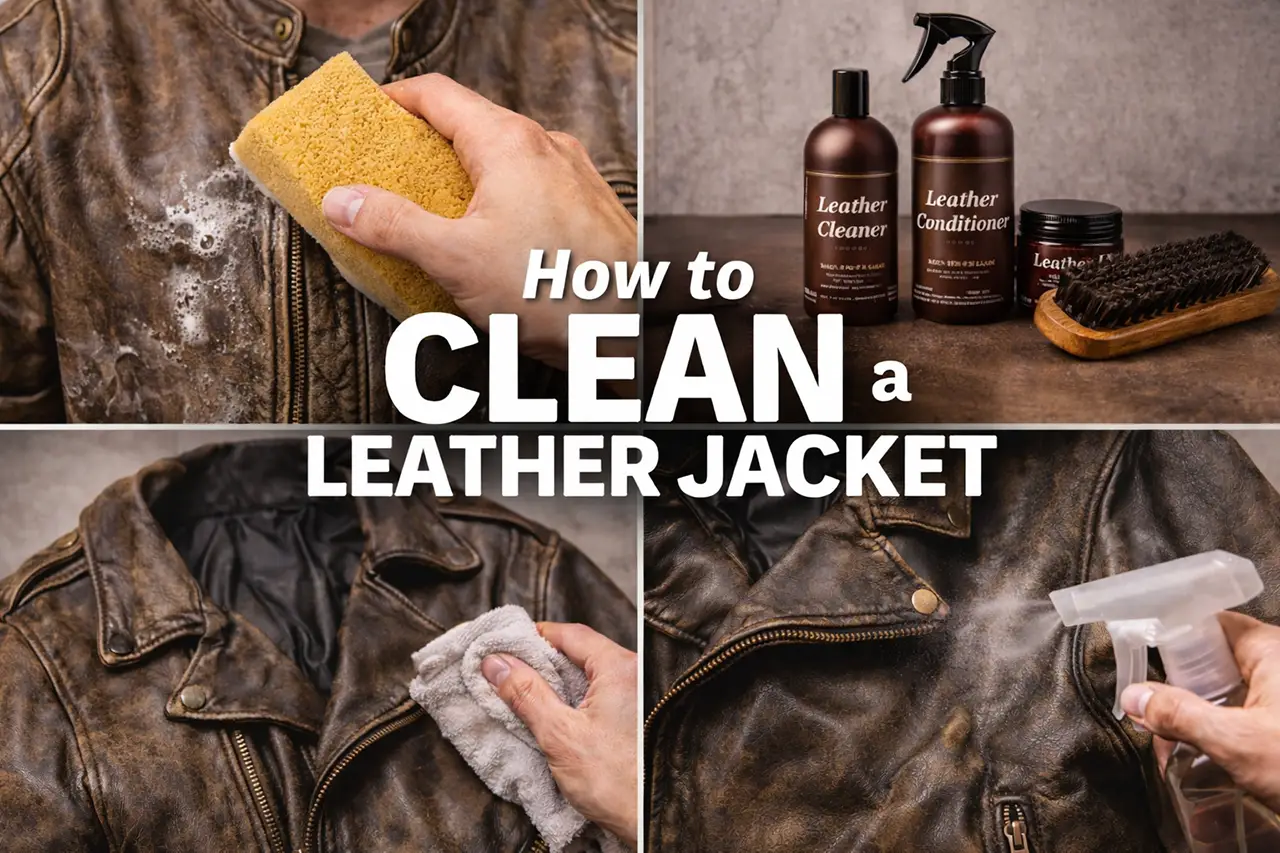
If there’s one thing that will destroy a good motorcycle jacket faster than a slide on the asphalt, it’s cleaning it the wrong way.
After years of riding—from baking on dusty backroads to getting caught in sudden downpours up in Montana—I’ve learned the hard way that you can’t just treat your riding gear like a regular piece of clothing.
Whether you’re rocking a classic leather hide or comparing materials in our Ultimate Guide to Motorcycle Jackets, one scrub with the wrong household soap will cause that expensive armor to stiffen, crack, and lose its protective qualities.
Here is the exact, road-tested method I use to pull out ingrained dirt, heavy bug splatters, and sweat while keeping the leather supple and ready for the next ride.
| ⚡ TL;DR — Quick Answer 1. Wipe off surface dirt with a damp microfiber cloth — no soaking. 2. Use a dedicated leather cleaner (not dish soap, not baby wipes). 3. Condition after every clean to restore oils and prevent cracking. 4. Let it air dry naturally — never near heat or direct sunlight. 5. Store properly: padded hanger, breathable bag, away from humidity. Scroll down for the full step-by-step process, product picks, and hard-learned mistakes. |
Why I Take Leather Jacket Cleaning Very Seriously
Let me start with a confession. About seven years ago, I tossed my first serious motorcycle jacket — a beautiful Dainese cowhide piece I had saved up three months to buy — into the washing machine.
I had seen some forum post that said “it works fine, just use cold water.” It did not work fine. What came out was a shrunken, stiff, cracked shell of the jacket I had put in. The leather was destroyed. I had to buy a new one.
That mistake cost me $400 and a lot of heartbreak. But it also turned me into someone who became almost obsessive about leather care.
Over the past decade of riding, I have owned six leather jackets, tested dozens of cleaning products, and talked to leather craftsmen, gear shop owners, and fellow riders about what actually works — and what quietly ruins your jacket over time.
This guide is everything I know. Not written for Google — written for you, a rider who wants their jacket to last a decade or more.
Understanding Your Leather Jacket Before You Clean It
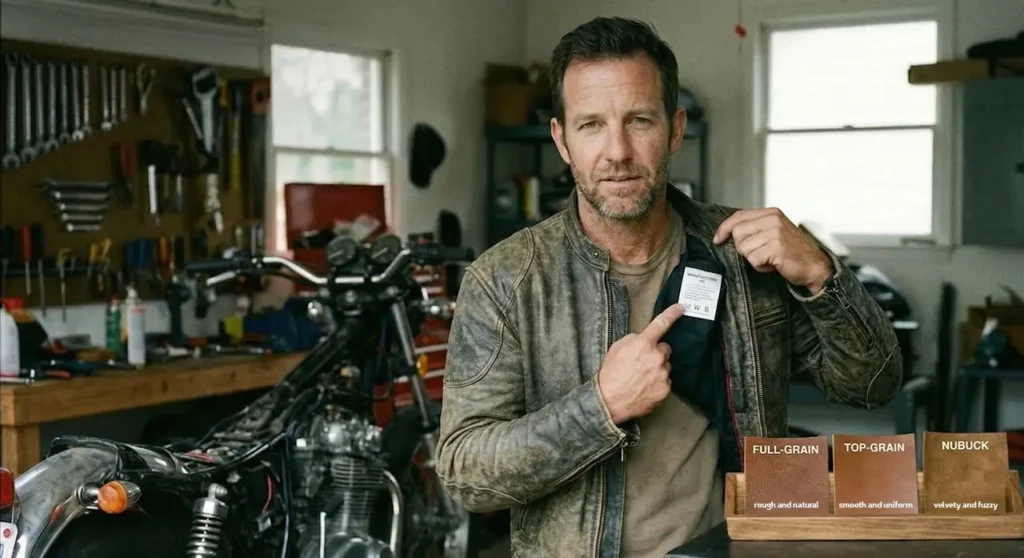
Not all motorcycle leather jackets are the same, and cleaning them is not one-size-fits-all. The first thing you need to know is what kind of leather you are dealing with.
Full-Grain Leather
This is the highest quality and most durable leather. It retains the full surface of the hide, including natural markings. Most premium motorcycle jackets — brands like Vanson, Aero Leathers, and top-tier Alpinestars — use full-grain leather. It is the most forgiving to clean but also the most expensive to replace if you damage it.
Top-Grain Leather
This is the most common type in mid-range motorcycle jackets. The top layer of the hide has been sanded to remove imperfections, making it more uniform but slightly less breathable. Brands like Dainese and Rev’It use top-grain on many of their models. It cleans well but can dry out faster than full-grain.
Corrected-Grain Leather
Found on budget motorcycle jackets. It has a more artificial, plastic-like feel. It is more water-resistant but less breathable and less durable over time. If your jacket feels almost like faux leather but is technically real, it is probably corrected-grain.
Nubuck and Suede
Some adventure and casual riding jackets use nubuck (buffed top-grain) or suede. These are completely different to clean — they require dry cleaning methods and specialist brushes, not the wet methods we will cover here. If your jacket is nubuck or suede, bookmark a different guide.
| 🔍 Quick Check Before You Start Look at the manufacturer’s care label inside your jacket. “W” or water symbol = wet cleaning okay. “S” = solvent-based cleaner only. “X” = professional cleaning only. When in doubt, spot-test any product on an inside seam first. |
What You Actually Need to Clean a Leather Jacket
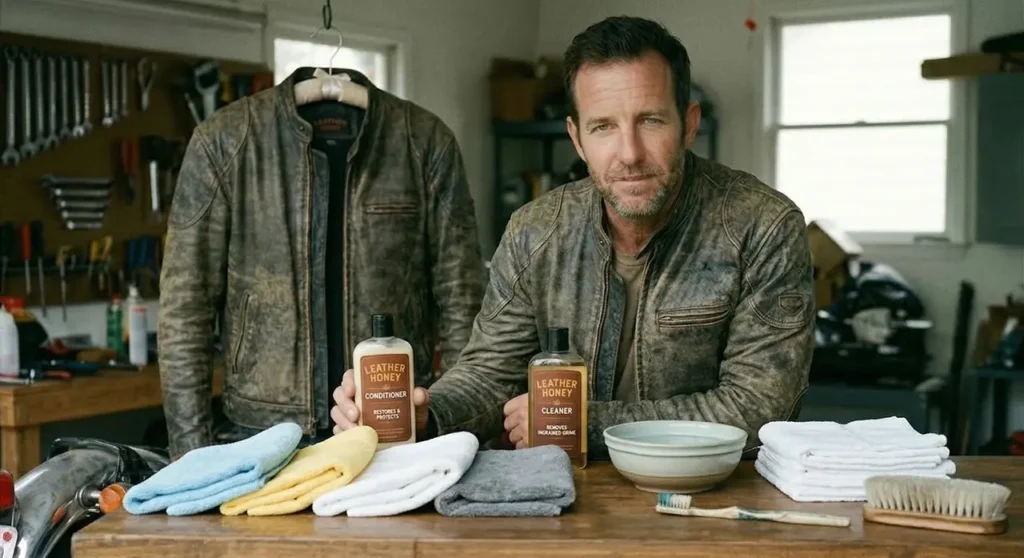
You do not need an expensive kit. But you do need the right things. Here is what I keep in my gear cleaning station:
The Essentials
- Microfiber cloths (at least 3 — one for cleaning, one for conditioner, one dry buffer)
- A dedicated leather cleaner — I use Leather Honey Cleaner or Bickmore Saddle Soap for heavier grime
- A dedicated leather conditioner — Leather Honey Conditioner, Lexol, or Fjallraven Leather Balm all work well
- A soft-bristle brush — an old toothbrush for stitching and seams, a slightly stiffer brush for textured areas
- A bowl of lukewarm water
- Clean, dry towels for blotting
What You Should Never Use
- Dish soap or hand soap — strips natural oils, leaves residue
- Baby wipes — they contain chemicals that can cause discoloration and dryness over time
- Rubbing alcohol — destroys leather finish
- WD-40 or petroleum-based products — can stain and degrade leather
- Washing machine or dryer — I learned this the hard way
- Hair dryer or direct heat — causes shrinkage and cracking
| ⚠️ A Note on Saddle Soap Saddle soap is great for heavy dirt removal but is slightly alkaline, which can dry out leather over time if used too frequently. Use it for deep cleans only (once or twice a season), and always follow up with a generous layer of conditioner. |
Step-by-Step: How to Clean Your Motorcycle Leather Jacket
I do this process two to three times a year depending on how much I ride — once at the start of riding season, once at the end, and sometimes mid-season if the jacket has taken some serious road grime or gotten caught in heavy rain.
Step 1: Shake Out and Brush Off Loose Debris
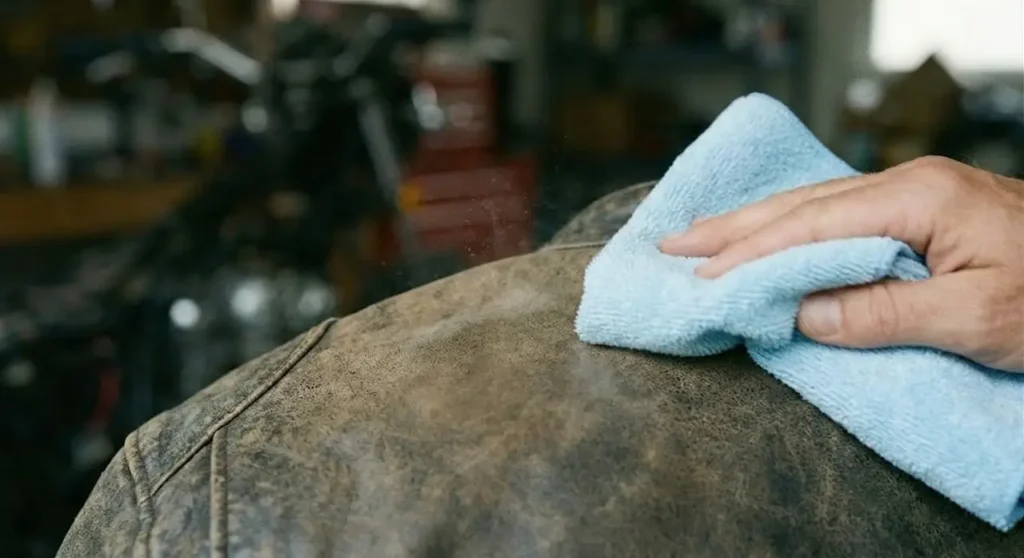
Before any liquid touches your jacket, get rid of loose dirt, dust, and debris. Give the jacket a good shake outside. Then use a dry soft-bristle brush — or even a clean, dry microfiber cloth — to gently brush off any surface dirt, especially around the seams, pockets, and collar where dust accumulates.
If there is dried mud (happens if you ride off-road or get caught in rain), let it dry completely first. Never try to scrub wet mud — you will push it deeper into the leather. Once dry, it brushes right off.
Step 2: Check All the Pockets
I know this sounds obvious, but I have found lip balm, a USB drive, and once an entire chocolate bar melted into a jacket pocket because I skipped this step. Empty everything. Remove any removable armor panels if your jacket has them — most motorcycle jackets have CE armor at the shoulders and elbows. These should not get wet.
Step 3: Dampen Your Cloth — Not the Jacket
Wet your microfiber cloth with lukewarm water and wring it out thoroughly. It should be damp, not dripping. Wipe down the entire exterior of the jacket in long, even strokes. This removes surface grime and preps the leather for the cleaner.
Pay attention to: collar and cuffs (body oils accumulate here), back panel (road spray), and under the arms (sweat residue from summer riding).
Step 4: Apply Your Leather Cleaner
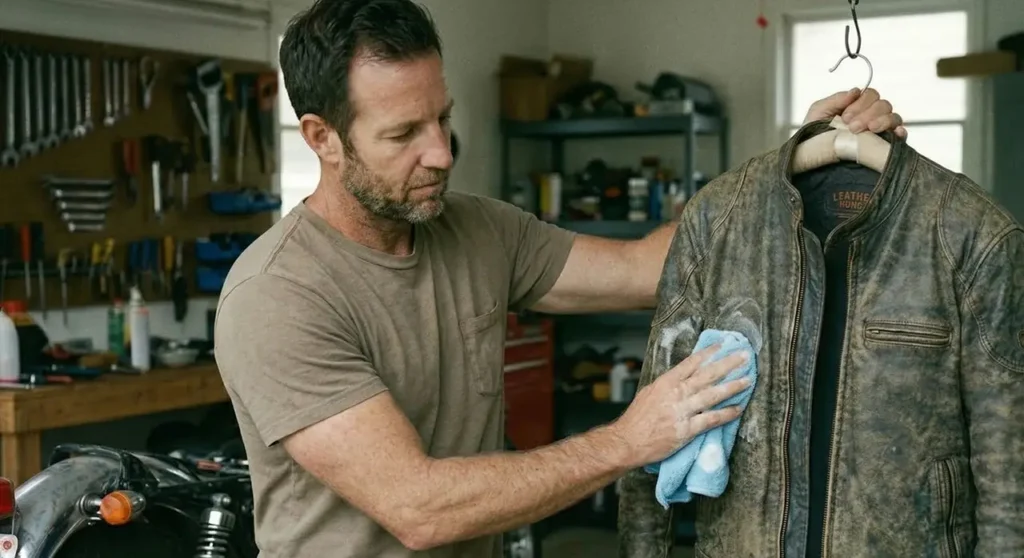
Put a small amount of your leather cleaner — the size of a large coin — onto a fresh damp cloth. Work it into the leather using small, circular motions. You are not scrubbing; you are massaging the cleaner in gently.
Work in sections: sleeves first, then the body front, then the back. For stitching and around zippers, use the soft toothbrush to get into crevices.
You will notice a light lather form — that is normal with saddle soap, and some cleaners produce slight foam. Do not let it sit for more than a minute before you wipe it off.
| 💡 Tip from Experience For jacket liners: if your jacket has a removable liner, check its label separately. Most textile liners can be hand-washed with mild detergent and air dried. Never put a leather jacket with a non-removable liner in the wash. |
Step 5: Wipe Off the Cleaner
Use a separate clean, damp cloth to wipe away all cleaner residue. Go over each section twice to make sure no soap or cleaner remains. Leftover cleaner can dry out or discolor the leather.
Step 6: Blot — Do Not Rub — Dry
Use a dry clean towel and gently blot the jacket to remove excess moisture. Do not rub — this can streak the leather and disrupt its texture. Get it as dry as you can with blotting alone.
Step 7: Let It Air Dry Naturally
This step requires patience. Hang the jacket on a wide, padded hanger (not a wire hanger — those can leave imprints) in a well-ventilated room. Keep it away from direct sunlight, radiators, heat vents, and window drafts.
Full drying can take anywhere from 2 to 6 hours depending on how damp the jacket got and your ambient humidity. Resist the urge to speed this up with a fan on full blast or, worse, a hair dryer. I have watched riders crack perfectly good leather by getting impatient at this step.
Step 8: Condition the Leather — This Is the Most Important Step
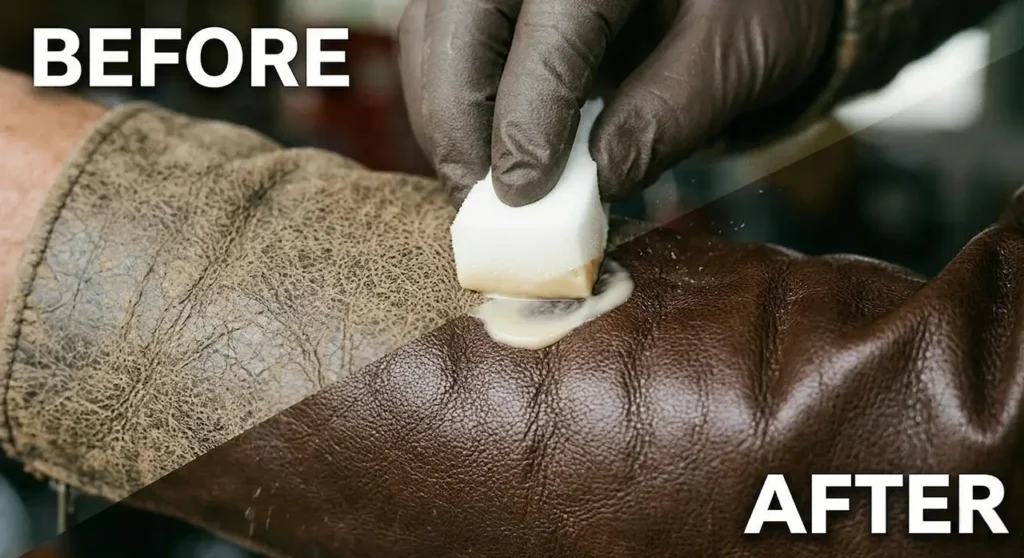
Once the jacket is fully dry to the touch, condition it. This step is not optional. Cleaning strips out some of the natural oils from the leather. If you skip conditioning, the leather will dry out and begin to crack — slowly at first, then rapidly.
Apply a generous amount of leather conditioner to a clean microfiber cloth. Work it into the jacket using circular motions, the same way you applied the cleaner. Cover every surface: the back, the sleeves, the shoulders, the collar, the front panels. Do not forget the areas around zippers and seams.
Let the conditioner absorb for at least 15 to 20 minutes. Then use a dry cloth to buff off any excess. The jacket should feel supple, soft, and have a subtle sheen — not greasy or over-coated.
| 🏆 My Go-To Conditioner Setup For everyday conditioning: Lexol Leather Conditioner (affordable, effective, widely available). For dry or cracked leather needing restoration: Leather Honey (heavier formula, great for neglected jackets). For waterproofing boost: Nikwax Leather Proof (apply after your regular conditioner has absorbed). Apply conditioner 2-4 times per year minimum — more often in dry climates. |
Dealing With Specific Situations
After Riding in Rain
Getting caught in rain happens. Here is what to do when you get home: do not hang it up soaking wet and ignore it. Shake off excess water, blot with a dry towel, and then hang it on a padded hanger in a ventilated space. Once it is fully dry — which may take a day — condition it immediately. Rain pulls oils out of leather aggressively.
If your jacket got completely saturated, apply a heavier coat of conditioner than usual and let it absorb overnight. Check the next day if it still looks or feels dull or stiff — apply a second coat if needed.
Removing Insect Splatter and Road Grime
This is a real issue for motorcycle riders. After a long summer highway ride, the front of your jacket can look like a bug cemetery. Fresh bug splatter is easiest to deal with — a damp microfiber cloth right after riding gets most of it off.
Dried, baked-on insect matter requires a bit more work. Dampen the area generously and let it soften for a minute before gently working it with a soft cloth or brush. Do not scrape with your fingernail or anything sharp — you will scratch the leather finish.
Removing Mold or Mildew
If your jacket was stored in a damp garage or basement and has developed mold or mildew (you will notice it by white or gray fuzzy patches and a musty smell), act fast. Mix equal parts water and white vinegar in a spray bottle, mist the affected area lightly, and wipe with a clean cloth. Let it air out for a full day before conditioning.
For severe mold growth, I would recommend taking the jacket to a professional leather cleaner. Mold can penetrate deep into the hide, and aggressive DIY attempts can permanently damage the leather.
Scuffs and Light Scratches
Minor scuffs — the kind you get from a low-speed tip-over or brushing against a wall — often respond well to conditioning alone. Apply conditioner to the scuffed area, work it in with your fingertip (the warmth helps), and let it absorb. For darker leathers, a matching leather color restorer can touch up the look.
Deep scratches that go through the finish layer need professional attention or a leather repair kit. I have had good results with Furniture Clinic Leather Repair Kits for minor damage, but be realistic — if the scratch is deep, your jacket will have a scar. Character, I say.
Dealing with Smell (Sweat and Road Odor)
Motorcycle jackets absorb sweat, especially at the collar and under the arms. For general deodorizing, a light spray of diluted distilled white vinegar (one part vinegar to three parts water) on the interior lining, followed by thorough air drying, works well and does not damage most linings.
If your jacket has a removable liner, washing it separately according to its care label makes a huge difference. For pervasive odors that will not go away, cedar inserts or activated charcoal bags placed inside a sealed storage bag overnight can help.
How Often Should You Clean Your Leather Jacket?
This is the question I get most often from newer riders. Here is my general schedule:
- Quick wipe-down: After every 2 to 3 rides, or whenever you notice surface dust or grime.
- Full clean: 2 to 3 times per year — beginning of season, mid-season, end of season.
- Deep clean (saddle soap): Once a year, or when the jacket is heavily soiled.
- Conditioning: Every full clean, and any time the leather starts to look dull or feel slightly stiff.
- Waterproofing treatment: Once or twice a year, or before heavy rain season.
Riders in dry, dusty climates (desert Southwest, for example) may need to condition more frequently — the low humidity accelerates leather drying. Riders in humid climates need to be more vigilant about mold and mildew, especially during storage.
Proper Storage: The Step Most Riders Skip
How you store your jacket between rides — and especially during the off-season — matters just as much as how you clean it. I have seen beautifully cared-for jackets get destroyed in one winter of bad storage.
The Right Way to Store Your Leather Jacket
- Use a wide, padded hanger. Wire hangers create pressure points that can deform the shoulders permanently.
- Keep it in a breathable garment bag — not a plastic dry-cleaning bag. Plastic traps moisture and creates a mold-friendly environment.
- Store in a cool, dry area with stable temperature. Avoid garages, basements, and attics where temperature and humidity swing dramatically.
- Never store in direct sunlight — UV rays fade and dry out leather over time.
- For long off-season storage, apply a generous conditioning coat before hanging it up. The leather will slowly absorb the conditioner during storage and stay supple.
| ❌ Common Storage Mistakes Folding the jacket and stacking it in a box — creases become permanent. Storing it in a plastic bin or vacuum bag — cuts off airflow, promotes mold. Hanging it in a hot garage all summer — heat and UV destroy the leather. Leaving armor in the jacket during long storage — can distort the shape. Hanging it on a hook by the collar — stretches the collar permanently. |
Leather Care Products I Actually Use and Recommend
I want to be straight with you: I am not sponsored by any of these brands. These are products I have used, tested, and found genuinely effective over years of riding. Prices vary by region and retailer.
Leather Cleaners
- Leather Honey Cleaner — gentle, pH-balanced, works on most leather types. My first choice for regular cleaning.
- Bickmore Saddle Soap — the classic choice for heavy-duty cleaning. Use sparingly and always follow with conditioner.
- Chamberlain’s Leather Milk (Cleaner No. 1) — premium option, extremely gentle, great for high-end jackets.
Leather Conditioners
- Lexol pH Leather Conditioner — widely available, affordable, effective. A solid all-rounder.
- Leather Honey Leather Conditioner — thicker formula, excellent for dry or neglected leather.
- Obenauf’s Heavy Duty LP — formulated originally for firefighters’ gear. Outstanding for heavily used, hard-working motorcycle jackets.
Waterproofing Treatments
- Nikwax Leather Proof — spray-on, easy to apply, does not significantly darken most leathers.
- Obenauf’s Leather Preservative — provides waterproofing and conditioning in one step. Will darken lighter leathers.
How to Make Your Motorcycle Leather Jacket Last a Lifetime
I genuinely believe a well-cared-for leather motorcycle jacket can outlast multiple bikes. I have met riders with 30-year-old Vanson jackets that look — and more importantly, protect — as well as the day they were bought.
The secret is not complicated. It is consistent, small habits:
- Clean it before it gets truly dirty. Surface grime is easy. Baked-in, neglected grime is a restoration project.
- Condition it regularly. Leather is skin — it needs moisture to stay flexible and strong.
- Respect the drying process. Slow and natural, always.
- Store it properly. A good jacket deserves a good hanger and a clean environment.
- Address problems early. A small crack caught early can be conditioned back. A crack ignored becomes a permanent split.
The riders who complain that leather jackets do not last are usually the ones who bought good leather and then treated it poorly. The riders who swear by their leather gear are the ones who understand that it is a living material that responds to care.
Quick Reference: Leather Jacket Cleaning at a Glance
| Task | Frequency | Product Needed |
| Surface wipe | After every 2–3 rides | Damp microfiber cloth |
| Full clean | 2–3x per year | Leather cleaner + soft brush |
| Deep clean | 1x per year / heavy soil | Saddle soap |
| Conditioning | Every clean + as needed | Leather conditioner |
| Waterproofing | 1–2x per year | Leather waterproof spray/balm |
| Rain care | After every soaking rain | Conditioner (heavier coat) |
| Off-season prep | Before storage | Conditioner + breathable bag |
Final Thoughts: Your Jacket Is Worth the Effort
A motorcycle leather jacket is not just gear. For most of us who ride, it is part of our identity. It rides with us through rain and heat and long empty highways. It takes the hits so we do not have to. Treating it right is not just about protecting an investment — though it is that too — it is about respecting the gear that keeps you safe.
The cleaning process I have laid out here takes maybe 30 to 45 minutes from start to finish, a few times a year. That is a tiny investment for gear that can genuinely last decades if cared for properly.
If you have any questions about your specific jacket or a problem I have not covered here, feel free to leave a comment below. I have been through most leather jacket situations at this point, and I am happy to help work through it.
Now go for a ride. The jacket can be cleaned later.
FAQs About Cleaning Leather Motorcycle Jackets
Can I put my leather motorcycle jacket in the washing machine?
Absolutely not. Fully submerging a leather jacket in water strips out all of its natural oils. This will cause the leather to shrink, warp, stiffen, and eventually crack as it dries. You should always clean motorcycle leather by hand using the spot-cleaning method.
Are baby wipes safe for a quick wipe-down after a ride?
No. It’s a common mistake, but most baby wipes contain alcohol, fragrances, or alkaline chemicals that dry out the leather and break down its protective finish over time. For a quick wipe-down at a gas station or after a ride, stick to a microfiber cloth dampened with plain water.
Can I use Dawn dish soap to clean my leather jacket?
Avoid dish soap entirely. Dish soaps are formulated as heavy degreasers designed to strip baked-on grease from pans. If you use it on your jacket, it will aggressively strip the essential natural oils right out of the leather, leaving your gear stiff and prone to tearing in a crash. Always use a pH-balanced, dedicated leather cleaner.
What should I do if my leather jacket gets completely soaked in the rain?
First, wipe off the excess surface water with a dry towel. Hang the jacket on a wide, padded hanger (so the shoulders don’t stretch) and let it dry naturally at room temperature in a well-ventilated area. Never use a hairdryer, toss it in the dryer, or hang it near a heater—forced heat bakes the leather and ruins it. Once it is 100% dry, apply a generous coat of leather conditioner to replenish the oils the water pushed out.
How do I get the sweat smell out of the inside liner?
If your jacket has a removable liner, simply unzip it and wash it according to the manufacturer’s tag (usually a gentle, cold cycle). If the liner is permanently attached, turn the jacket inside out. Lightly mist the fabric liner with a 50/50 mix of water and white vinegar, or use a dedicated motorcycle gear deodorizer. Let it air dry completely in a breezy, shaded spot before flipping it back right-side out.
Related Reading You Might Find Useful:
- How to Choose the Right Motorcycle Jacket for Your Riding Style
- CE Rating Explained: What Armor Levels Actually Mean
- Best Motorcycle Jackets Under $500 — Tested and Reviewed
- How to Break In a New Leather Motorcycle Jacket