So, you’re ready to experience the unmatched freedom of the open road on two wheels. The rumble of the engine, the connection to your surroundings—it’s an alluring prospect. But before you buy that perfect bike, your most important investment is in yourself.
Professional motorcycle training is the non-negotiable first step, a foundation for a lifetime of safe and confident riding. However, the path to getting your motorcycle license is often clouded with questions about cost. How much should you budget? What fees are involved beyond the class itself?
This guide is designed to demystify the entire process. We will provide a comprehensive breakdown of the costs associated with motorcycle classes, from the foundational beginner course to advanced training, and all the “hidden” fees in between.
The Importance of Formal Rider Training
Embarking on a motorcycling journey without formal training is not just risky; it’s a gamble with severe consequences. The statistics are sobering: motorcyclists were about 28 times more likely to die per mile traveled compared to occupants in passenger cars in 2023.
Formal training dramatically reduces this risk by replacing bad habits with proven techniques. It equips you with crucial riding skills for handling real-world traffic situations, emergency maneuvers, and understanding the physics of your motorcycle. It’s not just about passing a test; it’s about developing the muscle memory and mental framework to stay safe every time you ride.
What This Guide Will Cover
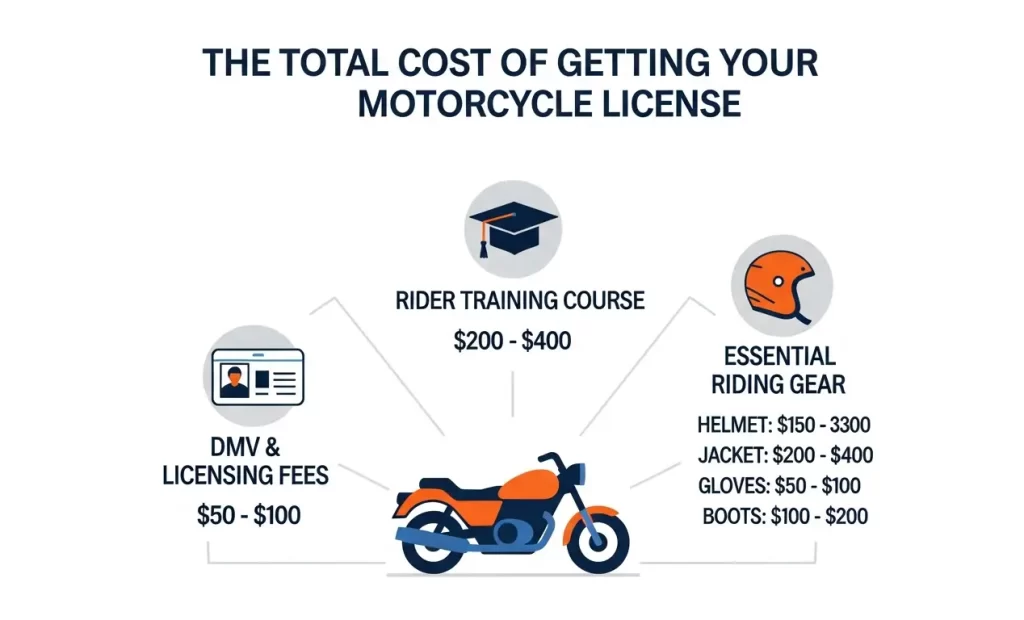
A realistic budget for a new rider includes the course, licensing fees, and essential protective gear.
This article serves as your ultimate financial roadmap to becoming a licensed motorcycle rider. We will dissect the costs of various training courses, explain the factors that influence pricing, and uncover the additional fees you need to anticipate, including licensing and essential riding gear. By the end, you will have a clear, realistic budget and a thorough understanding of the value you receive for your investment in professional motorcycle safety training.
The Foundation: Basic Motorcycle Rider Training Costs
For any aspiring rider, the journey begins with a basic course. This is where you learn the fundamental principles of motorcycle operation, safety, and control in a structured, low-risk environment. This initial investment is the most critical one you’ll make.
Understanding the Basic Rider Course (BRC) and Its Equivalents
The most widely recognized beginner program in the United States is the Basic RiderCourse (BRC) offered by the Motorcycle Safety Foundation (MSF). The MSF curriculum is a proven blend of classroom learning and hands-on riding exercises, designed to take a complete novice from zero to competent beginner.
Many states and training providers adopt the MSF’s BRC or use a very similar, state-approved curriculum. Other popular and reputable programs include the Harley-Davidson Riding Academy and various independent schools that are certified by state transportation departments. Regardless of the name, these foundational courses share a common goal: to instill core motorcycle safety and handling skills.
Typical Cost Range for 2-Wheel Basic Rider Courses
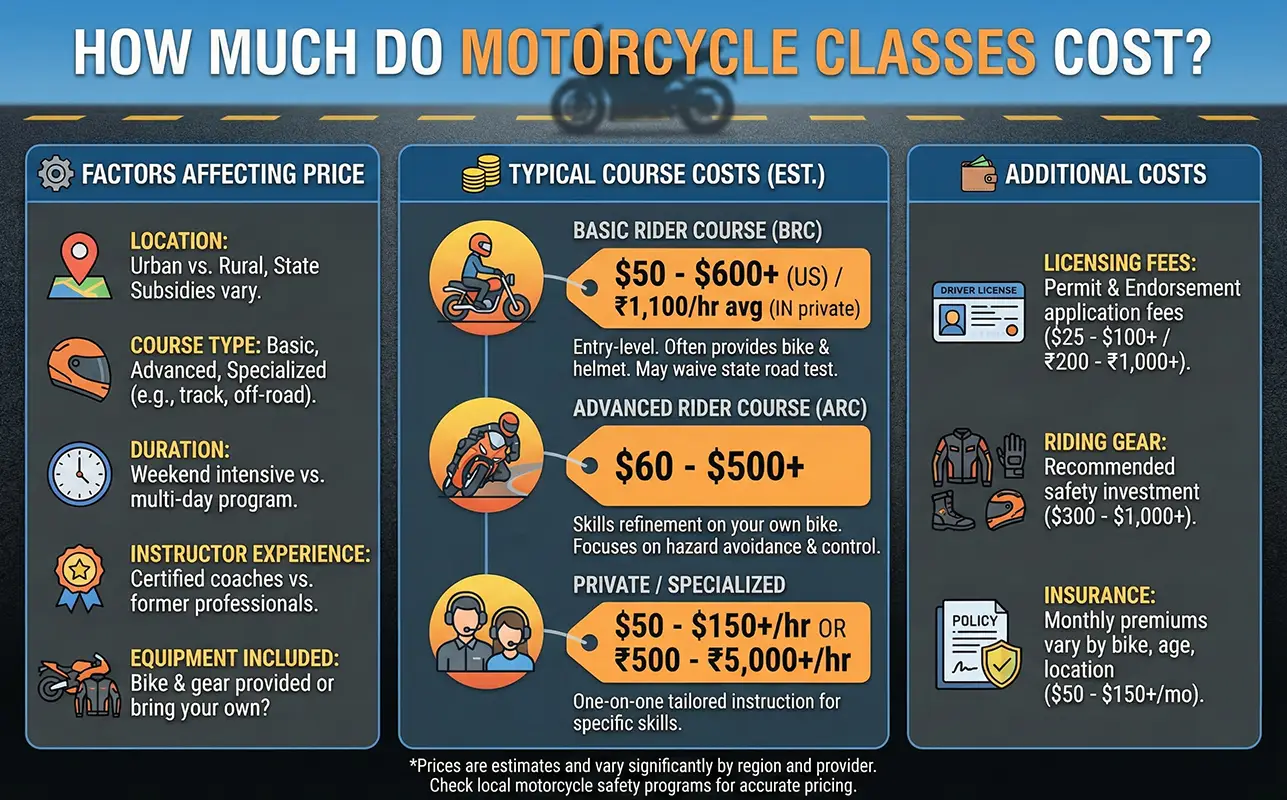
The cost of a Basic Rider Course can vary significantly, but most fall within a predictable range. On average, you can expect to pay between $150 and $450 for a standard BRC. This price is influenced by several factors, including your geographic location (urban areas are often more expensive), the type of provider (private schools vs. community colleges), and whether the program receives state subsidies.
For example, some states offer subsidized or even free training for residents, particularly for younger riders. Conversely, a premium provider like the Harley-Davidson Riding Academy might be at the higher end of this range, often offering a unique brand experience alongside the training.
What’s Included in the Standard BRC Fee
One of the great values of a BRC is what’s included in the price. Your course fee typically covers:
- Classroom Instruction: Several hours dedicated to learning the mental aspects of riding, including risk management, traffic strategies, motorcycle controls, and preparing for the road. Many programs now use an online “e-course” for this portion.
- On-Cycle Training: The majority of the course time (usually 10-15 hours) is spent on a closed-course riding range. This is where you practice fundamental skills like starting, stopping, turning, swerving, and emergency braking.
- Training Motorcycles: You do not need to own a motorcycle to take the course. The school provides a small, lightweight training bike (typically 125cc-300cc) that is easy for a beginner to handle.
- MSF-Certified Instructor: You’ll be guided by professional RiderCoaches who are certified by the Motorcycle Safety Foundation or an equivalent state body. They are trained to provide constructive feedback and ensure a safe learning environment.
- Basic Gear: Many schools provide a loaner helmet and sometimes gloves for students to use during the on-cycle portion of the training.
The BRC’s Role in Obtaining Your Motorcycle License or Endorsement
Perhaps the most significant benefit of completing a BRC is its direct link to getting your motorcycle license. In the vast majority of states, successfully passing the BRC—which includes both a written knowledge test and a practical riding skills evaluation—waives the need to take the skills test at the DMV or MVA.
Upon completion, you receive a certificate that you can take directly to the licensing agency to apply for your motorcycle endorsement. This streamlines the process, saves you time, and allows you to be evaluated in a familiar, low-stress environment on a bike you’ve already been practicing on.
The reality that 34% of motorcycle riders involved in fatal crashes in 2023 did not have a valid motorcycle license underscores the critical link between proper training, licensing, and safety.
Key Benefits for Beginner Riders
For a beginner, the BRC is more than just a path to a license; it’s a confidence-building machine. The course focuses on building a solid foundation in several key areas:
- Motorcycle Safety: You’ll learn proactive strategies for identifying and managing risk, making you a more aware and defensive rider from day one.
- Riding Skills: You’ll master clutch control, straight-line riding, stopping, turning, and crucial emergency maneuvers like swerving and quick stops.
- Motorcycle Operation: You’ll become intimately familiar with the function of every lever, pedal, and switch on a motorcycle.
- Motorcycle Controls: The course instills the precise, coordinated inputs required to operate a motorcycle smoothly and safely.
Beyond the Basics: Intermediate, Advanced, and Specialized Training Costs
Earning your motorcycle endorsement is not the end of your education; it’s the beginning. As you gain experience, continuing your training is essential for refining your skills and becoming a safer, more capable rider. The costs for these courses vary based on their specialization and duration.
Intermediate and Advanced Rider Courses
Once you have some real-world riding experience (typically 6-12 months), an intermediate or advanced course is the logical next step.
- Intermediate Courses (BRC II / Enhanced BRC): Often called the Basic RiderCourse 2, this one-day course is designed for riders who already have their license and are using their own motorcycle. It focuses on refining the skills learned in the BRC and introducing more complex cornering and braking techniques. The cost is generally lower than the initial BRC, typically ranging from $100 to $250.
- Advanced Rider Courses (ARC): These full-day or multi-day clinics are for experienced riders looking to push their skills to a higher level. They often incorporate track-based exercises to teach advanced techniques in body positioning, cornering lines, and trail braking. Expect to pay $300 to $700 or more for these specialized programs.
Specialized Training for 3-Wheel Vehicles
Riding a three-wheel motorcycle, like a Can-Am Ryker or a Harley-Davidson Tri-Glide, requires a distinct skill set. The dynamics of steering and cornering are fundamentally different from a two-wheel bike.
- 3-Wheel Basic Rider Course: The MSF and other organizations offer a dedicated curriculum for three-wheelers. Similar in structure to the 2-wheel BRC, it includes classroom and range time. The cost is comparable to the standard BRC, usually $200 to $450.
- Sidecar/Trike Education Program (S/TEP): This is another common program focused on the unique handling characteristics of these vehicles.
Off-Road and Adventure Rider Training
If your ambitions include exploring unpaved roads and trails, specialized off-road training is a must. These courses teach critical skills for handling a motorcycle on low-traction surfaces like dirt, gravel, and sand.
- Dirt Bike School: Introductory one-day dirt bike courses focus on fundamentals like body position, braking on loose surfaces, and throttle control. Costs typically range from $250 to $500.
- Adventure Rider Training: These multi-day courses are for riders of larger adventure motorcycles. They cover everything from packing your bike to navigating challenging terrain and performing field repairs. These intensive programs can cost from $600 to over $1,500.
Private Coaching and Personalized Riding Lessons
For riders who want one-on-one attention or need to work on a specific skill, private coaching is an excellent option. An instructor can tailor a lesson plan directly to your needs, whether it’s mastering slow-speed maneuvers or building confidence in traffic. Private coaching is typically billed by the hour, with rates ranging from $75 to $200 per hour, often with a two-hour minimum.
Introductory Motorcycle Experience Programs
For those who are simply “moto-curious” and not yet ready to commit to a full licensing course, many schools offer short “Introductory Motorcycle Experience” programs. These 2-3 hour sessions provide a taste of riding in a very controlled environment, allowing you to get a feel for the clutch and throttle without the pressure of a full course. These experiences are highly affordable, usually costing between $50 and $125.
Factors Influencing Motorcycle Class Costs
The sticker price of a motorcycle class isn’t arbitrary. Several key factors determine the final cost you’ll pay, and understanding them can help you find the best value for your budget.
Course Inclusions and Exclusions
When comparing course prices, it’s crucial to look at what is included. Does the fee cover the rental of a motorcycle and helmet? Are study materials, like the MSF handbook, provided, or is that an extra cost? Some schools charge additional fees for re-taking a failed knowledge or skills test, so be sure to ask about their policy. A seemingly cheaper course might become more expensive if it has numerous add-on costs.
Online Learning Components vs. Hands-On Training
The modern Basic Rider Course often employs a “blended learning” model. This typically involves an online e-course that must be completed before attending the in-person riding sessions. The cost of this e-course (usually around $20) may be bundled into the total class fee or paid separately to the Motorcycle Safety Foundation. This online component covers much of the traditional classroom material, allowing for more time on the bike during the hands-on portion of the training.
Special Promotions, Discounts, and Bundled Packages
Training providers often offer ways to save money. Look for early-bird registration discounts, off-season pricing, or special promotions around holidays. Some motorcycle dealerships may offer a discounted or free training course if you purchase a motorcycle from them. Additionally, group discounts may be available if you sign up with friends or family. It’s always worth asking a potential training school about any available discounts for military personnel, first responders, or students.
“Hidden” and Additional Fees to Anticipate
The cost of your training course is only one piece of the financial puzzle. To get legally on the road, you’ll need to budget for several other administrative and governmental fees. Thinking about these upfront prevents surprises later.
Rescheduling and Cancellation Fees
Life happens, but training schools operate on tight schedules. Most have strict policies regarding cancellations and rescheduling. If you need to change your class date, expect to pay a fee, which can range from $25 to $100 or more, especially if it’s a last-minute change. Canceling outright often results in forfeiting your entire course fee. Be sure to read the school’s policy carefully before you book.
Motorcycle Permit/Learner’s Permit Application Fees
Before you can get your full motorcycle endorsement, most states require you to obtain a learner’s permit. This usually involves passing a written knowledge test at the DMV based on the state’s motorcycle operator manual. The application fee for this permit is typically modest, ranging from $10 to $40. This permit allows you to practice riding on public roads with certain restrictions (e.g., no passengers, no nighttime riding).
DMV/MVA Fees for Your Motorcycle Endorsement or License Application
Once you’ve successfully completed your Basic Rider Course and have your certificate in hand (or passed the DMV’s road test), you’ll need to pay the state to add the motorcycle endorsement to your existing driver’s license. This fee varies by state but generally falls between $15 and $50. This is the final administrative step to becoming a fully licensed rider.
Costs for Retaking Knowledge or Skills Tests
If you don’t pass the written or riding portion of your training course or at the DMV on your first attempt, you will likely have to pay a fee to retake it. Retest fees at a training school can range from $25 to $75. If you are taking the test at the DMV, you may have to pay the application fee again. This is another reason why paying close attention during your BRC is a great investment—passing the first time saves you money.
Liability Waivers and Insurance Considerations for Training
While you are a student, the training school’s insurance generally covers you and the motorcycle you are using. You will be required to sign a liability waiver before the course begins, acknowledging the inherent risks of riding. It’s also a good time to start thinking about your own motorcycle insurance. Premium costs can vary widely; for instance, the average cost for liability-only coverage ranged from $145.67 in Pennsylvania to $359.81 in Delaware between 2024 and 2025. The good news is that nearly all insurance companies offer significant discounts for riders who have completed a certified motorcycle safety course.
The Essential Gear: A Separate, Non-Negotiable Investment
Your training fee gets you the knowledge. Your DMV fees get you the license. But your riding gear is what protects your body. This is a critical, separate cost that should be budgeted for before you ever start riding on the street. Do not cut corners here.
Why Safety Gear is Paramount for Training and Riding
Proper riding gear is the only thing between you and the pavement in an accident. It’s designed to absorb impact and resist abrasion, significantly reducing the severity of injuries. Most training courses have a mandatory gear requirement: you will not be allowed to ride without it. This requirement instills a fundamental safety habit from your very first day. Given that the rate of DOT-compliant motorcycle helmet use was only 73.8% in 2023, making it a personal, non-negotiable rule is crucial for self-preservation.
Estimated Costs for Essential Riding Gear
Building your first set of gear is an investment. You can find quality gear at various price points, but here’s a realistic budget for a beginner:
- DOT-Approved Helmet: This is the most important piece of gear. Expect to spend $150 – $400 for a quality full-face helmet from a reputable brand.
- Riding Jacket: A good jacket made of textile or leather with built-in armor will cost $150 – $500.
- Full-Finger Gloves: Look for leather or reinforced textile gloves that offer abrasion resistance and impact protection. Budget $40 – $150.
- Riding Pants: More protective than standard jeans, riding pants with abrasion-resistant materials and armor cost $100 – $300.
- Sturdy, Over-the-Ankle Boots: These protect your feet and ankles from impact and crushing injuries. Expect to pay $80 – $250.
Total Estimated Gear Cost: A solid, safe set of beginner gear will cost between $520 and $1,650.
“Borrow vs. Buy”: What Training Centers Typically Provide
For the Basic Rider Course, you don’t need to own a full set of gear right away. Nearly all training centers provide a DOT-approved helmet for students to use. Some may also have basic gloves available. However, you will almost always be required to provide your own long-sleeved shirt or jacket, long pants (sturdy denim is the minimum), and over-the-ankle footwear. While using the school’s helmet is fine for the class, purchasing your own well-fitting helmet should be your top priority before you begin riding on your own.
Conclusion
Becoming a licensed and safe motorcycle rider is an incredibly rewarding journey, and it begins with a clear understanding of the financial commitment. The cost of a basic training course, typically between $150 and $450, is the foundational investment. When you factor in state licensing and permit fees (around $25 to $90) and the non-negotiable cost of essential safety gear (starting at $520), a realistic “all-in” budget to get started is between $700 and $2,200.
While this may seem like a significant upfront cost, it’s crucial to frame it not as an expense, but as a one-time investment in your safety, skill, and long-term enjoyment of motorcycling. The techniques you learn in a professional training course can save you thousands in potential medical bills and repair costs, and may even save your life. Furthermore, completing a course often leads to tangible savings through insurance discounts and by waiving state-mandated testing fees.
Your next step is to research local, MSF-certified or state-approved training providers. Read reviews, compare what their course fees include, and find a program that fits your schedule and budget. By investing in proper training from the very beginning, you are setting yourself up for a lifetime of confident, competent, and, most importantly, safe two-wheeled adventures.