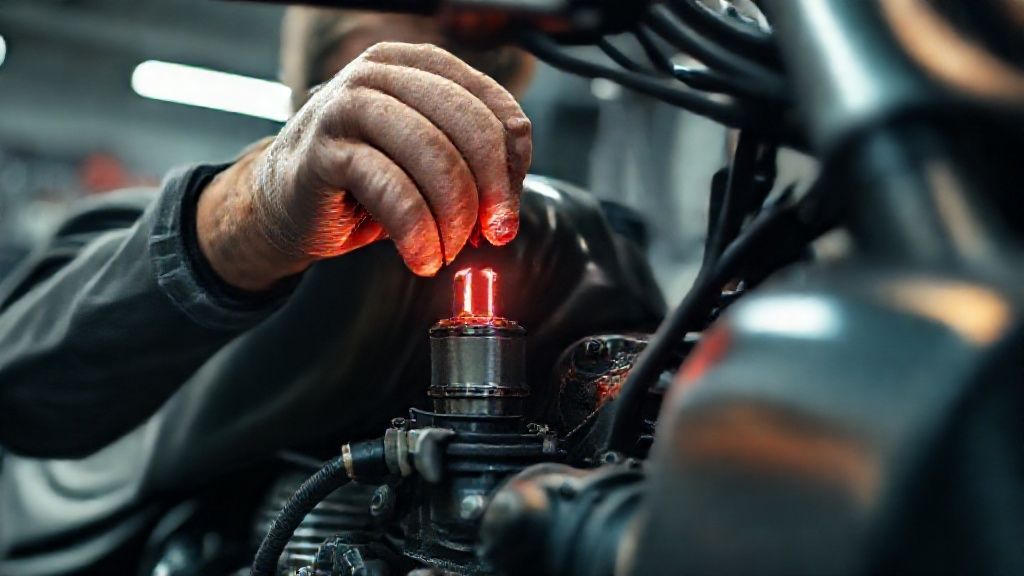
Understanding how to change ignition coil motorcycle components is an essential skill that every motorcycle owner should develop. The ignition coil is the heart of your bike’s electrical system, transforming the battery’s low voltage into the thousands of volts needed to create a spark at the spark plug. When this component fails, your motorcycle won’t start, will misfire, or will run poorly, leaving you stranded on the roadside.
Learning how to change ignition coil motorcycle parts yourself offers multiple benefits beyond just getting your bike running again. First, it significantly extends the life of your motorcycle by ensuring optimal engine performance and preventing damage from weak or inconsistent sparks. A failing ignition coil can cause incomplete combustion, leading to carbon buildup, fouled spark plugs, and even catalytic converter damage on newer models.
Difficulty Level: Intermediate. While not as complex as engine rebuilding, this task requires electrical knowledge, careful attention to connector orientations, and sometimes removing bodywork or fuel tanks.
Time Required: Expect to spend 45 minutes to 2 hours depending on your motorcycle model. Sport bikes with extensive fairings may take longer, while naked bikes or cruisers offer easier access.
Cost Savings: A dealership typically charges $150-$300 for this service ($75-$150 in labor plus markup on parts). The ignition coil itself costs $40-$150 retail. By doing it yourself, you’ll save $75-$150 in labor costs—money better spent on your next riding adventure. Additionally, you gain the confidence and knowledge to handle similar repairs in the future, making you a more self-sufficient rider.
Tools & Materials Needed

Tools:
- Socket set (typically 8mm, 10mm, and 12mm sockets)
- Ratchet with 6-inch extension
- Screwdriver set (Phillips and flathead)
- Allen key/hex wrench set (4mm, 5mm, 6mm common sizes)
- Torque wrench (calibrated, 10-50 Nm range)
- Needle-nose pliers
- Wire brush (brass or nylon)
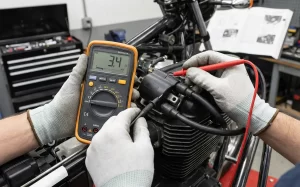
- Digital multimeter (for testing)
- Flashlight or headlamp
- Zip-top plastic bags (for organizing bolts)
- Masking tape and permanent marker (for labeling)
- Smartphone or camera (for reference photos)
Materials & Consumables:
- Replacement ignition coil (OEM or quality aftermarket, specific to your bike model)
- Dielectric grease (small tube)
- Contact cleaner spray (CRC or equivalent)
- Nitrile gloves (powder-free, medium or large)
- Shop towels or lint-free rags
- Thread locker (blue Loctite 243)
- Electrical tape (3M Temflex or similar quality)
- Zip ties (assorted sizes, if existing ones need cutting)
Optional but Recommended:
- Service manual for your specific motorcycle model
- Magnetic parts tray
- Spark plug gap tool
- Replacement spark plug cap (if integrated with coil)
Preparation & Safety

Proper preparation is critical when learning how to change ignition coil motorcycle components. Begin by parking your motorcycle on level ground, preferably in a well-lit garage or workspace. If you have a center stand, use it; otherwise, ensure your side stand is on solid ground and consider using a paddock stand for added stability. The engine must be completely cool—wait at least one hour after riding to avoid burns from hot engine components.
Disconnect the negative terminal of your battery first, then the positive terminal. This crucial step prevents electrical shorts, sparks, or damage to your bike’s ECU (Engine Control Unit) during the repair. Wrap the disconnected terminals with electrical tape or cover them to prevent accidental reconnection.
Remove any bodywork, fairings, or the fuel tank that blocks access to the ignition coil. Take photos with your smartphone at each stage of disassembly—these will be invaluable during reassembly. Place all fasteners in labeled zip-top bags organized by location (e.g., “left side fairing bolts,” “tank mounting bolts”).
Ensure adequate ventilation in your workspace, as you’ll be using contact cleaner and other chemicals. Lay down cardboard or a drop cloth to protect your floor and catch any dropped parts.
⚠️ SAFETY WARNINGS:
FUEL SYSTEM HAZARD: If removing the fuel tank, work in a well-ventilated area away from sparks, flames, or heat sources. Have a fire extinguisher rated for gasoline fires nearby.
CHEMICAL EXPOSURE: Wear nitrile gloves when handling contact cleaner and dielectric grease. These chemicals can irritate skin and eyes. Keep them away from painted surfaces.
MECHANICAL HAZARDS: Ensure the motorcycle is stable and cannot tip over during work. Use proper lifting techniques when removing heavy components like fuel tanks. Watch for pinch points when reinstalling bodywork.
EYE PROTECTION: Wear safety glasses when using contact cleaner spray or working beneath the motorcycle.
Step-by-Step Guide: How to Change Ignition Coil Motorcycle

Step 1: Locate and Identify the Ignition Coil
The ignition coil location varies by motorcycle model. On most bikes, you’ll find it near the spark plugs, mounted to the frame, engine, or under the fuel tank. Inline-four engines typically have four individual coils (one per cylinder), while V-twins usually have two. Single-cylinder bikes have one coil, often mounted near the cylinder head.
Consult your service manual to identify the exact location. The coil is usually a cylindrical or rectangular black component with electrical connectors on one end and a high-tension lead (thick wire) going to the spark plug on the other. On modern bikes, the coil may be mounted directly on top of the spark plug (called a “coil-on-plug” or COP design).
Take multiple photos of the coil’s position, wire routing, and connector orientations before touching anything. These reference images are invaluable during reassembly.
Mechanic’s Tip: If you’re unsure which coil is faulty on a multi-cylinder bike, you can swap coils between cylinders and see if the problem moves. If cylinder 2 was misfiring and you swap coils 2 and 3, and now cylinder 3 misfires, you’ve confirmed the coil is bad.
Step 2: Disconnect Electrical Connectors
With the battery disconnected, locate the electrical connector(s) attached to the ignition coil. Most connectors have a locking tab or clip that must be pressed or lifted before the connector can be pulled apart. Do not pull on the wires themselves—always grip the connector body.
Press the release tab and gently wiggle the connector while pulling straight back. If the connector is stuck due to corrosion or age, spray a small amount of contact cleaner around the connection and wait 30 seconds before trying again. Never use excessive force, as you can break the connector tabs or damage the wiring harness.
Once disconnected, spray contact cleaner into both the male and female sides of the connector. Use compressed air or let them air-dry completely. Inspect the connector pins for corrosion, bent pins, or discoloration. If you see green corrosion, gently clean it with a small wire brush.
Mechanic’s Tip: Take a close-up photo of the connector orientation before separating it. Many connectors look symmetrical but only fit one way. Mark the top of both connector halves with a small piece of masking tape labeled “TOP” if you’re worried about confusion during reassembly.
Step 3: Remove the Spark Plug Cap
The high-tension lead connects the ignition coil to the spark plug. On some motorcycles, this is a removable rubber cap that simply pulls off the spark plug. On others, particularly coil-on-plug designs, the entire coil sits directly on the plug.
For removable caps, grip the cap firmly (not the wire) and pull straight up with a twisting motion. It may be tight due to the rubber seal. If it won’t budge, gently work it back and forth while pulling upward. Never pull on the wire itself, as this can separate the conductor from the terminal inside the cap.
For coil-on-plug designs, you’ll remove the entire coil assembly in the next step, so simply note how it’s seated on the spark plug for now.
Mechanic’s Tip: When you remove the spark plug cap, this is an excellent opportunity to inspect the spark plug itself. If it’s fouled, worn, or hasn’t been changed according to your service schedule, replace it now while you have easy access.
Step 4: Remove Coil Mounting Bolts
Ignition coils are typically secured with one or two bolts or screws. Locate these fasteners—they’re usually 8mm, 10mm, or require a 5mm Allen key. Check your service manual for the correct size.
Before removing the bolts, place a magnetic parts tray nearby or prepare a labeled bag. Using the appropriate socket or Allen key, turn the mounting bolts counter-clockwise to loosen them. If a bolt is extremely tight, apply penetrating oil and wait five minutes before trying again. Use steady pressure rather than sudden force to avoid stripping the bolt head.
As you remove the last bolt, support the ignition coil with your other hand so it doesn’t fall. Some coils are heavy and can damage other components if dropped.
Examine the mounting bolts for thread damage or corrosion. If they’re rusty or stripped, replace them with new bolts of the same size and thread pitch from your local hardware store or motorcycle dealer.
Mechanic’s Tip: Count the number of turns it takes to remove each bolt and note if there are any washers or spacers. Some mounting locations use special washers for grounding, and forgetting to reinstall them can cause ignition problems.
Step 5: Extract the Ignition Coil
With the bolts removed and electrical connections disconnected, the ignition coil should now be free. For coil-on-plug designs, you’ll need to pull the coil straight up and out of the spark plug well. This may require some wiggling and steady upward pressure.
Grip the coil body firmly and pull straight up. If it’s stuck, gently rock it side-to-side while maintaining upward pressure. Do not use excessive force or pry tools, as you could damage the cylinder head or spark plug well.
For externally mounted coils, simply lift the coil away from its mounting bracket once the bolts are removed. Check if any rubber grommets or mounting bushings came off with the coil or remained in the mounting bracket. These need to be transferred to the new coil or reinstalled in the bracket.
Inspect the area where the coil was mounted. Look for signs of oil leakage, excessive carbon buildup, or damage to the mounting surface. Clean the mounting area with a shop towel and contact cleaner.
Mechanic’s Tip: If you’re removing a coil-on-plug from a deep spark plug well and it’s stuck, you can make a simple puller using a long bolt, a deep socket that fits over the coil, and a washer. Thread the bolt into the coil’s mounting hole, place the socket over the coil, and use the bolt to pull the coil straight up.
Step 6: Test the Old Coil (Verification)
Before installing the new coil, it’s wise to verify that the old coil is actually faulty. This confirms you’ve diagnosed the problem correctly and prevents unnecessary parts swapping.
Set your digital multimeter to measure resistance (ohms). Test the primary winding by touching the meter probes to the two small terminals where the electrical connector attaches. Your service manual will specify the correct resistance, typically 0.5-2.0 ohms. If you get an “OL” (open loop) reading or a value far outside the specification, the primary winding is bad.
Next, test the secondary winding by touching one probe to a primary terminal and the other to the high-tension terminal (where the spark plug wire connects). The specified resistance is usually 5,000-15,000 ohms. Again, “OL” or values far outside specification indicate a faulty coil.
If the coil tests within specification but you still have spark problems, the issue may be elsewhere in the ignition system—the CDI unit, wiring harness, or even the ECU.
Mechanic’s Tip: Keep the old coil even if it tests bad. Having a spare on hand for future diagnostic testing (swapping between cylinders) can be valuable. Label it clearly as “FAULTY” so you don’t accidentally reinstall it.
Step 7: Prepare the New Ignition Coil
Unbox your new ignition coil and compare it side-by-side with the old one. Verify that the mounting holes, electrical connector type, and high-tension lead configuration match exactly. Check that any rubber boots, grommets, or mounting hardware are included or transfer them from the old coil if needed.
Apply a thin layer of dielectric grease to the inside of the spark plug boot (the rubber part that connects to the spark plug). This grease prevents moisture intrusion, reduces corrosion, and makes future removal easier. Use a cotton swab to spread a thin, even coat—don’t overdo it, as excess grease can attract dirt.
If your new coil has separate mounting grommets or bushings, install them in the coil’s mounting holes now. Ensure they’re seated fully and evenly.
Inspect the electrical connector on the new coil. Apply a very small amount of dielectric grease to the male pins—just enough to coat them lightly. This protects against corrosion without interfering with electrical conductivity.
Mechanic’s Tip: If you’re installing an aftermarket performance coil, read the manufacturer’s instructions carefully. Some high-performance coils require different spark plug gaps or specific spark plug types. Verify your spark plugs are compatible before installation.
Step 8: Install the New Ignition Coil
Position the new ignition coil in the mounting location, ensuring any grommets or bushings align with the mounting holes. For coil-on-plug designs, carefully lower the coil into the spark plug well, aligning the coil’s boot with the spark plug terminal. Push down gently but firmly until the coil is fully seated. You should feel it click or settle into place.
For externally mounted coils, align the mounting holes with the bracket and insert the mounting bolts by hand. Thread each bolt in a few turns before tightening any of them—this ensures proper alignment and prevents cross-threading.
Using your socket or Allen key, tighten the mounting bolts in a crisscross pattern if there are multiple bolts. This ensures even pressure and proper seating. Consult your service manual for the correct torque specification, typically 8-12 Nm (6-9 ft-lbs) for coil mounting bolts.
Use your torque wrench to tighten each bolt to specification. Over-tightening can crack the coil housing or strip threads in aluminum mounting points. Under-tightening can cause vibration and eventual failure.
Mechanic’s Tip: Apply a small drop of blue thread locker (Loctite 243) to the mounting bolt threads before installation. This prevents the bolts from vibrating loose over time but still allows for future removal if needed. Never use red thread locker, which requires heat to remove.
Step 9: Reconnect Electrical Connections
Retrieve the electrical connector you disconnected earlier. Align it with the connector on the new ignition coil, referencing your photos if needed. The connector should only fit one way—don’t force it if it doesn’t slide together easily.
Push the connectors together until you hear a distinct “click,” indicating the locking tab has engaged. Give the wires a gentle tug to ensure they are secure and won’t vibrate loose while riding.
For externally mounted coils, reconnect the high-tension lead (spark plug wire) to the coil output terminal. If it uses a screw-on cap, ensure it is tight. If it pushes on, feel for the tactile “thud” or click that signals a solid connection. Slide the rubber dust boot over the connection to seal out moisture.
Step 10: Reassemble Bodywork and Tank
Before fully reassembling the bike, it is good practice to do a quick “dummy check.” Ensure no tools are left in the engine bay, no wires are pinched between the frame and the coil, and all fuel lines are routed correctly (if you moved the tank).
Reverse the disassembly process. If you removed the fuel tank, carefully lower it back into position, ensuring the fuel line and vacuum hoses are not kinked. Reconnect the fuel pump connector and fuel line quick-disconnects (listen for the click!).
Reinstall the fairings or side covers using the bolts you organized in your zip-top bags. Hand-thread all bolts first to ensure alignment, then tighten them securely.
Mechanic’s Tip: Use a small dab of anti-seize on fairing bolts, especially if they thread into dissimilar metals, to prevent them from seizing due to corrosion.
Step 11: Final System Check and Start-Up
Reconnect the motorcycle battery, starting with the positive (+) terminal first, followed by the negative (-) terminal. Tighten the terminal bolts securely using a screwdriver or socket.
Turn the ignition key to the “ON” position. You should hear the fuel pump prime (a high-pitched whine for a few seconds). Check that your instrument cluster lights up correctly and there are no new warning lights.
Start the engine. It should fire up smoothly without the hesitation or misfiring that caused you to replace the coil in the first place. Let the bike idle for a few minutes to warm up, listening for a steady, rhythmic idle.
Mechanic’s Tip: Take the bike for a short, low-speed test ride around your neighborhood before heading out on a major trip. This ensures everything is secure and the engine performs correctly under load.
Troubleshooting / Common Mistakes
Even with a straightforward job, things can go wrong. Here are the most common issues riders face after changing a coil:
- Bike Won’t Start: Check the “Kill Switch” on the handlebars (it happens to the best of us). If that’s on, double-check that you reconnected the fuel pump and that the spark plug boot is fully seated on the plug.
- Misfiring Continues: Ensure the electrical connector on the coil is tight. If the problem persists, check the spark plug itself—a bad coil often fouls the plug, so it’s best practice to replace the spark plug at the same time as the coil.
- Check Engine Light (CEL) is On: If you turned the ignition key on while the coil was disconnected, the ECU may have stored a fault code. After a few ride cycles, this often clears itself. If not, you may need an OBDII scanner to clear the code.
- Pinched Wires: If the bike runs but cuts out when you turn the handlebars, you may have routed the wiring harness too tightly or pinched a wire when reinstalling the tank.
Conclusion & Maintenance Schedule
Replacing an ignition coil is a manageable task that saves you a significant amount of money and gives you a deeper understanding of your motorcycle’s operation. By taking your time, using the right tools, and following safety precautions, you’ve restored your bike’s reliability and performance.
Ignition coils generally don’t have a specific maintenance interval like oil or filters; they are “replace on fail” components. However, you should visually inspect them for cracks or corrosion whenever you change your spark plugs (typically every 8,000–15,000 miles). Keeping the electrical connections clean and using dielectric grease will go a long way in preventing future failures.
Frequently Asked Questions (FAQ)
1. Do I need to replace all ignition coils at once?
If your motorcycle has multiple cylinders (and multiple coils), it is not strictly necessary to replace all of them if only one has failed. However, since they are the same age and have been subjected to the same heat and vibration, it is common for others to fail soon after. If your budget allows, replacing them as a set ensures long-term reliability.
2. Can I use a “Universal” ignition coil?
While universal coils exist, it is highly recommended to use an OEM (Original Equipment Manufacturer) or a model-specific aftermarket coil. Motorcycles have specific resistance requirements (Ohm ratings) for their electrical systems. Using the wrong coil can damage your bike’s CDI box or ECU, leading to a much more expensive repair.
3. How do I know which cylinder has the bad coil?
If you have a multi-cylinder bike and don’t know which coil is bad, you can use the “water test” (carefully spray water on the exhaust headers of a cold engine just after starting it—the cold header indicates the dead cylinder) or use an infrared thermometer. The cylinder that is not firing will have a significantly cooler exhaust pipe than the others.
4. Why do ignition coils fail?
Heat and vibration are the biggest enemies of ignition coils. Over time, the constant heating and cooling cycles can cause the internal insulation to break down or the housing to crack, allowing moisture to enter and cause a short circuit. High resistance from old spark plugs can also overwork a coil, causing it to overheat and fail prematurely.