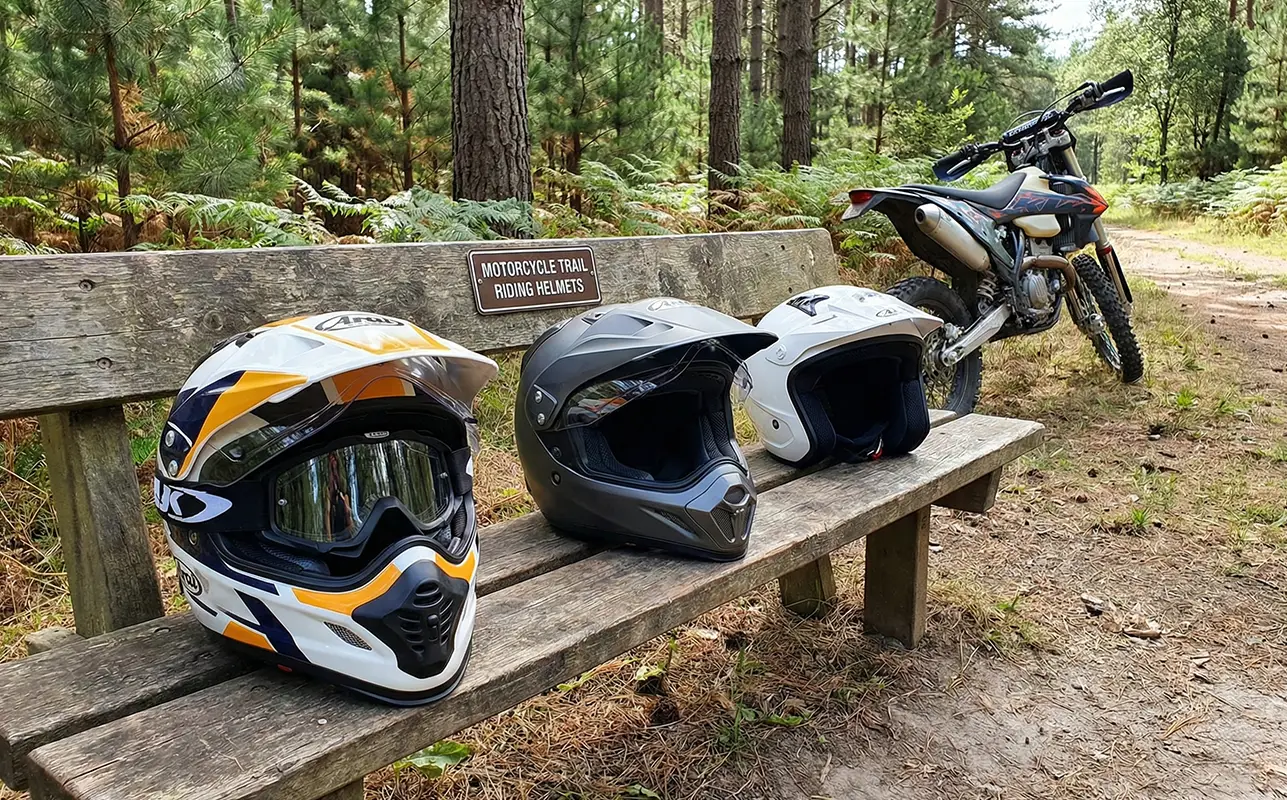
Motorcycle trail riding demands equipment that can withstand the unique challenges of off-road terrain, and your helmet is the most critical piece of safety gear you’ll invest in.
Unlike street riding, trail riding exposes you to flying debris, branches, mud, and unpredictable obstacles that require specialized head protection. For a complete breakdown of helmet types and safety standards, check out our Ultimate Guide to Motorcycle Helmets.
Choosing the best helmet for trail riding isn’t just about safety ratings—it’s about finding the perfect balance between protection, ventilation, visibility, and comfort. In this comprehensive guide, we’ve tested and evaluated the top helmets specifically designed for off-road motorcycle trail riding.
Our selection criteria include safety certifications, ventilation efficiency, weight, visor functionality, and dual sport vs. dirt bike helmets suitability. Whether you’re a weekend warrior or a seasoned trail rider, this list will help you find the perfect helmet.
1. Bell Moto-9S Flex
The Bell Moto-9S Flex represents the pinnacle of off-road helmet technology, combining advanced safety features with exceptional comfort. This premium helmet has become a favorite among professional riders and serious enthusiasts who demand the best protection available.
Overview
The Moto-9S Flex features Bell’s proprietary three-layer impact liner with Flex technology, which allows the helmet to move with your head during an impact, reducing rotational forces. The carbon composite shell comes in three sizes to ensure proper fit across different head shapes.
Bell’s Flying Bridge Visor system provides tool-free adjustability, allowing you to modify the visor position on the fly. The helmet includes an integrated roost guard and a magnetic Fidlock closure system. The progressive layering of EPS foam densities provides superior energy management.
With what is MIPS in motorcycle helmets (Multi-directional Impact Protection System) integration and excellent ventilation through 14 intake and 4 exhaust vents, this helmet excels in both safety and comfort.
Key Features
- Flex Energy Management: Three-layer impact liner.
- Carbon Composite Shell: Lightweight strength.
- Fidlock Magnetic Closure: Easy one-handed operation.
- Flying Bridge Visor: Fully adjustable with air intake vents.
Pros and Cons
Pros:
- Advanced Flex technology and MIPS provide exceptional rotational impact protection.
- Lightweight carbon composite shell reduces neck fatigue during long rides.
- Superior ventilation system keeps you cool in demanding conditions.
- Tool-free visor adjustment allows quick modifications during rides.
Cons:
- Premium price point may be prohibitive for casual riders.
- Some riders find the fit runs slightly narrow.
- Replacement parts can be expensive.
Pricing
The Bell Moto-9S Flex retails between $550 and $650.
Best For
Serious trail riders who prioritize advanced rotational impact protection.
2. Fox Racing V3 RS
Fox Racing has long been synonymous with motocross excellence, and the V3 RS continues that tradition with cutting-edge safety technology and rider-focused design. This helmet bridges the gap between professional-grade protection and accessible pricing.
Overview
The V3 RS incorporates Fox’s Fluid Inside technology, featuring a dual-density Varizorb EPS liner that’s specifically designed to manage energy across a wide range of impact scenarios. The carbon fiber shell maintains structural integrity while keeping weight to a minimum.
Fox’s MVRS (Magnetic Visor Release System) is a game-changer for trail riders, allowing the visor to detach during impacts to reduce rotational forces, then magnetically reattach. The helmet features an impressive 24 vents strategically positioned to maximize airflow.
The comfort liner uses moisture-wicking X-Static material with XT2 antimicrobial fabric. An integrated emergency release system allows medical personnel to safely remove cheek pads if needed.
Key Features
- Fluid Inside Technology: Rotational and linear impact management.
- MVRS: Magnetic Visor Release System.
- Varizorb EPS: Dual-density protection.
- Carbon Fiber Shell: High strength-to-weight ratio.
Pros and Cons
Pros:
- MVRS magnetic visor system provides innovative safety benefits.
- Excellent ventilation keeps riders comfortable in hot conditions.
- Wide goggle compatibility accommodates various brands and styles.
- Emergency cheek pad removal system aids first responders.
Cons:
- Magnetic visor may detach unintentionally on tight, brushy trails.
- Higher price point compared to entry-level options.
- Some riders report the liner compresses quickly over time.
Pricing
The Fox Racing V3 RS retails between $500 and $600.
Best For
Riders who frequent tight trails where visor snags are a common risk.
3. Shoei VFX-WR
Shoei brings its legendary quality and attention to detail to the off-road segment with the VFX-WR. Known for exceptional build quality and comfort, this helmet delivers premium protection for serious trail riders.
Overview
The VFX-WR features Shoei’s Advanced Integrated Matrix (AIM) multi-composite shell construction, combining multiple fiber types for optimal strength-to-weight ratio. The helmet utilizes a dual-layer, multi-density EPS liner that provides superior impact absorption.
Shoei’s engineers designed an extensive ventilation system with large intake vents at the chin bar, top, and sides. The wider eyeport design accommodates modern oversized goggles. The fully removable, washable interior features 3D Max-Dry System II fabric.
The neck roll is designed to work seamlessly with neck braces, making it an excellent choice for riders who prioritize comprehensive protection systems.
Key Features
- M.E.D.S. Technology: Motion Energy Distribution System.
- AIM+ Shell: Multi-ply matrix shell.
- 3D Max-Dry System II: Advanced moisture absorption.
- Mud Guard: Extended protection.
Pros and Cons
Pros:
- Exceptional build quality and attention to detail throughout.
- Superior comfort during extended riding sessions.
- Excellent neck brace compatibility for comprehensive protection.
- Wide eyeport accommodates oversized modern goggles.
Cons:
- Premium pricing reflects the high-end construction.
- Heavier than some carbon fiber competitors.
- Limited color and graphic options compared to other brands.
Pricing
The Shoei VFX-WR retails between $500 and $700.
Best For
Riders looking for legendary durability and a handcrafted finish.
4. Arai VX-Pro4
Arai’s commitment to round shell philosophy and handcrafted quality makes the VX-Pro4 a standout choice for riders who value traditional engineering excellence combined with modern safety standards.
Overview
The VX-Pro4 showcases Arai’s signature smooth, round shell design that’s engineered to glance off objects and disperse impact energy effectively. The proprietary Complex Laminate Construction (CLC) shell combines multiple layers of Super Fiber and special resins.
The ventilation system features large chin and forehead intakes with strategically placed exhaust vents. The fully removable, washable interior uses high-performance fabric that resists bacteria.
The VX-Pro4 includes Arai’s innovative visor pivot system that allows the visor to break away during severe impacts. It is a top choice for those with a round head shape (or intermediate oval leaning round).
Key Features
- CLC Shell: Complex Laminate Construction.
- Glancing Off Shape: Smooth shell to deflect energy.
- Facial Contour System (FCS): Enhanced stability.
- Emergency Release Tabs: Quick cheek pad removal.
Pros and Cons
Pros:
- Legendary Arai quality with handcrafted attention to detail.
- Round shell design excels at deflecting impacts.
- Multiple shell sizes provide optimal fit for various head sizes.
- Exceptional comfort for all-day riding.
Cons:
- Very high price point limits accessibility.
- Conservative styling may not appeal to all riders.
- Heavier than modern carbon fiber alternatives.
Pricing
The Arai VX-Pro4 retails between $600 and $750.
Best For
Riders who believe in the “glancing off” safety philosophy and want a plush interior.
5. Troy Lee Designs SE4
Troy Lee Designs combines eye-catching graphics with serious safety engineering in the SE4 Polyacrylite. This helmet offers professional-level protection at a more accessible price point, making it popular among enthusiast riders.
Overview
The SE4 features a polyacrylite shell construction that balances durability, weight, and cost effectively. TLD incorporates EPP (expanded polypropylene) and dual-density EPS liners that work together to manage both high and low-speed impacts.
The helmet is designed around MIPS technology, adding crucial rotational impact protection. The ventilation system includes 13 intake and 5 exhaust vents. Troy Lee’s signature attention to graphics means this helmet looks as good as it performs.
The moisture-wicking Coolmax interior is fully removable and washable. An innovative magnetic chin strap keeper prevents strap flutter.
Key Features
- MIPS Brain Protection System: Rotational impact defense.
- EPP Chin Bar: Durable impact protection.
- CoolMax Liner: Moisture-wicking comfort.
- Breakaway Visor Screws: Safety feature.
Pros and Cons
Pros:
- Excellent value proposition with professional-grade features.
- MIPS integration provides rotational impact protection.
- Outstanding graphics and color options for personalization.
- Effective ventilation system for hot weather riding.
Cons:
- Polyacrylite shell is heavier than carbon fiber options.
- Some riders find the fit runs slightly small.
- Interior padding may compress faster than premium competitors.
Pricing
The Troy Lee Designs SE4 Polyacrylite retails around $250.
Best For
Style-conscious riders who want MIPS safety on a budget.
6. Alpinestars Supertech M10
Alpinestars entered the helmet market with serious intent, and the Supertech M10 showcases innovative engineering that challenges established manufacturers. This helmet brings fresh thinking to off-road head protection.
Overview
The Supertech M10 features a carbon fiber shell construction available in four sizes for optimal fit. Alpinestars developed a patented A-Head fitment system that allows micro-adjustments to helmet position and angle (height and pitch), acting as a highly adjustable motorcycle helmet fitment guide.
The Multi-Directional Impact Protection System (MIPS) is fully integrated into the design. The ventilation design includes massive chin bar intakes and multiple crown vents. The hydration-compatible design allows routing for drink systems.
Key Features
- 3K Carbon Shell: High-density carbon outer layer.
- A-Head Fitting System: Adjustable height and angle.
- MIPS E-2: Low-friction layer.
- Hydration Ready: Integrated tube channels.
Pros and Cons
Pros:
- Innovative A-Head fitment system provides customizable positioning.
- Multiple protection technologies work together comprehensively.
- Exceptional ventilation performance in demanding conditions.
- Hydration system compatibility for extended rides.
Cons:
- Premium pricing reflects advanced engineering.
- Complex design may make repairs more challenging.
- Some riders find the fit system takes time to adjust properly.
Pricing
The Alpinestars Supertech M10 retails between $550 and $650.
Best For
Riders who need to adjust the angle of their helmet for neck braces or vision preference.
7. Leatt GPX 5.5
Leatt built its reputation on neck brace technology, and that expertise translates into the GPX 5.5’s design philosophy. This helmet is engineered to work seamlessly with protective equipment while providing standalone excellence.
Overview
The GPX 5.5 features a composite shell construction. Leatt’s 360° Turbine Technology places discs of energy-absorbing material throughout the liner, reducing rotational acceleration to the head and brain.
Designed specifically for neck brace compatibility, the helmet’s lower profile and reduced chin bar work optimally with Leatt’s brace systems. The ventilation system features 14 strategically positioned vents.
An innovative visor design with breakaway functionality reduces rotational forces during impacts. The helmet includes a hydration system compatibility feature.
Key Features
- 360° Turbine Technology: Reduces rotational acceleration.
- Composite Shell: Reduced outer shell volume.
- Neck Brace Compatible: Optimized lower rim.
- Hydration Ready: Hands-free kit optional.
Pros and Cons
Pros:
- Excellent neck brace compatibility for comprehensive protection systems.
- 360° Turbine Technology provides innovative rotational impact protection.
- Good value proposition with advanced safety features.
- Hydration system compatibility for extended trail rides.
Cons:
- Design is optimized for Leatt neck braces, may not work as well with other brands.
- Some riders find the fit runs small.
- Graphics and color options are more limited than competitors.
Pricing
The Leatt GPX 5.5 retails between $350 and $450.
Best For
Enduro riders who always wear a neck brace.
8. 6D ATR-2
6D Helmets pioneered the Omni-Directional Suspension (ODS) system, bringing aerospace-inspired engineering to motorcycle helmets. The ATR-2 represents their latest evolution in angular impact management technology.
Overview
The ATR-2’s defining feature is its patented ODS system, which uses elastomeric isolation dampers to suspend an inner EPS liner within an outer EPS liner, allowing movement in all directions during impacts. This system is specifically designed to reduce both linear and angular acceleration forces.
The carbon fiber shell comes in three sizes. The helmet’s ventilation system includes 10 intake vents and 4 exhaust ports positioned to create efficient airflow through the ODS channels.
The moisture-wicking Coolmax liner is removable and washable. For a deeper understanding of why this tech matters, read our article on helmet safety ratings explained.
Key Features
- ODS System: Omni-Directional Suspension.
- Rebuildable: Can be inspected and rebuilt after certain impacts (by 6D).
- Brow Rib: Adds structural integrity.
- Emergency Release: Cheek pads.
Pros and Cons
Pros:
- Unique ODS system provides exceptional angular impact protection.
- Independently tested and proven to reduce brain injury risk.
- Lightweight carbon fiber construction reduces neck fatigue.
- Innovative engineering backed by extensive research.
Cons:
- Premium pricing reflects advanced technology.
- ODS system makes the helmet slightly larger than conventional designs.
- Limited availability compared to mainstream brands.
Pricing
The 6D ATR-2 retails between $700 and $800.
Best For
Riders who want the most advanced suspension-based impact technology available.
9. Fly Racing Formula Carbon
Fly Racing delivers professional-level features at a competitive price point with the Formula Carbon. This helmet proves that advanced safety technology doesn’t always require premium pricing, making it accessible to more riders.
Overview
The Formula Carbon features a lightweight carbon fiber shell construction that significantly reduces neck strain during long rides. It is a top choice for the best lightweight carbon fiber helmet in the dirt category.
Fly Racing incorporates Conehead EPS technology and RHEON technology, a viscoelastic polymer that hardens on impact to absorb energy while remaining flexible during normal use. The ventilation system features 14 intake and 5 exhaust vents.
The Fly Adapt system allows the liner to be customized. The moisture-wicking interior is fully removable and washable.
Key Features
- 12K Carbon Fiber Shell: Ultra-lightweight.
- RHEON Impact Energy Cells: Adaptive energy absorption.
- Conehead EPS: Dual-density impact management.
- TFV Ventilation: True Functional Ventilation.
Pros and Cons
Pros:
- Excellent value with carbon fiber construction at accessible pricing.
- RHEON technology provides additional protection for common impact scenarios.
- Lightweight design reduces fatigue during extended rides.
- Good ventilation performance for hot weather conditions.
Cons:
- Brand recognition may be lower than established competitors.
- Some riders report the liner compresses faster than premium options.
- Limited color and graphic options compared to Troy Lee or Fox.
Pricing
The Fly Racing Formula Carbon retails between $650 and $700.
Best For
Riders looking for the lightest possible helmet with advanced energy absorption cells.
Conclusion
Selecting the best helmet for motorcycle trail riding ultimately depends on your specific needs, budget, and riding style. The helmets featured in this guide represent the pinnacle of current off-road helmet technology. Whether you prioritize cutting-edge safety features like the Bell Moto-9S Flex, the value proposition of the Fly Racing Formula Carbon, or the innovative engineering of the 6D ATR-2, there’s an excellent option available.
Remember that the best helmet is one that fits properly. Don’t compromise on safety—invest in quality head protection and be sure to check our guide on when to replace your motorcycle helmet to ensure you stay safe over the years.
Frequently Asked Questions
What’s the difference between a trail riding helmet and a street motorcycle helmet?
Trail riding helmets feature extended chin bars for better airflow and face protection, larger eye ports for goggle compatibility, and peaks (visors) to shield from sun, roost, and branches. Street helmets prioritize aerodynamics and have integrated face shields.
How often should I replace my trail riding helmet?
Replace your helmet immediately after any significant impact. Without impacts, manufacturers recommend replacement every 5 years due to degradation of materials from UV exposure and sweat.
Do I need MIPS or similar rotational impact protection technology?
While not legally required, rotational impact protection systems like MIPS, ODS, or Turbine Technology provide significant safety benefits by reducing forces transmitted to the brain during angled impacts, which are common in trail riding.
What safety certifications should I look for in a trail riding helmet?
At minimum, ensure your helmet meets DOT (US) certification. ECE 22.05/22.06 indicates European safety standards. Snell M2020D represents the highest standard for off-road helmets.
Should my trail riding helmet be compatible with a neck brace?
If you use a neck brace, ensure your helmet is designed for compatibility—look for features like reduced chin bar profiles and lower rear shells. Brands like Leatt and Alpinestars design specifically for this.