
Motorcycle Chain Cleaning: How to Clean, Lube, and Adjust Like a Pro
 Jake Miller
15 min read
Jake Miller
15 min read
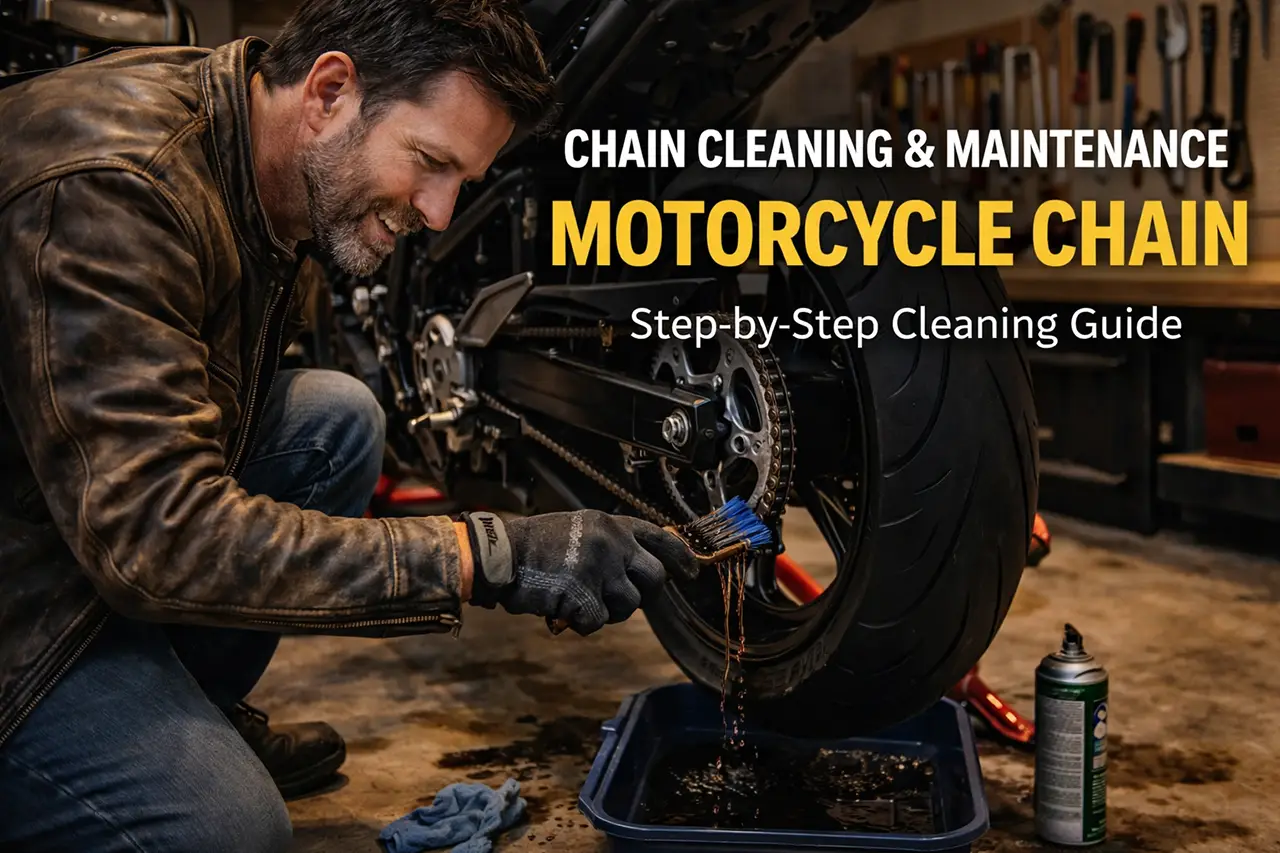
I’ll be honest with you — the first time I neglected my motorcycle’s chain for three months straight, I paid for it in ways I never want to repeat. A loud, rhythmic clunking noise on the highway, a chain that nearly jumped the sprocket on a sharp corner, and a mechanic’s bill that made me wince.
All of it could have been avoided with about 20 minutes and a few dollars’ worth of supplies. If you’re serious about keeping your ride safe and running smoothly, chain maintenance is one of the most foundational skills covered in the broader world of maintenance on a motorcycle — and it is one you absolutely cannot afford to skip.
In this guide, I’m going to walk you through everything I’ve learned over years of wrenching in my garage — from the right way to do motorcycle chain cleaning, to greasing a motorcycle chain without making a mess, to dialing in chain tension so your drivetrain runs with quiet, confident precision.
Whether you’re a weekend warrior or a daily commuter, this is the guide I wish someone had handed me on Day 1.
| TL;DR — The Short Version Clean your motorcycle chain every 300–500 miles (or after every wet ride). Use a dedicated chain cleaner, a stiff brush, and a quality O-ring-safe lubricant applied to the inner links while the chain is warm. Check slack — most bikes want 20–30 mm of vertical play at the tightest point — and adjust axle position equally on both sides. Doing this simple routine adds thousands of miles of life to your chain-and-sprocket set and keeps you safe on the road. |
What You’ll Learn in This Guide
Here’s a quick overview so you know exactly what we’re covering today:
- Why your chain needs regular attention (and what happens if you ignore it)
- The tools and products you actually need — no fluff
- Step-by-step motorcycle chain cleaning process
- How to properly oil and lube your chain, including greasing a motorcycle chain the right way
- How to check and adjust chain tension
- Common mistakes riders make and how to avoid them
- How often you should be doing all of this
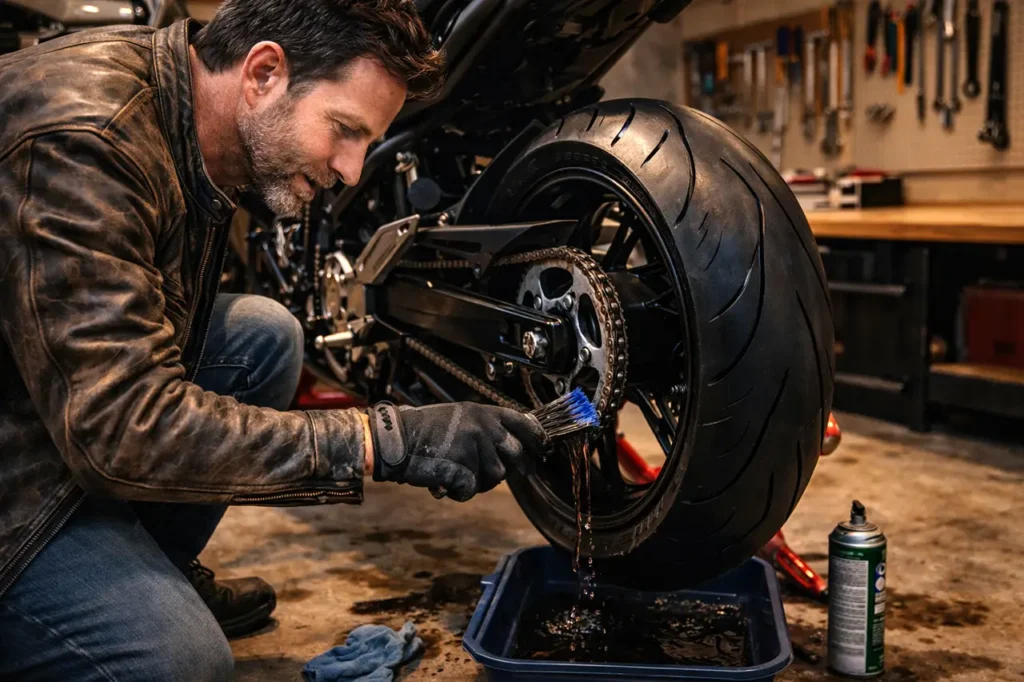
Mechanic cleaning a motorcycle chain in a garage setting
Why Motorcycle Chain Maintenance Is Non-Negotiable
Your motorcycle’s chain is the final link — literally — between the engine’s power and the rear wheel. It’s a precision component that operates under extreme stress: heat, grit, road spray, and constant tension-and-release cycling as you accelerate and brake. Left unchecked, it becomes a liability.
Here’s what I’ve seen happen to neglected chains over the years:
- Rapid wear on both the chain and the sprocket teeth, leading to expensive replacement of the entire set
- Chain stretch that throws off your sprocket mesh, causing rough, inefficient power delivery
- Dry links that crack and eventually snap — a chain failure at speed is genuinely dangerous
- Seized O-rings in O-ring chains, which destroys the internal grease seal and kills the chain fast
On the flip side, a well-maintained chain is practically invisible. It runs quietly, transfers power efficiently, and can last 20,000 miles or more on some bikes with proper care. The math is simple: spend 20 minutes every few hundred miles, or spend $150–$400 replacing a worn chain-and-sprocket set every year.
Real Talk from the Garage
I’ve had the same chain on my 650cc twin for over 18,000 miles. The secret? I clean and lube it every 400 miles without fail. My riding buddy who skips it regularly was replacing chains every 6,000 miles. Same bike, same roads, wildly different results.
What You Need: Tools and Products
Essential Tools
- Paddock stand or center stand (to lift the rear wheel)
- Stiff-bristle chain cleaning brush or an old toothbrush
- Microfiber cloths or old rags
- Gloves (nitrile or mechanic’s gloves)
- Ruler or chain slack gauge
- Spanners/wrenches for axle adjustment (check your bike’s service manual for sizes)
- Torque wrench (for final axle nut tightening)
Products
Chain Cleaner: Use a dedicated aerosol motorcycle chain cleaner — not WD-40, not brake cleaner, not petrol. These either strip the O-ring seals or leave residues that degrade lubricants. I use Motul Chain Clean or PJ1 Chain Cleaner, both of which are O-ring safe and cut through grime brilliantly.
Chain Lubricant: This is the most important product choice. For oiling a motorcycle chain or lubricating a motorcycle chain, use a purpose-made motorcycle chain lube. There are three main types:
- Wax-based lubes — clean, don’t fling much, great for dry climates. Brands: Motul Chain Paste, Muc-Off C3.
- O-ring-safe wet lubes — more durable in rain and on longer trips. Brands: PJ1 Blue Label, DID Chain Lube.
- Dry/PTFE lubes — minimal fling, great in dusty conditions but need reapplication more often.
Avoid thick greases designed for automotive use when greasing a motorcycle chain unless you’re working on an older non-O-ring chain. Thick grease traps grit and acts like sandpaper against the chain pins and rollers. Modern chain lubes are formulated specifically to penetrate, protect, and resist fling-off.
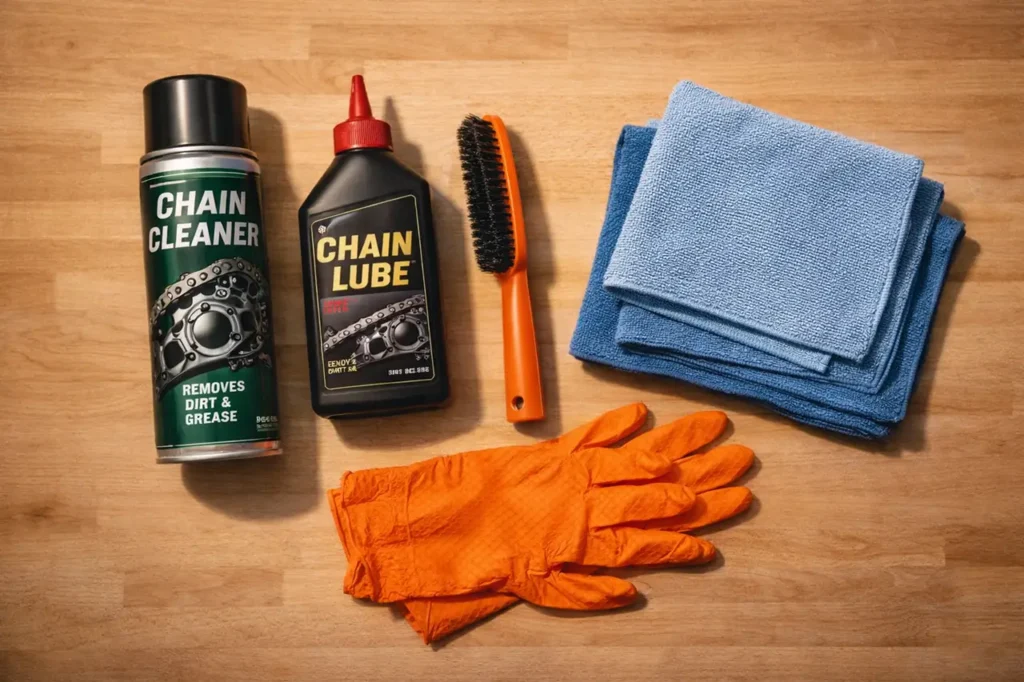
Motorcycle chain cleaning products laid out on a workbench
Step-by-Step Motorcycle Chain Cleaning
Let me walk you through my exact process. I’ve done this hundreds of times and this is the method that gives me the best results with the least mess.
Step 1 — Warm Up the Chain
Take the bike for a short 5-minute ride or let it idle for a couple of minutes. A warm chain has slightly expanded links and any lube residue is more fluid, making it much easier to clean off. Never clean a hot chain immediately after a long ride — let it cool for 10 minutes first.
Step 2 — Lift the Rear Wheel
Get the rear wheel off the ground using a paddock stand. This lets you rotate the wheel by hand and clean the entire chain without awkward repositioning. If you don’t have a stand, you’ll need to move the bike forward in stages — doable, just slower.
Step 3 — Apply Chain Cleaner
Spray your chain cleaner generously on the chain — top, bottom, and sides — rotating the wheel as you go. Let it soak for 2–3 minutes. The solvent will penetrate the grime, old lube, and road debris that has built up since your last motorcycle chain cleaning session.
Step 4 — Scrub Thoroughly
Using your chain brush, scrub every side of the chain — the inner plates, outer plates, rollers, and pins. Work in sections. You’ll be surprised (and maybe horrified) by how much black gunk comes off. I usually do two passes. Pay special attention to the area where the chain contacts the sprocket teeth, as this is where the worst buildup occurs.
Step 5 — Wipe and Degrease
Hold a folded microfiber cloth around the chain and slowly rotate the wheel to wipe off the loosened grime. Follow up with a second spray of cleaner if the chain still looks heavily contaminated, then wipe again. Keep going until the cloth comes away mostly clean.
Step 6 — Let It Dry
Give the chain 5–10 minutes to air dry, or gently pat dry with a clean cloth. You want all solvent residue gone before applying lube — solvent can thin out your lubricant and reduce its effectiveness significantly.
Pro Tip
Lay a folded piece of cardboard behind the chain before you start cleaning. It catches the spray and runoff, keeping your swingarm and wheel clean and making the whole job far less messy.
How to Properly Oil, Lube, and Grease a Motorcycle Chain
This is where most riders get it wrong — either applying too much, applying to the wrong part of the chain, or using the wrong product entirely. After years of trial and error, here’s the technique that works.
Where to Apply the Lube
Apply chain lube to the inner edge of the chain — specifically targeting the area where the inner link plates meet the rollers and O-rings. This is where the lube needs to penetrate. Spraying the outer plates looks dramatic but accomplishes very little; the lube just flings off at speed.
The Application Process — Oiling a Motorcycle Chain
- Position the nozzle of your lube can approximately 1 inch from the chain, aimed at the inner links.
- Hold the nozzle steady and slowly rotate the rear wheel with your other hand so the chain moves past the nozzle. One full rotation of the wheel = one complete chain cycle.
- Apply a thin, even coat. You’re looking for a light gloss, not drips. Less is genuinely more here.
- Let the lube sit for 3–5 minutes before riding — this allows it to penetrate the link plates and O-ring grooves.
- Before you head out, take a clean cloth and gently wipe the outer surface of the chain to remove any excess that might fling onto your wheel or tire.
Greasing a Motorcycle Chain — When and How
“Greasing” in the traditional sense is mostly relevant for older, unsealed chains (common on older bikes or dirt bikes). For these, a penetrating chain grease like Bel-Ray Chain Lube can be worked into the links with a brush and provides longer-lasting protection than spray lubes. For modern O-ring or X-ring chains, stick to dedicated chain lubes — they’re engineered to work with the seals rather than against them.
If you’re lubricating a motorcycle chain that runs in extreme conditions (track use, adventure touring in the rain), consider a heavy-duty wet lube and increase your reapplication frequency. I’ve ridden 500+ mile days in Scottish rain, and a quality wet lube every 250 miles kept things running perfectly.
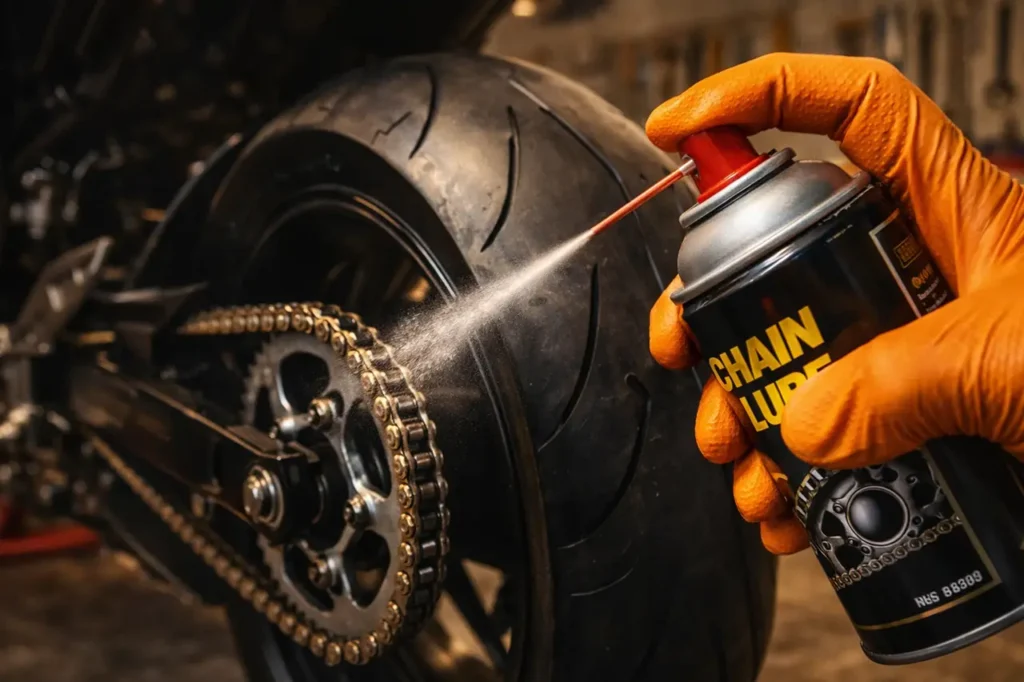
Close-up of applying chain lube to a motorcycle chain
How to Check and Adjust Motorcycle Chain Tension
A clean, well-lubed chain that’s incorrectly tensioned is still a problem. Too tight, and you’re putting enormous stress on the chain, bearings, and output shaft. Too loose, and you risk the chain slapping the swingarm, jumping a tooth, or coming off entirely. Getting this right is critical.
Checking Chain Slack
With the bike on a paddock stand, find the tightest point of the chain by rotating the wheel and checking slack at various positions. Chains wear unevenly, so the slack changes as you rotate.
At the tightest point, press up on the lower run of the chain midway between the two sprockets. The total vertical movement (up and down) should fall within your manufacturer’s specification. For most road bikes this is 20–30 mm (roughly 3/4 to 1-1/4 inches), but always verify in your service manual. Sport bikes often run tighter; cruisers and adventure bikes may allow more play.
Adjusting the Chain
- Loosen the axle nut — just enough to allow adjustment, not so much that the axle can move freely.
- Locate the chain adjusters on both sides of the swingarm. These are typically threaded bolts with locking nuts.
- Turn the adjusters equally on both sides. Most bikes have alignment marks on the swingarm — use these to ensure both sides are at the same position. Uneven adjustment causes the wheel to track at an angle, which affects handling.
- Check the slack again and repeat small equal adjustments until you’re within spec.
- Hold the axle in position and torque the axle nut to the manufacturer’s specification. This is not a step to skip — an under-torqued axle nut can back off on the road.
- Double-check alignment marks on both sides one final time.
Important Safety Note
Always check chain tension with a rider’s weight on the bike (or use a known weight on the seat) if your bike’s manual specifies this. Some bikes have significantly different chain slack measurements at rest vs. under load due to suspension linkage geometry.
How Often Should You Clean and Lube Your Chain?
This is the question I get most often from newer riders, and my answer is always: more often than you think.
My Personal Schedule
- Every 300–500 miles — Full clean and lube on dry road bikes.
- After every wet ride — Rain strips lubricant fast. If you’ve ridden in rain, top up the lube within the day.
- After every dusty or off-road session — Dust and grit clog the rollers and act as an abrasive. Clean before you lube.
- Before any trip over 500 miles — Start with a fresh clean and lube. Check again at the midpoint of very long journeys.
- At every oil change interval minimum — If nothing else, tie chain maintenance to your oil changes so it never gets forgotten.
For context, oiling a motorcycle chain should feel almost routine. I do a quick wipe-and-lube in about 10 minutes between rides. A full clean takes about 20–25 minutes including dry time. That’s a very small investment for the protection it provides.
Common Mistakes That Riders Make (And How to Avoid Them)
1. Using WD-40 as chain lube.
WD-40 is a water displacer and light penetrant, not a chain lubricant. It’ll clean a chain briefly but provides essentially no lasting protection and can swell O-rings over time. It’s a common mistake that a lot of beginners make because WD-40 is in every garage — stick to dedicated chain lubes.
2. Over-lubing the chain.
More lube is not better. Excess lube flings off at speed, lands on your rear tyre, and dramatically reduces traction. A thin, even coat is all you need. If it looks dripping wet, you’ve applied too much — wipe the excess off with a cloth.
3. Skipping the cleaning step.
Applying fresh lube over a dirty chain traps grit and abrasives inside the link plates. You’re essentially creating a paste that accelerates wear. Always clean before you lube — no exceptions.
4. Lubricating only the outer side of the chain.
The outer plates are decorative from a lubrication standpoint. Lube needs to reach the inner link plates and rollers. Target the inner edge and let capillary action do the work.
5. Ignoring sprocket wear.
A motorcycle chain cleaning routine should always include a visual check of your sprockets. Hooked, shark-fin teeth are a sign of heavy wear. Fitting a new chain onto worn sprockets destroys the new chain rapidly. If the sprockets are gone, replace all three components together.
6. Tensioning the chain at the loosest point.
As mentioned above, chains wear unevenly. If you tension at the loosest spot, the chain will be too tight at its tightest point. Always find and measure at the tightest spot.
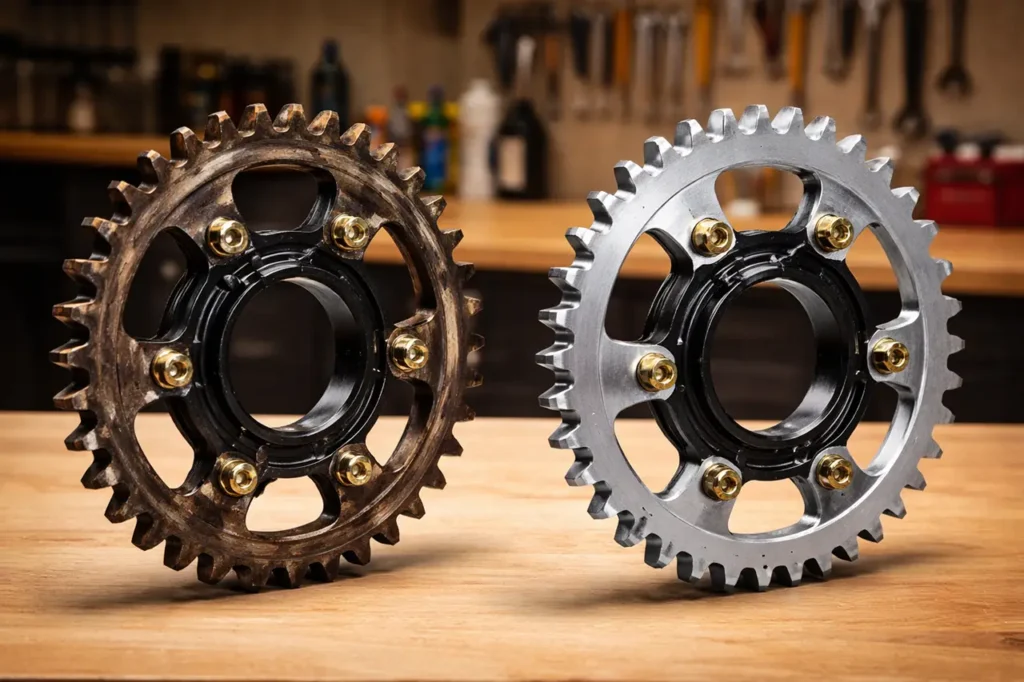
Worn motorcycle sprocket next to a new one for comparison
When to Replace Your Motorcycle Chain
Even with perfect motorcycle chain cleaning and lubrication habits, chains do eventually wear out. Here’s how to know when it’s time:
- Chain stretch beyond spec: Use a chain wear indicator tool or measure 12 full links — it should not exceed 1% stretch beyond the original pitch. Most tools make this a simple pass/fail check.
- Stiff links: If you see sections of the chain that don’t flex smoothly and remain rigid even after cleaning and lubricating a motorcycle chain, those links are seized internally and the chain needs replacing.
- Visible kinks: A kinked or bent chain is a serious safety hazard. Replace immediately.
- Significant side-to-side play: More than a few millimetres of lateral wobble in the chain indicates severe internal wear.
- Replacing worn sprockets: If you’re replacing the sprockets due to wear, always replace the chain at the same time, even if it looks okay. A new chain on worn sprockets (or vice versa) will cause accelerated wear on both.
Quality chain-and-sprocket sets from brands like DID, RK, JT Sprockets, or EK last a long time with proper care. Budget well for the set, and maintain them diligently. You’ll get excellent value over time.
Quick Reference: My Motorcycle Chain Maintenance Schedule
| Task | Frequency | Notes |
| Clean & Lube | Every 300–500 miles | More often in wet/dusty conditions |
| After wet ride | Every time | Even a top-up lube is enough |
| Tension check | Every 500 miles | Check at tightest chain point |
| Full tension adjust | As needed | Match adjusters both sides evenly |
| Sprocket inspection | Every 1,000 miles | Look for hooked/worn teeth |
| Chain wear check | Every 3,000–5,000 miles | Use a chain wear tool |
| Full replacement | When worn (typically 15–20k miles) | Replace chain + sprockets together |
Final Thoughts — The Chain Is Your Connection to the Road
Every mile I’ve ridden, every twisty back road I’ve enjoyed, every long touring day I’ve survived — all of that power went through the chain. It’s such a humble, overlooked component, and yet it’s doing one of the most critical jobs on the whole machine.
Motorcycle chain cleaning, greasing a motorcycle chain, oiling a motorcycle chain, lubricating a motorcycle chain — these aren’t glamorous tasks. You’re not going to post a photo of your chain on Instagram. But I promise you this: the riders who take the time to do this right ride safer, spend less money, and never have that sick, sinking feeling of hearing a chain start to protest mid-corner.
Make it a habit. Set a mileage reminder on your phone. Keep a small spray can of chain lube in your kit bag. Tie it to something you already do consistently — every oil change, every tire check, every Sunday morning pre-ride walk-around. It takes 20 minutes and it pays back in thousands of miles.
Ride safe, keep it tight, and keep it clean.
Found this guide useful? Drop a comment below and let me know what chain lube you swear by — I’m always looking to try new products. And if you’re building out your full maintenance routine, don’t miss the complete guide to maintenance on a motorcycle for the full picture.

Related Articles

9 Best Cleaner for Motorcycle Helmet: Top 9 Products to Keep Your Gear Crystal Clear
Your motorcycle helmet is your most critical piece of safety equipment, and keeping it clean isn’t just about aesthetics—it’s about…
Jake Miller
14 min read

How to Winterize Your Motorcycle: The Ultimate Guide for a Perfect Spring Start
As the riding season winds down and the crisp autumn air gives way to the bite of winter, your motorcycle…
Jake Miller
20 min read
How to Wash Your Motorcycle for a Flawless, Pristine Finish
A clean motorcycle is more than just a visual statement; it’s a testament to a rider’s dedication and a critical…
Jake Miller
18 min read