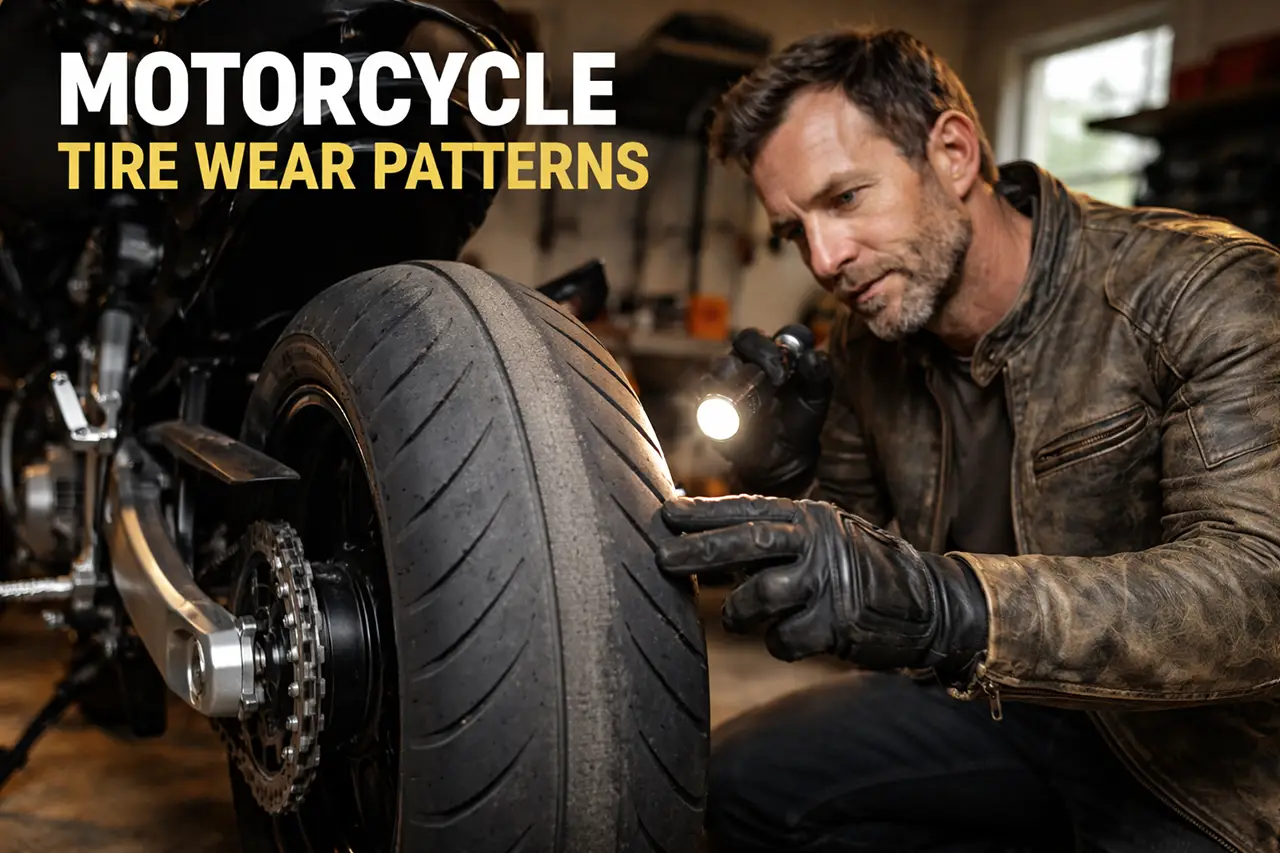
If you’ve been riding long enough, you know that your tires never lie. Every mile you put down — every hard stop, every sweeping corner, every commute on the highway — gets recorded right there in the rubber. Tire wear patterns are your bike’s way of communicating with you, and once you learn to read them, you unlock a whole new layer of awareness that makes you a safer, smarter rider.
Tire maintenance is just one piece of the bigger puzzle. If you want a full picture of keeping your bike running well, I’d recommend reading through my detailed guide on maintenance on a motorcycle — it covers everything from fluids to chain care to seasonal prep. But right now, let’s dig deep into the rubber.
I’ve been riding for over a decade, across sport bikes, naked bikes, and adventure tourers. In that time, I’ve replaced more tires than I care to count, and I’ve made every mistake in the book — running tires too long, ignoring early warning signs, and once, memorably, having a rear tire chunk itself on a highway because I hadn’t paid attention to what it was telling me for weeks. That experience taught me to respect what the rubber is showing.
TL;DR
- Center strip wear = too much highway/straight riding, check inflation.
- Edge wear = aggressive cornering or underinflation.
- Cupping/scalloping = suspension issue, worn shock absorbers.
- One-sided wear = misaligned wheel or collapsed swingarm bearing.
- Flat spot = hard braking or locking up. Time for new rubber.
- Feathering = aggressive acceleration, check chain alignment.
Always inspect tires before every ride. When in doubt, replace.
Why Tire Wear Patterns Matter More Than You Think
On a car, a bad tire is an inconvenience. On a motorcycle, it can be the difference between making it home and not. We’re riding on two small contact patches — each roughly the size of your palm — and those contact patches are the only thing connecting several hundred pounds of metal and momentum to the road.
When wear patterns go uneven or abnormal, it means the load distribution is off, the suspension isn’t doing its job correctly, the inflation is wrong, or your riding habits are putting excessive stress on one part of the tire. Each of those problems bleeds into your handling, your braking distance, and your ability to lean into a corner with confidence.
I make it a habit to visually inspect my tires at every fuel stop on longer rides and before any ride I take. Takes thirty seconds. You squat down, run your eyes around the contact patch, check the sidewalls, and move on. That thirty-second check has saved me from riding on compromised rubber more than once.
The 6 Most Common Motorcycle Tire Wear Patterns
Let’s go through each pattern one by one. For each one I’ll tell you what it looks like, why it happens, and what you need to do about it.
1. Center Wear (Flat Center Strip)
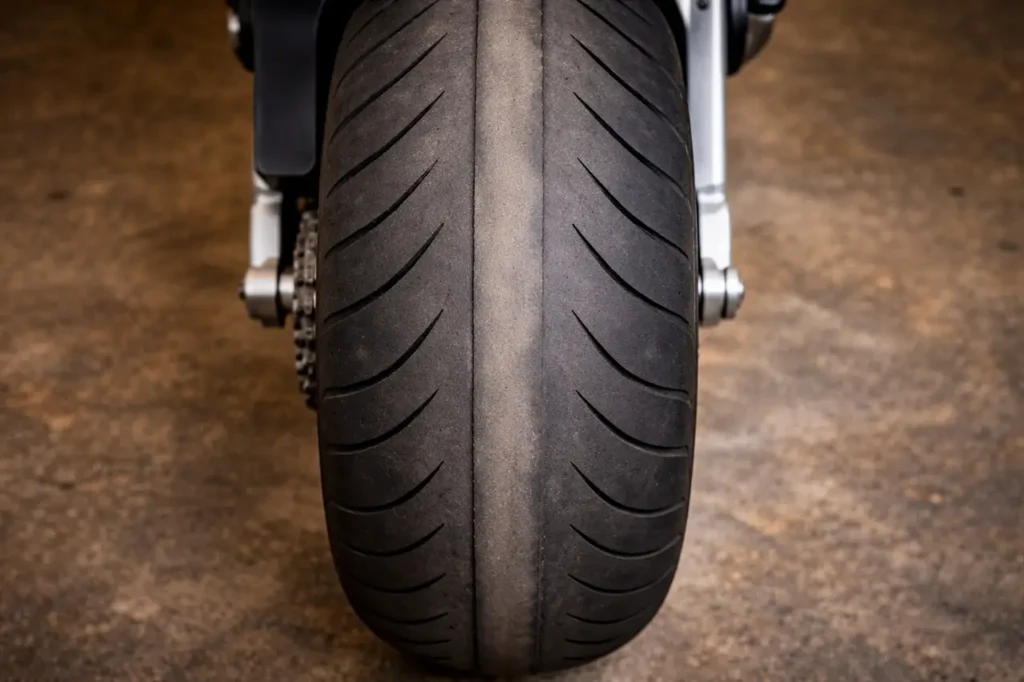
Close-up view of a motorcycle rear tire tread with a visibly flat, worn stripe running along the center of the tire. The edges of the tire still show fresh tread pattern while the center is smooth and slightly flattened.
What it looks like: A flat, smooth band running down the very center of your rear tire. If you look at the tire from behind or above, you’ll notice the round profile has been squared off at the middle.
Why it happens: This is the most common pattern I see on touring and commuter bikes, and it’s caused by putting in lots of straight-line miles — highways, long open roads — where the bike sits upright and all the weight loads the center of the tire. It’s a badge of honor for long-distance riders in one sense, but it’s also a performance and safety issue if you let it go too far.
What to do: First, check your tire pressure. Overinflation accelerates center wear dramatically, because the tire bows outward and contacts the road only at the very peak. If pressure is correct, the wear is purely mileage-related. You can continue riding, but once the center tread depth gets close to wear indicators (usually 1mm), you’re done. A squared-off tire also handles notably worse in corners — it wants to track straight and resist leaning, which is unnerving on mountain roads.
2. Edge Wear
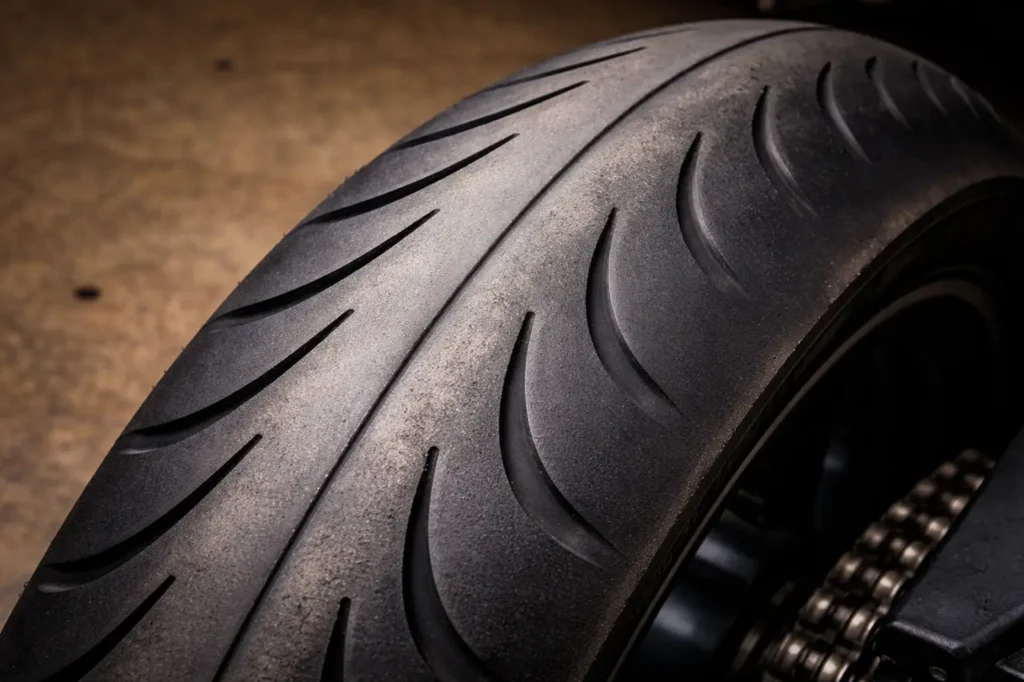
What it looks like: The outer shoulders of your tire are worn down while the center still has depth. On a rear tire especially, you’ll see the tread squashed and smoothed on both sides while the crown looks relatively fresh.
Why it happens: Two culprits here. First: underinflation, which causes the tire to sag, contact the road on its shoulders rather than its crown, and generate more heat on the edges. Second: riding style. If you spend a lot of time on twisty roads, canyon carving, or track days, you’re loading those edges hard. If you’re seeing edge wear without a lot of twisty mileage, underinflation is almost certainly your issue.
What to do: Check inflation first — always. If it’s low, inflate to spec, monitor, and see if the wear rate normalizes. If the wear is cornering-related, it’s expected and you can manage it by choosing tires designed for sport riding (softer compound on the shoulders) so they wear more evenly. Don’t panic over edge wear if you’re a canyon rider — just stay on top of tread depth and rotate to fresh rubber before the carcass gets exposed.
3. Cupping or Scalloping
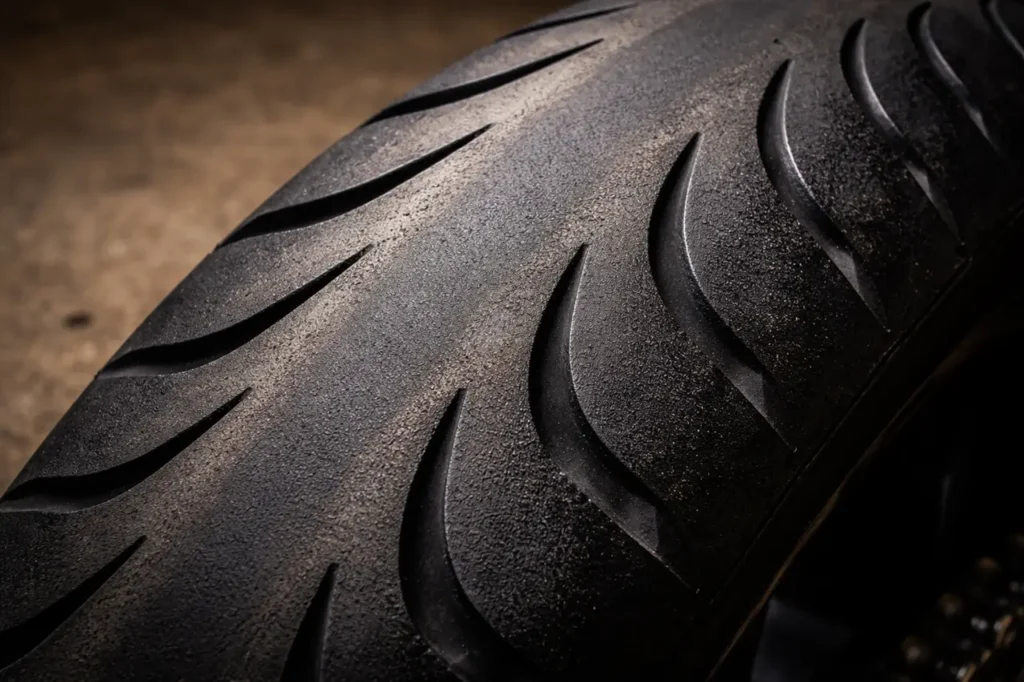
Close-up macro photo of a motorcycle tire tread showing scalloping or cupping wear — a series of wavy, hollowed-out scoop marks across the tread surface, alternating highs and lows.
What it looks like: A series of hollowed-out scoop marks or waves across the tread surface. Run your hand along the tire and instead of feeling a smooth progression, you feel a rhythmic series of high and low spots — like someone took an ice cream scoop to the rubber.
Why it happens: This is almost always a suspension problem. Worn shock absorbers, blown fork seals, or incorrect spring preload settings mean the wheel is bouncing and hopping rather than maintaining consistent road contact. Every time the wheel hops slightly, it grinds into the tire a little differently, and over time that creates those distinctive scallop marks. Some aggressive braking habits can also create isolated scallops on the front tire.
What to do: Do not ignore this one. Cupping is telling you that your suspension needs attention, and that means your handling and safety margin are compromised — not just your tire wear. Get the suspension inspected. Rebuild or replace the shocks/forks as needed. Then replace the affected tire, because the uneven surface will continue to wear abnormally even after the suspension is sorted. This is one of the wear patterns I’ve seen most commonly linked to unexpected tank slappers and instability at highway speeds.
4. One-Sided or Asymmetric Wear
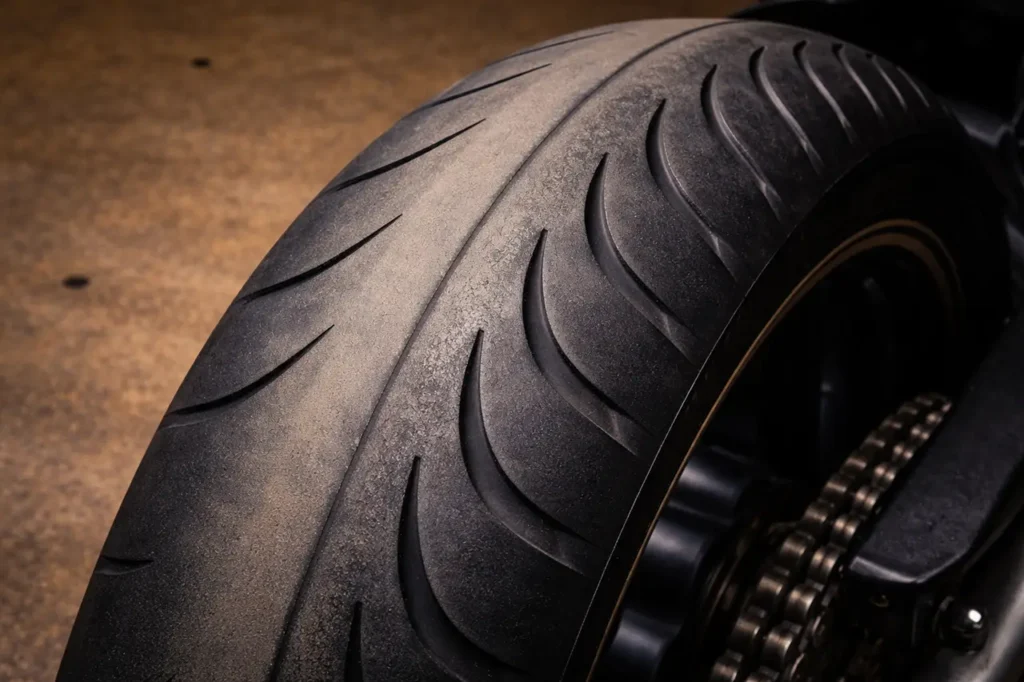
What it looks like: One side of the tire is noticeably more worn than the other. Stand behind the bike and look straight down at the rear tire — you’ll see the tread depth drop off sharply on one side.
Why it happens: Wheel misalignment is the number one cause. If your rear wheel isn’t tracked in line with the front, you’re loading the tire unevenly on every mile. This can happen after a chain adjustment done incorrectly, a crash, or just worn swingarm bushings that let the axle drift. Collapsed or worn steering head bearings can also contribute to asymmetric front tire wear.
What to do: Get a wheel alignment check immediately. This isn’t a wear-it-until-the-next-service thing — misalignment creates handling that feels vague and unpredictable, particularly mid-corner. Check that your chain adjuster marks are matching on both sides of the swingarm. If they’re matched and you’re still seeing one-sided wear, you may have a bent frame rail or worn swingarm pivot bearing. Either way, it needs a proper inspection before you put more miles on it.
5. Flat Spots

What it looks like: A very localized, often sharply defined flat area on the tire — usually on the front. Unlike center wear which is gradual and spread across the width, a flat spot is a small, precise patch where rubber has been abraded away.
Why it happens: Hard braking that locks the wheel. If you’ve grabbed a handful of front brake and felt the wheel skid — even briefly — you’ve likely put a flat spot on the tire. It can also happen from an extended parking period (the bike sitting in one position for months, leaving one spot of the tire loaded under the weight).
What to do: A significant flat spot means tire replacement — there’s no fixing a piece of missing rubber. If it’s small and you can feel vibration at speed, that tire is done. This is also a prompt to evaluate your braking technique and ABS setup. If you’re locking up without ABS, consider whether your brake fluid needs a bleed, your brake pads are glazed, or you simply need to practice progressive braking inputs. Locking a front wheel at any meaningful speed is one of the most dangerous things you can do on a motorcycle.
6. Feathering or Sawtooth Wear
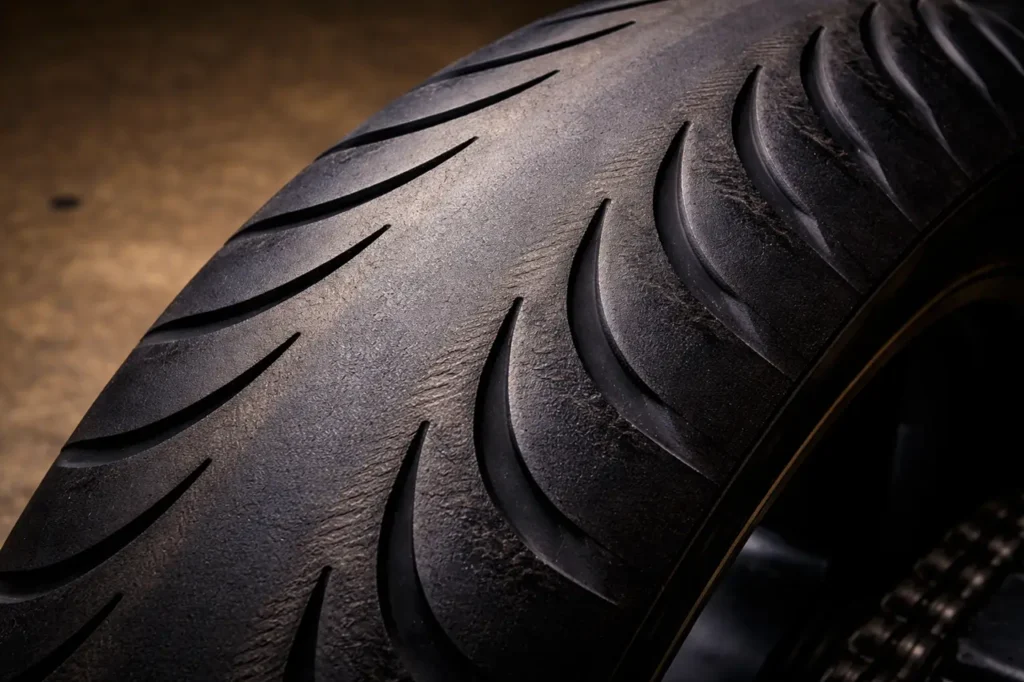
What it looks like: Run your fingernail along the tread blocks. If they feel like they have little ramps — smooth on one side, sharp on the other — that’s feathering. It gives the tread a sawtooth profile when viewed from the side.
Why it happens: Primarily aggressive acceleration on the rear tire. The aggressive torque application grinds the trailing edge of each tread block harder than the leading edge, creating that ramp profile. It can also indicate chain misalignment putting a lateral scrubbing force on the tire, or improper toe-in on bikes with wider rear rubber.
What to do: First, verify your chain alignment — this is the mechanical fix. If alignment is perfect, feathering is largely a riding style issue. Smooth out your throttle application out of corners and you’ll extend tire life significantly. The sawtooth pattern itself isn’t immediately dangerous, but it does reduce the effective contact area and grip, especially on wet roads where those micro-edges need to evacuate water.
Front vs. Rear: Why They Wear Differently
This trips up a lot of newer riders. On most motorcycles, the rear tire will wear roughly twice as fast as the front. Why? The rear handles the majority of acceleration forces, and braking is often biased toward the front but the rear still takes a beating. If you’re on a powerful naked bike or a sport bike, your rear tire is taking the brunt of every roll-on out of a corner.
The front tire typically shows more wear related to braking — particularly that flat spot risk — and steering inputs. You’ll often see more nuanced wear on the front because the steering geometry means the contact patch shifts in complex ways through a corner.
What this means practically: don’t assume you can replace rear and front simultaneously and have them both wear out at the same time. I typically go through two or three rear tires for every front, depending on the bike. Running mismatched tires (a fresh front, a worn rear) is fine and normal — but running a fresh rear on a front that’s showing cords is obviously not.
Reading Wear Indicators: The Built-In Warning System
Every modern motorcycle tire has wear indicator bars molded into the grooves — small raised rubber bridges sitting at the base of the tread channels. They’re typically marked on the sidewall with a small “TWI” (Tread Wear Indicator) triangle or arrow pointing to where the bar sits.
When the tread surface wears down to the level of those bars, you are at the legal and safety minimum — typically 1mm of tread depth. But here’s the honest rider’s truth: by the time those bars are flush with the tread surface, you’ve already sacrificed significant wet-weather grip.
I personally swap tires when I’m at around 2mm, especially heading into a season with rain. The degradation in grip between 3mm and 1mm on wet pavement is substantial — it’s not a linear decline. The last millimeter is where things get genuinely sketchy.
How Your Riding Style Shapes Your Tire Wear
I find it fascinating how much you can read about a rider’s habits from their tire wear. It’s like a fingerprint. Here’s what different riding profiles typically produce:
- The daily commuter: Heavy center wear, often combined with flat spots from stop-and-go braking. Rear tire squares off quickly.
- The canyon carver: Edge wear on both tires, more pronounced on the rear. Often asymmetric if they have a favorite direction of lean.
- The track day enthusiast: Even edge wear with some feathering. Front tire takes a beating from late braking. Tires wear fast but evenly.
- The long-distance tourer: Heavy center wear, often overinflation-related from attempting to maximize range, plus some cupping if shocks are tired.
- The new rider: Often uneven wear from inconsistent inputs, occasional flat spots from abrupt braking, and typically underinflated tires from not checking regularly.
Knowing your riding profile helps you choose the right tire compound. A touring tire will handle center loading better than a sport tire. A sport-touring tire tries to balance both. If you’re a committed canyon carver putting on mostly twisty miles, a sport compound that sacrifices center longevity for edge grip is the right call.
Tire Pressure: The Single Biggest Variable
I cannot stress this enough. The majority of abnormal tire wear patterns I’ve seen on fellow riders’ bikes trace back to incorrect tire pressure. It’s the one variable you have total control over, it takes two minutes to check, and it affects everything: handling, wear, fuel economy, and safety.
Overinflation causes: center wear, harsh ride, reduced contact patch, poor grip on rough surfaces.
Underinflation causes: edge wear, overheating, increased rolling resistance, potential sidewall failure at speed.
Always check pressure cold (before the bike has been ridden, or after sitting for at least three hours). The manufacturer’s recommended pressures are on the swing arm tag or in the owner’s manual — not on the tire sidewall (that’s the maximum pressure, not the recommended operating pressure). And check with a quality gauge, not a gas station indicator that’s been beaten up by a thousand users.
What to Do When You Spot Abnormal Wear
Here’s my personal decision tree when I notice something off:
- Check tire pressure first, always. Even if you think it’s right, check it.
- Inspect the tread depth at the wear indicators. If you’re at or near 1mm, the tire is done regardless of the pattern.
- Check wheel alignment if you see one-sided or feathering wear.
- Bounce the bike on its suspension to feel for worn shocks (should compress smoothly and rebound once without bobbing). Cupping wear means suspension inspection.
- Look at the sidewalls for cracking, bulging, or embedded objects.
- If there’s any doubt, don’t ride. The cost of a tire is nothing compared to a crash.
The key mindset shift for newer riders is this: tires are not a “run it until it looks obviously bad” item. They’re a proactive maintenance item where you’re making decisions based on wear patterns, not just tread depth. A tire with 3mm of tread but severe cupping is more dangerous than a tire at 2mm with clean, even wear.
When Is It Time to Replace Your Motorcycle Tires?
Beyond tread depth, here are the conditions that mean replace now, no matter the mileage:
- Sidewall cracking or crazing: UV degradation and aging rubber. Even if tread looks fine, a cracked sidewall can fail catastrophically.
- A bulge or bubble anywhere: This is carcass damage, likely from a pothole impact or running severely underinflated. Imminent blowout risk.
- Tires older than five years: Rubber degrades with age regardless of mileage. Check the DOT code on the sidewall — the last four digits tell you the week and year of manufacture (e.g., “3220” means 32nd week of 2020).
- Exposed cords or fabric showing through the rubber: Emergency. Ride slowly to the nearest safe stop and call for help.
- Any puncture that’s been plugged: A plug is an emergency fix only. A plugged tire should be inspected and replaced at the earliest opportunity, and some manufacturers don’t recommend riding at all on a plugged motorcycle tire.
Quick Reference: Tire Wear Pattern Summary
| Wear Pattern | Likely Cause | Action Required |
| Center strip | Overinflation or straight-line miles | Check pressure, monitor tread depth |
| Edge wear | Underinflation or cornering | Check pressure, consider sport compound |
| Cupping/Scalloping | Worn suspension components | Inspect suspension, replace tire |
| One-sided wear | Wheel misalignment | Align wheel, check swingarm bearings |
| Flat spot | Locked wheel braking | Replace tire, review braking technique |
| Feathering | Aggressive acceleration / chain misalignment | Check chain alignment, smooth throttle inputs |
Final Thoughts: Your Tires Are Trying to Talk to You
After all the miles I’ve put in, I’ve come to think of tire inspection as a conversation. The rubber doesn’t lie — it records exactly how you’ve been riding, how well you’ve maintained your bike, and what mechanical issues are developing under the surface.
Learning to read tire wear patterns isn’t just about extending tire life (though it definitely does that). It’s about understanding your bike more deeply, catching mechanical issues before they become failures, and staying ahead of problems instead of reacting to them on the road.
Make tire inspection a ritual. Check before every ride. Squat down, run your eyes and fingers over the tread, feel for anything unusual. The whole thing takes under a minute once it’s habit. And that minute might save your skin — literally.
Ride safe out there.
Frequently Asked Questions (FAQs)
How often should I check my motorcycle tire pressure?
You should ideally check your tire pressure before every ride, or at least once a week. Incorrect tire pressure—both overinflation and underinflation—is the leading cause of premature and abnormal wear patterns like center striping and edge wear.
What causes motorcycle tires to cup or scallop?
Cupping, also known as scalloping, is most often caused by suspension issues. If your shock absorbers are worn out or your suspension isn’t set up correctly for your weight, the tire will bounce microscopically, carving out wavy, scoop-like marks in the tread.
Why do my tires have edge wear if I mostly ride straight highways?
If you aren’t doing a lot of aggressive cornering or canyon carving but still notice heavy edge wear, the most likely culprit is underinflation. When a tire is under-inflated, it sags and makes excessive contact on its shoulders, which generates heat and wears the edges down prematurely.
Can a flat spot on a motorcycle tire be fixed?
No. A flat spot is typically caused by heavy emergency braking or locking up the rear wheel, which physically scrapes away a section of the rubber. Once a flat spot is there, it creates an imbalance and a vibration hazard. The only safe solution is to replace the tire.
How do I know when it’s time to replace my motorcycle tires?
You should replace your tires when the tread depth reaches the built-in wear indicators (usually around 1mm to 2mm). Additionally, you should get new rubber if you notice severe uneven wear, visible cords, dry rot, or if the tire is more than 5 years old, regardless of how much tread is left.
Why does my front tire wear differently than my rear tire?
The front and rear tires handle completely different forces. The rear tire manages acceleration and bears the brunt of the bike’s weight, making it prone to center wear. The front tire handles the majority of your braking and steering forces, which often leads to cupping or feathering over time.