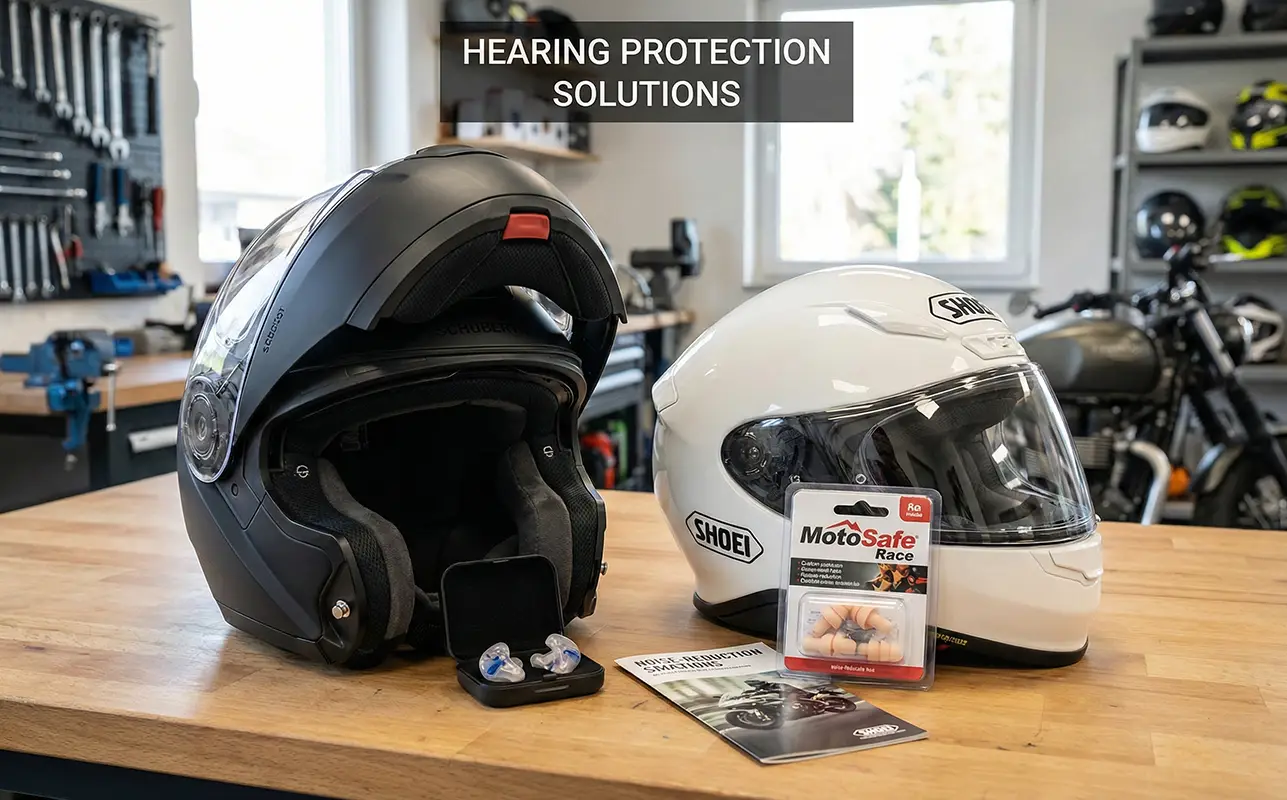
Every motorcyclist knows the exhilarating feeling of hitting the open road, but few realize the silent threat lurking beneath the roar of their engine: hearing damage.
Wind noise at highway speeds can reach 100-110 decibels—loud enough to cause permanent hearing loss after just 15 minutes of exposure. For a detailed guide on safety standards and noise ratings, check out our Ultimate Guide to Motorcycle Helmets.
In this comprehensive guide, we’ll explore the best motorcycle helmets specifically designed to minimize wind noise and protect your hearing. We’ve evaluated each helmet based on rigorous criteria including noise reduction capabilities, comfort during extended rides, and build quality. Whether you’re a daily commuter or long-distance tourer, this list will help you find the perfect helmet to preserve your hearing.
1. Schuberth C4 Pro
The Schuberth C4 Pro stands as the gold standard when it comes to quiet motorcycle helmets. This German-engineered modular helmet has earned its reputation through meticulous attention to aerodynamic design and acoustic engineering.
Overview
Schuberth features a specially designed aeroacoustic shell that channels air smoothly around the helmet, significantly reducing turbulence. The helmet’s advanced fiberglass matrix shell construction contributes to noise dampening. It is widely considered one of the best quietest motorcycle helmets available on the market.
At highway speeds, riders consistently report noise levels that are noticeably lower than competing helmets. The plush interior padding ensures a snug fit that further enhances noise reduction by eliminating gaps.
Key Features
- Direct Fiber Processing: Lightweight glass fiber shell.
- Integrated Communication: Pre-installed speakers and mic.
- Pinlock 120: Top-tier anti-fog lens included.
- Coolmax Interior: Premium comfort liner.
Pros and Cons
Pros:
- Exceptionally quiet at all speeds, with industry-leading noise reduction.
- Premium build quality with anti-bacterial, moisture-wicking liner.
- Integrated communication system compatibility (SC1).
- Superior ventilation system that doesn’t compromise on noise levels.
Cons:
- Premium price point typically retailing around $600-700.
- Heavier than some competitors due to robust construction.
- Limited color and graphic options compared to sportier brands.
Pricing: The Schuberth C4 Pro retails between $600 and $700.
Best For: Touring riders who prioritize silence above all else.
2. Shoei RF-1400
The Shoei RF-1400 represents the latest evolution in Shoei’s flagship full-face helmet line. Known for their exceptional quietness and premium quality, Shoei helmets have long been the choice of discerning riders.
Overview
Shoei’s RF-1400 incorporates extensive wind tunnel testing to create one of the quietest full-face helmets available. The helmet features an advanced AIM+ shell design. Shoei has refined the chin curtain and neck roll to eliminate air intrusion points.
The visor sealing system has been completely redesigned to prevent whistling and air leaks. It is a top contender for the best full-face motorcycle helmet for the money in the premium segment due to its noise isolation.
Key Features
- AIM+ Shell: Multi-ply matrix for rigidity.
- CWR-F2 Shield: Vortex generators reduce wind noise.
- Airtight Window Beading: Prevents water and air leaks.
- 3D Max-Dry System II: Moisture-wicking interior.
Pros and Cons
Pros:
- Exceptional noise reduction with refined aerodynamics.
- Outstanding build quality and attention to detail.
- Comfortable for all-day wear with plush interior materials.
- Wide variety of sizes ensuring proper fit for noise reduction.
Cons:
- Expensive investment at approximately $500-600.
- The snug fit may feel restrictive to some riders.
- Visor change mechanism is more complex than some competitors.
Pricing: The Shoei RF-1400 retails between $500 and $600.
Best For: Sport and street riders who want a race-bred helmet that is touring-quiet.
3. AGV K6
AGV brings Italian style and MotoGP-derived technology to the hearing protection conversation with the K6. This sport-touring helmet balances aggressive looks with surprisingly effective noise dampening.
Overview
The AGV K6 utilizes computational fluid dynamics to optimize acoustic performance. The helmet’s carbon-aramid-fiberglass shell is engineered to be lightweight while providing structural rigidity that helps dampen vibrations. It is a leading choice for the best lightweight carbon fiber helmet (composite) category.
AGV’s innovative wind protector works to minimize turbulence inside the helmet. The Ritmo fabric interior is designed to provide a snug, gap-free fit essential for blocking wind noise.
Key Features
- Carbon-Aramid Shell: Ultra-lightweight protection.
- Ultravision Visor: 190° horizontal field of view.
- Collarbone Safe Profile: Reduces injury risk.
- Ritmo Fabric: Sweat-wicking interior.
Pros and Cons
Pros:
- Excellent noise reduction for a sport-focused helmet.
- Lightweight construction reduces neck fatigue.
- Wide field of vision with minimal blind spots.
- Stylish designs appeal to sport riders.
Cons:
- Ventilation isn’t as robust as some touring-specific helmets.
- Aggressive sport fit may not suit round head shapes.
- Premium pricing places it in the upper market segment.
Pricing: The AGV K6 retails between $500 and $600.
Best For: Sport riders who want lightness without the noise of a pure race helmet.
4. HJC RPHA 11 Pro
HJC’s RPHA 11 Pro demonstrates that effective hearing protection doesn’t always require a premium price tag. This helmet brings advanced composite construction to a more accessible price point.
Overview
The RPHA 11 Pro features HJC’s Premium Integrated Matrix Plus (PIM+) shell construction. HJC has invested in wind tunnel testing to refine the helmet’s shape, resulting in significantly reduced wind noise.
The helmet includes a wind deflector and breath box that work synergistically to reduce turbulence. The multicool interior padding ensures a snug, noise-blocking fit.
Key Features
- PIM+ Shell: Carbon/Glass hybrid.
- ACS Ventilation: Front-to-back airflow.
- RapidFire Shield: Quick replacement system.
- MultiCool Interior: Antibacterial comfort.
Pros and Cons
Pros:
- Outstanding value proposition with impressive noise reduction capabilities.
- Lightweight design reduces rider fatigue.
- Excellent ventilation system balances airflow with noise control.
- Wide range of graphic options.
Cons:
- Interior materials don’t match the premium feel of higher-priced competitors.
- Fit runs slightly small, so sizing up may be necessary.
- Visor mechanism feels less refined.
Pricing: The HJC RPHA 11 Pro retails between $400 and $500.
Best For: Riders on a budget who need race-level aerodynamics and decent noise control.
5. Arai Regent-X
Arai’s Regent-X represents the brand’s dedication to both safety and rider comfort, including acoustic comfort. This touring-focused helmet incorporates decades of Arai’s hand-crafted quality.
Overview
The Regent-X showcases Arai’s philosophy of creating helmets that work with the rider’s body. Arai’s signature round head shape (or intermediate/round bias) minimizes turbulent air pockets.
The chin curtain and neck roll are carefully designed to seal against the rider’s neck, preventing air intrusion from below. The FCS cheek pads provide comfort while maintaining the tight seal necessary for optimal noise reduction.
Key Features
- PB-cLc Shell: Peripherally Belted Complex Laminate.
- FCS Cheek Pads: Custom jaw fit.
- Hyper-Ridge: Reinforced bottom edge.
- Glancing Off: Shell shape designed to slide.
Pros and Cons
Pros:
- Exceptional build quality with hand-crafted attention to detail.
- Superior comfort for extended wear.
- Highly customizable fit through removable padding systems.
- Excellent noise reduction that improves with proper fitting.
Cons:
- Premium pricing reflects hand-crafted quality.
- Round shape may not fit long oval heads comfortably.
- Heavier than some modern composite helmets.
Pricing: The Arai Regent-X retails between $600 and $750.
Best For: Touring riders who prioritize a custom fit and hand-made quality.
6. LS2 Challenger GT
The LS2 Challenger GT proves that budget-conscious riders don’t have to sacrifice hearing protection. This helmet offers impressive noise reduction at a fraction of the cost of premium alternatives. Note: While often confused with modulars due to naming, the Challenger GT is typically a full-face sport-touring helmet. We will describe the full-face features relevant to noise reduction.
Overview
LS2 has engineered the Challenger GT with a kinetic polymer alloy (KPA) shell. The helmet features a dual-density EPS liner that contributes to noise absorption. It solves the tinted visor vs. drop-down sun shield debate with an integrated sun visor.
LS2 has included a wind deflector and breath guard that work together to minimize interior turbulence. The laser-contoured interior provides a snug fit essential for blocking wind noise.
Key Features
- KPA Shell: Kinetic Polymer Alloy.
- Twin Shield System: Built-in sun visor.
- Class A Visor: Optically correct.
- Quick Release Strap: Easy on/off.
Pros and Cons
Pros:
- Exceptional value with noise reduction capabilities exceeding expectations.
- Lightweight construction reduces neck strain.
- Integrated sun visor eliminates the need for swapping shields.
- Pinlock-ready face shield included.
Cons:
- Not as quiet as premium helmets.
- Interior materials are basic and may wear faster.
- Ventilation controls can be tricky with gloves.
Pricing: The LS2 Challenger GT retails between $200 and $300.
Best For: Budget riders who need a quiet, full-featured helmet.
7. Bell Race Star Flex DLX
Bell’s Race Star Flex DLX brings race-proven technology to street riders who demand both performance and hearing protection. This helmet demonstrates that sport-focused designs can still prioritize acoustic comfort.
Overview
The Race Star Flex DLX incorporates Bell’s what is MIPS in motorcycle helmets (Flex system, a more advanced version). The carbon composite shell is engineered to be acoustically efficient.
The contoured neck roll and chin curtain create an effective seal that prevents air intrusion from below. The helmet typically includes a photochromic transition visors (ProTint) shield.
Key Features
- Flex Impact Liner: Progressive energy management.
- 3K Carbon Shell: High strength.
- ProTint Shield: Adaptive light tint.
- Virus CoolJade Liner: Cooling fabric.
Pros and Cons
Pros:
- Excellent noise reduction for a race-oriented helmet.
- Advanced Flex technology provides superior impact protection.
- Lightweight carbon construction.
- Aggressive styling with multiple graphic options.
Cons:
- Premium pricing reflects advanced technology.
- Sport-focused fit may not accommodate all head shapes.
- Ventilation can introduce some noise at max flow.
Pricing: The Bell Race Star Flex DLX retails between $750 and $850.
Best For: Track riders who want high-speed stability without ear-splitting noise.
8. Shark Evo-One 2
The Shark Evo-One 2 offers a unique approach with its innovative flip-back design that transforms from full-face to jet helmet. This French-engineered helmet combines versatility with effective noise reduction.
Overview
Shark has developed the Evo-One 2 with a fiberglass and aramid shell. When locked in full-face mode, the helmet’s acoustic performance is impressive, with carefully designed seals. It is one of the best motorcycle modular helmets for noise control due to its “Auto-Seal” system.
The plush interior lining is designed to conform to the rider’s head shape, creating a custom fit that enhances acoustic isolation.
Key Features
- Auto-Up/Auto-Down: Automatic visor lifting.
- Auto-Seal System: Presses visor against gasket.
- Dual Homologation: Certified open or closed.
- Integrated Sun Shield: UV protection.
Pros and Cons
Pros:
- Innovative flip-back design offers unique versatility.
- Comfortable interior with quality materials.
- Integrated sun visor and pinlock system.
- Competitive pricing for the technology offered.
Cons:
- Heavier than traditional full-face helmets.
- Noise levels increase significantly when partially open.
- Mechanism requires regular maintenance.
Pricing: The Shark Evo-One 2 retails between $430 and $480.
Best For: Commuters who want the option of open-face riding but seal up tight for the highway.
9. Scorpion EXO-R1 Air
The Scorpion EXO-R1 Air rounds out our list as an excellent mid-range option that doesn’t compromise on hearing protection. This sport-touring helmet offers impressive noise reduction capabilities.
Overview
Scorpion has engineered the EXO-R1 Air with a TCT shell. The Airfit inflation system allows riders to customize the fit, creating a personalized seal that enhances noise reduction. This acts as a built-in motorcycle helmet fitment guide tool to ensure acoustic sealing.
The helmet includes a chin curtain and neck skirt that effectively seal against wind intrusion from below.
Key Features
- AirFit System: Custom cheek pad inflation.
- Ultra-TCT Shell: Proprietary blend.
- KwikWick III: Antimicrobial liner.
- Ellip-Tec II: Secure shield mechanism.
Pros and Cons
Pros:
- Excellent noise reduction that rivals expensive helmets.
- Airfit inflation system allows for customized acoustic sealing.
- Competitive pricing makes quality hearing protection accessible.
- Good ventilation system balances cooling with noise control.
Cons:
- Interior materials don’t match the luxury feel of premium alternatives.
- Inflation system adds slight bulk.
- Limited availability in some regions.
Pricing: The Scorpion EXO-R1 Air retails between $400 and $460.
Best For: Riders who want to manually pump up the cheek pads to block out noise.
Conclusion
Protecting your hearing while enjoying the freedom of motorcycling shouldn’t be an afterthought. The Schuberth C4 Pro and Shoei RF-1400 set the standard for quietness, while the Scorpion EXO-R1 Air proves effective hearing protection doesn’t require a fortune.
Remember that even the quietest helmet benefits from the addition of quality earplugs.
Frequently Asked Questions
Do I still need earplugs if I have a quiet helmet?
Yes. Even quiet helmets can have internal noise levels of 95-105 dB at highway speeds. Safe exposure is around 85 dB. Earplugs reduce noise by another 20-30 dB, bringing you into the safe zone.
How much difference does proper helmet fit make for noise reduction?
It is critical. A loose helmet allows wind to rush into the gaps around your neck and ears, creating turbulence and noise. A snug fit seals out this wind.
Are modular helmets as quiet as full-face helmets?
Generally, full-face helmets are quieter due to having fewer seams. However, premium modulars like the Schuberth C4 Pro are engineered to be quieter than many average full-face helmets.
What causes the most wind noise in a motorcycle helmet?
Turbulence. Air flowing over vents, the visor seal, and especially the gap between the helmet and the rider’s neck creates chaotic air movement, which generates low-frequency roaring noise.
How often should I replace my helmet for optimal hearing protection?
Every 5 years. As the interior padding compresses and degrades over time, the fit becomes looser, allowing more wind noise to enter the helmet.