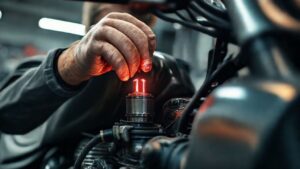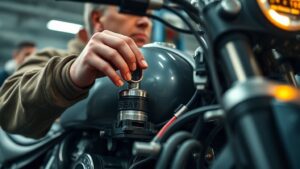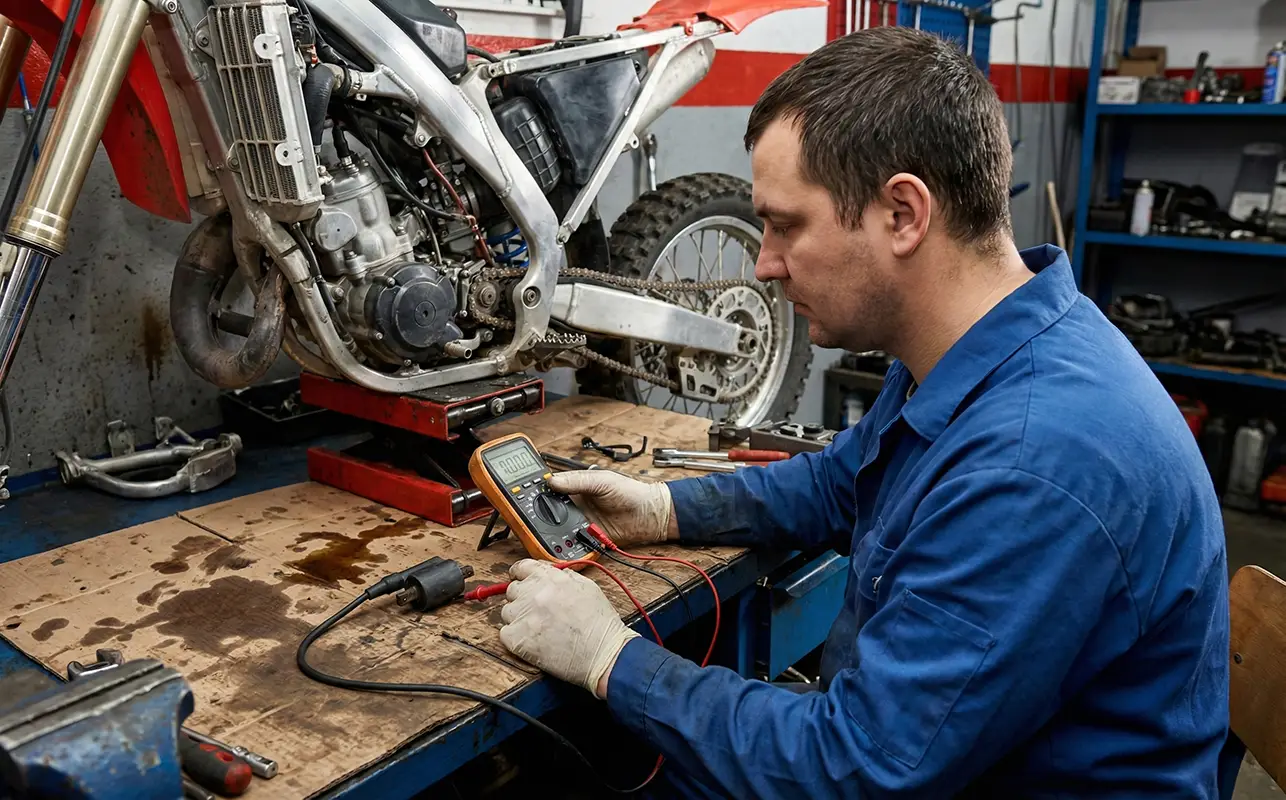
The ignition coil is one of the most critical components in your dirt bike’s electrical system, yet it’s often overlooked until something goes wrong. Learning how to test a dirt bike coil is an essential skill that every rider should develop, as it can save you from being stranded on the trail and prevent unnecessary replacements of parts that are actually functioning correctly.
The ignition coil transforms the low voltage from your battery or stator into the high voltage needed to create a spark at the spark plug, which ignites the fuel-air mixture in your engine. When this component fails or operates inefficiently, you’ll experience symptoms like difficulty starting, misfiring, loss of power, or complete engine shutdown.
Understanding how to test a dirt bike coil empowers you to diagnose ignition problems accurately, extending the life of your bike by preventing cascading failures that can occur when electrical issues go unaddressed. A faulty coil can cause your CDI box or stator to work harder than necessary, potentially damaging these more expensive components. By catching coil problems early, you maintain optimal engine performance and fuel efficiency.
Difficulty Level: Beginner to Intermediate – This task requires basic mechanical knowledge and the ability to use a multimeter, but doesn’t involve complex disassembly or specialized tools.
Time Required: 30-45 minutes for a complete test, including setup and documentation of readings.
Cost Savings: Performing this diagnostic yourself saves $75-150 in shop labor charges. Additionally, by accurately diagnosing the problem, you avoid replacing parts that don’t need replacement—a common issue when riders guess at electrical problems. A shop might charge $200-400 for full electrical system diagnostics, whereas a quality multimeter costs $25-60 and can be used indefinitely.
Tools & Materials Needed
Before beginning this diagnostic procedure, gather all necessary tools and materials. Having everything on hand prevents interruptions and ensures accurate testing.
Essential Tools:
- Digital multimeter with ohm-reading capability (minimum 20k ohm range)
- Spark plug socket (typically 16mm or 18mm, depending on your bike model)
- Socket wrench or ratchet
- Flathead screwdriver (small and medium sizes)
- Phillips head screwdriver set
- Needle-nose pliers
- Wire brush (brass bristles preferred)
- Flashlight or headlamp
- Service manual for your specific dirt bike model
Safety Equipment:
- Nitrile gloves (chemical and abrasion resistant)
- Safety glasses with side shields
- Work mat or cardboard to kneel on
Cleaning Supplies:
- Contact cleaner spray (electronic-safe formula)
- Clean shop rags or microfiber towels
- Compressed air canister or air compressor with blow gun
Optional but Recommended:
- Spark tester tool
- Camera or smartphone for documenting wire connections
- Masking tape and permanent marker for labeling wires
- Notebook for recording resistance readings
Preparation & Safety
Proper preparation is crucial when working with electrical systems. Position your dirt bike on a stable, level surface—preferably on a center stand, paddock stand, or suitable work stand. If your bike doesn’t have a stand, ensure it’s supported securely using a milk crate or tire chocks to prevent it from tipping during the procedure.
Pre-Work Checklist:
Turn off the engine and remove the key from the ignition if equipped. Allow the engine to cool completely for at least 30 minutes if you’ve been riding. Hot components can cause burns and make accurate electrical readings difficult. Disconnect the negative terminal from the battery if your bike has an electric start system. This prevents accidental starting and protects sensitive electronic components from voltage spikes during testing.
Work in a well-ventilated area with adequate lighting. Garages should have doors open or fans running, as you may be using chemical cleaners. Clear your workspace of clutter, fuel containers, and flammable materials. Keep a fire extinguisher rated for electrical fires (Class C) within reach.
SAFETY WARNING BLOCK:
Electrical Shock Hazard: Ignition coils store and generate extremely high voltage (15,000-45,000 volts). Never touch the coil, spark plug wire, or spark plug while the engine is running or being kicked over. Even with the engine off, residual charge can remain in the coil for several minutes.
Fire and Explosion Risk: When testing spark, fuel vapors can ignite. Never test spark near the fuel tank, carburetor, or any fuel source. Ensure the spark plug is grounded at least 12 inches away from these components.
Chemical Exposure: Contact cleaners contain solvents that can irritate skin and eyes. Always wear nitrile gloves and safety glasses. Use in ventilated areas only.
Mechanical Hazards: Even with the ignition off, a kick-start lever can move unexpectedly. Keep hands and tools clear of all moving parts. Ensure the bike is in neutral with the transmission disengaged.
Battery Precautions: If your bike has a battery, disconnecting terminals can cause sparks. Remove negative terminal first, positive second. Reverse when reconnecting.
Familiarize yourself with your bike’s specific ignition system layout by consulting the service manual. Take photographs of all wire connections before disconnecting anything—this will be invaluable during reassembly.
Step-by-Step Guide: How to Test a Dirt Bike Coil
Step 1: Locate and Access the Ignition Coil
The ignition coil location varies by manufacturer and model, but it’s typically mounted near the engine, often under the fuel tank or side panels. On most dirt bikes, you’ll find it attached to the frame with a rubber mounting bracket to absorb vibration.
Begin by removing any plastic bodywork that obstructs access to the coil. Use your Phillips head screwdriver to remove body panel screws, placing them in a container so they don’t get lost. On bikes where the fuel tank must be removed or lifted, first turn the fuel petcock to the “OFF” position and disconnect the fuel line using pliers to compress the spring clamp. Have a rag ready to catch any fuel dribbles.
Mechanic’s Tip: Take a photo with your smartphone of every connector before you disconnect it. This creates a visual reference that’s more reliable than memory, especially if you’re interrupted during the repair.
Once you have clear access to the coil, inspect it visually for obvious damage: cracks in the housing, burn marks, corrosion on terminals, or oil contamination. A coil covered in oil or fuel may have internal insulation breakdown. Note any damage in your notebook.
Step 2: Perform Visual Inspection and Cleaning
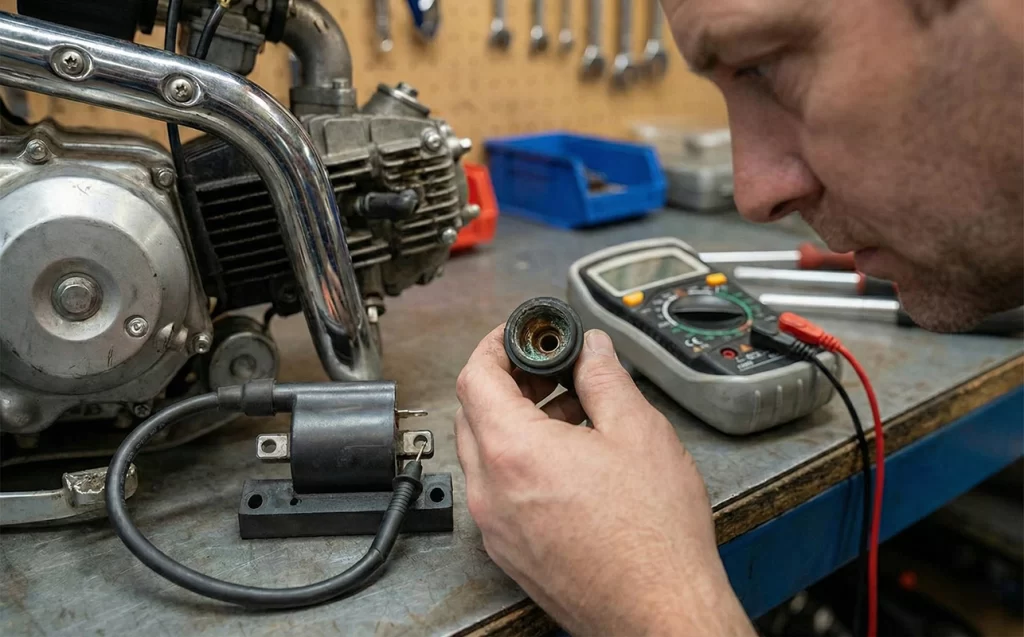
Before conducting electrical tests, clean the coil and all connections thoroughly. Dirt, oil, and corrosion create false readings and can actually cause intermittent ignition problems that mimic coil failure.
Using your wire brush with brass bristles (brass won’t scratch or conduct electricity like steel), gently clean the coil’s terminals and mounting points. Spray contact cleaner on all electrical connections, including the spark plug wire connection at the coil and the wire connector that leads to the CDI box or magneto. Allow the cleaner to penetrate for 30 seconds, then wipe with a clean shop rag.
Use compressed air to blow out any debris from the coil housing and surrounding area. Pay special attention to the rubber boot where the spark plug wire connects to the coil—moisture and dirt accumulation here commonly causes spark problems that riders mistake for coil failure.
Mechanic’s Tip: If you see white, crusty deposits around electrical connections, this is corrosion from moisture intrusion. This alone can cause ignition problems. Clean thoroughly with contact cleaner and consider applying dielectric grease during reassembly to prevent future corrosion.
Inspect the spark plug wire for cracks, abrasions, or exposed conductor wire. Run your fingers along its entire length, feeling for soft spots or damaged insulation. A damaged spark plug wire causes symptoms identical to a bad coil but costs much less to replace.
Step 3: Test Primary Coil Resistance
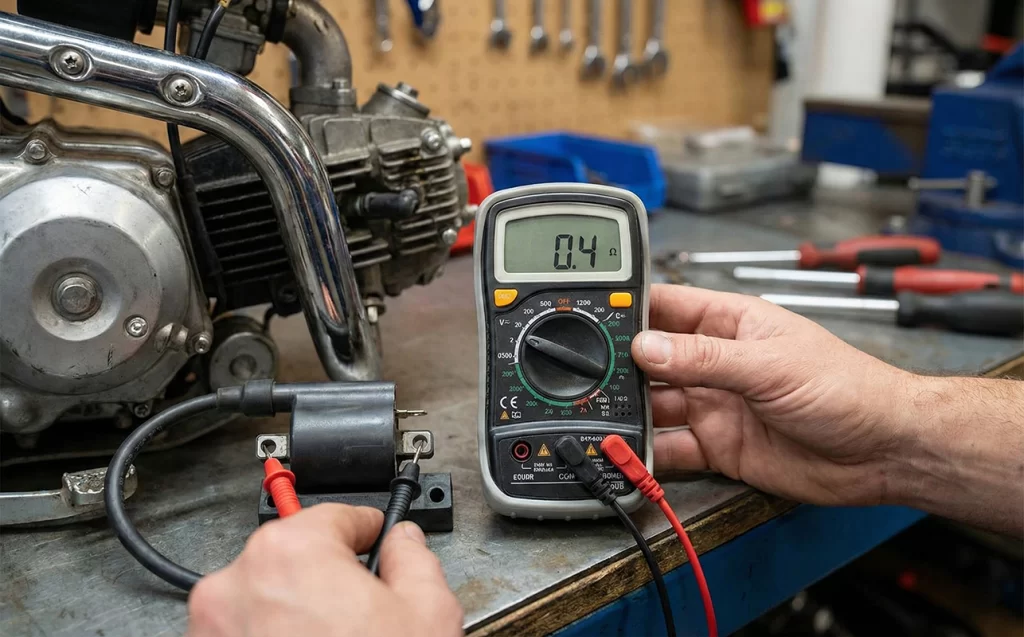
Now we’ll begin actual electrical testing. The ignition coil has two circuits: the primary winding (low voltage side) and secondary winding (high voltage side). We test each separately.
Set your digital multimeter to the ohms (Ω) setting, typically the 200-ohm or 2k-ohm range for primary testing. Touch the two meter probes together to verify the meter works—you should see a reading near zero ohms, confirming continuity.
Locate the primary coil terminals. These are the wire connector(s) coming from the CDI box or magneto—usually a two-wire connector with terminals visible inside the coil body. Consult your service manual for the exact configuration, as some coils have the primary circuit integrated into a multi-pin connector.
Disconnect the primary wire connector from the coil. Touch one multimeter probe to each of the two primary terminals on the coil itself (not the wire connector). The meter should display a resistance reading.
Typical primary coil resistance specifications:
- Most Japanese dirt bikes: 0.1 to 0.5 ohms
- European models: 0.2 to 0.8 ohms
- Older two-stroke models: 0.5 to 1.5 ohms
Record your actual reading and compare it to your service manual’s specifications. If the reading is infinite (displayed as “OL” or “1” on most meters), the primary winding has an open circuit and the coil has failed. If the reading is significantly lower than specified, the winding may be shorted.
Mechanic’s Tip: Temperature affects resistance readings. For most accurate results, test when the coil is at room temperature (68-72°F). A hot coil will show slightly higher resistance, which is normal but can confuse diagnosis if you’re not aware of this factor.
Step 4: Test Secondary Coil Resistance
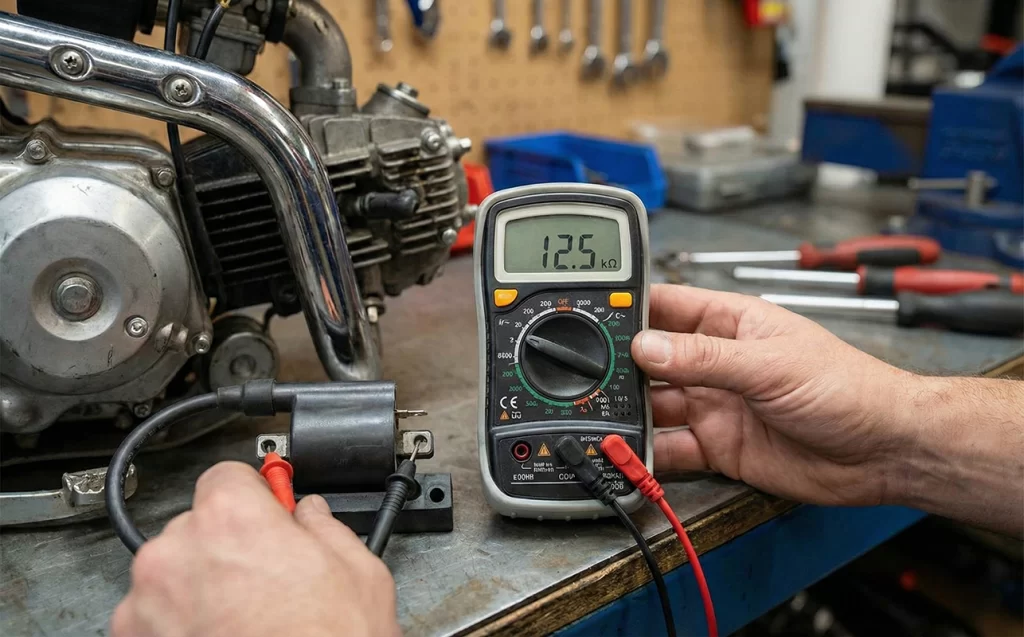
The secondary winding produces the high voltage needed for spark. This circuit has much higher resistance than the primary.
Switch your multimeter to a higher ohm range—typically 20k ohms (20kΩ) setting. Some coils require measuring up to 50k ohms, so check your manual first.
For this test, place one probe on the primary positive terminal (the one that connects to the CDI box’s power output) and the other probe on the spark plug wire terminal. On most dirt bikes, you can insert the probe into the rubber boot where the spark plug cap connects, making contact with the metal terminal inside. Alternatively, remove the spark plug cap and touch the probe directly to the wire core.
Typical secondary coil resistance specifications:
- Modern four-stroke dirt bikes: 5,000 to 15,000 ohms (5k-15kΩ)
- Two-stroke models: 8,000 to 25,000 ohms (8k-25kΩ)
- Older bikes with external resistor caps: 2,000 to 8,000 ohms (2k-8kΩ)
Record your reading and compare to specifications. An infinite reading indicates an open secondary winding—the coil has definitely failed. A reading significantly below specification suggests a short circuit in the winding, also indicating failure.
Mechanic’s Tip: If your reading is slightly out of specification, test again with the spark plug cap removed. Many caps contain a resistor (typically 5,000 ohms) that’s included in the total secondary resistance. A failed resistor cap can mimic coil problems. Test the cap separately by placing probes on each end—it should read approximately 5k ohms if it contains a resistor.
Step 5: Perform Spark Test
Resistance testing tells you if the coil’s windings are intact, but doesn’t confirm the coil can actually produce spark under load. A spark test provides this functional verification.
Remove the spark plug using your spark plug socket. Inspect the plug while it’s out—a fouled or damaged plug can cause symptoms that seem like coil failure. Reconnect the spark plug to the spark plug wire, ensuring a firm connection.
Ground the spark plug by placing its threaded portion against a clean, unpainted metal surface on the engine—the cylinder head fins work well. You can hold it in place with your hand, but grip only the rubber insulation on the spark plug wire, never the metal portions. Better yet, use a spark tester tool that holds the plug safely.
SAFETY REMINDER: Ensure the spark plug is at least 12 inches away from the fuel tank, carburetor, or any fuel source. Have a helper present if possible. Wear your safety glasses.
With the plug grounded, slowly kick the engine over (or press the electric start button briefly if equipped). Watch the spark plug gap closely. You should see a bright blue spark jump across the electrodes. The spark should be consistent with each kick or rotation.
Interpreting spark test results:
- Bright blue spark, consistent: Coil is functioning correctly; problem likely elsewhere
- Weak orange/yellow spark: Coil is weak or dying; may work when cold but fail when hot
- Intermittent spark: Loose connection, damaged wire, or failing coil
- No spark: Coil failure, CDI failure, or kill switch problem
Mechanic’s Tip: If you get no spark during this test but the coil passed resistance testing, the problem likely isn’t the coil. Check the kill switch (disconnect it and test again), inspect the CDI box connections, and verify the stator is producing power. Many riders replace perfectly good coils because they don’t test the entire ignition system systematically.
Step 6: Test for Grounding Issues
A coil that’s internally shorted to ground will drain the ignition system and prevent proper spark. This final test checks for this condition.
Set your multimeter to the highest ohm range (usually 2M or 20MΩ—megohms). Touch one probe to either of the coil’s primary terminals and the other probe to the coil’s metal mounting bracket or body. The reading should be infinite (OL), indicating no connection between the coil’s internal circuits and its case.
Repeat this test between the secondary terminal (spark plug wire connection) and the coil body. Again, you should see infinite resistance.
If you get any measurable resistance (anything other than infinite), the coil’s internal insulation has broken down and it’s shorting to ground. This is a definitive failure requiring coil replacement.
Mechanic’s Tip: This test is especially important if your bike has intermittent running problems that seem worse in wet conditions. A coil with deteriorating insulation may test fine when dry but short to ground when moisture is present. If you suspect this, spray the coil with water and immediately retest—a failing coil will show the short.
Step 7: Document Results and Reassemble
Record all your test results in your notebook with the date. This creates a maintenance history that helps track problems over time. Note the specific resistance readings, whether spark was present and what color it was, and any visual damage observed.
If the coil passed all tests, the ignition problem lies elsewhere—check the CDI box, stator/magneto, kill switch, and wiring harness. If the coil failed any test, replacement is necessary.
To reassemble, reconnect all wires to the coil, ensuring each connector clicks or seats firmly. Apply a small amount of dielectric grease to the inside of the spark plug wire boot before reconnecting it to the coil—this prevents moisture intrusion and makes future removal easier.
Reinstall the spark plug, torquing it to specification (typically 13-18 ft-lbs for most dirt bikes, but verify in your manual). Reconnect any fuel lines, ensuring clamps are properly positioned. Reinstall bodywork in reverse order of removal.
If you disconnected the battery, reconnect the positive terminal first, then negative. Turn the fuel petcock back to “ON” or “RES” position.
Mechanic’s Tip: Before declaring the job complete, start the bike and let it idle for 5 minutes, then take a short test ride. Listen for any misfiring or hesitation that might indicate a loose connection you made during reassembly. It’s better to discover a problem in your driveway than miles into the trail.
Troubleshooting Common Mistakes
Even experienced mechanics encounter challenges when learning how to test a dirt bike coil. Here are the most common issues and their solutions:
Problem: Multimeter shows erratic or fluctuating readings
Solution: This usually indicates poor probe contact. Clean the coil terminals again with contact cleaner and ensure your meter probes are making solid contact with bare metal, not touching corroded or painted surfaces. Also verify your multimeter battery is fresh—a weak battery causes unreliable readings.
Problem: Test results don’t match service manual specifications
Solution: First, confirm you’re looking at specifications for your exact bike model and year—coil specs vary significantly between models. Second, verify you’re testing at the correct points; some manuals specify testing at the wire connector rather than at the coil terminals, which includes wire resistance. Third, ensure you’re using the correct multimeter range setting—testing secondary resistance on a 200-ohm range will show “OL” even on a good coil.
Problem: Getting spark during testing, but bike still won’t start
Solution: A weak spark may be sufficient to jump the gap during testing but insufficient under compression. This indicates a marginal coil that’s failing. Also, ignition is only one part of the starting equation—verify you have fuel delivery and proper compression. A bike needs spark, fuel, air, and compression to run.
Problem: No spark during testing, but coil passes resistance tests
Solution: The problem is elsewhere in the ignition system. Systematically test the kill switch (disconnect and bypass it), CDI box (check connections and look for damage), and stator/magneto output (requires AC voltage testing). Also verify the engine is actually grounded properly—a broken ground wire prevents the ignition circuit from completing.
Problem: Coil tests good when cold but bike dies when hot
Solution: This classic symptom indicates the coil’s internal insulation is breaking down with heat expansion. Test the coil after running the engine until it dies—you’ll likely find the resistance has changed significantly or the coil shows a short to ground when hot. This is a definitive failure requiring replacement.
Problem: Accidentally touched probes to wrong terminals and now have no spark
Solution: You may have damaged the CDI box by creating an incorrect circuit. CDI boxes are sensitive to reverse polarity and incorrect connections. Check the CDI box fuse if equipped, and test the CDI box output using the procedures in your service manual. Unfortunately, CDI boxes are easily damaged and often require replacement after incorrect connections.
Conclusion
Learning how to test a dirt bike coil is a fundamental diagnostic skill that empowers you to maintain your bike’s ignition system effectively and economically. By following this systematic approach—visual inspection, primary resistance testing, secondary resistance testing, spark testing, and ground testing—you can definitively determine whether your ignition coil is functioning correctly or needs replacement.
Remember that the ignition coil is just one component in a complex electrical system. A methodical approach to diagnostics prevents the costly mistake of replacing parts that are actually working fine. Always test the entire ignition system, including the CDI box, stator, kill switch, and all wiring connections before concluding that any single component has failed.
Maintenance Schedule: Test your dirt bike coil whenever you experience starting difficulties, misfiring, or loss of power. As preventive maintenance, include coil inspection and connection cleaning in your annual pre-season service. Coils typically last 5-10 years or longer under normal conditions, but harsh riding environments with extensive vibration, moisture, or mud exposure can shorten their lifespan.
Keep your test results documented in a maintenance log. Tracking resistance readings over time helps you spot gradual deterioration before complete failure occurs, potentially saving you from a breakdown miles from the truck.
Ultimately, diagnosing your own electrical issues builds a deeper connection with your machine. Instead of feeling helpless when the engine sputters, you’ll have the confidence to pull out your multimeter, isolate the variable, and get back to riding.
Frequently Asked Questions (FAQs)
Can I test a dirt bike coil without a multimeter?
You can perform a basic “spark test” (Step 5) without a multimeter to see if the coil is firing, but this won’t tell you the whole story. A coil can be weak enough to cause poor performance but still produce a visible spark. To truly diagnose a failing coil before it leaves you stranded, you need a multimeter to check the internal resistance of the windings.
Are all dirt bike ignition coils the same?
No. While they look similar, ignition coils have specific internal resistance values matched to your bike’s CDI or ECU. Using a coil with the wrong resistance (e.g., using a 3-ohm coil on a system designed for 0.5 ohms) can burn out your expensive ignition module or result in a weak spark. Always buy a coil listed specifically for your make and model.
How often should I replace my ignition coil?
Ignition coils are not standard “consumable” items like oil or spark plugs. They are designed to last for the life of the motorcycle. However, heat, vibration, and moisture take their toll. On vintage bikes (15+ years old), it is proactive to test them annually. On modern bikes, replace them only if they fail testing or show physical damage.
My bike has a “Stick Coil” (Coil-on-Plug). How do I test that?
Many modern 4-stroke dirt bikes use a “Stick Coil” that sits directly on top of the spark plug. The testing principle is the same (check primary resistance at the connector and secondary resistance from the connector to the spark plug tip), but you will need the specific resistance values from your manual, as they differ significantly from traditional frame-mounted coils.
What is the most common cause of coil failure?
Vibration and Heat. Dirt bikes are subjected to extreme vibration, which can cause the internal copper windings to break or short out over time. Additionally, overheating the engine can melt the internal insulation of the coil, leading to failure. Ensure your coil is mounted securely and that the bike is not running lean (which causes excess heat).