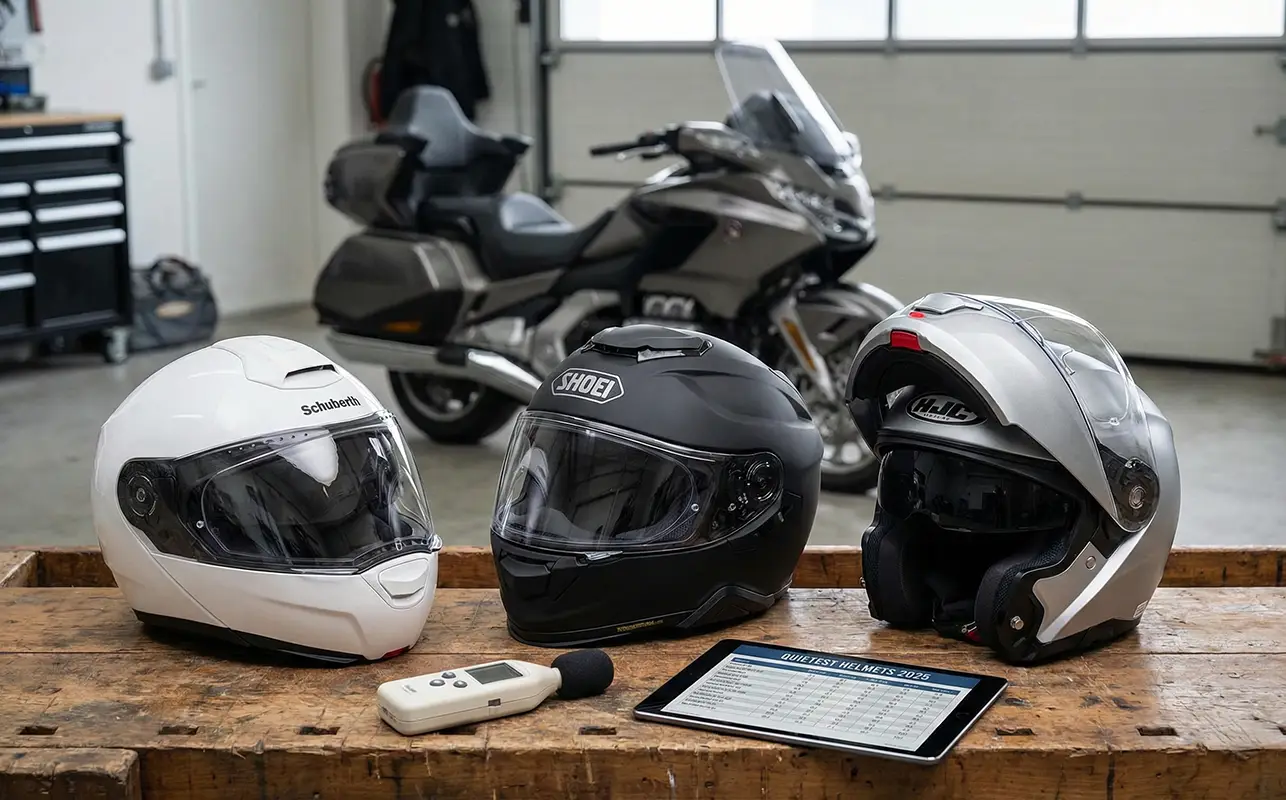
Every motorcyclist knows the frustration of excessive wind noise drowning out their thoughts during a long ride. That constant roar isn’t just annoying—it can cause fatigue, hearing damage, and reduce your awareness of important sounds around you. For a complete guide on how to choose the right gear for your ride, check out our Ultimate Guide to Motorcycle Helmets.
Finding the quietest motorcycle helmet can transform your riding experience, making every journey more comfortable and enjoyable.
In this comprehensive guide, we’ve tested and researched the market’s leading helmets to bring you the best options for noise reduction. We’ve evaluated each helmet based on aerodynamic design, seal quality, and interior padding density.
1. Schuberth C5
The Schuberth C5 represents the pinnacle of German engineering in the modular helmet category. Known for its whisper-quiet performance, this helmet has earned its reputation as one of the quietest options available on the market today.
Overview
Schuberth has built its reputation on creating exceptionally quiet helmets, and the C5 continues this legacy. The helmet features an advanced aerodynamic shell design developed through extensive wind tunnel testing. The multi-piece shell construction uses a special anti-resonance design that dampens vibrations.
The helmet’s seal system is extraordinarily effective, with a thick neck roll and cheek pads. It is the reigning champion of the best motorcycle modular helmets when it comes to noise isolation. The C5 also incorporates a direct ventilation system that manages airflow without creating whistling sounds.
Key Features
- Aeroacoustic Shell: Tuned for silence in wind tunnels.
- Anti-Roll-Off System (A.R.O.S.): Ensures secure fit.
- Direct Fiber Processing: Lightweight strength.
- Integrated Comms Ready: Pre-wired for SC2 system.
Pros and Cons
Pros:
- Exceptionally quiet at all speeds, measuring among the lowest decibel levels.
- Premium build quality with excellent fit and finish.
- Integrated sun visor and communication system compatibility.
- Superior ventilation system that operates silently.
Cons:
- Premium price point that may be prohibitive.
- Heavier than some competitors due to robust construction.
- Limited color options compared to sportier brands.
Pricing: The Schuberth C5 retails between $750 and $900.
Best For: Touring riders who refuse to compromise on silence or modular convenience.
2. Shoei RF-1400
Shoei’s flagship full-face helmet combines race-proven performance with exceptional noise reduction capabilities. The RF-1400 has quickly become a favorite among riders who demand both silence and superior protection.
Overview
The Shoei RF-1400 represents years of refinement. Its aerodynamic shell shape has been optimized through computational fluid dynamics to minimize wind noise and buffeting. The helmet features Shoei’s proprietary 3D Max-Dry interior system, which contributes to noise reduction through its dense construction.
The face shield sealing system is particularly impressive, using a secure locking mechanism that eliminates wind leaks. It is often cited as the best full-face motorcycle helmet for the money in the premium segment due to its longevity and performance.
Key Features
- AIM+ Shell: Multi-ply matrix for rigidity.
- CWR-F2 Shield: Vortex generators reduce wind noise.
- Airtight Window Beading: Prevents water and air leaks.
- E.Q.R.S.: Emergency Quick Release System.
Pros and Cons
Pros:
- Outstanding noise reduction across a wide range of riding positions.
- Excellent build quality with attention to detail.
- Wide range of sizes and shell sizes for optimal fit.
- Superior ventilation that doesn’t compromise quietness.
Cons:
- High price point, though justified by performance.
- Some riders find the fit runs slightly small.
- Replacement parts and shields can be expensive.
Pricing: The Shoei RF-1400 retails between $500 and $600.
Best For: Street and sport riders who want a quiet helmet that can handle track days.
3. AGV K6
AGV brings Italian styling and MotoGP-derived technology to the quiet helmet category with the K6. This sport-oriented helmet proves you don’t have to sacrifice silence for aggressive styling and performance.
Overview
The AGV K6 showcases how modern helmet design can achieve both aerodynamic efficiency and noise reduction. Its shell design features a compact profile that cuts through the wind with minimal resistance. It is a top contender for the best lightweight carbon fiber helmet (composite) category.
AGV’s exclusive interior padding uses a combination of materials specifically chosen for their sound-dampening properties. The ventilation system has been carefully designed to prevent the whistling that plagues many sport helmets.
Key Features
- Carbon-Aramid Shell: Ultra-lightweight protection.
- Ultravision Visor: 190° horizontal field of view.
- Collarbone Safe Profile: Reduces injury risk.
- Ritmo Fabric: Premium skin feel.
Pros and Cons
Pros:
- Excellent noise reduction for a sport helmet design.
- Lightweight construction reduces neck fatigue.
- Wide field of vision with minimal blind spots.
- Aggressive styling appeals to sport bike riders.
Cons:
- Not quite as quiet as touring-focused competitors.
- Snug fit may not suit all head shapes.
- Premium pricing for top-tier features.
Pricing: The AGV K6 retails between $500 and $600.
Best For: Riders who want specific sport performance without the deafening wind noise.
4. Arai Regent-X
Arai’s Regent-X is purpose-built for touring riders who prioritize comfort and quietness over aggressive styling. This helmet represents Arai’s commitment to rider comfort during extended journeys.
Overview
The Arai Regent-X takes a different approach to noise reduction. Its rounder shell shape creates a neutral position in the wind, reducing turbulence rather than trying to slice through it. The helmet features Arai’s famous multi-density EPS liner.
Arai’s attention to detail extends to the chin curtain and breath deflector. The Regent-X’s interior uses plush, removable padding that conforms to your head. For more on how shell construction affects safety and noise, read our article on helmet safety ratings explained.
Key Features
- PB-cLc Shell: Peripherally Belted Complex Laminate.
- VAS Shield Mechanism: Glancing off impact technology.
- FCS Cheek Pads: Custom jaw fit.
- Hyper-Ridge: Reinforced bottom edge.
Pros and Cons
Pros:
- Consistently quiet across different bike types and speeds.
- Exceptional comfort for all-day riding.
- Legendary Arai build quality and safety standards.
- Interior improves with break-in period.
Cons:
- Conservative styling may not appeal to all riders.
- Premium price reflects hand-assembled construction.
- Rounder shape may create lift at very high speeds.
Pricing: The Arai Regent-X retails between $600 and $750.
Best For: Riders who appreciate hand-made quality and a plush, quiet interior.
5. HJC RPHA 91
HJC’s RPHA 91 modular helmet delivers impressive quietness at a more accessible price point. This helmet proves that effective noise reduction doesn’t always require a premium investment.
Overview
The HJC RPHA 91 represents exceptional value in the quiet helmet category. Its advanced polycarbonate composite shell is both lightweight and aerodynamically efficient. The modular design includes a robust chin bar locking mechanism.
HJC has equipped the RPHA 91 with a sophisticated sealing system featuring a plush neck roll. It is a fantastic option if you are looking for best motorcycle helmets with bluetooth, as it seamlessly integrates with the Smart HJC system.
Key Features
- PIM+ Shell: Carbon/Glass hybrid.
- Sun Shield: Wide-view internal visor.
- 3D Engineered Interior: Noise reduction.
- RapidFire Shield: Quick replacement.
Pros and Cons
Pros:
- Excellent value with performance rivaling more expensive options.
- Lightweight construction reduces fatigue on long rides.
- Modular convenience without major noise penalties.
- Good ventilation that operates quietly.
Cons:
- Build quality doesn’t match premium brands.
- Limited intermediate shell sizes compared to premium manufacturers.
- Some quality control inconsistencies reported.
Pricing: The HJC RPHA 91 retails between $550 and $650.
Best For: Touring riders who want the latest tech and quietness below the $800 price point.
6. Bell Race Star Flex DLX
Bell’s Race Star Flex DLX brings professional racing technology to street riders seeking both protection and quietness. This helmet showcases how advanced safety features can coexist with excellent noise reduction.
Overview
The Bell Race Star Flex DLX incorporates Bell’s innovative Flex impact liner system. The three-piece shell construction allows for optimal shaping of each size, resulting in better aerodynamics and reduced noise.
The face shield features Bell’s photochromic transition visors (ProTint) technology, which adapts to changing light. The interior padding is plush and dense, creating excellent noise isolation.
Key Features
- Flex Impact Liner: Three-layer energy management.
- 3K Carbon Shell: High strength.
- ProTint Shield: Adaptive light tint included.
- Virus CoolJade Liner: Keeps skin cool.
Pros and Cons
Pros:
- Advanced Flex impact protection system enhances safety.
- Quiet performance that improves with proper fit.
- Excellent ventilation without noise penalties.
- Photochromic shield option eliminates need for shield changes.
Cons:
- Premium pricing for top-specification models.
- Aggressive styling and fit may not suit touring riders.
- Heavier than some competitors in its class.
Pricing: The Bell Race Star Flex DLX retails between $750 and $850.
Best For: Riders who want the most advanced impact technology and adaptive vision.
7. Shark Evo-One 3 (Evo-GT)
The Shark Evo-One 3 (often updated as the Evo-GT) offers a unique approach to modular helmet design with its innovative flip-back system, all while maintaining impressive noise reduction.
Overview
Shark stands out in the modular helmet category with its ability to convert into a jet-style helmet by flipping the chin bar completely back. The helmet’s shell design minimizes turbulence through its smooth lines.
The sealing system is comprehensive, featuring a thick neck roll and dense cheek pads. It is also one of the best motorcycle helmet for glasses wearers thanks to Shark’s Easy Fit system.
Key Features
- Auto-Up/Auto-Down: Automatic visor lifting.
- Auto-Seal System: Presses visor against gasket.
- Dual Homologation: Certified open or closed.
- Integrated Sun Shield: UV protection.
Pros and Cons
Pros:
- Versatile design offers both full-face and jet configurations.
- Quieter than most modular helmets in its price range.
- Integrated sun visor works effectively.
- Good value considering the feature set.
Cons:
- Heavier than dedicated full-face helmets.
- Mechanical complexity may raise long-term durability concerns.
- Not as quiet as premium touring-specific helmets.
Pricing: The Shark Evo-GT retails between $450 and $550.
Best For: Urban commuters who need the flexibility of an open face with highway quietness.
8. LS2 Challenger GT
LS2’s Challenger GT delivers surprising quietness at a budget-friendly price point, making it an excellent option for riders seeking noise reduction without premium costs.
Overview
The LS2 Challenger GT represents one of the best values in quiet helmets. Its kinetic polymer alloy shell is both lightweight and aerodynamically efficient. LS2 has equipped the Challenger GT with a comprehensive sealing system including a removable breath deflector.
The helmet’s ventilation system manages to provide adequate airflow without creating excessive noise. It also solves the tinted visor vs. drop-down sun shield dilemma by including an integrated drop-down sun visor.
Key Features
- KPA Shell: Kinetic Polymer Alloy.
- Twin Shield System: Built-in sun visor.
- Class A Visor: Optically correct.
- Quick Release Strap: Easy on/off.
Pros and Cons
Pros:
- Exceptional value with noise reduction rivaling mid-tier helmets.
- Lightweight design reduces neck fatigue.
- Integrated sun visor adds convenience.
- Wide range of graphic options available.
Cons:
- Build quality doesn’t match premium manufacturers.
- Interior padding may compress faster than higher-end options.
- Limited availability of replacement parts in some regions.
Pricing: The LS2 Challenger GT retails between $200 and $300.
Best For: Riders on a budget who need a quiet, do-it-all helmet.
9. Ruroc Atlas 4.0
The Ruroc Atlas 4.0 brings a fresh, modern approach to helmet design with its distinctive styling and surprisingly effective noise reduction for a helmet at this price point.
Overview
Ruroc’s Atlas 4.0 has gained attention for its unique aesthetic. The helmet’s carbon fiber and fiberglass composite shell provides a solid foundation for noise isolation. Ruroc’s Shockwave dampening system contributes to reducing vibration-based noise transmission.
The face shield system uses a magnetic quick-release mechanism. What sets the Atlas 4.0 apart is its integrated communication system capability. For tips on sizing this unique shell, see how to measure head for motorcycle helmet.
Key Features
- Carbon Fiber Shell: Strong and light.
- Rheon Tech: Impact energy control liner.
- Fidlock Buckle: Magnetic chin strap.
- Bluetooth Ready: Integrated pockets for Shockwave.
Pros and Cons
Pros:
- Unique styling stands out from traditional helmet designs.
- Integrated communication system works well with reduced wind noise.
- Memory foam interior improves fit and noise isolation over time.
- Reasonable price for the feature set offered.
Cons:
- Styling is polarizing and won’t appeal to traditional riders.
- Not as quiet as dedicated touring helmets from established manufacturers.
- Relatively new brand with less long-term reliability data.
Pricing: The Ruroc Atlas 4.0 retails between $450 and $550.
Best For: Riders who want to stand out visually while enjoying a quiet, tech-integrated ride.
Conclusion
Choosing the quietest motorcycle helmet involves balancing multiple factors including your budget and riding style. While premium options like the Schuberth C5 and Shoei RF-1400 deliver exceptional noise reduction, excellent alternatives exist like the LS2 Challenger GT.
Remember that helmet quietness is just one aspect of a safe ride. Ensure any helmet you choose fits comfortably for the duration of your typical rides.
Frequently Asked Questions
What makes a motorcycle helmet quiet?
A quiet helmet relies on an aerodynamic shell to minimize turbulence, a tight neck roll seal to prevent wind entering from below, and dense interior padding to dampen sound. The lack of protruding vents also helps.
How much difference does a quiet helmet really make?
A lot. Average helmets can reach 105 decibels at highway speeds. A quiet helmet can reduce this to 85-90 decibels. Since the decibel scale is logarithmic, this is a massive reduction in perceived noise and fatigue.
Should I still wear earplugs with a quiet helmet?
Yes. Even the quietest helmets are loud enough at highway speeds to cause hearing damage over time (above 85dB). Earplugs are essential for long-term hearing protection.
Do modular helmets compromise on quietness compared to full-face helmets?
Historically, yes, due to the hinge gaps. However, premium modulars like the Schuberth C5 use advanced sealing to rival or even beat many full-face helmets in quietness.
How important is helmet fit for noise reduction?
It is critical. A loose helmet leaves gaps around the neck and ears where wind rushes in, creating a roar. A snug, properly fitted helmet seals out this noise.