A sportbike rider needs a different helmet than a cruiser rider. Why? Because of aerodynamics, noise, and… bugs. That sleek sportbike tuck position creates unique demands on a helmet compared to the upright posture of a cruiser or touring bike. The wind hits differently, the speeds vary, and let’s be honest – nothing ruins a ride faster than taking a june bug to the face at 70 mph.
Here’s the reality every rider faces: there’s always a trade-off when choosing a helmet. Want more airflow to stay cool? Prepare for more wind noise. Seeking maximum protection? Be ready for a bit more weight and heat, especially in stop-and-go traffic. The perfect helmet doesn’t exist, but the perfect helmet for your specific riding style absolutely does.
In this guide, we’ll break down the pros and cons of the 6 main helmet categories so you can pick the right tool for the job. We’ll explore everything from full-face options that prioritize safety to minimalist half helmets that maximize freedom (while sacrificing protection). By the end, you’ll understand which style matches your riding needs, aesthetic preferences, and comfort requirements.
Fitting is just step one. To understand safety ratings like DOT and Snell, check out our Ultimate Guide to Motorcycle Helmets.
Before picking a style, make sure you understand how safety testing works in our Helmet Safety Ratings Guide.
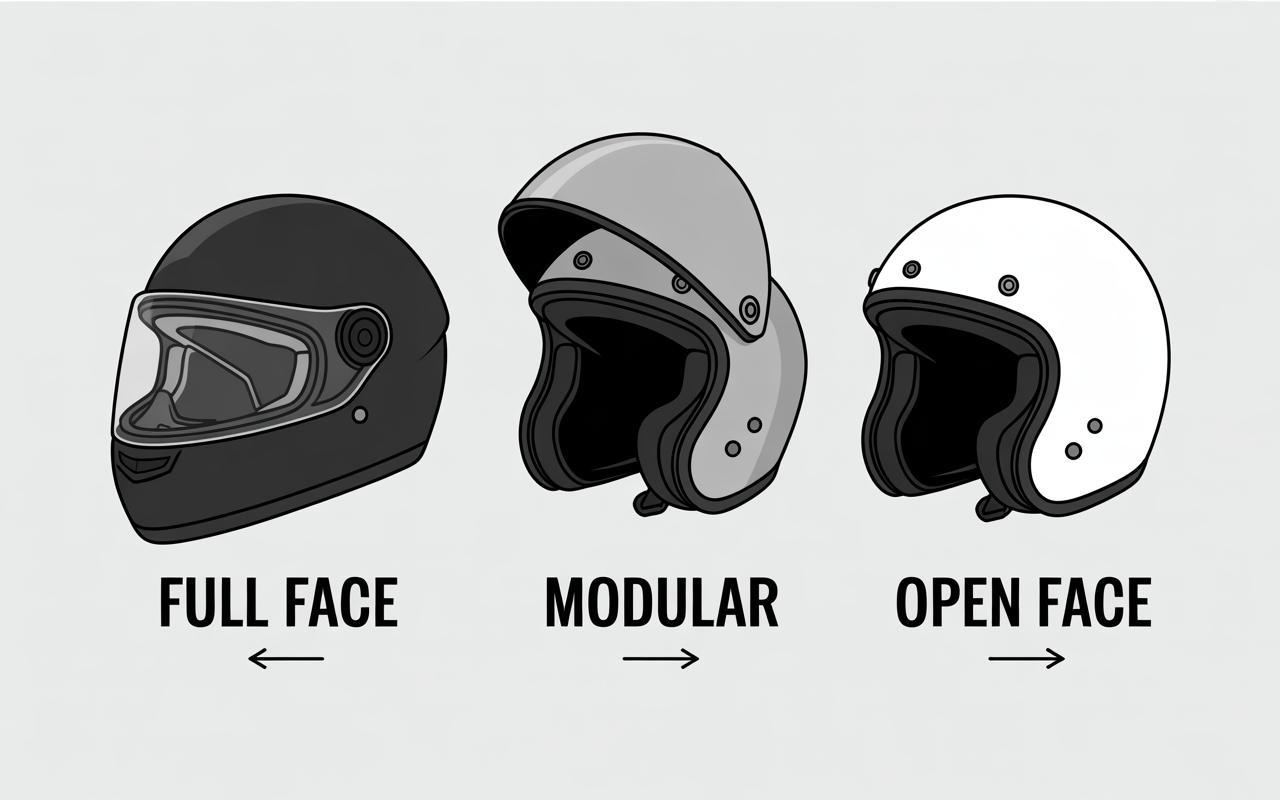
The Full Face Helmet (The Safest Choice)
The full face helmet stands as the gold standard for motorcycle safety, and for good reason. If you’re riding a sportbike, hitting the track, or simply prioritizing maximum protection during your daily commute, this is your go-to option.
Who It’s For
Full face helmets are the preferred choice for sportbike enthusiasts, track day warriors, and safety-conscious commuters. These riders understand that when you’re leaning into corners at speed or navigating through unpredictable traffic, comprehensive protection isn’t optional—it’s essential.
The Design
What defines a full face helmet is its complete coverage design. It envelops your entire head with a solid, one-piece shell that includes an integrated, fixed chin bar. The face is protected by a flip-down visor that creates a complete seal against the elements. This unified structure eliminates weak points that could compromise protection during impact.
Maximum Protection Benefits
The statistics don’t lie—full face helmets offer significantly better protection in crash scenarios than any other style. The enclosed design protects against facial trauma, road rash, and flying debris that would otherwise make direct contact with your skin. In the event of a crash, having that extra layer between your face and the pavement can mean the difference between walking away with minor injuries or facing extensive reconstructive surgery.
The Critical Importance of Chin Protection
Here’s a fact many riders overlook: approximately 19% of all helmet impacts occur in the chin area during crashes. Full face helmets are the only style that provides dedicated protection for this vulnerable region. That sturdy chin bar acts as a crucial barrier between your jaw and the pavement, potentially saving you from serious facial injuries that other helmet types simply cannot prevent.
The Quietest Ride
Beyond safety, full face helmets excel at noise reduction. Their sealed design significantly dampens wind noise, which not only makes for a more pleasant ride but also helps prevent long-term hearing damage—a common but overlooked issue among frequent riders. The aerodynamic shape cuts through air efficiently, reducing the buffeting and howling that plague more open designs.
Looking for maximum silence on the highway? Check our list of Quietest Motorcycle Helmets.
Complete Environmental Protection
Full face helmets provide unmatched protection from environmental factors. Rain, wind, insects, road debris, and even UV rays are kept at bay. Anyone who’s taken a June bug to the face at 60 mph knows exactly how valuable this feature can be. In cold weather, the enclosed design also helps maintain warmth, extending your riding season.
The Drawbacks
Despite their advantages, full face helmets aren’t perfect. The primary complaint is heat buildup, especially when stuck in slow-moving traffic on hot days. Even with sophisticated ventilation systems, they can become uncomfortably warm during idle periods. Additionally, the enclosed design makes it difficult to communicate with others at stoplights or gas stations without flipping up the visor or removing the helmet entirely.
The full face design also restricts peripheral vision slightly more than open-face alternatives, though modern designs have significantly improved in this area to meet safety standards while maximizing field of view.
The Modular Helmet (The Flip-Up)
The modular helmet might just be the Swiss Army knife of motorcycle headgear. Also known as flip-up helmets, these versatile options have gained massive popularity among touring and adventure riders who need the best of both worlds.
Who it’s for
If you’re planning cross-country adventures or extended touring rides, the modular helmet deserves serious consideration. These helmets are particularly beloved by:
- Long-distance touring riders who need to communicate, hydrate, or eat without fully removing their helmet
- Adventure riders who alternate between highway stretches and off-road exploration
- Riders who wear glasses and find traditional full-face helmets cumbersome
- Communication-heavy riders who frequently need to speak with passengers or other riders at stops
The Design: Convenience Meets Protection
What makes modular helmets special is their innovative chin bar mechanism. At first glance, they look identical to full-face helmets, but with the press of a button, the entire front section—including the face shield and chin bar—pivots upward to expose your face.
This design allows riders to quickly:
- Communicate face-to-face at stops
- Take a drink or small snack
- Adjust glasses without helmet removal
- Get fresh air during breaks without removing the entire helmet
Pros: Versatility Without Compromise
The modular helmet’s greatest strength is its adaptability. When fully closed, it provides near full-face protection, but when stopped, you can instantly transform it into an open-face configuration. This makes it exceptionally convenient for:
- Glasses wearers who struggle with the tight entry of traditional full-face helmets
- Riders who need to frequently communicate at stops
- Touring riders who make multiple short stops and don’t want to repeatedly remove their helmet
- Those who experience occasional claustrophobia in full-face designs
Cons: The Trade-offs
Despite their versatility, modular helmets come with some compromises:
- Added Weight: The hinge mechanism adds approximately 200-300 grams compared to equivalent full-face helmets, which can cause neck fatigue on longer rides
- Increased Noise: The seams where the modular section meets the helmet base often allow more wind noise to penetrate
- Safety Considerations: Unless specifically P/J homologated (approved for riding with the chin bar both closed and open), the chin bar mechanism represents a potential weak point in impacts
- Price Premium: The complex mechanism typically makes modular helmets more expensive than comparable full-face models
Planning a long road trip? See our top picks for Best Modular Helmets.
P/J Homologation: A Critical Safety Distinction
When shopping for modular helmets, pay special attention to whether they’re P/J homologated. This certification means the helmet has been tested and approved for riding with the chin bar in both positions (closed and open). Non-P/J homologated helmets should only be ridden with the chin bar locked in the closed position.
Looking for the perfect companion for your next cross-country adventure? See our top picks for Best Modular Helmets.
The Dual Sport / Adventure (ADV) Helmet
Adventure riders demand versatility from their gear, and the ADV helmet delivers exactly that. Designed specifically for riders who transition between pavement and dirt trails, these helmets represent the perfect middle ground between street and off-road designs.
Who it’s for:
Adventure and dual sport riders who split their time between highways and dirt paths are the primary market for ADV helmets. If you ride a BMW GS, KTM Adventure, Triumph Tiger, or Kawasaki KLR 650, this helmet style was made with you in mind.
The Hybrid Design:
The ADV helmet combines the best elements of street and off-road helmets into one versatile package. You’ll notice these distinctive features:
- A face shield like a street helmet for wind and debris protection
- A prominent sun peak (visor) that extends above the eye port to block glare
- An elongated chin bar providing extra airflow and protection
- Aggressive styling with angular vents and geometry
- Removable parts that allow customization based on riding conditions
Ventilation Benefits:
One of the ADV helmet’s strongest attributes is its superior ventilation system. Multiple intake and exhaust vents create constant airflow, making these helmets comfortable during physically demanding off-road sections or hot weather riding. The extended chin bar also increases air circulation around the face, reducing fogging and heat buildup.
Many ADV helmets feature larger eye ports that accommodate goggles underneath the face shield—perfect for dusty conditions where you might want to flip up the visor but still need eye protection.
Highway Speed Drawbacks:
The same features that make ADV helmets great off-road can become liabilities at highway speeds. The prominent sun peak acts like a sail, catching wind and creating drag at higher velocities. This can cause:
- Neck fatigue on long highway stretches
- Buffeting in crosswinds
- Increased noise levels compared to streamlined street helmets
- Potential lifting force when checking over your shoulder at speed
Some premium ADV helmets address this with removable or adjustable peaks, allowing riders to optimize their setup based on the day’s riding plans. When the highway miles increase, simply remove the peak for better aerodynamics.
Despite these compromises, the dual sport helmet remains the go-to choice for adventure riders who need one helmet that can handle everything from desert trails to interstate highways.
The Off-Road / Motocross Helmet
The off-road/motocross helmet stands out immediately with its aggressive design and distinctive features that serve a specific purpose: to excel in the dirt. These helmets are purpose-built for off-road riding conditions where different challenges exist compared to street riding.
Who It’s For
Off-road helmets are designed specifically for dirt bike riders, enduro enthusiasts, and motocross racers. If you’re hitting trails, jumping berms, or competing in motocross events, this is your helmet category. However, it’s important to understand that these helmets are not intended for highway or street use.
The Design
What makes motocross helmets immediately recognizable is their unique configuration:
- Extended chin bar and peak: The elongated chin section provides additional protection from roost (dirt kicked up by other riders) while the prominent peak (or visor) shields your eyes from sun, mud, and debris.
- No face shield: Unlike street helmets, off-road helmets don’t include a built-in visor or face shield. Instead, they’re designed with a large eye port to accommodate goggles.
- Aggressive ventilation: These helmets feature extensive ventilation systems with large intake and exhaust ports to maximize airflow during physically demanding riding.
- Lightweight construction: Every ounce matters during a long day of off-road riding, so these helmets prioritize weight reduction.
Pros
- Superior ventilation: The extensive airflow design keeps you cool during physically demanding off-road riding where you’re constantly working your body.
- Enhanced visibility: The wide eye port provides excellent peripheral vision, crucial for navigating technical terrain.
- Goggle compatibility: Designed specifically to work with off-road goggles, which provide better protection from dust and mud than a face shield.
- Lightweight comfort: The reduced weight decreases neck fatigue during long rides on rough terrain.
- Optimal for hot conditions: If you’re riding in hot weather on dirt, no other helmet style will keep you as cool.
Cons
- Terrible aerodynamics: The extended peak creates significant drag at highway speeds, potentially causing neck strain.
- No wind protection: Without a face shield, your face is exposed to wind, bugs, and debris at road speeds.
- Excessive noise: These helmets are extremely loud on the street due to their ventilation design.
- Cold in cooler temperatures: The massive airflow that’s beneficial in hot conditions becomes a major disadvantage in cold weather.
- Limited protection from elements: Rain, cold, and bugs become serious issues without a face shield.
If you’re exclusively riding off-road, a motocross helmet offers the perfect combination of protection, ventilation, and functionality for dirt environments. However, if your riding includes any significant street time, you’ll want to consider a dual-sport helmet or keep a separate street helmet for road use.
The Open Face (3/4) Helmet
The open face helmet, also known as the 3/4 helmet, is a popular choice among vintage motorcycle enthusiasts, cafe racer riders, and scooter aficionados. With its distinctive profile that covers the top, back, and sides of the head while leaving the face exposed, this helmet style offers a perfect blend of protection and freedom that appeals to riders seeking a more classic aesthetic.
Who It’s For
If you’re cruising through the city on a Vespa, channeling your inner Steve McQueen on a cafe racer, or simply prefer the vintage motorcycle lifestyle, the open face helmet might be your style of choice. These helmets are particularly popular among riders who:
- Value the classic, timeless aesthetic of traditional motorcycling
- Ride primarily in urban environments at moderate speeds
- Appreciate direct connection with their surroundings
- Want the wind on their face but still desire some protection
- Frequently need to communicate with others without removing their helmet
The Design
The open face helmet covers approximately three-quarters of your head—hence the “3/4” nickname. It protects the top, back, and sides of your head while leaving your face completely exposed. Many models come with a flip-down visor to protect your eyes from wind, debris, and bugs, while others rely on separate eyewear.
The interior typically features comfort padding similar to full-face helmets, and many premium models include removable, washable liners. The shell construction varies from polycarbonate in budget options to fiberglass composite and carbon fiber in higher-end models.
Pros: Freedom and Visibility
The open face helmet offers several distinct advantages:
- Unmatched field of vision: Without a chin bar restricting your view, you enjoy a completely unobstructed peripheral vision.
- The wind-in-your-face experience: For many riders, feeling the breeze is part of the authentic motorcycling experience.
- Easy communication: You can talk to others, drink water, or take photos without removing your helmet.
- Classic style: Few helmet styles capture the essence of vintage motorcycling better than a well-designed open face.
- Less claustrophobic: Riders who feel confined in full-face helmets appreciate the openness.
- Lighter weight: With less material, these helmets typically weigh less than their full-face counterparts.
Cons: The Serious Safety Compromise
Despite their appeal, open face helmets come with significant safety drawbacks that every rider should consider:
- Zero chin protection: This is the most critical drawback. Studies show that approximately 19% of all crash impacts happen directly to the chin area—a completely unprotected zone with open face helmets.
- Face exposure: In the event of a crash, your face is completely vulnerable to road rash, debris, and impact.
- Limited weather protection: Rain, cold air, and bugs have direct access to your face.
- Wind noise: The open design creates more wind noise at highway speeds compared to full-face options.
- Potential for lift: At higher speeds, these helmets can create lift unless they fit perfectly.
If you choose an open face helmet, ensure it fits perfectly to avoid lift. Review our Helmet Fitment Guide here for proper sizing techniques.
While open face helmets meet legal requirements in most jurisdictions, riders should be fully aware of the safety trade-offs they’re making. The vintage appeal and freedom come at the cost of significantly reduced protection in the event of a crash.
The Half Helmet (The Brain Bucket)
The half helmet, often affectionately (or critically) called the “brain bucket,” represents the minimalist approach to motorcycle head protection. Popular among cruiser riders, particularly in the Harley-Davidson community, these helmets offer the bare minimum required by law in many states.
Who it’s for:
Half helmets are primarily favored by cruiser riders who prioritize the freedom feeling of the open road. They’re a common sight at motorcycle rallies and on custom choppers where the aesthetic is as important as the ride itself.
The Design:
The design is straightforward – coverage extends only to the top of the skull, leaving the face, ears, and base of the skull completely exposed. Most half helmets feature a simple shell with minimal padding and a basic retention system. Some models include snap-on visors to reduce sun glare, though these offer no impact protection.
Pros:
- Maximum airflow: Nothing beats a half helmet when it comes to keeping cool on hot rides
- Extremely lightweight: With minimal material, these helmets cause almost no neck fatigue
- Enhanced sensory experience: Riders can hear, see, and feel their surroundings completely
- Easy to store: Their compact size makes them simple to stow when not in use
- Classic aesthetic: For many cruiser enthusiasts, the look is part of the culture
Cons:
- Least safe option: The limited coverage leaves critical areas of the head completely unprotected
- Zero face protection: No defense against road debris, insects, or weather
- Minimal impact absorption: Less material means less energy dispersion in a crash
- Base of skull exposure: The vulnerable lower skull area remains completely unshielded
- Extreme wind noise: Expect significant noise at highway speeds
- No features: Forget about integrated sun visors, communication systems, or other conveniences
While half helmets satisfy the letter of the law in states with helmet requirements, they represent a significant compromise in safety. The statistics are clear – they provide substantially less protection than full-face or modular options in crash scenarios. For riders who choose this style, supplementing with quality eye protection is essential, and understanding the safety limitations is crucial.
How to Choose the Right Helmet Style for Your Riding
Selecting the perfect helmet goes beyond safety ratings—it’s about matching your specific riding needs. Your motorcycle type, riding environment, and personal preferences all play crucial roles in determining which helmet will serve you best.
Match Your Helmet to Your Riding Style
Your motorcycle and how you ride it should heavily influence your helmet choice:
- Sport bike riders benefit from full-face helmets with aerodynamic designs that cut through wind at high speeds and provide the neck support needed in a tucked position
- Cruiser enthusiasts often prefer open face or modular options for the relaxed, upright riding position where wind buffeting is less of an issue
- Touring riders typically choose modular helmets for the perfect balance of protection and convenience during long-distance journeys
- Dual-sport adventurers need the versatility of ADV helmets that work both on highways and dirt trails
Climate Considerations Matter
Your local weather patterns should influence your decision:
- Hot climates call for excellent ventilation systems—ADV and off-road helmets excel here, while full-face options with multiple vents can also work well
- Cold weather riders benefit from full-face or modular helmets with closable vents and good seal around the neck to prevent freezing air from entering
- Rain-prone regions demand helmets with effective anti-fog systems and quality face shields—full-face and modular options typically perform best
Noise Tolerance is Personal
How much ambient sound you can tolerate will narrow your options:
- Noise-sensitive riders should gravitate toward full-face helmets, which typically offer the best sound insulation
- Those who prefer environmental awareness might choose open face or ADV helmets that allow more ambient sound
- Highway commuters will appreciate the quieter ride of aerodynamic full-face designs that reduce wind noise at higher speeds
Communication Needs
Modern riders often need to stay connected:
- Group riders who frequently communicate with others might prefer helmets pre-configured for Bluetooth systems
- Solo commuters who take calls might choose modular helmets for easy conversation access at stops
- Music enthusiasts should look for helmets with space for speakers and microphones without creating pressure points
Remember that no single helmet excels in every category. Prioritize your most frequent type of riding and the features that matter most to you. The perfect helmet is the one that balances your specific needs while never compromising on proper fit and safety certification.
Safety Considerations Across Helmet Types
When it comes to motorcycle helmets, not all styles offer the same level of protection. Understanding these safety differences can literally be a life-saving decision.
Impact Zone Coverage
The primary difference between helmet styles is which areas of your head they protect:
- Full Face Helmets: Protect 100% of your head, including the critical chin area. Studies show that approximately 19% of all helmet impacts occur in the chin area—protection that only full face helmets provide completely.
- Modular Helmets: Offer similar coverage to full face when closed, but the flip-up mechanism creates a potential weak point. Look for P/J homologated modular helmets, which are tested and certified for riding with the chin bar in both positions.
- Dual Sport Helmets: Provide full coverage similar to full face helmets but with different aerodynamics. The extended chin bar and peak can actually help deflect branches and debris when off-roading.
- Open Face Helmets: Leave your face and chin completely exposed. While they protect the top, sides, and back of your head, they offer zero protection for your face in a forward fall or impact.
- Half Helmets: Cover only the top portion of your head, leaving the back of your head, face, and chin completely vulnerable. They meet minimum legal requirements in some states but offer the least protection of any style.
Certification Variations
Different helmet styles may meet different certification standards:
- Full face, modular, and dual sport helmets typically achieve the highest safety ratings (DOT, ECE, Snell, or SHARP).
- Open face helmets can meet DOT and ECE standards but rarely achieve Snell certification due to the lack of face protection.
- Half helmets often only meet the minimum DOT standard and rarely qualify for more stringent certifications.
Retention Systems
The chin strap and retention system also vary by helmet style:
- Full face and modular helmets usually feature robust double D-ring or ratchet systems.
- Adventure and off-road helmets often use D-rings for security during rough riding.
- Some open face and half helmets use simpler quick-release mechanisms that may not hold as securely in violent impacts.
Visibility Factors
Safety isn’t just about impact protection—it’s also about preventing accidents:
- Full face helmets offer a more limited peripheral vision but many modern designs address this with wider eye ports.
- Modular and open face designs provide better peripheral awareness.
- Dual sport helmets offer excellent visibility for spotting obstacles on trails.
Remember that the safest helmet is ultimately the one that fits properly and that you’ll actually wear consistently. A properly fitted open face helmet that you wear 100% of the time is safer than a full face helmet that’s uncomfortable and left at home half the time.
Noise and Aerodynamics: How Helmet Style Affects Your Ride
The helmet you choose dramatically impacts your riding experience, especially when it comes to noise levels and aerodynamics. Many riders underestimate how significant these factors become after hours in the saddle.
Wind Noise Differences
Full face helmets typically offer the quietest ride, with noise levels often 5-10 decibels lower than other styles. This difference might not sound significant, but remember that decibels work on a logarithmic scale—a 10dB reduction feels like cutting the noise in half.
Modular helmets, while convenient, introduce seams and gaps around the chin bar mechanism that allow more wind noise to penetrate. Even the best modular helmets are typically 3-5 decibels louder than comparable full-face models.
Open face and half helmets provide almost no noise protection. At highway speeds, the constant wind roar can reach 100+ decibels—loud enough to cause hearing damage during extended exposure. Many riders with these helmet styles rely on earplugs for longer journeys.
Buffeting at Highway Speeds
Helmet shape significantly affects how air flows around your head at speed. Full face helmets are typically designed with wind tunnels to minimize buffeting, the uncomfortable shaking caused by turbulent airflow.
Adventure helmets with their distinctive peaks create more wind resistance, which can cause noticeable neck strain above 70 mph. Some models feature adjustable peaks that can be repositioned or removed for highway riding.
Half helmets create the least wind resistance but offer minimal protection from the elements. The direct wind blast to your face can cause eye fatigue and dryness, even with sunglasses or a windshield.
Impact on Neck Fatigue
The aerodynamic profile of your helmet directly affects neck fatigue during long rides. Poorly designed helmets create lift at highway speeds, essentially tugging your head backward. This constant resistance forces your neck muscles to work overtime.
Weight distribution is equally important. Full face helmets distribute weight evenly around your head, while modular helmets tend to be front-heavy due to the flip-up mechanism. This extra weight—often 200-300 grams more than comparable full-face models—can lead to increased neck strain over time.
For touring riders who spend long hours on highways, investing in a helmet specifically designed for aerodynamic efficiency can significantly reduce fatigue. Look for helmets with spoilers or stabilizers at the rear that help cut through the air smoothly rather than creating turbulence.
Remember that your riding position also affects aerodynamics. A helmet that works perfectly on a sportbike’s tucked position might create uncomfortable buffeting on an upright cruiser. This is why many cruiser riders prefer half or three-quarter helmets despite the safety tradeoffs.
Ventilation Systems: Staying Cool in Different Helmet Types
Keeping cool while riding isn’t just about comfort—it’s about safety. When you’re overheating, concentration drops and fatigue sets in faster. Each helmet style approaches ventilation differently, with distinct advantages and limitations.
Airflow Design Differences
Full Face Helmets rely on strategically placed intake and exhaust vents. Premium models feature adjustable chin vents, crown vents, and rear extractors creating a pressure system that pulls hot air out. The closed design means manufacturers must engineer airflow paths through EPS foam channels—something brands like Shoei and Arai have mastered.
Modular Helmets typically offer similar ventilation to full face options but with an ace up their sleeve—the ability to flip up entirely at stops. This “instant ventilation” feature is invaluable in hot weather traffic jams, though the additional seams often make them slightly less effective when fully closed.
Dual Sport/ADV Helmets excel in ventilation with their off-road DNA. The prominent chin bar sits further from the face, creating more interior volume for air circulation. The peak also directs airflow toward top vents when positioned correctly.
Off-Road Helmets are ventilation kings, designed for high-exertion riding with massive chin bar vents and minimal face coverage. They prioritize maximum airflow over weather protection, making them ideal for hot conditions but terrible for cold weather.
Open Face and Half Helmets provide unmatched ventilation by simply eliminating barriers between your face and the elements. While this keeps you cool, it offers zero protection from insects, debris, or weather.
Heat Management Techniques
Effective heat management goes beyond just vent placement. Modern helmets incorporate:
- Moisture-wicking liners that pull sweat away from your skin
- Removable neck curtains that can be detached in hot weather
- Anti-microbial padding to prevent odor buildup when sweating
- Adjustable vent sliders for customizing airflow based on conditions
The difference between a budget and premium helmet often shows most clearly in ventilation performance. Higher-end models feature more sophisticated internal channeling systems that maintain cooling without excessive noise.
Fogging Prevention
Nothing ruins visibility faster than a fogged visor. Different helmet styles address this problem in various ways:
Full Face Helmets typically include anti-fog pinlock inserts or similar dual-lens systems that create a thermal barrier preventing condensation. Their chin vents are specifically designed to direct air across the shield’s interior.
Modular Helmets use similar anti-fog technology but face additional challenges with their movable parts creating more potential for seal issues.
Dual Sport Helmets often allow riders to crack the shield slightly while still protecting the eyes, or to swap to goggles in extreme conditions.
Open Face Helmets rarely struggle with fogging due to the natural airflow, though those with face shields may include anti-fog treatments.
The ventilation system you need ultimately depends on your riding environment and style. Desert riders need maximum airflow, while those in colder climates benefit from adjustable vents that can be closed to retain heat when necessary.
Communication Systems Compatibility
The rise of Bluetooth communication systems has changed how riders interact on the road, but not all helmet types accommodate these devices equally. Your helmet choice significantly impacts how easily you can stay connected while riding.
Full face helmets offer the most seamless integration for communication systems. Their enclosed design provides ample space in the ear pockets for speakers and the padding can be easily modified to accommodate wiring. The chin bar creates a natural windscreen for your microphone, resulting in clearer audio for your riding partners. Most premium full face helmets now come “comm-ready” with pre-cut speaker pockets and cable routing channels.
Modular helmets follow closely behind in communication-friendliness. When manufacturers design these helmets, they typically account for the added weight of a comm system. The main challenge comes with microphone placement – when the chin bar is up, your microphone position changes dramatically. Advanced systems use dual microphones to compensate for this.
Dual sport/ADV helmets present unique challenges for communication systems. While they offer good speaker accommodation, the increased wind noise at highway speeds can interfere with audio quality. The extended chin and peak design often requires special mounting brackets for external communication units.
Off-road helmets are the least communication-friendly. Their minimalist padding provides few places to secure speakers comfortably against the ears, and the open face design creates significant wind noise that overwhelms most microphones. Some riders opt for in-ear solutions instead of helmet-mounted systems when using this helmet type.
Open face and half helmets struggle with microphone placement due to the lack of a chin bar. Boom microphones become necessary but remain exposed to wind, often resulting in garbled transmission. Speaker installation is also challenging in half helmets due to limited interior space and padding.
For group riders or those who commute daily, this compatibility factor might tip the scales toward full face or modular options, even if other helmet types seem appealing for different reasons. Before purchasing any communication system, verify its compatibility with your specific helmet model, as interior shapes can vary significantly even within the same helmet category.
Summary Table: Quick Comparison of Motorcycle Helmet Types
Choosing the right helmet becomes much clearer when you can compare all options at a glance. This table breaks down the key characteristics of each helmet type to help you make an informed decision based on your specific riding needs.
| Helmet Type | Safety Rating | Noise Level | Weather Protection | Best Use Case |
|---|---|---|---|---|
| Full Face | Excellent | Low | Excellent | Sport bikes, track days, daily commuting, high-speed riding |
| Modular | Very Good | Medium | Very Good | Touring, long-distance rides, riders with glasses, urban commuting |
| Dual Sport/ADV | Very Good | High | Good | Adventure riding, mixed on/off-road, dual sport motorcycles |
| Off-Road/Motocross | Good (for off-road) | Very High | Poor | Dirt biking, motocross, trail riding, no highway use |
| Open Face (3/4) | Fair | High | Poor | Cruising, scooters, cafe racers, urban low-speed riding |
| Half Helmet | Poor | Very High | Very Poor | Cruisers, custom bikes, minimal legal compliance |
Remember that while style and comfort are important, safety should always be your primary consideration. Full face helmets consistently offer the best protection in crash scenarios, especially for your vulnerable chin and face areas which receive a significant percentage of impacts during accidents.
Conclusion: Finding Your Perfect Helmet Match
Choosing the right motorcycle helmet ultimately comes down to balancing safety, comfort, and your specific riding needs. After exploring all the different types of motorcycle helmets, certain priorities should guide your final decision.
Safety should always be your first consideration. If you value protection above all else—and you should—a full-face helmet offers unparalleled coverage for your entire head, including that crucial chin area where nearly 19% of impacts occur. No other helmet style can match this level of protection, which is why track riders and daily commuters alike gravitate toward full-face designs.
For those needing versatility, especially on long journeys, modular helmets present an excellent compromise. The ability to flip up the chin bar at gas stations, for quick conversations, or when navigating at low speeds makes touring more convenient without completely sacrificing safety. Just remember that most modulars (unless P/J homologated) should be ridden in the closed position at speed.
Your riding style naturally guides your helmet choice. Adventure riders benefit from the dual-sport helmet’s versatility across varied terrain. Cruiser riders often prefer the freedom of open-face or half helmets, though they should understand the safety trade-offs they’re making. Urban commuters might appreciate the lightweight practicality of an open-face for city speeds, while anyone hitting highways regularly should strongly consider full protection.
Remember that fit is just as important as style. Even the safest helmet design fails to protect you properly if it’s too loose or uncomfortably tight. Take the time to measure your head and try on multiple brands, as each manufacturer has slightly different internal shapes.
Now that you understand the different types of motorcycle helmets and which might suit your riding style best, it’s time to find specific models that offer the best protection for your budget. Check out our Best Helmets for Beginners list to get started with quality options that won’t break the bank but will keep your head protected where it counts.
Whatever style you choose, make it a helmet you’ll actually wear every time you ride—because the best helmet in the world can’t protect you if it’s sitting on a shelf.
FAQs About Motorcycle Helmet Types
Can I use a modular helmet with the chin bar up while riding?
Most modular helmets are only certified for riding with the chin bar closed. Only helmets with P/J homologation have been tested and approved for riding safely with the chin bar in both the open and closed positions. Always check your helmet’s certification before riding with the chin bar flipped up.
Why are full face helmets quieter than other types?
Full face helmets create a sealed environment around your head with no gaps for wind to penetrate. The one-piece shell design eliminates seams and openings that allow wind noise to enter, while the aerodynamic shape helps air flow smoothly around the helmet rather than creating turbulence. This can reduce noise levels by 5-10 decibels compared to open designs.
Can I wear an off-road helmet on the highway?
Off-road helmets are specifically designed for dirt riding and are not recommended for highway use. The large peak creates dangerous drag at high speeds, the lack of a face shield leaves you completely exposed to wind and debris, and the massive ventilation makes them extremely cold and noisy at road speeds. For mixed riding, choose a dual sport helmet instead.
Do half helmets actually protect you in a crash?
Half helmets provide minimal protection, covering only the top portion of your skull while leaving your face, chin, and the base of your skull completely exposed. While they meet minimum legal requirements in some states, they offer significantly less protection than other helmet types and should be considered the bare minimum for safety compliance rather than adequate crash protection.
Are modular helmets as safe as full face helmets?
When properly closed, quality modular helmets offer protection very close to full face helmets, though the hinge mechanism can be a potential weak point in severe impacts. Look for modular helmets that are P/J homologated, meaning they’ve been tested and certified with the chin bar in both positions. However, they typically weigh 200-300 grams more than comparable full face helmets due to the flip-up mechanism.
What helmet type is best for hot weather riding?
For maximum ventilation in hot weather, off-road and dual sport helmets offer the best airflow with their large vents and extended chin bars. However, if you’re riding on the street, look for a full face or modular helmet with multiple adjustable vents and moisture-wicking liners. The ability to flip up a modular helmet at stops provides instant cooling relief in traffic.
Why do adventure helmets have that peak on top?
The sun peak (or visor) on adventure helmets serves multiple purposes: it blocks sun glare similar to a baseball cap, deflects branches and debris during off-road riding, and can help reduce rain hitting your face shield. However, this same peak creates wind resistance and drag at highway speeds, which can cause neck fatigue on long road stretches.
Can I add a communication system to any helmet type?
Full face and modular helmets are the most compatible with Bluetooth communication systems, offering ample space for speakers in the ear pockets and natural microphone placement. Open face, half, and off-road helmets present significant challenges due to limited padding, exposed microphones that catch wind noise, and difficulty securing speakers properly. Always verify compatibility with your specific helmet model before purchasing a comm system.
What’s the difference between an open face and a half helmet?
An open face (or 3/4) helmet covers the top, back, and sides of your head while leaving your face exposed, providing substantially more protection than a half helmet. A half helmet covers only the top portion of your skull, leaving the base of your skull, face, ears, and chin completely unprotected. Open face helmets offer better safety while still providing the wind-in-your-face experience many riders seek.
Do I need different helmets for different types of riding?
Many riders do keep multiple helmets for different purposes. A full face for highway commuting and sport riding, a dual sport for adventure trips, or an open face for casual city cruising allows you to optimize for each riding situation. However, if you can only have one helmet, choose based on your most frequent riding type, with safety as the primary consideration—a properly fitted full face helmet remains the safest choice for all street riding.