I’ll never forget the morning I watched a colleague—a respected motorcycle journalist—arrive at a press launch for a new sportbike.
She removed her helmet to reveal what can only be described as a catastrophe: matted roots, gravity-defying spikes at odd angles, and a grease line across her forehead that made her look like she’d just emerged from a wind tunnel experiment gone wrong. The irony? She was about to spend the next two hours on camera reviewing the bike.
That moment crystallized something I’d been observing throughout my two decades covering the motorcycle industry: helmet hair isn’t just a cosmetic inconvenience—it’s a legitimate barrier that keeps talented riders, particularly women and image-conscious professionals, from embracing motorcycling as daily transportation.
The relationship between protective headgear and presentable hair has plagued riders since the first helmets became mandatory in the 1960s. While our Ultimate Guide to Motorcycle Helmets covers the critical safety aspects of choosing the right helmet, the aesthetic aftermath of wearing one remains a universal challenge.
According to a 2022 survey by Motorcycle Consumer News, approximately 34% of riders—especially those who commute to professional environments—cite “helmet hair” as a significant deterrent to riding more frequently.
Understanding how to keep your hair looking good after a ride isn’t vanity; it’s about removing obstacles to motorcycle adoption and making two-wheeled transportation a viable daily option for everyone.
Understanding the Science Behind Helmet Hair
Before we dive into solutions, it’s essential to understand why helmets wreak such havoc on our hair. The phenomenon isn’t mysterious—it’s physics, biology, and materials science converging in the confined space between your scalp and your helmet’s EPS liner.
The Compression Factor
A properly fitted motorcycle helmet applies uniform pressure around your entire head—that’s fundamental to its protective function. When you’re selecting gear using a Motorcycle Helmet Fitment Guide, you’re looking for that “firm but not painful” fit that ensures the helmet won’t shift during impact. However, this same compression flattens hair follicles against your scalp, disrupting their natural growth pattern and removing volume. After 20-30 minutes of riding, your hair essentially “remembers” this compressed state.
The problem intensifies with hair length and texture. Fine, straight hair collapses more readily under pressure, while thick, curly hair fights back, often resulting in bizarre geometric patterns that mirror the helmet’s interior shape. The liner material matters too—some moisture-wicking fabrics in premium helmets actually reduce the compression effect compared to basic foam liners.
Heat and Moisture: The Hidden Culprits
Your scalp contains approximately 100,000 hair follicles and countless sebaceous glands that produce natural oils. During a ride, your head generates significant heat—even with excellent ventilation. This creates a greenhouse effect inside your helmet, causing your scalp to perspire. The moisture combines with natural oils, essentially creating a styling product you didn’t ask for.
Modern helmets with advanced ventilation systems—particularly those featured in our guide to the Best Quietest Motorcycle Helmets—help mitigate this issue by promoting airflow. However, even the best-ventilated helmet can’t completely eliminate the heat-moisture problem, especially during summer riding or in stop-and-go traffic where airflow is minimal.
Static Electricity and Friction
The third factor is often overlooked: static electricity. As you pull your helmet on and off, the liner material rubs against your hair, creating static charge. This is particularly problematic with polycarbonate helmet shells and synthetic liner materials. The static causes individual hairs to repel each other, resulting in that characteristic “electrocuted” look many riders experience, especially in dry climates or during winter months.
Pre-Ride Hair Preparation Strategies
Learning how to keep your hair looking good after a ride begins before you even start your motorcycle. The preparation phase is where you set yourself up for success—or failure.
Strategic Styling for Different Hair Types
For short hair (less than 4 inches), the key is avoiding excessive product before riding. Heavy gels or pomades will create pressure points under helmet compression, leaving distinctive dents and lines. Instead, use a light, water-based styling cream applied to damp hair, then let it air-dry completely before riding. The slight natural texture will help your hair bounce back after helmet removal.
Medium-length hair (4-8 inches) presents the greatest challenge because it’s too long to simply compress and too short to secure effectively. The solution is the “strategic part flip.” If you normally part your hair on the left, part it on the right before riding. The helmet will compress it back toward your natural part, and when you remove the helmet and flip it back, you’ll have natural volume rather than flat, matted sections.
Long hair (over 8 inches) requires securing, but the method matters enormously. Forget everything you think you know about ponytails—the traditional high ponytail creates a pressure point at the base of your skull that results in a distinctive “bump” and volume loss at the crown. We’ll address the proper securing techniques in the next section.
The Right Products Make All the Difference
I’ve tested dozens of hair products over the years specifically for their post-helmet performance. Here’s what actually works:
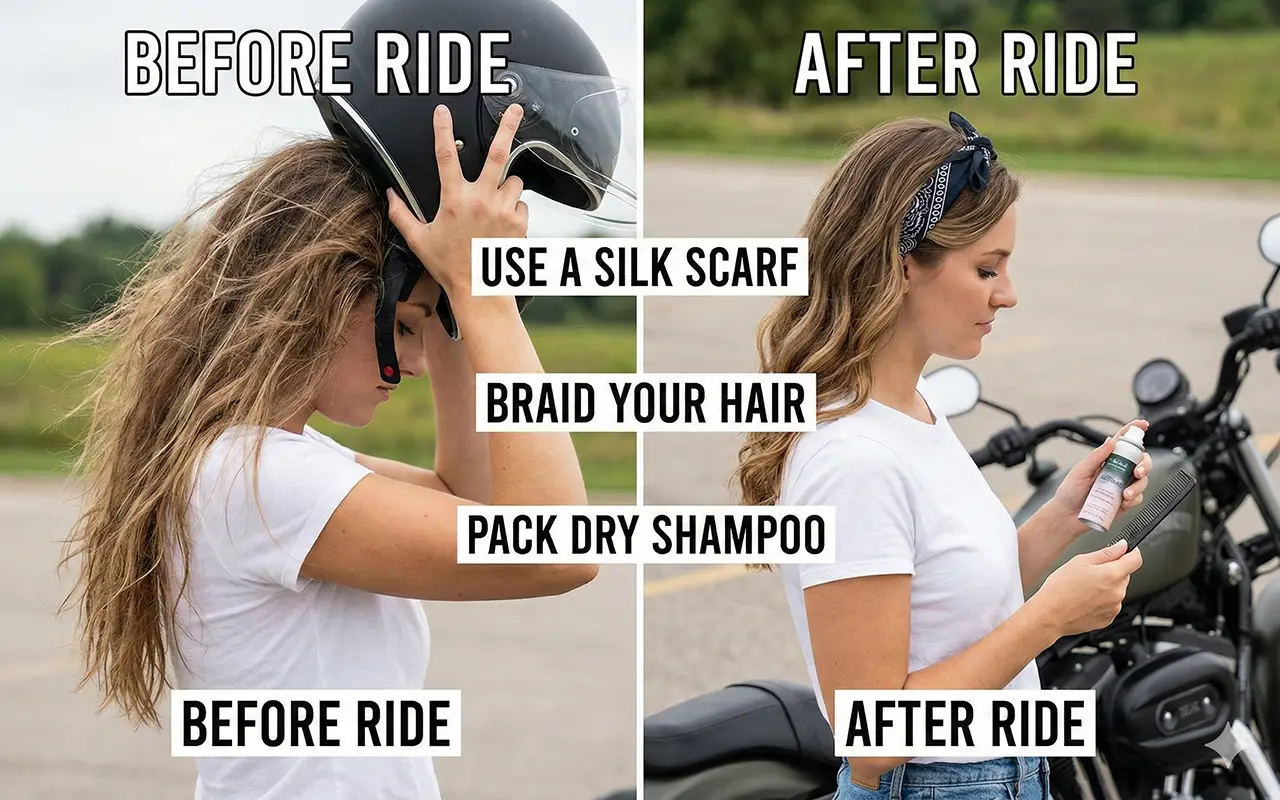
Dry shampoo before riding: This seems counterintuitive, but applying a small amount of dry shampoo to your roots before putting on your helmet creates a protective barrier that absorbs the oils and moisture your scalp produces during the ride. Use a light hand—too much will create buildup that looks worse than helmet hair.
Leave-in conditioner for the ends: If you have medium to long hair, apply a small amount of leave-in conditioner to the ends (not the roots) before riding. This reduces friction between hair strands and prevents the tangling that often occurs during rides, particularly with Full Face vs. Modular vs. Open Face Helmets that have different interior shapes.
Anti-static spray: A light mist of anti-static spray on your hair and even on the helmet liner itself can dramatically reduce that post-ride “stuck in a light socket” appearance. I keep a travel-size bottle in my tank bag for mid-ride touch-ups on long trips.
Timing Your Hair Washing
This might sound odd, but when you wash your hair relative to when you ride matters significantly. Freshly washed hair (within 2-3 hours) is more prone to helmet hair because it lacks the natural oils that provide structure and memory. Hair that was washed the previous evening typically performs better under a helmet—it has enough natural oil to maintain body but isn’t greasy.
If you must ride with freshly washed hair, use a volumizing mousse at the roots and ensure your hair is completely dry. Even slightly damp hair will flatten dramatically under helmet compression and won’t recover without rewashing.
Helmet Selection and Modification for Hair-Friendly Riding
Not all helmets are created equal when it comes to preserving your hairstyle. While safety must always be the primary consideration—as detailed in our coverage of Helmet Safety Ratings Explained—certain design features can minimize hair disruption.
Helmet Shape and Interior Design
The internal shape of your helmet significantly impacts how it affects your hair. Helmets designed for round head shapes tend to create more uniform compression, which paradoxically can be better for hair because the pressure is distributed evenly rather than concentrated in specific areas. If you’re choosing between options in guides like best motorcycle helmet for big hair, pay attention to the interior volume and shape.
Modern helmets increasingly feature removable and washable liners—a feature we discuss extensively in our article on How to Wash Your Motorcycle Helmet Liner. Beyond hygiene benefits, these removable liners allow you to modify the interior for better hair accommodation. Some riders with particularly challenging hair situations have successfully installed custom silk or satin liner covers that reduce friction and static.
Weight Matters More Than You Think
Heavier helmets create more pressure points and require more neck muscle engagement, which increases perspiration and heat—both enemies of good hair. This is where premium materials shine. The helmets featured in our best lightweight carbon fiber helmet roundup typically weigh 200-400 grams less than equivalent polycarbonate models. That weight reduction translates to less compression force and reduced perspiration, both of which help preserve your hairstyle.
The material comparison in our Carbon Fiber vs. Polycarbonate Helmets article reveals that carbon fiber helmets also typically feature more sophisticated ventilation systems, further reducing the heat and moisture that contribute to helmet hair.
Ventilation: The Unsung Hero
Exceptional ventilation does more than keep you comfortable—it actively prevents helmet hair by reducing the moisture and heat that cause your hair to mat and lose structure. When evaluating helmets, look for designs with multiple intake vents at the forehead and crown, plus effective exhaust vents at the rear. The airflow should create a through-draft that pulls heat away from your scalp.
During testing sessions for various helmet reviews, I’ve measured temperature differences of up to 8°C between well-ventilated and poorly ventilated helmets in identical conditions. That temperature difference directly correlates with scalp perspiration and, consequently, hair condition after the ride.
The Art of Securing Long Hair
If you have hair longer than shoulder-length, how you secure it before donning your helmet is absolutely critical to how it looks when you arrive at your destination.
The Low, Loose Braid: Your Best Friend
After testing every conceivable method over hundreds of rides, I can definitively state that the low, loose braid is the superior solution for long hair. Here’s the technique: Gather your hair at the nape of your neck—not at the base of your skull where the helmet will create pressure. Create a loose three-strand braid, securing it with a soft fabric hair tie (never rubber bands, which create kinks). The braid should be loose enough that you can easily slide two fingers through any section.
This method works because it keeps hair organized and prevents tangling while avoiding the pressure points that ponytails create. When you remove your helmet and unbraid your hair, you’ll have gentle waves rather than a rat’s nest or a distinctive ponytail bump.
The Helmet-Compatible Bun
For very long or very thick hair, even a low braid might create bulk that interferes with helmet fit. The solution is what I call the “helmet-compatible bun.” Create a low ponytail at the nape of your neck, then twist the length loosely and coil it into a flat bun that sits below the helmet’s lower edge. Secure it with bobby pins (not a clip, which creates pressure points). This keeps the bulk below the helmet’s contact area while still controlling your hair.
This technique works particularly well with Best Motorcycle Modular Helmets, which typically have a slightly different interior shape that accommodates low-positioned hair arrangements better than traditional full-face designs.
What Never to Do
Avoid these common mistakes that guarantee helmet hair disaster: Never use metal clips or hard plastic accessories—they create painful pressure points and distinctive dents in your hair. Never create a high ponytail or bun at the crown or back of your head where the helmet makes primary contact. Never use excessive amounts of hairspray or gel before riding—these products will essentially glue your hair into whatever compressed shape the helmet creates. And never, ever ride with wet or even damp hair unless you want to arrive looking like you stuck your finger in an electrical socket.
During the Ride: Active Hair Management
How to keep your hair looking good after a ride isn’t just about preparation—what happens during the ride matters too, particularly on longer journeys.
Strategic Stop Planning
On rides longer than 45 minutes, plan stops not just for fuel and rest, but for hair intervention. Remove your helmet every 45-60 minutes if possible, even if just for two or three minutes. This allows your hair to partially recover its natural position and lets your scalp breathe, reducing the moisture buildup that causes matting.
During these stops, run your fingers through your hair (don’t brush or comb yet—that comes later), and if you have long hair, redo your braid or bun. This “reset” prevents your hair from setting too firmly into the compressed helmet-hair position.
Managing Helmet Interior Moisture
Carry a small microfiber cloth in your jacket pocket. During stops, wipe down the interior of your helmet, particularly around the forehead area where moisture accumulates. This simple step removes the moisture that would otherwise transfer back to your hair when you put the helmet back on. Regular maintenance like this also extends helmet liner life, as discussed in our guide on When to Replace Your Motorcycle Helmet.
Adjusting Ventilation Throughout the Ride
Don’t just set your helmet vents and forget them. Actively manage ventilation throughout your ride based on conditions. In stop-and-go traffic, open all vents fully to maximize airflow despite low speeds. On highways, you can often close some vents as speed-generated airflow provides sufficient cooling. In cold weather, modulate vents to maintain comfort while preventing excessive heat buildup—your hair doesn’t care if you’re cold; it only responds to moisture and heat at the scalp.
Post-Ride Hair Recovery Techniques
You’ve arrived at your destination. Now comes the critical moment: helmet removal and hair recovery. This is where technique separates those who look presentable from those who look like they lost a fight with a hedge trimmer.
The Proper Helmet Removal Technique
How you remove your helmet affects your hair almost as much as wearing it. Never yank your helmet off quickly—this creates maximum static and disruption. Instead, unfasten the chinstrap completely, then grasp the helmet at the sides (not the back) and lift slowly and steadily. As the helmet clears your head, use your free hand to smooth your hair downward, following the helmet’s path. This minimizes the upward lift that creates that characteristic “surprised” look.
If you have long hair that’s been braided or bunned, remove the helmet first, then immediately release your hair before it “sets” in the secured position. The longer you wait, the more pronounced any creases or bends will be.
The 60-Second Hair Revival Routine
I’ve developed a quick routine that works in any bathroom or even using a motorcycle mirror. First, flip your head upside down and run your fingers through your hair from roots to ends, gently shaking as you go. This restores volume and breaks up any matted sections. Stand upright and use your fingers (not a brush yet) to redistribute your hair into roughly its intended style.
Apply a small amount of dry shampoo to your roots, focusing on the areas that contact the helmet most—typically the crown and sides. Massage it in with your fingertips using circular motions. This absorbs excess oil and adds texture that creates the appearance of volume.
If you have a small travel brush, now is the time to use it, but brush gently from ends to roots, not roots to ends. This prevents pulling and breakage while working out any tangles. For the finishing touch, use a tiny amount of lightweight styling product—a texturizing spray or a small dab of pomade—to reshape your style.
The Emergency Kit Every Rider Should Carry
Based on years of testing, here’s what I keep in my motorcycle’s storage compartment for hair emergencies: a travel-size dry shampoo (the most important item), a small paddle brush with soft bristles, a compact mirror, a few bobby pins or soft hair ties, a travel-size anti-static spray, and a small container of lightweight styling product. This entire kit fits in a space smaller than a water bottle and has saved my appearance countless times.
For riders who frequently need to look professional immediately after arriving, consider keeping a full change of clothes and a complete hair kit at your destination. I know several commuters who maintain a “grooming station” in their office desk drawer with everything needed for a complete hair reset.
Advanced Solutions for Chronic Helmet Hair
For riders who commute daily or spend significant time on motorcycles, basic techniques might not be enough. Here are advanced solutions that address persistent helmet hair issues.
Silk and Satin Helmet Liners
Custom silk or satin helmet liners represent a game-changing solution for serious helmet hair sufferers. These smooth-surface liners dramatically reduce friction and static compared to standard foam and fabric liners. You can purchase pre-made versions designed for motorcycle helmets, or have one custom-made by a seamstress for about $30-40.
The installation is straightforward: remove your existing comfort liner (if possible), then either attach the silk liner with small pieces of velcro or simply place it loose inside the helmet. The silk moves with your hair rather than against it, preventing the friction that causes static and tangling. This solution is particularly effective for riders with fine or naturally static-prone hair.
Hair Treatments That Make a Difference
Certain professional hair treatments can make your hair more resistant to helmet-induced damage. Keratin treatments, while expensive ($150-400), smooth the hair cuticle and add structure that helps hair bounce back from compression. These treatments last 3-6 months and many riders report dramatically improved post-helmet hair appearance.
For a less expensive option, regular deep conditioning treatments (weekly or bi-weekly) strengthen hair and improve its elasticity, helping it recover more quickly from the compression and friction of helmet wear. Focus on treatments that add moisture without weighing hair down—lightweight, protein-based conditioners work best.
Strategic Haircuts for Riders
If you’re a daily rider, discuss your helmet situation with your stylist. Certain cuts are dramatically more helmet-friendly than others. Layered cuts generally perform better than blunt cuts because layers have natural movement that helps them recover from compression. Avoid styles that require precise placement of every strand—they’re fighting a losing battle against helmet physics.
For men, slightly longer styles (1-2 inches on top) paradoxically handle helmet wear better than very short cuts because they have enough length to reshape after helmet removal. The worst length is the awkward middle zone of about half an inch, which is long enough to get compressed but too short to style afterward.
Helmet Hair Solutions by Hair Type and Length
Different hair types require different approaches. Here’s a detailed breakdown based on specific hair characteristics.
Fine, Straight Hair
This hair type is most susceptible to helmet hair because it lacks natural volume and body. The key is creating texture before riding. Apply a volumizing mousse to damp hair, then blow-dry using your fingers to create lift at the roots. Don’t brush it smooth—you want slightly messy texture that will better survive helmet compression.
Consider a slightly shorter cut if you’re a frequent rider—chin-length or shorter styles recover more easily than longer fine hair. When choosing a helmet, prioritize lightweight options like those in our best lightweight carbon fiber helmet guide, as these create less compression force on fine hair.
Thick, Coarse Hair
Thick hair creates different challenges—primarily, fitting it comfortably inside a helmet without creating excessive pressure. The solution is ensuring you have a helmet with adequate interior volume. Some riders with very thick hair find that helmets designed for round head shapes provide more interior space than oval-shaped helmets.
For thick hair, the post-ride recovery is usually easier because the hair has natural body that helps it bounce back. The main issue is often a “dented” appearance where the helmet compressed specific areas. Address this by focusing your post-ride finger-combing on those compressed zones, using a bit of water or styling product to reshape them.
Curly and Textured Hair
Curly hair and helmet wear present unique challenges. The compression disrupts curl patterns, often creating a flattened top with frizzy, undefined curls at the ends. The solution requires protecting the curl structure during the ride.
Before riding, apply a leave-in conditioner or curl cream to define your curls, then use the “pineapple” method: gather all your hair loosely at the very top of your head (if the helmet allows) or create multiple loose twists pinned at the nape of your neck. After helmet removal, spritz your hair lightly with water mixed with a bit of leave-in conditioner, then scrunch to reactivate the curls.
Many riders with natural curls find that protective styles—braids, twists, or bantu knots—work best for regular riding. These styles maintain the hair’s health while preventing the single-curl disruption that makes post-helmet hair management difficult.
Color-Treated and Damaged Hair
Chemically treated hair is more fragile and susceptible to the friction and compression of helmet wear. If you have color-treated hair, prioritize hair health over styling. Use strengthening treatments regularly, and always apply a heat protectant product before riding (yes, even though you’re not using heat tools—the term “heat protectant” is misleading; these products actually protect against friction and environmental stress).
Consider scheduling your color treatments and riding schedule strategically. Freshly colored hair (within 48 hours) is more porous and fragile, making it more susceptible to helmet damage. If possible, avoid long rides immediately after coloring.
Gender-Specific Considerations and Solutions
While helmet hair affects all riders, men and women often face different specific challenges and have access to different solutions.
Solutions for Women Riders
Women typically have more styling options but also face higher appearance expectations in professional environments. The low braid technique mentioned earlier remains the gold standard for longer hair, but women with medium-length hair (shoulder to chin length) face the most difficult styling challenge.
For this length, consider the “twist and tuck” method: part your hair deeply to one side, twist the longer section loosely, and tuck it behind your ear before putting on your helmet. This creates an intentional asymmetric style that looks deliberate rather than accidental when you remove your helmet.
Many women riders also benefit from accessories. A silk or satin scarf worn over your hair before putting on the helmet (think 1950s style) can protect your hairstyle while adding a vintage aesthetic. Some riders incorporate this into their riding persona, making it a signature look.
For specific helmet recommendations that work particularly well for women riders, check our guide on Best full face motorcycle helmets for women, which considers both safety and interior design factors that affect hair.
Solutions for Men Riders
Men’s helmet hair solutions typically focus on quick recovery rather than prevention, as men’s hairstyles generally involve shorter hair with less elaborate styling. The key is having the right products immediately available.
A small amount of matte-finish styling clay or fiber kept in your jacket pocket allows for quick restyling after helmet removal. Apply it to slightly damp hands, work it through your hair, and reshape your style in about 15 seconds. Matte products are superior to gels or pomades because they don’t create the “wet” look that can appear greasy after helmet wear.
For men with very short hair (less than an inch), helmet hair is usually minimal, but you might experience the “hat line” effect—a visible line where the helmet compressed your hair. A quick fix: dampen your hands slightly, run them through your hair, and let it air-dry for two minutes. The slight moisture resets the hair’s position without requiring product.
Men with longer hair (past the ears) should follow the same principles as women regarding securing hair before riding, though the specific styles might differ. A low, small ponytail or man-bun positioned at the nape of the neck works well, avoiding the pressure points that traditional top-positioned buns create.
Seasonal Adjustments for Year-Round Riding
How to keep your hair looking good after a ride requires different strategies depending on the season and weather conditions.
Summer Riding and Hair Management
Summer presents the greatest challenge because heat and humidity create maximum perspiration and oil production. In hot weather, consider washing your hair in the morning but styling it minimally—the helmet and heat will disrupt any elaborate styling anyway.
Apply dry shampoo liberally before riding to absorb the inevitable sweat. During the ride, maximize ventilation by opening all helmet vents. If you’re riding in temperatures above 85°F (29°C), plan stops every 30-40 minutes to remove your helmet briefly and let your scalp breathe.
For summer commuting, some riders adopt a “destination styling” approach: arrive with inevitable helmet hair, then do a complete hair reset using the bathroom facilities at work. This requires keeping a full hair kit at your destination but produces better results than trying to preserve a hairstyle through summer heat and helmet compression.
Winter Riding Hair Strategies
Cold weather creates different challenges: static electricity increases dramatically, and the contrast between cold outside air and warm helmet interior creates condensation that dampens hair. Combat static by using leave-in conditioner before riding and anti-static spray after helmet removal.
The condensation issue is trickier. It occurs when warm, moist air from your breath and scalp meets the cold helmet shell, creating tiny water droplets that dampen your hair from the inside. The solution is maintaining airflow even in cold weather—keep at least some vents partially open to prevent moisture accumulation. Yes, you’ll be slightly colder, but your hair will thank you.
Winter is also when helmet liner hygiene becomes critical. The warm, moist environment inside a winter helmet creates ideal conditions for bacteria and odor, which can transfer to your hair. Regular liner washing, as detailed in our How to Wash Your Motorcycle Helmet Liner guide, is essential for both hygiene and hair health.
Rain Riding and Hair Protection
Riding in rain creates obvious hair challenges. Water infiltration around the helmet seal, humidity, and the need to wear rain gear that creates additional heat all conspire against your hairstyle. For rainy day riding, abandon any hope of maintaining a complex hairstyle—focus instead on damage prevention.
Apply a leave-in conditioner before riding to create a protective barrier against moisture. If you have long hair, secure it tightly (this is one situation where a tight braid is appropriate) to prevent water from penetrating and causing tangling. After riding in rain, don’t attempt to style your hair until it’s completely dry—styling wet or damp hair causes damage and the results won’t hold anyway.
Some riders keep a waterproof helmet cover in their luggage for unexpected rain. While primarily designed to keep the helmet dry when parked, these covers can also be worn over the helmet during light rain, providing an additional barrier against moisture infiltration.
Professional Commuting: Looking Boardroom-Ready After Your Ride
For riders who commute to professional environments where appearance matters, the stakes are higher. Here are strategies specifically for professional riders.
The Two-Helmet Strategy
Serious professional commuters sometimes employ a two-helmet strategy: a high-quality, properly fitted helmet for the actual ride, and a lighter, less compressive helmet for the final few miles to work. This approach is controversial—I don’t recommend compromising safety for appearance—but some riders use a quality modular helmet for the final approach, which can be partially opened at stoplights to let hair recover.
A more practical version of this strategy involves keeping a second helmet at work for lunch rides or short trips, while your primary commuting helmet stays in your office where you can access your full grooming kit.
The Office Hair Kit Essentials
Professional riders should maintain a comprehensive hair kit at their workplace. This goes beyond the basic emergency kit mentioned earlier. Include: a full-size bottle of dry shampoo, a quality brush or comb, a small hair dryer (critical for quick recovery), styling products appropriate to your hair type, a hand mirror for checking the back of your head, and possibly a small flat iron or curling iron for emergency restyling.
Some offices have shower facilities—if yours does, consider the nuclear option for important meeting days: pack your styling tools and products, ride to work with minimal hair concern, then shower and completely restyle your hair after arriving. This approach treats your ride as a workout rather than a commute, eliminating any attempt to preserve a hairstyle through the journey.
Strategic Meeting Scheduling
If your schedule allows, try to avoid critical meetings in the first 30 minutes after arriving. Hair continues to recover from helmet compression for 20-30 minutes after removal—the initial post-helmet appearance isn’t the final state. If you have an important presentation, arrive 45 minutes early, do your initial hair recovery routine, then let your hair naturally settle for 20 minutes before doing final styling touches.
Long-Distance Touring: Multi-Day Hair Management
Multi-day motorcycle tours present unique hair challenges. You’re wearing a helmet for extended periods daily, often without access to your full range of hair products and tools.
Packing the Right Products
For touring, pack travel-size versions of essential products, but prioritize differently than for daily riding. Dry shampoo becomes even more critical—it can extend the time between actual hair washing when facilities are limited. A leave-in conditioner serves double duty as both a styling product and hair protection. Pack a small, collapsible brush rather than a bulky full-size one.
Consider solid or powder products rather than liquids to save space and avoid leakage issues. Solid shampoo bars, for example, work well for touring and take up minimal space. Some riders also pack a small spray bottle that can be filled with water at stops—a light misting of water can revive hair between full washings.
Daily Hair Routines on Tour
On multi-day tours, establish a daily hair routine. Each morning, assess your hair’s condition and adjust your strategy. If your hair is getting progressively worse each day (common on tours), consider a mid-tour reset: find a hotel with good shower facilities, do a complete hair wash and deep conditioning treatment, then start fresh.
During daily riding, take advantage of every stop to remove your helmet briefly and let your hair recover. On a typical touring day with 6-8 hours of riding, you should be removing your helmet at least 6-8 times for gas, food, sightseeing, and rest stops. These brief recovery periods prevent your hair from setting into a severely compressed state.
Protective Styles for Extended Tours
For tours lasting more than 3-4 days, consider adopting a protective hairstyle that prioritizes hair health over daily appearance. For long hair, this might mean keeping it in tight French braids or cornrows for the entire riding portion of the day. These styles hold up incredibly well under a helmet and can often be worn for 2-3 days with minor touch-ups, saving you significant time and frustration on the road.
Another invaluable tool for the long-distance tourer is the seamless neck gaiter (often called a “Buff”). By pulling the gaiter up over your head like a hood before putting on your helmet, you create a barrier that keeps hair flat, clean, and static-free. It might not look fashionable during the transition, but when you pull it off at dinner, your hair will be smooth and manageable rather than a tangled, windblown disaster.
The Bottom Line: Don’t Let Vanity Park Your Bike
The fear of “helmet hair” should never be the reason you leave your motorcycle in the garage and take the car. Yes, riding a motorcycle requires some compromise with your appearance—you probably won’t arrive looking like you just stepped out of a salon chair. But with the right preparation, the correct products, and a few strategic techniques, you can absolutely arrive looking professional, put-together, and ready for your day.
Remember the core strategy: Prep, Protect, and Revive.
Prep your hair with the right cut and minimal product.
Protect it during the ride with smart securing methods and balaclavas
- Revive it immediately upon arrival with a quick, practiced routine.
That colleague I mentioned at the start of the article? She eventually mastered the art of the pre-ride braid and the post-ride dry shampoo blast. She’s still reviewing bikes, and while she still gets helmet hair, she now knows exactly how to fix it in under two minutes.
Your hair is resilient. It will recover. So put on that helmet, enjoy the ride, and worry about the rest when you get there.
Frequently Asked Questions About Helmet Hair
Does wearing a head sock or balaclava actually help with helmet hair?
Yes, but the material matters. A cotton balaclava might just flatten your hair further. However, a silk or satin head liner is excellent for reducing friction. It allows the helmet to slide on and off without pulling your hair strands, which significantly reduces static and tangles (the “rat’s nest” effect). It keeps your style smoother, even if it is slightly flatter.
Can I put my helmet on while my hair is still wet?
You should avoid this at all costs. Wet hair is more malleable than dry hair. If you put a helmet on wet hair, it will dry in the exact shape of the helmet liner, creating “hard” ridges and flat spots that are almost impossible to fix without re-washing your hair. Always dry your hair completely before riding.
What is the absolute best hairstyle for long hair under a helmet?
The “low, loose braid” is widely considered the gold standard. By braiding the hair low at the nape of the neck, you avoid pressure points on the back of your skull. The braid structure keeps hair organized and tangle-free, and when you undo it, it usually leaves you with nice, gentle waves rather than kinks.
Which hair products should I avoid before riding?
Avoid “setting” products like strong-hold hairspray, heavy gels, or sticky pomades. These products are designed to freeze hair in place. When the helmet compresses your hair, these products will “glue” it into that flat, compressed shape. Instead, use lightweight, flexible-hold products or texturizing sprays that allow for movement and reshaping.
How do I stop my hair from having static electricity after a ride?
Static is caused by friction between your hair and the helmet liner. The best quick fix is to carry a dryer sheet (the kind used for laundry) in your pocket and smooth it over your hair after the ride. Alternatively, a small travel-size bottle of anti-static spray or even a tiny amount of leave-in conditioner applied to dry ends can neutralize the charge.
Do expensive helmets cause less helmet hair?
Generally, yes, but not just because of the price tag. Premium helmets usually have better ventilation (which reduces sweat) and higher-quality, moisture-wicking liner fabrics (which reduce friction). Cheaper helmets often use scratchy synthetic materials that increase static and trap heat, both of which worsen helmet hair.
Is there a quick fix for the “helmet line” across my forehead?
That red line or indentation is caused by pressure on the skin. To fade it quickly, gently massage the area to stimulate blood flow. If your hair is flattened in a line there, dampen your fingers with a little water, rub the roots at the line vigorously, and let it air dry for a minute to lift the hair back up.