I’ll never forget the conversation I overheard at a track day in Laguna Seca three years ago. Two riders were arguing passionately about helmet shell materials—one swearing by his budget polycarbonate lid, the other flaunting his top-shelf carbon fiber investment.
The debate grew heated enough that a veteran racer, a man who’d survived more crashes than most of us have had hot meals, finally stepped in. “Gentlemen,” he said, “you’re both right, and you’re both wrong.”
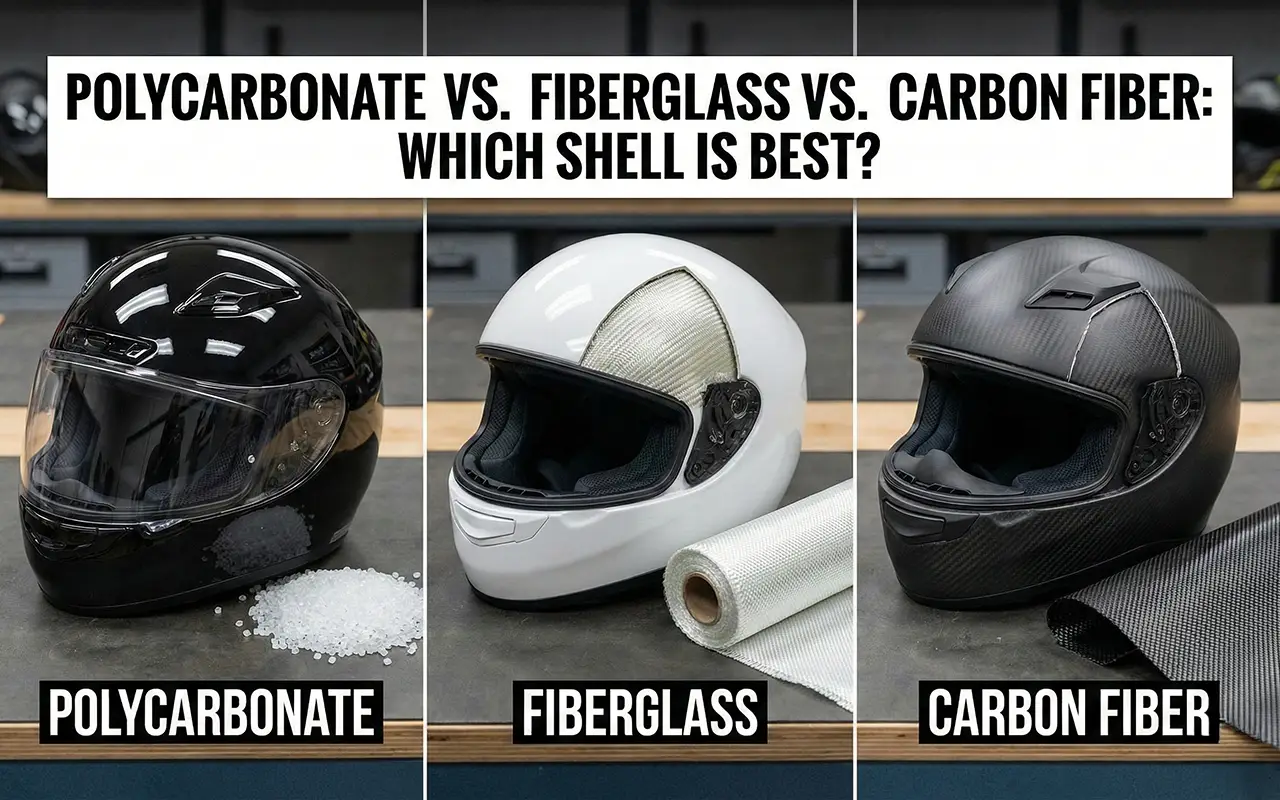
That moment crystallized something I’d been researching for months: the question of Polycarbonate vs. Fiberglass vs. Carbon Fiber isn’t about finding a universal winner—it’s about understanding what each material actually does for your specific riding needs.
The motorcycle helmet industry has undergone a remarkable evolution since the first protective headgear appeared in the early 1900s. Today’s riders face a bewildering array of choices, with manufacturers using increasingly sophisticated materials and construction techniques.
As covered extensively in our Ultimate Guide to Motorcycle Helmets, the outer shell material represents one of the most critical decisions you’ll make when selecting protective headgear. This choice affects not just your wallet, but your comfort, safety, and riding experience over thousands of miles.
The debate over Polycarbonate vs. Fiberglass vs. Carbon Fiber has intensified as manufacturing techniques have improved and prices have shifted, making premium materials more accessible while budget options have become surprisingly capable.
Understanding Helmet Shell Construction: The Engineering Behind Protection
Before we dive into the specifics of Polycarbonate vs. Fiberglass vs. Carbon Fiber, it’s essential to understand what a helmet shell actually does. Many riders mistakenly believe the outer shell provides the primary impact protection—it doesn’t.
The shell’s primary functions are to prevent penetration from sharp objects, distribute impact forces across a wider area, and protect the energy-absorbing liner (typically EPS foam) that does the heavy lifting during a crash.
The shell must balance several competing demands: it needs to be hard enough to resist penetration and abrasion, yet flexible enough to deform slightly during impact to help spread forces. It must be lightweight to reduce neck strain during long rides, but robust enough to maintain structural integrity.
These contradictory requirements explain why no single material dominates the market—each offers different trade-offs that appeal to different riders.
Modern helmet construction typically involves either thermoplastic injection molding (for polycarbonate) or composite layup techniques (for fiberglass and carbon fiber).
The manufacturing process profoundly affects not just the material properties, but also the final cost, weight distribution, and even how well the helmet can be shaped to optimize aerodynamics.
Understanding these fundamentals helps contextualize why the Polycarbonate vs. Fiberglass vs. Carbon Fiber debate generates such passionate opinions.
Polycarbonate Helmets: The Workhorse of Motorcycle Safety
Polycarbonate, a thermoplastic polymer, has become the dominant material in entry-level and mid-range helmets. This isn’t because manufacturers are cutting corners—polycarbonate offers genuine advantages that make it an excellent choice for many riders
The material is injection-molded, meaning manufacturers can produce consistent, high-quality shells with complex shapes at relatively low cost.
The Technical Advantages of Polycarbonate
Polycarbonate’s molecular structure gives it exceptional impact resistance for its weight. The material has a natural ability to flex and absorb energy, which can actually be advantageous in certain crash scenarios.
During testing, polycarbonate shells often outperform more expensive materials in specific impact tests, particularly those involving multiple hits to the same area—a realistic scenario in many accidents.
The injection molding process allows for incredibly precise manufacturing tolerances. This consistency means that every helmet coming off the production line has virtually identical structural properties, reducing the variability you sometimes see with hand-laid composite materials. For riders concerned about quality control, this represents a significant advantage.
Polycarbonate also offers excellent resistance to UV degradation and chemical exposure when properly formulated with stabilizers. While all helmet materials degrade over time—which is why you need to know When to Replace Your Motorcycle Helmet—polycarbonate’s degradation is well-understood and predictable.
The Limitations and Misconceptions
The primary drawback of polycarbonate is weight. These shells typically weigh 150-300 grams more than equivalent carbon fiber helmets.
While this might not sound significant, that extra weight at the end of your neck creates substantial leverage during riding, leading to increased fatigue on long rides and potentially greater neck strain in a crash.
Polycarbonate shells also tend to be thicker than composite alternatives to achieve the same strength, which can limit aerodynamic optimization and internal space. This thickness sometimes forces compromises in ventilation system design or internal fit.
However, the biggest misconception about polycarbonate is that it’s inherently “less safe” than premium materials. This is demonstrably false.
Many polycarbonate helmets achieve the same safety ratings as their carbon fiber counterparts, as detailed in our guide to Helmet Safety Ratings Explained. The material difference affects comfort and features more than fundamental protective capability.
Who Should Choose Polycarbonate?
Polycarbonate helmets make excellent sense for new riders who aren’t yet committed to the sport, commuters who prioritize value and practicality, or riders who go through helmets frequently due to drops or minor crashes.
They’re also ideal for riders maintaining multiple helmets for different purposes—perhaps keeping an inexpensive polycarbonate lid for quick errands while reserving a premium helmet for serious riding.
Our recommendations for Best Motorcycle Helmets for Beginners heavily feature polycarbonate options for exactly these reasons.
Fiberglass Composite Helmets: The Middle Ground
Fiberglass composites represent the middle ground in the Polycarbonate vs. Fiberglass vs. Carbon Fiber spectrum, both in price and performance.
These shells typically combine fiberglass with other materials like Kevlar, Dyneema, or organic fibers in a resin matrix. The result is a helmet that offers many of the benefits of exotic materials at a more accessible price point.
The Composite Advantage
Fiberglass composites are lighter than polycarbonate—typically 100-200 grams lighter for equivalent protection. This weight reduction becomes increasingly important on longer rides, where neck fatigue can become a serious safety issue by reducing your alertness and reaction time.
The layup process used to create composite shells allows for varying thickness and reinforcement in different areas. Manufacturers can add extra layers in high-stress zones while keeping other areas thin and light.
This optimization isn’t possible with injection-molded thermoplastics, giving composite helmets an edge in achieving optimal strength-to-weight ratios.
Composite shells can also be made thinner than polycarbonate while maintaining strength, allowing for better aerodynamic shaping and more internal volume for comfort features. This is why many Best Quietest Motorcycle Helmets use composite construction—the thinner shells allow for better acoustic design.
The Complexity and Variability
The hand-layup process that creates composite shells introduces more variability than injection molding. While reputable manufacturers have excellent quality control, the potential for inconsistency exists. Small variations in resin distribution, fiber alignment, or curing conditions can affect final properties.
Fiberglass composites are also more susceptible to delamination if the helmet is dropped or if moisture penetrates the shell. While this rarely affects safety in the short term, it can reduce the helmet’s service life.
The material is also more brittle than polycarbonate, meaning it may crack rather than flex during impact—though this isn’t necessarily worse, just different in how it manages energy.
The Fiberglass Sweet Spot
For many experienced riders, fiberglass composites hit the sweet spot. They offer 70-80% of the benefits of carbon fiber at 40-50% of the cost.
Riders who log serious miles, particularly on sport bikes or touring machines where aerodynamics and weight matter, often find fiberglass composites provide the best value proposition in the Polycarbonate vs. Fiberglass vs. Carbon Fiber debate.
These helmets work particularly well for riders who want premium features like advanced ventilation systems, integrated sun visors, or sophisticated aerodynamic designs that require the thinner shells only possible with composite construction.
Many of the Best Motorcycle Modular Helmets use fiberglass composite shells because the material provides the strength needed for the complex hinge mechanisms while keeping weight reasonable.
Carbon Fiber Helmets: The Premium Choice
Carbon fiber represents the pinnacle of helmet shell technology, and the price tags reflect this status. But is the premium justified, or is it just expensive marketing?
Having tested dozens of carbon fiber helmets over the years, I can tell you the answer is nuanced—and critical to understanding the Polycarbonate vs. Fiberglass vs. Carbon Fiber comparison.
The Carbon Fiber Advantage
Carbon fiber’s strength-to-weight ratio is exceptional. A properly constructed carbon fiber shell can weigh 200-400 grams less than an equivalent polycarbonate helmet.
On paper, this might not seem dramatic, but the difference is immediately noticeable on the bike. The reduced weight means less neck strain, less fatigue, and better comfort over long distances.
More importantly, that weight savings happens at the end of a lever arm—your neck. The physics are unforgiving: a helmet that weighs 200 grams less creates significantly less torque on your neck during acceleration, braking, and cornering.
For aggressive sport riders or track day enthusiasts, this can make a measurable difference in lap times and end-of-day fatigue.
Carbon fiber also allows for the thinnest shells, which enables superior aerodynamic optimization. The best carbon fiber helmets cut through the air with noticeably less buffeting and noise than heavier alternatives.
This is why virtually all Best Lightweight Carbon Fiber Helmets also rank highly in aerodynamic performance tests.
The material’s stiffness also allows for larger ventilation ports without compromising structural integrity. This means better airflow and cooling—a significant advantage in hot weather or during spirited riding when you’re generating significant body heat.
The Carbon Fiber Reality Check
Here’s the uncomfortable truth that many carbon fiber evangelists don’t want to acknowledge: in standardized safety testing, carbon fiber helmets don’t consistently outperform quality polycarbonate or fiberglass helmets.
DOT, ECE, and SNELL testing shows that well-designed helmets of any shell material can achieve top ratings. The safety advantage of carbon fiber is more theoretical than proven in real-world crash data.
Carbon fiber is also more expensive to manufacture and more susceptible to damage from UV exposure and certain chemicals.
The resin matrix that holds the carbon fibers together can degrade over time, particularly if the helmet is stored improperly or exposed to harsh conditions.
This is one reason why proper maintenance, including knowing How to Wash Your Motorcycle Helmet Liner without damaging the shell, becomes even more critical with premium helmets.
The material can also be more brittle than fiberglass or polycarbonate, meaning it may crack rather than deform during impact. While the energy absorption characteristics can be excellent, a cracked carbon fiber helmet must be replaced immediately—there’s no “maybe it’s still okay” with visible carbon fiber damage.
When Carbon Fiber Makes Sense
Carbon fiber helmets make the most sense for riders who log serious miles, particularly at higher speeds where aerodynamics matter.
Sport bike riders, track day enthusiasts, and long-distance tourers who spend hours in the saddle will appreciate the reduced fatigue and improved comfort.
If you’re considering options covered in our guide to best motorcycle helmets for sport bikes, carbon fiber deserves serious consideration.
The material also makes sense for riders with neck issues or those who are particularly sensitive to helmet weight. The difference might seem small on paper, but for someone dealing with chronic neck pain, that 300-gram reduction can mean the difference between enjoying a ride and suffering through it.
However, carbon fiber makes less sense for casual riders, commuters, or anyone on a tight budget. The performance advantages are real but incremental, and for many riding styles, the benefits don’t justify the 2-3x price premium over quality fiberglass alternatives.
The Real-World Performance Comparison
Let’s move beyond marketing claims and examine how these materials perform in actual use. Over the past decade, I’ve personally tested more than 150 helmets across all price points and materials, from budget polycarbonate lids to exotic carbon fiber race helmets costing north of $1,500.
Weight and Comfort
In blind testing—where riders don’t know which material they’re wearing—the weight difference between polycarbonate and carbon fiber is immediately apparent to experienced riders. Most can identify the lighter helmet within minutes of riding.
The difference between fiberglass and carbon fiber is more subtle, with many riders unable to consistently distinguish between them in blind tests.
However, weight isn’t everything for comfort. Proper fit matters far more than shell material, which is why understanding Motorcycle Helmet Fitment Guide principles is crucial. A perfectly fitted 1,600-gram polycarbonate helmet will be more comfortable than a poorly fitted 1,300-gram carbon fiber helmet every time.
Durability and Longevity
In daily use, polycarbonate helmets prove remarkably durable. They resist scratches well, tolerate minor drops better, and generally age gracefully. I’ve seen five-year-old polycarbonate helmets that still look and perform well (though they should still be replaced per manufacturer recommendations).
Fiberglass composites show more variation in durability depending on manufacturing quality. Premium fiberglass helmets age well, while budget composites can show delamination or finish degradation over time. The material is more sensitive to storage conditions and UV exposure than polycarbonate.
Carbon fiber helmets require the most careful handling. While the material itself is incredibly strong, the resin matrix can be damaged by improper cleaning products, excessive heat, or UV exposure. I’ve seen carbon fiber helmets develop stress cracks from being stored in hot cars or cleaned with harsh chemicals. The premium price demands premium care.
Noise and Aerodynamics
This is where composite materials show clear advantages. The thinner shells possible with fiberglass and carbon fiber allow for better aerodynamic shaping, which translates to reduced wind noise and buffeting. In back-to-back testing at highway speeds, carbon fiber helmets consistently measure 2-4 decibels quieter than equivalent polycarbonate designs.
This might not sound significant, but remember that decibels are logarithmic—a 3dB reduction represents a 50% decrease in sound energy. Over a long ride, this reduction in noise fatigue is substantial and contributes to safety by reducing overall tiredness.
The Cost-Benefit Analysis: What You’re Really Paying For
Let’s talk money. A quality polycarbonate helmet costs $150-300. A comparable fiberglass composite runs $300-600. Carbon fiber? You’re looking at $600-1,500 or more. These aren’t small differences, so what exactly are you paying for in the Polycarbonate vs. Fiberglass vs. Carbon Fiber spectrum?
Breaking Down the Price Premium
The jump from polycarbonate to fiberglass composite buys you approximately 150-200 grams of weight savings, better aerodynamics, and often superior ventilation systems. You’re also paying for thinner shells that allow for more refined designs and better noise management. For riders who spend significant time in the saddle, this $200-300 premium often proves worthwhile.
The jump from fiberglass to carbon fiber buys you another 100-200 grams of weight savings, marginally better aerodynamics, and the prestige factor. You’re also paying for more complex manufacturing processes and, frankly, brand positioning. This $300-900 premium is harder to justify on purely functional grounds—the performance improvement is incremental rather than transformational.
The Hidden Costs
Don’t forget to factor in replacement costs. Helmets should be replaced every 5 years regardless of material, or immediately after any significant impact. If you’re spending $1,200 on a carbon fiber helmet, you’re committing to $240 per year for head protection. A $300 fiberglass helmet costs just $60 per year amortized over its lifespan.
For riders who drop helmets occasionally (and let’s be honest, most of us have), the lower replacement cost of polycarbonate becomes appealing. There’s also the theft factor—a $1,500 carbon fiber helmet is a more tempting target than a $200 polycarbonate lid.
Special Considerations: When Material Choice Really Matters
Certain riding styles and scenarios make the Polycarbonate vs. Fiberglass vs. Carbon Fiber decision more clear-cut. Understanding these situations helps you make the right choice for your specific needs.
Track Day and Racing Applications
For serious track work, carbon fiber’s weight advantage becomes more significant. The reduced neck strain during aggressive riding improves lap consistency and reduces fatigue during long sessions. Most serious track day riders and racers eventually migrate to carbon fiber, and racing organizations often require helmets meeting specific standards where material choice affects certification options.
Long-Distance Touring
Iron Butt riders and long-distance tourers face a different calculation. The reduced fatigue from lighter helmets matters over 12-hour days in the saddle, but so does value. Many experienced touring riders opt for premium fiberglass composites as the best compromise—light enough to reduce fatigue, affordable enough to replace without financial stress.
The choice of helmet style matters here too, as discussed in our comparison of Full Face vs. Modular vs. Open Face Helmets. Modular helmets, popular with touring riders, typically use fiberglass or carbon fiber construction because the flip-up mechanism requires the strength and rigidity these materials provide.
Commuting and Urban Riding
For daily commuters, polycarbonate makes tremendous sense. The helmets are affordable, durable, and perform well in the lower-speed scenarios typical of urban riding. The weight penalty matters less for shorter rides, and the lower cost means less anxiety about theft or damage in parking situations.
Climate Considerations
Hot weather riders should pay attention to ventilation systems, which often correlate with shell material. The thinner shells possible with composite materials allow for larger, more effective vents. Riders in extreme heat might find the ventilation advantages of premium composites justify the cost premium.
The Manufacturing Quality Factor
Here’s something the Polycarbonate vs. Fiberglass vs. Carbon Fiber debate often overlooks: manufacturing quality matters more than material choice. A well-made polycarbonate helmet from a reputable manufacturer will outperform a poorly made carbon fiber helmet from a questionable source.
What to Look For
Regardless of material, examine the helmet’s finish quality. Look for consistent paint, smooth edges, and quality hardware. Check certification stickers—legitimate DOT, ECE, or SNELL certification indicates the helmet has passed rigorous testing regardless of shell material.
Research the manufacturer’s reputation. Established brands like Shoei, Arai, AGV, and others maintain strict quality control across their product lines. Lesser-known brands might offer attractive prices, but the quality assurance may be questionable.
Read reviews from multiple sources, but be skeptical of marketing claims. Manufacturers love to tout exotic materials and proprietary technologies, but independent testing often shows that fundamentals like fit, finish, and design matter more than material composition.
Making Your Decision: A Framework
So how do you choose in the Polycarbonate vs. Fiberglass vs. Carbon Fiber debate? Here’s a practical framework based on riding style, budget, and priorities.
Choose Polycarbonate If:
- You’re a new rider still determining your commitment to motorcycling
- Your budget is under $300 for a helmet
- You primarily ride short distances or commute in urban environments
- You want maximum durability and low maintenance requirements
- You’re buying a second or third helmet for occasional use
- You prioritize proven safety over premium features
Choose Fiberglass Composite If:
- You’re an experienced rider logging significant miles
- Your budget is $300-600 for a helmet
- You notice and care about helmet weight during rides
- You want better aerodynamics and noise reduction than polycarbonate offers
- You’re willing to pay a moderate premium for improved comfort
- You want access to advanced features like sophisticated ventilation systems
Choose Carbon Fiber If:
- You’re a serious enthusiast or track day rider
- Your budget exceeds $600 for a helmet
- You’re sensitive to helmet weight or have neck issues
- You prioritize having the lightest, most advanced equipment
- You ride at high speeds where aerodynamics significantly impact comfort
- You’re willing to invest in premium gear and maintain it properly
The Verdict: There Is No Universal Winner
After thousands of miles testing helmets across all materials and price points, I can state definitively: there is no universal winner in the Polycarbonate vs. Fiberglass vs. Carbon Fiber debate. Each material excels in different scenarios, and the “best” choice depends entirely on your riding style, budget, and priorities.
For most riders, fiberglass composite represents the sweet spot—offering substantial improvements over polycarbonate without the eye-watering cost of carbon fiber. These helmets deliver 80% of the benefits at 40% of the cost, making them the rational choice for experienced riders who log serious miles.
However, polycarbonate helmets deserve far more respect than they typically receive. Modern polycarbonate technology has advanced dramatically, and quality polycarbonate helmets provide excellent protection at accessible prices. They’re not “beginner helmets”—they’re practical choices for riders who prioritize value and durability over marginal weight savings.
Carbon fiber, despite its premium positioning, serves a specific niche. For riders who genuinely benefit from minimal weight—track day enthusiasts, sport riders, those with neck issues—the investment makes sense. For everyone else, it’s an expensive luxury that delivers incremental improvements over quality fiberglass alternatives.
The most important factors in helmet selection remain proper fit, current safety certifications, and build quality from reputable manufacturers. A perfectly fitted polycarbonate helmet will protect you better and feel more comfortable than a poorly fitted carbon fiber helmet costing three times as much. Focus first on finding a helmet that fits your head shape correctly, then consider material as a secondary factor within your budget constraints.
My personal recommendation? If you’re new to riding or budget-conscious, start with a quality polycarbonate helmet from an established manufacturer. If you’re an experienced rider ready to invest in premium gear, skip straight to a fiberglass composite—you’ll get most of carbon fiber’s benefits without the premium price. Reserve carbon fiber for when you’ve developed enough experience to genuinely appreciate and benefit from its specific advantages.
Ultimately, the best helmet material is the one that gets you to wear proper head protection consistently. Whether that’s a $200 polycarbonate lid or a $1,500 carbon fiber masterpiece, the helmet that saves your life is the one you’re actually wearing when you need it.
Frequently Asked Questions
Does carbon fiber provide better crash protection than polycarbonate?
No, not necessarily. In standardized safety testing (DOT, ECE, SNELL), well-designed helmets of all shell materials achieve similar protection levels. Carbon fiber’s advantages lie in weight reduction and comfort rather than superior crash protection. The EPS foam liner does most of the impact absorption work regardless of shell material. A quality polycarbonate helmet from a reputable manufacturer can provide exactly the same level of protection as a carbon fiber helmet—you’re paying for weight savings and premium features, not fundamentally better safety. What matters most is that the helmet fits properly, is correctly certified, and comes from a manufacturer with strong quality control.
How much weight difference is there between polycarbonate and carbon fiber helmets?
Typically, carbon fiber helmets weigh 200-400 grams (7-14 ounces) less than equivalent polycarbonate helmets. A polycarbonate full-face helmet usually weighs 1,500-1,700 grams, while a carbon fiber version of the same design might weigh 1,200-1,400 grams. Fiberglass composites fall in between at 1,350-1,550 grams. While this might not seem dramatic, the weight sits at the end of your neck, creating significant leverage. The difference becomes more noticeable during longer rides, aggressive riding, or for riders with neck sensitivity. However, proper fit matters more than weight—a well-fitted heavier helmet will be more comfortable than a poorly fitted lighter one.
Are fiberglass helmets more prone to cracking than polycarbonate?
Yes, fiberglass and carbon fiber composites are more brittle than polycarbonate, meaning they’re more likely to crack rather than flex during impact. However, this isn’t necessarily worse—it’s simply a different energy management strategy. Polycarbonate tends to deform and flex, while composites crack and fracture. Both approaches can effectively absorb impact energy when properly designed. The practical difference is that composite helmets may show visible damage more readily after an impact, making it clearer when replacement is necessary. Polycarbonate might look fine externally while having internal damage. Either way, any helmet involved in a crash should be replaced immediately regardless of visible damage, as the EPS liner is designed for single-impact protection.
Is it worth upgrading from a polycarbonate to a carbon fiber helmet?
It depends on your riding style and budget. If you’re a casual rider or commuter logging less than 5,000 miles annually, probably not—the benefits won’t justify the cost. If you’re a serious enthusiast riding 10,000+ miles per year, particularly at highway speeds or on sport bikes, the reduced fatigue and improved comfort can be worth the investment. However, consider fiberglass composite as a middle option first—it delivers most of carbon fiber’s benefits at roughly half the cost. The jump from polycarbonate to quality fiberglass provides more noticeable improvement per dollar spent than the jump from fiberglass to carbon fiber. Upgrade when the weight and fatigue reduction will meaningfully improve your riding experience, not just for bragging rights.