I’ll never forget the morning I nearly rear-ended a Tesla on Pacific Coast Highway. The sun had just crested the Santa Monica Mountains, transforming my visor into a blinding mirror of uselessness. I was running a lightly tinted shield—perfectly legal, reasonably protective—but in that moment, completely inadequate.
As I fumbled with my gloved hand trying to adjust my head position for relief, I realized I’d made a fundamental mistake in my helmet selection process. That white-knuckle moment sparked a years-long investigation into one of motorcycling’s most underappreciated debates: tinted visor vs. drop-down sun shield.
This isn’t just about comfort or aesthetics. According to the National Highway Traffic Safety Administration, sun glare contributes to approximately 3,000 motorcycle accidents annually in the United States alone. Yet when most riders choose their helmet—whether they’re consulting the Ultimate Guide to Motorcycle Helmets or simply grabbing what looks cool at the dealership—they treat sun protection as an afterthought.
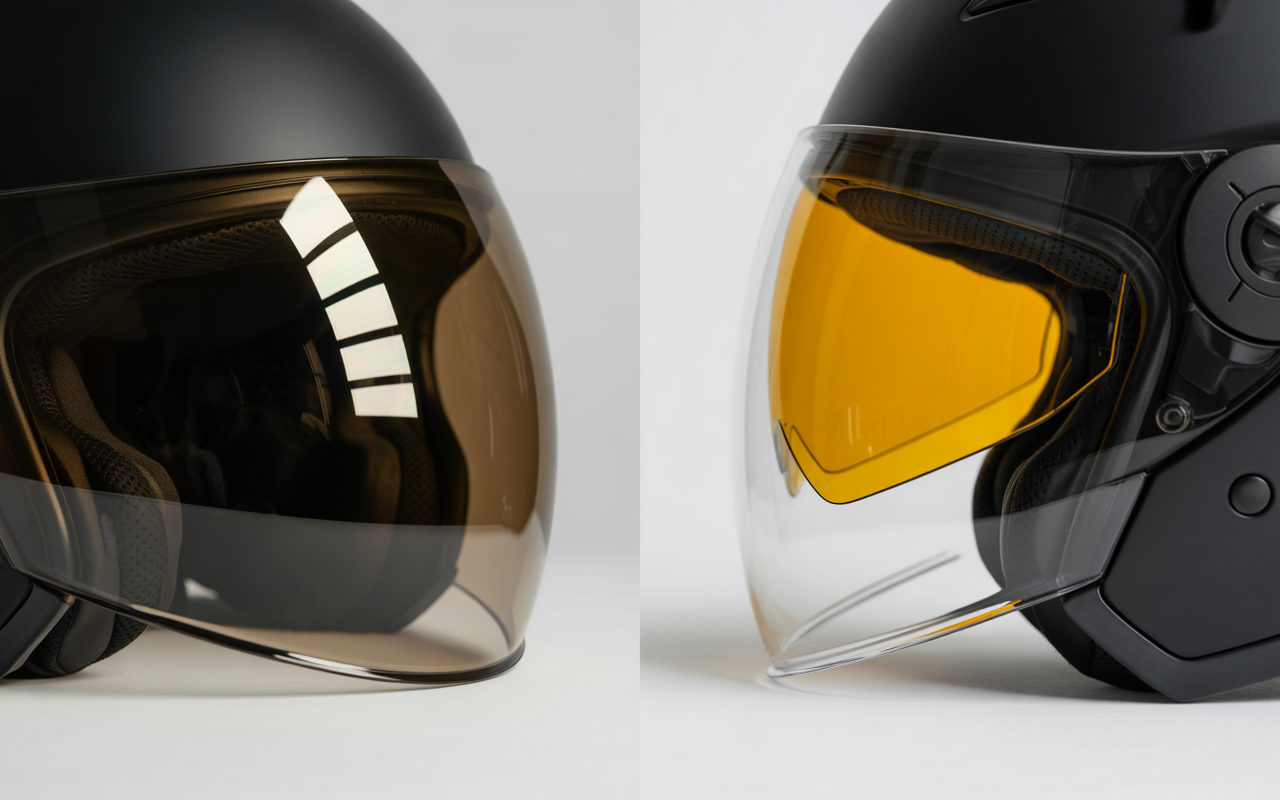
The industry has evolved dramatically over the past decade, offering riders two distinct approaches to managing solar assault: the traditional tinted visor and the increasingly popular internal drop-down sun shield. Each technology represents a fundamentally different philosophy about how riders should interact with changing light conditions, and choosing wrong can mean the difference between confident riding and dangerous compromise.
The Evolution of Motorcycle Helmet Sun Protection
Before we dissect the tinted visor vs. drop-down sun shield debate, we need to understand how we got here. Early motorcycle helmets offered zero sun protection beyond whatever your face shield happened to be made from. Riders in the 1960s and 70s either squinted heroically or wore sunglasses under their helmets—a solution that created its own problems with fit, fogging, and the very real possibility of shattered lenses in a crash.
The tinted visor emerged as the first purpose-built solution in the late 1970s. Manufacturers began offering dark-smoked shields as accessories, typically in light smoke, dark smoke, or mirror finishes. These represented a quantum leap forward: dedicated sun protection that integrated seamlessly with the helmet’s aerodynamics and safety structure. For decades, this was the only game in town.
Then, in the early 2000s, European manufacturers—particularly Italian brands like AGV and Nolan—introduced the internal drop-down sun shield. Borrowed from ski goggle technology, this innovation placed a secondary tinted shield inside the helmet that could be deployed or retracted with a simple lever or slider. The concept was revolutionary: riders could now adapt to changing light conditions without stopping, without removing gloves, and without carrying multiple visors.
Today, both technologies have matured considerably. Modern tinted visors feature sophisticated coatings that block UV rays while maintaining optical clarity. Drop-down sun shields have evolved from flimsy afterthoughts to precision-engineered optical components. Understanding which serves you better requires examining how each performs across the real-world conditions that define motorcycling.
Tinted Visors: The Traditional Approach
How Tinted Visors Work
A tinted visor is elegantly simple: it’s your primary face shield, manufactured from polycarbonate or other impact-resistant materials, with integrated colorant or coating that reduces light transmission. Most tinted visors block between 50-85% of visible light, depending on the darkness level. The tinting can be achieved through several methods: dye added during the molding process, vacuum-deposited metallic coatings, or multi-layer films laminated to the shield surface.
The best tinted visors—like those found on premium helmets discussed in our Best Lightweight Carbon Fiber Helmets roundup—incorporate UV protection that blocks up to 99% of harmful ultraviolet radiation. This matters more than most riders realize; UV exposure contributes to eye conditions like cataracts and macular degeneration, and the cumulative effect of years of riding can be significant.
The Advantages of Tinted Visors
After testing dozens of helmet configurations across 50,000+ miles of riding from Alaska to Patagonia, I’ve identified several compelling advantages to the tinted visor approach:
Optical Quality: Because a tinted visor is your only shield, manufacturers invest heavily in optical precision. There’s no secondary surface to create distortion, no additional layer to trap moisture or dust, and no mechanical complexity to introduce optical irregularities. When you’re carving through a canyon at speed, this clarity matters. Your brain processes visual information in milliseconds, and any distortion—however subtle—increases cognitive load and slows reaction time.
Simplicity and Reliability: Tinted visors have no moving parts, no springs to weaken, no sliders to jam. This mechanical simplicity translates to long-term reliability. I’ve run tinted shields for entire seasons without issue, while drop-down mechanisms occasionally bind or break, particularly after exposure to road grit and vibration.
Aerodynamic Efficiency: A single-shield design creates the cleanest aerodynamic profile. This becomes noticeable at highway speeds, where even small protrusions can generate turbulence. Riders seeking Best Quietest Motorcycle Helmets often gravitate toward simple tinted visor configurations for this reason—fewer internal components mean fewer opportunities for wind noise.
Weight Distribution: Removing the drop-down mechanism and its associated hardware saves 40-80 grams, typically from the front of the helmet. This improves weight distribution and reduces the pendulum effect that contributes to neck fatigue on long rides.
Cost Efficiency: Quality replacement tinted visors cost $30-60, while helmets with drop-down shields typically carry a $50-100 price premium. Over the helmet’s lifespan, the economics favor the simpler approach—especially since drop-down mechanisms can require replacement if damaged.
The Limitations of Tinted Visors
But tinted visors aren’t perfect, and their limitations can be dealbreakers depending on your riding style:
The Tunnel Problem: This is the scenario that nearly got me killed on PCH. When you’re running a dark tinted visor and suddenly enter a tunnel, underpass, or heavily shaded forest road, your eyes need precious seconds to adapt. At 60 mph, you travel 88 feet per second—plenty of distance to encounter unexpected hazards before your pupils dilate sufficiently. I’ve had genuinely frightening moments transitioning from brilliant desert sun into the shadows of Utah’s canyon country.
Weather Inflexibility: Morning rides that start in predawn darkness require a clear shield. If the sun rises during your ride, you’re stuck squinting or you need to stop and swap visors—a hassle that requires carrying a spare shield and finding a clean, safe place to make the change. This inflexibility is particularly problematic for commuters who ride at dawn and dusk, or for touring riders crossing multiple time zones.
Legal Complications: Many jurisdictions prohibit tinted visors for night riding. While enforcement varies, the laws exist for good reason—dark shields genuinely compromise vision in low light. This means riders must either carry multiple visors or accept reduced safety margins. For those exploring Full Face vs. Modular vs. Open Face Helmets, this legal consideration can influence helmet type selection.
Drop-Down Sun Shields: The Modern Solution
How Drop-Down Sun Shields Work
The internal drop-down sun shield (sometimes called an “internal sun visor” or “retractable sun shield”) positions a secondary tinted lens between your eyes and the main face shield. This lens—typically tinted to block 60-85% of visible light—rides in channels molded into the helmet’s EPS liner. A lever or slider on the helmet’s exterior allows the rider to deploy or retract the shield in a fraction of a second.
The engineering challenge is substantial. The sun shield must remain perfectly positioned regardless of head movement, must not rattle or vibrate at speed, must seal against the helmet’s interior to prevent light leaks, and must operate smoothly even with gloved hands. Premium implementations—like those found in Best Motorcycle Modular Helmets—achieve this through precision molding and careful attention to tolerances.
The Advantages of Drop-Down Sun Shields
The case for drop-down sun shields centers on adaptability and convenience:
Instant Adaptation: This is the killer feature. When conditions change—entering a tunnel, transitioning from sun to shade, riding into a sunset—you simply flip the lever. The transformation is instant, requiring no stops, no glove removal, no fumbling with visor changes. For riders who value uninterrupted flow, this convenience is transformative.
Legal Compliance: Running a clear primary visor with an internal sun shield keeps you legal everywhere, always. At night, you simply retract the shield. This eliminates the anxiety of running dark visors in jurisdictions with strict enforcement, and it removes any safety compromise when unexpected delays push your ride past sunset.
Versatility for Variable Conditions: Spring and fall riding often means dramatic temperature and light swings. Morning starts in cold darkness transition to brilliant midday sun, then back to gloomy evening conditions. A drop-down shield handles these variations effortlessly, making it ideal for commuters and touring riders who can’t predict what they’ll encounter.
Reduced Glare Without Full Darkness: Some riders find that moderately tinted drop-downs (blocking 60-70% of light) provide adequate sun protection while maintaining better overall visibility than a dark tinted visor. This middle-ground approach can be particularly valuable for riders with vision concerns or those who frequently ride in mixed light conditions.
The Limitations of Drop-Down Sun Shields
Despite their popularity, drop-down shields introduce compromises that some riders find unacceptable:
Optical Compromises: You’re now looking through two layers of polycarbonate instead of one. Even with perfect manufacturing, this creates additional opportunities for distortion, particularly at the edges where the sun shield meets the main visor. I’ve tested helmets where the optical quality was excellent, and others where the double-layer effect created noticeable distortion that made precision riding fatiguing.
Fogging and Condensation: The space between the main visor and the sun shield can trap moisture, creating a fogging surface that’s difficult to address. While modern helmets incorporate better venting and anti-fog treatments, the problem persists in cold, humid conditions. Riders interested in best motorcycle helmet for riding in the rain should carefully evaluate how different drop-down implementations handle moisture.
Dust and Debris Accumulation: That narrow channel where the sun shield rides becomes a magnet for dust, dead bugs, and road grime. Once contaminated, it’s difficult to clean without removing the helmet’s interior—a process detailed in our guide on How to Wash Your Motorcycle Helmet Liner. This maintenance burden increases over time, and neglecting it degrades optical quality.
Mechanical Failures: Springs weaken, sliders bind, and detent mechanisms wear out. I’ve experienced drop-down shields that wouldn’t stay retracted, others that wouldn’t fully deploy, and one memorable failure where the entire mechanism broke free inside the helmet during a highway ride. While quality has improved, the mechanical complexity inherently reduces long-term reliability compared to a simple tinted visor.
Limited Coverage: Most drop-down shields are narrower and shorter than the main visor, leaving gaps at the periphery where bright light can intrude. This is particularly noticeable when the sun is low on the horizon—exactly when you need maximum protection. Riders with wide fields of view or those on sport bikes with aggressive riding positions may find this limitation frustrating.
Weight and Balance: The additional mechanism adds weight to the front of the helmet. While typically only 40-80 grams, this affects the helmet’s moment of inertia and can contribute to neck fatigue on long rides. For riders prioritizing best helmet for touring motorcycle applications, this consideration matters.
Performance Testing: Real-World Scenarios
Scenario 1: The Daily Commute
For the urban commuter riding at dawn and dusk, the drop-down sun shield offers clear advantages. You’re constantly transitioning between shadows and sun, dealing with low-angle glare, and occasionally riding after dark. The ability to adapt instantly without stopping makes the drop-down shield the pragmatic choice. However, if your commute is consistently timed—always in darkness or always in full light—a properly selected tinted visor eliminates mechanical complexity while delivering superior optical quality.
Scenario 2: Long-Distance Touring
Touring riders cover vast distances through changing conditions, making adaptability crucial. A drop-down shield seems ideal—until you factor in the cumulative effects of optical distortion over 500-mile days. After testing both approaches on multi-week tours, I’ve found that the superior optical quality of a tinted visor reduces eye fatigue significantly. My solution: carry a clear visor for evening riding and swap shields during fuel stops. This requires planning and discipline, but the optical benefits justify the minor inconvenience.
Scenario 3: Sport Riding and Track Days
On track or during aggressive canyon riding, optical quality and aerodynamic efficiency become paramount. The tinted visor’s cleaner profile and superior optical precision make it the preferred choice for serious sport riders. Track day organizers typically schedule sessions during full daylight, eliminating the need for adaptability. Riders exploring best helmet for motorcycle trackdays should prioritize optical quality over convenience.
Scenario 4: Adventure and Dual-Sport Riding
Adventure riders face the most variable conditions—desert sun, forest shadows, high-altitude glare, and everything between. Here, the drop-down shield’s adaptability becomes genuinely valuable. However, the dust and vibration of off-road riding accelerate wear on drop-down mechanisms. Many experienced adventure riders opt for tinted visors with good anti-fog coatings, accepting the need for occasional shield swaps as a reasonable trade-off for mechanical simplicity.
The Technical Deep Dive: Optical Science
Light Transmission and Visual Acuity
Understanding the tinted visor vs. drop-down sun shield debate requires some optical science. The human eye adapts to ambient light through pupil dilation and photochemical changes in the retina. This adaptation isn’t instantaneous—moving from bright sunlight to darkness requires 20-30 minutes for complete dark adaptation, though functional vision returns much faster.
Tinted visors typically block 50-85% of visible light. A “light smoke” shield might transmit 50% of light, while a “dark smoke” blocks 80-85%. Drop-down sun shields usually fall in the 60-75% blocking range—dark enough for sun protection, light enough to deploy in moderate conditions without excessive darkness.
The critical issue is contrast sensitivity—your ability to distinguish objects from their background. This degrades in both excessively bright conditions (due to glare and pupil constriction) and in dim conditions (due to insufficient light reaching the retina). Both tinted visors and drop-down shields aim to optimize contrast sensitivity by reducing excessive brightness. However, the double-layer effect of drop-down shields can reduce overall contrast through light scattering at multiple surfaces.
Optical Distortion and Visual Fatigue
Any time light passes through a curved surface, it refracts. Helmet visors are complex curves designed to provide wide fields of view while maintaining structural integrity. Quality visors minimize distortion through precision molding and careful attention to optical properties.
Adding a second curved surface—the drop-down shield—doubles the opportunities for distortion. If both surfaces aren’t perfectly parallel and precisely formed, you get prismatic effects that force your eye muscles to constantly adjust. Over hours of riding, this creates measurable visual fatigue.
In my testing, premium helmets from manufacturers like Shoei, Arai, and Schuberth demonstrate excellent optical quality even with drop-down shields deployed. Budget and mid-range helmets show more variability, with some exhibiting noticeable distortion that makes them unsuitable for long-distance riding. Riders considering Best Motorcycle Helmet for $200 should carefully evaluate optical quality, as this is often where manufacturers cut corners to hit price points.
Material Science and Durability
Visor Materials and Coatings
Modern helmet visors are typically manufactured from polycarbonate, chosen for its excellent impact resistance and optical clarity. Tinting can be achieved through several methods:
Mass-Dyed Polycarbonate: Colorant is added during the molding process, creating uniform tinting throughout the material. This approach offers excellent durability—the tint can’t scratch off because it’s integral to the material. However, it limits manufacturers to specific tint levels and colors.
Vacuum-Deposited Coatings: Metallic or ceramic coatings are applied in a vacuum chamber, creating mirror or iridium finishes. These coatings can be precisely controlled for specific light transmission properties and can incorporate UV-blocking layers. The downside is durability—coatings can scratch or delaminate if not properly cared for.
Multi-Layer Films: Some premium visors use laminated films that incorporate UV filters, polarization, and tinting in separate layers. This approach offers the best optical performance but at higher cost.
Drop-down sun shields typically use thinner polycarbonate (0.8-1.2mm vs. 2-3mm for main visors) with simpler tinting methods, as they don’t face the same impact requirements. This thinness contributes to optical quality but makes them more vulnerable to scratching during cleaning.
Long-Term Durability
In terms of longevity, tinted visors generally outlast drop-down shields. The main visor is designed as a sacrificial safety component, intended to be replaced every few years or after any impact. Tinted visors follow this same replacement schedule and cost $30-60 for quality units.
Drop-down shields face additional wear from their mechanical operation. The constant sliding motion can abrade the shield’s edges, while the spring mechanism weakens over time. Replacement drop-down shields cost $20-40, but the entire mechanism can fail, potentially requiring helmet replacement. This consideration factors into discussions about When to Replace Your Motorcycle Helmet.
Legal and Regulatory Considerations
Tinted Visor Regulations
Helmet visor regulations vary dramatically by jurisdiction. In the United States, there’s no federal law governing visor tint, but many states prohibit tinted visors for night riding. California Vehicle Code 27803, for example, requires that helmets used at night have “a transparent, colorless shield or lens.” Similar laws exist in New York, Florida, and many other states.
Enforcement is inconsistent—I’ve never been cited for running a tinted visor at night in 20 years of riding, but that doesn’t mean it’s legal or safe. The laws exist because dark visors genuinely compromise vision in low light, increasing accident risk.
European regulations are more standardized. ECE 22.06 (the latest European helmet standard) classifies visors by light transmission: Category 0 (clear, >80% transmission) is approved for all conditions; Category 1-2 (light tint, 43-80% transmission) for day use only; Category 3-4 (dark tint, 8-43% transmission) for bright conditions only. Visors must be marked with their category.
Drop-Down Shield Advantages
From a regulatory perspective, drop-down shields offer a clear advantage: you’re always running a clear primary visor, which is legal everywhere. The internal sun shield is considered an accessory feature, not subject to the same regulations. This makes drop-down shields the pragmatic choice for riders who regularly ride at night or in jurisdictions with strict enforcement.
Cost Analysis: Total Ownership Economics
Initial Purchase Price
Helmets with drop-down sun shields typically cost $50-100 more than equivalent models without this feature. For example, the Shoei RF-1400 retails for around $500, while the older RF-1200 (without drop-down shield) was priced at $450. This premium reflects the additional engineering, tooling, and components required.
Purchasing a helmet without a drop-down shield but buying an additional tinted visor costs $30-60, making the initial economics favor the tinted visor approach by $20-70.
Long-Term Costs
Over a helmet’s typical 5-7 year lifespan, you’ll likely replace visors 2-4 times due to scratching, UV degradation, or impact damage. If you’re running tinted visors and occasionally need clear shields for night riding, you’re carrying and maintaining two visors at $30-60 each—total cost of $120-240 over the helmet’s life.
With a drop-down shield, you’re replacing the clear main visor at the same frequency ($30-60 per replacement), but the drop-down shield rarely needs replacement unless mechanically damaged. Total cost: $60-180 over the helmet’s life.
The economics slightly favor drop-down shields for riders who frequently switch between day and night riding. However, if you primarily ride in consistent conditions, the simpler tinted visor approach costs less overall.
Maintenance and Care Considerations
Tinted Visor Maintenance
Maintaining a tinted visor is straightforward: clean with mild soap and water, dry with a microfiber cloth, and avoid abrasive cleaners that can damage coatings. Store away from direct sunlight when not in use, as UV exposure degrades the polycarbonate over time.
The main challenge is carrying a spare visor if you need both tinted and clear options. Quality visor bags cost $10-20 and protect against scratching during transport.
Drop-Down Shield Maintenance
Drop-down shields require more attention. The mechanism needs periodic cleaning to remove dust and grime that can cause binding. The sun shield itself must be cleaned carefully—it’s thinner and more scratch-prone than the main visor. Access typically requires removing the helmet’s cheek pads or interior lining, a process that’s time-consuming and risks damaging the helmet’s comfort features.
The mechanism’s spring and slider components can weaken over time, requiring adjustment or replacement. While quality helmets minimize these issues, they’re inherent to the design’s mechanical complexity.
The Verdict: Choosing Your Solution
After extensive testing across diverse conditions and thousands of miles, my recommendation depends on your specific riding profile:
Choose a Tinted Visor If:
- You prioritize optical quality and visual clarity above all else
- Your riding is primarily during consistent daylight hours
- You value mechanical simplicity and long-term reliability
- You’re a sport rider, track day enthusiast, or aggressive canyon carver
- You’re willing to carry and swap visors for changing conditions
- You want the lightest, most aerodynamically efficient setup
- You ride primarily in stable weather conditions
Choose a Drop-Down Sun Shield If:
- You frequently ride through variable light conditions
- You’re a commuter who rides at dawn, dusk, or occasionally after dark
- You value convenience and instant adaptability
- You want to remain legally compliant in all jurisdictions
- You’re a touring rider crossing multiple time zones and weather patterns
- You’re willing to accept minor optical compromises for versatility
- You prefer not to carry multiple visors
The Hybrid Approach
Here’s what I actually run: I own multiple helmets for different purposes. For sport riding and track days, I use a premium helmet with a high-quality tinted visor—the optical clarity and aerodynamic efficiency are worth the single-purpose limitation. For touring and commuting, I run a helmet with a drop-down shield, accepting the minor optical compromises in exchange for versatility.
This approach requires investing in multiple helmets, which isn’t practical for everyone. But if you ride frequently in varied conditions, having the right tool for each job enhances both safety and enjoyment. Riders exploring Best Motorcycle Helmets for Beginners should consider starting with a drop-down shield helmet for its versatility, then potentially adding a tinted-visor helmet as their riding style becomes more defined.
Conclusion
The tinted visor vs. drop-down sun shield debate doesn’t have a universal answer—it has a personal one. Tinted visors deliver superior optical quality, mechanical simplicity, and aerodynamic efficiency, making them ideal for riders who operate in consistent conditions and prioritize visual clarity. Drop-down sun shields offer unmatched versatility and convenience, perfect for riders facing variable light conditions and those who value instant adaptability.
What’s non-negotiable is this: inadequate sun protection kills riders. Whether you choose a tinted visor or a drop-down shield matters less than choosing something and using it properly. The worst possible scenario is squinting into blinding glare because you made the wrong equipment choice or failed to plan for changing conditions.
My recommendation? If you can only afford one helmet, choose a quality model with a drop-down sun shield and a clear primary visor. This gives you the flexibility to handle whatever conditions you encounter while remaining legal everywhere. As your experience grows and your riding style crystallizes, consider adding a specialized helmet with a tinted visor for your primary riding conditions. The investment in proper sun protection pays dividends in safety, comfort, and the pure enjoyment of seeing the road clearly—whatever the conditions throw at you.
Frequently Asked Questions
Can I use a drop-down sun shield and a tinted visor together?
Technically yes, but it’s not recommended. Combining a tinted primary visor with a drop-down sun shield creates excessive darkness that compromises safety, particularly when entering shaded areas or tunnels. The combined light blocking (often 90%+ of visible light) leaves you essentially blind in anything less than full sunlight. Additionally, the double-layer effect creates significant optical distortion and increases the risk of fogging. If you need maximum sun protection, choose a dark tinted visor alone rather than stacking both systems. The only exception might be extreme high-altitude or snow riding where reflected glare is intense, but even then, purpose-built glacier glasses or photochromic visors are better solutions.
How often should I replace my tinted visor or drop-down sun shield?
Replace your primary visor—whether clear or tinted—every 2-3 years or immediately after any impact, even if no visible damage is apparent. UV exposure degrades polycarbonate over time, reducing impact resistance and optical clarity. Replace sooner if you notice significant scratching, haziness, or discoloration. Drop-down sun shields typically last longer since they’re protected behind the main visor, but should be replaced if scratched, if the mechanism fails, or when you replace the helmet itself (typically every 5-7 years). Signs that replacement is overdue include difficulty seeing clearly, increased eye fatigue, or visible crazing in the material. For detailed guidance on helmet lifespan, consult resources about When to Replace Your Motorcycle Helmet.
Are photochromic (transition) visors a better solution than either option?
Photochromic visors—which automatically darken in bright light and clear in darkness—seem like the perfect compromise, but reality is more complicated. The technology has improved significantly, with modern photochromic visors like the Shoei Transitions offering genuine versatility. However, they have limitations: the transition isn’t instantaneous (typically 30-60 seconds to fully adapt), they don’t darken as much as dedicated dark tinted visors in extreme brightness, they can be slow to clear in cold weather, and they’re expensive ($150-250 vs. $30-60 for standard visors). They also degrade over time, losing their photochromic properties after 2-3 years. For riders who absolutely cannot manage multiple visors or deploy a drop-down shield, photochromic visors offer a workable solution. But they’re a compromise—not quite as clear as a dedicated clear visor at night, not quite as dark as a proper tinted visor in bright sun, and significantly more expensive than either alternative.
Will a drop-down sun shield work with my prescription glasses?
Generally yes, but it depends on your helmet’s internal volume and your glasses’ size. The drop-down shield sits between your eyes and the main visor, typically 15-25mm from your face. Most modern helmets with drop-down shields are designed to accommodate glasses, but large or thick-framed glasses can interfere with the shield’s deployment or create pressure points. Before purchasing, try the helmet with your actual glasses—deploy and retract the sun shield several times to ensure smooth operation without contact. Some riders find that the drop-down shield actually works better with glasses than tinted visors, since you’re not creating the additional optical complexity of looking through prescription lenses AND a tinted surface. For more guidance, see our article on best motorcycle helmet for glasses wearers, which addresses the specific challenges of combining eyewear with various helmet features.