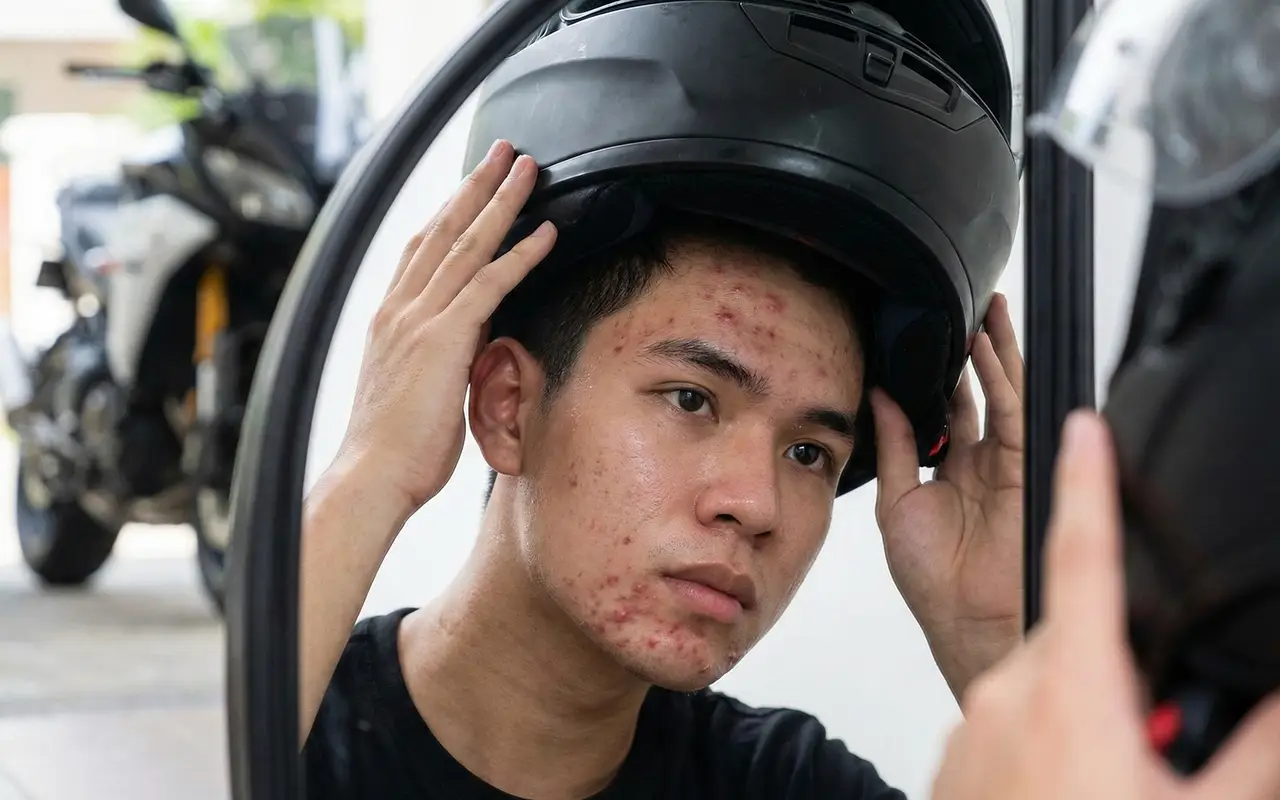
I still remember the first time I noticed it—a cluster of angry red bumps along my jawline after a particularly long summer ride through the Appalachians. At first, I blamed the heat, the sweat, maybe even the greasy diner breakfast I’d wolfed down that morning.
But when the breakouts kept appearing in the exact same spots where my helmet made contact with my skin, the pattern became impossible to ignore. I wasn’t alone in this discovery.
Talk to any rider who logs serious miles, and you’ll hear similar stories of “helmet acne”—those persistent breakouts that seem to appear exclusively on the chin, forehead, and jawline.
This phenomenon, clinically known as acne mechanica, has plagued motorcyclists since the dawn of modern helmet design. Unlike hormonal or cystic acne, helmet acne is triggered by a perfect storm of friction, pressure, heat, and bacteria—all concentrated in the areas where your helmet makes the most contact with your face.
As helmets have evolved to become more protective and aerodynamic (as detailed in our Ultimate Guide to Motorcycle Helmets), they’ve also become more form-fitting, which unfortunately means more sustained contact with your skin.
The problem has become so prevalent that dermatologists now regularly treat riders specifically for this condition, and the motorcycle community has developed an entire arsenal of prevention strategies.
Understanding how to prevent breakouts on your chin and forehead isn’t just about vanity—it’s about comfort, confidence, and maintaining healthy skin while pursuing the riding lifestyle we love.
The Science Behind Helmet Acne: Understanding the Enemy
Before we can effectively combat helmet acne, we need to understand exactly what’s happening beneath your skin when you strap on your lid.
Acne mechanica differs fundamentally from the acne most people experience during adolescence. While traditional acne is primarily driven by hormonal fluctuations and excess sebum production, helmet acne is a direct mechanical response to your riding gear.
When you wear a helmet, especially during extended rides or in hot weather, several factors converge to create the perfect breeding ground for breakouts. First, there’s friction—the constant rubbing of helmet padding against your skin.
This mechanical irritation causes minor trauma to your pores and hair follicles, triggering an inflammatory response. Your body interprets this friction as an injury and responds by increasing blood flow to the area, which can lead to swelling and redness.
Second, there’s occlusion—the blocking of your pores by the helmet’s close contact with your skin. Your face naturally produces sebum (oil) to protect and moisturize your skin. Under normal circumstances, this oil evaporates or is absorbed by the environment.
But when a helmet creates a seal against your face, that oil has nowhere to go. It accumulates on the skin’s surface and within your pores, mixing with dead skin cells, bacteria, and sweat to form comedones—the medical term for clogged pores that can develop into pimples.
Third, and perhaps most significantly, there’s the heat and humidity factor. The interior of a motorcycle helmet can reach temperatures significantly higher than the ambient air, especially during summer riding or in stop-and-go traffic.
This heat causes you to sweat, and that sweat becomes trapped against your skin by the helmet liner. The warm, moist environment is ideal for bacterial growth, particularly Propionibacterium acnes (P. acnes), the bacteria primarily responsible for inflammatory acne.
The areas most affected—the chin, forehead, and jawline—correspond directly to where helmet padding makes the firmest contact with your face. These are also areas where the helmet’s chin bar and brow padding create the tightest seal, trapping the most heat and moisture. Understanding this mechanical cause-and-effect relationship is crucial because it tells us exactly where to focus our prevention efforts.
Pre-Ride Preparation: Setting Your Skin Up for Success
The battle against helmet acne begins long before you twist the throttle. Your pre-ride skincare routine is your first line of defense, and getting it right can dramatically reduce your chances of developing breakouts.
Cleansing: The Foundation of Prevention
Start every ride with a clean face. This might seem obvious, but the type of cleansing matters enormously. Use a gentle, non-comedogenic facial cleanser that won’t strip your skin of its natural protective oils.
Harsh, drying cleansers might seem like a good idea for preventing oil buildup, but they actually trigger a rebound effect—your skin produces even more oil to compensate for what’s been stripped away.
Look for cleansers containing salicylic acid (0.5% to 2%) if you’re prone to breakouts. Salicylic acid is a beta-hydroxy acid that penetrates into pores to dissolve the debris that can lead to clogs.
It also has mild anti-inflammatory properties that can help prevent the redness and swelling associated with acne mechanica. Cleanse thoroughly but gently, paying special attention to your chin, jawline, and forehead—the areas that will be in direct contact with your helmet.
Timing matters too. Cleanse no more than 30 minutes before your ride. Cleansing too far in advance allows oil to accumulate again before you even put your helmet on, while cleansing immediately before riding can leave your skin slightly damp, which can exacerbate friction issues.
Moisturizing: The Protective Barrier
This is where many riders make a critical mistake—they skip moisturizer entirely, thinking that less product on their face means less chance of clogged pores.
The opposite is actually true. A lightweight, oil-free moisturizer creates a protective barrier between your skin and your helmet, reducing friction and preventing the direct transfer of bacteria and debris from the helmet liner to your pores.
Choose a gel-based or water-based moisturizer specifically labeled “non-comedogenic” and “oil-free.” These formulations provide hydration without adding excess oil to your skin.
Ingredients like hyaluronic acid are excellent because they draw moisture into the skin without leaving a greasy residue. Apply a thin, even layer and give it at least five minutes to fully absorb before putting on your helmet.
For riders with particularly sensitive or acne-prone skin, consider using a moisturizer that contains niacinamide (vitamin B3). Research has shown that niacinamide helps regulate sebum production, strengthens the skin’s barrier function, and has anti-inflammatory properties—all beneficial for preventing helmet acne.
Barrier Products and Anti-Chafing Solutions
For long-distance riders or those particularly prone to breakouts, specialized barrier products can make a significant difference. Anti-chafing balms designed for athletes, when applied to the chin and jawline, create a smooth, friction-reducing layer between your skin and helmet.
Look for products containing dimethicone or similar silicone-based ingredients that create a breathable but protective film.
Some riders swear by applying a thin layer of cornstarch-based powder to problem areas before riding. The powder absorbs excess moisture and reduces friction.
However, be cautious with this approach—too much powder can actually clog pores, and some powders contain ingredients that can exacerbate acne. If you choose this method, use sparingly and opt for products specifically designed for facial use.
Helmet Selection and Fit: Choosing the Right Gear
Not all helmets are created equal when it comes to preventing skin problems. Your choice of helmet style, materials, and fit can significantly impact your likelihood of developing helmet acne. This is one area where investing in quality gear pays dividends not just in safety, but in skin health.
Helmet Style Considerations
The type of helmet you wear affects how much contact it makes with your face and how much ventilation reaches your skin.
Full-face helmets, while offering the best protection (as explained in our guide to Full Face vs. Modular vs. Open Face Helmets), create the most occlusion and trap the most heat. However, this doesn’t mean you should sacrifice safety for skin health. Instead, focus on choosing a full-face helmet with superior ventilation systems.
Modern high-end helmets feature sophisticated airflow designs with multiple intake and exhaust vents that create a continuous flow of air through the helmet.
This air circulation helps evaporate sweat and reduces the temperature inside the helmet—both crucial factors in preventing acne mechanica. When shopping for a helmet, pay attention to ventilation specifications and read reviews specifically mentioning airflow and heat management.
Modular helmets can offer a compromise for urban riders who frequently stop. The ability to flip up the chin bar at stoplights allows trapped heat and moisture to escape, giving your skin periodic relief. However, ensure that any modular helmet you consider meets the same safety standards as traditional full-face designs.
The Critical Importance of Proper Fit
An ill-fitting helmet is one of the primary contributors to helmet acne. A helmet that’s too tight creates excessive pressure and friction, while one that’s too loose shifts during riding, causing repetitive rubbing against the same spots on your face. Getting the fit right is non-negotiable.
Our comprehensive Motorcycle Helmet Fitment Guide covers this in detail, but the key principle is that your helmet should be snug without being painfully tight.
When you put it on, it should feel firm against your cheeks and forehead, but you shouldn’t feel specific pressure points. If you can identify exactly where the helmet is touching your face because those spots feel compressed, the fit isn’t right.
Pay particular attention to the cheek pads and chin bar area. These are the most common sites for helmet acne, and they’re also the areas where fit problems are most apparent.
Many quality helmets come with interchangeable cheek pads in different thicknesses, allowing you to customize the fit. Don’t hesitate to experiment with different pad configurations to find the one that distributes pressure most evenly across your face.
Remember that helmet liners compress over time. A helmet that fits perfectly when new will become slightly looser after several months of regular use. This is normal and expected, but it means you should reassess fit periodically and consider replacing the liner when it becomes too compressed to maintain proper fit.
Material Matters: Shell and Liner Considerations
The materials your helmet is constructed from can influence your skin health in subtle but important ways. While the helmet shell material (whether carbon fiber or polycarbonate) doesn’t directly contact your skin, it affects the helmet’s weight, which in turn affects how much pressure the helmet exerts on your face and neck.
Lighter helmets reduce overall fatigue and minimize the downward pressure that can exacerbate friction and irritation.
Carbon fiber helmets, while more expensive, can weigh significantly less than their polycarbonate counterparts—sometimes by a pound or more. For riders logging long miles or dealing with persistent skin issues, this weight reduction can make a meaningful difference.
The liner material that does contact your skin is even more critical. Look for helmets with moisture-wicking, antimicrobial liners.
Modern technical fabrics designed for athletic wear have made their way into helmet construction, and they’re a game-changer for skin health. These fabrics actively pull moisture away from your skin and incorporate silver ions or other antimicrobial treatments that inhibit bacterial growth.
Some premium helmets feature removable and washable liners—a feature that’s invaluable for preventing helmet acne. The ability to regularly clean your liner (as detailed in our guide on how to wash your motorcycle helmet liner) means you can eliminate the buildup of oils, sweat, bacteria, and dead skin cells that contribute to breakouts.
During the Ride: Active Prevention Strategies
Even with perfect preparation and ideal gear, what you do during your ride significantly impacts your skin health. Long rides require active management strategies to minimize the conditions that lead to helmet acne.
Strategic Breaks and Helmet Removal
One of the most effective prevention strategies is also the simplest: take regular breaks and remove your helmet. During extended rides, aim to remove your helmet for at least five to ten minutes every hour or two. This allows trapped heat and moisture to dissipate, gives your skin a chance to breathe, and interrupts the continuous friction that contributes to mechanical acne.
When you remove your helmet, resist the urge to touch your face excessively. Your hands accumulate oils, bacteria, and road grime during riding, and transferring these to your face can introduce new sources of irritation and infection.
If you need to wipe sweat or adjust anything, use a clean tissue or a dedicated face towel that you’ve brought along specifically for this purpose.
Use these breaks to assess your skin condition. If you notice areas that feel particularly hot, sweaty, or irritated, those are the spots most likely to develop breakouts. Make a mental note and pay extra attention to cleaning those areas when you finish your ride.
Managing Sweat and Moisture
Sweat is inevitable during riding, especially in warm weather or during physically demanding rides like off-road or track days. The key is managing that moisture so it doesn’t sit against your skin for extended periods.
Some riders find success with thin, moisture-wicking balaclava or skull cap worn under the helmet. These garments, made from technical fabrics similar to athletic base layers, create a barrier between your skin and the helmet liner while actively pulling moisture away from your face. The balaclava absorbs sweat before it can saturate the helmet liner, and it’s much easier to wash a balaclava after each ride than to clean your entire helmet liner.
However, this approach requires careful consideration. Adding an extra layer means additional material in contact with your skin, which can increase occlusion if not done correctly.
Only use purpose-designed motorcycle balaclavas made from thin, breathable, antimicrobial fabrics. Avoid cotton or thick materials that will trap heat and moisture rather than wicking it away.
For riders in particularly hot climates or those prone to heavy sweating, consider helmets specifically designed for hot weather ventilation. Our guide to the best motorcycle helmets for hot weather covers options with maximum airflow and cooling features.
Hydration and Internal Temperature Regulation
Your body’s internal temperature regulation affects how much you sweat, which directly impacts helmet acne. Staying properly hydrated helps your body regulate temperature more efficiently, potentially reducing the amount of sweat your skin produces during riding.
Drink water consistently throughout your ride, not just when you feel thirsty. Dehydration actually triggers increased oil production in your skin as your body attempts to prevent moisture loss, creating a counterproductive cycle. Proper hydration keeps your skin’s natural moisture balance stable and supports healthy skin barrier function.
Post-Ride Care: The Critical Recovery Window
What you do in the first 30 minutes after removing your helmet may be the most important factor in preventing helmet acne. This is when your pores are most vulnerable—they’re dilated from heat, saturated with sweat and oil, and potentially contaminated with bacteria from your helmet liner. Your post-ride routine should be as disciplined as your pre-ride preparation.
Immediate Cleansing Protocol
Remove your helmet as soon as you safely can after stopping. Don’t leave it on while you’re parked or standing around—every extra minute of occlusion increases the risk of clogged pores. Once the helmet is off, gently blot (don’t wipe) your face with a clean towel or paper towel to remove surface sweat. Wiping can spread bacteria and oils across your face, while blotting lifts them away.
If you’re at home or have access to proper facilities, cleanse your face as soon as possible—ideally within 15 to 30 minutes of removing your helmet. Use the same gentle, non-comedogenic cleanser you used before the ride. If you’re on a long trip or don’t have immediate access to washing facilities, keep facial cleansing wipes in your bike’s storage. Look for wipes specifically designed for acne-prone skin, containing salicylic acid or other acne-fighting ingredients.
When cleansing, pay extra attention to your chin, jawline, and forehead—the primary contact areas. Use gentle circular motions rather than harsh scrubbing. Aggressive cleansing can actually worsen acne by irritating already stressed skin and triggering increased oil production as a defensive response.
Treatment and Recovery Products
After cleansing, while your skin is still slightly damp, apply a treatment product if you’re prone to breakouts. Products containing benzoyl peroxide (2.5% to 5%) or salicylic acid (0.5% to 2%) can help prevent clogged pores from developing into full-blown pimples. These ingredients work by killing acne-causing bacteria, dissolving pore-clogging debris, and reducing inflammation.
However, don’t overdo it with acne treatments. Using too many active ingredients or applying them too frequently can dry out and irritate your skin, which paradoxically makes you more susceptible to acne mechanica. If you’re using treatment products, apply them only to problem areas, not your entire face, and follow with a lightweight, non-comedogenic moisturizer to maintain your skin’s barrier function.
For riders dealing with persistent helmet acne despite preventive measures, consider incorporating a weekly exfoliation treatment. Chemical exfoliants containing alpha-hydroxy acids (AHAs) or beta-hydroxy acids (BHAs) help remove dead skin cells that can clog pores. Use these treatments on non-riding days to give your skin time to recover before your next ride.
Ice and Anti-Inflammatory Measures
If you notice redness or inflammation in your typical problem areas after a ride, applying ice wrapped in a clean cloth for 10 to 15 minutes can help. The cold constricts blood vessels, reducing inflammation and preventing minor irritation from developing into full breakouts. This is particularly effective if you catch the inflammation early, within an hour or two of your ride.
Some riders also find success with over-the-counter hydrocortisone cream (0.5% to 1%) applied sparingly to inflamed areas. This can reduce the inflammatory response that leads to acne lesions. However, don’t use hydrocortisone regularly or for extended periods without consulting a dermatologist, as prolonged use can thin the skin and cause other problems.
Helmet Hygiene: Maintaining Clean Gear
Your helmet’s cleanliness directly impacts your skin health. A dirty helmet liner is essentially a bacteria-laden sponge pressed against your face, making breakouts almost inevitable regardless of how well you care for your skin. Establishing a regular helmet cleaning routine is non-negotiable for preventing helmet acne.
Regular Liner Cleaning Schedule
At minimum, you should deep-clean your helmet liner every two to four weeks, depending on how frequently you ride and how much you sweat. For daily riders or those in hot climates, weekly cleaning may be necessary. Between deep cleans, spot-clean the liner after every ride using antimicrobial wipes or a spray specifically designed for helmet interiors.
For removable liners, follow the manufacturer’s instructions carefully. Most can be hand-washed in lukewarm water with a mild detergent. Avoid hot water, which can break down the adhesives that hold the liner components together, and never use harsh chemicals or bleach, which can degrade the materials and irritate your skin. Our detailed guide on how to wash your motorcycle helmet liner provides step-by-step instructions for various helmet types.
After washing, allow the liner to air dry completely before reinstalling it. Never put a damp liner back in your helmet—the moisture creates an ideal environment for bacterial and fungal growth. Drying typically takes 24 to 48 hours, so serious riders should consider having a spare liner that can be swapped in while the other is being cleaned and dried.
Non-Removable Liner Maintenance
If your helmet has a non-removable liner, maintenance becomes more challenging but no less important. After each ride, spray the liner with an antimicrobial helmet spray and allow it to air dry. These sprays contain ingredients that kill bacteria and neutralize odors without requiring water or removal of the liner.
Once a month, do a more thorough cleaning by dampening a clean microfiber cloth with a mixture of mild soap and water, then gently wiping down all liner surfaces. Follow with a cloth dampened with plain water to remove soap residue, then allow the helmet to air dry completely—preferably in a well-ventilated area or in front of a fan. Never use a hairdryer or other heat source to speed drying, as heat can damage the helmet’s safety components.
Chin Bar and Strap Attention
Don’t neglect the chin bar padding and chin strap. These components make direct contact with your jaw and chin—prime real estate for helmet acne. The chin strap in particular accumulates sweat, oils, and bacteria, then presses all of that directly into your skin every time you fasten your helmet.
Clean the chin strap weekly using the same method as the liner—gentle soap and water, thorough rinsing, and complete air drying. Some chin straps are removable and machine washable; check your helmet’s manual. If your helmet is approaching the age where replacement should be considered (typically five years for regular use, as discussed in our article on when to replace your motorcycle helmet), heavily soiled or degraded chin straps might be a sign it’s time for a new lid.
Storage Practices
How you store your helmet between rides affects its cleanliness and your skin health. Never store your helmet in a sealed bag or container immediately after riding. The trapped moisture and heat create a perfect environment for bacterial growth. Instead, store your helmet in a cool, dry place with good air circulation.
Consider using a helmet bag made from breathable fabric rather than plastic. These bags protect your helmet from dust and scratches while allowing air circulation. Some riders keep a small sachet of silica gel or activated charcoal in their helmet during storage to absorb residual moisture and odors.
Avoid storing your helmet in direct sunlight or in hot environments like your car’s trunk during summer. UV exposure and heat degrade the helmet’s materials and can cause the liner to break down faster, potentially releasing particles that irritate your skin.
Advanced Solutions for Persistent Problems
Despite your best prevention efforts, some riders continue to struggle with helmet acne. If you’ve implemented all the basic strategies and still experience regular breakouts, it’s time to consider more advanced solutions and possibly professional intervention.
Dermatological Treatments
If helmet acne persists for more than a few months despite rigorous prevention efforts, consult a dermatologist. They can prescribe topical or oral medications that address the problem more aggressively than over-the-counter products. Topical retinoids, for example, increase cell turnover and prevent pores from becoming clogged, while oral antibiotics can reduce the bacterial load contributing to inflammatory acne.
For severe cases, dermatologists might recommend treatments like chemical peels or laser therapy to reduce acne scarring and reset the skin’s condition. These treatments are typically most effective during the off-season or when you can take a break from regular riding to allow your skin to heal fully.
Custom Helmet Modifications
Some riders with persistent problems have found success with custom helmet modifications. Professional helmet shops can install aftermarket liners made from specialized antimicrobial or hypoallergenic materials. While this involves additional expense, it can be worthwhile if standard liners consistently cause problems.
Another option is strategically adding or removing padding to change how the helmet contacts your face. This requires expertise—improper modifications can compromise the helmet’s safety performance—so only work with certified helmet technicians who understand both the safety requirements and the skin health considerations.
Lifestyle and Dietary Factors
While helmet acne is primarily mechanical, your overall skin health affects how susceptible you are to breakouts. Some riders find that dietary changes make a noticeable difference. High-glycemic foods (refined sugars and carbohydrates) and dairy products have been linked to increased acne in some individuals. Keeping a food and breakout diary can help you identify if certain foods correlate with worsening helmet acne.
Stress management also matters. Stress hormones can increase oil production and inflammation, making your skin more reactive to mechanical irritation. If you ride primarily for recreation, the stress relief from riding might actually help your skin. But if you’re commuting in stressful traffic conditions, the psychological stress combined with the physical irritation from your helmet can create a perfect storm for breakouts.
Seasonal Adjustments
Your prevention strategy should adapt to seasonal changes. Summer riding requires more aggressive moisture management and more frequent helmet cleaning. You might need to carry facial cleansing wipes and take more frequent breaks to manage sweat. Winter riding presents different challenges—cold air can dry out your skin, making it more susceptible to irritation from friction. Adjust your moisturizing routine accordingly, using richer formulations in winter while still choosing non-comedogenic products.
Special Considerations for Different Riding Styles
Different types of riding present unique challenges for preventing helmet acne. Understanding these distinctions can help you tailor your prevention strategy to your specific riding style.
Sport and Track Riding
Aggressive sport riding and track days generate the most heat and sweat due to the physical demands and sustained high speeds. Sport riders should prioritize helmets with maximum ventilation and consider wearing a moisture-wicking balaclava. The aggressive riding position in sport helmets also means different pressure points on your face compared to touring or cruiser helmets.
Track riders have the advantage of regular breaks between sessions, providing opportunities to remove the helmet and cleanse the face. Take full advantage of these breaks—bring cleansing wipes and a clean towel to the track, and don’t skip the post-session face cleaning even when you’re excited to review your lap times or discuss your session with fellow riders.
Touring and Long-Distance Riding
Long-distance riders face the challenge of extended helmet wear with limited opportunities for removal. The key is choosing a helmet specifically designed for touring comfort, with excellent ventilation and plush, moisture-wicking liners. Many touring-specific helmets feature advanced ventilation systems that maintain airflow even at highway speeds.
For multi-day tours, pack a spare helmet liner if possible, allowing you to swap to a clean liner midway through the trip. If this isn’t feasible, make helmet liner cleaning part of your evening routine at each stop. Most hotel rooms provide adequate facilities for washing a liner and enough time overnight for it to dry.
Urban Commuting
City riders face unique challenges from stop-and-go traffic, which generates heat without the cooling airflow of highway speeds. The frequent helmet removal and replacement during errands also means more opportunities for introducing bacteria to the helmet’s interior.
Commuters should prioritize frequent helmet cleaning—potentially after every few rides rather than weekly—and consider keeping cleansing wipes in their bike’s storage for quick face cleaning during the day. A modular helmet can be advantageous for commuters, allowing you to flip up the chin bar at traffic lights to let heat escape without fully removing the helmet.
Off-Road and Adventure Riding
Off-road riding is physically demanding and generates significant sweat, but adventure and dirt bike helmets typically offer better ventilation than street helmets due to their design. The chin bar is usually further from your face, and the peak and open face port provide excellent airflow.
However, off-road riding introduces dirt and dust into the equation. This debris can mix with sweat and oils to create a particularly problematic combination for your pores. Off-road riders should be especially diligent about post-ride cleansing and helmet cleaning, as the dust and dirt accelerate liner contamination.
The Role of Communication Systems and Accessories
Modern riders often outfit their helmets with Bluetooth communication systems, action cameras, and other accessories. While these enhance the riding experience, they can also impact skin health in ways many riders don’t consider.
Bluetooth System Considerations
Bluetooth communication systems, whether integrated or aftermarket, add components inside your helmet that can affect fit and ventilation. Speakers positioned near your ears can alter how the cheek pads sit against your face, potentially creating new pressure points. When choosing helmets with integrated Bluetooth or installing aftermarket systems, pay attention to how these additions affect the helmet’s fit around your jaw and cheeks.
The microphone boom, typically positioned near your chin, can create an additional point of contact with your face. Some riders develop localized breakouts exactly where the microphone touches their chin. If this happens, try adjusting the microphone position or adding a small piece of moleskin or medical tape to the microphone to create a softer contact surface.
Camera Mounts and External Accessories
While external accessories like camera mounts don’t directly contact your skin, they can affect your helmet’s aerodynamics and ventilation. A camera mounted on the chin bar can disrupt airflow that would normally ventilate the lower portion of your helmet, potentially increasing heat and moisture buildup around your jaw and chin.
If you regularly use action cameras or other mounted accessories, pay attention to whether your helmet acne worsens when these accessories are installed. You might need to adjust vent positions or take more frequent breaks to compensate for the reduced ventilation.
Conclusion: Taking Control of Your Skin Health
Helmet acne doesn’t have to be an inevitable consequence of riding. While the mechanical nature of the problem means you’ll never completely eliminate the risk as long as you’re wearing a helmet, the strategies outlined here can dramatically reduce the frequency and severity of breakouts. The key is consistency—sporadic attention to prevention won’t yield results, but a disciplined routine of pre-ride preparation, during-ride management, post-ride care, and regular helmet maintenance can keep your skin clear and healthy.
Understanding how to prevent breakouts on your chin and forehead comes down to managing the three primary factors: friction, occlusion, and bacterial contamination. Choose a well-ventilated helmet that fits properly, maintain impeccable helmet hygiene, establish a consistent skincare routine tailored to riding, and don’t hesitate to seek professional dermatological help if problems persist. Your skin health is as important as any other aspect of riding safety and comfort. The confidence that comes from clear, healthy skin enhances your entire riding experience, allowing you to focus on what matters most—the pure joy of the ride.
Remember that every rider’s skin is different. What works perfectly for one person might not work for another. Be willing to experiment with different products, routines, and strategies until you find the combination that keeps your skin clear. The investment of time and attention you make in preventing helmet acne will pay dividends in comfort, confidence, and long-term skin health throughout your riding career.
Frequently Asked Questions
How long does it take for helmet acne to clear up once I start prevention measures?
Most riders notice improvement within two to three weeks of implementing a consistent prevention routine. However, existing breakouts may take four to six weeks to fully heal. The timeline depends on the severity of your acne, your skin type, and how consistently you follow prevention measures. If you don’t see any improvement after six weeks of diligent prevention efforts, consult a dermatologist, as you may need prescription-strength treatments to address underlying issues.
Can I use over-the-counter acne treatments like benzoyl peroxide or salicylic acid after every ride?
Yes, but proceed with caution. While these ingredients are effective at combating acne, they can also be drying and irritating, especially when used frequently. If your skin becomes red, excessively dry, or flaky, reduce the frequency of application (e.g., every other ride) or use a lower concentration product. It’s also crucial to follow up with a good moisturizer to maintain your skin’s barrier function. If your skin is particularly sensitive, consult a dermatologist before starting any new treatment regimen.
Is it better to wash my helmet liner by hand or in a washing machine?
Both methods can be effective if done correctly. Hand washing is generally gentler and less likely to damage delicate fabrics or internal padding, making it the safer option for most liners. If you choose to machine wash, use a gentle cycle with cold or lukewarm water, place the liner in a mesh laundry bag to protect it from snagging, and use a mild detergent. Never use hot water, bleach, or fabric softener, and always air dry the liner completely—never put it in a clothes dryer.
Do certain types of helmets cause more acne than others?
Yes, full-face helmets, due to their more enclosed design and closer fit around the chin and cheeks, are more likely to contribute to helmet acne than open-face or modular helmets. However, full-face helmets also offer the best protection. The key is to choose a high-quality full-face helmet with excellent ventilation and a moisture-wicking, antimicrobial liner, and to follow a strict helmet hygiene routine. Don’t compromise safety for skin health; instead, manage the skin health challenges of your chosen helmet.
Can helmet acne leave permanent scars?
Yes, like any type of acne, helmet acne can lead to scarring if it’s severe, if you pick or squeeze the blemishes, or if it’s not treated properly. The constant friction and irritation from the helmet can also impede healing and increase the risk of scarring. To minimize scarring risk, avoid picking at breakouts, treat inflammation promptly with ice or anti-inflammatory products, and see a dermatologist for early intervention if you develop severe or cystic acne. Protecting your skin from sun exposure after a breakout can also help prevent post-inflammatory hyperpigmentation (dark spots).