I’ll never forget the white-knuckle ride through Oregon’s Cascade Range when an unexpected storm turned my visor into a waterfall. Despite my best efforts with gloved fingers, the water sheeted across my field of vision, transforming highway markers into abstract blurs and taillights into crimson smears.
That terrifying twenty-minute stretch taught me what thousands of riders learn the hard way each season: water management on your visor isn’t just about convenience—it’s about survival.
The motorcycle industry has long borrowed solutions from the automotive world, and for decades, riders reached for Rain-X as their go-to water repellent. But here’s the problem: Rain-X was formulated for tempered automotive glass, not the polycarbonate or acrylic shields that protect our faces.
As helmet technology has evolved—from basic bubble shields to the sophisticated multi-layer systems found in modern lids covered in our Ultimate Guide to Motorcycle Helmets—so too has our understanding of proper visor treatment.
The chemical composition that works brilliantly on your car’s windshield can actually degrade the anti-scratch coatings, anti-fog treatments, and UV protection layers that manufacturers painstakingly engineer into today’s visors.
Learning how to hydrophobic coat your visor properly requires understanding both the science of water repellency and the specific materials you’re working with.
Understanding Hydrophobic Coatings and Why Your Visor Needs One
Before we dive into application techniques for how to hydrophobic coat your visor, let’s establish what we’re actually trying to achieve. Hydrophobic literally means “water-fearing,” and these coatings work by creating a microscopically smooth surface with extremely low surface energy.
When water contacts this treated surface, it can’t spread out into a vision-obscuring sheet. Instead, it beads up into tight droplets that roll off at speeds as low as 30-40 mph, carried away by wind resistance.
The physics are elegant: water molecules are strongly attracted to each other through hydrogen bonding, but weakly attracted to hydrophobic surfaces.
This imbalance causes the water to minimize its contact area with the surface, forming spherical beads. On an untreated visor, water spreads out because the surface energy of the plastic is higher than the cohesive forces within the water itself.
For riders, this isn’t academic theory—it’s the difference between clear vision and dangerous guesswork. At highway speeds in heavy rain, an untreated visor becomes nearly opaque. Your brain struggles to process the distorted visual information, reaction times slow, and target fixation becomes a real danger.
I’ve witnessed riders drift into adjacent lanes or miss critical braking markers simply because they couldn’t see clearly through the water curtain on their shields.
The Rain-X Problem: Why Traditional Products Fail on Motorcycle Visors
Rain-X became a household name in the 1970s, and riders naturally assumed what worked on car windshields would work on helmet visors.
For a while, it seemed to—water beaded beautifully, and visibility improved dramatically. But then riders started noticing problems: hazing that wouldn’t buff out, premature wear of anti-fog coatings, and in some cases, actual crazing or micro-cracking of the visor material itself.
The issue lies in Rain-X’s formulation. The original product contains isopropanol and other solvents designed to clean and prepare automotive glass, plus siloxane polymers that create the hydrophobic layer.
These solvents are aggressive—perfect for removing road film from glass, but potentially damaging to the softer plastics used in helmet visors. Polycarbonate, the most common visor material, is particularly susceptible to chemical attack from certain solvents.
Even more problematic is the interaction with modern visor coatings. Today’s premium visors, especially those found in helmets designed for rain riding, come with factory-applied treatments: anti-scratch hard coats, anti-fog layers (either chemical or physical like Pinlock), UV blockers, and sometimes even photochromic properties. Rain-X can compromise these coatings, particularly the anti-fog treatments that rely on hydrophilic (water-attracting) chemistry—the exact opposite of what you’re applying.
Motorcycle-Specific Hydrophobic Products: What Actually Works
Fortunately, the market has evolved beyond automotive hand-me-downs. Several manufacturers now produce hydrophobic treatments specifically formulated for motorcycle helmet visors.
Understanding how to hydrophobic coat your visor properly means choosing products that respect the unique material properties and existing coatings on your shield.
Silicone-Based Treatments: The Gentle Approach
Products like Nikwax Visor Proof and Motul Helmet Visor Clean use gentler silicone-based formulations without aggressive solvents.
These create a thin hydrophobic layer through different chemistry than Rain-X, typically using water-based carriers rather than alcohol or petroleum distillates. The silicone polymers they deposit are similar in concept but applied through a more visor-friendly delivery system.
Application is straightforward: clean the visor thoroughly with a dedicated plastic-safe cleaner, allow it to dry completely, then apply the treatment in thin, even coats using a microfiber applicator.
The key difference from Rain-X is that you don’t need to buff aggressively—in fact, excessive buffing can remove too much product. A light, even distribution followed by gentle polishing produces the best results.
Performance-wise, these products typically last 3-5 rides in wet conditions, which is actually comparable to Rain-X on glass. The beading isn’t quite as dramatic initially, but it’s more consistent over the product’s lifespan. More importantly, they won’t damage your visor’s existing coatings or the base material.
Ceramic Nano-Coatings: The Premium Solution
The newest generation of hydrophobic treatments uses ceramic nano-particle technology, borrowed from high-end automotive detailing.
Products like Gtechniq C2v3 (which is actually safe for plastics despite its automotive origins) and motorcycle-specific versions like MotorX Ceramic Shield create an incredibly durable hydrophobic layer through chemical bonding rather than simple deposition.
These products work by forming covalent bonds with the visor surface, creating a semi-permanent coating that can last dozens of rides. The ceramic particles create an extremely smooth, low-energy surface that repels not just water but also dirt, bugs, and road grime.
When learning how to hydrophobic coat your visor with ceramic products, precision matters more than with silicone treatments.
The application process is more involved: the visor must be perfectly clean and dry, often requiring an alcohol-based prep wipe (ironically, the same chemicals we’re avoiding in the treatment itself).
The ceramic product is applied in very thin layers—too much product creates streaking and uneven curing. Most require a curing time of 1-12 hours before exposure to water, during which the chemical bonding occurs.
The investment is significant—a quality ceramic treatment costs $20-40 versus $7-10 for traditional products—but the durability justifies the expense for serious riders. I’ve had ceramic treatments last an entire riding season with proper maintenance, compared to reapplying silicone products every few weeks.
DIY Solutions: When Commercial Products Aren’t Available
In a pinch, riders have discovered household alternatives. Plain dish soap (the kind that contains surfactants but no moisturizers or additives) can provide temporary water repellency through a different mechanism—it reduces surface tension rather than creating a truly hydrophobic surface. Apply a thin film, let it dry to a haze, then buff lightly. This lasts maybe one ride but requires no special products.
Another option is pure carnauba wax, the same stuff used on car paint. Applied very sparingly and buffed thoroughly, it creates mild hydrophobic properties without the harsh solvents in Rain-X. However, it can leave a slight film that affects optical clarity, and it’s not my first recommendation for anyone who rides regularly in challenging conditions.
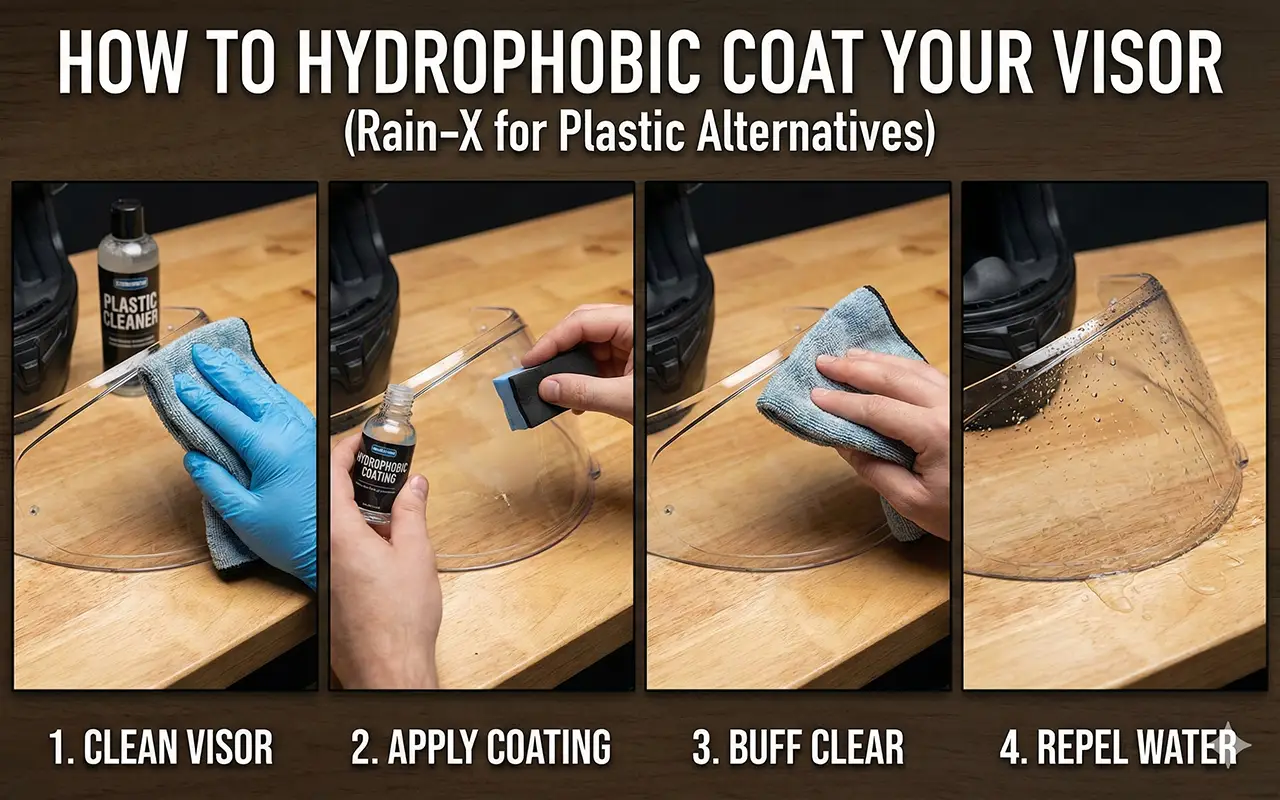
The Step-by-Step Process: How to Hydrophobic Coat Your Visor Correctly
Regardless of which product you choose, proper application technique is crucial for both performance and safety. I’ve refined this process over two decades of riding in the Pacific Northwest, where rain isn’t a possibility—it’s a guarantee. This method works whether you’re treating the shield on modular helmets or traditional full-face designs.
Step 1: Deep Cleaning (The Foundation of Success)
This is where most riders fail before they even begin. Your visor must be absolutely, perfectly clean—not just “looks clean” but chemically clean at the molecular level. Any contamination—oils from your skin, residual bug splatter, old wax, silicone from previous treatments—will prevent proper bonding of the new coating.
Start by removing the visor from your helmet. Most modern helmets feature tool-free quick-release mechanisms, though some require small screwdrivers. Removing the visor allows you to clean both sides thoroughly and inspect for damage. If you’re not sure about your helmet’s visor removal process, check resources like our guide on helmet maintenance which covers these mechanisms in detail.
Wash the visor with warm (not hot) water and a dedicated plastic cleaner or very mild dish soap. Use your bare hands or a very soft microfiber cloth—never paper towels or rough materials that can create micro-scratches. Rinse thoroughly under running water to remove all soap residue.
For the final cleaning step before treatment, use a 50/50 mixture of distilled water and isopropanol (rubbing alcohol) or a dedicated plastic prep solution.
This removes any remaining oils or contaminants. Apply with a clean microfiber cloth, working in straight lines rather than circles to avoid swirl marks. Immediately follow with a dry microfiber cloth to prevent water spots.
Let the visor air dry for at least 15 minutes in a dust-free environment. I use a bathroom with the door closed and the exhaust fan running—it creates a slightly positive pressure that keeps dust out while allowing the visor to dry completely.
Step 2: Inspection and Damage Assessment
Before applying any coating, inspect your visor carefully under good lighting. Hold it at various angles to check for scratches, crazing, or cloudiness.
Minor scratches are normal and won’t prevent treatment, but deep gouges or cracks mean it’s time for replacement. If you’re unsure about visor condition and when to replace it, the principles in our helmet replacement guide apply equally to visors.
Check the edges and mounting points for cracks—these are stress points where damage often begins. If you find significant damage, stop here. Applying hydrophobic coating to a compromised visor is pointless; you need a new shield.
Also verify what coatings your visor already has. Most quality visors come with anti-fog treatments, and some have Pinlock systems installed. You can typically apply hydrophobic coatings to the exterior of visors with interior anti-fog treatments, but check your helmet manufacturer’s recommendations. Some warranty policies are voided by aftermarket treatments.
Step 3: Application Technique (Product-Specific Methods)
Now we get to the actual application of your chosen hydrophobic product. The technique varies slightly depending on whether you’re using silicone-based or ceramic treatments, but the principles remain consistent.
For silicone-based products like Nikwax Visor Proof, work in a well-ventilated area at room temperature (60-75°F is ideal). Shake the bottle thoroughly, then apply a small amount—less than you think you need—to a clean microfiber applicator pad. Work in straight, overlapping passes across the visor surface, maintaining even coverage. The goal is a thin, uniform layer with no dry spots or heavy buildup.
Most silicone products require a brief drying time (2-5 minutes) before buffing. You’ll see a slight haze develop as the carrier evaporates. Using a separate clean microfiber cloth, buff the surface with light to moderate pressure using straight strokes. The visor should become crystal clear with no streaking. If you see streaks, you’ve applied too much product—use a slightly damp microfiber cloth to remove excess, then re-buff.
For ceramic nano-coatings, precision is paramount. These products often come with dedicated applicator pads—use them. Apply a few drops (literally 3-5 drops for an entire visor) to the applicator, then work in small sections, perhaps 3×3 inches at a time. Spread the product in a crosshatch pattern: horizontal passes, then vertical passes over the same area. This ensures complete coverage at the microscopic level.
Ceramic products typically flash off (the carrier evaporates) within 30-60 seconds. You’ll see the surface go from wet to slightly tacky. Immediately buff with a clean microfiber cloth using moderate pressure. This is when the nano-particles are leveling and bonding—proper buffing at this stage determines the final clarity and smoothness of the coating.
Some ceramic products recommend a second layer after the first has cured for 1-2 hours. This builds thickness and durability. If applying a second coat, repeat the entire process: light cleaning with a damp microfiber cloth, complete drying, then application using the same technique.
Step 4: Curing and Initial Testing
Patience during the curing phase separates successful treatments from disappointing ones. Silicone products are typically ready for use within 10-15 minutes after final buffing, though they continue to cure and improve over the first few hours. Ceramic coatings require longer—anywhere from 1 to 12 hours depending on the specific product. Read the manufacturer’s instructions carefully and don’t rush this step.
During curing, keep the visor in a clean, dry, dust-free environment. Don’t reinstall it on your helmet yet—you want air circulation around both sides. I prop visors against a wall at a slight angle, exterior surface facing out, in my temperature-controlled garage.
After the recommended curing time, perform a water test before reinstalling the visor. Spray or splash clean water on the treated surface. You should see immediate, tight beading with contact angles approaching 90 degrees (the water beads should look nearly hemispherical). Tilt the visor at a 30-40 degree angle—the beads should roll off cleanly, leaving minimal water trails.
If the water sheets or beads poorly, you likely have contamination from incomplete cleaning or uneven application. In this case, you’ll need to remove the treatment (using the same alcohol/water solution from the cleaning phase), clean thoroughly, and start over. This is frustrating but necessary—a poorly applied coating performs worse than no coating at all.
Maintenance and Longevity: Making Your Treatment Last
Understanding how to hydrophobic coat your visor is only half the equation; maintaining that coating determines whether you’re reapplying weekly or enjoying protection for months. The durability of hydrophobic treatments varies dramatically based on riding conditions, cleaning methods, and the quality of the initial application.
Proper Cleaning Between Treatments
The number one killer of hydrophobic coatings is aggressive cleaning. Every time you drag a dry cloth across your visor to remove bugs, you’re abrading the coating. Every time you use harsh chemicals, you’re breaking down the molecular bonds that create water repellency.
Instead, adopt a gentle maintenance routine. After each ride, rinse the visor with plain water to remove loose dirt and bugs. For stubborn debris, soak a microfiber cloth in warm water and lay it on the affected area for 30-60 seconds to soften the contamination before gently wiping. Never scrub dry debris—you’re just grinding it into the coating.
For weekly deep cleaning, use products specifically designed for treated plastics. Plexus Plastic Cleaner is popular in the motorcycle community because it cleans without attacking coatings. Spray it on, let it sit for a few seconds, then wipe with a clean microfiber cloth. Flip to a clean section of the cloth frequently to avoid redistributing dirt.
Avoid any product containing ammonia, which is found in many household glass cleaners. Ammonia attacks both the visor material and most hydrophobic coatings. Similarly, avoid petroleum-based products unless specifically formulated for plastics.
Recognizing When Reapplication Is Needed
Hydrophobic coatings don’t fail suddenly—they degrade gradually. You’ll notice water beading becomes less tight, with larger contact patches. Eventually, water starts sheeting in small areas, particularly in the center of your field of vision where airflow keeps the coating under constant stress.
For silicone-based products applied correctly, expect 4-6 weeks of performance in regular riding conditions, or 3-5 serious rain rides. Ceramic coatings can last 6-12 months with proper care. However, these are averages—your mileage will vary based on how often you ride, the conditions you encounter, and how meticulously you maintain the coating.
When performance degrades noticeably, you have two options: spot treatment or full reapplication. For silicone products, full reapplication is usually easier—just clean and reapply. For ceramic coatings, you can sometimes extend life with a silicone-based topper applied over the ceramic base. This gives you the durability of ceramic with the easy reapplication of silicone.
Special Considerations: Pinlock, Tinted Visors, and Photochromic Shields
Modern helmet technology introduces complications when learning how to hydrophobic coat your visor. Not all shields are created equal, and some require modified approaches to avoid damaging expensive features.
Working with Pinlock Anti-Fog Systems
Pinlock inserts create a dual-pane system that prevents interior fogging through an air gap and moisture-absorbing materials. The good news: you can absolutely apply hydrophobic coatings to visors with Pinlock systems. The bad news: you must be careful not to contaminate the Pinlock insert itself or the pins that hold it in place.
Remove the Pinlock insert before applying any treatment. Clean the main visor as described earlier, apply your hydrophobic coating to the exterior surface only, and allow it to cure completely before reinstalling the Pinlock. Never apply hydrophobic treatments to the interior surface of a visor with Pinlock—you’ll compromise the seal and the insert’s anti-fog properties.
If you’re struggling with fogging issues despite proper treatments, our detailed guide on Pinlock vs. anti-fog sprays covers troubleshooting techniques and alternative solutions.
Tinted and Photochromic Visors
Tinted visors and photochromic (transition) shields have additional coatings that can react unpredictably with some hydrophobic treatments. The tinting is usually a dye incorporated into the plastic itself, which is generally safe, but the UV-blocking and photochromic layers on the surface are more delicate.
Before treating any tinted or photochromic visor, test your chosen product on a small, inconspicuous area—typically the bottom edge near one of the mounting points. Apply the treatment, let it cure, then check for any discoloration, haziness, or (for photochromic shields) changes in transition behavior. If you notice any issues, that product isn’t compatible with your visor.
Generally, silicone-based treatments are safer for specialty visors than ceramic coatings, simply because they don’t bond as aggressively. However, premium ceramic products specifically marketed for motorcycle use have usually been tested on various visor types. When in doubt, contact the coating manufacturer with your specific helmet and visor model.
Troubleshooting Common Problems
Even with careful application, you may encounter issues when learning how to hydrophobic coat your visor. Here’s how to diagnose and fix the most common problems.
Streaking and Uneven Beading
If water beads well in some areas but sheets in others, you have uneven coating coverage. This usually results from contamination during application (oils from fingerprints, dust particles) or insufficient product in certain areas. The solution is to remove the coating with an alcohol-based cleaner, thoroughly clean the visor again, and reapply.
Persistent streaking that appears during application and won’t buff out typically means you’ve used too much product. The excess can’t cure properly and leaves a tacky residue. Remove it with a slightly damp microfiber cloth, allow the visor to dry, then reapply using less product.
Hazing or Cloudiness
If your visor develops a hazy appearance after treatment, you’ve likely damaged the existing coatings—either the anti-scratch layer or the base material itself. This is most common with aggressive products like original Rain-X or when using abrasive cleaning methods.
Minor hazing can sometimes be removed with plastic polish (like Novus #2 or Meguiar’s PlastX), but this removes material and should be a last resort. If polishing doesn’t restore clarity, the visor needs replacement. This is why choosing appropriate products and gentle cleaning methods is so critical.
Coating Failure in Cold Weather
Some riders report that hydrophobic coatings work brilliantly in warm weather but fail in cold rain or when temperatures drop below 40°F. This isn’t imagination—it’s physics. Water’s surface tension increases as temperature decreases, making it “stickier” and harder to repel. Additionally, some coating formulations become less flexible in cold weather, reducing their effectiveness.
If you regularly ride in cold conditions, look for products specifically tested at low temperatures. Ceramic coatings generally perform better in cold than silicone-based products. You may also need to reapply more frequently during winter months. Riders dealing with extreme weather conditions should also consider helmets optimized for those environments, as discussed in our guide to cold weather riding helmets.
The Economics: Cost-Benefit Analysis of Hydrophobic Treatments
Let’s talk money, because understanding how to hydrophobic coat your visor isn’t just about technique—it’s also about whether the investment makes sense for your riding style and budget.
A quality replacement visor costs $30-80 depending on your helmet model, with premium shields for high-end helmets reaching $100-150. Hydrophobic treatments range from $8 for basic silicone products to $40 for premium ceramic coatings. A single bottle typically provides 10-20 applications for silicone products or 5-10 for ceramic treatments.
If proper treatment extends your visor’s life by preventing damage from aggressive cleaning or allowing you to see clearly without repeatedly wiping (which causes scratching), the economics are favorable. Even the most expensive ceramic coating pays for itself if it prevents one premature visor replacement.
But there’s also the safety factor, which is harder to quantify. How much is clear vision in a downpour worth? How much would you pay to avoid the distraction and danger of water sheeting across your field of vision at 70 mph? When I frame it this way, hydrophobic treatment isn’t an expense—it’s insurance.
For riders in wet climates or those who tour long distances regardless of weather, I consider hydrophobic treatment mandatory, not optional. For fair-weather riders or those in arid regions, it’s more of a nice-to-have convenience. Assess your own riding patterns and make the decision accordingly.
Alternative and Complementary Strategies
Hydrophobic coatings are powerful tools, but they’re not the only approach to managing water on your visor. A comprehensive strategy combines multiple techniques for maximum visibility in challenging conditions.
Visor Positioning and Riding Technique
Your head position dramatically affects how water behaves on your visor. In heavy rain, tuck slightly lower than normal to angle your visor more vertically. This increases the component of wind force perpendicular to the surface, helping water blow off even without perfect hydrophobic treatment.
Speed also matters. Below about 35 mph, even well-treated visors may accumulate water because wind force is insufficient to overcome surface tension. If you’re stuck in slow traffic during a downpour, you may need to crack your visor slightly to improve visibility, accepting some water intrusion as the price of seeing clearly.
Some riders swear by the “finger wipe” technique—quickly swiping a gloved finger across the visor to clear water. This works but accelerates coating wear and risks scratching if your glove has picked up any grit. If you must wipe, use the side of your glove (which contacts your grip and is usually cleaner) rather than the palm or fingers (which touch everything and accumulate abrasive particles).
Helmet Selection for Wet Weather
Some helmet designs shed water better than others regardless of coating. Aerodynamic shapes with smooth surfaces and minimal protrusions create more laminar airflow, which helps water slide off. Aggressive venting, while great for hot weather, can actually worsen visibility in rain by directing water onto the visor.
If you frequently ride in wet conditions, consider helmets specifically designed for touring or adventure riding, which typically prioritize weather protection over maximum ventilation. The best touring helmets often feature longer chin bars and optimized aerodynamics that work synergistically with hydrophobic treatments.
The Tear-Off and Roll-Off Systems
Borrowed from motocross, tear-off systems use stacked layers of thin plastic film that you remove as they become dirty or water-covered. Roll-off systems use a continuous film on spools that you advance with a lever. Both provide instantly clear vision without any coating.
These systems are overkill for street riding in most situations, but some adventure riders and track day enthusiasts swear by them. They’re expensive, require specific helmet compatibility, and add complexity, but they deliver unmatched visibility in truly extreme conditions. For most riders, proper hydrophobic treatment is a more practical solution.
Conclusion
Learning how to hydrophobic coat your visor properly transforms wet-weather riding from a white-knuckle ordeal into a manageable challenge. The key takeaways: avoid automotive products like Rain-X that weren’t designed for plastic visors; invest in motorcycle-specific silicone or ceramic treatments; prioritize meticulous cleaning and proper application technique over expensive products; and maintain coatings through gentle cleaning rather than aggressive scrubbing.
After two decades of riding through every weather condition imaginable, I’ve settled on a two-tier approach: ceramic nano-coating applied at the start of each season for durability, with quick silicone touch-ups as needed before long trips or when I notice performance degrading. This combination provides 8-10 months of reliable water repellency with minimal maintenance.
The difference between riding with and without proper hydrophobic treatment isn’t subtle—it’s the difference between confident, controlled riding and anxious survival mode. Water management on your visor is as important as tire choice, brake maintenance, or any other safety system on your motorcycle. Treat it with the same seriousness, invest the time to do it right, and you’ll wonder how you ever rode without it. The next time you’re caught in an unexpected downpour, you’ll be grateful you took the time to properly treat your visor, because clear vision isn’t just about comfort—it’s about making it home safely.
Frequently Asked Questions
Can I use Rain-X on my motorcycle helmet visor?
While traditional Rain-X works on automotive glass, it’s not recommended for motorcycle helmet visors. The aggressive solvents in Rain-X can damage polycarbonate and acrylic visor materials and degrade anti-fog and anti-scratch coatings. Instead, use motorcycle-specific hydrophobic products like Nikwax Visor Proof or ceramic nano-coatings formulated for plastic shields. These provide similar water-repelling benefits without risking damage to your expensive visor or its protective coatings.
How long does hydrophobic coating last on a motorcycle visor?
Longevity depends on the product type and riding conditions. Silicone-based treatments typically last 4-6 weeks of regular riding or 3-5 serious rain rides before requiring reapplication. Ceramic nano-coatings are more durable, lasting 6-12 months with proper maintenance. Factors that reduce coating life include frequent aggressive cleaning, riding in dusty conditions, and repeated wiping with gloves. Gentle cleaning with plastic-safe products and avoiding unnecessary contact extends coating durability significantly.
Should I apply hydrophobic coating to both sides of my visor?
No, apply hydrophobic coating only to the exterior surface of your visor. The interior requires hydrophilic (water-attracting) anti-fog treatments, which work through opposite chemistry. Applying hydrophobic coating to the inside will compromise fog prevention and potentially damage Pinlock systems or factory anti-fog coatings. Focus your hydrophobic treatment exclusively on the outer surface where rain, bugs, and road spray impact the visor during riding.
What’s the best way to remove old hydrophobic coating before reapplying?
Remove old coatings using a 50/50 mixture of distilled water and isopropanol (rubbing alcohol) applied with a microfiber cloth. Gently wipe the entire visor surface, then rinse with clean water and dry thoroughly. For stubborn ceramic coatings, you may need a dedicated coating remover or plastic polish, but use these sparingly as they remove material. Always follow removal with thorough cleaning using plastic-safe soap and water, then a final alcohol wipe before applying fresh hydrophobic treatment to ensure optimal bonding.