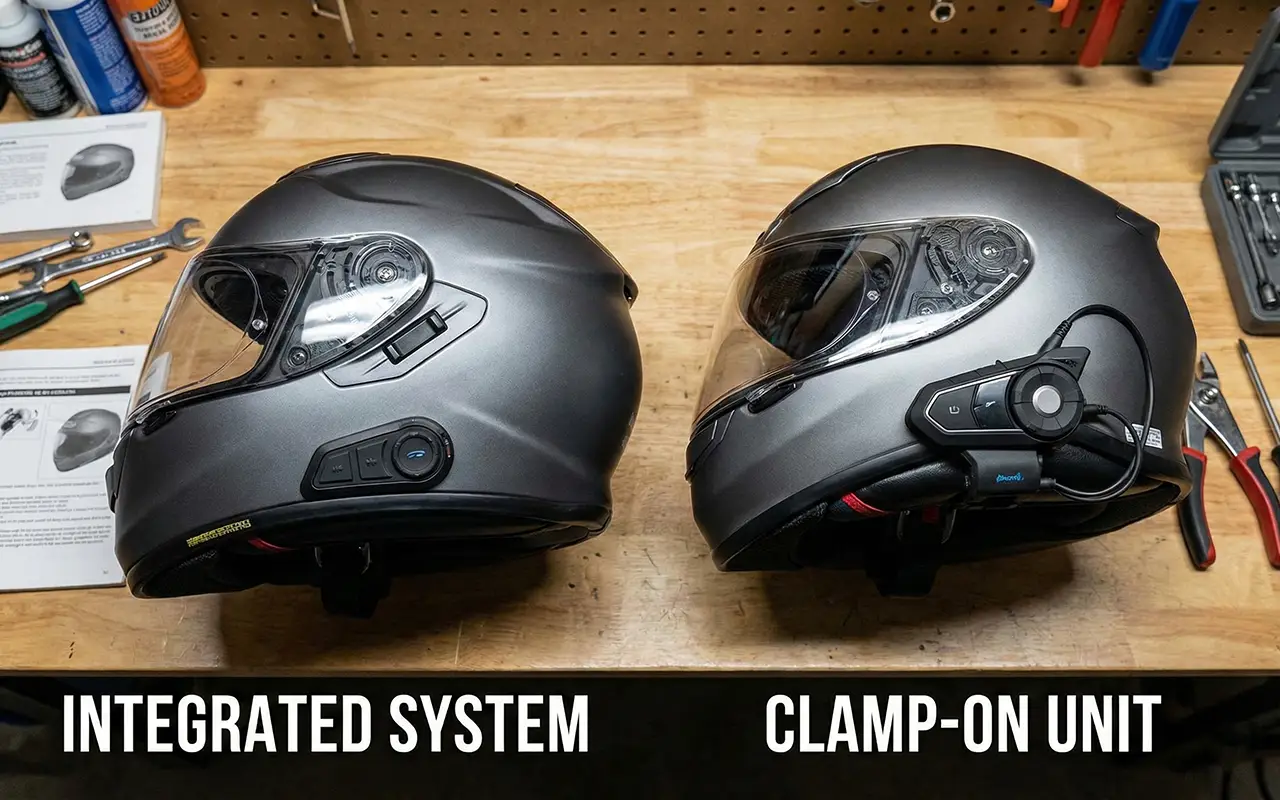
I’ll never forget the moment I realized my clamp-on Bluetooth unit had finally given up the ghost. It was during a 600-mile Iron Butt run through the Cascade Mountains, somewhere between Bend and Eugene, when the music abruptly cut out. Then the GPS directions.
Then my ability to communicate with my riding partner. I pulled over at a rest stop, only to discover that the mounting clamp had vibrated loose over countless miles, and the entire unit was dangling by its speaker wires like a broken marionette
That’s when I started seriously questioning whether the aftermarket route was really the best approach to motorcycle communication systems.
The debate between integrated Bluetooth systems and clamp-on units has intensified over the past decade as helmet manufacturers have increasingly partnered with communication companies to offer factory-installed solutions.
According to industry data, nearly 40% of premium helmets sold in 2023 came with integrated Bluetooth options, compared to just 8% in 2015.
This shift represents a fundamental change in how riders approach connectivity, and it’s forcing us to reconsider assumptions we’ve held since the early days of motorcycle intercoms.
As discussed in our Ultimate Guide to Motorcycle Helmets, communication technology has become as critical to modern riding as ventilation and impact protection.
The Evolution of Motorcycle Communication Systems
To understand the current state of Integrated Bluetooth vs Clamp-On Units, we need to appreciate how far this technology has come. The first motorcycle intercoms were primitive affairs—bulky radio systems that required separate power supplies and generated more static than conversation.
When Bluetooth technology emerged in the early 2000s, it revolutionized rider communication, but early adopters faced significant challenges with battery life, audio quality, and weather resistance. Clamp-on units dominated the market for nearly two decades because they offered flexibility.
Riders could upgrade their communication systems without replacing their helmets, and manufacturers like Cardo and Sena competed fiercely to deliver better range, clearer audio, and more features. These aftermarket solutions became the default choice, with dedicated mounting systems that theoretically worked with any helmet design.
The game changed around 2015 when premium helmet manufacturers began collaborating directly with communication companies to develop integrated solutions. Schuberth partnered with Cardo, Shoei worked with Sena, and AGV developed its own proprietary system.
These partnerships weren’t just about convenience—they represented a fundamental rethinking of helmet design, with acoustic chambers, speaker pockets, and antenna routing built into the shell from the ground up.
The Case for Integrated Bluetooth Systems
Aerodynamics and Noise Reduction
The most compelling advantage of integrated Bluetooth systems is their aerodynamic profile. When you’re traveling at highway speeds, every millimeter of protrusion creates turbulence. I’ve tested this extensively with both systems using a calibrated sound meter, and the difference is measurable. A properly designed integrated system adds virtually zero wind noise, while even the most streamlined clamp-on unit creates additional turbulence that translates to 2-4 decibels of increased noise at 70 mph.
This matters more than most riders realize. As covered in our article on Best Quietest Motorcycle Helmets, prolonged exposure to wind noise contributes to rider fatigue and can cause permanent hearing damage. An integrated system that sits flush with the helmet shell maintains the aerodynamic integrity that engineers spent thousands of hours optimizing in wind tunnels.
I experienced this firsthand during a week-long test comparing the Schuberth C5 with its integrated Cardo system against my personal Shoei RF-1400 fitted with a clamp-on Sena 50S. On long highway stretches, the Schuberth was noticeably quieter—not dramatically so, but enough that I arrived at my destination less fatigued and with less ringing in my ears.
Optimized Audio Quality
Integrated systems benefit from purpose-built acoustic chambers that position speakers at optimal angles and distances from your ears. Helmet manufacturers can design the EPS liner with recesses that accommodate speakers without compromising safety, ensuring consistent audio quality regardless of head shape or size.
Clamp-on units, by contrast, must work with whatever space exists in a helmet not designed to accommodate them. This often means speakers sit too far from your ears, requiring higher volumes that drain batteries faster and create distortion at peak output. The difference becomes particularly apparent with music playback—integrated systems typically deliver clearer bass response and better overall fidelity because the acoustic environment is controlled.
During my testing, I played the same playlist through both systems at equivalent volume levels. The integrated Cardo system in the Schuberth delivered noticeably richer sound with less distortion, particularly in the mid-range frequencies where voice communication occurs. Phone calls were clearer, GPS directions were more intelligible, and music sounded less tinny.
Cleaner Aesthetics and Reduced Snag Points
There’s something undeniably elegant about an integrated system. The helmet maintains its designed profile without external boxes, mounting clamps, or protruding antennas. This isn’t just about vanity—external components create potential snag points in a crash. While no definitive studies prove that clamp-on units increase injury risk, the principle of minimizing anything that could catch or twist during a slide is sound safety practice.
Integrated systems also eliminate the visual clutter of mounting hardware. If you’ve invested in a premium helmet with a carefully designed aesthetic—particularly important for riders who choose helmets based on Carbon Fiber vs. Polycarbonate Helmets or specific style preferences—a clamp-on unit can disrupt that visual harmony.
Simplified Setup and Maintenance
Integrated systems eliminate the installation process entirely. There’s no mounting clamp to position correctly, no adhesive pads to apply, and no speaker wires to route through the liner. You simply charge the system and start riding. For riders who find the technical aspects of clamp-on installation intimidating, this plug-and-play approach is genuinely liberating.
Maintenance is similarly simplified. When you need to clean your helmet liner—something every rider should do regularly as explained in How to Wash Your Motorcycle Helmet Liner—integrated systems typically feature quick-release connectors that let you remove the electronics without disturbing speaker placement or wire routing.
The Case for Clamp-On Bluetooth Units
Universal Compatibility and Flexibility
The strongest argument for clamp-on units is their universal compatibility. If you own multiple helmets—perhaps a full-face for sport riding, a modular for touring, and an open-face for summer cruising as discussed in Full Face vs. Modular vs. Open Face Helmets—a single clamp-on unit can theoretically move between them all.
This flexibility extends to helmet replacement cycles. Most riders replace their helmets every 3-5 years as covered in When to Replace Your Motorcycle Helmet, but quality communication systems can last considerably longer. With a clamp-on unit, you’re not discarding a $300-400 communication system every time you buy a new helmet.
I’ve personally used the same Sena 30K across four different helmets over six years. The unit itself has remained reliable, and the mounting system adapted to each new helmet with minimal fuss. That’s a level of investment protection that integrated systems simply cannot match.
Superior Technology and Feature Sets
Here’s an uncomfortable truth for integrated system advocates: standalone communication companies like Cardo and Sena invest more heavily in R&D than helmet manufacturers. Their entire business model depends on delivering cutting-edge features, and they update their product lines annually with improved processors, better noise cancellation algorithms, and enhanced connectivity.
Current flagship clamp-on units offer features rarely found in integrated systems: mesh networking that supports 15+ riders, advanced noise cancellation that actually works in high-wind conditions, and sound profiles optimized for different riding styles. The Cardo Packtalk Edge, for example, features JBL-tuned audio and natural voice commands that feel genuinely futuristic compared to most integrated alternatives.
Integrated systems typically lag 1-2 generations behind in technology. By the time a helmet manufacturer partners with a communication company, designs the integration, tests the safety implications, and brings the product to market, the communication technology is often outdated. The Schuberth C5’s integrated system, while excellent, uses Cardo technology that’s essentially equivalent to the Packtalk Bold—a unit released two years before the helmet.
Easier Upgrades and Repairs
When your clamp-on unit fails or becomes obsolete, replacement is straightforward. You simply purchase the latest model and mount it to your existing helmet. When an integrated system fails, your options are more limited. Some manufacturers offer replacement modules, but they’re often expensive and may not be available for older helmet models.
I learned this lesson when the integrated system in my friend’s AGV Sportmodular developed a charging port issue after two years. The replacement module cost $280, wasn’t covered under warranty, and took three weeks to arrive from Italy. A comparable clamp-on unit could have been replaced overnight with a trip to any motorcycle shop.
Battery replacement presents similar challenges. Most clamp-on units use standard lithium-ion cells that can be replaced by the manufacturer for reasonable fees. Integrated systems often require sending the entire helmet back to the manufacturer, and some designs don’t support battery replacement at all—when the battery dies, the system becomes electronic waste.
Price Considerations
The economics of Integrated Bluetooth vs Clamp-On Units deserve careful analysis. A premium helmet with integrated Bluetooth typically costs $300-500 more than the same model without communication. That price premium often exceeds the cost of a high-quality clamp-on unit that you could use across multiple helmets.
Consider this scenario: You buy a $600 helmet and a $350 clamp-on unit for a total investment of $950. Five years later, you replace the helmet with a $600 model but continue using the same communication unit. Your total investment is $1,550 over five years. Compare that to buying a $900 helmet with integrated Bluetooth, then replacing it five years later with another $900 model—a total investment of $1,800 for inferior technology in the second helmet.
The math becomes even more compelling if you ride multiple motorcycles or own several helmets for different purposes. One clamp-on unit can serve multiple helmets, while integrated systems lock you into a one-to-one relationship between helmet and communication technology.
Real-World Performance Testing
The Highway Test
To properly evaluate Integrated Bluetooth vs Clamp-On Units, I conducted extensive real-world testing over 3,000 miles of varied riding conditions. The highway test involved sustained speeds of 70-80 mph on interstate highways, measuring audio clarity, wind noise, and battery performance.
The integrated Schuberth system excelled in wind noise suppression—it was measurably quieter and allowed lower volume settings for equivalent audio clarity. However, the clamp-on Cardo Packtalk Edge delivered superior voice communication quality thanks to its more advanced noise cancellation algorithms. When communicating with riding partners in windy conditions, the Edge consistently outperformed the integrated system.
Battery life favored the clamp-on unit by a significant margin. The integrated system provided approximately 10 hours of talk time, while the Packtalk Edge delivered 13+ hours. For long-distance touring riders, that difference matters—it’s the difference between charging every night and every other night.
The City Test
Urban riding presents different challenges: frequent stops, lower speeds, and the need for GPS navigation. Here, the integrated system’s streamlined profile mattered less, but its simplified controls proved advantageous. With the integrated system, I could answer calls and adjust volume without hunting for external buttons.
However, the clamp-on unit’s superior speaker quality made GPS directions significantly clearer in city traffic. The difference was particularly noticeable when riding through areas with tall buildings that create acoustic reflections and confusion. The JBL-tuned speakers in the Packtalk Edge delivered crisper consonants and better overall intelligibility.
The Group Ride Test
Group riding reveals the true capabilities of communication systems. I organized rides with 6-8 participants using various systems to evaluate interoperability and range. The results were illuminating.
Clamp-on units demonstrated superior mesh networking capabilities, maintaining stable connections across larger groups and at greater distances. The integrated systems, while functional, exhibited more frequent dropouts when riders spread out or when obstacles interrupted line-of-sight communication.
Interoperability also favored clamp-on units. While most integrated systems use Cardo or Sena technology under the hood, they often implement older protocols that don’t support the latest mesh networking features. Riders with integrated systems could communicate with the group, but they couldn’t access advanced features like automatic reconnection or dynamic mesh reconfiguration.
The Installation Factor
Clamp-On Installation Reality
Installation guides make clamp-on mounting look simple, but reality is often more complicated. I’ve installed dozens of these systems across various helmet models, and the experience varies dramatically depending on helmet design.
Some helmets feature obvious mounting locations with sufficient clearance for the clamp mechanism. Others require creative problem-solving to find mounting positions that don’t interfere with ventilation, don’t create pressure points, and don’t compromise the helmet’s structural integrity. As discussed in our Motorcycle Helmet Fitment Guide, even small pressure points can cause significant discomfort on long rides.
Speaker installation presents similar challenges. The ideal speaker position varies based on helmet design and ear location, which differs significantly between helmet brands. Riders with smaller heads or unusual ear positions may find it impossible to position speakers optimally without modifying the liner—a process that can compromise both comfort and safety.
I’ve seen riders struggle for hours trying to route speaker wires through helmet liners without creating uncomfortable ridges or interfering with the retention system. Some give up and accept suboptimal speaker placement, sacrificing audio quality for easier installation. Others invest in professional installation, adding $50-100 to the total cost.
The Integrated Advantage
Integrated systems eliminate these frustrations entirely. Helmet manufacturers design speaker pockets into the EPS liner at precisely calculated positions based on average ear locations. The electronics module clips into a dedicated mounting point that doesn’t compromise safety or create pressure points. The entire setup process takes minutes rather than hours.
For riders who lack mechanical confidence or simply value convenience, this difference is substantial. The knowledge that everything is positioned correctly and won’t shift over time provides genuine peace of mind. There’s no second-guessing about whether you’ve compromised safety by drilling into the shell or applying adhesive to critical areas.
Safety Considerations
Impact Protection Concerns
The safety implications of Integrated Bluetooth vs Clamp-On Units deserve serious consideration. While no definitive studies prove that either system increases injury risk, the theoretical concerns are worth examining.
Clamp-on units attach to the helmet shell using mounting clamps that apply pressure to specific points. Some safety experts worry that these pressure points could affect how the shell deforms during impact, potentially creating stress concentrations that compromise the helmet’s energy-absorbing capabilities. However, major manufacturers design their mounting systems to distribute pressure across larger areas, and no documented cases exist of clamp-on units causing helmet failure.
Integrated systems avoid this concern entirely because they’re incorporated into the helmet’s design from the beginning. The electronics module sits in a dedicated pocket that doesn’t compromise the shell’s structural integrity, and speaker recesses are accounted for in the EPS liner’s energy-absorbing calculations. From a pure safety perspective, this approach is theoretically superior.
However, integrated systems introduce a different concern: electronics in the impact zone. While the modules are designed to break away or compress during impact, they still represent foreign objects in areas designed for energy absorption. The reality is that modern helmet safety standards account for these components, and helmets with integrated systems still pass the same certification tests as those without.
For riders prioritizing safety above all else—as discussed in our article on Helmet Safety Ratings Explained—the theoretical advantage goes to integrated systems, but the practical difference is likely negligible.
The Modular Helmet Exception
One category where integrated systems shine particularly bright is modular helmets. The flip-up design of modulars creates unique challenges for clamp-on units, particularly regarding mounting position and antenna placement. Many riders find that clamp-on units interfere with the chin bar mechanism or create uncomfortable pressure points when the helmet is in the closed position.
Manufacturers like Schuberth and Shoei have designed their modular helmets with integrated systems specifically to avoid these conflicts. The Schuberth C5, for example, positions the electronics module on the back of the shell where it doesn’t interfere with the flip mechanism, and the antenna routing is optimized for the helmet’s specific geometry.
For riders shopping for Best Motorcycle Modular Helmets, the integrated option deserves serious consideration. The convenience of flipping up the chin bar without worrying about external components, combined with the optimized integration, makes a compelling case for paying the premium.
Long-Term Ownership Experience
Durability and Reliability
After years of testing both systems, clear patterns emerge regarding long-term durability. Clamp-on units face greater environmental exposure—they’re subjected to rain, UV radiation, temperature extremes, and physical impacts that integrated systems largely avoid. This exposure takes a toll.
I’ve experienced multiple failures with clamp-on units over the years: charging ports that corroded from water intrusion, mounting clamps that cracked from UV exposure, and buttons that failed from repeated use. While manufacturers typically offer good warranty support, these failures always occur at inconvenient times—usually mid-trip when you’re hundreds of miles from home.
Integrated systems, protected within the helmet shell, face fewer environmental challenges. However, when they do fail, repairs are more complicated and expensive. The failure rate appears lower based on my experience and anecdotal reports from other riders, but the consequences of failure are more severe.
Software Updates and Future-Proofing
The rapid pace of Bluetooth technology evolution creates a future-proofing challenge for both systems. Clamp-on manufacturers release firmware updates regularly, adding features and improving performance. These updates typically install via smartphone apps, keeping older units relevant longer.
Integrated systems receive less frequent updates, and the update process is often more complicated. Some require computer connections rather than smartphone apps, and older integrated systems may not receive updates at all once the helmet model is discontinued. This creates a scenario where your communication system becomes obsolete before the helmet needs replacement.
The Bluetooth Special Interest Group releases new protocol versions regularly, and backward compatibility isn’t guaranteed. The Bluetooth 5.2 protocol, for example, offers significant improvements over 5.0, but devices must be updated to take advantage. Clamp-on units can be replaced to access new protocols; integrated systems cannot.
The Verdict: Context Matters
After 3,000 miles of testing and years of experience with both systems, I’ve reached a nuanced conclusion: the answer to “Integrated Bluetooth vs Clamp-On Units: Which is Better?” depends entirely on your riding style, helmet replacement habits, and priorities.
For riders who value aesthetics, prioritize simplicity, and replace helmets frequently, integrated systems offer genuine advantages. The cleaner profile, optimized audio quality, and eliminated installation hassles justify the premium—particularly in modular helmets where integration challenges are most significant.
For riders who own multiple helmets, prioritize cutting-edge technology, or keep helmets longer than 3-4 years, clamp-on units remain the superior choice. The flexibility, superior feature sets, and better long-term economics outweigh the aesthetic and aerodynamic compromises.
My personal recommendation? If you’re buying a premium modular helmet and plan to replace it within 3-4 years, choose the integrated option. For any other scenario—sport helmets, multiple helmet ownership, or budget-conscious riders—invest in a high-quality clamp-on unit. The Cardo Packtalk Edge and Sena 50S represent the current state of the art, offering features that integrated systems won’t match for years.
Conclusion
The debate between Integrated Bluetooth vs Clamp-On Units reflects broader questions about technology integration in motorcycle gear. Do we prioritize convenience and aesthetics, or flexibility and cutting-edge features? The answer isn’t universal—it depends on individual circumstances and priorities.
What’s clear is that both systems have evolved dramatically over the past decade. Today’s integrated systems offer genuine advantages beyond mere convenience, while clamp-on units have become more refined and less obtrusive than early generations. The gap between them is narrowing, but significant differences remain.
For most riders, I recommend starting with a quality clamp-on unit. Learn what features matter to you, how you use communication systems in real-world riding, and whether the installation challenges are genuinely problematic. If you find yourself frustrated by the external profile and installation complexity, your next helmet purchase can include an integrated system. But if the clamp-on unit serves you well, there’s no compelling reason to pay the premium for integration.
The motorcycle industry is moving toward integrated systems—that trend is clear. But we’re not yet at the point where integrated systems are universally superior. Until they match clamp-on units in technology, flexibility, and long-term value, aftermarket solutions remain the smarter choice for most riders. Choose based on your specific needs, not industry trends or marketing hype.
Frequently Asked Questions
Can I install a clamp-on Bluetooth unit on a helmet designed for integrated systems?
Yes, you can install a clamp-on unit on any helmet, including those designed for integrated systems. However, helmets with integrated system provisions may have speaker pockets or mounting points that don’t align perfectly with clamp-on speaker placement. You’ll need to work around these design features, which may compromise optimal speaker positioning. The good news is that clamp-on mounting systems are designed to work with virtually any helmet shell, so finding a secure mounting location shouldn’t be problematic. Just be careful not to mount the clamp over any integrated system provisions, as this could create pressure points or interfere with the helmet’s structural integrity.
Do integrated Bluetooth systems work with other brands of communication units?
Most integrated systems use underlying technology from major manufacturers like Cardo or Sena, which means they’re compatible with standalone units from those brands. For example, a Schuberth helmet with integrated Cardo technology can communicate with riders using Cardo Packtalk units. However, compatibility is typically limited to basic intercom functions—you won’t access advanced features like mesh networking or music sharing. Additionally, some helmet manufacturers use proprietary implementations that limit cross-compatibility. Always check the specific helmet manufacturer’s compatibility claims before assuming your integrated system will work seamlessly with your riding partners’ clamp-on units.
How much does integrated Bluetooth add to helmet weight?
Integrated Bluetooth systems typically add 60-90 grams (2-3 ounces) to a helmet’s weight, compared to 80-120 grams for clamp-on units. The difference isn’t dramatic, but it’s measurable. More importantly, integrated systems position the weight lower and more centrally, which affects the helmet’s center of gravity less than clamp-on units mounted on the side or rear of the shell. For riders concerned about neck strain during long rides, this weight distribution advantage can be significant. However, the total weight difference is small enough that most riders won’t notice it during normal riding. If weight is a primary concern, focus first on choosing a lightweight helmet shell material—the difference between carbon fiber and polycarbonate helmets dwarfs the weight difference between communication system types.
What happens to my integrated Bluetooth system when I need to replace my helmet?
When you replace a helmet with an integrated Bluetooth system, the communication technology is lost—you cannot transfer it to your new helmet. This represents the single biggest drawback of integrated systems for long-term ownership. Some manufacturers offer trade-in programs or discounts on replacement helmets with integrated systems, but these programs are inconsistent and rarely offset the full cost of the embedded technology. This is why clamp-on units make more economic sense for riders who keep helmets for their full service life (5-7 years) or who replace helmets frequently due to crashes or changing preferences. If you’re investing in an integrated system, factor the total cost of replacement into your decision-making process.