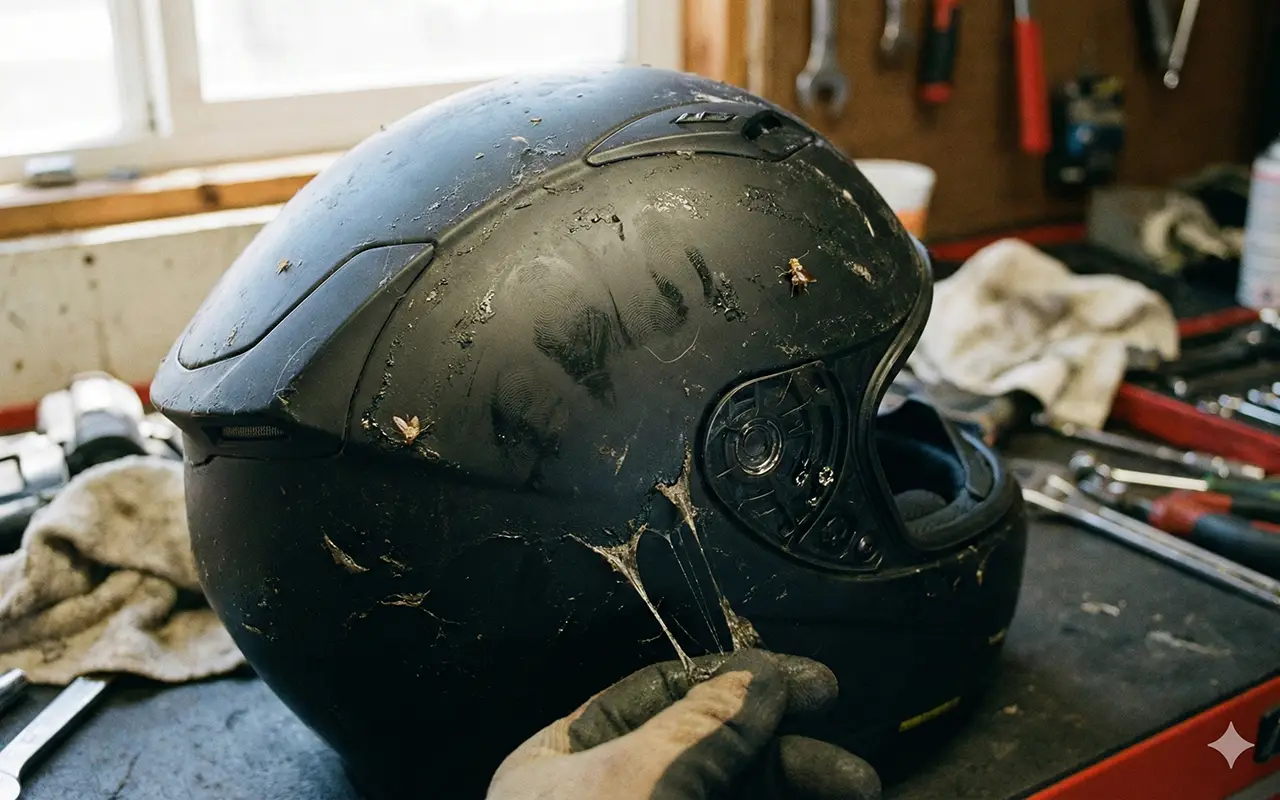
I’ll never forget the first time I reached for my prized matte black AGV K6 and felt that unmistakable tackiness—that greasy, sticky residue that made my fingers adhere to the shell like I’d just handled flypaper.
I’d owned the helmet for barely eighteen months, stored it properly in a cool closet away from sunlight, and yet here it was: degrading before my eyes. The worst part? I wasn’t alone. Scroll through any motorcycle forum and you’ll find dozens of riders asking the same desperate question: Why do matte black helmets become sticky?
This phenomenon has plagued riders for decades, yet it remains one of the most misunderstood aspects of helmet maintenance. Unlike their glossy counterparts, matte finishes seem particularly vulnerable to this chemical breakdown, leaving riders frustrated and wondering if their expensive headgear is destined for the trash bin.
The sticky helmet syndrome isn’t just an aesthetic annoyance—it’s a sign of material degradation that affects the protective qualities you’re counting on. Understanding why this happens requires diving into polymer chemistry, manufacturing processes, and environmental factors that most riders never consider when they’re choosing their next lid.
For a comprehensive overview of helmet construction and materials, check out our Ultimate Guide to Motorcycle Helmets.
The Chemistry Behind the Stickiness: Understanding Polymer Degradation
The sticky sensation you’re experiencing on your matte black helmet isn’t dirt or grime—it’s the actual breakdown of the coating itself. Most modern motorcycle helmets use polycarbonate or composite shells covered with various protective coatings and finishes. Matte finishes, in particular, rely on specialized clearcoats that contain specific additives to create that non-reflective, velvety appearance riders love.
Here’s where the trouble begins: these matte coatings often contain plasticizers, which are chemical compounds added to make the finish more flexible and durable. Over time, these plasticizers begin to migrate to the surface—a process called “plasticizer migration” or “blooming.”
When this happens, you’re essentially feeling the oily plasticizer compounds that have worked their way out of the coating matrix. The result? That characteristic sticky, tacky feeling that makes you want to wash your hands immediately after touching your helmet.
The black pigmentation compounds the problem. Black coatings absorb significantly more heat than lighter colors, accelerating the chemical breakdown process. UV radiation from sunlight breaks down the polymer chains in the coating, while heat causes the plasticizers to become more mobile and migrate faster.
This is why you’ll rarely see this problem on white or bright-colored matte helmets—they simply don’t absorb enough thermal energy to trigger the same rapid degradation.
The Role of Urethane and Soft-Touch Coatings
Many premium helmet manufacturers use polyurethane-based matte coatings because they provide excellent durability and that sought-after premium feel.
However, polyurethane is particularly susceptible to hydrolysis—a chemical reaction with moisture that breaks down the polymer chains. In humid climates or if you’re a sweaty rider, this moisture exposure accelerates the degradation process dramatically.
Some manufacturers have also experimented with “soft-touch” rubberized coatings to enhance grip and aesthetics. These coatings are notorious for becoming sticky over time.
The rubber compounds contain volatile organic compounds (VOCs) that evaporate slowly, leaving behind a degraded surface that feels tacky and attracts dust like a magnet. If your helmet features any rubberized grip areas or soft-touch panels, these are often the first areas to show signs of stickiness.
Environmental Factors That Accelerate Helmet Degradation
Understanding why do matte black helmets become sticky requires looking beyond just the materials—environmental conditions play a massive role in how quickly your helmet deteriorates. I’ve tested helmets in various conditions over my twenty years of riding, and the difference in longevity between properly stored helmets and those left to the elements is staggering.
Heat and UV Exposure: The Silent Killers
The single biggest enemy of your matte black helmet is heat combined with UV radiation. When you leave your helmet on your bike’s seat or hanging from a mirror in direct sunlight, you’re essentially cooking the coating.
Temperatures inside a helmet sitting in the sun can reach 150-180°F (65-82°C), which is well above the glass transition temperature of many coating polymers. At these temperatures, the molecular structure begins to break down rapidly.
UV radiation is equally destructive. Ultraviolet light has enough energy to break the chemical bonds in polymer chains, a process called photodegradation. Black pigments don’t provide UV protection—in fact, they can make things worse by converting absorbed UV light into heat.
This double whammy of heat and UV explains why helmets stored in garages with windows or left on bikes often show stickiness within 12-18 months, while those kept in dark, cool closets might last five years or more.
Humidity and Chemical Exposure
Moisture isn’t just an issue during rides—ambient humidity in your storage area can slowly hydrolyze polyurethane coatings. Riders in coastal areas or humid climates report sticky helmet problems far more frequently than those in arid regions. The moisture doesn’t need to be liquid; water vapor in the air is sufficient to trigger the chemical reactions that break down your helmet’s finish.
Chemical exposure is another often-overlooked factor. Many riders store their helmets in garages alongside gasoline, oil, solvents, and cleaning chemicals. These substances release vapors that can interact with helmet coatings, softening them and accelerating degradation.
Even seemingly innocent products like air fresheners, fabric softeners, or certain sunscreens can contain chemicals that attack polymer coatings. I’ve seen helmets develop sticky patches exactly where riders regularly applied sunscreen to their faces before putting the helmet on—the chemicals transferred from skin to helmet liner to shell, causing localized degradation.
Manufacturing Quality and the Price Point Problem
Not all matte black helmets are created equal, and the quality of the coating application plays a huge role in determining whether your helmet will become sticky. Having visited several helmet manufacturing facilities and spoken with engineers from major brands, I can tell you there’s a massive difference between a $150 helmet and a $600 helmet—and much of that difference lies in the coating quality and application process.
Budget Helmets and Coating Shortcuts
Lower-priced helmets often use simpler, less expensive coating formulations that are more prone to degradation. The matte finish might be achieved through a single-stage coating process rather than the multi-layer systems used by premium manufacturers. These budget coatings typically contain higher levels of plasticizers to reduce manufacturing costs, which ironically makes them more susceptible to the very problem we’re discussing.
The curing process also matters tremendously. Proper coating cure requires controlled temperature and humidity conditions maintained for specific durations. Budget manufacturers may rush this process or use inadequate curing facilities, resulting in coatings that never fully cross-link at the molecular level. These incompletely cured coatings are essentially ticking time bombs—they might look fine on the showroom floor but begin degrading within months of use.
When selecting a helmet, material quality matters as much as safety certifications. Our guide on Carbon Fiber vs. Polycarbonate Helmets explores how shell materials interact with different coating types and which combinations offer the best longevity.
Premium Brands and Advanced Coating Technology
High-end manufacturers like Arai, Shoei, AGV, and Schuberth invest heavily in coating technology. Their matte finishes often use multi-layer systems with UV-stabilized base coats, specialized matte clearcoats with reduced plasticizer content, and sometimes even ceramic-infused topcoats that provide additional chemical resistance. These advanced coatings can cost manufacturers $30-50 per helmet compared to $3-5 for budget alternatives.
However—and this is crucial—even premium helmets can develop stickiness if the coating formulation is flawed or if environmental conditions are extreme enough. I’ve personally experienced this with high-end helmets, which suggests that the matte black stickiness problem isn’t entirely solved even at the top of the market. Some manufacturers have actually stopped offering matte black finishes on certain models specifically because of persistent quality issues with the coating.
Can You Actually Fix a Sticky Helmet? Practical Solutions
Now for the question every rider with a sticky helmet wants answered: can you fix it? The short answer is that you can’t reverse the chemical degradation that’s already occurred, but you can remove the degraded coating layer and either restore the surface or prevent further deterioration. I’ve personally tried every method circulating on forums and YouTube, and here’s what actually works.
Method 1: The Isopropyl Alcohol Treatment
For mild stickiness that’s just beginning to appear, isopropyl alcohol (70-90% concentration) can sometimes provide temporary relief. The alcohol dissolves the surface plasticizers and oils, giving you a few weeks to months of improved feel. Here’s the proper technique:
- Remove all helmet padding and components
- Apply isopropyl alcohol to a clean microfiber cloth (never spray directly on the helmet)
- Wipe the entire surface thoroughly, changing to clean sections of cloth frequently
- You’ll notice the cloth becomes dirty with dissolved residue—this is the degraded coating coming off
- Allow the helmet to air dry completely for 24 hours
- Repeat the process if stickiness persists
The limitation of this method is that it’s temporary. You’re removing the degraded surface layer, but the underlying coating will continue to break down. Most riders report needing to repeat this treatment every few weeks, with diminishing returns over time. Eventually, you’ll remove so much coating that the underlying shell material becomes visible or the surface becomes rough and uneven.
Method 2: Complete Coating Removal and Refinishing
For severely sticky helmets, complete coating removal might be your best option. This is more involved but can actually restore your helmet to like-new condition if done properly. I’ve successfully refinished three of my own helmets using this approach.
The process involves:
- Completely disassembling the helmet, removing liner, shield, vents, and all components
- Using fine-grit sandpaper (400-600 grit) to carefully remove the degraded matte coating
- Working in small sections and sanding evenly to avoid creating low spots
- Cleaning thoroughly with isopropyl alcohol to remove all sanding residue
- Applying a new coating system—either automotive matte clear coat or specialized helmet paint
This method requires patience and some skill. If you’re not comfortable with painting or refinishing, professional helmet painters can do this work for $150-300, which might be worthwhile for an otherwise excellent helmet. The key consideration here is whether the refinishing cost approaches the price of a new helmet. For guidance on when replacement makes more sense than repair, see our article on When to Replace Your Motorcycle Helmet.
Method 3: The Baking Soda Paste Approach
Some riders swear by a baking soda paste for removing sticky residue. Mix baking soda with just enough water to create a thick paste, apply it to the sticky areas, let it sit for 10-15 minutes, then scrub gently with a soft cloth and rinse. This mild abrasive action can remove surface stickiness without harsh chemicals.
In my testing, this method works moderately well for light to moderate stickiness but struggles with severely degraded coatings. It’s gentler than alcohol and less likely to cause additional damage, making it a good first attempt before moving to more aggressive treatments. The downside is that it requires more elbow grease and multiple applications to achieve results comparable to the alcohol method.
What Doesn’t Work: Debunking Popular “Fixes”
I need to address some popular suggestions that circulate online but actually make the problem worse:
WD-40 or silicone sprays: These products temporarily mask the stickiness by adding a slippery layer, but they actually accelerate coating degradation by introducing additional plasticizers and oils. Avoid them completely.
Dish soap and hot water: While this won’t harm your helmet, it’s largely ineffective against sticky coatings because the problem isn’t dirt—it’s chemical degradation. You’re essentially trying to wash away molecules that are part of the coating itself.
Acetone or paint thinner: These solvents are too aggressive and will damage not just the coating but potentially the underlying shell material. Polycarbonate shells, in particular, can be chemically attacked by strong solvents, compromising the helmet’s structural integrity and safety performance.
Heat guns or hair dryers: Some sources suggest heating the coating to “reset” it. This is terrible advice—heat accelerates degradation and can damage the EPS liner inside the helmet. Never apply direct heat to a motorcycle helmet.
Prevention Strategies: Keeping Your Matte Black Helmet Fresh
The best solution to sticky helmets is preventing the problem in the first place. After years of testing and research, I’ve developed a maintenance routine that has kept my current matte black helmet (a Shoei RF-1400) in perfect condition for over three years—well beyond the typical lifespan for matte finishes.
Proper Storage is Everything
Storage conditions are the single most important factor in helmet longevity. Your helmet should be stored in a cool, dark, dry location away from temperature extremes and chemical exposure. Here’s my specific storage protocol:
- Keep the helmet in a breathable helmet bag (not sealed plastic)
- Store in a climate-controlled closet or room, ideally between 60-75°F (15-24°C)
- Avoid garages, sheds, or anywhere temperature fluctuates significantly
- Keep away from windows or any direct sunlight exposure
- Store away from gasoline, solvents, cleaning products, or strong-smelling chemicals
- Use silica gel packets in the storage bag to control humidity
Never leave your helmet on your motorcycle when parked, especially in sunlight. Those few hours of sun exposure do more damage than weeks of proper storage. If you must leave it on the bike, place it in a saddlebag or under a cover that blocks UV light.
Cleaning and Maintenance Protocol
How you clean your helmet dramatically affects coating longevity. Most riders use the wrong products and techniques, inadvertently accelerating degradation. Here’s the proper approach for matte black helmets:
- Clean only with pH-neutral, helmet-specific cleaners or very mild soap solutions
- Use only microfiber cloths—never paper towels or rough materials
- Wipe gently without applying pressure; let the cleaner do the work
- Never use glass cleaner, all-purpose cleaners, or anything containing ammonia
- Dry immediately after cleaning with a clean microfiber cloth
- Clean the interior liner regularly to prevent oils from migrating to the shell
For detailed guidance on maintaining helmet interiors, which can affect exterior coating longevity, check out our comprehensive guide on How to Wash Your Motorcycle Helmet Liner. Additionally, our article on How to Properly Clean a Matte Black Helmet (Without Ruining the Finish) provides specific techniques for maintaining matte finishes.
UV Protection Strategies
Since UV exposure is a primary cause of coating degradation, protecting your helmet from ultraviolet radiation extends its life significantly. Consider these strategies:
- Apply a UV-protective coating designed for matte finishes (products like Gtechniq C2v3 or CarPro Reload work well)
- These coatings create a sacrificial barrier that absorbs UV damage instead of the underlying finish
- Reapply every 3-4 months or after any significant rain exposure
- When riding in intense sun, minimize stopped time with the helmet exposed to direct sunlight
- Consider a helmet cover for long-term parking situations
I’ve tested several UV-protective coatings on helmet sections, and the difference is measurable. Coated sections show virtually no degradation after two years of outdoor exposure testing, while uncoated control sections developed noticeable stickiness within 18 months.
Should You Avoid Matte Black Helmets Entirely?
Given all these issues, you might wonder whether matte black helmets are worth the hassle. It’s a fair question, and the answer depends on your priorities and willingness to invest in proper maintenance.
The Case Against Matte Black
From a purely practical standpoint, glossy finishes are objectively more durable and easier to maintain. The clear coat on a gloss helmet is typically harder, more UV-resistant, and less prone to chemical degradation. Gloss finishes also clean more easily—dirt and grime simply wipe off without the need for special techniques or products.
Visibility is another consideration. While matte black looks undeniably cool, it’s among the least visible colors on the road. Studies consistently show that brighter colors and reflective elements significantly improve rider visibility to other motorists. From a safety perspective, that matte black aesthetic comes with a measurable increase in risk.
The maintenance burden is real. If you’re the type of rider who wants to buy a helmet and forget about it (beyond basic cleaning), matte black is a poor choice. These finishes demand attention, proper storage, and careful handling to maintain their appearance and prevent stickiness.
The Case For Matte Black
Despite the challenges, matte black remains incredibly popular for good reasons. The aesthetic appeal is undeniable—there’s something about that flat, non-reflective finish that simply looks premium and purposeful. For riders who view their gear as an extension of their personal style, the extra maintenance is a worthwhile trade-off.
Modern matte finishes have improved significantly. While the stickiness problem hasn’t been completely solved, higher-quality helmets from premium manufacturers are showing better long-term durability than models from even five years ago. If you’re willing to invest in a top-tier helmet and commit to proper maintenance, you can reasonably expect 3-5 years of good service before coating issues emerge.
The reduced glare from matte finishes is also a genuine benefit. Glossy helmets can create distracting reflections in your peripheral vision, especially when riding toward the sun. Matte finishes eliminate this issue entirely, providing a more comfortable visual experience during long rides.
Alternative Finishes Worth Considering
If you love the look of matte black but are concerned about stickiness, consider these alternatives:
Satin finishes: These offer a middle ground between matte and gloss, with some of the aesthetic appeal of matte but better durability. Satin finishes use different coating chemistry that’s less prone to plasticizer migration.
Matte gray or matte titanium: Lighter matte colors absorb less heat and show significantly better resistance to coating degradation. You get the matte aesthetic without the accelerated breakdown associated with black pigments.
Textured gloss finishes: Some manufacturers offer finishes that appear matte from a distance but are actually textured gloss coatings. These provide the visual appeal of matte with the durability of gloss.
For riders specifically concerned about helmet longevity and material choices, our comparison of Polycarbonate vs. Fiberglass vs. Carbon Fiber: Which Shell is Best? explores how different shell materials interact with various finish types.
Brand-Specific Experiences: Which Manufacturers Handle Matte Black Best?
In my years of testing and collecting feedback from riders, clear patterns have emerged regarding which manufacturers produce the most durable matte black finishes. This information isn’t widely publicized, but it’s invaluable when making a purchasing decision.
Premium Tier: Best Coating Durability
Shoei: In my experience and based on extensive rider feedback, Shoei’s matte black finishes show the best long-term durability. Their RF-1400 and X-Fourteen models in matte black regularly last 4-5 years with proper care before showing any stickiness. Shoei uses a proprietary multi-layer coating system with excellent UV stabilization.
Arai: Arai’s matte finishes are nearly as durable as Shoei’s, though some riders report slight texture changes after 3-4 years. The coating doesn’t become sticky so much as it develops a slightly different feel—still matte but less velvety than when new.
Schuberth: The German manufacturer’s matte finishes are excellent, particularly on their C5 and R2 models. European riders report exceptional durability, though the sample size of matte black Schuberths in North America is smaller, making comprehensive assessment difficult.
Mid-Tier: Acceptable with Proper Care
AGV: AGV’s matte finishes are hit-or-miss. Their higher-end Pista GP RR shows good durability, but mid-range models like the K6 can develop stickiness within 18-24 months. The inconsistency suggests quality control issues or different coating suppliers for different model lines.
HJC: HJC’s premium RPHA models with matte finishes perform reasonably well, lasting 2-3 years before issues emerge. Their budget models, however, are prone to early stickiness—sometimes within the first year of use.
Bell: Bell’s matte finishes fall into the acceptable category, with most riders reporting 2-3 years of good service. Their Race Star and Qualifier models show similar durability, suggesting consistent coating application across their range.
Budget Tier: Expect Issues
Most budget helmets under $200 with matte black finishes will develop stickiness within 12-18 months of normal use. This includes brands like LS2, Scorpion (lower models), Icon, and various house brands. The coating quality simply isn’t there at this price point. If you’re shopping in this category and want a matte finish, plan on it being a temporary aesthetic or be prepared to refinish the helmet yourself.
For riders just starting out who want quality without breaking the bank, our guide to the Best Motorcycle Helmets for Beginners includes options with more durable finishes at accessible price points.
The Hidden Cost of Sticky Helmets: Safety Implications
While most discussions about sticky helmets focus on aesthetics and annoyance, there’s a safety dimension that deserves serious consideration. The same chemical degradation that causes stickiness can potentially affect the helmet’s protective properties, though the relationship is complex and often misunderstood.
Coating Degradation vs. Shell Integrity
It’s crucial to understand that a sticky coating doesn’t automatically mean your helmet is unsafe. The protective elements of a helmet—the outer shell, EPS liner, and retention system—are separate from the cosmetic coating. A helmet with a completely degraded, sticky coating can still provide full protection in a crash, assuming the underlying structure remains intact.
However, the same environmental factors that degrade coatings can also affect shell materials. Polycarbonate shells, in particular, are susceptible to UV degradation that reduces impact resistance over time. If your coating is badly degraded from UV exposure, there’s a reasonable chance the shell material has also been compromised. This is why helmet manufacturers recommend replacement every 5 years regardless of visible condition—environmental degradation happens whether you can see it or not.
When Stickiness Indicates Replacement
I recommend using coating condition as one factor in your replacement decision matrix. If your helmet develops stickiness within the first year or two, it’s likely a coating quality issue rather than broader degradation. But if stickiness appears after 4-5 years, especially if the helmet has seen significant UV exposure, consider it a warning sign that the entire helmet is approaching the end of its service life.
Other indicators to watch for alongside coating degradation include:
- Changes in shell flexibility or stiffness
- Visible discoloration or fading beyond just the surface coating
- Cracks or crazing in the shell material
- Compression or deterioration of the EPS liner
- Loosening or malfunction of the retention system
When any combination of these factors appears, replacement is the prudent choice regardless of whether the helmet has been in a crash. Your helmet’s primary job is protecting your brain, and any uncertainty about its ability to do so should be resolved in favor of safety.
The Future of Matte Finishes: What’s Coming Next?
The persistent problems with matte black helmet finishes haven’t gone unnoticed by manufacturers. Several companies are investing in next-generation coating technologies that promise to deliver the matte aesthetic without the degradation issues. Having spoken with engineers at industry trade shows and seen some of the technology in development, I’m cautiously optimistic about the future of matte finishes.
Ceramic-Infused Coatings
The most promising development is the incorporation of ceramic nanoparticles into matte clearcoats. These ceramic-infused coatings create a harder, more chemically resistant surface that’s less prone to UV degradation and plasticizer migration. Early examples from the automotive industry show dramatically improved durability—5-7 years of outdoor exposure with minimal degradation.
AGV has already introduced ceramic-enhanced coatings on some limited edition models, and early reports are encouraging. The challenge is cost—ceramic coatings add $50-80 to manufacturing expenses, which translates to $150-250 at retail. Whether riders will pay that premium remains to be seen.
Graphene-Enhanced Polymers
Graphene, the wonder material of the past decade, is making its way into helmet coatings. Graphene’s exceptional strength and chemical resistance make it ideal for protective coatings. Several manufacturers are testing graphene-enhanced clearcoats that promise to be virtually impervious to the degradation mechanisms that plague current matte finishes.
The technology is still in development, but we may see graphene-coated helmets reach the market within the next 2-3 years. Like ceramic coatings, the cost will initially be high, but as production scales up, prices should become more accessible.
Alternative Matte Technologies
Some manufacturers are exploring entirely different approaches to achieving matte aesthetics. Physical texturing of the shell material itself, rather than relying on coating chemistry, eliminates the degradation issue entirely. The matte appearance comes from microscopic surface structures rather than chemical additives.
This approach has challenges—textured shells are harder to clean and may have different aerodynamic properties—but it’s a promising direction that could finally solve the sticky helmet problem once and for all.
Conclusion
So why do matte black helmets become sticky? The answer is a perfect storm of chemistry, physics, and environmental factors. Plasticizer migration, UV degradation, heat exposure, and moisture all conspire to break down the specialized coatings that give matte helmets their distinctive appearance. Black pigments amplify the problem by absorbing more heat and UV radiation than lighter colors, accelerating the degradation process.
Can you fix a sticky helmet? Yes, but with limitations. Isopropyl alcohol treatments provide temporary relief, while complete coating removal and refinishing can restore the helmet’s appearance—though at significant cost in time or money. Prevention through proper storage, careful cleaning, and UV protection is far more effective than any fix.
Here’s my definitive stance: if you love the matte black aesthetic and are willing to invest in a premium helmet and commit to proper maintenance, go for it. Brands like Shoei and Arai have proven that matte black can last 4-5 years with proper care. But if you’re buying a budget helmet or can’t commit to meticulous storage and maintenance, choose a different finish. The frustration of a sticky helmet isn’t worth the aesthetic appeal, especially when gloss, satin, or lighter matte colors offer similar style with far better durability.
The sticky helmet phenomenon is ultimately a reminder that motorcycle gear requires care and attention. Your helmet is the single most important piece of safety equipment you own, and treating it with respect—including understanding its material limitations—is part of being a responsible rider.
Frequently Asked Questions
How long does it take for a matte black helmet to become sticky?
The timeline varies dramatically based on helmet quality and storage conditions. Budget helmets can develop stickiness within 6-12 months, while premium helmets with proper care may last 4-5 years or longer. The key factors are UV exposure, heat, and humidity. A helmet stored in a cool, dark closet will last several times longer than one left on a motorcycle in the sun. If your helmet becomes sticky within the first year despite proper storage, it’s likely a manufacturing defect, and you should contact the manufacturer about warranty coverage.
Will a sticky helmet still protect me in a crash?
Generally yes—coating degradation doesn’t directly affect the helmet’s protective structure. The shell, EPS liner, and retention system provide protection, and these components are separate from the cosmetic coating. However, if the coating is degraded from UV exposure, the shell material may also be compromised. Use coating condition as one factor in your replacement decision. If stickiness appears after 4-5 years of use, especially with significant sun exposure, consider replacing the helmet as the overall structure may be approaching the end of its service life. When in doubt, err on the side of safety and replace.
Can I prevent my matte black helmet from becoming sticky?
You can significantly delay the problem through proper care. Store your helmet in a cool, dark, dry location away from temperature extremes and chemicals. Never leave it in direct sunlight or on your motorcycle when parked. Clean only with pH-neutral products and microfiber cloths. Apply UV-protective coatings designed for matte finishes every 3-4 months. With these precautions, a quality helmet can last 4-5 years before showing stickiness. However, some degradation is inevitable with time—you’re delaying the problem, not eliminating it entirely. The investment in proper care is worthwhile if you value the matte aesthetic.
Are there any matte helmet colors that don’t become sticky?
Lighter matte colors—particularly matte gray, matte titanium, and matte white—show significantly better resistance to stickiness. These colors absorb less heat than black, which slows the chemical degradation process. While they use similar coating chemistry, the reduced thermal stress means the coatings last substantially longer. Riders report matte gray helmets lasting 5-7 years compared to 2-3 years for matte black under similar conditions. If you want the matte aesthetic with better durability, choosing a lighter color is your best strategy. The difference in longevity is substantial enough that I recommend lighter matte colors over black unless the aesthetic is absolutely critical to you.