When you see someone walking down the street in a sleek leather jacket from Gap or Zara, you might think it looks similar to motorcycle gear. Don’t be fooled. The difference between fashion leather and riding jackets isn’t just about style—it’s about survival.
Fashion jackets are designed to look good and keep you moderately warm. Motorcycle jackets are engineered to save your life.
In a slide across asphalt, a fashion jacket will disintegrate within seconds, allowing the road to grind away at your skin. A proper riding jacket will hold up, creating a barrier between your body and the pavement.
Your motorcycle jacket serves as the primary shield for your most vital organs—protecting your spine, ribs, heart, and the largest organ of all: your skin.
While helmets get most of the attention in safety discussions, your jacket covers more of your body and defends against both impact and abrasion injuries.
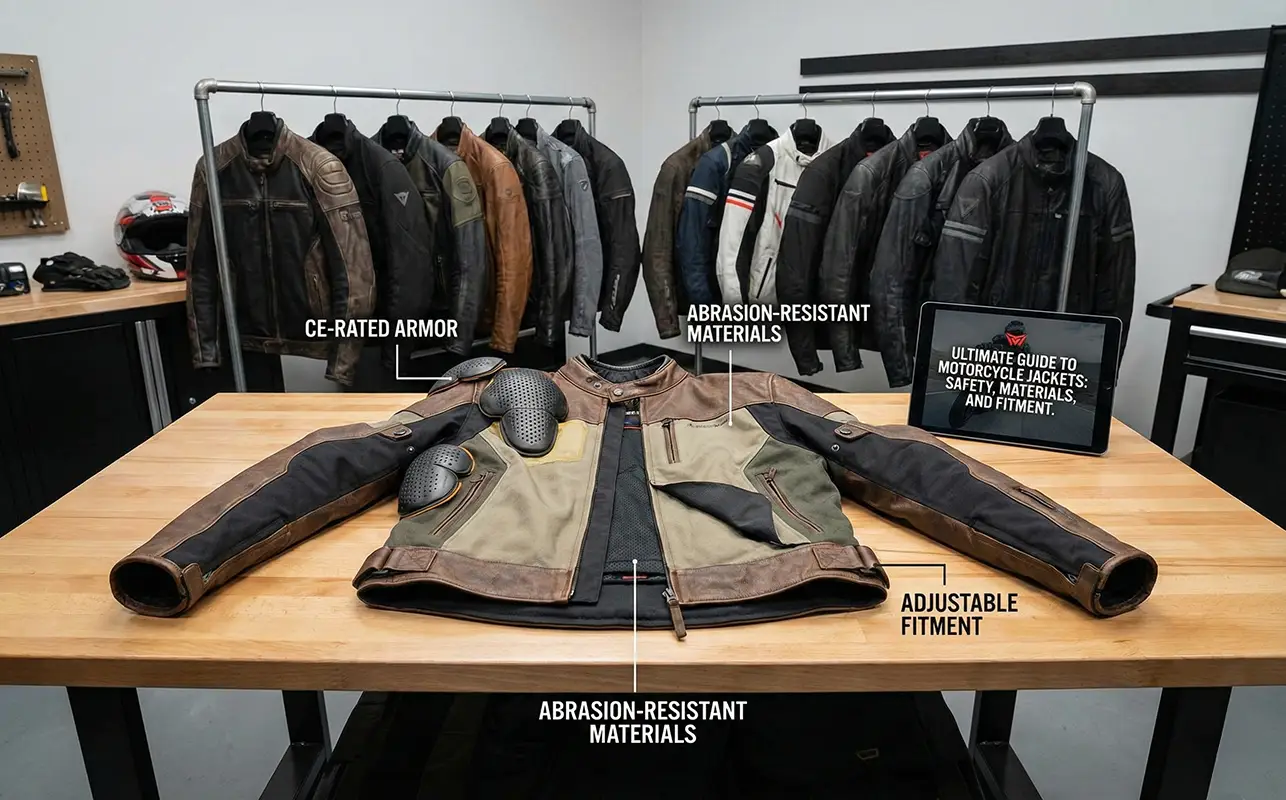
In this comprehensive guide, we’ll help you navigate the ongoing debate between leather versus textile materials, explain what those mysterious “CE” safety ratings actually mean, and ensure you purchase a jacket that fits perfectly for maximum protection.
Whether you’re commuting daily or planning weekend adventures, choosing the right motorcycle jacket is a decision your body will thank you for if things go wrong.
Just starting out with motorcycle gear? Make sure you have your helmet sorted first. Read our Ultimate Motorcycle Gear Guide before continuing with your jacket selection.
Material Wars: Leather vs. Textile vs. Mesh
When shopping for a motorcycle jacket, the first major decision you’ll face is what material to choose. Each option offers distinct advantages and drawbacks that make them suitable for different riding conditions and personal preferences.
Leather: The Classic Choice
Pros:
- Superior abrasion resistance: Leather slides better on asphalt than any other material, providing the best protection in a crash scenario.
- Timeless style: Nothing beats the classic look of a well-crafted leather motorcycle jacket.
- Longevity: With proper care, a quality leather jacket can last decades, actually improving with age as it molds to your body.
- Wind protection: Naturally blocks wind effectively once broken in.
Cons:
- Weight: Significantly heavier than textile options, which can cause fatigue on longer rides.
- Heat retention: Becomes uncomfortably hot in summer temperatures above 80°F.
- Not waterproof: Requires additional treatment and still isn’t ideal in heavy rain.
- Break-in period: Takes time to conform to your body and achieve maximum comfort.
- Cost: Quality motorcycle-specific leather jackets start around $300 and can exceed $1,000.
Best for: Sport riding, track days, cooler weather, riders prioritizing maximum protection, and those who appreciate classic styling.
Textile: The Versatile Option
Pros:
- Weather versatility: Often designed as 3-season jackets with removable liners.
- Waterproofing: Many come with built-in waterproof membranes or treatments.
- Practical features: Typically include more pockets and adjustability options.
- Lighter weight: Easier to wear for extended periods without fatigue.
- Lower maintenance: Many can be machine washed following manufacturer instructions.
Cons:
- Variable protection: Quality varies dramatically; cheap textiles can melt in high-speed slides.
- Denier matters: Look for at least 600D in impact zones; 1000D+ for maximum protection.
- Bulkier fit: Often doesn’t conform to the body as well as leather.
- Shorter lifespan: Even quality textile jackets typically need replacement after 5-7 years.
Best for: Commuting, touring, adventure riding, varied weather conditions, and riders who prioritize versatility and convenience.
Mesh: The Hot Weather Specialist
Pros:
- Maximum airflow: Direct ventilation makes riding possible in extreme heat.
- Lightweight comfort: The lightest option available, reducing rider fatigue.
- Quick-drying: If caught in rain, dries much faster than leather or standard textile.
- Affordability: Generally less expensive than comparable leather options.
Cons:
- Reduced protection: The ventilation comes at a cost to abrasion resistance.
- Single-purpose: Primarily useful only in hot weather.
- One-time crash protection: Mesh tends to tear rather than abrade in crashes, often rendering the jacket unusable after an accident.
- No weather protection: Offers minimal wind blocking and no insulation for cooler temperatures.
Best for: Summer riding, urban environments, slower speeds, tropical/desert climates, and riders who prioritize comfort in hot weather.
Making Your Choice
Your selection ultimately depends on your riding style, climate, and personal preferences:
- Primarily warm weather in urban areas? A quality mesh jacket with good armor might be sufficient.
- All-season rider in variable conditions? A textile jacket with removable liners offers the most versatility.
- Sport rider focused on maximum protection? Leather remains the gold standard for abrasion resistance.
- Can’t decide? Many experienced riders own multiple jackets for different conditions. If budget allows, a textile jacket for practical riding and a leather jacket for weekend fun provides the best of both worlds.
Remember that regardless of material, proper fit and quality armor are equally important factors in a jacket’s protective capabilities. Even the best leather won’t protect you if the armor shifts away from impact zones during a crash.
[Still can’t decide? Read our deep dive on Leather vs. Textile Jackets: Which is Right for You?]
Understanding Safety Ratings: What is “CE”?
When shopping for motorcycle jackets, you’ll encounter various “CE” labels. These aren’t just marketing jargon—they’re critical safety certifications that could make all the difference in a crash.
CE (Conformité Européenne) certification indicates that protective motorcycle gear meets specific European safety standards. While these standards originated in Europe, they’ve become the global benchmark for motorcycle safety gear.
Armor Protection Levels: CE Level 1 vs. Level 2
Motorcycle jackets contain impact protectors (commonly called “armor”) in key areas like shoulders and elbows. These protectors are rated according to their ability to absorb and distribute impact energy:
CE Level 1 Armor
- Absorbs and distributes moderate impact energy
- Standard in most entry-level and mid-range jackets
- Provides adequate protection for everyday street riding
- Thinner and more flexible, offering better comfort
CE Level 2 Armor
- Absorbs significantly more impact energy than Level 1
- Provides superior protection in high-speed crashes
- Usually thicker and potentially less flexible
- Worth the upgrade, especially for highway riding or aggressive riding styles
Most jackets come with Level 1 armor as standard. If you’re serious about protection, consider upgrading to Level 2 armor, particularly for your back protector where spine protection is critical.
Jacket Abrasion Ratings: The A/AA/AAA System
Beyond impact protection, jackets themselves are now rated on their abrasion resistance—how well they’ll hold up when sliding across pavement:
Class A Rating
- Basic protection suitable for urban riding
- Designed for lower speeds (typically city riding under 40 mph)
- Lighter weight and often more comfortable
- Appropriate for short commutes and casual rides
Class AA Rating
- Medium-level protection ideal for touring and daily riding
- Balanced compromise between protection and comfort
- Suitable for most highway riding situations
- The most common rating for all-around motorcycle jackets
Class AAA Rating
- Maximum abrasion resistance for high-speed slides
- Typically found in racing leathers and premium gear
- Heavier and potentially less comfortable for daily use
- Essential for track days or aggressive sport riding
When selecting a jacket, match the protection rating to your typical riding style. A city commuter might be fine with Class A, while someone who frequently rides highways should consider at least Class AA protection.
Remember that these ratings aren’t just marketing—they represent actual testing where materials are subjected to abrasion, tearing, and impact tests. A properly rated jacket provides scientifically verified protection rather than just promises.
Looking for comprehensive motorcycle safety information? Check out our Helmet Safety Ratings Explained guide to understand how helmet certifications work alongside jacket ratings.
The “Hidden” Upgrade: The Back Protector
When you purchase a motorcycle jacket for $300, $400, or even $500, you’d expect it to provide comprehensive protection, right? Unfortunately, there’s an industry secret that many riders discover too late: most motorcycle jackets come with nothing more than a thin foam pad in the back protector pocket.
This foam insert is not a back protector—it’s essentially a placeholder. In a serious impact, this foam offers minimal protection for one of your most vulnerable areas: your spine.
Why Stock Foam Pads Are Inadequate
The standard foam pad included with most jackets serves primarily as a comfort feature or space filler. These pads:
- Lack impact absorption capabilities
- Have no official safety certification
- Deform permanently after even minor impacts
- Provide virtually no protection against penetration injuries
Think of it this way: would you trust a helmet that wasn’t safety certified? Your spine deserves the same level of consideration.
The Importance of CE Level 2 Back Protectors
A proper CE Level 2 back protector is designed to absorb and distribute impact forces away from your spine. These protectors:
- Absorb up to 70% more impact energy than Level 1 protectors
- Maintain their protective properties through multiple impacts
- Cover a larger area of your back
- Are tested to withstand forces that would cause serious spinal injury
The difference between a foam pad and a CE Level 2 back protector could literally be the difference between walking away from a crash and not walking at all.
How to Choose the Right Back Protector Insert
When selecting a back protector for your jacket, consider these factors:
- Compatibility: Ensure it fits your specific jacket model (most manufacturers make protectors for their jacket lines)
- Coverage area: Should extend from between your shoulder blades to your tailbone
- Thickness: Thicker offers more protection but can affect comfort
- Flexibility: Should contour to your back in riding position
- Ventilation: Look for designs with air channels to reduce heat buildup
Many riders prefer articulated protectors that move with your body rather than rigid plates that can dig into your back in certain positions.
Cost Considerations
Here’s the good news: upgrading to a proper back protector is surprisingly affordable. Most quality CE Level 2 back protector inserts range from $40-$80—a small price compared to the jacket itself and an insignificant investment considering the protection it provides.
Always budget for this “hidden upgrade” when purchasing a new jacket. The $50-60 you spend on a quality back protector is perhaps the best value-for-money safety investment you can make in motorcycling.
Remember: that stock foam pad is meant to be replaced. Don’t ride without proper back protection—your spine is irreplaceable.
Learn why the foam pad is useless in our guide to [Motorcycle Armor & Back Protectors].
Fitment Guide: How Should It Fit?
When shopping for a motorcycle jacket, proper fit isn’t just about comfort—it’s about survival. Unlike regular clothing where looser fits are often preferred, motorcycle jackets follow different rules entirely.
The Snug Rule
A motorcycle jacket needs to be noticeably tighter than your casual clothes. This isn’t the clothing industry trying to make you feel bad about your physique—it’s physics. In a crash, a loose jacket will shift, twist, and potentially expose the very body parts it’s designed to protect.
Think of it this way: if your jacket is loose, the armor inside it becomes mobile. That elbow pad that’s supposed to protect your joint might rotate away during a slide, leaving your actual elbow exposed to the asphalt. The same applies to shoulder and back protection.
When trying on jackets, the initial fit should feel snug—almost like a gentle hug. You shouldn’t be able to grab handfuls of excess material anywhere, particularly around the torso.
The Reach Test
Here’s where many riders make their first mistake: they try on jackets standing with their arms at their sides, as if posing for a photograph. But that’s not how you ride.
Instead, perform the “reach test”:
- Extend your arms forward as if you’re gripping handlebars
- Lean forward slightly into your riding position
- Turn your head side to side as if checking traffic
In this position, the jacket sleeves should still fully cover your wrists. Standing normally with arms down, the sleeves might actually look too long—that’s normal and exactly what you want. When you reach for the handlebars, those seemingly long sleeves will be just right.
The jacket shouldn’t ride up excessively in the back either. A slight lift is normal, but if you’re exposing your lower back, the jacket is too short.
European vs. American Cut
Not all motorcycle jackets are cut from the same cloth—literally. There’s a noticeable difference between European and American manufacturers:
European Cut (Alpinestars, Dainese, REV’IT!):
- Slimmer overall profile
- Pronounced V-taper from shoulders to waist
- Typically tighter in the midsection
- Often longer in the sleeves relative to size
- Athletic fit assuming less body fat
American Cut (Icon, Joe Rocket, Firstgear):
- Boxier, more relaxed fit
- More room in the midsection
- Shorter in the torso generally
- Wider across the shoulders and chest
- Accommodates a greater range of body types
If you’re athletic with broad shoulders and a narrow waist, European brands might fit you better. If you have a more average build or carry extra weight around the middle, American brands could provide more comfort.
Critical Fit Points to Check
When trying on a jacket, pay special attention to these areas:
Shoulders: The armor should sit directly over your shoulder joint, not floating on top or sliding down your arm.
Elbows: Bend your arm 90 degrees. The elbow armor should cover your elbow completely, not slide down to your forearm.
Torso: Zip the jacket fully. You should be able to fit 1-2 fingers between the jacket and your body—not your entire fist.
Collar: With the jacket zipped up, the collar shouldn’t choke you, but it also shouldn’t gape open. You want it to seal against weather without restricting movement.
Remember that leather will stretch and conform to your body over time, while textile generally maintains its original fit. Factor this in when deciding between a snug or very snug leather jacket.
The perfect motorcycle jacket should feel like a second skin—protective, comfortable, and so well-fitted that you forget you’re wearing it until it saves your life.
Weather Protection: Liners and Layers
When it comes to motorcycle riding, Mother Nature doesn’t always cooperate. One day you’re riding in scorching heat, and the next morning you might face a chilly downpour. This is where the liner system in your motorcycle jacket becomes crucial.
Types of Thermal Liners
Thermal liners are your best friends during cold-weather riding. They typically come in several varieties:
- Quilted Vests/Liners: These removable inserts button or zip into your main jacket. They trap body heat while adding minimal bulk, making them perfect for those chilly morning commutes.
- Full-Sleeve Thermal Liners: Offering more comprehensive insulation than vest-style liners, these protect your arms as well as your core from cold temperatures.
- Microfleece Liners: Lighter than traditional quilted liners but still providing excellent warmth, these are perfect for fall riding when you need just a bit of extra insulation.
Most quality jackets allow you to remove these liners as the day warms up, giving you temperature flexibility without carrying extra gear.
Waterproof Liner Technologies
Nothing ruins a ride faster than being soaked to the bone. Waterproof technologies in motorcycle jackets generally fall into two main categories:
Internal Z-Liner Systems
Z-liners are waterproof membranes sandwiched between the outer shell and the inner comfort liner. They’re called Z-liners because the water must follow a Z-shaped path to reach your body.
Pros:
- More affordable than laminated options
- Typically more comfortable against the skin
- Can be removed in many jackets when not needed
Cons:
- The outer shell gets completely soaked, making your jacket heavy
- Wet outer shells can create a “cold sandwich” effect
- Takes longer to dry once wet
Gore-Tex and Laminated Systems
The gold standard in waterproofing, Gore-Tex and similar laminated technologies bond the waterproof membrane directly to the outer shell.
Pros:
- Water beads off the surface instead of soaking in
- Jacket remains lightweight even in heavy rain
- Dries much faster than Z-liner systems
- Often more breathable, reducing sweat buildup
Cons:
- Significantly more expensive
- Can be stiffer and less comfortable initially
- Requires special cleaning to maintain waterproofing
The 4-Season Jacket Myth
Many manufacturers advertise their jackets as “4-season,” promising year-round comfort with a few adjustments. Let’s be honest—this is largely marketing hype.
The reality is that a true 4-season jacket would need to excel in 100°F summer heat and sub-freezing winter conditions—an almost impossible task. What you typically get is a compromise that’s:
- Too hot for genuine summer riding (even with vents open and liners removed)
- Not quite warm enough for dedicated winter use without significant layering
- Often bulkier and heavier than specialized seasonal jackets
Most experienced riders eventually invest in at least two jackets: a well-ventilated option for warm weather and a more substantial jacket for cold conditions. This approach provides better protection and comfort than trying to make one jacket work for all situations.
For those on a budget, a quality 3-season textile jacket with removable liners offers the best compromise, with the understanding that extreme weather might require additional gear or simply choosing another transportation option.
Remember that proper layering under your jacket can extend its seasonal range considerably. Technical base layers can help manage moisture in both hot and cold conditions, while mid-layers can add warmth when temperatures drop.
Before planning a long trip across multiple climate zones, test your jacket’s performance in different weather conditions during shorter rides to avoid uncomfortable surprises far from home.
Jacket Styles by Riding Type
Choosing a motorcycle jacket that matches your riding style isn’t just about aesthetics—it’s about functionality. Different riding disciplines have unique demands, and manufacturers have developed specialized jacket designs to address these needs.
Sport/Race Jackets
Sport and race jackets prioritize aerodynamics and protection at high speeds:
- Pre-curved arms that naturally conform to a tucked, sport riding position
- Aggressive fit that eliminates flapping at highway speeds
- Aerodynamic hump on the upper back that improves airflow and houses hydration systems
- Heavy-duty protection with reinforced impact zones and thicker leather (1.2-1.4mm)
- Minimal pockets to maintain streamlined profile
- Performance stretch panels at mobility points like underarms and sides
- External sliders at shoulders and elbows
- Short front cut designed for the leaned-forward sport riding position
Sport jackets from brands like Alpinestars, Dainese, and RST typically feature race-inspired graphics and are constructed primarily from premium cowhide or kangaroo leather.
Adventure/Touring Jackets
Adventure and touring jackets are built for long-distance comfort and versatility:
- ¾ length design that extends below the belt for increased coverage and weather protection
- Multiple pockets (often 6+ storage compartments) for maps, electronics, and travel essentials
- High collar with micro-fleece lining to prevent wind intrusion
- Adjustable fit systems with waist, arm, and collar cinches
- Ventilation networks with chest, back, and arm intake/exhaust ports
- Removable thermal and waterproof liners for climate adaptability
- Reflective panels for increased visibility
- Connection zippers to attach to matching pants for full-body protection
Adventure jackets from Klim, REV’IT!, and Rukka often utilize advanced textiles like 750D Cordura with Gore-Tex waterproofing technology.
Cruiser/Classic Jackets
Cruiser and classic-styled jackets blend traditional aesthetics with modern protection:
- Simple, timeless leather designs with minimal branding
- Relaxed, upright fit suited for the cruiser riding position
- Hidden or subdued armor that maintains the classic look
- Minimal technical features with emphasis on style
- Traditional materials like heavyweight buffalo or cowhide leather
- Classic details such as snap collars, quilted panels, and belt adjusters
- Longer back to accommodate the upright riding position
Brands like Roland Sands Design, Merlin, and Indian Motorcycle offer heritage-inspired jackets that don’t scream “motorcycle gear” when you’re off the bike.
Urban/Commuter Jackets
Urban and commuter jackets focus on versatility and inconspicuous protection:
- Casual styling that resembles everyday fashion (hoodies, flannel shirts, denim jackets)
- Protective reinforcement with Kevlar, Aramid, or Cordura lining
- Discreet armor pockets that accommodate CE protectors without bulky appearance
- Weather-resistant treatments for unexpected rain showers
- Reflective details that remain hidden until illuminated
- Practical features like secure internal pockets for valuables and electronics
- Lighter weight construction for comfort during daily use
Brands like Resurgence Gear, Knox, and REV’IT! excel at creating protective gear that doesn’t look like traditional motorcycle apparel.
When selecting a jacket style, consider your primary riding environment, typical distance, and the riding position of your motorcycle. A sport jacket on a cruiser (or vice versa) creates ergonomic challenges that can lead to discomfort on longer rides. The best jacket is one that complements both your motorcycle and your riding habits.
Riding a cafe racer? Check out our list of [Best Retro Motorcycle Jackets].
Best Motorcycle Jackets for Beginners offers excellent recommendations for new riders still discovering their preferred style.
Construction Quality: What Makes a Great Motorcycle Jacket
When shopping for a motorcycle jacket, looking beyond style and brand names to assess construction quality can be the difference between adequate protection and exceptional safety. The devil is truly in the details when it comes to motorcycle gear.
Seam Strength: The Hidden Lifesaver
Seams are often the first failure point in a crash. Premium motorcycle jackets feature double or triple stitching, especially at impact zones like shoulders, elbows, and back. Look for:
- Multiple-row stitching: More rows mean stronger connections between panels
- Reinforced stress points: Extra stitching where panels meet at angles
- Safety stitching: Special patterns that prevent entire seams from unraveling if one thread breaks
A quick test: gently pull the seams apart with your fingers. Quality stitching should feel tight and immovable.
Zipper Quality: More Than Just Convenience
Zippers aren’t just about getting in and out of your jacket—they’re critical safety components. Premium jackets typically feature:
- YKK or equivalent quality zippers: The industry standard for reliability
- Metal zippers: More durable than plastic alternatives
- Zipper garages: Small fabric flaps that prevent wind penetration and zipper scratching
- Connection zippers: Allow pants attachment for full-body protection
Ventilation Systems: Staying Cool Under Pressure
Effective ventilation can make the difference between a comfortable ride and a miserable sweat session:
- Strategic vent placement: Chest, back, and underarm vents create effective airflow tunnels
- Two-way zippers: Allow precise control over ventilation
- Mesh-backed vents: Prevent the jacket from ballooning at speed
- Exhaust vents: Paired with intake vents to create true air circulation
Armor Pockets: Protection Where You Need It
Quality jackets include thoughtfully designed armor pockets:
- Adjustable pocket positions: Allow customized placement of armor to your body
- Secure closures: Keep armor in place during a crash
- Back protector pocket: Large enough for substantial CE Level 2 protection
- Chest protector provisions: Additional protection for vital organs
Adjustment Features: The Perfect Fit
A properly fitted jacket keeps armor in position during a crash:
- Waist adjusters: Prevent jacket ride-up
- Arm adjusters: Eliminate flapping material
- Collar adjustments: Seal out wind and rain
- Cuff closures: Secure glove overlap to prevent exposed skin
Remember that a well-constructed motorcycle jacket might cost more upfront, but the investment pays dividends in both comfort and protection. As riders often say, “Dress for the slide, not just the ride.”
Looking for specific recommendations? Check out our best motorcycle jackets for beginners guide for top options at various price points.
Understanding Motorcycle Jacket Prices: Where to Invest and Where to Save
When shopping for your first motorcycle jacket, the price tags can cause serious sticker shock. Quality motorcycle jackets typically range from $200 to $1000+, but understanding where that money goes helps you make smarter purchasing decisions.
Price Ranges by Jacket Type
Entry-Level Textile Jackets: $150-300
These provide basic protection with CE Level 1 armor in shoulders and elbows (but usually just foam in the back). Brands like Joe Rocket, Alpinestars’ lower-end models, and REAX offer decent protection at this price point.
Mid-Range Textile Jackets: $300-500
These jackets feature improved materials with higher abrasion resistance, better waterproofing, and often more sophisticated ventilation systems. Look for brands like REV’IT!, Dainese, and Klim’s entry-level offerings.
Entry-Level Leather Jackets: $250-400
Basic leather protection with minimal features. The leather quality is acceptable but not premium. Brands like Icon and First Manufacturing provide good value here.
Premium Leather Jackets: $500-1000+
These feature top-grain leather, comprehensive armor systems, and superior construction. Brands like Dainese, Alpinestars, and REV’IT! dominate this category with jackets that can last a decade or more with proper care.
Adventure/Touring Jackets: $400-1200
These technical jackets command higher prices due to their modularity, weather resistance, and comprehensive protection systems. The premium you pay delivers versatility across multiple riding conditions.
Smart Investment Areas
Back Protection: $50-100
Most jackets come with a basic foam insert. Upgrading to a CE Level 2 back protector is one of the wisest investments you can make. Your spine deserves the best protection possible.
Quality Leather: Worth the Premium
A well-made leather jacket can last 10+ years and provide superior abrasion resistance. The cost-per-year makes premium leather a surprisingly economical choice for frequent riders.
Armor Upgrades: $20-40 per piece
Upgrading from CE Level 1 to Level 2 armor in key impact zones provides significantly better protection for a relatively small investment.
Where You Can Save
Last Season’s Models: 20-40% Savings
Motorcycle jacket technology doesn’t change dramatically year to year. Last season’s colors and styles often go on clearance, offering the same protection at substantial discounts.
Avoid Paying for Fashion
Some brands charge a premium for styling. While looking good matters, prioritize protection over fashion-forward designs if you’re on a budget.
Skip “Four-Season” Claims
Rather than buying an expensive “do-everything” jacket that compromises in every condition, consider a dedicated warm-weather jacket and add layers for colder months.
The Cost of Replacement After Crashes
One aspect many riders overlook is that motorcycle jackets are essentially single-crash items. After a significant slide, the jacket has done its job and needs replacement:
- Textile jackets will likely have melted or torn areas that compromise protection
- Leather jackets might be salvageable after minor slides, but significant abrasion will have removed too much material for safety
- Internal armor can develop microscopic cracks that reduce impact protection
Some manufacturers offer crash replacement discounts, which can save 30-50% on a replacement jacket. Ask about these policies before purchasing.
Remember that while $400 might seem expensive for a jacket, it’s considerably cheaper than a hospital stay. When viewed as insurance for your skin and bones, quality motorcycle jackets represent remarkable value for the protection they provide.
Maintenance: Keeping Your Motorcycle Jacket Alive
Your motorcycle jacket is more than just riding gear—it’s an investment in your safety and comfort. Proper maintenance not only extends its lifespan but ensures it performs optimally when you need it most. Let’s explore how to care for different jacket materials to keep them in prime condition for years to come.
Smelly gear? Here is [How to Wash Your Motorcycle Jacket] properly.
Leather Care: Preserving Your Second Skin
Leather jackets require regular attention to prevent them from drying out, cracking, and losing their protective qualities:
- Regular cleaning: Wipe down your leather jacket with a slightly damp cloth after rides to remove dust, bugs, and road grime. For deeper cleaning, use specialized leather cleaners that don’t strip natural oils.
- Conditioning is crucial: Apply a quality leather conditioner every 3-6 months (more frequently if you ride in harsh conditions). This prevents the leather from drying out and maintains its flexibility and strength. Work the conditioner in with gentle circular motions and let it absorb overnight.
- Address scuffs promptly: Minor scuffs can be buffed out with appropriate leather creams. Don’t let damage accumulate, as it can compromise the jacket’s integrity.
- Waterproofing: Apply a leather-specific waterproofing treatment annually to maintain water resistance without affecting breathability.
Textile Care: Technical Maintenance
Textile jackets require different care techniques to preserve their technical properties:
- Follow manufacturer instructions: Always check the care label first, as some advanced fabrics have specific requirements.
- Specialized detergents: Use technical wash products like Nikwax Tech Wash rather than regular laundry detergent. Standard detergents can damage waterproof membranes and leave residues that attract dirt.
- Never use fabric softener: This is the cardinal sin of textile gear maintenance. Fabric softeners clog the micropores in waterproof membranes, destroying their ability to repel water while allowing vapor to escape.
- Reactivate DWR coatings: After washing, apply a spray-on durable water repellent (DWR) treatment to restore the outer fabric’s ability to shed water.
- Gentle cycle, air dry: Wash on gentle cycles with similar colors, zip all zippers, and close all hook-and-loop fasteners. Air dry your jacket rather than using a machine dryer unless specifically recommended by the manufacturer.
Proper Storage Techniques
How you store your jacket between rides and seasons matters significantly:
- Use wide, padded hangers: Wire hangers can distort the shape of your jacket, especially heavier leather ones. Invest in quality hangers that support the shoulders properly.
- Allow air circulation: Never store jackets in plastic bags or airtight containers, which can trap moisture and lead to mold growth. Breathable garment bags are ideal for long-term storage.
- Keep away from direct sunlight: Prolonged exposure to sunlight can fade colors and weaken fabrics. Store in a cool, dark place.
- Stuff sleeves lightly: For leather jackets, lightly stuff the sleeves with acid-free tissue paper to help maintain their shape during long storage periods.
- Address moisture issues: If your jacket gets soaked, ensure it’s completely dry before storing. For leather, allow it to dry naturally away from direct heat sources.
When to Replace Your Jacket
Even with excellent care, motorcycle jackets don’t last forever. Here are signs it’s time for a replacement:
- Post-crash damage: If your jacket has protected you in a crash, thank it for its service and replace it. Even if damage isn’t visible, the protective qualities may be compromised.
- Worn impact zones: Thinning leather or fraying textile in high-impact areas (elbows, shoulders, back) indicates diminished protection.
- Failed seams: Broken stitching, especially in critical safety areas, can compromise the jacket’s ability to stay intact during a slide.
- Armor degradation: If the armor pockets are stretched or the armor itself is cracked or damaged, protection is compromised.
- Zipper failures: While some zippers can be replaced, failure of main closure systems often indicates end-of-life for the jacket.
- Waterproofing beyond repair: If your textile jacket still soaks through despite proper care and reproofing, it’s likely time for a replacement.
Remember that proper maintenance isn’t just about aesthetics—it’s about preserving the protective qualities that might one day save your skin. A well-maintained jacket not only looks better but performs better when you need it most.
Women’s Motorcycle Jackets: Fit, Design, and Considerations
When it comes to motorcycle jackets, women riders have unique needs that go beyond just “shrinking and pinking” men’s gear. The right women’s motorcycle jacket combines safety features with a cut designed specifically for female body proportions.
How Women’s Jackets Differ in Cut and Design
Women’s motorcycle jackets are engineered with several key differences from men’s versions:
- Tailored waistlines: Women’s jackets typically feature a more pronounced taper at the waist to accommodate natural curves
- Adjusted chest proportions: More room in the bust area with strategic armor placement that doesn’t compromise protection
- Shorter torso length: Women generally have shorter torsos relative to their height compared to men
- Narrower shoulders: The armor placement and overall cut reflects typically narrower female shoulder width
- Different hip-to-waist ratios: Women’s jackets allow more room through the hips while maintaining a secure fit
Many manufacturers now use body-mapping technology to design jackets that protect the female form without restricting movement or comfort.
Fit Considerations Specific to Women Riders
When shopping for a motorcycle jacket, women riders should prioritize:
- Proper armor placement: Shoulder and elbow protectors should sit directly over these joints when in riding position
- Riding position compatibility: Sport bike riders need more pre-curved sleeves than cruiser riders
- Room for layering: Consider whether you’ll need to wear additional layers underneath during colder weather
- Length in riding position: The jacket should cover your lower back completely when leaning forward
- Sleeve length: Sleeves should reach your wrists when arms are extended to handlebars
Remember that motorcycle jackets should fit more snugly than casual jackets. If you can pinch more than an inch of material at the sides, it’s likely too loose and the armor won’t stay in position during a crash.
Top Women’s Motorcycle Jacket Brands
Several manufacturers have invested significantly in women-specific designs:
- Dainese: Known for their Italian styling and excellent ergonomic fit for women
- Alpinestars: Offers a wide range of women’s jackets from sport to touring with excellent protection
- REV’IT!: Their women’s line features innovative materials and thoughtful design details
- Icon: Popular for urban riding with women-specific cuts that don’t sacrifice protection
- Klim: Excellent adventure and touring options with female-specific sizing
Each brand tends to have its own fit profile, so trying multiple brands is often necessary to find your perfect match.
Common Fit Issues to Avoid
Women riders frequently encounter these problems when selecting jackets:
- Too tight across the chest: Creates discomfort and restricts movement
- Armor that shifts position: If elbow protectors slide away from joints, protection is compromised
- Gapping at the lower back: Exposes skin when in riding position
- Excess material bunching: Creates pressure points and wind buffeting
- Sleeves too long or short: Proper coverage of wrists is essential for protection
Don’t settle for a jacket that “almost” fits. The right jacket feels like a second skin in riding position, not just when standing in the store.
Many women find success with adjustable jackets featuring waist cinches, sleeve adjusters, and multiple snap positions that allow for customization of fit. These features are particularly helpful for riders with proportions that don’t align with standard sizing.
Visibility Features: Being Seen on the Road
When it comes to motorcycle safety, being visible to other road users is just as important as protecting yourself in a crash. Many riders focus exclusively on protective features while overlooking visibility elements that could prevent accidents in the first place.
Reflective Materials
Most quality motorcycle jackets incorporate reflective piping or panels that illuminate when headlights shine on them. These materials work through retroreflection—tiny glass beads or prismatic patterns that return light directly to its source. Look for jackets with reflective elements positioned on the shoulders, back, and arms for maximum visibility from multiple angles.
The difference between basic and premium reflective materials is significant. Higher-end jackets often use 3M Scotchlite™ or similar industrial-grade reflective materials that maintain brightness even after years of use and washing. Budget jackets may use reflective elements that dim significantly after just a few months of wear.
Hi-Viz Color Options
The science is clear: fluorescent yellow-green (often called “hi-viz”) is the most visible color across various lighting conditions. This is why emergency vehicles and road workers worldwide use this specific shade. Many manufacturers offer hi-viz versions of their popular jacket models at no additional cost.
While black remains the most popular color choice for motorcycle jackets, consider these alternatives that significantly improve your visibility:
- Hi-viz yellow/green (most visible in all conditions)
- Orange (highly visible in urban environments)
- White (excellent contrast against dark roads)
- Bright red (stands out in daylight conditions)
Balancing Style with Visibility
Many riders resist hi-viz gear because of aesthetic concerns. Fortunately, manufacturers have responded with clever design solutions:
- Two-tone jackets with hi-viz panels only on critical visibility areas
- Removable hi-viz vests that can be worn over any jacket
- Subtle reflective elements that remain invisible until illuminated
- Strategic placement of bright colors on shoulders and arms where they’re most visible to drivers
Remember that visibility doesn’t always mean wearing a jacket that resembles a traffic cone. Modern designs incorporate safety elements while maintaining a stylish appearance.
Add-On Visibility Enhancements
If your preferred jacket lacks adequate visibility features, consider these aftermarket options:
- Reflective vest overlays
- Clip-on LED lights
- Reflective arm bands
- Helmet reflective tape
- Backpack covers with reflective elements
These affordable additions can dramatically improve your visibility without requiring you to replace your favorite jacket.
Effectiveness in Different Conditions
Visibility needs change dramatically based on riding conditions:
Daytime: Bright colors (yellow, orange, red) provide the best contrast against typical backgrounds.
Nighttime: Reflective elements become crucial, as colors alone are difficult to distinguish in darkness.
Dawn/Dusk: The most dangerous times for visibility. Both bright colors AND reflective elements are essential during these transition periods.
Fog/Rain: Hi-viz yellow-green penetrates fog better than any other color, while reflective elements help in rainy conditions when headlights create more reflection.
For riders who frequently travel in varying conditions, investing in a jacket with both bright coloration and quality reflective elements provides the most comprehensive visibility protection.
Remember that the Ultimate Motorcycle Gear Guide emphasizes visibility as one of the key safety factors when selecting riding apparel. While protection in a crash is vital, preventing that crash through enhanced visibility could be the most important feature of your motorcycle jacket.
The Future of Protection: Motorcycle Airbag Jackets
Motorcycle safety technology has evolved dramatically over the past decade, with airbag jackets representing the cutting edge of rider protection. These innovative garments are designed to deploy in milliseconds during a crash, providing crucial protection to your vital organs and spine when you need it most.
How Airbag Technology Works
Motorcycle airbag jackets contain inflatable chambers strategically positioned to protect your most vulnerable areas: chest, back, shoulders, and collarbones. When triggered, these chambers inflate with gas in a fraction of a second (typically 20-40 milliseconds), creating a rigid cushion that absorbs impact energy and prevents hyperextension injuries.
The technology works similar to automotive airbags but with specialized adaptations for motorcycling. The inflated jacket creates a protective cocoon around your torso, reducing the force transmitted to your body during impact and preventing many common crash injuries.
Electronic vs. Mechanical Deployment Systems
There are two primary deployment technologies in today’s market:
Electronic Systems:
- Use sophisticated algorithms and sensors (accelerometers, gyroscopes, GPS)
- Continuously analyze rider position and bike dynamics 100+ times per second
- Can detect crashes before impact in many scenarios
- Require charging (typically 20-25 hours of riding time)
- Examples: Dainese D-air, Alpinestars Tech-Air, Klim Ai-1
Mechanical Systems:
- Use a physical tether connected to the motorcycle
- Deploy when the rider separates from the bike with sufficient force
- No batteries or charging required
- Simpler technology but potentially slower deployment
- Examples: Helite Turtle, Hit-Air systems
The electronic systems offer more sophisticated crash detection but come with higher prices and maintenance requirements. Mechanical systems provide reliable protection with less complexity but may have limitations in certain crash scenarios.
Cost Comparison
Airbag technology represents a significant investment in your safety:
- Entry-level mechanical systems: $500-700
- Mid-range electronic vests: $800-1,200
- Premium integrated airbag jackets: $1,500-2,500
While this represents a considerable premium over standard protective gear, many riders consider it worthwhile given the substantial safety benefits. Some manufacturers now offer subscription models where you purchase the vest and pay a monthly fee for the electronic monitoring system.
Real-World Effectiveness
Research and real-world crash data have demonstrated the remarkable effectiveness of airbag technology:
- Reduces transmitted forces to the torso by up to 95%
- Decreases risk of serious thoracic injuries by approximately 56%
- Virtually eliminates collarbone fractures in direct impacts
- Significantly reduces spinal compression injuries
MotoGP and professional racing have embraced this technology universally, with riders crediting airbag systems for walking away from crashes that would have previously caused serious injury. The technology has now filtered down to consumer products that offer similar levels of protection.
Popular Models on the Market
Several manufacturers have established themselves as leaders in airbag technology:
Alpinestars Tech-Air 5: A versatile electronic system that can be worn under any properly sized motorcycle jacket. Offers comprehensive upper body protection with approximately 20-25 hours of active riding time per charge.
Dainese Smart Jacket: An innovative vest that can be worn over or under any jacket. Uses the sophisticated D-air® algorithm developed through MotoGP racing experience.
Klim Ai-1: An electronic airbag vest with a subscription-based model that makes the technology more accessible to everyday riders.
Helite Turtle 2: A mechanical system known for its reliability and additional back protector. Popular among touring and adventure riders for its simplicity.
As this technology continues to evolve, we’re seeing more affordable options entering the market, making this life-saving innovation accessible to more riders every year.
Common Mistakes to Avoid When Buying a Motorcycle Jacket
Purchasing your first motorcycle jacket is exciting, but it’s easy to make errors that could compromise your safety or comfort. Let’s examine the most common pitfalls new riders fall into when selecting this crucial piece of gear.
Choosing Style Over Safety
The sleek, minimalist leather jacket you saw in that motorcycle movie might look fantastic, but does it offer adequate protection? Many riders, particularly beginners, prioritize aesthetics over safety features. That vintage-inspired jacket with no armor inserts might earn you style points at the coffee shop, but it won’t protect your shoulders, elbows, or spine in a crash.
Remember that fashion-oriented “motorcycle-style” jackets from mainstream retailers are designed to look the part but offer virtually no protection. In a slide across asphalt, these fashion pieces can literally melt into your skin rather than protecting it. Always verify that your jacket meets CE safety standards and includes proper armor points, regardless of how it looks.
Improper Sizing Errors
One of the most common mistakes is buying a motorcycle jacket that’s too loose. Unlike casual wear, motorcycle jackets should fit snugly. Many riders purchase jackets in their regular clothing size only to discover this critical error too late.
A properly fitted jacket keeps armor positioned correctly over your impact points. If your jacket is too loose, the elbow armor can rotate away from your joint during a crash, leaving you unprotected exactly when you need it most. Conversely, a jacket that’s too tight restricts movement and becomes uncomfortable during rides.
When trying on jackets, assume the riding position—arms extended forward as if gripping handlebars. The sleeves should still cover your wrists completely, and there shouldn’t be excess material bunching around your torso.
Seasonal Limitation Pitfalls
Many new riders purchase a jacket perfect for summer riding without considering the other three seasons. That ventilated mesh jacket feels amazing in July but becomes virtually unusable by October.
Similarly, buying a heavily insulated leather jacket might seem cozy for winter rides, but you’ll be sweltering in warmer months. Consider your typical riding season and climate before purchasing. If you ride year-round, you might need multiple jackets or a versatile option with removable thermal and waterproof liners.
Be wary of marketing claims about “4-season jackets.” While these adaptable options exist, they often represent compromises in all conditions rather than excellence in any particular season. A true all-weather jacket typically comes with a higher price tag reflecting its sophisticated design and materials.
Ignoring Armor Quality
Not all armor is created equal. Many budget jackets come with basic foam inserts that offer minimal impact protection. Even more concerning, most jackets—even premium ones—come with a simple foam back pad that provides virtually no spine protection in a crash.
Always check the CE rating of included armor. CE Level 1 provides basic protection, while CE Level 2 offers superior impact absorption. If your jacket comes with Level 1 armor, consider upgrading to Level 2, especially for spine protection.
Perhaps the most dangerous oversight is failing to replace the stock foam back pad with a proper CE-rated back protector. This relatively inexpensive upgrade (typically $40-70) significantly enhances protection for one of your most vulnerable areas.
Overlooking Comfort for Long Rides
That jacket might feel fine in the store for five minutes, but how will it feel after three hours on the highway? New riders often underestimate the importance of long-term comfort features.
Consider factors like collar design (will it chafe your neck?), seam placement (any pressure points when leaning forward?), and ventilation options. A jacket with strategically placed vents can make the difference between an enjoyable journey and a sweat-soaked ordeal.
Weight is another overlooked factor—a heavy leather jacket might provide excellent protection, but the fatigue from carrying that extra weight can affect your concentration and reaction time on longer rides.
Remember that your motorcycle jacket is more than just protective gear—it’s equipment you’ll wear for hours at a time. Balancing safety with comfort ensures you’ll actually wear it consistently rather than leaving it in the closet because it’s uncomfortable.
Conclusion: Finding Your Perfect Motorcycle Jacket
Choosing the right motorcycle jacket is a crucial decision that balances protection, comfort, and style. Throughout this guide, we’ve covered the essential aspects of motorcycle jackets to help you make an informed choice.
Remember these key takeaways:
- Safety comes first: Always prioritize jackets with proper CE-rated armor and abrasion resistance appropriate for your riding style
- Material matters: Leather offers superior abrasion resistance, while textile provides versatility and often better weather protection
- Fit is critical: A properly fitting jacket keeps armor in place during a crash
- Back protection: Most jackets come with inadequate back padding—budget for a proper CE Level 2 back protector
- Consider your riding style: Sport, touring, adventure, or urban riding all benefit from specific jacket designs
Your ideal jacket will depend on your typical riding conditions:
- Sport riders: Look for pre-curved sleeves, aerodynamic fit, and high abrasion resistance
- Touring enthusiasts: Prioritize weather protection, adjustability, and ample storage
- Adventure riders: Seek versatility with removable liners and excellent ventilation
- Urban commuters: Balance protection with everyday wearability and convenience
While it’s tempting to choose based on looks alone, remember that your jacket is your primary defense against road rash and impact injuries. The right jacket should feel like a second skin—protective and comfortable for the long haul.
Ready to find your perfect motorcycle jacket? Check out our best motorcycle jackets for beginners guide for specific recommendations that combine safety, comfort, and value.
FAQs About Motorcycle Jackets
Can I use a regular leather jacket from a fashion store for motorcycle riding?
No, fashion leather jackets are not designed for motorcycle safety and will disintegrate in seconds during a crash. Motorcycle-specific jackets use thicker, higher-quality leather (typically 1.2-1.4mm) with reinforced stitching and armor pockets. Fashion jackets lack these critical safety features and can actually melt into your skin during a slide across asphalt.
Do I really need to buy a separate back protector for my new jacket?
Yes, absolutely. Most motorcycle jackets, even expensive ones, only include a thin foam pad in the back pocket that provides minimal protection. A proper CE Level 2 back protector costs between $40-80 and significantly improves spine protection. This is one of the most important upgrades you can make to your riding gear.
How tight should a motorcycle jacket fit?
A motorcycle jacket should fit snugger than your regular clothes but not restrict movement. You should only be able to fit 1-2 fingers between the jacket and your body when zipped up. The key test is extending your arms forward in riding position—sleeves should still cover your wrists completely, and armor should stay positioned over your shoulders and elbows.
What’s the difference between CE Level 1 and Level 2 armor?
CE Level 2 armor absorbs significantly more impact energy than Level 1—approximately 70% more protection. Level 1 is adequate for casual street riding, while Level 2 provides superior protection for highway speeds and aggressive riding. Most jackets come with Level 1 as standard, but upgrading to Level 2, especially for back protection, is highly recommended.
Is a textile jacket as protective as leather?
High-quality textile jackets with 600D or higher denier ratings in impact zones can provide excellent protection, though leather still offers superior abrasion resistance in high-speed slides. Textile jackets excel in versatility, weather protection, and practicality. For maximum protection in sport riding or track days, leather remains the gold standard, but quality textile jackets are perfectly adequate for most street riding.
Can one motorcycle jacket work for all seasons?
While manufacturers market “4-season” jackets, they typically represent compromises rather than excellence in any condition. A true versatile jacket needs removable thermal and waterproof liners, but even then, it will be too hot for genuine summer riding and not quite warm enough for winter without additional layers. Most experienced riders eventually own at least two jackets for different weather conditions.
How do I know what CE rating my jacket has?
Look for labels inside the jacket or on the armor itself indicating CE certification. The jacket’s overall abrasion rating (A, AA, or AAA) should be listed on a permanent label, usually near the size tag. Individual armor pieces will have their own CE Level 1 or Level 2 markings. If you can’t find these labels, the jacket may not be properly certified for motorcycle use.
Should I buy a jacket one size larger to fit layers underneath?
No, buy the correct size for your body and choose a jacket designed with removable liners if you need cold-weather versatility. Buying oversized jackets causes armor to shift away from impact zones during a crash, compromising protection. Quality motorcycle jackets are designed with enough room for appropriate base layers without needing to size up.
How often should I replace my motorcycle jacket?
Replace your jacket immediately after any crash where it protected you, even if damage isn’t visible. Without crashes, quality leather jackets can last 10+ years with proper care, while textile jackets typically need replacement after 5-7 years. Replace any jacket showing worn impact zones, failed seams, damaged armor, or compromised waterproofing that can’t be restored.
Are motorcycle airbag jackets worth the extra cost?
Motorcycle airbag jackets provide exceptional protection, reducing transmitted forces to the torso by up to 95% and decreasing serious thoracic injury risk by approximately 56%. While they cost significantly more ($500-2,500), the safety benefits are substantial. If your budget allows and you frequently ride at highway speeds, airbag technology represents one of the best safety investments available to motorcyclists today.