When we swing a leg over a motorcycle, we enter into an unwritten contract with physics—one that doesn’t care about our experience level, our confidence, or our aesthetic preferences. The harsh reality that many riders fail to grasp is just how fragile the human brain truly is.
Consider this sobering fact: a fall from just 33 centimeters (approximately 13 inches) can be fatal. That’s less than the height of your knee. If your unprotected head strikes the pavement at a specific angle from this minimal height, the impact force is sufficient to cause a traumatic brain injury (TBI) that could end your life.
Most of us have never worried about falling while standing still because our bodies have evolved sophisticated reflexes to protect us. When you trip while walking, your arms instinctively shoot forward to break your fall. Your knees bend to absorb impact. Your body contorts to distribute force away from vital organs.
But on a motorcycle, these evolutionary advantages vanish completely. Your hands are committed to the handlebars; your feet are positioned on the pegs. In a crash scenario—particularly in a “high-side” where the bike literally launches you—you have zero control over how your body lands. Your head essentially becomes a projectile, subject only to the merciless laws of physics.
This is why helmet choice isn’t just about compliance with the law or looking the part. It’s about understanding that the 3-4 pounds of engineered protection you place on your head represents the difference between walking away from a crash and not walking again. The science is unambiguous: properly fitted, well-constructed helmets dramatically reduce the risk of fatal head injuries.
When riders choose to forego helmets or select inadequate ones based on style rather than substance, they’re making decisions based on a fundamental misunderstanding of the risks involved. The freedom of the open road comes with responsibilities—first among them is acknowledging that our bodies weren’t designed to survive impacts at the speeds motorcycles can achieve.
The Physics of Survival: Why Shape Matters More Than Price
When riders shop for helmets, they’re often drawn to flashy graphics and aggressive styling. However, the most critical safety feature isn’t the carbon fiber construction or the price tag—it’s the basic shape of the helmet itself.
The “Glancing Off” Theory
In motorcycle crashes, direct impacts are only part of the danger. What happens after initial impact can be equally critical to your survival. This is where the “glancing off” theory becomes essential.
When your helmet strikes the pavement at speed, it needs to slide across the surface rather than catch or grip. This sliding action disperses energy gradually instead of transferring it all at once to your skull and brain. Think of it like skipping a stone across water versus dropping it straight in—one dissipates energy, the other concentrates it.
The highest-level racing helmets used in MotoGP aren’t adorned with dramatic fins and sharp angles. They’re purposefully designed with smooth, rounded shells that promote this glancing effect. This isn’t a styling choice—it’s a calculated safety decision based on crash dynamics.
Round vs. Angular: A Matter of Life and Death
The physics is simple but profound: a smooth, oval helmet allows impact forces to be channeled away from your head by sliding across the impact surface. When a helmet catches or snags on asphalt, all that forward momentum must go somewhere—and that somewhere is directly into your neck and brain.
Consider what happens in a 60 mph crash:
- A round helmet will slide, gradually scrubbing off speed
- An angular helmet with protruding features can catch on road imperfections
- Each snag point creates a potential fulcrum for neck rotation
This is why professional racers, who have access to any helmet technology they want, consistently choose designs that prioritize smooth, rounded shells over aggressive styling.
The Hidden Danger of Rotational Energy
When a helmet snags during a crash, something particularly dangerous happens. The linear energy of your forward motion instantly converts to rotational energy. This rotation creates torsional forces on your neck and, more critically, causes your brain to rotate within your skull.
This rotation can lead to Diffuse Axonal Injury (DAI)—one of the most devastating forms of traumatic brain injury. Unlike localized impacts that damage specific brain regions, DAI tears axons (the long connecting fibers between neurons) throughout the brain. The damage is widespread and often irreversible.
Even a seemingly minor crash can become catastrophic if your helmet catches on the road surface and initiates this rotational acceleration. Your brain, floating in cerebrospinal fluid, continues moving after your skull has suddenly changed direction, causing shearing forces that tear neural connections.
Engineering Over Aesthetics
The next time you’re drawn to a helmet with aggressive styling, ask yourself: “Is this design optimized for sliding, or for looking cool?” Those sharp angles, protruding vents, and decorative ridges might look impressive in the showroom, but on the asphalt, they become potential snag points that could convert your forward momentum into deadly rotational force.
The safest helmets follow a simple principle: they’re designed to slide, not catch. Their rounded, smooth shells may seem boring by comparison, but they’re engineered specifically to protect your brain by promoting that crucial glancing effect during a crash.
Remember: in the split second of impact, physics doesn’t care about how cool your helmet looks—it only responds to shape, angle, and momentum. Choose accordingly.
Helmet Anatomy & Material Science: Understanding Your Helmet’s Construction
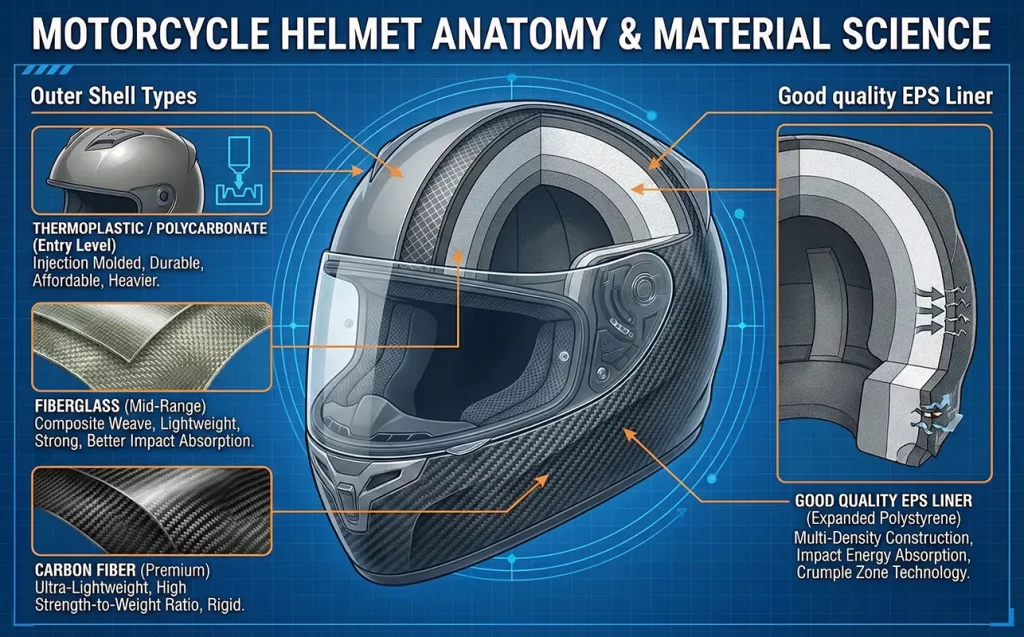
A motorcycle helmet isn’t just a simple shell—it’s a sophisticated piece of safety equipment with multiple layers working together to protect your most valuable asset: your brain. Each helmet consists of three critical layers, with the outer shell being the first line of defense.
1. The Outer Shell: Your First Line of Defense
The hard outer shell serves two vital functions: preventing sharp objects from penetrating your helmet and distributing the force of an impact across a wider surface area. The material of this shell significantly affects the helmet’s protective qualities, weight, and your overall riding experience. Your main options include:
# Thermoplastic/Polycarbonate (Entry Level)
These helmets are created through injection molding—essentially pouring molten plastic into a pre-shaped mold. Think of it as mass-produced armor for your head. While they provide adequate protection for everyday riding, manufacturers must make these shells thicker to achieve safety certifications, resulting in a significant weight penalty.
Advantages:
- Significantly more affordable than other options
- Highly durable against everyday knocks and minor impacts
- Resistant to UV degradation
- Can be manufactured in various colors and designs easily
- Good for beginner riders on a budget
Disadvantages:
- Considerably heavier than premium materials
- Requires greater thickness to achieve necessary strength
- Less effective at distributing impact forces
- May transmit more vibration to your head during riding
- Typically shorter lifespan than premium materials
# Fiberglass (Mid-Range)
A distinct step up in both price and performance, fiberglass helmets consist of hand-laid glass fiber weaves saturated with resin. These shells are not only lighter than plastic alternatives but also employ a beneficial failure mechanism—they crack and delaminate upon impact. This process of breaking apart actually helps absorb energy, preventing it from transferring to your head.
Properties:
- Significantly lighter than plastic alternatives
- Superior strength-to-weight ratio compared to thermoplastic
- Engineered to crack and delaminate upon impact—this controlled failure actually absorbs energy that would otherwise reach your head
- Better at distributing impact forces across the shell
- More comfortable for longer rides due to reduced weight
- Moderately priced, offering good value for serious riders
# Carbon Fiber (Premium)
The gold standard used in MotoGP and Formula 1, carbon fiber shells offer an unmatched strength-to-weight ratio. Their molecular structure distributes impact force almost instantaneously across the entire shell. While significantly more expensive, the reduced neck fatigue from the lighter weight and superior energy management capabilities make carbon fiber helmets worth considering for serious riders.
Benefits:
- Exceptional strength-to-weight ratio—the lightest option available
- Nearly instantaneous distribution of impact force across the entire helmet
- Significantly reduces rider fatigue on long journeys due to minimal weight
- Superior structural integrity even in high-speed impacts
- Excellent vibration dampening properties
- The ultimate in protection for your head
- Often includes additional safety technologies and features
- Typically longer lifespan than other materials when properly maintained
2. The EPS Liner: The True Lifesaver
When it comes to motorcycle helmet safety, the Expanded Polystyrene (EPS) liner is the unsung hero of your protection system. While riders often focus on shell materials and graphics, this seemingly simple foam layer is actually a marvel of engineering designed specifically to save your brain in those critical milliseconds during impact.
# How EPS Works During Impact
The science behind EPS is both simple and elegant. When your helmet strikes the pavement, the outer shell stops almost instantly. Your brain, however, continues moving forward inside your skull due to inertia. This is where the EPS liner performs its life-saving role.
The EPS foam is designed with a controlled crush zone—essentially, it’s engineered to fail in a specific way. As impact forces compress the foam, it crushes progressively, extending the stopping distance of your head by precious millimeters. This transforms what would be a sudden, violent deceleration into a more gradual slowdown, reducing the peak forces experienced by your brain.
Think of it as the difference between hitting a brick wall versus falling into a pile of cardboard boxes. Both will stop you, but one does so much more gently than the other.
# Multi-Density Foam Engineering
Premium helmets don’t just use a uniform layer of EPS—they employ multi-density foam engineering. This sophisticated approach recognizes that different areas of your head require different levels of protection:
- Temple regions: These vulnerable areas receive softer, more compressible foam that begins absorbing energy at lower impact forces
- Crown area: The top of your head can withstand higher forces, so manufacturers use denser foam here
- Occipital region: The back of the head gets medium-density foam optimized for common backward falls
This strategic placement of varying foam densities ensures that the helmet provides appropriate protection regardless of where impact occurs. The engineering behind this is incredibly precise—foam densities are calculated down to specific compression rates measured in g-forces.
# Why This Layer Is Critical for Survival
While the outer shell gets all the attention with its glossy finishes and bold graphics, the EPS liner is truly what stands between you and traumatic brain injury. Here’s why it’s absolutely critical:
- Brain deceleration management: The EPS liner’s primary job is to slow your brain’s deceleration. Even a difference of a few milliseconds in stopping time can mean the difference between walking away and permanent disability.
- Single-use design: Unlike the outer shell, which might survive minor impacts, the EPS liner is designed to crush and never recover. This is intentional—once compressed, it has done its job and sacrificed itself to save you.
- Temperature stability: Quality EPS maintains its protective properties across a wide range of temperatures, ensuring consistent protection whether you’re riding in summer heat or winter cold.
- Lightweight protection: Despite its incredible protective capabilities, EPS adds minimal weight to the helmet, allowing manufacturers to focus on comfort without sacrificing safety.
Remember that this critical component has a lifespan. Even invisible micro-compressions from minor impacts or simple aging of the material can compromise its protective abilities. This is precisely why helmets have expiration dates—the EPS liner gradually loses its ability to perform as designed, even if it looks perfectly fine to the naked eye.
When selecting your next helmet, look beyond the marketing hype about exotic shell materials and consider the quality of the EPS liner system. It’s literally the component that will cushion your brain when everything else goes wrong.
The Comfort Liner: Fit Equals Safety
The soft inner padding that touches your skin serves a dual purpose. While providing comfort during long rides, it performs the crucial safety function of maintaining proper helmet position during a crash.
A properly fitted comfort liner ensures the helmet grips your head securely, keeping the protective EPS layer precisely where it needs to be during impact. If your helmet shifts even slightly during a crash, it can expose unprotected areas of your head to direct impact.
Pro Tip: Always wear a balaclava when riding. Human sweat contains acids and oils that gradually degrade the comfort liner materials, adhesives, and even the EPS foam. A balaclava creates a protective barrier, extending your helmet’s lifespan and maintaining its structural integrity over time.
The synergy between these three layers—shell, EPS, and comfort liner—creates a comprehensive protection system that works in harmony to absorb, dissipate, and manage impact energy. Understanding this engineering makes it clear why investing in quality head protection isn’t optional—it’s essential for anyone who rides.
The “Hidden” Expiry Date: Why Your Helmet Has a Shelf Life
Most riders are shocked to discover that motorcycle helmets have an expiration date. Unlike fine wine, helmets don’t improve with age—they degrade, often invisibly. The industry standard is clear: replace your helmet every 5 years, regardless of crashes or visible damage.
The 5-Year Replacement Rule
This isn’t a marketing ploy to sell more helmets. The 5-year guideline (maximum 6 years from manufacture date) comes from extensive testing by helmet manufacturers and safety organizations. Even stored in perfect conditions, a helmet’s protective qualities diminish over time.
Think of your helmet like a car tire—it has a limited useful life even if it looks perfectly fine. After 5 years of use, the materials have undergone enough stress cycles, temperature fluctuations, and chemical changes that they can no longer be trusted to perform as designed in a crash scenario.
The EPS Hardening Issue
The science behind helmet degradation is straightforward. The Expanded Polystyrene (EPS) liner—that white foam layer between the outer shell and comfort padding—is the critical component that absorbs impact energy during a crash.
This EPS foam is essentially a hardened petroleum product that undergoes a slow chemical change over time:
- Oxidation: The foam reacts with oxygen in the air, gradually hardening
- Heat cycles: Repeated heating and cooling (like being stored in a hot garage) accelerate degradation
- UV exposure: Ultraviolet rays break down the molecular structure
- Sweat and oils: Body oils and acidic sweat seep into the foam, degrading adhesives and materials
As the EPS ages, it loses elasticity and becomes brittle. In a crash, instead of compressing to absorb impact energy, an aged liner might snap or remain rigid—transferring that force directly to your skull and brain.
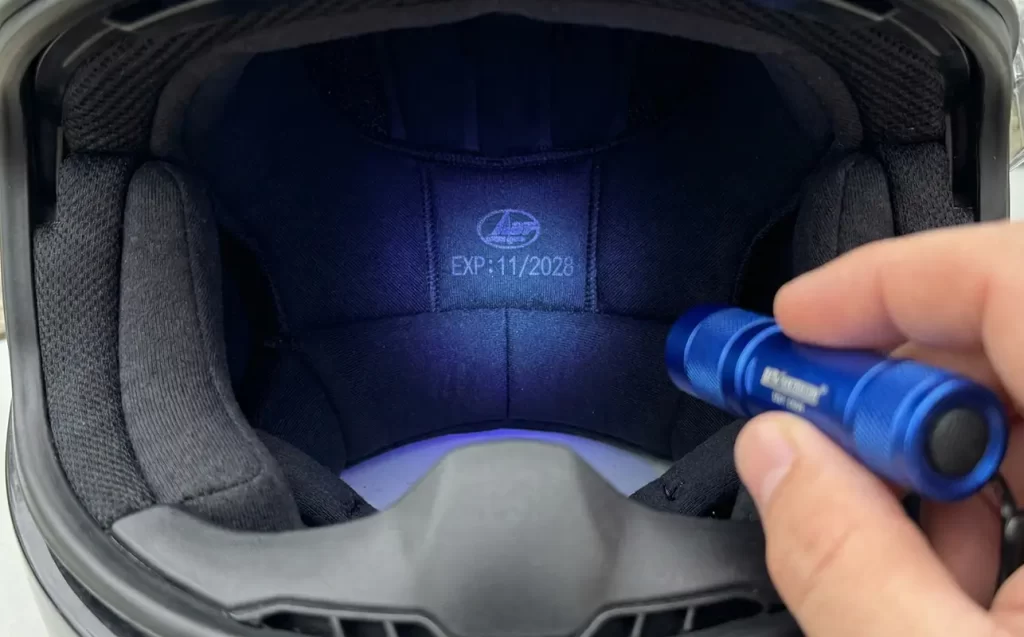
How to Check the Manufacturing Date
Never trust the box or the purchase date. Here’s how to find your helmet’s true age:
- Turn the helmet upside down
- Pull back the comfort padding near the chin strap or at the crown of the head
- Look for a sewn-in tag or heat-stamp directly on the white EPS foam
- Locate the production code, usually formatted as “MFG DATE: MM/YYYY”
Some manufacturers use a date code system instead. For example, “04/26” would indicate April 2026. If you can’t find a clear date, check the manufacturer’s website for their specific coding system.
Avoiding Old Stock: The Retailer Trap
A common but dangerous practice is retailers selling “new” helmets that have been sitting in warehouses for years. You might be paying full price for a helmet that’s already halfway through its useful life.
Red flags to watch for:
- Discontinued graphics or colorways still being sold as “new”
- Significant discounts on premium helmets with no apparent reason
- Dusty boxes or faded packaging
- Retailers who seem reluctant to let you check the date code
Always check the manufacturing date before purchasing. If the helmet was made more than 1-2 years ago, either negotiate a substantial discount or walk away. You deserve the full 5-year lifespan from your safety investment.
Remember: No matter how pristine your helmet looks or how carefully you’ve treated it, the invisible degradation of its protective materials makes replacement necessary. Your brain is worth the investment of a fresh helmet every five years.
The Art of the Perfect Fit: Finding Your Helmet Soulmate
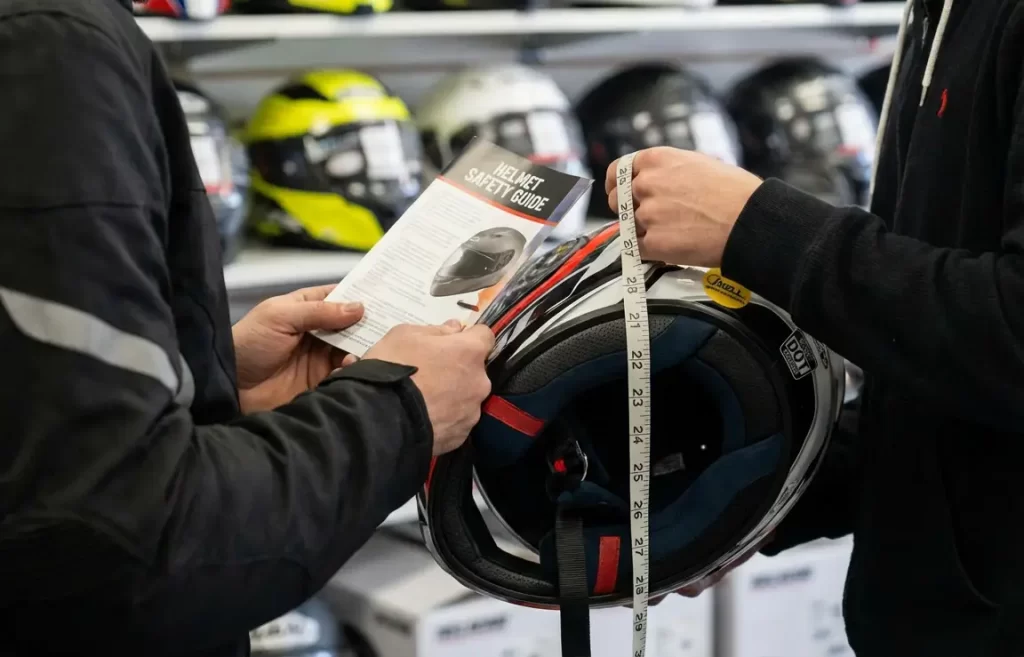
Finding the perfect fitting helmet is perhaps the most crucial aspect of helmet safety that riders often overlook. Remember this fundamental truth: a $1,000 Arai helmet that’s too big offers less protection than a $100 helmet that fits perfectly. When a helmet is loose, it will rotate during a crash, potentially exposing your forehead or jaw to the pavement – exactly the scenario you’re trying to avoid.
The “Tight is Right” Rule
First-time helmet buyers are often shocked by how tight a new helmet should feel. Here’s the reality: when you first put on a properly sized helmet, it should feel uncomfortably tight. Your cheeks should be squished to the point where you resemble a chipmunk storing nuts for winter. This isn’t just normal – it’s necessary.
Why? Because helmet padding compresses with use. The comfort liner will break in and compress by approximately 15-20% after about 20 hours of riding. If your helmet feels “comfortable” or “just right” in the showroom, within a month of regular use, it will become dangerously loose.
The Proper Measurement Technique
Finding your correct helmet size starts with accurate measurement:
- Get the right tools: Use a soft tape measure, not a rigid construction tape.
- Find the widest part: Wrap the tape around the widest part of your head, approximately one inch above your eyebrows and just above your ears.
- Measure in centimeters: Note your measurement in centimeters (e.g., 58cm) as most helmet manufacturers use the metric system.
- Check specific brand sizing: Don’t assume all brands size the same way. A “Medium” in Shoei might be a “Large” in HJC. Always consult the specific manufacturer’s size chart.
- Consider head shape: Beyond size, head shape matters. Some brands cater to “round oval” heads while others fit “intermediate oval” or “long oval” shapes better.
The Shake Test
Once you’ve found what seems to be your size, it’s time for the shake test:
- Put the helmet on and secure the strap properly.
- With your head level, shake vigorously from side to side.
- The helmet should move with your skin. If the helmet rotates independently while your head stays still, it’s too big.
- Repeat the test by nodding up and down.
A helmet that shifts significantly during this test will not stay in position during a crash when forces are exponentially higher.
The Roll-Off Test
This critical test assesses whether your helmet would stay on during the most dangerous phase of a crash:
- Fasten the helmet securely.
- Grab the back of the helmet at the base of your neck.
- Try to roll it forward and off your head.
- A properly fitting helmet should not be able to roll off your head in this manner.
If you can pull the helmet forward over your face, it will likely come off in a crash – rendering it completely useless when you need it most.
Dealer Sales Tactics to Avoid
Be wary of these common sales pitches:
- “This size is close enough”: If a dealer doesn’t have your exact size in stock, they might try to convince you that going up a size “fits fine” or that you can “add thicker cheek pads later.” Never compromise on size.
- “It will break in a lot”: While padding does compress, it shouldn’t compress enough to turn a proper fit into a loose one. If a salesperson suggests you’ll “grow into it,” walk away.
- “This is how they all fit”: If you try on a helmet and can easily slide a finger between your forehead and the helmet, it’s too big – regardless of what the salesperson says.
- “Premium helmets run small/large”: This is often said to justify selling you whatever they have in stock. Each brand publishes detailed size charts – trust the numbers, not sales talk.
Remember that a helmet is a deeply personal piece of safety equipment. Take your time, try multiple brands and models, and never settle for “close enough.” Your life may literally depend on this decision.
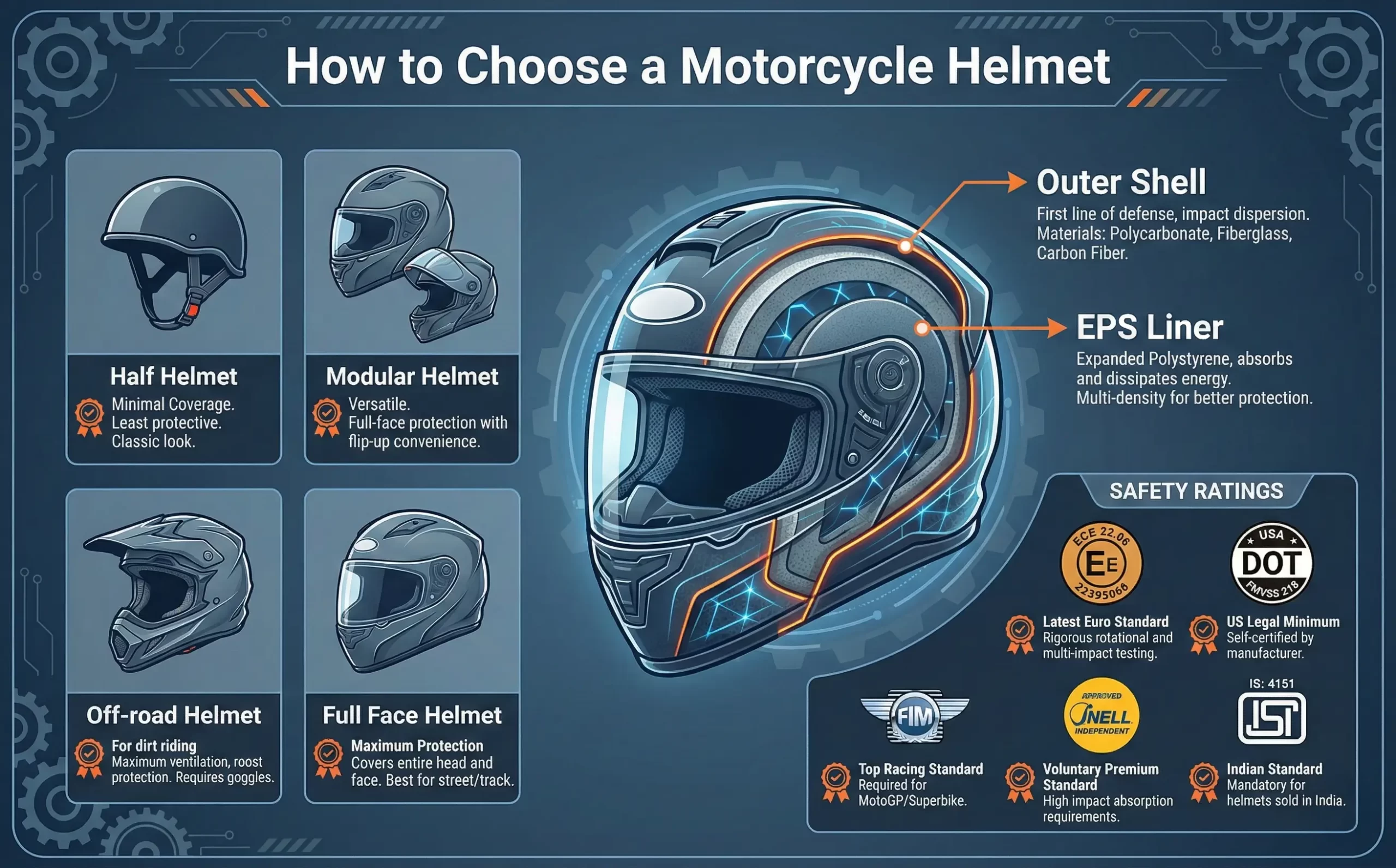
Helmet Types – The Good, The Bad, and The Dangerous
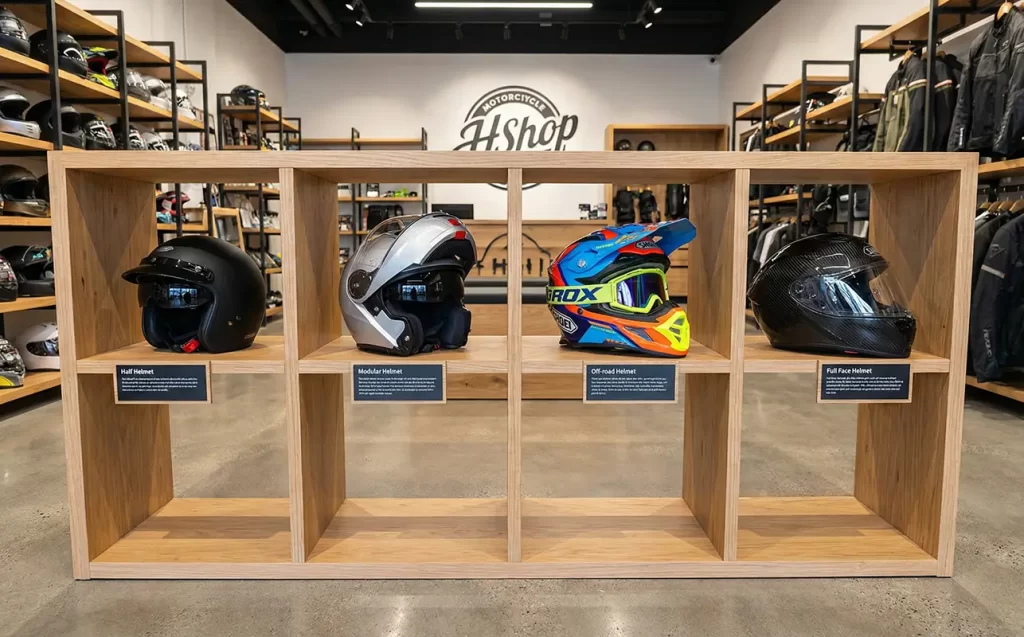
Not all helmets are created equal. When shopping for head protection, you’ll encounter several distinct styles, each with their own safety profile and intended use case. Understanding these differences could literally save your life.
The Half Helmet (The Brain Bucket)
Half helmets cover only the top portion of your skull, leaving your face, jaw, and chin completely exposed. They’re often marketed as providing “freedom” and “the authentic riding experience.”
The harsh reality? These helmets are fundamentally dangerous. Crash statistics consistently show that a significant percentage of impacts occur directly to the face and chin area during motorcycle accidents. When you wear a half helmet, you’re essentially gambling that you’ll somehow magically avoid facial impact during a crash.
I’ve personally witnessed riders with half helmets suffer catastrophic facial injuries – shattered jaws, lost teeth, and severe facial abrasions requiring multiple reconstructive surgeries. All because they wanted to “feel the wind” on their face. The temporary sensation of freedom simply isn’t worth the permanent disfigurement risk.
If you own a half helmet, it’s best repurposed as a shelf decoration or memorabilia – not as actual riding protection.
The Modular Helmet (The Flip-Up)
Modular helmets represent an ingenious compromise between safety and convenience. These helmets feature a hinged chin bar that can be lifted upward, converting a full-face helmet into an open-face configuration when needed.
For certain riders, modulars offer significant benefits:
- Eyeglass wearers can easily put on or remove their glasses without removing the entire helmet
- Those with claustrophobia can flip up the front at stops for better airflow and reduced anxiety
- Communication is easier at gas stations or with riding partners without full helmet removal
However, modulars come with important trade-offs. The hinge mechanism adds weight compared to traditional full-face helmets, potentially increasing neck fatigue on longer rides. More critically, the structural integrity at the hinge point is inherently weaker than a one-piece shell.
A crucial warning: never ride with the chin bar up at highway speeds unless your helmet specifically states it’s dual-homologated (P/J rated). An uplifted chin bar catches wind like a sail, creating dangerous neck torque during high-speed riding.
The Adventure Helmet (The Hybrid)
Adventure helmets blend elements from street and off-road designs. They feature the protective coverage of a full-face helmet but incorporate a distinctive “peak” or sun visor above the eye port and an extended chin bar for improved airflow.
These helmets excel in mixed-terrain riding scenarios. The oversized eye port delivers exceptional peripheral vision – almost fish-eye level – which proves invaluable when navigating technical off-road sections. The prominent peak effectively blocks sun glare when riding into sunrise or sunset, a common challenge on dawn/dusk adventures.
However, adventure helmets have notable drawbacks for pure street riding. That useful off-road peak becomes a liability at highway speeds, catching wind and creating head-buffeting that can quickly lead to neck fatigue. They’re also typically louder than standard road helmets due to their more angular aerodynamics and larger ventilation systems.
If you ride an adventure bike like the Royal Enfield Himalayan or spend significant time on gravel and dirt, these helmets match both your riding style and aesthetic. Just be prepared for increased wind noise on extended highway stretches.
The Full Face Helmet (The Gold Standard)
The full-face helmet represents the pinnacle of motorcycle head protection. With its unified shell construction covering the entire head and face, it provides unmatched structural integrity without compromising points.
The safety advantages are compelling:
- Complete facial protection from impacts and road debris
- Superior aerodynamics reducing neck strain at speed
- Better noise isolation preserving hearing over time
- Integrated shield system protecting eyes without separate eyewear
Modern full-face helmets have effectively addressed historical complaints about ventilation and claustrophobia. Advanced channeling systems now provide excellent airflow even in warm conditions, while wider eye ports reduce the “closed-in” feeling that deterred some riders in the past.
Whether you’re commuting through city traffic or carving canyon roads, the full-face helmet offers the best combination of protection, comfort, and functionality. From a pure safety perspective, it’s the recommended choice for virtually all riding scenarios where maximum protection is the priority.
Demystifying Safety Ratings (2026 Standards)
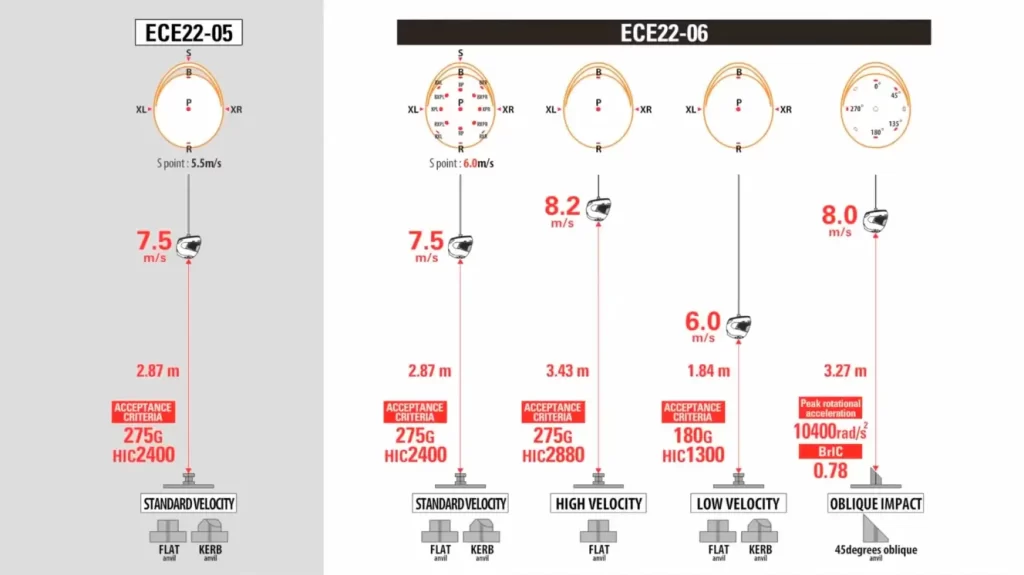
When shopping for a motorcycle helmet, you’ll encounter a bewildering array of safety certification stickers: DOT, ECE, SNELL, ISI. These aren’t just marketing badges—they represent different testing protocols with varying levels of rigor. Understanding what these certifications actually mean could be the difference between adequate and superior protection.
ECE 22.06 (The New Benchmark)
If you’re buying a helmet in 2026, the gold standard to look for is ECE 22.06. This latest European standard represents a significant evolution in helmet testing methodology.
What makes ECE 22.06 superior to previous standards is its comprehensive approach to real-world crash scenarios. Unlike older protocols that primarily tested direct impacts, 22.06 specifically evaluates:
- Rotational forces: Tests measure how the helmet responds to angled impacts that cause the head to rotate—a common cause of traumatic brain injuries
- Multiple impact points: Testing includes impacts at various points including the chin bar (a common impact zone in crashes)
- Variable speeds: Both high and low-velocity impacts are evaluated
- Visor penetration resistance: Ensures face shields won’t shatter and cause eye injuries
- Retention system strength: Tests if the chin strap will keep the helmet in place during a crash
Helmets meeting this standard have undergone rigorous third-party testing at certified laboratories, making it the most trustworthy certification available for street riders.
DOT (Department of Transportation)
While the DOT sticker is legally required for all helmets sold in the United States, it’s important to understand its limitations:
- Self-certification: Perhaps most concerning, DOT is a self-certified standard. Manufacturers test their own helmets and apply the sticker themselves
- Limited government oversight: The NHTSA only occasionally purchases and tests helmets for compliance after they’re already on the market
- Outdated testing criteria: The FMVSS 218 standard hasn’t been substantially updated in decades and doesn’t account for rotational forces
- Binary pass/fail system: Unlike ECE, which has graduated ratings, DOT is simply pass/fail, giving consumers no information about relative performance
A DOT-only helmet provides basic protection, but consider it the minimum standard rather than an indicator of exceptional safety.
FIM (Racing Standard)
The FIM (Fédération Internationale de Motocyclisme) certification represents the pinnacle of helmet protection:
- Developed for professional racing: This standard was created specifically for MotoGP and other professional motorcycle racing series
- Extreme impact testing: Tests simulate the high-speed crashes professional racers experience
- Mandatory for competition: Required for all riders in FIM-sanctioned events
- Extremely limited availability: Only found on premium helmets typically costing $700+
- Overkill for street riding: While offering exceptional protection, the extreme specifications address racing scenarios that street riders rarely encounter
If you see a helmet with FIM certification, you can be confident it offers extraordinary protection, though you’re paying a premium for a level of protection that exceeds what most street riders require.
ISI (Indian Standards Institute)
For riders in India, the ISI mark is a legal requirement, but it comes with several important considerations:
- Minimum local standard: While mandatory, the ISI certification represents a basic safety threshold
- Counterfeiting concerns: The market is unfortunately flooded with helmets bearing fake ISI stickers
- Limited testing scope: The standard doesn’t evaluate many of the impact scenarios covered by ECE or SNELL
- Best when paired with international certifications: Look for helmets that carry both ISI and ECE certification for optimal protection
When purchasing an ISI-certified helmet, buy only from authorized dealers representing established brands like Axor, MT, or SMK that maintain their international reputation by meeting multiple certification standards.
The certification you choose directly impacts your level of protection. While budget constraints are real, prioritizing a helmet with ECE 22.06 certification represents the best balance of proven protection and reasonable cost for most riders.
The Smart Rider’s Investment Guide: Prioritizing Safety Over Marketing Hype
When it comes to motorcycle safety gear, particularly helmets, many riders fall into a dangerous mindset: “I have a cheap bike, so I’ll buy a cheap helmet.” This logic fundamentally misunderstands what you’re actually protecting.
You can replace a motorcycle. You can repair a broken arm. You can even get a heart transplant. But you cannot get a brain transplant. Once brain tissue is damaged, the effects are often permanent and life-altering.
Finding Quality Within Your Budget
The good news is that excellent protection doesn’t require emptying your bank account. High-quality, ECE 22.06 certified helmets are readily available in the $100-$200 range (approximately ₹5,000-₹10,000). These helmets offer substantial protection that meets rigorous safety standards without the premium price tag of luxury brands.
What you’re paying for with more expensive helmets is often:
- Reduced weight (carbon fiber vs. polycarbonate)
- Better aerodynamics and noise reduction
- Premium comfort features
- Brand prestige and aesthetics
None of these factors fundamentally change the core protective capability if the helmet meets the same safety standards.
Avoiding Marketing Traps
Be particularly wary of marketing gimmicks that try to upsell you on minimal safety improvements. For example, many riding jackets now boast ratings like “CE Level 1” or “Class A” protection:
- Class A is the lowest safety rating, designed only for city riding at speeds up to 45km/h
- Class AA is the middle tier, suitable for touring
- Class AAA is the highest rating, designed for high-speed slides
Many manufacturers will dramatically increase the price of a jacket simply because they’ve obtained the basic “Class A” certification. Don’t pay premium prices for minimum protection—understand what these ratings actually mean before making your purchase.
The Safety Features That Actually Matter
When evaluating helmets within your budget, prioritize these critical safety features:
- Proper fit – A $150 helmet that fits perfectly is safer than a $1,000 helmet that’s too loose
- Recent manufacture date – Never buy a helmet more than 1-2 years old, even if “new” in box
- Full-face design – Provides comprehensive protection for your entire head
- Current safety certification – Look for ECE 22.06 certification when possible
- Smooth, round shell design – Promotes “glancing off” in a crash
Making the Investment Decision
Think of your helmet as insurance—not for your bike, but for your future. The difference between a $70 bargain-bin helmet and a $150 quality helmet might seem significant at purchase, but spread that cost over the 5-year lifespan of the helmet, and you’re talking about pennies per day for substantially better protection.
Remember: You’re not just buying a piece of equipment; you’re investing in your continued ability to enjoy riding for years to come. No chrome accessory or engine upgrade will ever be as valuable as your continued cognitive function after an unexpected crash.
Helmet Maintenance: Extending Your Helmet’s Lifespan
Your helmet is a life-saving investment that deserves proper care. Regular maintenance not only keeps your helmet looking good but also ensures it maintains its protective qualities throughout its usable life.
Proper Cleaning Techniques
Motorcycle helmets accumulate dirt, bugs, and sweat that can degrade materials over time. Follow these steps for effective cleaning:
- Remove electronics and padding: Take out removable cheek pads, liners, and any communication systems before cleaning.
- Shell cleaning: Use lukewarm water with mild soap (baby shampoo works well). Never use petroleum-based cleaners, household cleaners, or harsh chemicals as they can weaken the shell’s integrity.
- Visor care: Clean your visor with microfiber cloth and specialized visor cleaner. Avoid paper towels or regular household glass cleaners as they can create micro-scratches that impair vision.
- Interior cleaning: Hand wash removable padding in cold water with mild detergent. For non-removable liners, use antibacterial helmet refresher sprays designed specifically for this purpose.
- Drying process: Always air dry your helmet away from direct sunlight. Never use hairdryers or heaters as excessive heat can damage the EPS foam.
The Balaclava Advantage
Wearing a balaclava (helmet liner) under your helmet is one of the most underrated maintenance practices:
- Sweat barrier: Human sweat contains acids and oils that degrade helmet materials over time. A balaclava acts as a protective barrier.
- Comfort improvement: It wicks moisture away from your skin, keeping you cooler in summer and warmer in winter.
- Extended liner life: Your helmet’s comfort padding will last significantly longer when protected from direct contact with hair products, skin oils, and sweat.
- Hygiene benefits: Balaclavas can be washed frequently, reducing bacterial buildup that causes odors and potential skin issues.
Storage Recommendations
How you store your helmet when not in use greatly affects its lifespan:
- Dedicated helmet bag: Store your helmet in a breathable helmet bag to protect it from dust and accidental drops.
- Temperature control: Keep your helmet in a climate-controlled environment. Extreme temperatures (hot garages in summer or freezing sheds in winter) accelerate the breakdown of EPS foam and adhesives.
- Position matters: Store your helmet on a flat surface or on a dedicated helmet stand. Never hang it by the chin strap or D-rings, as this stretches the retention system.
- Avoid chemical exposure: Keep helmets away from gasoline, solvents, and exhaust fumes, which can silently degrade materials.
When Cosmetic Damage Requires Replacement
Not all scratches mean your helmet needs replacement, but some “cosmetic” damage can compromise safety:
- Shell cracks: Any crack, no matter how small, indicates the helmet has absorbed impact energy and must be replaced immediately.
- Deep gouges: Surface scratches are cosmetic, but deep gouges that expose the inner layers compromise the shell’s structural integrity.
- Visor damage: Scratches that impair visibility or cracks in the visor mechanism require immediate replacement of the visor (not necessarily the entire helmet).
- Comfort liner compression: If your helmet suddenly feels loose despite strap adjustments, the interior padding has likely compressed beyond its functional limit.
- EPS foam damage: Any visible compression or cracking of the white EPS foam means the helmet has done its job absorbing energy—and now needs replacement.
Remember, a well-maintained helmet not only lasts longer but also provides better protection. Invest five minutes after each ride to inspect and clean your helmet, and you’ll maximize both its lifespan and its ability to protect you when it matters most.
The Hidden Dangers: When to Replace Your Helmet Regardless of Age
Your helmet might look perfectly fine on the outside, but hidden damage could be compromising your safety without you knowing it. Unlike a cracked phone screen or a dented car, helmet damage isn’t always visible to the naked eye.
Micro-Fractures: The Invisible Killers
Helmets are designed to absorb impact through controlled destruction. Even a seemingly minor drop from handlebar height (about 3-4 feet) can create microscopic fractures in the EPS liner. These hairline cracks might be invisible, but they create weakness points that can catastrophically fail during a real crash.
Think of it like a pre-cracked egg shell. It holds its shape until pressure is applied, then fails much more easily than an intact shell would. Similarly, a helmet with micro-fractures might look perfect but provide substantially less protection when you need it most.
The Petroleum-Based Degradation
The EPS foam in your helmet is petroleum-based and degrades when exposed to certain chemicals. Common culprits include:
- Gasoline fumes at filling stations
- Bug sprays and insect repellents
- Some cleaning products
- Hair products (gel, spray, oils)
These substances can break down the molecular structure of your helmet’s protective components, rendering them less effective at energy absorption during impacts.
Non-Negotiable Replacement Scenarios
Replace your helmet immediately if any of these occur:
- After any crash – Even a low-speed tip-over. Once the EPS has compressed, it cannot return to its original protective capacity.
- If dropped from more than 3 feet – The internal damage may be invisible but significant.
- If the shell shows any cracks – Even hairline fractures indicate structural compromise.
- If the comfort liner or cheek pads have deteriorated – These affect fit, and a loose helmet is dangerous.
- If exposed to extreme heat – Left in a hot car or near a heat source, the adhesives and EPS can degrade.
Manufacturer Inspection Services
Several premium helmet manufacturers offer post-crash inspection services:
- Arai offers a crash damage analysis service where they’ll inspect your helmet and provide a detailed report.
- Shoei provides similar inspection services through authorized dealers.
- Bell and AGV have programs to examine helmets after incidents.
However, these services typically don’t “clear” a helmet for continued use after a significant impact. Instead, they help educate riders about hidden damage and provide documentation that might be useful for insurance claims.
Remember: Manufacturers are unanimous in their stance that helmets should be replaced after any significant impact. When they examine your damaged helmet, they’re looking to confirm the damage, not certify it as safe for continued use.
The “Better Safe Than Sorry” Reality
The human brain is irreplaceable. No matter how attached you are to your helmet or how expensive it was, the cost of replacement pales in comparison to the potential cost of brain injury. When in doubt, replace it. Your future self will thank you for prioritizing safety over sentiment or savings.
Advanced Helmet Features: What Modern Riders Need to Know
Modern helmet technology has evolved far beyond basic impact protection. Today’s premium helmets incorporate sophisticated systems that enhance comfort, reduce fatigue, and integrate with our connected world.
Ventilation Systems: The Science of Airflow
A well-designed ventilation system isn’t just about comfort—it’s critical for safety. When you’re riding in hot weather, your core temperature rises, and cognitive function can decline. Modern helmets feature:
- Multi-channel airflow paths: Premium helmets use wind tunnel testing to create paths that draw air in through chin vents, circulate it over your head, and expel hot air through exhaust ports.
- Adjustable vents: The best systems allow you to open or close vents with gloved hands, adapting to changing weather conditions.
- Brow ventilation: Advanced designs incorporate subtle channels that direct air across your forehead and eye area, preventing fogging without creating wind noise.
Remember that more vents don’t always mean better cooling. The engineering of the airflow channels matters more than the number of intake ports.
Noise Reduction: Protecting Your Hearing
Wind noise at highway speeds can reach 100+ decibels—loud enough to cause permanent hearing damage during extended rides. Modern helmets address this through:
- Wind tunnel optimization: The shell shape is designed to minimize turbulence around the neck and base of the helmet.
- Neck rolls and curtains: These create a seal between your neck and the helmet, preventing wind from rushing upward.
- Acoustic padding: Special materials in the ear areas absorb sound waves rather than reflecting them.
- Aerodynamic spoilers: Small ridges that direct airflow away from the helmet base, reducing the vacuum effect that creates noise.
Even the best helmet can benefit from earplugs during long rides. They don’t block important sounds like sirens or horns but filter out the damaging wind noise.
Anti-Fog Technologies: Maintaining Clear Vision
Fogging occurs when warm, moist air from your breathing meets the cooler surface of your visor. Modern solutions include:
- Pinlock inserts: These create a double-glazed window effect with a sealed air chamber between two visor layers, preventing condensation.
- Anti-fog coatings: Hydrophilic treatments that spread moisture into an invisible layer rather than allowing it to form droplets.
- Breath deflectors: Channeling your exhaled air downward and away from the visor.
- Heated visors: Premium helmets sometimes include electrical elements that maintain the visor at a temperature above the dew point.
The Pinlock system remains the gold standard, but requires specific visors designed to accept the insert.
Communication System Integration: Staying Connected
Modern helmets increasingly accommodate wireless communication systems:
- Pre-installed recesses: Designed specifically for speakers and microphones without compromising comfort or safety.
- Cable routing channels: Allowing clean installation without exposed wires.
- Bluetooth compatibility: Some helmets now come with built-in Bluetooth modules that pair directly with your phone.
- Voice command optimization: Microphone placement that works with voice assistants even at highway speeds.
When choosing a helmet for communication system compatibility, consider whether you want a universal mount that works with any comm system, or a helmet specifically designed for one brand’s system with seamless integration.
The best modern helmets balance these features without compromising their primary purpose: protecting your brain in a crash. Advanced features should complement, never replace, excellent impact protection.
The Rider’s Pledge: A Commitment to Safety Beyond Yourself
Motorcycling offers a unique freedom that cannot be replicated by any other form of transportation. The wind in your face, the direct connection to the road, and the unfiltered experience of the world around you create an unparalleled sense of liberation. However, this freedom comes with a profound responsibility—not just to yourself, but to everyone who cares about you.
When you swing your leg over a motorcycle, you’re making a silent contract with the universe. You’re acknowledging the risks and committing to mitigate them through proper gear, training, and mindset. This isn’t just about personal choice; it’s about recognizing that your safety decisions affect others.
Every time you put on your helmet, you’re making a statement to your family that you value the life you share with them. Every time you wear proper riding gear, you’re showing your children what responsible risk management looks like. Your choices on the road aren’t just protecting your body—they’re protecting the emotional wellbeing of everyone waiting for you to come home.
Developing safety habits isn’t a one-time decision but a daily practice. Start by performing pre-ride gear checks as routinely as you check your tire pressure. Make putting on quality safety gear as automatic as fastening your seatbelt in a car. These small, consistent actions compound over time into a safety mindset that could save your life.
Leading by example extends beyond your own riding circle. When newer riders see experienced motorcyclists in full gear, it normalizes safety. When your riding group maintains high standards for protective equipment, it creates a culture where safety isn’t optional—it’s expected. Your choices influence the community around you.
Remember that the true cost of a motorcycle accident isn’t measured in medical bills or repair costs. It’s measured in the tears of your loved ones, in missed birthdays and anniversaries, in the empty chair at family gatherings. When viewed through this lens, that “expensive” helmet or that “inconvenient” riding jacket becomes the most valuable investment you could possibly make.
Take the pledge today: Check your helmet’s manufacturing date. Replace any outdated or inadequate gear. Commit to wearing proper protection on every ride, regardless of distance. Promise yourself and your loved ones that you’ll dress for the slide, not just the ride.
Your future self—and everyone who loves you—will thank you for it.