Understanding the New Rider Challenges
Every year, thousands of riders discover the freedom of two wheels, but beginner motorcycle riding comes with unique obstacles that experienced riders have long forgotten. The statistics paint a sobering picture: new motorcyclists face their highest risk of accidents during their first year, when inexperience meets complex road situations.
The learning curve extends far beyond basic controls. New riders must simultaneously master throttle control, braking techniques, cornering physics, and hazard recognition—all while managing the psychological challenges that separate motorcycling from car driving. Target fixation, where riders unconsciously steer toward whatever captures their visual attention, represents just one of many mental traps that catch beginners off-guard.
Understanding these challenges isn’t about discouragement—it’s about preparation. When you recognize the specific hurdles ahead, you can build the skills and habits that transform nervous beginners into confident, safety-conscious riders who truly enjoy their time on two wheels.
Essential Safety Gear for Beginners
Your safety gear serves as your last line of defense against serious injury, making it the most critical investment any new rider can make. While basic motorcycle training courses cover protective equipment, understanding what to prioritize helps you build a comprehensive safety foundation without breaking the bank.
Start with the “ATGATT” principle—All The Gear, All The Time. A DOT-approved helmet remains non-negotiable, as head injuries account for the majority of fatal motorcycle accidents. However, research shows that newer riders face particularly high risks during their learning phase, making additional protection essential.
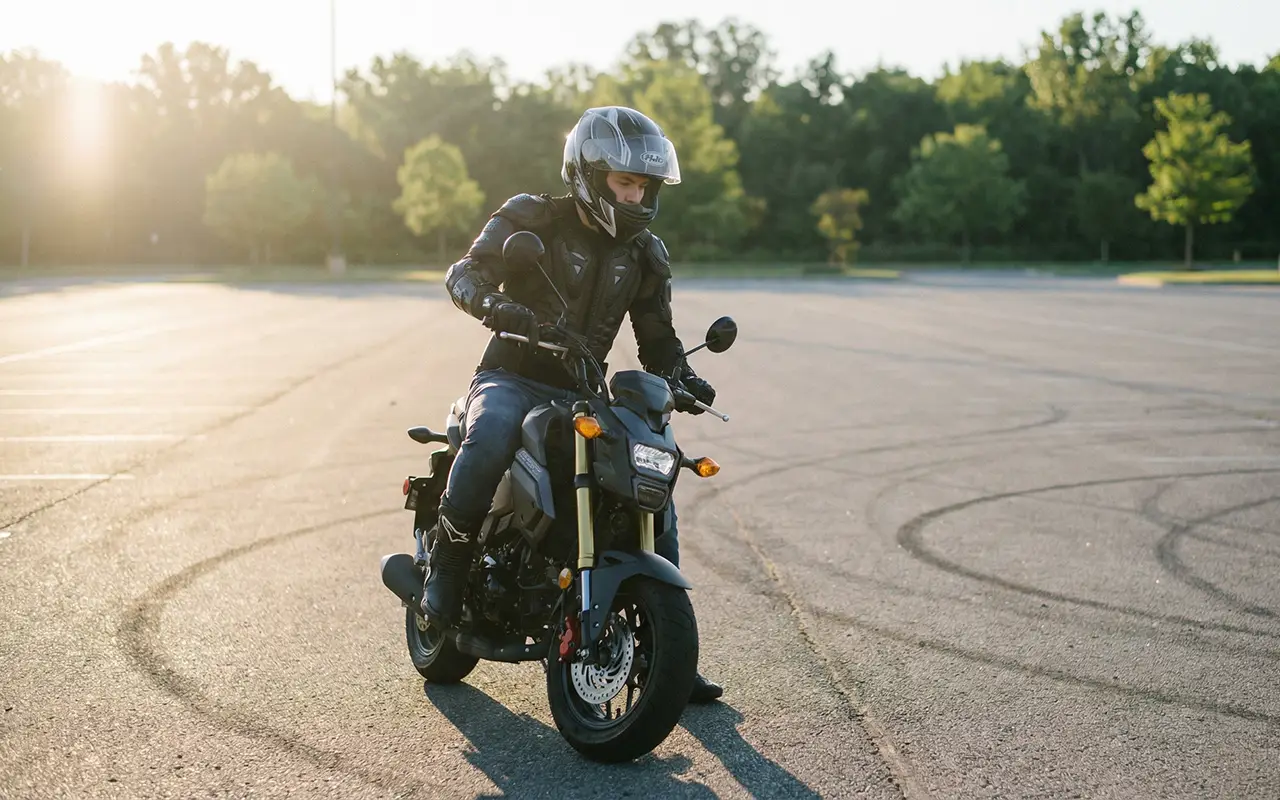
Your core gear should include a sturdy jacket with armor inserts, protective pants or kevlar-lined jeans, over-the-ankle boots, and full-finger gloves. Quality doesn’t always mean expensive—many budget-friendly options meet safety standards.
Focus on proper fit over fashion, as ill-fitting gear won’t protect effectively and may distract you while riding. Remember that motorcycle riding tips emphasize visibility alongside protection. Choose bright colors or reflective elements to help other drivers spot you. This investment in safety gear directly supports what you’ll learn in motorcycle training, creating habits that protect you throughout your riding journey.
Training and Skill Development
Proper training forms the foundation of safe motorcycle operation, transforming the complex act of riding a motorcycle from an intimidating challenge into a manageable skill set. Professional motorcycle safety courses provide structured learning environments where beginners can develop essential techniques under expert supervision, significantly reducing the risk of accidents during those crucial early months.
The Motorcycle Safety Foundation’s research reveals that structured training programs dramatically improve rider outcomes, particularly in emergency situations where split-second decisions matter most. These courses cover fundamental skills like throttle control, cornering techniques, crucially, how to brake motorcycle effectively using both front, and rear brakes in coordination.
Beyond basic operation, quality training programs emphasize hazard recognition and defensive riding strategies. Students learn to identify potential dangers before they become critical, from scanning intersections for turning vehicles to maintaining proper following distances.
The combination of classroom instruction and hands-on practice creates muscle memory that becomes invaluable when real-world situations demand immediate response.
Quality training isn’t just about passing a test—it’s about building the foundation for a lifetime of safe riding. The skills developed in these early stages directly correlate with long-term riding success, making professional instruction one of the most valuable investments any new rider can make before hitting the road independently.
Finding Balance: The Physical and Mental Components
Balance on a motorcycle involves far more than simply staying upright—it requires mastering both the physical mechanics of bike control and the mental discipline of focused awareness. Many beginner motorcycle tips overlook this crucial dual nature, focusing solely on technical skills while neglecting the psychological aspects that keep riders safe and confident.
Physical balance begins with understanding your bike’s weight distribution and center of gravity. Learning how to pick up motorcycle after a low-speed drop becomes essential practice, as it teaches you to work with the machine’s physics rather than against them. Use proper lifting techniques: squat down, grab the handlebars and a solid frame point, then lift with your legs while keeping the bike close to your body.
Mental balance proves equally critical during those first months on the road. Research indicates that new riders face heightened risks during their initial year, often due to overconfidence paired with underdeveloped hazard recognition skills. Maintaining situational awareness while processing multiple inputs—throttle, brakes, clutch, traffic patterns—demands substantial cognitive bandwidth.
The key lies in developing both aspects simultaneously through deliberate practice, building muscle memory for physical controls while training your mind to continuously scan, assess, and respond to changing conditions with measured confidence.
Developing Effective Riding Habits
Building consistent, safe riding habits from the beginning transforms first time motorcycle riding from a series of reactive decisions into automatic, protective responses. The habits you establish during your initial months on the road become deeply ingrained patterns that can either enhance your safety or create dangerous vulnerabilities.
Consistency in pre-ride inspections represents one of the most crucial habits new riders must develop. A systematic approach to checking tire pressure, lights, brakes, and fluid levels before each ride prevents mechanical failures that could lead to accidents. Research indicates that mechanical issues contribute to a significant percentage of motorcycle incidents, making this habit essential for long-term safety.
Developing proper following distance becomes second nature through deliberate practice. The three-second rule provides insufficient cushion on a motorcycle—experienced riders maintain at least four seconds behind vehicles, increasing this distance in adverse weather or traffic conditions. This expanded buffer zone allows adequate reaction time for emergency braking or evasive maneuvers.
Regular practice sessions in controlled environments reinforce muscle memory for critical skills like emergency braking and swerving. However, as riders begin developing these foundational habits, they must also learn to recognize and avoid the common pitfalls that can undermine their progress.
Common Mistakes to Avoid as a Beginner
Understanding what not to do can be just as valuable as learning proper techniques. New riders often fall into predictable patterns that increase their risk and slow their development as skilled motorcyclists.
Overconfidence after initial success represents one of the most dangerous pitfalls. Many beginners feel confident after their first few rides, leading them to attempt more challenging roads or speeds before mastering fundamental skills.
Statistics show that 5 Eye-Opening Statistics About Motorcycle Accidents reveal that inexperienced riders are significantly overrepresented in accident data, often due to poor decision-making rather than lack of basic control.
Target fixation occurs when riders stare at obstacles they want to avoid—guardrails, potholes, or other vehicles—inadvertently steering toward them. This natural human tendency becomes particularly dangerous on motorcycles, where your eyes directly influence your path.
Inadequate following distance remains a common error among new riders who haven’t yet developed proper judgment for stopping distances. Unlike cars, motorcycles require different braking techniques, distances, and especially in varying weather conditions.
These fundamental new rider tips focus on awareness and patience—qualities that develop through conscious practice rather than accumulated miles. Recognizing these common pitfalls helps beginners focus their attention on building proper habits from the start, setting the foundation for applying these principles in real-world riding scenarios.
Example Scenarios: Applying Beginner Tips
Understanding how to apply motorcycle safety tips in real-world situations helps new riders translate theory into practice. Consider a common scenario: approaching a busy intersection where traffic is backing up. A prepared beginner would reduce speed early, check mirrors for following vehicles, and position themselves in the left tire track for better visibility and escape routes.
Example scenario: You’re riding on a sunny morning when you encounter an unexpected oil patch in a curve. The proper response involves maintaining steady throttle, avoiding sudden braking or steering inputs, and keeping your eyes focused on your intended path through the hazard. This demonstrates how foundational skills like smooth control inputs and target fixation work together during critical moments.
Weather changes present another practical application. When light rain begins during your ride, implementing the previously discussed habits becomes crucial – reducing speed by 25%, increasing following distance to four seconds, and avoiding painted lines or metal surfaces.
These scenarios show how consistent practice of basic techniques creates automatic responses when conditions become challenging, setting the stage for understanding when riding conditions might exceed a beginner’s current skill level.
Limitations and Considerations
While proper techniques and safety practices significantly improve riding outcomes, every beginner motorcyclist must understand that motorcycling inherently carries risks that cannot be completely eliminated.
Even with perfect execution of safety protocols, external factors beyond your control—such as weather conditions, road hazards, and other drivers’ actions—can create dangerous situations. The learning curve extends well beyond initial training.
Research shows that safety-critical events from the motorcyclist’s perspective often involve complex scenarios that require split-second decision-making skills developed only through experience. No amount of preparation can replicate every real-world situation you’ll eventually encounter on the road.
Additionally, physical and mental limitations vary among individuals. Factors like reaction time, depth perception, and physical strength affect riding ability differently for each person.
What works perfectly for one rider may require modification for another, emphasizing the importance of honest self-assessment and gradual skill development as you progress toward more advanced riding techniques.
Future Implications: Advancing Your Riding Skills
As you progress beyond the beginner stage, your motorcycle journey transforms from basic survival skills to refined mastery. The foundation you’ve built through proper training and consistent practice creates opportunities for advanced skill development that enhance both safety and enjoyment.
Continuing education through advanced riding courses becomes increasingly valuable as you gain experience. These programs introduce techniques like emergency braking scenarios, cornering optimization, and hazard recognition that weren’t appropriate during initial training.
Your safety gear requirements may also evolve—track days might call for specialized protective equipment beyond standard street gear. The transition from novice to intermediate rider typically occurs after accumulating several thousand miles of varied riding experience.
However, this progression shouldn’t diminish your respect for fundamental safety principles. Advanced riders who maintain beginner-level vigilance regarding protective equipment, defensive positioning, and continuous learning demonstrate the wisdom that separates skilled motorcyclists from merely experienced ones.
Building expertise requires embracing lifelong learning rather than assuming competence. As your skills develop, consider how each ride can reinforce the safety habits that will serve you throughout your motorcycling career.
Key Beginner Motorcycle Riding Takeaways
Your journey as a beginner motorcyclist centers on mastering fundamental skills that form the foundation of safe riding. Throttle control emerges as perhaps the most critical technique—smooth, progressive acceleration prevents wheel spin, maintains traction, and keeps you in command of your motorcycle’s power delivery.
The statistics underscore why proper preparation matters: your first year riding presents the highest risk period, making skill development non-negotiable. However, riders who commit to structured learning, practice essential techniques consistently, and maintain situational awareness dramatically improve their safety outcomes.
Remember that becoming a proficient motorcyclist isn’t about rushing to advanced techniques—it’s about perfecting the basics until they become second nature. Your protective gear, defensive riding mindset, and commitment to continuous learning will serve you throughout your entire motorcycling journey, creating positive habits that evolve with your growing expertise.
Understanding motorcycle culture’s nuances will further enhance your riding experience and community integration.
FAQs
What is the 1% rule in motorcycles?
The 1% rule in motorcycles refers to the principle that riders should never exceed 1% throttle input per 1% of available traction. This foundational concept helps beginners understand the delicate relationship between power delivery and grip, particularly crucial during acceleration, cornering, and braking scenarios.
In practice, this rule emphasizes the importance of clutch control and smooth throttle management. When traction is compromised—such as on wet pavement or gravel—riders must proportionally reduce their throttle inputs to maintain control. For example, if available traction drops to 70% due to road conditions, maximum safe throttle application should correspondingly decrease to 70%.
The 1% rule becomes particularly relevant during low-speed maneuvers where precise power delivery matters most. Smooth clutch control combined with minimal throttle adjustments prevents wheel spin and maintains stability. This principle directly connects to the broader concept of traction management, where understanding your bike’s limits prevents dangerous situations before they develop.
Mastering this rule requires consistent practice and heightened awareness of changing road conditions. As you develop this sensitivity to traction and power delivery, you’ll naturally transition into more advanced riding principles that govern safe following distances and reaction times.
What is the 12 second rule for motorcycles?
The 12-second rule for motorcycles is a fundamental spacing principle that requires maintaining at least 12 seconds of following distance behind the vehicle ahead. Unlike the standard 3-second rule for cars, motorcycles need significantly more reaction time due to their unique braking characteristics, and vulnerability on the road. This extended following distance becomes particularly crucial during slow speed maneuvers where motorcycles have less stability and require more time to execute emergency stops or evasive actions. At highway speeds, 12 seconds translates to roughly 1,000 feet of separation – giving you ample time to assess hazards, brake gradually, and maintain control.
The rule accounts for several motorcycle-specific factors: longer stopping distances on wet surfaces, the need to downshift while braking, and the potential for target fixation when obstacles appear suddenly. Experienced riders often extend this to 15-20 seconds in adverse conditions such as rain, heavy traffic, and or unfamiliar roads. However, the 12-second rule isn’t universally applied in all riding scenarios. In dense urban traffic, strict adherence may prove impractical, but the underlying principle remains vital: maximize your reaction time and escape routes whenever possible. This conservative approach to following distance sets the foundation for understanding the more serious risks that claim most motorcyclists’ lives.
What kills most motorcyclists?
Understanding the leading causes of motorcycle fatalities is crucial for every rider’s survival. According to crash data, the majority of motorcycle deaths result from collisions with other vehicles, particularly when cars fail to see motorcycles during left turns or lane changes. Single-vehicle crashes account for approximately 42% of motorcycle fatalities, often involving loss of control during cornering or emergency braking situations.
Speed and impairment represent the deadliest combination for motorcyclists. Excessive speed reduces reaction time and increases crash severity, while alcohol impairment affects critical judgment and motor skills. Head injuries remain the primary cause of death, which is why proper helmet use is non-negotiable.
Inexperience kills disproportionately – new riders face significantly higher fatality rates during their first year. Poor hazard recognition, inadequate braking techniques, and overconfidence in abilities create a deadly recipe. The key insight? Most fatal crashes are preventable through proper training, defensive riding techniques, and consistent safety practices that we’ll explore in common beginner mistakes.
What not to do as a beginner motorcycle?
Avoiding critical mistakes can mean the difference between a safe ride and becoming part of motorcycle accident statistics. Never skip proper training or attempt to learn advanced techniques like counter steering without professional instruction. Resist the urge to start with a high-powered bike – research shows younger adults face significantly higher risks when riding powerful motorcycles beyond their skill level.
Don’t ride beyond your comfort zone or attempt to keep up with experienced riders during group rides. Avoid riding in adverse weather conditions, especially rain or strong winds, until you’ve mastered basic skills. Never neglect protective gear, even for short trips around the neighborhood.
Most importantly, don’t assume you know everything after a few rides. The learning curve is steep, and overconfidence kills. Stay humble, practice consistently, and remember that every experienced rider was once exactly where you are now. Your dedication to safe riding practices today will determine whether you become a lifelong motorcyclist or another cautionary tale.