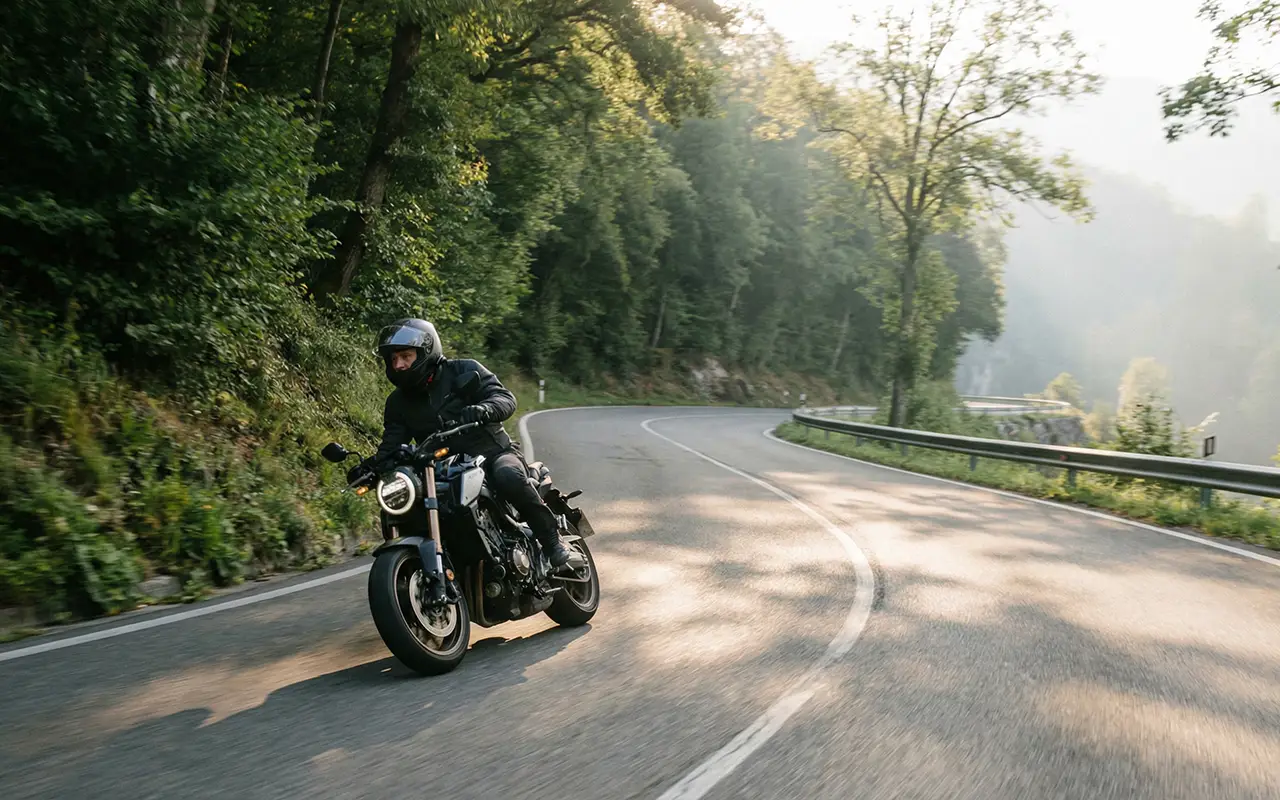
The moment your motorcycle leans into a curve, physics takes over, transforming rider and machine into a delicate dance of balance, momentum, and precision. Beyond the basics covered in beginner motorcycle riding tips, Motorcycle cornering separates confident riders from those who merely survive their journeys—it’s where skill truly matters.
At its core, cornering involves managing three critical elements:
- entry speed
- body position
- throttle control
Your body position acts as the primary tool for weight distribution, allowing you to influence the bike’s center of gravity and maintain optimal traction through the turn. When executed properly, proper cornering technique reduces tire stress while maximizing control and safety margins.
The physics are unforgiving: enter too fast, and no amount of technique can save you. However, master the fundamentals, and every corner becomes an opportunity to improve rather than merely endure. Understanding how lean angle, contact patches, and weight transfer work together forms the foundation of advanced riding skills.
Ready to transform your approach to curves? Let’s explore the core principles that separate smooth, confident cornering from white-knuckle survival riding.
Core Principles of Cornering Techniques
Mastering motorcycle cornering techniques requires understanding three fundamental elements that work in harmony: vision, body positioning, and throttle control. Unlike car driving, where steering adjustments primarily guide direction changes, motorcycles rely on countersteering—pushing the handlebar in the opposite direction of your intended turn to initiate lean.
The relationship between speed and lean angle forms the foundation of safe cornering. As velocity increases through a curve, greater lean angles become necessary to maintain the same turning radius. This physics principle directly impacts your approach strategy and explains why professional riders emphasize proper entry speed.
Braking dynamics play a crucial role in cornering safety, with most braking ideally completed before entering the turn. Trail braking—gradually releasing brake pressure while leaning into the corner—can be effective for experienced riders but requires precise throttle coordination. The key is maintaining smooth, progressive inputs rather than abrupt changes that can upset the motorcycle’s stability.
Body positioning significantly influences cornering performance. Moving your body weight to the inside of the turn reduces the motorcycle’s required lean angle for the same corner speed, keeping more tire contact patch available and improving ground clearance. This technique becomes the foundation for more advanced cornering methods that maximize both safety and performance.
The Slow, Look, Press, Roll Method
The Slow, Look, Press, Roll method represents one of the most systematic motorcycle riding techniques for approaching corners with confidence and control. This four-step sequence breaks down cornering into manageable phases, allowing riders to develop muscle memory and consistent execution.
Slow begins before the corner, emphasizing proper speed management as the foundation of safe cornering. Effective riders scrub speed well before the turn-in point, using progressive braking while the motorcycle remains upright. This phase determines everything that follows—arriving too fast forces rushed decisions and compromises line selection.
Look involves scanning the entire corner from entry to exit, identifying the ideal path and any potential hazards. Your eyes should track where you want the motorcycle to go, not where you fear it might end up. Research shows that riders who maintain proper visual scanning techniques demonstrate significantly improved corner entry precision.
Press refers to the gentle steering input that initiates lean, while Roll describes the smooth throttle application through the corner’s exit phase. This final element maintains stability and drives the motorcycle out of the turn with controlled acceleration, setting up optimal positioning for the next section of road.
Countersteering: The Science Behind the Technique
Counter-steering represents the most counterintuitive yet essential skill in motorcycle cornering. Unlike bicycles or cars, motorcycles require riders to initially steer in the opposite direction of their intended turn to initiate lean and change direction effectively.
The physics behind counter-steering involves momentarily destabilizing the motorcycle’s upright position. When you push forward on the right handlebar, the front wheel briefly points left, causing the bike to lean right and ultimately turn right. This technique becomes increasingly critical as speeds exceed 15-20 mph, where traditional steering methods become ineffective.
Understanding tire grip dynamics enhances counter-steering effectiveness. The contact patch between tire and pavement generates the friction necessary for directional changes, but this grip has finite limits. Proper counter-steering technique maximizes available traction by creating smooth, progressive lean angles rather than abrupt steering inputs that can overwhelm tire capabilities.
Many riders unconsciously use counter-steering but lack awareness of the technique. This unconscious application often leads to hesitation in emergency situations where deliberate, confident counter-steering inputs could prevent accidents. Developing conscious control over this fundamental skill sets the foundation for advanced body positioning and weight distribution techniques.
Body Position and Center of Gravity
Proper body positioning fundamentally transforms how a motorcycle handles through corners by strategically shifting the center of gravity. When riders maintain an upright posture while allowing the bike to lean, they create a lower combined center of gravity that enhances stability and reduces the lean angle required for any given corner speed.
The most effective approach involves body lean that complements rather than fights the motorcycle’s natural dynamics. Riders should shift their weight toward the inside of the turn while keeping their outside knee firmly against the tank for control. This technique, known as “hanging off,” allows the motorcycle to maintain a more upright position while still achieving the necessary lean angle for cornering.
Weight distribution plays a crucial role in tire contact patch management. By positioning the body correctly, riders can optimize front and rear tire loading, improving grip and feedback through the corner. The key lies in smooth weight transitions that don’t upset the motorcycle’s balance mid-corner.
Advanced cornering techniques demonstrate that riders who master body positioning can corner faster with greater safety margins. Understanding these fundamentals sets the foundation for more sophisticated techniques like trail braking and advanced tire grip management.
Advanced Techniques: Trail Braking and Tire Grip Management
Trail braking represents one of the most sophisticated cornering techniques, allowing riders to maintain controlled deceleration deep into corner entry while gradually transitioning to throttle control. This advanced method involves applying light brake pressure while initiating the lean, then progressively releasing the brakes as the motorcycle reaches its maximum lean angle.
The technique works by keeping weight on the front wheel longer, which enhances front tire grip and allows for later braking points. As the rider releases brake pressure, the motorcycle’s suspension settles into its cornering attitude, optimizing contact patches for maximum traction through the turn’s apex.
Tire grip management becomes critical when combining trail braking with lean angles approaching 45 degrees or more. Modern sport touring tires can handle lean angles up to 50 degrees before reaching their adhesion limits, but managing this grip requires understanding the relationship between braking forces and cornering loads.
The key lies in smooth transitions—abrupt changes in brake pressure or throttle input can overwhelm available traction. Successful trail braking demands precise throttle control as riders transition from deceleration to maintenance throttle, then to gentle acceleration through corner exit.
However, these advanced techniques require extensive practice in controlled environments, as the margin for error decreases significantly when operating at the limits of tire adhesion.
Trade-offs and Alternatives in Cornering Techniques
Every cornering scenario presents multiple viable approaches, each with distinct advantages and limitations that riders must weigh against changing conditions. The choice between aggressive line selection and conservative positioning often depends on visibility, traffic density, and surface conditions rather than pure performance metrics.
Late apex techniques excel on track environments but require extensive sight lines and predictable surfaces. Conversely, early apex approaches sacrifice some speed for enhanced safety margins, particularly valuable when road conditions include gravel, wet pavement, and or blind corners where escape routes remain limited. Body positioning alternatives create similar trade-offs. Full lean-off positioning maximizes ground clearance and tire grip but demands significant physical commitment and may prove impractical during extended touring rides. Neutral positioning offers consistent control across varying conditions while sacrificing ultimate lean angle capabilities.
The outside-inside-outside racing line delivers maximum theoretical speed but assumes ideal conditions and clear sight lines. Alternative defensive lines that maintain road position flexibility often prove more practical for street riding, where unpredictable hazards frequently emerge.
Understanding these trade-offs prevents riders from applying inappropriate techniques to unsuitable situations, though recognizing when technique selection goes wrong requires understanding common application errors.
Common Mistakes and How to Avoid Them
Even experienced riders fall into predictable cornering traps that compromise both safety and performance. Understanding these common errors provides a roadmap for continuous improvement in how to corner motorcycle effectively.
Target fixation represents the most dangerous mistake, where riders stare at obstacles or the inside edge of curves rather than looking through the turn. This creates a self-fulfilling prophecy—motorcycles naturally track where the rider’s eyes focus. The solution requires conscious effort to keep your vision ahead, scanning the exit point and beyond.
Poor apex finding undermines cornering efficiency and safety margins. Many riders apex too early, particularly on blind corners, leaving insufficient room for course corrections if the turn tightens unexpectedly. Later apex points provide better visibility, exit options, and though this requires restraint when corner entry feels comfortable. Speed management errors typically manifest as excessive entry speed or abrupt mid-corner adjustments. Proper cornering technique emphasizes completing most braking before lean initiation. Riders who carry too much speed into corners often panic and make dangerous corrections like grabbing brakes or standing the bike up.
Body position rigidity creates unnecessary fatigue and reduces control precision. Relaxed arms and proper weight distribution allow the motorcycle to move naturally beneath you, improving both comfort and handling responsiveness.
Recognizing these patterns in your own riding creates opportunities for targeted practice and measurable improvement in real-world scenarios.
Practical Example Scenarios
Understanding cornering techniques becomes clearer when examined through real-world situations that riders encounter regularly. These scenarios demonstrate how different techniques apply to varying conditions and contexts.
The Tight Mountain Switchback: Approaching a decreasing radius turn with limited visibility requires early speed reduction and conservative line selection. The outside-inside-outside approach proves most effective here, with trail braking applied gently through the first third of the turn to maintain control while gathering visual information about the corner’s exit.
Urban Intersection Turns: City riding presents unique challenges with pedestrians, debris, and varying road surfaces. A wider entry line provides better visibility of potential hazards, while maintaining steady throttle through the turn ensures predictable bike behavior. The key lies in reading traffic patterns and positioning for maximum escape routes.
Highway Off-Ramp Scenarios: High-speed exits demand precise speed management before the turn begins. Counter-steering input should be smooth and progressive, with body position adjustments supporting the bike’s natural lean rather than forcing it. Banking changes and surface transitions require constant attention to tire loading.
Wet Weather Cornering: Reduced traction conditions call for earlier braking, gentler lean angles, and smoother inputs throughout the entire cornering sequence. These scenarios highlight how fundamental techniques adapt to challenging conditions while maintaining the same core principles.
Key Takeaways
Mastering motorcycle cornering transforms both your riding confidence and safety margins on the road. The foundation begins with proper body positioning—looking through the turn while maintaining a relaxed grip—and extends through understanding how lean angle, throttle control, and line selection work together as an integrated system.
The most critical safety principle remains slow in, fast out. This approach allows you to gather information about the corner’s characteristics before committing to maximum lean angles. While late braking techniques can be valuable for experienced riders, they should never compromise your ability to complete the turn safely within your skill envelope.
Consistent practice on familiar roads builds the muscle memory and confidence needed for unexpected situations. Whether navigating decreasing radius turns, managing surface hazards, or adapting to changing weather conditions, the fundamentals remain constant: smooth inputs, progressive lean angles, and maintaining visual focus through the apex.
Remember that cornering mastery is a journey, not a destination. Even seasoned riders continuously refine their technique, understanding that the best cornering approach prioritizes safety while maximizing enjoyment of every curve the road offers.
Frequently Asked Questions
What is the importance of entry speed in motorcycle cornering?
Entry speed is crucial as it determines a rider’s ability to navigate a turn safely. Entering too fast can lead to rushed decisions and compromise line selection.
How does body positioning affect motorcycle cornering?
Proper body positioning helps distribute weight, allowing for a reduced lean angle and increased tire contact, which enhances traction and stability during turns.
What is counter-steering and why is it important?
Counter-steering involves steering opposite to the direction you want to turn, initiating lean. It’s essential for effective cornering, especially at speeds over 15-20 mph.
What does the Slow, Look, Press, Roll method entail?
This method breaks cornering into four phases: Slow for speed management, Look for scanning the corner, Press for initiating lean, and Roll for smooth throttle application.
How does trail braking enhance cornering performance?
Trail braking involves gradually releasing brake pressure while leaning into the corner, allowing for better control and stability if executed with precise throttle coordination.