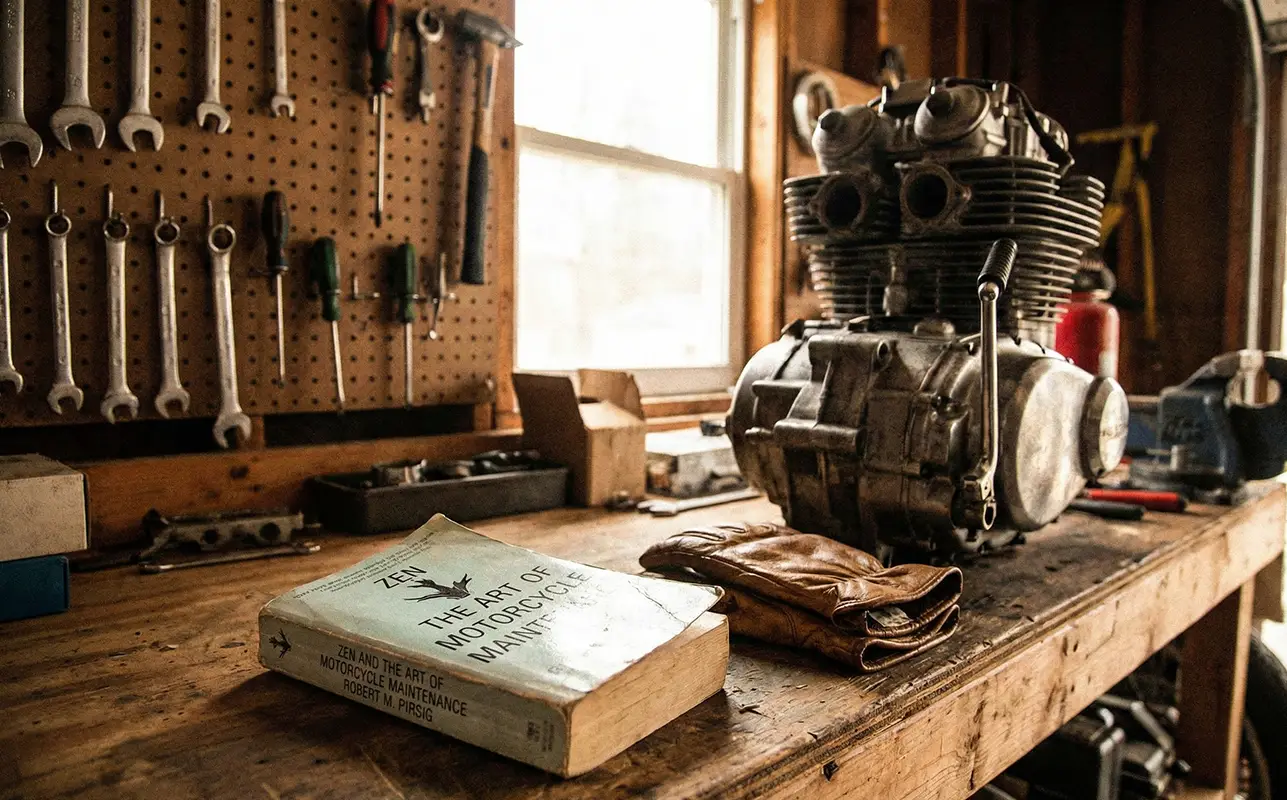
In the world of motorcycle literature, there are service manuals, and then there is the manual. I’m not talking about a standard motorcycle maintenance book like your Clymer or Haynes guides, nor the factory service PDF you downloaded from a sketchy forum at 2 AM to fix a leaking fork seal. I’m talking about Robert M. Pirsig’s 1974 masterpiece, Zen and the Art of Motorcycle Maintenance.
If you hang around garages long enough, you’ll see copies of the art of motorcycle maintenance book on greasy workbenches, usually dog-eared, stained with 10W-40, and holding up a wobbly table leg.
It’s a book that has divided riders for decades. Some call it a dense, rambling philosophy lecture that has nothing to do with bikes. Others call it the most important book ever written about the mechanical mind.
After fifty years, does Robert Pirsig Zen and the Art of Motorcycle Maintenance still hold up? For the modern rider—obsessed with TFT displays, traction control, and ECU re-mapping—is there anything to learn from a guy riding a 1960s Honda Super Hawk across the Dakotas?
The answer is a resounding yes.
In fact, I’d argue that Pirsig Zen and the Art of Motorcycle Maintenance is more relevant today than it was in the 70s.
We live in an era of disposable technology, “black box” electronics, and a culture that encourages us to buy a new part rather than fix the old one.
Pirsig teaches us something different. He teaches us how to see, how to care, and most importantly, how to keep our cool when a fifty-cent bolt strips and threatens to ruin our entire weekend.
This isn’t just a review of the book Zen and the Art of Motorcycle Maintenance. This is a deep dive into the philosophy of the garage.
We’re going to look at the “Classical” vs. “Romantic” mind, the infamous “Gumption Trap,” and why finding the zen of motorcycle maintenance might be the best tool in your box.
Part 1: The Chautauqua on Two Wheels

The structure of the book is a “Chautauqua”—an old American term for a traveling series of lectures. But instead of a tent, the classroom is the saddle of a motorcycle.
The narrator (Pirsig) and his son Chris are riding two-up on an older motorcycle, accompanied by their friends John and Sylvia Sutherland, who are riding a brand-new, high-end BMW.
As they cross the high plains of America, Pirsig uses the ride to deconstruct how we think about technology.
He isn’t just talking about motorcycle maintenance and zen as a quirky juxtaposition; he is arguing that they are actually the same thing.
To fix a machine requires a state of mind that is calm, attentive, and connected to reality—a state that is fundamentally “Zen.”
But not everyone sees it that way.
The Romantic Rider (John Sutherland)
John is a good guy. He’s a musician, a lover of life, and a great riding buddy. But he is terrified of technology. To him, the motorcycle is a magic carpet.
He loves the wind in his face, the scenery, and the feeling of freedom. But he refuses to look under the tank.
He doesn’t want to know how the engine works; in fact, the very thought of valves, pistons, and chains depresses him.
He represents the Romantic view of the world. He looks at the art of motorcycle maintenance and sees only “surface appearance”—shiny chrome, sleek lines, and the promise of adventure. He wants the experience of riding without the responsibility of the machine.
When his bike breaks down, John feels betrayed. The magic has failed. He becomes angry, helpless, and entirely dependent on professional mechanics to restore the magic for him.
He is the guy who stands on the side of the road kicking his tire because he doesn’t know how to check a fuse.
We all know a rider like John. They ride the latest, most expensive gear. They wash their bike every weekend, but they panic if the chain needs tensioning.
They treat the machine as a mystery that is best left untouched. They might search online for the art of Zen and motorcycle maintenance looking for a shortcut to happiness, but they miss the mechanical reality required to get there.
The Classical Rider (The Narrator)
The narrator, on the other hand, views the world through a Classical lens. When he looks at a motorcycle, he doesn’t just see a shiny object; he sees a system of concepts.
He sees steel shapes that function according to the laws of physics. He sees tolerance, pressure, heat, and wear.
To the Classical mind, a motorcycle isn’t magic. It’s a machine made of parts. If the bike stops running, it’s not a betrayal; it’s just a cause-and-effect problem. A wire is loose, a jet is clogged, or a gap is too wide.
The narrator carries a tool kit and knows how to use it. He listens to the engine not just for the roar, but for the “slap-slap-slap” of the tappets.
He understands that motorcycle maintenance and Zen are connected—not through chanting or incense, but through a calm, logical understanding of how the world actually works.
The Conflict of Perspectives
The tension in the book—and in our own lives—comes when these two worlds collide. John gets frustrated with the narrator because the narrator is always analyzing things, taking the “romance” out of the ride. The narrator gets frustrated with John because John essentially chooses to be helpless.
There is a moment early in the book that perfectly captures this. John’s handlebars are slipping. It’s a minor issue, annoying but fixable.
But John doesn’t fix it. He just complains about it. He lets the handlebars slip for thousands of miles because he is afraid to touch the bolts. To him, tightening those bolts opens a door to a terrifying world of mechanics he wants to avoid.
For us at Revv Rider, the lesson here is foundational. You don’t have to be a master mechanic, but choosing to be willfully ignorant of your machine puts a wall between you and the experience of riding.
When you understand how your bike works—even just a little bit—you aren’t just a passenger on a magic carpet. You are a partner in the machine’s operation. You are practicing the true art of motorcycle maintenance.
Part 2: The $1800 Shim (Defining Quality)
One of the most famous scenes in the book—and the one that defines the difference between a “parts swapper” and a true mechanic—is the story of the beer can shim.
John’s expensive BMW is having those handlebar troubles. The narrator looks at it and realizes that the factory clamps aren’t gripping the bars tight enough. The tolerances are slightly off. The solution is simple: he needs a thin strip of metal to wrap around the bars, adding just enough thickness for the clamps to bite down.
The narrator spots a discarded beer can in the grass. He picks it up and excitedly explains to John that this is perfect. Aluminum from a beer can is soft, malleable, and rust-proof. It is the perfect material for a shim.
John is horrified.
He sees his BMW as a piece of precision German engineering worth $1,800 (a fortune in the 70s). He sees the beer can as roadside trash. The idea of putting “trash” on his “precision machine” is an insult to him. He refuses to let the narrator do it. He would rather have loose handlebars than “degrade” his bike with a beer can.
What is Quality?
This scene is where the art and zen of motorcycle maintenance truly meet practical application. Pirsig introduces his central philosophy: Quality.
- John’s View: Quality is inherent in the brand, the price tag, and the status. A BMW part has quality. A beer can does not. He is judging the object, not the function.
- The Narrator’s View: Quality is about function and fitness for purpose. The aluminum in the can is chemically identical to “precision” aluminum stock. It fits the need perfectly. Therefore, in that moment, the beer can is a high-quality part.
This is a trap many modern mechanics fall into. We obsess over buying “Stage 1” kits, anodized billet aluminum accessories, and branded tools. We think that if we buy the expensive part, we are doing “good work.” We scroll through forums debating which synthetic oil is “best” while ignoring the fact that our chain is rusted solid.
Pirsig teaches us that a true mechanic looks past the label. If a zip-tie holds a cable perfectly in place, it is a high-quality repair. If a piece of duct tape seals an airbox in an emergency and gets you home, it is a high-quality solution.
The Lesson: Don’t confuse the symbol of quality (brand names, high prices) with the reality of quality (does it work? does it last? is it elegant?). The mechanic who can fix a bike on the side of the road with a multi-tool and a piece of wire understands motorcycle maintenance and the art of Zen better than the guy who can only install bolt-on parts in a heated garage.
Part 3: The Gumption Trap

If there is one term from this book motorcycle maintenance enthusiasts should tattoo on their forearm, it is the Gumption Trap.
We have all been there. You decide to do a simple job—maybe an oil change or swapping out a battery. It should take 20 minutes. You have your tools laid out. You have your coffee. You are feeling good. You are full of “gumption.”
Then, the first bolt you try to remove strips.
The head rounds off. You try to grab it with pliers, and it slips, gouging your knuckles. You try to drill it out, and the drill bit snaps off inside the hole.
In the span of 30 seconds, you have gone from a happy, competent rider to a furious, cursing mess. You throw your wrench across the garage. You hate the bike. You hate the manufacturer. You hate yourself.
Your “gumption”—your internal reservoir of enthusiasm and energy—has been drained. You are stuck.
Anatomy of a Trap
Pirsig identifies this as the single biggest danger in motorcycle maintenance and Zen practice. It’s not the mechanical problem that stops you; it’s the emotional reaction to the problem.
“If you haven’t got gumption, there’s no way the motorcycle can possibly be fixed. But if you have got it and know how to keep it, there’s absolutely no way in this whole world that motorcycle can keep from getting fixed.”
He categorizes Gumption Traps into two main types:
1. Setbacks (External Traps)
These are physical things that go wrong. The machine fights back.
- The Stripped Screw: The classic example. A fifty-cent piece of metal holds up a project worth thousands of dollars.
- The Missing Part: You take the whole engine apart, only to realize you are missing one gasket.
- The Intermittent Failure: The bike runs fine in the garage but dies on the highway. This is the “ghost” in the machine that drains your spirit because you can’t find it to fight it.
How to escape: Pirsig suggests that when you hit a setback, the worst thing you can do is keep working. If you keep working while angry, you will break something else. You will over-torque a bolt or cross-thread a spark plug. Instead, you must stop. Put down the tools. Go have a cup of coffee. Stare at the bike for a while without touching it. By doing this, you stop fighting the machine and start observing it. Often, the solution (heat, penetrating oil, a different angle) only appears when you stop trying to force it.
2. Hang-ups (Internal Traps)
These are traps inside your own head. They are the mental blocks that prevent you from seeing the solution.
- Ego: You think you know everything, so you don’t check the manual. You assume the noise is the carburetor because you’re “good at carbs,” when it’s actually a loose spark plug wire. Ego blinds you to the truth.
- Anxiety: You are so afraid of breaking the bike that you are shaking. This nervousness makes your hands clumsy, which usually leads to you breaking the bike.
- Boredom: You are doing a repetitive task (like cleaning a chain), and your mind drifts. You get sloppy. You miss a spot, or you pinch a finger.
How to escape:
- For Ego: Practice humility. The motorcycle doesn’t care who you are. It only respects physics. If you want to master the art of motorcycle maintenance, you must first master your own impatience.
- For Anxiety: Read the manual. Then read it again. Visualize the steps. Anxiety comes from the unknown; knowledge kills anxiety.
- For Boredom: Slow down. Treat the boring task as a ritual. Pirsig talks about “Zen” not as a religious chanting, but as the act of being totally present in what you are doing. If you are cleaning a bolt, just clean the bolt. Don’t think about the ride later. Just make that bolt perfect.
Part 4: The Church of Reason vs. The Assembly Line
Later in the book, Pirsig dives into why modern technology often feels cold or “soulless.” He talks about the mechanic who works on an assembly line or in a dealership.
He describes a nightmare scenario where he takes his bike to a shop. The mechanics are listening to loud radio, moving fast, joking around, and treating his bike like a piece of meat. They don’t care. They strip bolts, leave grease marks, and fix one thing while breaking another.
Why?
Because they are separated from the Quality of their work. To them, it’s just a job. They are following a manual, but they aren’t feeling the machine. They are spectators. They are disconnected from zen and motorcycle maintenance.
Pirsig argues that the “Assembly Line” mentality is what kills the soul of technology. It turns us into robots who just swap parts without understanding the system.
The Craftsman Mindset
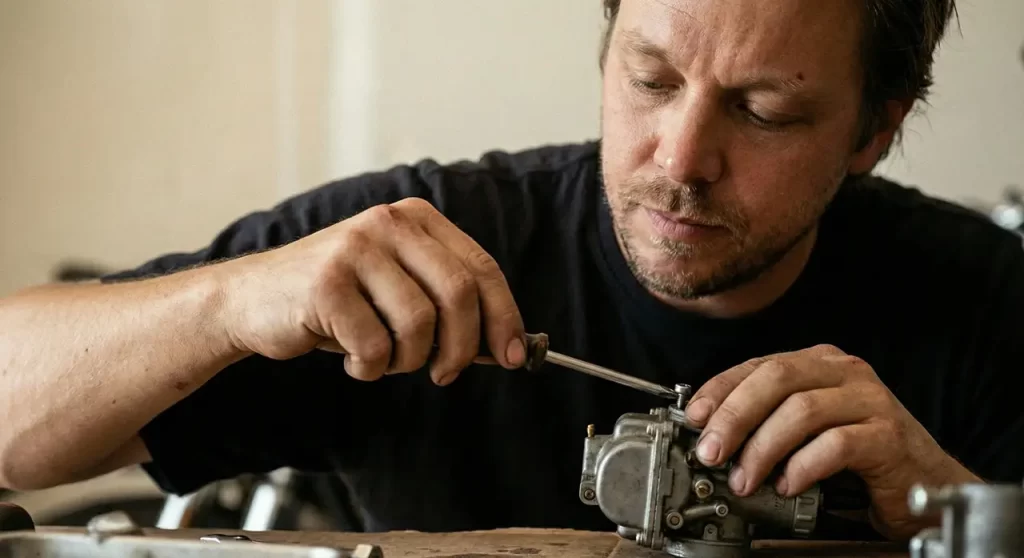
The antidote to the Assembly Line is the Craftsman Mindset.
When you work on your own bike, there is no separation between you and the machine. You are the rider and the mechanic. If you leave the brakes loose, you are the one who crashes. This connection forces you to care. It forces you to invest in the outcome.
Pirsig describes this state as “peace of mind.” It’s not about being sleepy or relaxed; it’s about being so in tune with the work that you don’t notice time passing. You aren’t fighting the metal; you are working with it.
“The material and his thoughts are changing together in a progression of changes until his mind’s at rest at the same time the material’s right.”
This is the “Zen” in the title. It’s that moment in the garage when the radio fades out, the world disappears, and it’s just you and the torque wrench. The bolt clicks at the exact right moment. The cover slides on perfectly. You feel a sense of deep satisfaction.
That feeling? That is the reason we wrench. It’s not just to save money on labor costs. It’s to reconnect with the physical world in a way that feels honest and true. It is the core of motorcycle maintenance and the art of zen.
Part 5: Is Pirsig Relevant for Modern Bikes?
Some critics argue that Zen and the Art of Motorcycle Maintenance is outdated. After all, Pirsig was tuning carburetors and adjusting mechanical points.
Today, we have Fuel Injection, ABS, Traction Control, and ECUs that are sealed in epoxy. You can’t fix a microchip with “peace of mind.”
Or can you?
While the technology has changed, the philosophy remains the same. Modern bikes are more complex, yes. They require diagnostic computers instead of feeler gauges. But the Gumption Trap is still there.
When your dashboard lights up with an obscure error code, you feel the same sinking feeling Pirsig felt when his engine misfired. You have two choices:
- The Romantic Choice: Panic. Blame the electronics. Curse “modern junk.” Load it on a trailer and pay someone else to deal with it.
- The Classical Choice: Calm down. Get the wiring diagram. Research the error code. trace the circuit.
The modern “Classical” rider understands that even a digital system is just a logical path of electrons. It can be understood. It can be diagnosed.
The tools have changed—from screwdrivers to multimeters—but the mindset required to use them is identical. The zen of motorcycle maintenance applies just as much to coding an ECU as it does to jetting a carb.
Part 6: Practical Takeaways for the Revv Rider
So, how do we apply 50-year-old philosophy to our modern garage? Here are five practical “Revv Rider Rules” inspired by Pirsig to help you master the art of motorcycle maintenance:
1. Maintain Your Gumption First, Your Bike Second
If you are angry, hungry, or tired, stop working. The bike isn’t going anywhere. Working while frustrated is the fastest way to turn a $10 repair into a $1,000 disaster. Protect your peace of mind as if it were a valuable tool. If you feel the “Gumption Trap” closing in, walk away.
2. Respect the “Stuck Screw”
When a bolt won’t move, don’t just grab a bigger breaker bar and force it. That bolt is trying to tell you something. Maybe it has red Loctite. Maybe it’s reverse-threaded. Maybe it’s seized with rust. Listen to the machine. Use heat. Use penetrating oil. Be patient. The stuck screw is a test of your character, not just your strength.
3. Embrace the “Beer Can Shim”
Don’t be a snob about parts. Yes, OEM parts are great. But sometimes, ingenuity is better. If you can fix something reliably with a simple, clever solution, do it. Understanding why a fix works is more important than how much the part cost. This is the essence of art of motorcycle maintenance—creativity within the laws of physics.
4. Keep a Clean Shop
Pirsig talks a lot about how your environment reflects your mind. If your garage is a mess of scattered tools and oily rags, your mind will be scattered, too. You will lose parts. You will get frustrated. Clean your workspace before you start. Put tools back when you are done with them. A clean shop creates a calm mind, which leads to Quality work.
5. Be the Narrator, Not John
Don’t be afraid of your bike. It’s just metal and plastic. It operates on logic. If you don’t understand how your fuel injection works, don’t say “it’s magic.” Buy a book. Watch a video. Learn. The more you understand your machine, the less you will fear it, and the more you will enjoy the ride.
FAQ: Understanding the Book and the Philosophy
If you are looking to pick up a copy or just want to win an argument at the bar, here are the answers to the most common questions about this literary classic.
What genre is Zen and the Art of Motorcycle Maintenance?
This is the most common question because the book defies easy categorization. It is technically a fictionalized autobiography, but it is also a philosophy book and a travelogue. It is not a technical manual. If you are looking for a standard book motorcycle maintenance guide with torque specs and wiring diagrams, this isn’t it. But if you want a book about how to think while fixing your bike, this is the genre-defying masterpiece you need.
Is it actually about motorcycle maintenance?
Yes and no. It uses motorcycle maintenance and the art of Zen as a metaphor for life. However, the mechanical descriptions are accurate. Pirsig discusses tuning carburetors, adjusting chains, and diagnosing electrical faults with great detail, using them to explain broader philosophical concepts. You will learn more about the attitude of a mechanic than the mechanics of a bike.
Why is “Zen” in the title?
The title is a play on the book “Zen in the Art of Archery.” Pirsig isn’t teaching Buddhist meditation. He is using “Zen” to describe a state of total engagement with the task at hand. When you are fully focused on the art of motorcycle maintenance, the subject (you) and the object (the bike) merge. There is no separation. That “oneness” is the Zen he is talking about.
What is the best motorcycle maintenance book for beginners?
If you want to learn to turn wrenches, buy the Haynes or Clymer manual for your specific bike model first. That is your textbook. Then, buy Zen and the Art of Motorcycle Maintenance as your “philosophy” book. Read the manual to know what to do; read Pirsig to know how to be while you do it.
Conclusion
Zen and the Art of Motorcycle Maintenance isn’t an easy read. It’s long, it digresses into Greek history, and the narrator is arguably going insane for half of it. It asks a lot of the reader.
But if you are a rider who wants to do more than just turn the key and go, it is essential reading. It validates every frustration you have ever felt in the garage. It gives a name to the satisfaction you feel when an engine finally catches and idles smoothly after a rebuild.
It teaches us that the motorcycle is a mirror. When we fix the bike, we are really fixing ourselves. We are learning patience, logic, and care. We are learning to see the Quality in the world.
So, the next time you are kneeling on the concrete floor, cursing at a stripped drain plug, take a deep breath. Put down the wrench. Remember Pirsig. You aren’t just fixing a motorcycle; you’re maintaining your own sanity. And that is an art worth mastering.