As the riding season winds down and the crisp autumn air gives way to the bite of winter, your motorcycle faces its greatest adversary: downtime.
For the growing number of enthusiasts, with on-road motorcycle registrations in the U.S. more than doubling to 8.8 million in 2023, proper storage is more than a chore—it’s an essential act of preservation.
Letting a bike sit unprepared through the cold months is a gamble against moisture, corrosion, and chemical degradation.
This guide is your comprehensive roadmap to winterizing your motorcycle, ensuring that when the first warm day of spring arrives, your machine is ready to roar back to life, not leave you stranded with a costly and preventable problem.
Introduction: Why Your Motorcycle Deserves a Winter Nap, Not a Winter Nightmare
Properly winterizing your motorcycle is the single most important maintenance task you can perform to guarantee a seamless transition from storage back to the open road.
It’s a proactive investment in your bike’s health, saving you from the frustration and expense of springtime repairs.
The process addresses the key enemies of a stored vehicle: fuel degradation, battery sulfation, corrosion from moisture, and tire damage. By taking a few hours to prepare your bike for its winter slumber, you’re not just putting it away; you’re setting it up for peak performance when the next riding season begins.
The Dreaded “ICE APOCALYPSE”: Preventing a Failed Spring Start
Every rider dreads the moment they turn the key in spring only to be met with silence or a sputtering engine. This “Internal Combustion Engine Apocalypse” is often the direct result of neglecting winter storage procedures.
Stale, separated fuel clogs carburetors and fuel injectors. A dead battery, weakened by months of cold and inactivity, fails to provide the necessary cranking amps. Corrosion can seize cables and brake components.
According to Zenith Motorcycles, temperatures below freezing (32°F) can cause oil thickening, tyre pressure loss, and fuel issues, turning your bike’s vital fluids into liabilities. Winterizing is the preemptive strike against this collection of problems, ensuring your first ride is a joyous one, not a trip to the repair shop.
Investing in Longevity: How Winterizing Protects Your Bike and Wallet
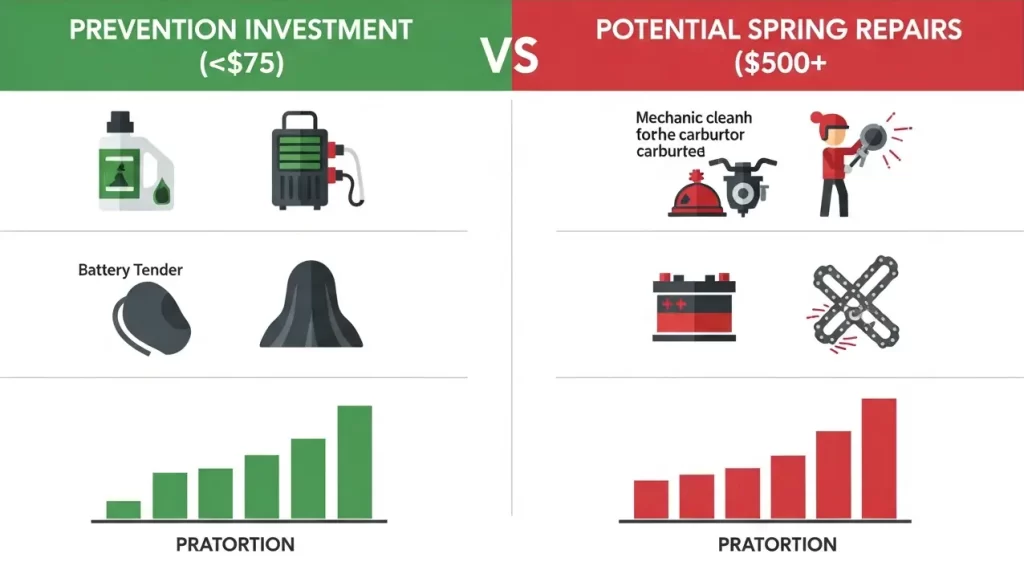
A small investment in winterizing supplies can save you hundreds of dollars in springtime repair bills.
Think of winterizing as an investment with a guaranteed return. The cost of a bottle of fuel stabilizer, a battery tender, and a few hours of your time is minuscule compared to the potential cost of a professional carburetor cleaning, a new battery, or rust remediation.
Clogged fuel systems alone can run into hundreds of dollars in labor. A battery that has been allowed to fully discharge and freeze is often irreversibly damaged.
Moisture that settles on metal surfaces can lead to pitting and rust on chrome, fasteners, and even within the engine itself.
By following a thorough winterizing process, you are actively protecting your bike’s value, extending its lifespan, and ensuring your maintenance budget is spent on upgrades and tires, not on fixing problems that were entirely preventable.
The Foundation: Pre-Winterization Checklist and Gathering Supplies
Success in any project begins with preparation. Before you start the hands-on process of winterizing your bike, taking the time to organize your tools, materials, and workspace will transform a potentially chaotic task into a smooth, methodical procedure. A well-prepared rider is an efficient one, ensuring no critical step is missed.
Essential Tools and Materials: From Fuel Stabilizer to a Battery Tender
Gathering everything you need beforehand prevents interruptions and ensures you have the right product for each step. Your specific needs may vary slightly based on your motorcycle model, but this core list will cover most bikes.
Essential Supplies:
- Fuel Stabilizer: A non-negotiable item. Choose a quality brand like Star Tron additive or Yami fuel stabilizer.
- Motor Oil & Filter: For a pre-storage oil change.
- Chain Cleaner & Lubricant: If your bike is chain-driven.
- Motorcycle-Specific Soap/Cleaner: To remove road grime.
- Wax or Polish: To protect the paint.
- Multi-Purpose Lubricant (e.g., WD-40) & White Lithium Grease: For cables and pivot points.
- Fogging Oil (optional but recommended): For internal engine protection.
- Shop Rags/Microfiber Towels: For cleaning, drying, and application.
Essential Tools:
- Battery Tender/Smart Charger: To maintain battery health.
- Wrench Set/Socket Set: For oil changes and battery removal.
- Oil Filter Wrench.
- Oil Drain Pan.
- Tire Pressure Gauge & Air Compressor/Pump.
- Motorcycle Stand(s): Center stand or front/rear paddock stands to lift the tires off the ground.
- Funnel.
- Work Gloves and Safety Glasses.
Carving Out Time: Approaching Winterization Methodically
Don’t rush the process. Set aside a dedicated afternoon to winterize your bike properly. A hurried job leads to missed steps.
Approach the task methodically, following a logical sequence like the phases outlined in this guide. Start with the fuel system, as this requires running the engine.
Move on to fluid changes while the engine is still warm. Finally, focus on cleaning, lubrication, and battery care before settling the bike into its final storage spot.
A checklist can be your best friend, allowing you to mark off each task as you complete it, providing peace of mind that nothing has been overlooked.
Phase 1: Fuel System Preparation – The Heart of a Smooth Spring Start
The fuel system is the most common casualty of improper winter storage. Modern gasoline, especially ethanol-blended fuel, can begin to degrade in as little as 30-60 days.
This degradation leads to the formation of varnish and gum, which can clog the microscopic passages in fuel injectors and carburetors, resulting in poor performance or a complete failure to start. Protecting your fuel system is the single most critical step in the entire winterizing process.
Filling the Gas Tank: Preventing Condensation and Rust
The first step in fuel system care is to top off your fuel tank, leaving only a small amount of room for expansion. A full gas tank minimizes the amount of exposed surface area on the inside walls of the tank.
This is crucial because a partially empty tank allows air, laden with moisture, to sit inside. As temperatures fluctuate during the winter, this moisture can condense into water droplets on the bare metal walls.
This water can then lead to rust formation inside your fuel tank—a severe problem that can send rust particles throughout your entire fuel system. A full tank of fuel effectively displaces this moist air, acting as a primary barrier against internal corrosion.
Choosing and Adding Fuel Stabilizer: Guarding Against Fuel Degradation
Once the tank is full, the next step is to add a quality fuel stabilizer. A stabilizer is a chemical fuel additive designed to combat the two primary issues with stored fuel: oxidation and moisture absorption.
It contains antioxidants that prevent the fuel from breaking down and forming gummy deposits. It also includes compounds that bond with any absorbed water, allowing it to be safely burned through the engine rather than settling at the bottom of the tank.
When choosing a stabilizer, look for one that specifically mentions protection against the effects of ethanol. Products like the Star Tron Enzyme Fuel Treatment or the OEM-specific Yami fuel stabilizer are engineered to handle the challenges of modern fuels.
Follow the manufacturer’s instructions carefully for the correct ratio of stabilizer to gasoline. It’s better to add slightly more than recommended than not enough. Pour the stabilizer directly into the full gas tank.
Circulating the Stabilizer: Running the Engine for Optimal Protection
Simply adding a fuel stabilizer to the tank is not enough. The treated fuel must be circulated throughout the entire fuel system to be effective.
This means it needs to flow from the fuel tank, through the fuel lines, fuel pump, and into the carburetors or fuel injectors. The only way to achieve this is to run the engine.
After adding the stabilizer, start your motorcycle and let it run for 5-10 minutes. This is long enough to ensure the stabilized fuel mixture has replaced the untreated fuel in all the critical components.
For fuel-injected bikes, a short, gentle ride around the block is even better as it ensures the entire system is fully pressurized and circulated.
This single step ensures that every part of your fuel system, not just the tank, is protected from varnish and corrosion during the winter.
The Pure Gas Advantage: Why Non-Ethanol Gas is a Smart Choice for Storage
For maximum protection, consider using non-ethanol gasoline, often referred to as “Pure Gas,” for your final fill-up before storage.
The primary issue with ethanol-blended fuel (E10) is that ethanol is hygroscopic, meaning it actively attracts and absorbs water from the atmosphere.
Over time, this can lead to “phase separation,” where the water-ethanol mixture separates from the gasoline and sinks to the bottom of your fuel tank. This corrosive mixture can wreak havoc on fuel system components.
Non-ethanol gas eliminates this primary risk. While you should still use a fuel stabilizer with Pure Gas to prevent oxidation, you remove the potent threat of phase separation.
Websites like pure-gas.org can help you locate stations that sell non-ethanol fuel. While it may be more expensive, the peace of mind and superior protection it offers for long-term winter storage make it a very smart investment for any rider.
Phase 2: Engine and Fluid Care – Protecting Your Motorcycle’s Core
With the fuel system secured, the next phase focuses on the lifeblood of your motorcycle: its engine oil, coolant, and other vital fluids.
These fluids can harbor contaminants and moisture that, if left to sit over the winter, can cause significant internal damage. Addressing them before storage is essential for maintaining the long-term health and reliability of your bike’s powertrain.
The Essential Oil Change: Removing Contaminants Before Storage
Performing an oil change before you store your motorcycle for the winter is a hotly debated topic, but the engineering logic is clear: it’s the best practice.
Used motor oil is not just oil; it’s a suspension of contaminants, including acidic byproducts from combustion, unburnt fuel, moisture, and microscopic metal particles.
Leaving this dirty oil to sit in your engine for months allows these corrosive agents to settle on and potentially etch sensitive internal components like bearings and transmission gears.
By changing the oil and filter before storage, you are flushing out these harmful contaminants and replacing them with a fresh, clean batch of oil with intact protective additives.
This ensures your engine’s internals are bathed in a clean, non-corrosive environment throughout the winter. When spring arrives, you’ll be ready to ride immediately without the chore of a pre-season oil change.
Cooling System Maintenance (for Liquid-Cooled Bikes)
If your bike is liquid-cooled, your coolant (antifreeze) is another critical fluid to inspect. Coolant does more than just prevent freezing; it also contains corrosion inhibitors that protect the aluminum and other metals within your engine and radiator.
Over time, these inhibitors break down. Before storage, check your coolant level and condition. Use a coolant tester to verify its freeze protection level is adequate for your region’s coldest temperatures.
If the coolant is old (check your owner’s manual for service intervals) or appears dirty or rusty, this is the perfect time to flush the system and refill it with fresh, new coolant. This ensures your cooling system is protected from both freezing and internal corrosion during its long winter nap.
Transmission and Brake Fluid Check: Addressing Moisture and Wear
While typically less urgent than oil and coolant, it’s wise to inspect your other fluids. For bikes with separate transmission oil, check the level and condition just as you would engine oil.
More importantly, inspect your brake fluid. Brake fluid is highly hygroscopic, meaning it absorbs moisture from the air over time. This moisture lowers the fluid’s boiling point and can cause internal corrosion in the master cylinders and calipers.
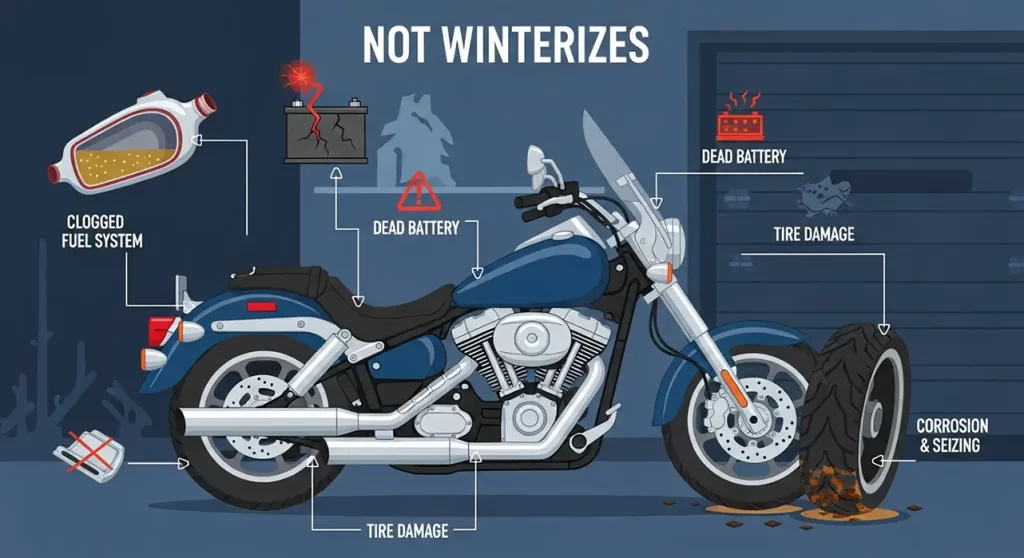
Neglecting winter storage can lead to a cascade of preventable problems, from a dead battery to a clogged fuel system.
Check the fluid level in the reservoirs. If the fluid appears dark or cloudy, it’s a sign that it has absorbed significant moisture and should be flushed and replaced.
Even if it looks clean, adhere to the manufacturer’s recommended replacement interval, which is typically every two years. Ensuring your brake system contains fresh fluid before storage minimizes the risk of moisture-related damage.
Cylinder Fogging: Internal Engine Protection Against Rust and Corrosion
For the ultimate in internal engine protection, especially for those storing their bike in a damp environment or for an extended period, consider using fogging oil.
This specialized oil is sprayed directly into the cylinders through the spark plug holes. It creates a thin, protective film of anti-corrosive oil over the cylinder walls, piston rings, and valve seats. This film prevents ambient moisture from causing rust to form on these precision-machined surfaces.
The process is simple: remove the spark plugs, spray a few seconds of fogging oil into each cylinder, and then briefly turn the engine over (with the ignition off) to distribute the oil evenly.
Reinstall the spark plugs, and your engine’s internals will be sealed against corrosion. When you start the bike in the spring, this oil will burn off harmlessly within the first few minutes.
Lubricating Cables and Pivots: Ensuring Smooth Operation in Spring
Finally, take a few minutes to lubricate all the moving parts and control cables on your motorcycle. Over the winter, moisture can creep into cable housings and pivot points, causing rust and binding. This can lead to a stiff clutch lever, a sticky throttle, or seized brake pivots in the spring.
Use a dedicated cable-lubing tool to force lubricant through the clutch, throttle, and brake cables. Apply a small amount of white lithium grease to pivot points like the clutch and brake levers, footpegs, and shifter linkage.
This simple act ensures that when you’re ready to ride again, all your controls will operate as smoothly as they did at the end of the previous riding season.
Phase 3: Battery Preservation – Your Guarantee for a Perfect Spring Ignition
Your motorcycle’s battery is one of the most vulnerable components during winter storage. Cold temperatures and inactivity are a lethal combination for a lead-acid battery.
A neglected battery will not only fail to start your bike in the spring but may be damaged beyond recovery. Proper battery care is the final key to guaranteeing a perfect, instant start when the riding season returns.
Cleaning Battery Terminals: Preventing Corrosion and Ensuring Good Connection
Before connecting any charging device, it’s crucial to ensure the battery terminals are clean and free of corrosion. Corrosion, which often appears as a white or greenish powder, acts as an insulator, preventing a solid electrical connection. This can hinder both charging and the delivery of power to the starter.
Disconnect the negative terminal first, followed by the positive. Use a wire brush or a dedicated battery terminal cleaning tool to scrub the terminals and cable connectors until they are bright and shiny.
Once clean, reconnect the terminals (positive first, then negative) and apply a thin layer of dielectric grease to prevent future corrosion.
Charging and Maintaining with a Battery Tender or Batteryguard
The single best way to preserve your battery over the winter is to use a modern, multi-stage “battery tender” or “smart charger.” These devices are not simple trickle chargers.
A trickle charger provides a constant, low-amperage current that can eventually overcharge and damage a battery. A smart tender, in contrast, monitors the battery’s voltage and delivers a charge only when needed.
It goes through a cycle of charging, testing, and maintaining, keeping the battery at its optimal voltage without overcharging.
As BikeBoxMT LLC notes, a battery loses 20% of its capacity at 0°C and nearly 50% at -18°C, making a maintainer essential to combat this natural discharge in cold weather.
Simply connect the tender and leave it plugged in all winter; it will manage your battery’s health automatically.
Optimal Battery Storage Conditions: Keeping it Cool and Dry
Where you store your battery also matters. If you plan to leave the battery in the bike while connected to a tender, ensure the storage location (like a garage) doesn’t experience extreme temperature swings.
If your storage area is unheated and subject to deep freezes, or if you don’t have access to an outlet for a tender, the best option is to remove the battery from the motorcycle altogether.
Store the battery in a cool, dry place off of a concrete floor (an old but still valid precaution). A basement is often ideal.
Even when removed, the battery will still self-discharge, so connecting it to a battery tender in its storage location once a month to top it off is the best practice for ensuring maximum longevity and a full charge in the spring.
Phase 4: Cleaning, Lubrication, and Rust Prevention – Exterior Defense
With the internal systems protected, it’s time to defend your motorcycle’s exterior from the slow, creeping attack of winter moisture and grime.
A thorough cleaning and application of protective coatings will create a barrier that shields your bike’s paint, chrome, and metal components from corrosion and degradation, ensuring it looks as good in the spring as it did when you put it away.
A Thorough Wash and Dry: Removing Road Grime and Corrosive Elements
The last ride of the season leaves behind a film of dirt, bug residue, and road grime. These contaminants are not inert; they can contain acidic elements and trap moisture against your bike’s surfaces, promoting rust and damaging the paint’s clear coat.
Before storage, give your bike a meticulous wash. Use a high-quality, motorcycle-specific soap and pay close attention to hard-to-reach areas like the underside of the engine and inside the wheel wells.
Once washed, dry the bike completely using a microfiber towel or a leaf blower to force water out of crevices, fastener heads, and cooling fins where it might otherwise sit and cause corrosion.
Waxing and Protecting Paintwork: A Barrier Against Moisture and Dust
After the bike is perfectly clean and dry, apply a quality coat of wax or paint sealant to all painted surfaces, including the fuel tank, fenders, and side covers.
This isn’t just for shine; the wax creates a hydrophobic barrier that repels any ambient moisture in your garage or storage unit. It also makes it easier to wipe off the dust that will inevitably accumulate over the winter. This protective layer is your paint’s first line of defense against the dampness of the winter air.
Rust Prevention Beyond the Surface: Addressing Chrome, Bare Metal, and Fasteners
Paint isn’t the only surface that needs protection. Chrome exhaust pipes, handlebars, and accents are susceptible to pitting and rust if left exposed to moisture.
After cleaning, apply a dedicated chrome polish to these parts. For unpainted metal surfaces, like engine casings or exposed frame sections, a light spray of a moisture-displacing lubricant like WD-40 or ACF-50 can provide a protective film.
Pay special attention to nuts, bolts, and other fasteners, giving them a quick spray to prevent them from seizing with surface rust over the winter months.
Chain Cleaning and Lubrication: Preventing Seizing and Rust
If your bike has a chain drive, it requires special attention. Use a dedicated chain cleaner and a brush to scrub away all the old, dirty lubricant and road grime.
A dirty chain will rust quickly in storage. Once the chain is spotless and dry, apply a fresh, generous coat of high-quality chain lubricant.
Be sure to rotate the wheel to coat every link and roller evenly. This fresh layer of lube will displace moisture and prevent the chain’s O-rings from drying out, ensuring it’s ready to roll smoothly in the spring without any stiff or rusted links.
Addressing Other Moving Parts: Levers, Footpegs, and Control Cables
Your work isn’t done yet. Other moving parts require lubrication to prevent them from seizing or becoming stiff during storage.
Apply a small amount of grease to the pivot points of your brake and clutch levers, as well as the hinges for your footpegs and side stand.
As mentioned earlier, ensuring your control cables are properly lubricated is key. This comprehensive approach to lubrication ensures that every component that is designed to move will do so freely and effortlessly when the riding season resumes.
Phase 5: Tire and Suspension Care – Preventing Flat Spots and Wear
The final phase of preparation focuses on the parts of your motorcycle that bear its weight: the tires and suspension.
A bike that sits stationary for months on end puts continuous pressure on the same small patch of its tires, which can lead to flat spots and carcass damage.
Proper preparation can easily prevent this and ensure your tires are safe and ready for the road.
Inflating Tires to Proper Pressure: The First Line of Defense Against Flat Spots
Your first and simplest defense against tire damage is proper inflation. Before storing the bike, inflate your tires to the maximum recommended pressure listed on the tire’s sidewall.
This is typically higher than your normal riding pressure. The increased pressure helps the tire maintain its round shape and provides more resistance to developing flat spots under the bike’s static weight.
It’s important to remember that for every 10-degree drop in temperature, tire pressure can decrease by 1 to 2 PSI, so starting with a higher pressure compensates for this natural loss over the cold winter months.
Just remember to reset the pressure to your normal riding specification before your first ride in the spring.
Using Stands to Elevate the Bike: The Ultimate Tire Protection
The absolute best way to prevent flat spots is to take the weight off the tires completely. If your motorcycle has a center stand, use it. This will lift the rear wheel off the ground.
For the front, or for bikes without a center stand, a set of front and rear paddock stands is an excellent investment. By elevating the bike so both wheels are suspended in the air, you completely eliminate the pressure that causes flat spots.
This also unloads the suspension components, allowing them to rest in a neutral state for the duration of the storage period. If stands are not an option, try to move the bike forward or backward a few inches every few weeks to rotate the tires and change the pressure point.
Final Storage Placement and Covering
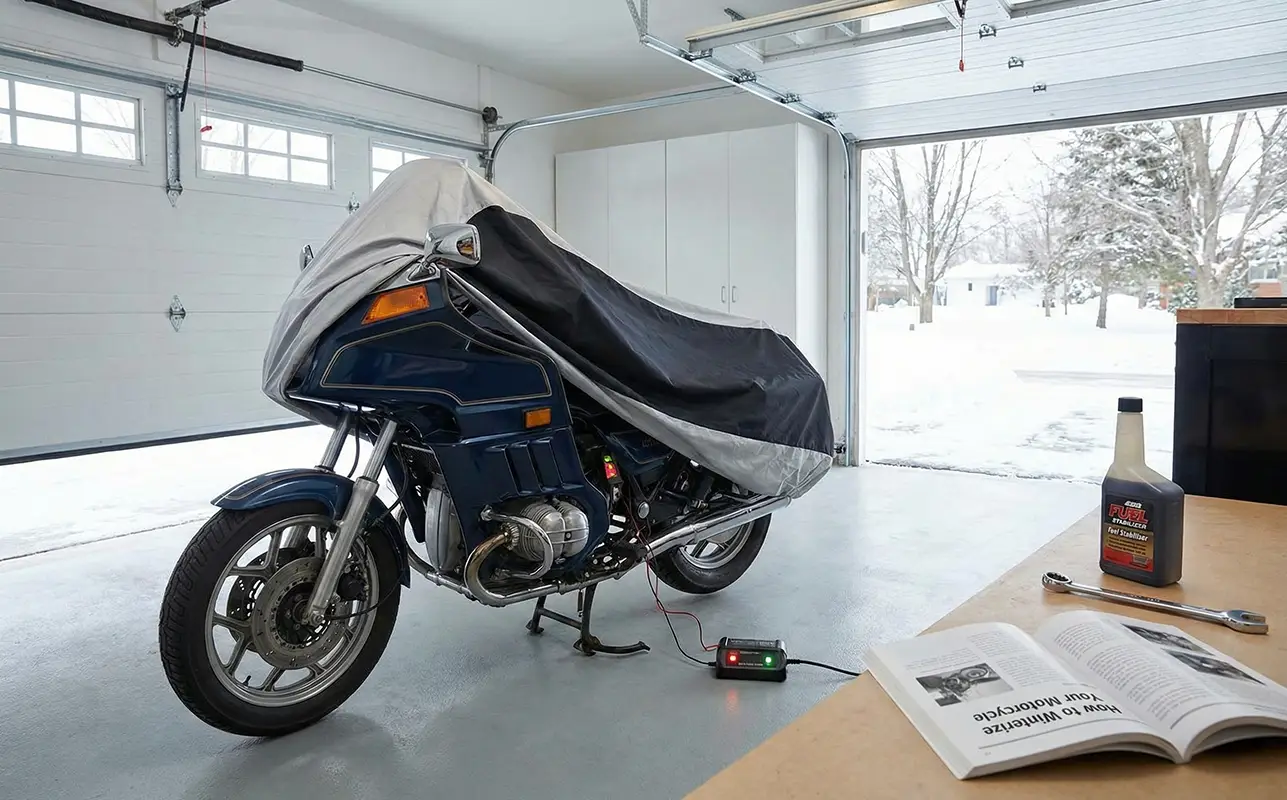
Once your bike is fully prepared, move it to its final storage spot. A climate-controlled garage is ideal, but any dry, secure location will work.
The final touch is to cover the bike. It’s crucial to use a breathable, motorcycle-specific cover. Do not use a generic plastic or vinyl tarp.
Non-breathable materials trap moisture underneath, creating a humid microclimate that can promote corrosion and mold—the very things you’ve worked so hard to prevent. A proper cover will keep dust off while allowing air to circulate, keeping the bike dry and protected until spring.
Conclusion
Winterizing your motorcycle is not merely a suggestion; it’s a foundational aspect of responsible ownership. By methodically addressing each critical system—fuel, engine, battery, exterior surfaces, and tires—you are performing a comprehensive act of preservation.
This process is your assurance against the common springtime frustrations of a clogged fuel system, a dead battery, and the corrosive effects of a long, damp winter. You’ve invested in your machine, and this procedure is the ultimate protection for that investment, safeguarding its performance, appearance, and value.
The reward for your diligence comes on that first perfect spring day. While others may be contending with repair bills and troubleshooting a bike that won’t start, you will be able to simply check your tire pressure, turn the key, and ride away.
The smooth, powerful response of a well-preserved engine and the gleam of protected paintwork are the tangible results of your efforts. Your future self will thank you for taking the time to prepare.
Now, with your bike safely tucked away, you can rest easy through the winter, confident that your next riding season will begin flawlessly, right where the last one left off.