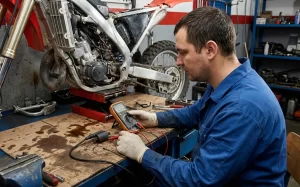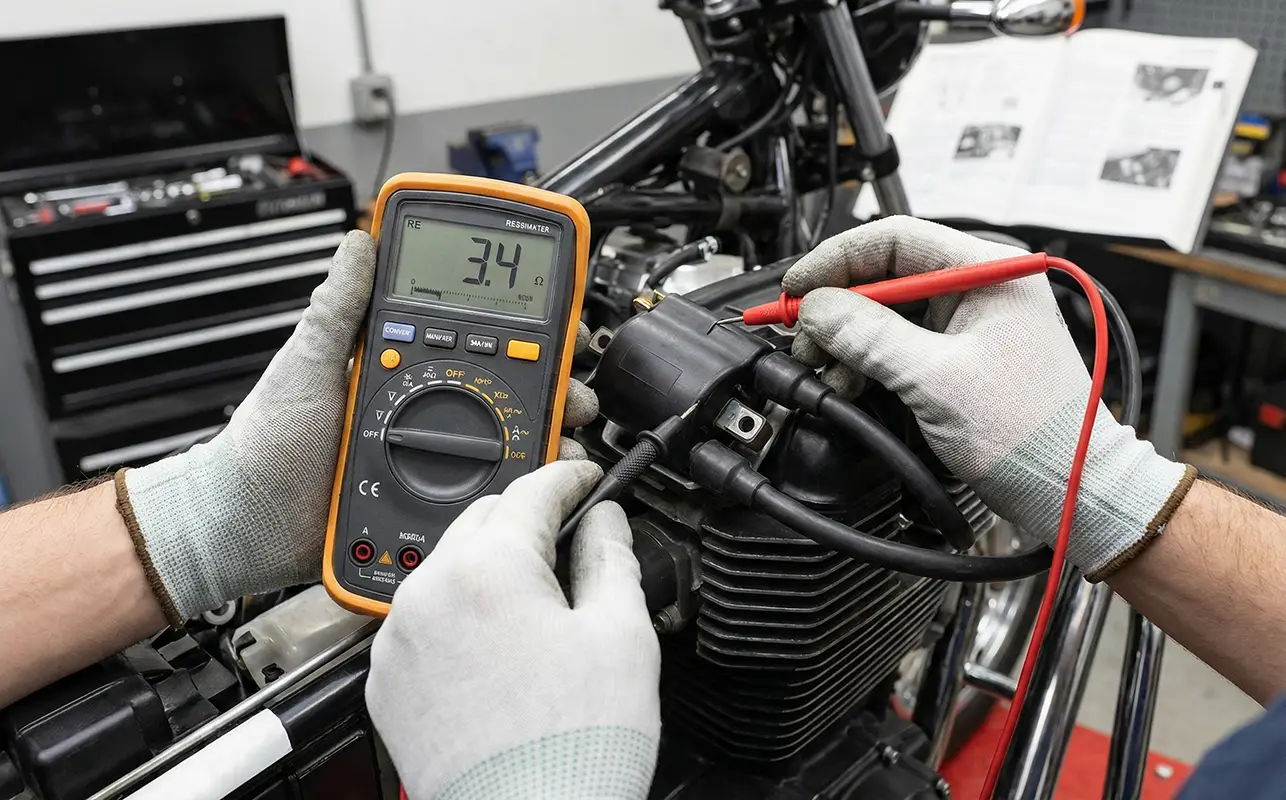
The ignition coil is one of the most critical components in your motorcycle’s electrical system, responsible for converting low voltage from the battery into the high voltage needed to create a spark at the spark plug. When your motorcycle experiences starting problems, misfiring, poor acceleration, or reduced fuel efficiency, a faulty ignition coil could be the culprit. Learning how to check motorcycle ignition coil with multimeter is an essential skill that can save you time and money by allowing you to diagnose ignition problems accurately before replacing expensive parts unnecessarily.
This comprehensive tutorial will guide you through the entire process of testing your motorcycle’s ignition coil using a multimeter. Whether you’re a beginner mechanic or an experienced rider looking to expand your diagnostic capabilities, this guide provides detailed, step-by-step instructions that will help you determine if your ignition coil is functioning properly or needs replacement. By the end of this tutorial, you’ll understand how ignition coils work, how to safely access and test them, and how to interpret your multimeter readings to make informed repair decisions.
The entire testing process typically takes 30-45 minutes, depending on your motorcycle’s design and accessibility. You’ll gain confidence in troubleshooting electrical issues, develop a better understanding of your motorcycle’s ignition system, and potentially save hundreds of dollars in diagnostic fees at repair shops. This knowledge empowers you to maintain your motorcycle more effectively and ensures you’re never stranded due to an undiagnosed ignition problem.
Prerequisites
What You’ll Need
Before you begin learning how to check motorcycle ignition coil with multimeter, gather the following tools and materials:
- Digital Multimeter: A quality digital multimeter capable of measuring resistance (ohms) and voltage is essential. Models with auto-ranging features make testing easier.
- Motorcycle Service Manual: Your specific motorcycle’s service manual containing ignition coil specifications and resistance values.
- Basic Hand Tools: Screwdrivers, socket set, and wrenches for removing panels and accessing the ignition coil.
- Safety Equipment: Insulated gloves and safety glasses for protection while working with electrical components.
- Wire Brush or Contact Cleaner: For cleaning terminals and connections before testing.
- Notebook and Pen: To record your measurements and compare them with specifications.
- Flashlight or Work Light: For proper visibility in tight spaces.
Skill Level: Beginner to intermediate. Basic understanding of electrical concepts is helpful but not required.
Estimated Time: 30-45 minutes for complete testing and reassembly.
Step 1: Understanding Your Motorcycle’s Ignition Coil
Before you begin testing, it’s crucial to understand what an ignition coil does and how it functions within your motorcycle’s electrical system. This knowledge will help you interpret your test results accurately.
Instructions
- Locate your motorcycle’s service manual and find the section on the ignition system to identify the type of ignition coil your motorcycle uses (single coil, dual coil, or coil-on-plug).
- Study the wiring diagram in your manual to understand how the ignition coil connects to the CDI (Capacitor Discharge Ignition) or ECU (Electronic Control Unit), battery, and spark plugs.
- Note the manufacturer’s specifications for primary and secondary coil resistance, typically measured in ohms (Ω), as these values will be your reference points during testing.
- Identify whether your ignition coil has internal or external resistors, as this affects the expected resistance readings.
Explanation
Understanding your ignition coil’s design and specifications is fundamental to accurate testing. Ignition coils contain two wire windings: the primary winding (with fewer turns of thicker wire) and the secondary winding (with many turns of finer wire). The primary winding receives 12 volts from the battery, while the secondary winding generates the high voltage (15,000-50,000 volts) needed to fire the spark plug. Different motorcycle models have different resistance specifications, so knowing your specific values is essential for proper diagnosis.
Tips and Best Practices
- If you don’t have a physical service manual, many manufacturers offer digital versions online or through authorized dealers.
- Take photos of the wiring diagram on your phone for easy reference while working on the motorcycle.
- Write down the specified resistance values clearly before starting your tests to avoid confusion later.
- Common mistake to avoid: Never assume all ignition coils have the same resistance values—specifications vary significantly between manufacturers and models.
Step 2: Safety Precautions and Preparation
Working with electrical components requires proper safety measures to protect both yourself and your motorcycle’s sensitive electronics from damage.
Instructions
- Park your motorcycle on a level surface and engage the center stand or side stand securely.
- Turn off the ignition switch and remove the key to prevent accidental starting during testing.
- Disconnect the negative (-) terminal from the battery to eliminate any risk of electrical shock or short circuits.
- Wait at least 5-10 minutes after disconnecting the battery to allow any residual electrical charge in the system to dissipate.
- Put on insulated gloves and safety glasses before proceeding with any electrical work.
- Ensure your work area is well-lit and free from moisture, as water can affect electrical readings and create safety hazards.
Explanation
Safety is paramount when working with electrical systems. Even though motorcycle batteries operate at relatively low voltages (12V), the ignition coil generates extremely high voltages that can cause serious injury. Disconnecting the battery prevents accidental sparks, protects sensitive electronic components from voltage spikes, and ensures accurate multimeter readings without interference from the running electrical system. The waiting period allows capacitors to discharge completely.
Tips and Best Practices
- Always disconnect the negative terminal first and reconnect it last to minimize the risk of creating a short circuit with your tools.
- Place the disconnected battery cable away from the terminal to prevent accidental contact during testing.
- If your motorcycle has been running, allow the engine to cool completely before working on electrical components near hot engine parts.
- Common mistake to avoid: Never test electrical components with the ignition on or engine running, as this can damage your multimeter and provide inaccurate readings.
Step 3: Accessing the Ignition Coil
Depending on your motorcycle model, the ignition coil may be located under the fuel tank, beneath side panels, or in other locations that require partial disassembly to access.
Instructions
- Consult your service manual to identify the exact location of the ignition coil on your specific motorcycle model.
- Remove any necessary body panels, seats, or covers using appropriate tools, keeping track of all fasteners and their locations.
- If required, carefully lift or remove the fuel tank following proper procedures in your service manual, ensuring fuel lines are properly secured or disconnected.
- Take photographs of the ignition coil and its connections before disconnecting anything to ensure proper reassembly later.
- Visually inspect the ignition coil for obvious signs of damage such as cracks, burn marks, corrosion, or oil contamination.
- Check all wire connections to the ignition coil for looseness, corrosion, or damage to the insulation.
Explanation
Proper access to the ignition coil is essential for accurate testing. Many ignition problems are actually caused by poor connections rather than coil failure, so visual inspection is an important diagnostic step. Documenting the original configuration with photographs prevents confusion during reassembly and ensures all connections are restored correctly. Physical damage to the coil casing can allow moisture infiltration, which causes internal short circuits and failure.
Tips and Best Practices
- Use a magnetic tray or small containers to organize screws and bolts by location to simplify reassembly.
- Label wires with masking tape if multiple connections look similar to avoid confusion.
- If the ignition coil shows external damage like cracks or carbon tracking (black lines on the surface), it likely needs replacement regardless of test results.
- Common mistake to avoid: Don’t force panels or covers—if something doesn’t come off easily, check for hidden fasteners or clips you may have missed.
Step 4: Setting Up Your Multimeter
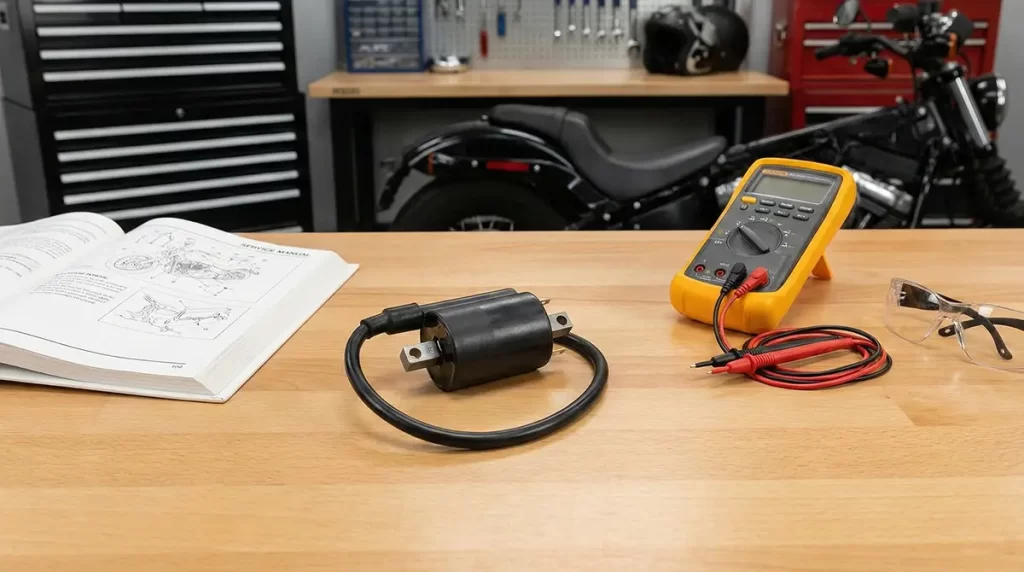
Proper multimeter configuration is critical for obtaining accurate resistance measurements when you check motorcycle ignition coil with multimeter.
Instructions
- Turn on your digital multimeter and set it to the resistance (Ω) or ohms measurement mode.
- If your multimeter has multiple resistance ranges, start with the 20kΩ (20,000 ohms) range for secondary coil testing and 200Ω range for primary coil testing.
- Touch the two multimeter probes together and verify that the reading shows zero or near-zero ohms, confirming the meter is functioning correctly.
- If your multimeter has a “relative” or “zero” function, use it with the probes touching to eliminate the resistance of the test leads from your measurements.
- Inspect the multimeter probes for damage, corrosion, or worn tips that could affect readings.
- If necessary, clean the probe tips with fine sandpaper or a wire brush to ensure good electrical contact.
Explanation
A properly calibrated multimeter is essential for accurate ignition coil testing. The resistance measurement (ohms) tells you if the coil windings are intact or if there’s a break (open circuit) or short circuit in the wire. Different resistance ranges on your multimeter provide different levels of precision—using the appropriate range ensures your readings are accurate and easy to interpret. Zeroing out the test lead resistance eliminates a common source of measurement error.
Tips and Best Practices
- If your multimeter shows “OL” (overload) or “1” when probes are apart, it’s correctly indicating infinite resistance (open circuit).
- For the most accurate readings, use a multimeter with at least 1% accuracy or better.
- Replace your multimeter’s battery if readings seem erratic or the display is dim, as low battery voltage affects measurement accuracy.
- Common mistake to avoid: Don’t test resistance with power applied to the circuit—always disconnect components from the electrical system before resistance testing.
Step 5: Testing Primary Coil Resistance
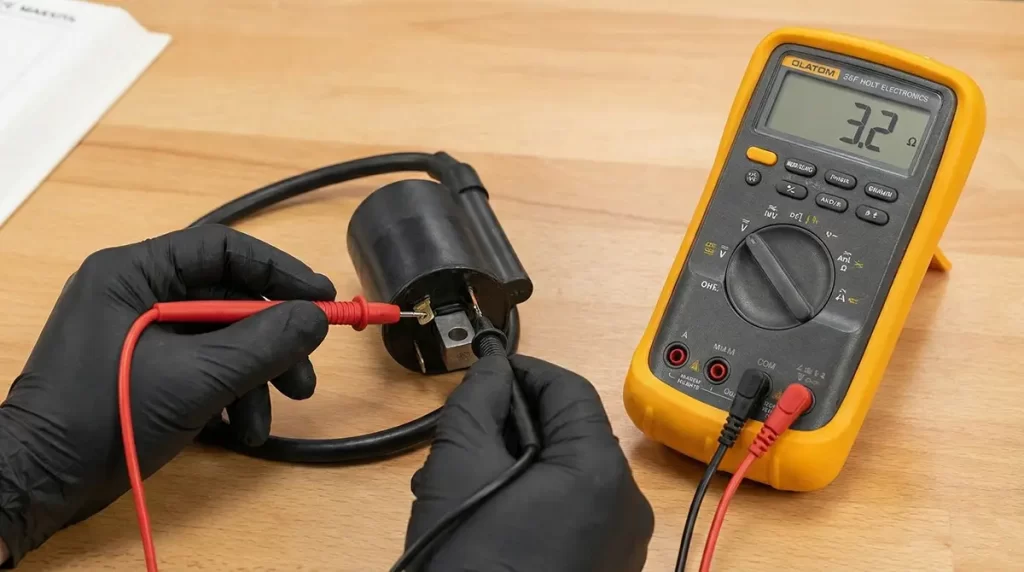
The primary coil winding is the first test you’ll perform when learning how to check motorcycle ignition coil with multimeter, as it’s the most common point of failure.
Instructions
- Locate the primary coil terminals on your ignition coil—these are typically marked with “+” and “-” or may be the terminals where the power supply and ground wires connect.
- Disconnect the wire connectors from the primary terminals to isolate the coil for testing.
- Set your multimeter to the 200Ω (ohms) range or use auto-ranging mode.
- Place the red (positive) probe on one primary terminal and the black (negative) probe on the other primary terminal.
- Record the resistance reading displayed on your multimeter.
- Compare your measurement to the specification in your service manual—typical primary coil resistance ranges from 0.5Ω to 3.0Ω, but this varies by model.
- Reverse the probe positions and take another reading to verify consistency.
Explanation
The primary coil resistance test checks the integrity of the low-voltage winding that receives power from the battery. A reading significantly higher than specifications indicates increased resistance due to corroded connections or damaged wire inside the coil. A reading of infinite resistance (OL on the display) means the primary winding has a break and the coil has failed. A reading near zero suggests a short circuit, which also indicates coil failure.
Tips and Best Practices
- Clean the coil terminals with contact cleaner before testing to ensure good probe contact and accurate readings.
- Press the probes firmly against the terminals—poor contact can result in false high readings.
- Some coils have very low primary resistance (less than 1Ω), which may be difficult to measure accurately with basic multimeters.
- Common mistake to avoid: Don’t confuse primary and secondary terminals—testing between the wrong terminals will give meaningless results.
Troubleshooting
Problem: Multimeter shows unstable or fluctuating readings.
Solution: Clean both the coil terminals and multimeter probes thoroughly. Ensure probes are making solid contact with the terminals and aren’t touching each other or other metal surfaces.
Problem: Reading is slightly outside specifications but not drastically different.
Solution: Resistance can vary slightly with temperature. If the reading is within 10-20% of specifications and the motorcycle runs normally, the coil is likely acceptable. Test again when the coil is at different temperatures for comparison.
Step 6: Testing Secondary Coil Resistance
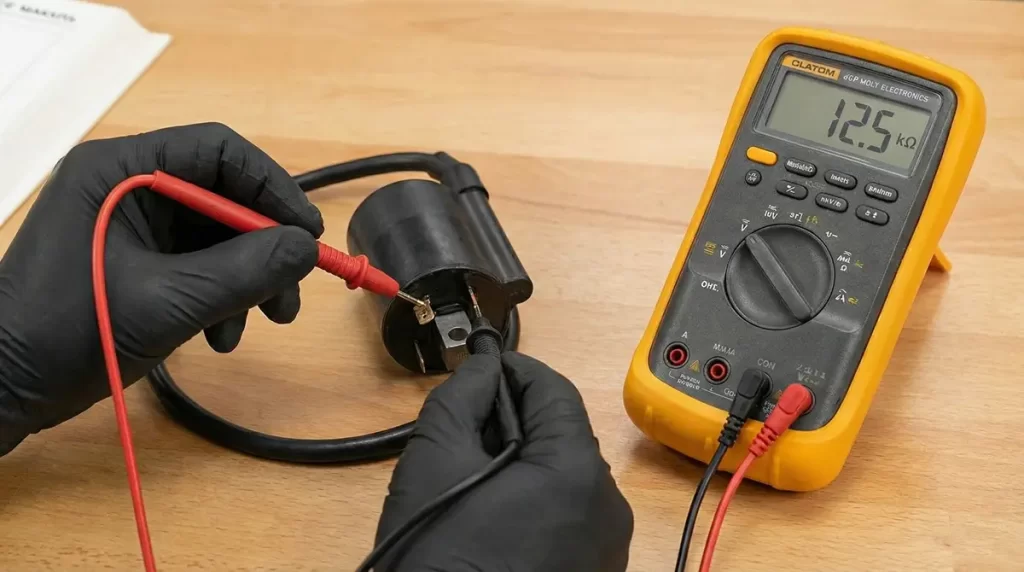
The secondary coil test measures the high-voltage winding that generates the spark, completing your comprehensive ignition coil diagnosis.
Instructions
- Identify the secondary coil terminal—this is typically the terminal that connects to the spark plug wire or the center tower where the spark plug cap attaches.
- If testing a coil with an attached spark plug wire, remove the spark plug cap from the spark plug but leave it connected to the coil.
- Set your multimeter to the 20kΩ (20,000 ohms) range or use auto-ranging mode for higher resistance measurements.
- Place one probe on the primary positive (+) terminal and the other probe on the secondary terminal (spark plug wire connection).
- Record the resistance reading—typical secondary coil resistance ranges from 5kΩ to 15kΩ (5,000 to 15,000 ohms), but specifications vary widely by model.
- If your coil serves two cylinders, test the resistance to each secondary terminal separately.
- Compare your measurements to your service manual specifications.
Explanation
The secondary coil contains many more windings than the primary coil, which is why its resistance is much higher. This high resistance is necessary to generate the extremely high voltage needed to jump the spark plug gap. An infinite resistance reading (OL) indicates a break in the secondary winding, while a very low reading suggests a short circuit between windings. Either condition means the coil cannot generate sufficient voltage to fire the spark plug reliably.
Tips and Best Practices
- Secondary coil resistance specifications vary more between models than primary resistance, so always verify your specific values.
- If your coil has a built-in spark plug cap, include it in the measurement as it’s part of the secondary circuit.
- For coil-on-plug systems, you may need to test between the primary ground and the spark plug terminal.
- Common mistake to avoid: Don’t assume a coil is good just because it shows some resistance—the reading must fall within the specified range for proper operation.
Troubleshooting
Problem: Secondary resistance is higher than specifications.
Solution: High secondary resistance can cause weak spark and misfiring. Check if there’s corrosion in the spark plug cap or wire connections. If the coil itself measures high, replacement is necessary.
Problem: Cannot get a stable reading on secondary coil.
Solution: Ensure you’re testing between the correct terminals. Some coils require testing from primary negative to secondary, others from primary positive. Consult your wiring diagram for the correct test points.
Step 7: Testing for Ground Shorts
Testing for shorts to ground ensures the ignition coil’s insulation is intact and preventing electrical leakage that would reduce spark intensity.
Instructions
- Keep your multimeter set to resistance (ohms) mode, using the highest range available (usually 20MΩ or 2000kΩ).
- Connect one multimeter probe to a clean, bare metal part of the motorcycle’s frame or engine (a good ground point).
- Touch the other probe to each primary terminal of the ignition coil, one at a time.
- Observe the reading—it should show infinite resistance (OL or overload on the display).
- Repeat the test by touching the probe to the secondary terminal (spark plug wire connection).
- Again, the reading should show infinite resistance, indicating no connection between the coil windings and ground.
- If any reading shows continuity (low resistance) to ground, the coil has internal insulation breakdown and must be replaced.
Explanation
The ignition coil windings must be completely isolated from the metal coil housing and motorcycle frame. If the insulation breaks down due to heat, vibration, or age, electrical current can leak to ground instead of generating the full voltage at the spark plug. This short to ground causes weak spark, misfiring, and poor engine performance. Even a small amount of leakage that wouldn’t completely prevent the engine from running can cause noticeable performance problems.
Tips and Best Practices
- Make sure the ground point you’re testing against is clean, bare metal with no paint, rust, or corrosion that could give false readings.
- Test multiple ground points if you’re getting unexpected readings to ensure you have a good ground connection.
- Some moisture on the outside of the coil can create a false short reading—wipe the coil dry before testing.
- Common mistake to avoid: Don’t confuse the designed ground connection (primary negative terminal) with a short to ground—the primary negative should show continuity to ground when connected in the circuit, but not when disconnected.
Troubleshooting
Problem: Multimeter shows low resistance to ground from coil terminals.
Solution: First verify that all wires are disconnected from the coil. If still showing continuity to ground with all wires disconnected, the coil has internal insulation failure and requires replacement.
Problem: Reading fluctuates between infinite and some resistance value.
Solution: This often indicates intermittent insulation breakdown, which is common in failing coils. The coil may work when cold but fail when hot. Replace the coil to prevent being stranded.
Step 8: Testing Spark Output (Optional Advanced Test)
While resistance testing is usually sufficient, testing actual spark output provides additional confirmation of ignition coil performance under operating conditions.
Instructions
- Reconnect all wiring to the ignition coil after completing resistance tests.
- Remove the spark plug from the cylinder and reconnect it to the spark plug cap/wire.
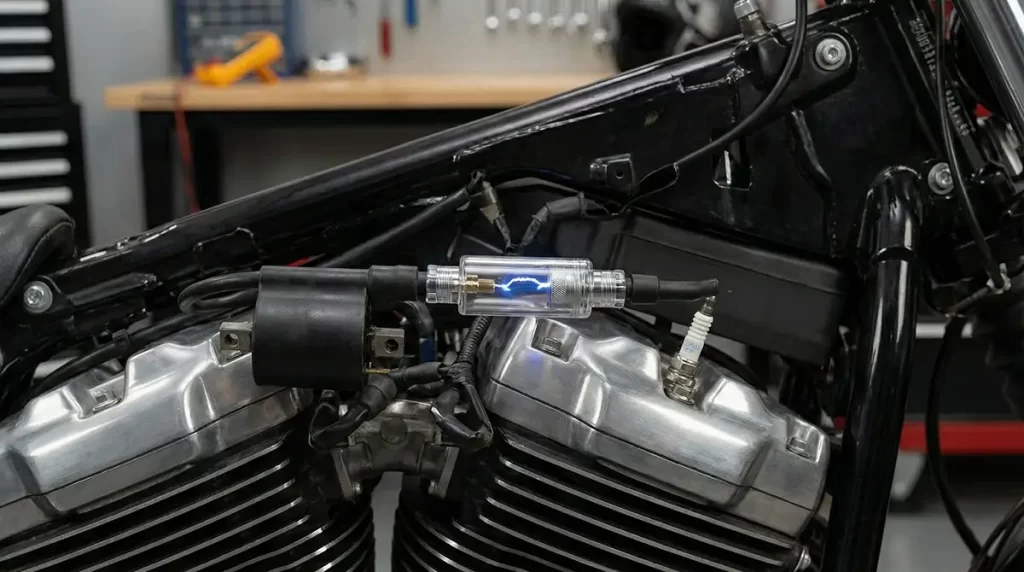
- Ground the spark plug threads against a clean metal part of the engine using insulated pliers or a grounding clip—never hold the plug with your bare hands.
- Reconnect the battery negative terminal.
- Turn the ignition on and press the starter button briefly while observing the spark plug gap.
- Look for a strong, bright blue spark jumping across the spark plug gap—a weak yellow or orange spark indicates coil problems.
- After testing, turn off the ignition and disconnect the battery again before proceeding.
Explanation
This live spark test shows how the ignition coil performs under actual operating conditions, which can reveal problems that don’t show up in static resistance testing. A healthy ignition coil produces a bright blue spark that’s clearly visible even in daylight. Weak, yellow, or intermittent spark indicates insufficient voltage output, even if resistance measurements were within specifications. This test is particularly useful for diagnosing intermittent problems that occur only when the engine is running.
Tips and Best Practices
- Always ground the spark plug securely—an ungrounded plug can damage the ignition coil and electronic components.
- Keep the spark plug at least 1/4 inch away from the spark plug hole to prevent fuel vapors from igniting.
- Don’t crank the engine for more than 5 seconds at a time to avoid overheating the starter motor.
- Common mistake to avoid: Never test spark by holding the spark plug wire near ground—this can damage the coil and gives an inaccurate representation of spark quality.
Troubleshooting
Problem: No spark appears at the spark plug gap.
Solution: Check that all connections are secure and the kill switch is in the run position. If connections are good and resistance tests passed, the problem may be in the CDI/ECU, trigger coil, or other ignition system components rather than the coil itself.
Problem: Spark is present but weak or yellow in color.
Solution: Weak spark with acceptable resistance readings suggests the coil is beginning to fail or there are voltage supply problems. Check battery voltage (should be 12.5-13V) and all ground connections. Consider replacing the coil if it’s old.
Step 9: Inspecting and Testing Spark Plug Wires and Caps
The spark plug wires and caps are part of the secondary ignition system and must be tested as part of a complete ignition coil diagnosis.
Instructions
- Visually inspect the spark plug wire for cracks, burns, or damaged insulation that could allow spark to leak before reaching the plug.
- Check the spark plug cap for cracks, carbon tracking, or corrosion on the internal connection.
- Remove the spark plug cap from the wire (if separable) and inspect the wire terminal for corrosion or damage.
- Set your multimeter to resistance mode at the 20kΩ range.
- Measure the resistance of the spark plug wire by placing one probe at each end—typical resistance is 5-10kΩ per foot of wire, but check your specifications.
- Test the spark plug cap separately by measuring resistance through it—most caps contain a resistor of 5kΩ (5,000 ohms).
- If resistance is higher than specifications or infinite (OL), replace the wire and/or cap.
Explanation
Spark plug wires and caps are often overlooked when diagnosing ignition problems, but they’re critical components that can cause symptoms identical to a failed ignition coil. The wire’s insulation prevents spark from escaping before reaching the plug, while the resistor in the wire or cap suppresses radio frequency interference. Deteriorated wires or caps can cause weak spark, misfiring, and difficulty starting, even when the ignition coil itself is functioning perfectly.
Tips and Best Practices
- Replace spark plug wires and caps as a set to ensure consistent resistance and performance.
- When installing new spark plug caps, ensure the wire is inserted fully and the connection is secure.
- Some spark plug caps screw onto the wire while others push on—use the correct installation method for your type.
- Common mistake to avoid: Don’t route new spark plug wires too close to hot engine components or sharp edges that could damage the insulation.
Troubleshooting
Problem: Spark plug wire shows much higher resistance than specifications.
Solution: High resistance in the wire indicates internal conductor breakdown. This is common in old wires and requires replacement. Don’t try to repair damaged spark plug wires—always replace them.
Problem: Spark plug cap won’t stay connected to the wire.
Solution: The wire end may be corroded or the cap’s internal spring may be worn. Cut off 1/4 inch of wire to expose fresh conductor and try again. If the cap still won’t grip, replace it.
Step 10: Checking Supply Voltage to the Ignition Coil
Before concluding that an ignition coil has failed, verify that it’s receiving proper voltage from the electrical system, as low voltage can mimic coil failure symptoms.
Instructions
- Reconnect the battery negative terminal if it’s still disconnected.
- Set your multimeter to DC voltage measurement mode at the 20V range.
- Turn the ignition switch to the “ON” position without starting the engine.
- Back-probe the positive (+) wire connector at the ignition coil with the red multimeter probe (insert the probe into the back of the connector without disconnecting it).
- Connect the black probe to a good ground point on the motorcycle frame.
- Read the voltage—it should be within 0.5V of battery voltage (typically 12-13V with a healthy battery).
- If voltage is significantly low or absent, trace the power supply wire back to find the source of voltage drop or open circuit.
Explanation
The ignition coil requires full battery voltage to function correctly. Low voltage reaching the coil can result from corroded connections, damaged wiring, a faulty ignition switch, blown fuse, or a failing battery. These problems cause symptoms identical to a failed coil—weak spark, misfiring, and starting difficulties—but replacing the coil won’t solve the problem. Always verify proper voltage supply before condemning an ignition coil, as this simple test can save you from unnecessary parts replacement.
Tips and Best Practices
- Use back-probing or pin-piercing techniques to test voltage without disconnecting connectors, which ensures you’re measuring voltage under normal operating conditions.
- Check voltage both with ignition on and while cranking the engine, as voltage drop under load can reveal weak batteries or poor connections.
- Test voltage at the battery terminals first to establish a baseline, then compare to voltage at the coil.
- Common mistake to avoid: Don’t assume the battery is good just because it starts the engine—a weak battery may have enough power to crank but insufficient voltage for proper ignition.
Troubleshooting
Problem: Voltage at the coil is 2-3 volts lower than battery voltage.
Solution: This indicates excessive voltage drop in the supply circuit. Check for corroded connectors, damaged wiring, or a faulty ignition switch. Clean all connections and retest. Replace damaged components as needed.
Problem: No voltage at the ignition coil with ignition on.
Solution: Check the fuse for the ignition system first. If the fuse is good, trace the power wire from the coil back toward the ignition switch, testing voltage at each connector until you find where voltage is lost.
Step 11: Testing Ground Connections
A proper ground connection is just as important as voltage supply for ignition coil operation, and poor grounds are a common cause of ignition problems.
Instructions
- Locate the ground wire connection for the ignition coil—this may be a separate wire to the frame or a ground through the coil mounting bolts.
- Set your multimeter to resistance (ohms) mode at the 200Ω range.
- Place one probe on the coil’s ground terminal or mounting point and the other on the battery negative terminal.
- The resistance should be less than 1Ω, indicating a solid ground connection.
- If resistance is higher, locate the ground connection point on the frame and inspect it for corrosion, paint, or loose mounting.
- Clean the ground connection point with a wire brush until bare metal is exposed.
- Apply dielectric grease to the cleaned connection to prevent future corrosion, then retest resistance.
Explanation
The ground connection completes the electrical circuit for the ignition coil’s primary winding. Poor ground connections create resistance that reduces current flow through the coil, resulting in weak magnetic field generation and insufficient secondary voltage for a strong spark. Ground problems are particularly common on older motorcycles where corrosion has accumulated over years of exposure to weather and road chemicals. A high-resistance ground can make a perfectly good ignition coil appear to have failed.
Tips and Best Practices
- Many ground problems are intermittent—the connection may work when stationary but fail due to vibration while riding.
- When cleaning ground connections, remove any paint or powder coating to expose bare metal for best conductivity.
- Use star washers under ground connection bolts to bite through any surface oxidation and maintain good contact.
- Common mistake to avoid: Don’t rely on paint or powder-coated surfaces for ground connections—they act as insulators and prevent proper electrical contact.
Troubleshooting
Problem: Ground resistance is higher than 1Ω.
Solution: Clean both the frame connection point and the wire terminal thoroughly. If the wire terminal is corroded, cut it off and install a new terminal. Ensure the mounting bolt is tight after cleaning.
Problem: Ground resistance varies when wiggling wires.
Solution: This indicates a damaged wire or loose connection. Trace the ground wire along its entire length, checking for breaks or corrosion. Replace the wire if internal damage is suspected.
Step 12: Documenting Results and Making Repair Decisions
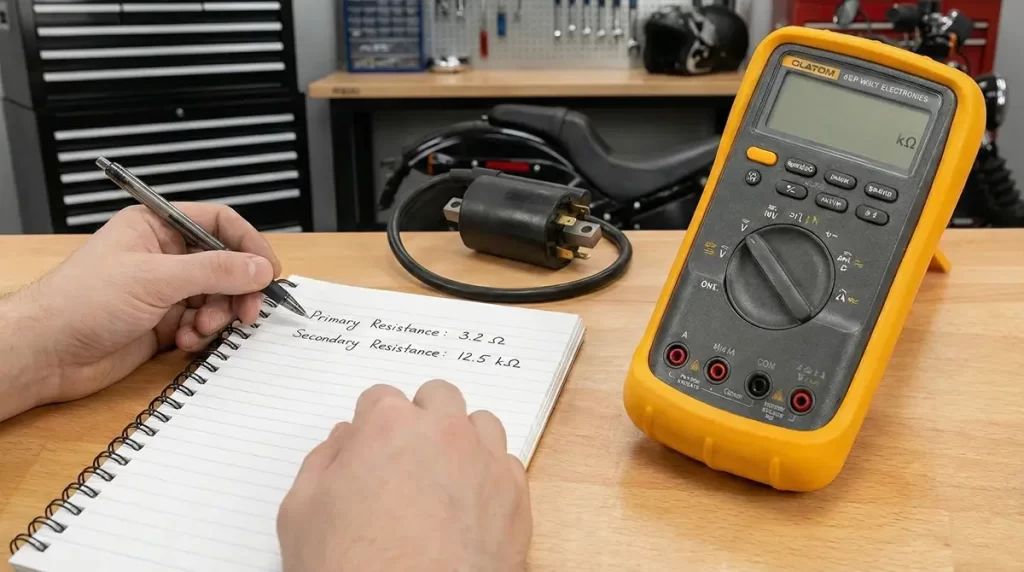
After completing all tests, you need to analyze your results and determine the appropriate course of action for your motorcycle’s ignition system.
Instructions
- Review all the measurements you recorded during testing and compare each one to the specifications in your service manual.
- Create a simple table listing each test (primary resistance, secondary resistance, ground short, supply voltage, ground resistance) with your measured value and the specification range.
- Mark each test as “PASS” or “FAIL” based on whether your measurement falls within specifications.
- If all resistance tests passed but spark is weak, consider the coil’s age and whether it’s approaching the end of its service life.
- If any test failed, determine whether the ignition coil itself has failed or if there’s a problem with supporting components (wiring, connectors, voltage supply, ground).
- Make a repair plan that addresses all identified issues, prioritizing safety-critical items first.
- Order replacement parts as needed, ensuring they meet or exceed OEM specifications.
Explanation
Proper documentation and analysis of test results ensures you make the right repair decisions and don’t waste money replacing parts that are actually functioning correctly. Sometimes multiple issues exist simultaneously—for example, a marginal ignition coil combined with poor ground connections—and addressing only one problem won’t fully resolve the symptoms. By systematically evaluating all test results together, you can develop a comprehensive repair plan that addresses the root causes of ignition problems rather than just treating symptoms.
Tips and Best Practices
- Keep your test results with your motorcycle’s maintenance records for future reference.
- If test results are borderline (just barely within specifications), consider the coil’s age and service history—preventive replacement may be wise.
- When replacing ignition coils, always use high-quality parts from reputable manufacturers, as cheap aftermarket coils often fail prematurely.
- Common mistake to avoid: Don’t assume the first failed test you find is the only problem—complete all tests to identify all issues before beginning repairs.
Troubleshooting
Problem: All tests pass but ignition problems persist.
Solution: The problem may lie elsewhere in the ignition system, such as the CDI/ECU, trigger coil (pickup coil), or timing sensor. Expand your diagnosis to include these components using your service manual’s troubleshooting procedures.
Problem: Tests show conflicting results (some pass, some fail).
Solution: Retest any measurements that don’t make sense. Ensure your multimeter is functioning correctly by testing known good resistors. If results remain inconsistent, the coil likely has intermittent internal faults and should be replaced.
Step 13: Reassembly and Final Verification
After completing testing and any necessary repairs, proper reassembly and verification ensure your motorcycle’s ignition system is fully functional and safe to operate.
Instructions
- If you replaced the ignition coil, apply a small amount of dielectric grease to all electrical connectors before reconnecting them.
- Reconnect all wiring to the ignition coil, ensuring each connector clicks or locks securely into place.
- Verify that spark plug wires are routed away from hot engine components and moving parts.
- Reinstall any body panels, fuel tank, or covers that were removed to access the ignition coil, referring to your photographs for correct placement.
- Reconnect the battery negative terminal and tighten it securely.
- Turn the ignition on and check for any warning lights or unusual indicators on the instrument panel.
- Start the engine and listen for smooth, consistent operation without misfiring or hesitation.
- Take the motorcycle for a test ride, paying attention to acceleration, throttle response, and overall performance.
Explanation
Proper reassembly is just as important as correct diagnosis and repair. Loose connections can create new problems, and incorrectly routed wires can be damaged by heat or moving parts, leading to future failures. The test ride verifies that your repairs were successful and that the ignition system is functioning correctly under real-world operating conditions. Any remaining issues should be immediately apparent during the test ride, allowing you to address them before they leave you stranded.
Tips and Best Practices
- Double-check that all connectors are fully seated—partially connected plugs are a common cause of intermittent problems.
- Use cable ties to secure spark plug wires in their original routing path, preventing them from rubbing or chafing.
- After reassembly, visually inspect your work area to ensure no tools or parts were left in the engine compartment.
- Common mistake to avoid: Don’t overtighten electrical connectors or mounting bolts, as this can crack plastic components or strip threads.
Troubleshooting
Problem: Engine runs rough or misfires after reassembly despite passing all tests.
Solution: Check that all connectors are fully seated and spark plug wires are on the correct cylinders. Verify spark plug gaps are correct and plugs are properly torqued. Ensure no vacuum lines or sensors were left disconnected.
Problem: Check engine light illuminates after starting.
Solution: Use a diagnostic scanner to read any fault codes. Some motorcycles store codes when the battery is disconnected. Clear the codes and see if they return. If codes persist, address the specific system indicated by the code.
Verification and Testing
How to Know You’re Done
Use this checklist to confirm you’ve successfully completed the ignition coil testing and any necessary repairs:
- All resistance measurements fall within specifications: Primary coil resistance, secondary coil resistance, and ground short tests all show values within the ranges specified in your service manual.
- Supply voltage is correct: The ignition coil receives full battery voltage (within 0.5V) when the ignition is turned on.
- Ground resistance is minimal: Less than 1Ω resistance between the coil ground and battery negative terminal.
- Visual inspection passed: No cracks, carbon tracking, or physical damage visible on the coil, wires, or connectors.
- Spark test shows strong blue spark: If you performed the optional spark test, the spark should be bright blue and consistent.
- Engine starts easily: The motorcycle starts promptly without excessive cranking or hesitation.
- Smooth idle and acceleration: The engine idles smoothly without misfiring and accelerates cleanly without stumbling or hesitation.
- No warning lights: All dashboard warning lights function normally with no check engine or ignition system warnings.
- Test ride completed successfully: The motorcycle performs normally under various operating conditions including acceleration, cruising, and deceleration.
- Documentation complete: All test results are recorded for future reference and maintenance history.
If any items on this checklist haven’t been satisfied, review the relevant sections of this tutorial and retest or repair as necessary. Don’t consider the job complete until all verification criteria are met, as unresolved issues will likely cause problems in the future.
Conclusion
Learning how to check motorcycle ignition coil with multimeter is an invaluable skill that empowers you to diagnose and resolve ignition system problems confidently and accurately. Throughout this comprehensive tutorial, you’ve learned how to systematically test every aspect of your ignition coil’s operation, from basic resistance measurements to advanced voltage supply and ground verification. These diagnostic techniques enable you to distinguish between actual ignition coil failures and problems with supporting components like wiring, connectors, and power supply circuits, saving you from unnecessary parts replacement and expense.
The multimeter testing procedures covered in this guide are fundamental to motorcycle electrical system diagnosis and apply to virtually all motorcycle makes and models with minor variations. By following the step-by-step instructions provided, you’ve gained the knowledge to perform professional-quality ignition system diagnostics in your own garage. Remember that proper documentation of test results, careful comparison to manufacturer specifications, and thorough verification after repairs are essential elements of successful troubleshooting.
As you continue to develop your motorcycle maintenance skills, the diagnostic approach you’ve learned here—systematic testing, careful measurement, logical analysis, and thorough verification—will serve you well when troubleshooting other electrical and mechanical systems. Keep your service manual handy, maintain your multimeter properly, and don’t hesitate to retest if results seem unusual. With practice, checking your motorcycle ignition coil with a multimeter will become a quick and routine part of your diagnostic process, helping you keep your motorcycle running reliably for years to come.
Frequently Asked Questions
How often should I test my motorcycle ignition coil?
You should test your motorcycle ignition coil whenever you experience symptoms of ignition problems such as difficulty starting, misfiring, poor acceleration, or reduced fuel economy. As preventive maintenance, testing the ignition coil every 2-3 years or 15,000-20,000 miles is reasonable, especially on older motorcycles. However, ignition coils typically last 50,000-100,000 miles or more under normal conditions, so frequent testing isn’t necessary if the motorcycle is running normally. Include ignition coil testing as part of your diagnostic routine whenever performing major service or troubleshooting electrical issues. If you ride in harsh conditions with extreme temperatures, moisture, or vibration, more frequent testing may be warranted as these factors accelerate ignition coil degradation.
Can a motorcycle ignition coil test good but still be bad?
Yes, an ignition coil can pass static resistance tests but still fail under operating conditions. This occurs because multimeter testing measures resistance at room temperature with no load, while actual operation subjects the coil to high temperatures, vibration, and electrical stress. Internal insulation can break down when hot, causing intermittent failures that don’t show up in cold testing. Similarly, internal connections may be marginal and pass resistance tests but fail under the high-voltage conditions during engine operation. If your coil passes all multimeter tests but you still have ignition problems, consider performing a dynamic spark test under operating conditions or replacing the coil if it’s old and has high mileage. Some intermittent coil failures only occur when the engine is fully warmed up or under heavy load, making them difficult to diagnose with static tests alone.
What is the difference between primary and secondary coil resistance?
The primary coil winding consists of several hundred turns of relatively thick wire and connects to the battery voltage (12V), resulting in low resistance typically between 0.5-3.0 ohms. The secondary coil winding contains thousands of turns of very fine wire wrapped around the primary winding, creating the high voltage (15,000-50,000V) needed to fire the spark plug, which results in much higher resistance typically between 5,000-15,000 ohms (5-15 kΩ). The primary coil creates a magnetic field when current flows through it, and when this current is suddenly interrupted by the CDI or ignition module, the collapsing magnetic field induces a very high voltage in the secondary winding due to its many more turns of wire. Both windings must have resistance within specifications for the coil to function properly—the primary must allow sufficient current flow to build a strong magnetic field, while the secondary must generate adequate voltage to jump the spark plug gap.
Can I test an ignition coil without removing it from the motorcycle?
Yes, you can test most aspects of an ignition coil without complete removal from the motorcycle. Primary and secondary resistance tests only require disconnecting the electrical connectors, which can usually be done with the coil mounted in place. Ground short testing also doesn’t require removal. However, thorough visual inspection for cracks, carbon tracking, and physical damage is easier with the coil removed. Some motorcycles have ignition coils in locations with limited access, making it difficult to get multimeter probes on the terminals without removal. If your initial tests with the coil installed indicate problems, or if access is severely restricted, removing the coil for more thorough inspection and testing is recommended. Additionally, removing the coil allows you to clean mounting surfaces and inspect the coil mounting hardware for corrosion or damage that could affect ground connections.
What causes motorcycle ignition coils to fail?
Motorcycle ignition coils fail due to several factors, with heat being the most common culprit. Excessive heat from the engine or poor ventilation breaks down the insulation between wire windings, causing internal short circuits. Vibration from the engine and road can cause internal wire connections to break, resulting in open circuits. Moisture infiltration through cracks in the coil housing corrodes internal components and degrades insulation. Electrical stress from incorrect spark plug gaps (too wide) forces the coil to generate excessive voltage, accelerating insulation breakdown. Age-related deterioration of materials naturally occurs over time, with typical coil lifespan being 50,000-100,000 miles. Physical damage from impacts, improper installation, or contact with hot engine components can crack the coil housing. Poor electrical connections causing voltage spikes or reverse polarity from incorrect battery installation can damage coil electronics. Using incorrect spark plugs or spark plug wires with wrong resistance values can also stress the coil and lead to premature failure.
What should I do if my ignition coil resistance readings are borderline?
If your ignition coil resistance readings are close to but not significantly outside specifications (within 10-20% of the specified range), consider several factors before deciding on replacement. First, ensure your multimeter is accurate by testing known resistors or having it calibrated. Temperature affects resistance, so retest the coil when it’s at different temperatures—cold, warm, and fully heated after running. If readings are consistent and the motorcycle runs normally without misfiring or starting problems, the coil is likely acceptable for continued use, but monitor it closely for deterioration. However, if the motorcycle has any performance issues or the coil is old with high mileage, borderline readings suggest the coil is beginning to fail and preventive replacement is wise to avoid being stranded. Consider that ignition coils typically fail gradually rather than suddenly, so borderline readings often indicate a coil approaching the end of its service life. When in doubt, replacement provides peace of mind, especially before long trips or during routine major service intervals.
Can a bad CDI or ECU cause symptoms similar to a bad ignition coil?
Yes, a faulty CDI (Capacitor Discharge Ignition) unit or ECU (Engine Control Unit) can cause symptoms nearly identical to ignition coil failure, including difficulty starting, misfiring, weak spark, and poor performance. The CDI or ECU controls when the ignition coil fires by interrupting primary current flow at precisely the right moment. If this control signal is weak, mistimed, or absent, the coil cannot generate proper spark even if the coil itself is functioning perfectly. This is why comprehensive testing is essential—you must verify that the ignition coil is receiving proper voltage, has good ground connections, and is being triggered correctly by the CDI/ECU before concluding the coil has failed. When ignition problems persist after confirming the coil tests good, expand your diagnosis to include the CDI/ECU, trigger coil (pickup coil), crankshaft position sensor, and related wiring. Your service manual will have specific testing procedures for these components. In some cases, both the coil and CDI may be marginal, with neither fully failed but together causing problems.