
8 Best Motorcycle GPS Units in Australia for Outback Tours and Weekend Blasts
 Jake Miller
10 min read
Jake Miller
10 min read
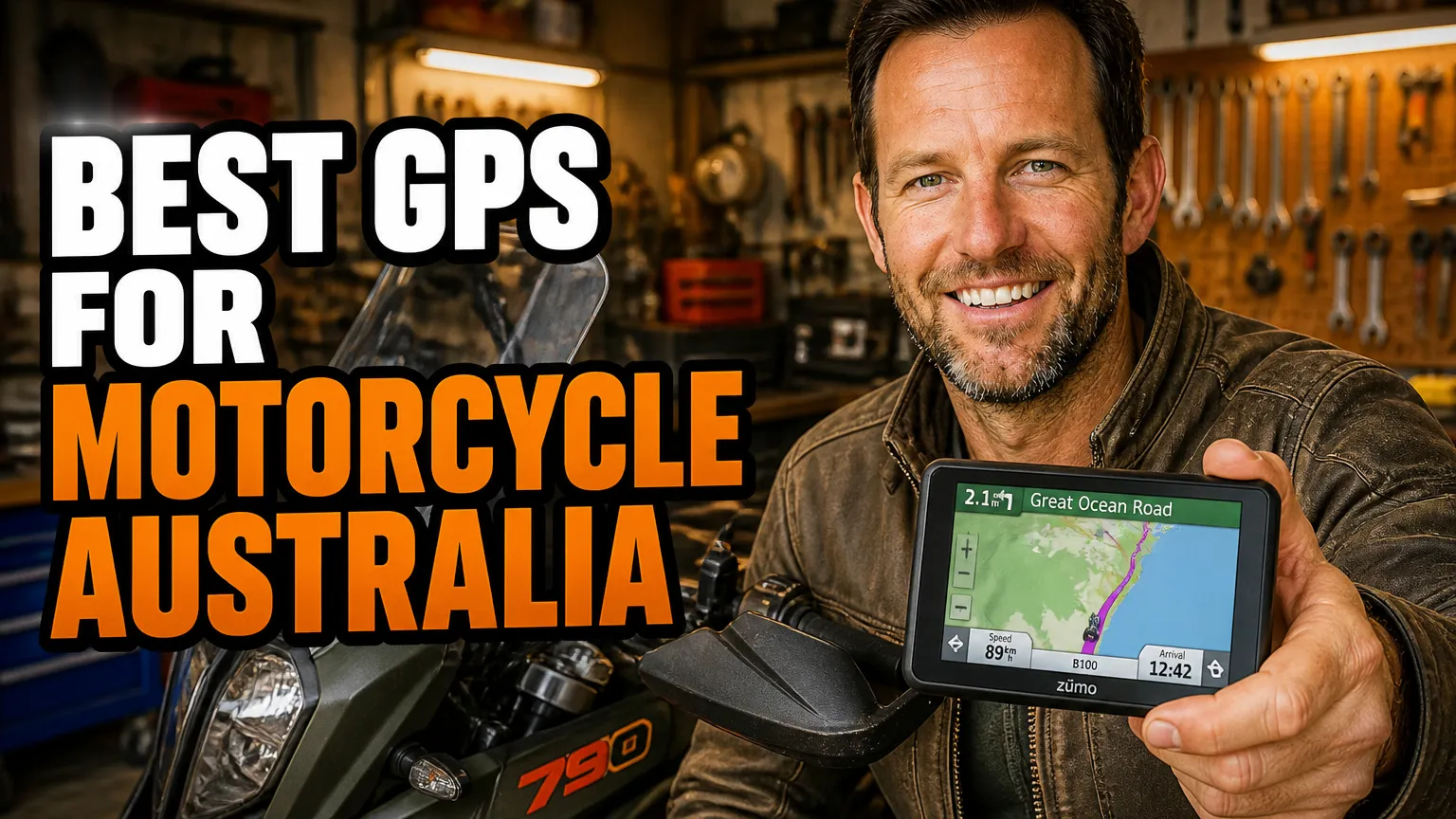
I’ve been riding in Australia for over a decade, and I’ve learned the hard way that navigation here is a different sport to navigation in Europe. Distances are enormous, phone coverage vanishes the moment you leave the coast, and a 42°C day will cook a smartphone on a handlebar mount before lunch.
So I’ve run a lot of units on my own bikes, from a little 250 on the Great Ocean Road to a big adventure twin on the Birdsville Track. Some have been brilliant. One or two ended up in a drawer.
Below is my honest list of the best GPS for motorcycle Australia riders actually use, covering everything from a $350 minimalist unit to a satellite-connected adventure navigator.
- My overall pick is the Garmin zūmo XT2 for its huge glove-friendly screen and Australian road maps.
- For remote touring with no phone signal, the Garmin Montana 700i and its inReach satellite SOS is the safest bet.
- On a tight budget, the Garmin zūmo 396 LMT-S still does proper turn-by-turn navigation for under $500.
- If you’d rather keep your phone, a Quad Lock mount with a vibration dampener is the cheapest working setup.
- Whatever you buy, check the IP rating. Australian dust and creek crossings will find any weak point.
How I Worked Out What Belongs on This List
I didn’t just read spec sheets. Every unit here has either lived on one of my bikes or on a mate’s bike on a ride I was part of, and I’ve formed opinions the slow way.
The things I care about most are simple. Can I read the screen in full sun? Can I operate it with winter gloves on? Does it survive corrugations, dust and a water crossing?
And critically for Australia: does it have proper maps of the whole country, not just the capital cities? Several big-name units fail that test.
1. Garmin zūmo XT2 — Best Motorcycle GPS Overall
If you want one answer and you don’t want to think about it again, this is it. The Garmin zūmo XT2 is the unit I recommend to almost every rider who asks me what to buy.
The headline feature is the 6-inch, 1280 x 720 display. It’s genuinely bright enough to read through a tinted visor in the middle of an Australian summer, and the capacitive touchscreen works with gloves on. That last point alone rules out most phone-based setups.
What Makes It Work Down Here
It ships with Australian and New Zealand road maps preloaded, plus it’s rated IPX7 and built to MIL-STD-810 standards for shock and vibration. I’ve had mine through bulldust and a couple of shallow creek crossings with no issues.
Garmin’s Adventurous Routing is the feature I use most. I tell it to favour curves and hills, and it quietly reroutes me off the boring highway onto backroads I’d never have found on my own.
It also supports the Garmin Tire Pressure Monitor Sensors and pairs with an inReach device for satellite messaging if you’re heading properly remote. Expect to pay around AUD $1,099 to $1,199.
2. Garmin zūmo XT — Best Value Premium Option
The Garmin zūmo XT is the previous flagship, and because the XT2 exists, it’s now excellent value. I still run one on my second bike.
You get a 5.5-inch 1280 x 720 screen, the same IPX7 sealing, the same powered mount and the same Adventurous Routing engine. Battery life is around 6 hours off the bike, which is plenty for a lunch stop.
The screen is slightly smaller than the XT2 and it’s a touch slower to redraw when you zoom right out, but for most riders that difference is invisible. You’re saving roughly $300 to $400.
If you mostly ride sealed roads around the coast and do the occasional long tour, this is the smart buy. I’ve taken mine from Melbourne to Cairns without a single routing complaint.
3. TomTom Rider 550 — Best for Winding Road Rides
TomTom has never been as popular as Garmin in Australia, which is a shame, because the TomTom Rider 550 does one thing better than anyone: it finds brilliant riding roads.
The Winding Roads routing mode is genuinely clever, and TomTom’s Road Trips feature lets you plan a loop and share it with your riding group. I’ve used it to string together a full day in the Victorian Alps with almost no boring sections.
The Practical Details
It has a 4.3-inch glove-friendly screen, IPX7 waterproofing, lifetime world maps and around 6 hours of battery. A RAM mount comes in the box, which saves you a bit of cash.
The screen is smaller and lower resolution than the Garmin units, and it’s harder to read in harsh glare. Pricing sits around AUD $549 to $649.
My verdict: buy it if route planning and twisty roads matter more to you than a big screen.
4. Garmin zūmo 396 LMT-S — Best Budget Dedicated GPS
Not everyone wants to spend four figures, and the Garmin zūmo 396 LMT-S is the unit I point budget-conscious riders toward. It’s the cheapest way I know to get proper, offline, glove-friendly motorcycle navigation.
You get a 4.3-inch display, IPX7 sealing, Bluetooth hands-free calling, rider alerts for sharp curves and speed cameras, and lifetime maps for Australia and New Zealand. Battery life is roughly 4 hours.
The screen resolution is modest and the processor is showing its age. Zooming in and out isn’t instant. But once a route is loaded, it just works, and that’s what matters when you’re 200 km from the nearest town.
At around AUD $399 to $499, it leaves room in the budget for a decent mount and a tank bag. For a first dedicated GPS, I think it’s hard to beat.
5. Garmin Montana 700i — Best for Remote Outback Touring
This is the unit I’d take if I were crossing the Simpson or riding the Anne Beadell Highway. The Garmin Montana 700i is a rugged handheld that doubles as a motorcycle navigator, and it’s the safest option on this list.
The reason is built-in inReach satellite technology. That means two-way satellite messaging and an interactive SOS button that works with zero phone coverage, anywhere in Australia. For solo remote riding, that’s not a luxury, it’s insurance.
Ruggedness and Mapping
It has a 5-inch screen, IPX7 and MIL-STD-810 ratings, and up to 18 hours of battery life using the rechargeable pack, or standard AA batteries if you’re really stuck. It runs TopoActive and Garmin’s topographic mapping.
It’s bulky on a handlebar and the screen isn’t as bright as the zūmo XT2. Expect around AUD $1,199, plus a satellite subscription.
For an Australia-specific alternative, the Hema HX-2 is worth a look. It comes loaded with Hema’s legendary 4WD and outback tracks, though it lacks satellite messaging.
6. Beeline Moto II — Best Minimalist Option
I’ll be honest: I didn’t expect to like the Beeline Moto II as much as I do. It’s a tiny round puck that shows nothing but an arrow and a distance to the next turn.
And on a naked bike or a classic, that’s exactly what you want. No giant screen ruining your lines, no distraction, just a clean arrow telling you where to go. It pairs with the Beeline app on your phone, which does the actual routing.
Where It Shines and Where It Doesn’t
Battery life is outstanding at 30+ hours, it charges over USB-C, and it’s rated IP67. It’s also small enough to swap between bikes in seconds. Pricing is around AUD $349.
The catch is that it depends on your phone for routing, so you still need a charged phone with you. If you’re riding deep into the outback, this isn’t the tool. If you’re commuting and doing weekend blasts, it’s brilliant.
7. Chigee AIO-5 Lite — Best CarPlay and Android Auto Display
This category barely existed a few years ago and now it’s one of the fastest-growing. The Chigee AIO-5 Lite puts wireless Apple CarPlay and Android Auto on your handlebar in a properly rugged package.
You get a bright 5.5-inch touchscreen, IP67 sealing, and a powered mount that keeps it topped up. Because it mirrors your phone, you can run Google Maps, Waze, Spotify or Calimoto on a screen that’s built for a motorcycle.
The Dashcam Bonus
The Lite version includes front and rear cameras with dashcam recording, plus blind spot detection and support for tyre pressure sensors. That’s a lot of functionality for around AUD $600 to $700.
The downsides are real: it still relies on your phone being nearby and charged, and the software can be a bit fussy after firmware updates. The Carpuride W702 is a cheaper 7-inch alternative if you want a bigger screen and don’t need cameras.
8. Quad Lock Motorcycle Mount and Phone — Best Phone-Based Setup
I know plenty of riders who refuse to buy a dedicated GPS, and honestly, with the right mount, a phone does a decent job. The Quad Lock Motorcycle Mount system is what I’d use.
The key components are the bar clamp or handlebar mount, the Vibration Dampener, and the weatherproof wireless charging head. Together they hold a phone solidly, protect its camera stabiliser from vibration damage, and keep it charged on long days.
What It Costs and What It Costs You
A full setup runs roughly AUD $130 to $250 depending on which head and mount you choose. Pair it with an offline-capable app like Calimoto, Scenic or Google Maps with offline regions downloaded.
But I have to be straight with you about the limitations. Phones overheat and shut down in Australian summer heat, they’re not glove-friendly, and they die fast when running GPS with the screen on. For day rides it’s fine. For the outback, it isn’t.
What Actually Matters When You Buy in Australia
Water and Dust Sealing
Look for at least IPX7 or IP67. Anything less and a creek crossing or a dusty corrigated road will eventually get inside. I’ve killed a cheap unit this way and it’s an expensive lesson.
Battery Life and Power
You want a powered mount so the unit charges while you ride. Battery matters for when you stop, or if a fuse blows. Anything under 4 hours off-bike is annoying on a long lunch stop.
Australian Maps and Offline Navigation
This is where cheap units fall over. Make sure the device has preloaded Australia and New Zealand maps, or full Australian topographic coverage if you’re heading off sealed roads.
Glove-Friendly, Sunlight-Readable Screens
A capacitive touchscreen that ignores gloves is useless in winter. And a screen that washes out in direct sun is useless year round. Test this before you buy if you possibly can.
Satellite Communication
If you ride solo in remote areas, a unit with inReach or similar satellite messaging is worth every dollar. No phone signal means no emergency call, and Australia has a lot of places with no signal.
My Final Take
If I had to pick one for the average Australian rider, it’s the Garmin zūmo XT2. It has the best screen, the best maps and the best routing for our roads.
For remote touring, the Garmin Montana 700i is the one I’d trust with my life, literally, thanks to inReach.
And if money is tight, the Garmin zūmo 396 LMT-S or a well-set-up Quad Lock phone mount will still get you where you’re going. Just know the trade-offs before you commit.
Whichever way you go, buy once and buy properly. A GPS that fails 300 km from the nearest town is worse than no GPS at all.
Frequently Asked Questions
Is a dedicated motorcycle GPS better than using my phone in Australia?
For most riders, yes. A dedicated unit like the Garmin zūmo XT2 survives heat, dust and vibration that regularly kill phones, and it keeps navigating with zero mobile coverage.
Which motorcycle GPS is best for remote outback touring?
I would take the Garmin Montana 700i. Its built-in inReach satellite messaging and SOS work where there is no phone signal at all.
Do motorcycle GPS units work without phone signal in Australia?
They do. Dedicated units store maps on board, so navigation keeps working in the Simpson Desert or the Victorian High Country with zero bars.
How much should I spend on a motorcycle GPS in Australia?
Expect around AUD $400 to $500 for a solid entry unit, $600 to $800 for premium routing, and $1,100 or more for satellite equipped adventure models.

Related Articles

6 Best Motorcycle Phone Mounts That Keep Your Phone Charged on the Road
Compare six dependable motorcycle phone mounts with wireless or USB charging, including fit, power wiring, vibration protection, weather resistance, and…
Jake Miller
10 min read

5 Best Motorcycle Phone Mounts for Naked Bikes and Open-Cockpit Riding
I compare secure, vibration-conscious phone mounts for naked and touring bikes, with fit notes, real trade-offs, and setup tips for…
Jake Miller
11 min read

7 Best Phone Mounts for Sport Bikes: Secure, Vibration-Smart Picks
Compare secure phone mounts for sport bikes, including clip-on fit, vibration control, case systems, prices, and my practical picks for…
Jake Miller
12 min read