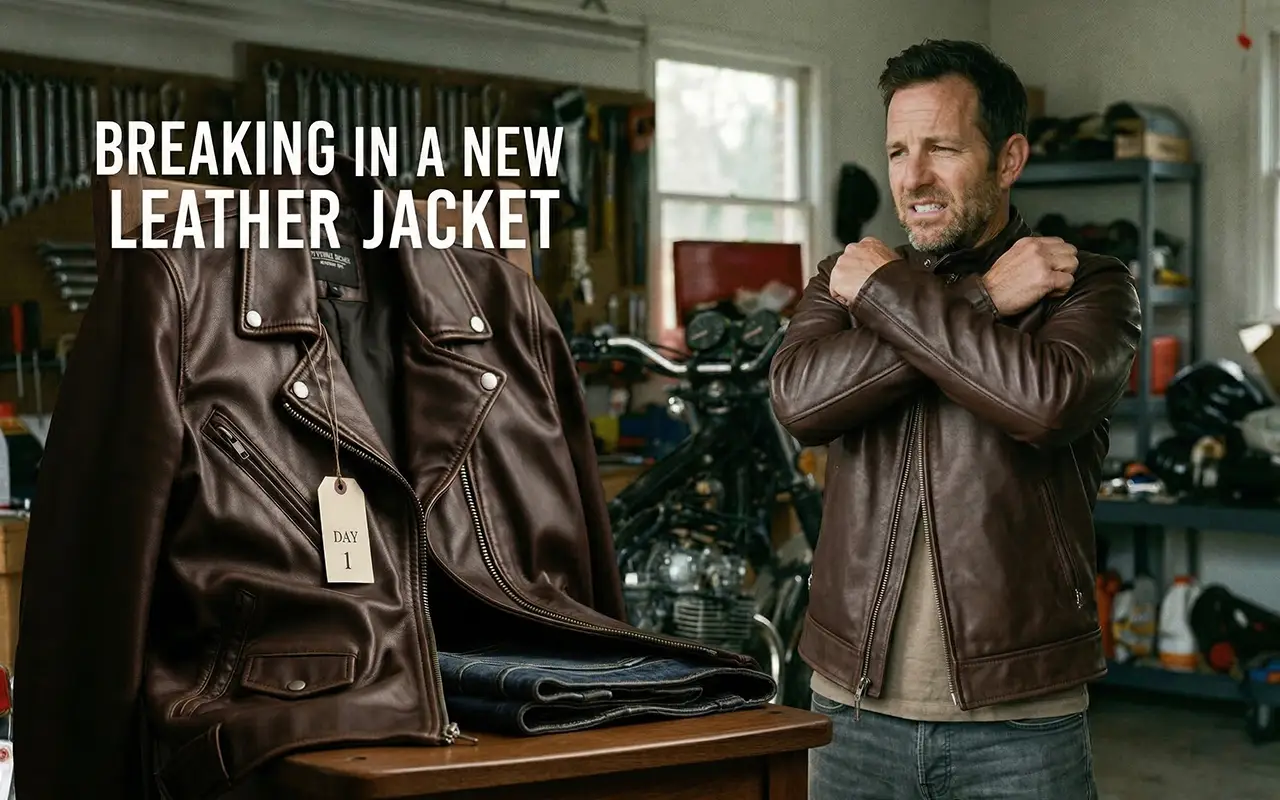
Buying a new leather motorcycle jacket is exciting, but wearing it for the first time can feel like putting on a suit of armor. Here is the fast track to making it fit like a second skin. (If you haven’t found the right jacket yet, be sure to check out our Ultimate Guide to Motorcycle Jackets first).
| ⚡ TL;DR — Quick Summary Breaking in a new leather motorcycle jacket takes time and a little effort, but it’s worth every minute. The fastest and safest methods are: wear it as often as possible (even off the bike), apply a quality leather conditioner like Leather Honey or Bick 4, flex and work the panels by hand, and if needed, do a light mist-and-wear session. Avoid heat guns, machine washing, or soaking it in water. Give it 2–6 weeks of consistent wear and your stiff jacket will become the most comfortable piece of gear you own. |
The Jacket Was Perfect — Until I Put It On
I still remember the day I unboxed my first proper leather motorcycle jacket. It was a classic black café racer style, full-grain cowhide, and cost me three months of saving up. The moment I pulled it out of the box, it smelled incredible — that rich, unmistakable scent of new leather. I put it on immediately.
And it felt like wearing a suit of armor.
The sleeves barely moved. The chest panel creaked every time I breathed. I couldn’t even fully extend my arms without the jacket fighting back. I’d done my research on brands and leather quality, but I hadn’t thought about the break-in process at all. I assumed leather would just… soften on its own.
That was my first mistake. Over the following weeks of frustration, I learned everything there is to know about breaking in a leather motorcycle jacket — through trial, error, and a few near-disasters involving methods I definitely do not recommend.
This post is everything I wish someone had told me on day one.
Why Leather Jackets Need to Be Broken In
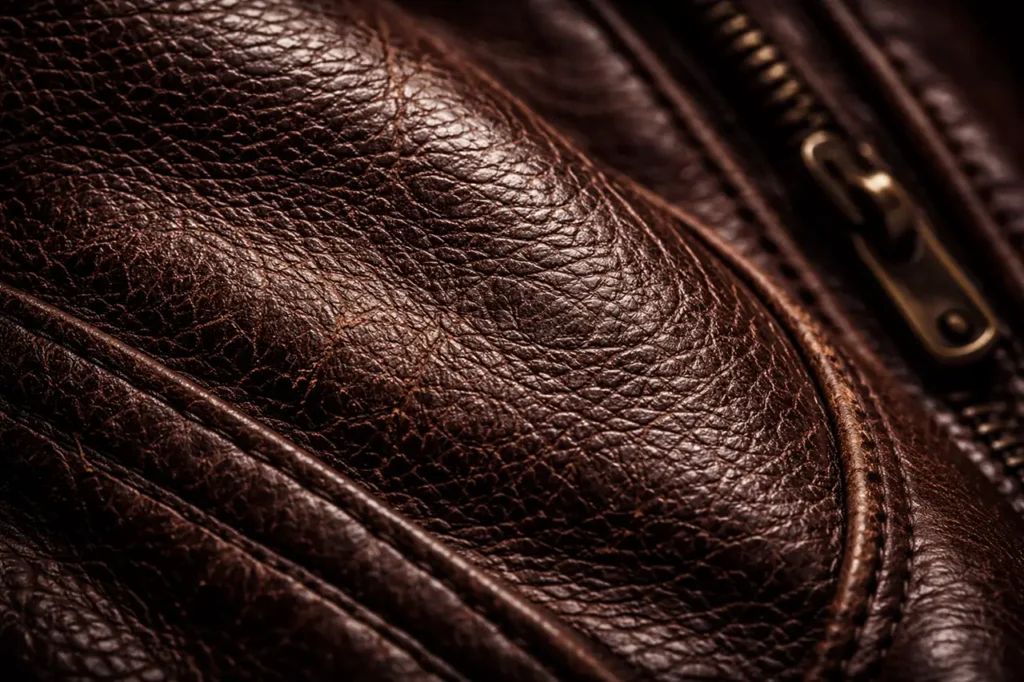
Close-up macro shot of leather fibers and grain texture on a motorcycle jacket, showing the natural pores and surface texture, deep brown color, dramatic lighting
Before we get into the how, let me explain the why — because understanding what’s actually happening to the leather helps you choose the right approach.
A new leather jacket is made from animal hide that has been tanned, dyed, and treated with various finishing compounds. During this process, the fibers in the leather become relatively rigid and compact. The jacket is also cut and stitched to fit a standardized pattern, which may not perfectly match your body shape.
Breaking in the leather means gradually loosening and softening those tightly packed fibers so they can flex, conform, and move with your body. Think of it like a new pair of leather shoes — they need to mold to the shape of your foot before they’re truly comfortable. A motorcycle jacket needs to mold to your riding posture, the width of your shoulders, and the way you grip handlebars.
For motorcycle riding specifically, a properly broken-in jacket is not just more comfortable — it can actually be safer. A jacket that moves with you allows better control of the bike, reduces fatigue on long rides, and ensures that armored panels sit correctly over your elbows, shoulders, and back where they’re designed to protect you.
How Long Does It Take?
Honestly? It depends on several factors:
- The type and thickness of leather (thicker hides take longer)
- How often you wear it
- What break-in methods you use
- The tanning method — vegetable-tanned leather tends to be stiffer than chrome-tanned
In my experience, most good-quality leather motorcycle jackets reach a noticeably more comfortable state within 2 to 4 weeks of regular wear. A full, complete break-in — where the jacket really conforms to your shape — can take anywhere from 6 weeks to 3 months if you’re only wearing it on rides.
The good news is that you can accelerate this process significantly with the methods I’m about to share. Let’s get into it.
Method 1: Wear It — Everywhere, All the Time

This is the most effective method, full stop. Nothing breaks in leather faster than body heat, your natural movement, and time spent wearing the jacket.
Here’s what I started doing after my first stiff-jacket disaster: I began wearing my leather jacket around the house, not just on rides. I wore it while cooking dinner. I wore it watching TV. I wore it on grocery runs. Every hour spent wearing it is an hour the leather is learning your shape.
Your body heat warms the leather, which makes the fibers more pliable. Your natural movement — turning your head, reaching up, twisting your torso — constantly flexes the leather in all the places it needs to flex. Over time, it begins to remember your shape.
Pro Tips for Everyday Wear:
- Wear it zipped up: This helps the front panels break in at the right position. Don’t leave it open.
- Move deliberately: Do shoulder rolls, reach across your body, stretch your arms forward like you’re on the bike. Make the jacket work.
- Layer underneath: Wearing a light hoodie or zip-up under the jacket creates gentle but consistent outward pressure, which helps the panels expand into a more natural riding position.
- Sit in your riding position: If you have a chair at the right height, sit in it while wearing the jacket with your arms slightly forward — this mimics your posture on the bike and breaks in exactly the right areas.
I wore my second leather jacket around the house for about two hours every evening for the first two weeks. By the end of week two, it had transformed dramatically.
Method 2: Use a Quality Leather Conditioner
This is the method that made the biggest single difference for me, and I wish I’d started here. A good leather conditioner penetrates the leather fibers and lubricates them, making the leather softer, more supple, and significantly easier to break in through wear.
Think of it like this: dry leather fibers are stiff and resist movement. Conditioned leather fibers are lubricated and flex far more easily. You’re not weakening the leather — you’re restoring and enhancing its natural flexibility.
Products I’ve Personally Tested and Trust:
- Leather Honey Leather Conditioner: This is my current go-to. It’s a thick, oil-based conditioner that penetrates deeply. It darkens the leather slightly (which I personally like), but a small amount goes a long way and the softening effect is noticeable within 24 hours.
- Bick 4 Leather Conditioner: Lighter than Leather Honey, great if you don’t want any darkening. It’s water-based and dries quickly. Perfect for lighter-colored or finished leathers.
- Renapur Leather Balsam: A beeswax-based product that conditions and adds a light water resistance. I’ve used this on jackets that needed both softening and protection.
- Mink Oil: Old-school and effective, though it can darken leather quite significantly. I’d only use it on darker jackets where that’s not a concern.
| ⚠️ Products to Avoid Avoid petroleum-based products (like WD-40 or motor oil) — they will degrade the leather over time. Avoid silicone sprays — they seal the leather and prevent it from breathing, which causes premature cracking. Avoid products not specifically made for leather goods. |
How to Apply Leather Conditioner Properly:
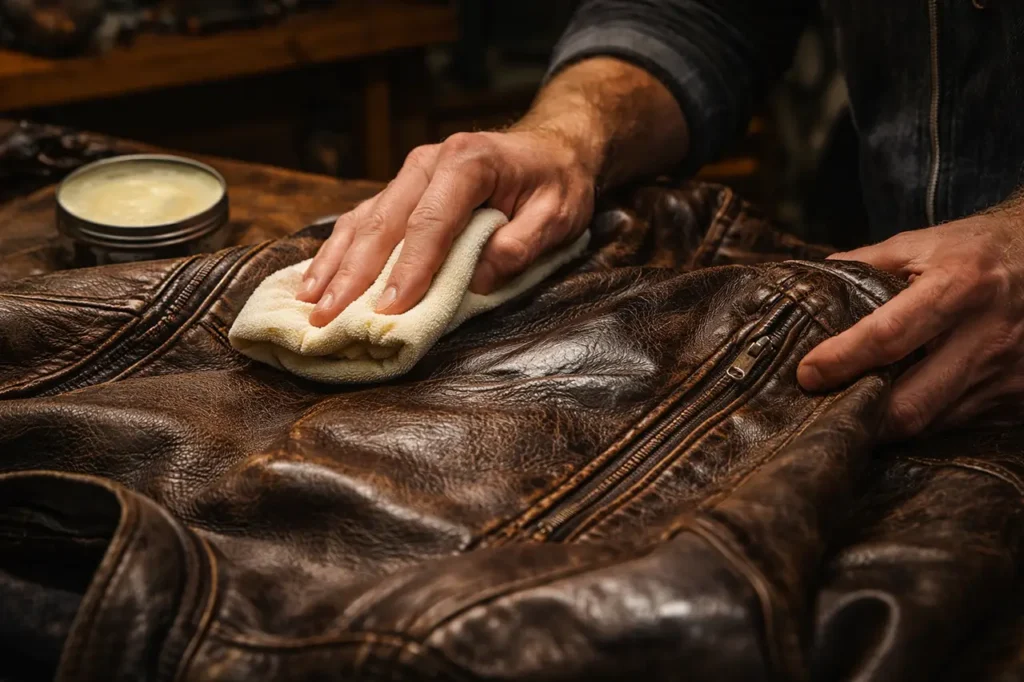
Applying leather conditioner to a dark brown motorcycle jacket with a soft cloth
- Clean the jacket first with a damp cloth to remove any surface dust or oils.
- Apply a small amount of conditioner to a soft, lint-free cloth. Don’t apply it directly from the container to the jacket.
- Work it in using small circular motions, covering the entire jacket. Pay extra attention to stiff areas like the chest, shoulders, and upper back.
- Let it absorb for at least 30 minutes, then buff off any excess with a clean cloth.
- Put the jacket on immediately after — the warmth of your body and your movement will help the conditioner penetrate further.
I typically condition a new jacket once at the start, then again after the first two weeks of wear. After that, once every few months is plenty for maintenance.
Method 3: Hand-Flex the Leather
This is something most guides skip, but it’s genuinely useful — especially for areas that don’t get worked much by normal wearing, like the underarms and the lower back panel.
The idea is simple: pick up the jacket, grab both sides of a stiff panel, and gently work it back and forth. You’re manually flexing the leather fibers in directions they’ll naturally need to flex while riding. Don’t be rough — you’re not trying to tear anything. Just consistent, gentle, repetitive flexing.
Where to Focus:
- Underarm gussets — these need to flex every time you reach forward
- The shoulder area — critical for arm movement on the bike
- The lower back — stiffness here causes that “riding up” feeling on the bike
- The collar area — especially if you ride with the collar up or wear a balaclava
- Around the zipper pull areas — these often crease awkwardly at first
I spent about 15 minutes per evening doing this for the first week with my most recent jacket. It felt a bit silly, but the results were real — those specific areas softened much faster than they would have from wearing alone.
Method 4: The Mist-and-Wear Method (Use With Care)
This method requires some caution, so read the whole section before trying it.
The mist-and-wear technique involves lightly misting the inside of the jacket with water, putting it on, and wearing it for a few hours while it dries. The moisture temporarily softens the leather fibers, and as the jacket dries on your body, it molds more closely to your shape.
I’ve used this method successfully, but there are rules:
| Rules for the Mist-and-Wear Method ✅ Use distilled water, not tap water (minerals in tap water can leave stains) ✅ Mist the INSIDE only — do not wet the outer surface of finished leather ✅ Use a fine mist — you want the leather slightly damp, not wet ✅ Follow up with conditioner after the jacket has fully dried ❌ Do NOT use this method on suede or nubuck leather ❌ Do NOT soak the jacket or get it truly wet ❌ Do NOT use heat to dry it afterward — let it air dry naturally |
Done correctly, this method can make a noticeably stiff jacket significantly more pliable in a single session. Done incorrectly, it can cause water staining, warping, or premature drying of the leather.
I’d recommend combining this with the conditioner method: mist and wear first, let dry completely overnight, then condition the next morning.
Method 5: Ride the Bike
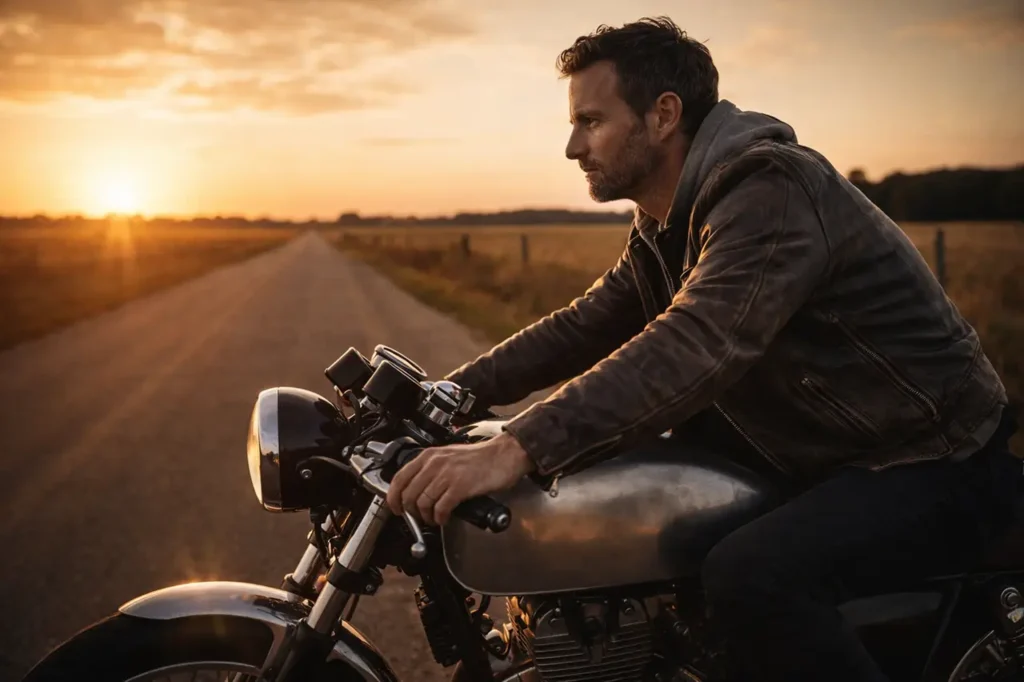
Obviously. But let me tell you why this is different from just wearing it around the house.
Riding a motorcycle puts the jacket under stresses that walking around never does. The forward lean compresses the lower back panel.
The vibration from the bike subtly works the leather in ways no other activity does. The wind creates resistance against the panels.
And most importantly, your riding posture stretches the jacket in precisely the configuration it needs to be comfortable while riding.
This seems obvious, but a lot of riders endure the discomfort of a new jacket for one or two rides and then leave it in the closet because it’s uncomfortable. That’s the worst thing you can do. Push through the first few rides — they’re the most important ones.
Tips for Riding With a New Jacket:
- Start with shorter rides: One to two hours is plenty for the first few sessions. Long rides with a super stiff jacket can cause actual soreness from the restricted movement.
- Ride in warm weather if possible: Heat softens leather. A warm ride is the fastest way to get the jacket breaking in.
- Move around on the bike: Shift your weight, shrug your shoulders, adjust your position. Give the leather reason to flex.
- Don’t give up after ride one: The jacket will feel noticeably better after each of the first five or six rides.
Methods You Should Absolutely Avoid
I’ve seen some terrible advice online. Here’s what not to do:
❌ Don’t use a heat gun or hair dryer: Applying concentrated heat dries out the leather oils rapidly and can cause cracking, warping, and discoloration. I’ve seen expensive jackets ruined this way.
❌ Don’t put it in the washing machine: Machine washing destroys the finish, shrinks and warps the leather, and strips out all of its natural oils. There’s no coming back from this.
❌ Don’t soak it in water: Submerging leather in water can cause it to become stiff and brittle when it dries, especially if dried too quickly or unevenly.
❌ Don’t use petroleum jelly (Vaseline): While it does soften leather temporarily, it attracts dirt, clogs the pores, and degrades the leather long-term.
❌ Don’t stretch it by hand aggressively: Gentle flexing is fine. Grabbing the jacket and yanking on it can stress the stitching and potentially tear the leather at stress points.
❌ Don’t store it stuffed in a bag during break-in: Store it on a wide, padded hanger in a breathable garment bag. Folding or cramming a new stiff jacket causes uneven creasing.
My Recommended Break-In Timeline
Based on my own experience and the methods above, here’s the schedule I now follow with every new leather motorcycle jacket:
Day 1 — Conditioning Day: Clean the jacket, apply a generous coat of leather conditioner to the entire exterior. Let it absorb for an hour, then buff. Spend 15 minutes hand-flexing all the stiff areas.
Days 2–7 — Daily Wear: Wear the jacket every day for at least 2 hours, including around the house. Ride if you can. Do shoulder rolls and arm stretches while wearing it.
Week 2 — Mist Session (Optional): If there are still very stiff areas, do one mist-and-wear session. Continue daily wear.
End of Week 2 — Second Conditioning: Apply conditioner again, focusing on areas that are still stiff. By now, the jacket should be noticeably more comfortable.
Weeks 3–6 — Continued Riding: Keep riding. Keep wearing it off the bike. The jacket should be reaching a very comfortable state by week four.
Month 2 onwards — Maintenance: Condition every 2–3 months depending on use. The jacket is now broken in and will only get better with time.
Long-Term Care: Keeping Your Broken-In Jacket Perfect
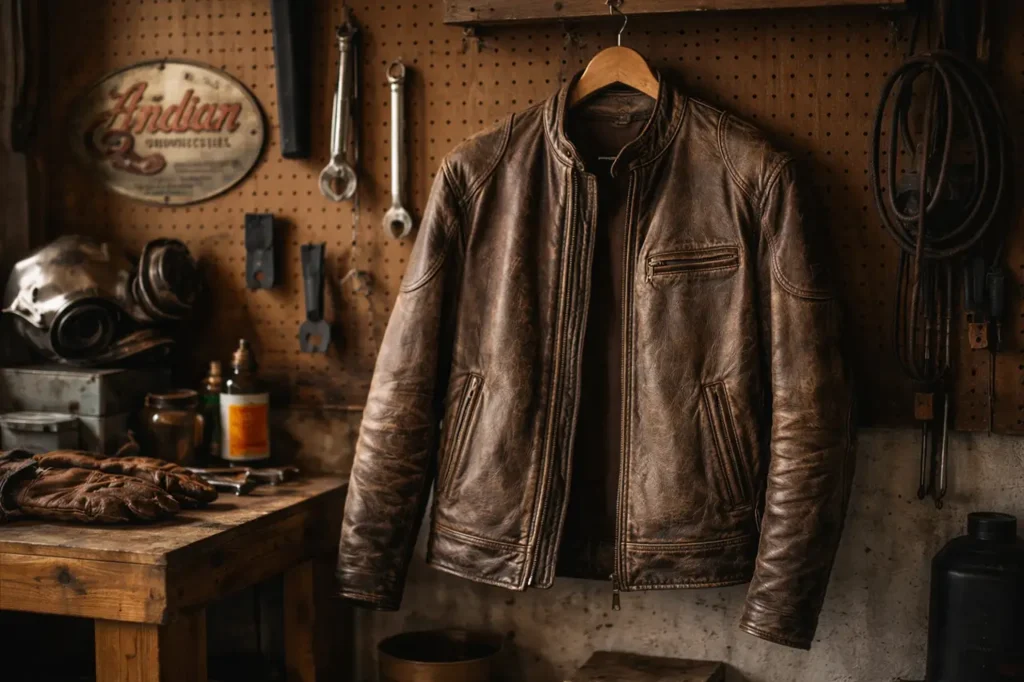
A well-worn, beautifully aged brown leather motorcycle jacket hanging on a wooden hanger in a rustic garage, surrounded by vintage motorcycle memorabilia
Once you’ve put in the work to break in your jacket, you want to protect that investment. A well-maintained leather motorcycle jacket can last decades. Here’s what I do to keep mine in great shape:
- Condition regularly: Every 2–3 months for a jacket in regular use, or whenever the leather starts to feel drier than usual.
- Clean before conditioning: Use a dedicated leather cleaner or a barely damp cloth to remove grime before applying conditioner. Conditioning over dirt pushes it into the leather.
- Dry naturally after getting caught in rain: Don’t rush the drying process. Hang it up, let it air dry at room temperature, then condition once dry.
- Store on a padded hanger: A wide hanger prevents shoulder creasing. A breathable garment bag protects from dust without trapping moisture.
- Keep it away from direct sunlight when stored: Prolonged UV exposure fades and dries out leather.
- Address scratches quickly: Minor surface scratches on leather often buff out with a bit of conditioner and a soft cloth. Deeper scuffs can sometimes be addressed with leather repair products.
Frequently Asked Questions
How do I know when my leather jacket is fully broken in?
You’ll know. When you put it on and it moves with you rather than against you — when you can reach forward in your riding position without feeling any restriction — it’s broken in. The leather will feel soft and supple to the touch, and the jacket will have taken on a shape that feels like it was made for you specifically.
Will breaking in my jacket make it lose its shape?
No — and this is a common fear that stops people from conditioning or flexing their jackets. Breaking in leather doesn’t weaken it or cause it to lose its structural integrity. It simply makes it more flexible. The jacket will still hold its shape when you hang it up; it’ll just be far more comfortable to wear.
My jacket has armored panels — does that affect the break-in process?
Slightly, yes. The area immediately surrounding the armor panels may take a bit longer to break in because the armor limits how much that section of leather can flex. Make sure you’re working those border areas specifically when hand-flexing. Some riders also remove the armor panels during the break-in period and reinstall them afterward, though I personally prefer to leave them in.
Can I speed up the process?
The combination of conditioning + daily wear + hand flexing + riding is about as fast as you can go safely. Trying to rush it with heat or excessive water will cause damage. Patience is part of the process.
My jacket is perforated leather — do the same rules apply?
Yes, with one caveat: be more sparing with liquid conditioner on perforated leather, as it can seep through the holes and stain the lining. Use a dry conditioner or wax-based product instead, applied very sparingly.
Final Thoughts
Breaking in a leather motorcycle jacket is one of those things that nobody tells you about when you’re buying your first one. You walk out of the shop feeling like a million dollars, get home, put it on for a real ride, and wonder if you made a terrible mistake.
You didn’t. You just need to put in a little time.
The leather jacket sitting in my wardrobe right now is my most prized piece of motorcycle gear. It’s been through thousands of miles of riding, two overseas trips, and more rainy days than I can count. It’s perfectly molded to my shape, moves with me like a second skin, and only looks better with every passing year.
None of that would have been possible without those first weeks of intentional break-in. Trust the process. Condition it, wear it, ride it, and give it time.
The jacket will reward your patience for the rest of its life.
| 💬 Found this helpful? If this post helped you break in your leather jacket, I’d love to hear how it went. Drop a comment below with your jacket type and which method worked best for you. And if you have a tip I haven’t covered here, share it — the motorcycle community runs on shared knowledge. |
Related Reading You Might Find Useful: