
9 Best Motorcycle Jackets for 100 Degrees (What Actually Keeps You Riding Through a Heat Wave)
 Jake Miller
15 min read
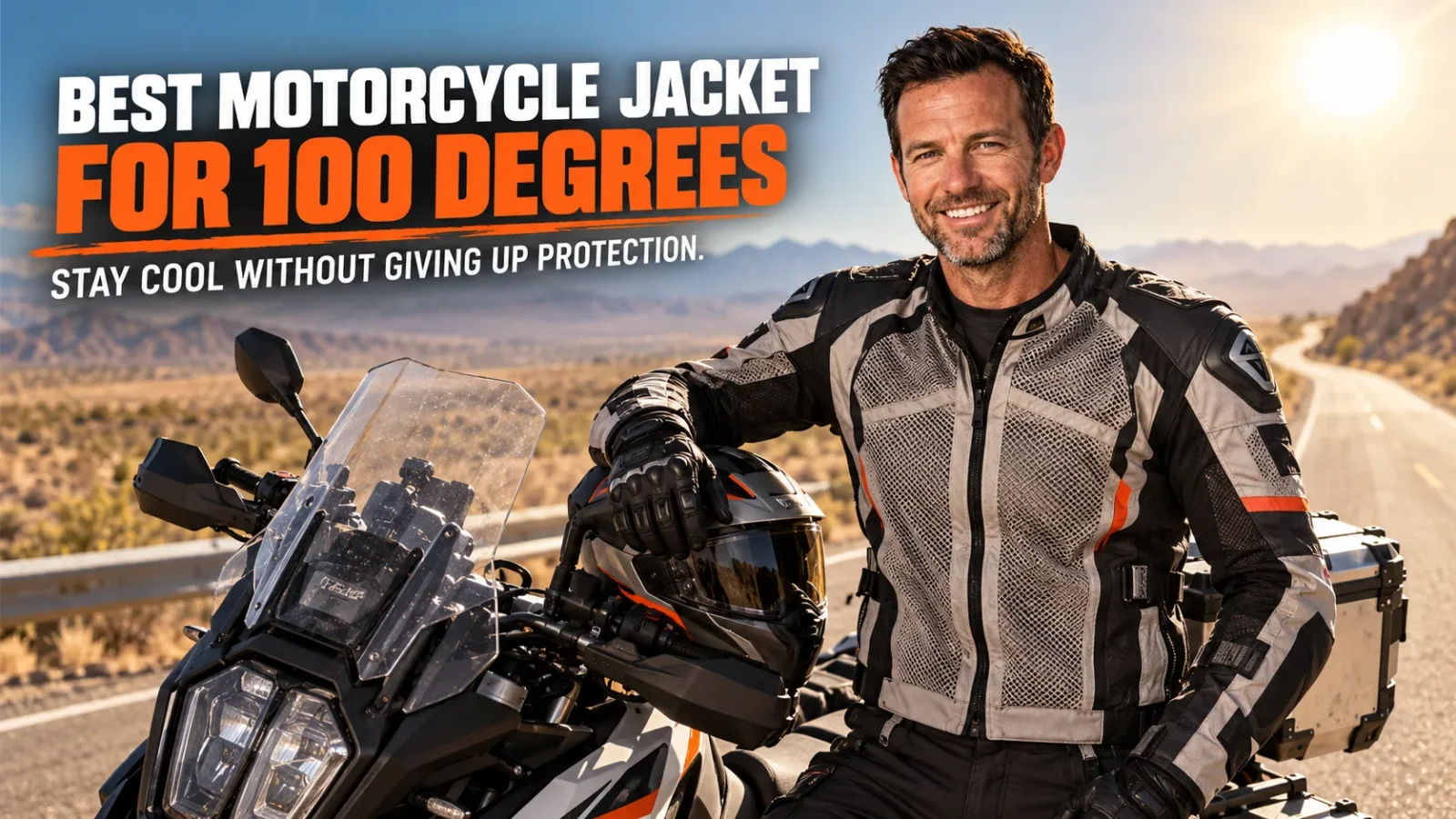
I once rode 90 miles across Kansas in 103°F heat wearing a jacket that looked like it should breathe and didn’t. By the second gas stop I was nauseous, my hands were shaking, and I sat in a gas station bathroom running cold water over my wrists for ten minutes before I trusted myself to keep riding. That was heat exhaustion, not just discomfort — and it changed how I evaluate “hot weather” gear ever since.
Disclosure: some links in this article are affiliate links. As an Amazon Associate I earn from qualifying purchases, and I may also earn a commission from RevZilla at no extra cost to you.
TL;DR
- Best all-around pick for true 100°F riding: Klim Induction — near-total mesh coverage, CE Level 1 armor, built specifically for extreme heat
- Best value: Joe Rocket Phoenix Ion — real mesh coverage and CE armor at a price that doesn’t sting
- Best premium pick: Dainese Air Frame D1 — race-derived ventilation with serious build quality
- The gap most guides ignore: a jacket that flows air at 60 mph can still be a sauna at a stoplight — I explain why that matters more at 100°F than any spec sheet number
- Sun exposure is a real risk at highway speeds in direct sun — I cover UPF/sun protection, which almost no gear guide mentions
- Two corrections from the original version of this post: one jacket was listed as “waterproof” when the actual product is the mesh version, and one listed product doesn’t exist as a jacket at all — I’ve fixed both and flagged them inline
Why 100°F Riding Is a Different Problem Than “Hot Weather”
Most gear guides lump “summer riding” and “100-degree riding” together, and that’s a mistake. At 80–85°F, a partially mesh jacket with some ventilation zippers gets you by fine.
At 100°F and above, you’re managing something closer to a medical risk than a comfort preference — heat exhaustion, dehydration, and heat stroke are real possibilities on a long ride in direct sun, especially in stop-and-go traffic where airflow drops to nothing.
I don’t say that to scare you out of riding in summer. I say it because the gear decisions actually matter more at this temperature than they do at 80°F, and most buying guides don’t treat the two situations differently.
A jacket that’s “good for summer” isn’t automatically good for 100°F — the difference between roughly 60% mesh coverage and roughly 85% mesh coverage is the difference between tolerable and genuinely dangerous on a long, slow ride.
The Stoplight Problem: Airflow at Speed vs. Airflow at Zero
Here’s something almost no jacket review mentions: a mesh jacket’s cooling performance at 65 mph tells you very little about how it performs sitting at a red light in stop-and-go city traffic.
At speed, air is forced through the mesh whether the jacket is well-designed or not. At a stoplight, in slow parking-lot traffic, or idling at a gas pump in direct sun, you’re relying entirely on the mesh’s passive breathability and how much of the jacket is actually open mesh versus solid panel with a few vents.
This matters enormously at 100°F because that’s exactly when you’re most likely to be stuck in traffic — heat waves and summer traffic tend to arrive together. When I evaluate a jacket below, I’m weighing both: how it performs moving and how it performs stopped. A jacket that’s 85% mesh with minimal solid paneling will still feel bearable at a dead stop; a jacket that’s 50% mesh with “ventilation zippers” through solid fabric will not.
Sun Exposure: The Risk Nobody Puts on the Spec Sheet
If you’re riding for hours in direct sun at 100°F, UV exposure through thin mesh fabric is a real consideration, not a minor one. Most motorcycle mesh isn’t rated or tested for UPF (Ultraviolet Protection Factor) the way sun-specific athletic wear is, and manufacturers rarely publish this number for jackets.
That doesn’t mean mesh jackets are dangerous — it means don’t assume the jacket is doing sun protection work it was never designed to do. A base layer with a stated UPF rating underneath a mesh jacket, plus sunscreen on exposed skin at wrists and neck, closes this gap better than trusting the jacket alone.
How I Evaluated These Jackets
- Mesh coverage percentage — how much of the jacket is actual open mesh versus solid panel
- Armor level — CE Level 1 or Level 2, stated explicitly
- Stopped-traffic performance — how the jacket likely performs with no forward airflow
- Build quality and abrasion resistance — since more mesh generally means a trade-off here
- Real-world price — what you’re actually getting at the price point
Quick Comparison Table
| Jacket | Mesh Coverage | Armor | Price Tier | Buy It |
|---|---|---|---|---|
| Klim Induction | Very high (~85%+) | CE Level 1 | Premium ($300–$400) | RevZilla · Amazon |
| Joe Rocket Phoenix Ion | High (~75%) | CE Level 1 | Budget ($120–$160) | RevZilla · Amazon |
| Rev’it Tornado 3 | High (~70%) | CE Level 1 | Mid ($250–$300) | RevZilla (not confirmed on Amazon) |
| Bilt Blaze Mesh (corrected from “Waterproof”) | High (~75%) | CE-rated | Budget (under $130) | Amazon (Cycle Gear house brand — not sold on RevZilla) |
| Dainese Air Frame D1 | High (~70%) | CE Level 1 | Premium ($300–$350) | RevZilla · Amazon |
| Scorpion EXO Drafter II | Moderate-High (~65%) | CE-rated | Budget-Mid ($170–$220) | RevZilla · Amazon |
| Fly Racing Flux Air | High (~75%) | CE Level 1 | Budget ($130–$170) | RevZilla · Amazon |
| Icon Mesh AF CE (corrected — “Airflite Pleasuredome” is a helmet, not a jacket) | High (~75%) | CE Level 1 | Mid ($200–$250) | RevZilla (not confirmed on Amazon) |
1. Klim Induction — Best All-Around Pick for True 100°F Riding

Mesh coverage: very high (~85%+) · CE Level 1 armor · Premium ($300–$400)
If I could only recommend one jacket from this entire list for genuinely riding through 100°F heat, this is it. Klim built the Induction specifically around the stoplight problem — it’s mesh in nearly every direction, not just chest and back, so it still moves air passively even at a dead stop. CE Level 1 armor is included, and the shell holds up better than the amount of open mesh would suggest.
Pros:
- Near-total mesh coverage performs well even stopped in traffic
- CE Level 1 armor doesn’t get sacrificed for the ventilation
- Klim’s reputation for durability despite the mesh-heavy build
- A Klim Induction Pro version exists with upgraded armor if you want to step up
Cons:
- Sits at the top of the price range on this list
- Less abrasion resistance than a solid-panel textile jacket, as with any mesh-forward design
- No waterproofing — pair with a separate rain layer for unpredictable weather
2. Joe Rocket Phoenix Ion — Best Value
Mesh coverage: high (~75%) · CE Level 1 armor · Budget ($120–$160)
This is the jacket I point budget-conscious riders toward when the temperature is genuinely brutal and the wallet is genuinely tight. Real mesh coverage, CE Level 1 armor included rather than sold separately, and a price that doesn’t require justifying to anyone. It won’t outperform the Klim Induction at a dead stop, but for the price, it’s not close to a fair fight.
Pros:
- Strong mesh coverage for the price point
- CE Level 1 armor included standard
- Reflective elements help with visibility on long summer rides
- Compatible with Joe Rocket’s zip-in liner if you need three-season versatility later
Cons:
- Noticeably less airflow at a dead stop compared to the Klim Induction
- Build quality is good, not exceptional, at this price
- Fewer color and sizing options than the bigger-name brands
3. Rev’it Tornado 3 — Best Engineered Ventilation
Mesh coverage: high (~70%) · CE Level 1 armor · Mid ($250–$300)
Buy it: RevZilla
Rev’it’s ventilation engineering shows in the Tornado 3 — the mesh placement is deliberate rather than just “mesh everywhere,” with reinforcement exactly where abrasion risk is highest and airflow concentrated where your body actually needs it. It’s not the absolute highest mesh percentage on this list, but the engineering behind where that mesh sits makes it perform better than the raw number suggests.
Pros:
- Thoughtful mesh placement rather than uniform coverage
- CE Level 1 armor with solid Rev’it build quality
- A women’s Tornado 3 version exists in the same line
- Reinforced high-wear zones without sacrificing much airflow
Cons:
- Pricier than the budget picks without a Level 2 armor upgrade to show for it
- Less reliably available on Amazon — plan to buy through RevZilla or Cycle Gear
- Slightly less total mesh coverage than the Klim Induction
4. Bilt Blaze Mesh Jacket (Corrected from “Waterproof”) — Best True Budget Pick
Mesh coverage: high (~75%) · CE-rated armor · Budget (under $130)
Buy it: Amazon
Note: the original version of this post listed this pick as “Bilt Blaze Waterproof Jacket,” which makes little sense for a 100°F heat guide — a waterproof membrane actively works against breathability. The jacket that actually belongs on a hot-weather list is the Bilt Blaze Mesh, a genuinely different product in the same line. I’ve corrected the pick and links.
This is the jacket for riders who want real mesh coverage without spending real money. It won’t match the Klim Induction’s stopped-traffic performance, but for a jacket that regularly sells under $130, the mesh coverage and included armor are a legitimately good deal.
Pros:
- Genuinely budget-friendly, regularly under $130
- Real mesh coverage, not just a couple of zippered vents
- CE-rated armor included at the shoulders and elbows
- Cycle Gear’s retail backing makes returns and exchanges simple
Cons:
- Build quality is a step below the premium picks, as expected at this price
- Not available on RevZilla — Amazon or Cycle Gear only
- Armor level isn’t always clearly stated as Level 1 vs. Level 2 in listings — confirm before buying if that matters to you
5. Dainese Air Frame D1 — Best Premium Pick

Mesh coverage: high (~70%) · CE Level 1 armor · Premium ($300–$350)
Dainese brings race-derived construction to a mesh jacket, and it shows in the fit and the confidence of the build. This isn’t the highest mesh percentage on the list, but what mesh it has is placed with real engineering behind it, and the overall construction feels like it’s built to last far longer than the budget picks.
Pros:
- Race-derived construction and fit quality
- CE Level 1 armor with Dainese’s reputation for protection engineering
- A women’s Air Frame D1 version is available in the same line
- Build quality noticeably above the budget tier
Cons:
- Premium pricing without stepping up to Level 2 armor
- Slightly less total mesh coverage than dedicated heat-first jackets like the Klim Induction
- Sizing runs closer to a European/slim fit — check the size chart carefully
6. Scorpion EXO Drafter II — Best Budget-Mid Balance
Mesh coverage: moderate-high (~65%) · CE-rated armor · Budget-Mid ($170–$220)
Scorpion sits in a comfortable middle ground here — more mesh coverage than the absolute budget picks, without reaching premium pricing. It’s a sensible pick if you want better stopped-traffic performance than the cheapest options but don’t need Klim-level engineering.
Pros:
- Solid mid-tier mesh coverage without premium pricing
- CE-rated armor included
- Reasonably durable construction for the price
- Good availability across both RevZilla and Amazon
Cons:
- Mesh coverage trails the top picks on this list, so stopped-traffic performance is a step down
- Styling is more utilitarian than some competitors
- Not the lightest jacket on this list if weight matters to you on long rides
7. Fly Racing Flux Air — Best Off-Road-Leaning Budget Pick
Mesh coverage: high (~75%) · CE Level 1 armor · Budget ($130–$170)
Fly Racing’s off-road heritage shows in the more rugged cut, which suits dual-sport and adventure-leaning riders who still want genuine mesh coverage for extreme heat. It’s a strong budget option if your riding style skews more off-pavement than the street-focused picks on this list.
Pros:
- Strong mesh coverage at a budget-friendly price
- CE Level 1 armor included standard
- More rugged cut suits dual-sport and off-road-leaning riders
- A women’s Flux Air version is available in the same line
Cons:
- Less refined street fit compared to Dainese or Rev’it
- Build quality is good but not premium-tier
- Fewer color options than the bigger street-focused brands
8. Icon Mesh AF CE (Corrected — “Airflite Pleasuredome” Is a Helmet) — Best Streetwear-Style Pick
Mesh coverage: high (~75%) · CE Level 1 armor · Mid ($200–$250)
Buy it: RevZilla
Note: the original version of this post listed “Icon Airflite Pleasuredome Jacket” as a pick — that name actually belongs to an Icon full-face helmet graphic, not a jacket at all. Icon’s real hot-weather jacket in this category is the Mesh AF CE, which I’ve swapped in here along with corrected links.
Icon’s streetwear-influenced styling sets this jacket apart from the more traditional touring look of most picks on this list, while still delivering genuine mesh coverage and CE Level 1 armor. It’s a solid pick if you want something that doesn’t look purely like technical riding gear once you’re off the bike.
Pros:
- Strong mesh coverage with CE Level 1 armor included
- Streetwear-influenced styling stands out from typical touring jacket looks
- A women’s Mesh AF CE version is available in the same line
- Solid mid-tier value for the coverage and armor you get
Cons:
- Less reliably available on Amazon — RevZilla or Cycle Gear are safer bets
- Styling won’t appeal to riders who want a more traditional technical look
- Sits at a mid-tier price without Level 2 armor to match
What to Ignore When Comparing Hot-Weather Jackets
“Breathable” without a mesh percentage. Every jacket in this category claims to be breathable. What matters is how much of the jacket is actually open mesh versus solid fabric with a couple of zippered vents — ask for the percentage if it’s not listed.
Included thermal liners. In a jacket built for 100°F riding, a thermal liner you’ll never use isn’t a selling point — it’s a marketing checkbox. Don’t let it push your decision toward a jacket with less actual mesh coverage.
Vague “CE-approved” claims. As with any protective gear, if a listing doesn’t state Level 1 or Level 2 explicitly, assume Level 1 and ask directly if it matters to your decision.
Staying Safe at 100°F: Beyond the Jacket
The jacket is one piece of managing extreme heat on a ride — it’s not the whole solution. A few things worth doing regardless of which jacket you choose:
- Hydrate before you’re thirsty. By the time you feel thirsty, you’re already behind. Drink water at every stop, not just when you remember to.
- Know the early signs of heat exhaustion: dizziness, nausea, unusual fatigue, or stopping sweating despite the heat. If you notice these, stop riding, get into shade or air conditioning, and rehydrate before continuing — don’t push through it.
- A wetted base layer or cooling vest under a mesh jacket meaningfully extends how long you can ride comfortably in extreme heat, especially in dry climates where evaporative cooling works well.
- Plan stops in shade, not just at gas stations with no cover. Ten minutes out of direct sun does more for your core temperature than most people expect.
This isn’t a substitute for medical advice — if you’re ever unsure whether what you’re experiencing is heat exhaustion, treat it seriously and get out of the heat immediately.
Frequently Asked Questions
Do I really need a jacket in 100-degree weather, or is it safer to ride without one?
You need one. Riding without a jacket in extreme heat trades one risk (feeling hot) for several worse ones: direct sun exposure to bare skin, no protection in a fall, and no barrier against road debris and hot air at speed, which can actually cause more skin dehydration than a well-ventilated jacket does. A genuinely high-mesh-coverage jacket like the ones on this list is safer than bare arms, not less safe.
How much of a jacket needs to be mesh for it to actually work at 100°F?
Based on the jackets that perform well at a dead stop versus those that don’t, aim for something in the 70%+ open mesh range if you’re regularly riding in 100°F heat, especially with any stop-and-go traffic. Jackets in the 50-60% range with a few zippered vents through solid panels tend to perform noticeably worse the moment you’re not moving.
Can a mesh jacket actually protect me in a crash?
Yes, if it has CE-approved armor at the shoulders and elbows — the mesh fabric itself provides less abrasion resistance than solid textile, but the armor is doing the critical impact-protection work regardless of how much mesh surrounds it. Check specifically for CE Level 1 or Level 2 armor rather than assuming “mesh” automatically means less protective; several jackets on this list balance real armor with real airflow.
Can I wear a mesh jacket in light rain?
Briefly, yes — but mesh jackets aren’t designed for rain and will soak through quickly in anything beyond a passing drizzle. If you’re riding somewhere with unpredictable summer storms, keep a compact rain layer in your storage for unexpected weather, since none of the jackets on this list are built as rain gear.
What should I wear under a mesh jacket in extreme heat?
A moisture-wicking base layer works better than bare skin or cotton — cotton holds sweat against your body rather than moving it away, which actually makes you hotter over time. A base layer with a stated UPF rating adds meaningful sun protection that the mesh jacket alone doesn’t reliably provide, which matters more the longer you’re riding in direct sun.
Final Thoughts
At 100°F, the difference between a genuinely good jacket and a “summer-rated” jacket in name only comes down to two things most reviews skip: how much of it is real open mesh, and how it performs the moment you stop moving. The Klim Induction earns its price by nailing both.
The Joe Rocket Phoenix Ion and Bilt Blaze Mesh prove you don’t need to spend $300+ to get real mesh coverage and included armor. Whichever you choose, don’t let the jacket alone carry the job — hydration, shade breaks, and knowing the signs of heat exhaustion matter just as much as what you’re wearing.
Once your jacket’s sorted, round out your hot-weather kit with a helmet built for airflow, and if your riding takes you into unpredictable summer storms, my waterproof jackets guide covers the other end of the weather spectrum. For care tips that keep a mesh jacket’s armor and fabric performing through a full riding season, my jacket washing guide and CE ratings guide are worth a read.
Ride safe, stay hydrated, and know the signs of heat exhaustion before you need to.

Related Articles

7 Best Hoodies for Motorcycle Riding: Real Gear I Actually Wear on Two Wheels
I tested the best hoodies for motorcycle riding, from Kevlar-lined stealth options to armored commuter picks. Here's what actually protects…
Jake Miller
9 min read
9 Best Vests for Motorcycle Riding: Real-World Picks I Actually Wear
I've ridden thousands of miles in motorcycle vests. Here are 9 real, tested picks — from armored leather to hi-vis…
Jake Miller
12 min read
8 Best Heated Vests for Motorcycle Riding: Wired and Battery Picks for Cold Commutes
I've ridden through freezing winter commutes with eight heated vests. Here's which 12V wired and battery powered heated vests actually…
Jake Miller
11 min read