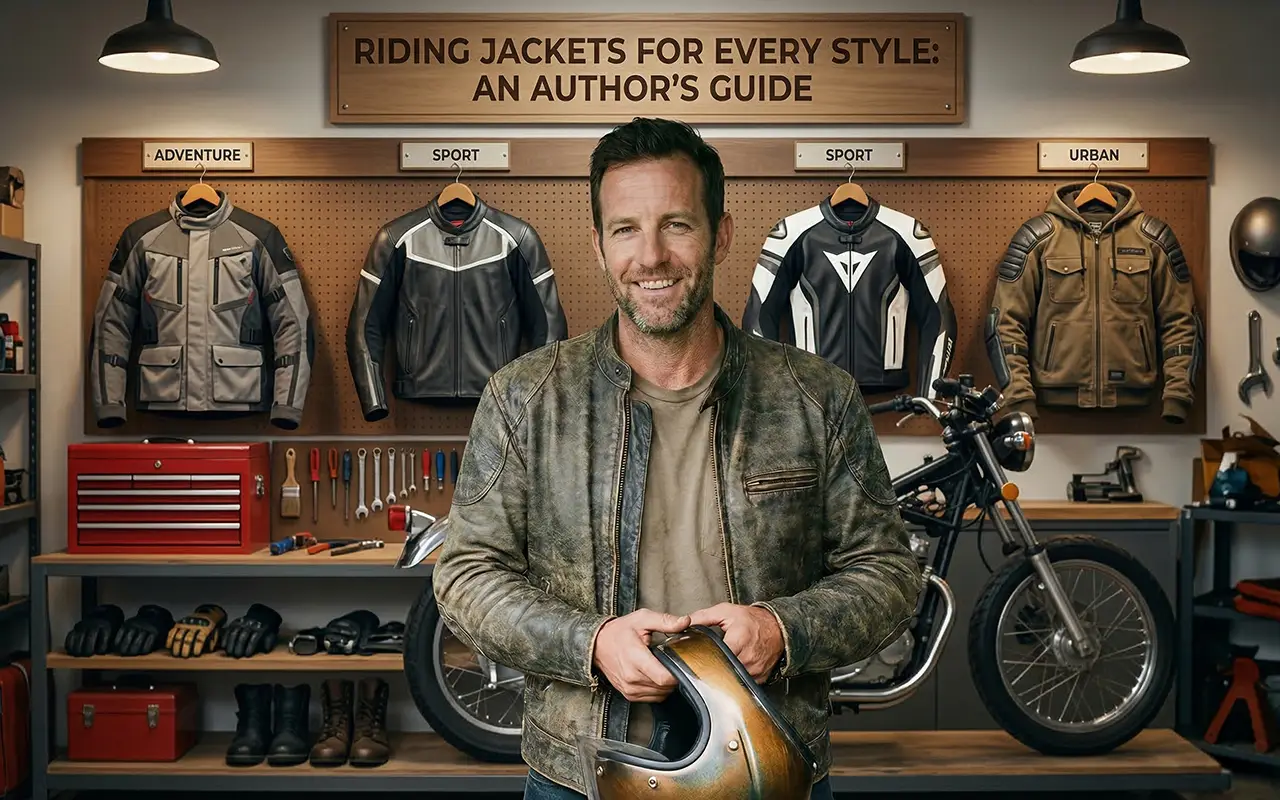
Buying your first motorcycle jacket—or upgrading your current one—is one of the most important gear decisions you will make. It’s not just about looking the part; it is the literal barrier between your skin and the asphalt.
I’ve spent over 15 years riding everything from sport bikes in the canyons to ADV bikes across state lines. In that time, I’ve owned incredible jackets that felt like a second skin, and cheap ones that failed when I needed them most.
Choosing the right jacket comes down to matching the materials, armor, and fit to the exact type of riding you do.
While our Ultimate Guide to Motorcycle Jackets covers every technical detail in depth, if you are in a rush, here is the short version of what you need to know:
| ⚡ TL;DR — The Quick Answer After 15+ years of riding across different styles, here’s the short version: • Match your jacket to your riding style first — sport, touring, adventure, or casual. • Always look for CE Level 1 or Level 2 armor at shoulders, elbows, and optionally the back. • Leather wins for abrasion resistance; textile wins for versatility and all-weather use. • Fit is everything — a jacket that shifts during a crash offers less protection. • Your budget sweet spot: $200–$500 gets you solid protection without diminishing returns. Keep reading for the full breakdown with real-world advice from the road. |
The Jacket That (Almost) Saved My Skin
I still remember the first time I laid my bike down. It was a wet October morning on a country road outside Nashville — a patch of gravel I didn’t see until my front wheel had already committed.
I was wearing a budget jacket I’d grabbed on clearance. I walked away with road rash on my forearm and a bruised ego, but the jacket came apart at the shoulder seam. That was my wake-up call.
Since then, I’ve worn through half a dozen jackets across 80,000+ miles of sport riding, touring through Europe, and weekend canyon carving.
I’ve also watched friends make expensive mistakes buying the wrong gear for the wrong purpose. This guide is everything I wish someone had told me before that October morning.
Choosing the right motorcycle jacket is genuinely one of the most important decisions you’ll make as a rider — not just for safety, but for comfort, longevity, and whether you’ll actually want to wear it.
A jacket that’s uncomfortable or impractical gets left in the closet, and a jacket in the closet protects nobody.
1. Know Your Riding Style First
Before you even look at a single jacket, you need to get honest with yourself about how and where you actually ride. Not how you imagine you ride, or how you’d like to ride — how you actually ride.
This one question will eliminate about 60% of the options and make the decision dramatically easier.
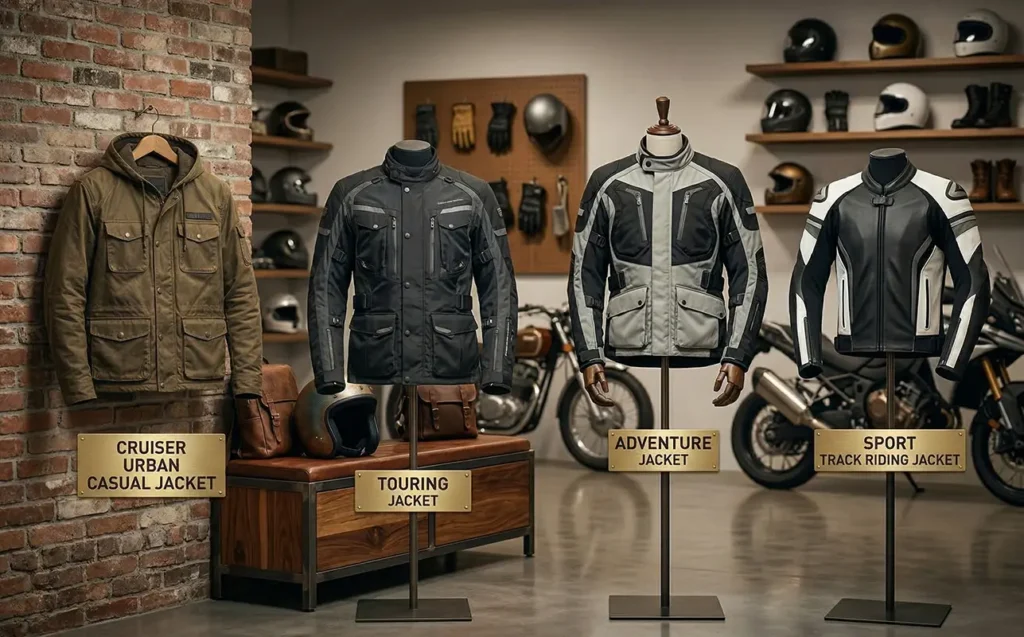
Sport / Track Riding
If you’re spending time on sport bikes, twisties, or track days, you’re crouched forward, generating speed, and need a jacket cut for that aggressive forward lean.
Sport jackets hug the body closely, have pre-curved sleeves, and prioritize abrasion resistance above everything else.
They’re typically leather or heavy-duty cordura. They’re also usually hot, stiff, and not great for anything other than riding.
Touring / Long-Distance
Touring riders eat miles for breakfast. You’re upright or slightly leaned forward, exposed to changing weather, and you need a jacket that protects you across hundreds of miles without becoming a physical burden.
Textile jackets dominate here — they breathe better, have more pockets, zip-in liners for cold mornings, and ventilation panels for summer afternoons. Waterproofing is a serious consideration.
Adventure / Dual-Sport
ADV riding has exploded in the last decade, and for good reason — there’s nothing quite like pointing a GS or an Africa Twin at a mountain trail.
Adventure jackets need to handle both on-road crashes and off-road falls, often in remote locations. They tend to be textile, built tougher, with CE Level 2 back protection as a near-standard feature. Ventilation matters because you’re often working hard.
Cruiser / Urban / Casual
If you’re riding a Harley through the city or taking your scrambler to brunch, style is part of the equation — and that’s completely legitimate.
Classic leather cafe-racer jackets and modern urban moto jackets can still offer solid protection while looking incredible.
The trade-off is usually less technical performance. But a jacket you’re actually going to wear every day is worth more than a technical jacket gathering dust.
| Rider Reality Check Ask yourself these questions before buying: • What’s my average ride distance — 20 miles or 200? • Am I riding in one climate or do I cross seasons? • Do I commute in it, or is it strictly for weekend rides? • Do I care about looking ‘motorcycle-y’ off the bike? Your honest answers shape everything that follows. |
2. The Protection Question: What Actually Matters
Let me be direct: protection is not negotiable. Everything else — style, weight, price — comes after you’ve confirmed a jacket will actually do its job when things go wrong. Here’s what that means in practical terms.
CE Armor Certification
The CE (Conformité Européenne) standard is the benchmark for motorcycle armor, and it’s been updated significantly over the years. The current standard you’ll see is EN 13594 for gloves and EN 1621 for body armor. For jackets, focus on EN 1621-1 (limb protectors) and EN 1621-2 (back protectors).
CE Level 1 armor is the baseline — it’s adequate protection for street riding at normal speeds. CE Level 2 armor absorbs significantly more impact force and is worth the extra cost. For back protection especially, I strongly recommend spending up to Level 2. The difference in a spinal injury situation is not trivial.
Always check that a jacket actually includes armor — not just has pockets for it. ‘Armor-ready’ means nothing if it ships with foam pads that wouldn’t survive a parking lot tip-over.
Abrasion Resistance: Leather vs. Textile
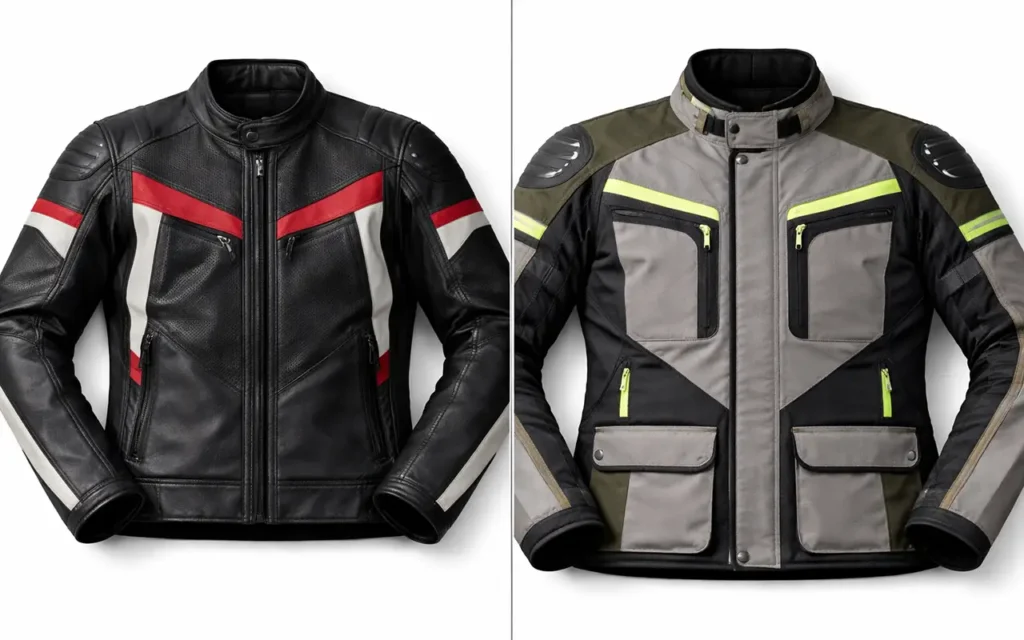
This is the great debate in motorcycle gear, and honestly, both sides have merit. Here’s how I think about it:
- Leather: Naturally superior abrasion resistance, conforms to your body over time, excellent in a slide. Downsides: heavy, hot in summer, stiffens in cold, requires care, not waterproof.
- Textile (Cordura, ballistic nylon, aramid blends): Versatile, weatherproof, lighter, easier to care for. Top-tier textiles from brands like Aerostich or RevIt are genuinely comparable to leather in abrasion tests. Cheaper textiles are not.
- Mesh jackets: Great airflow, terrible abrasion resistance on their own. Fine for city speeds with good armor, not for highway riding.
My personal rule: leather for sport/track use, quality textile for everything else. If you’re buying one jacket for all purposes, a 600D cordura textile with CE Level 2 armor is probably your most versatile bet.
The Back Protector Situation
Most jackets come with CE Level 1 back protection at best, and some ship with nothing but a foam pad. Your spine is not something to economize on.
If a jacket you love doesn’t include a proper CE Level 2 back protector, budget $50–$100 to add one from D3O, Knox, or Forcefield. It’s probably the single highest-value safety upgrade you can make.
3. Fit — The Detail Most Riders Get Wrong
I’ve seen riders buy a jacket two sizes too large because it ‘feels more comfortable.’ I understand the instinct — loose feels relaxed.
But in a crash, a loose jacket rides up, shifts, and leaves you exposed in precisely the spots where the armor was supposed to be. Fit is a safety issue, not just a vanity one.
What Good Fit Looks Like
- Shoulder armor should sit directly over your shoulder joint — not on your upper arm, not on your neck.
- Elbow armor should align with your actual elbow when your arm is in the riding position (slightly bent, hands on bars).
- The jacket should not ride up when you reach forward to the bars.
- You should be able to take a deep breath without the jacket straining at the chest.
- Sleeve length: wrists should be covered even at full extension. No gaps between gloves and jacket.
Sizing Across Brands
Here’s something nobody tells you enough: motorcycle jacket sizing is wildly inconsistent across brands. A ‘Large’ in Alpinestars is not the same as a ‘Large’ in Klim or Dainese.
European brands often size smaller. If you’re buying online, pull the actual chest, waist, and sleeve measurements from the brand’s size chart and measure yourself. Don’t go by the label.
If you’re between sizes, size up for textiles (you can layer underneath) and size down for leather (it breaks in and stretches slightly with wear).
Pre-Curve Sleeves and Riding Position
Sport and adventure jackets often have pre-curved sleeves — the arms are stitched at an angle that mimics the riding position. This eliminates fabric bunching when you reach for the handlebars.
If you’re trying on a jacket in the store and it feels awkward standing upright, sit on a bike or mimic the riding position before writing it off. It might feel perfect on the bike.
4. Weather, Ventilation, and the All-Season Challenge
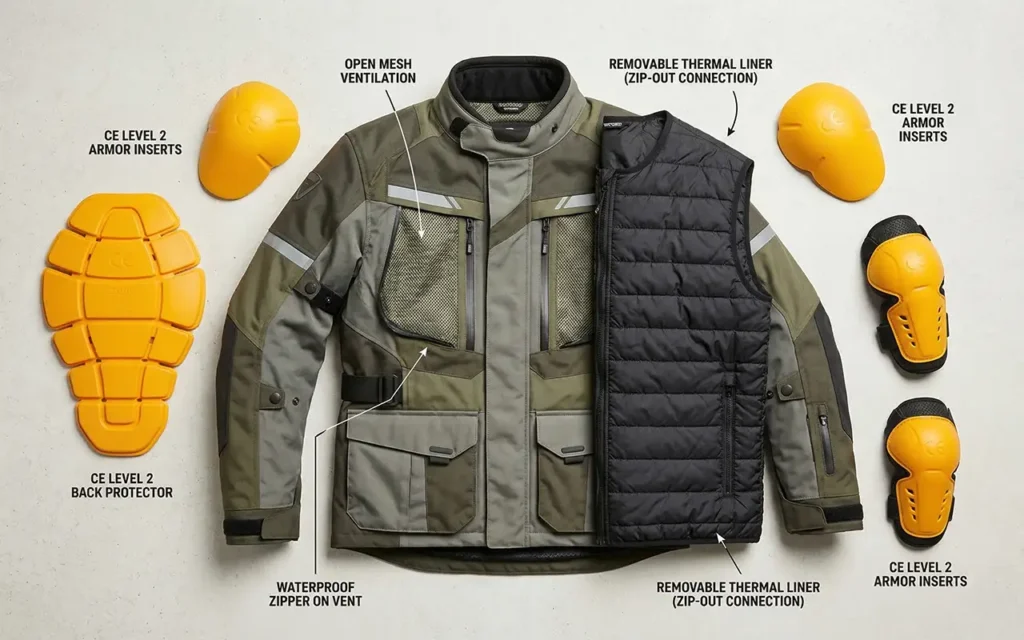
Most riders don’t ride in one type of weather. Unless you’re purely a summer canyon carver, you’re dealing with cold mornings, hot afternoons, rain, and everything in between. How a jacket handles that range matters enormously for whether you actually wear it.
Ventilation Systems
Look for jackets with zip-open vents on the chest and back — not just mesh panels, but actual vents you can open and close. Chest vents channel air in; back vents let it out.
The combination creates a chimney effect that actually moves air through the jacket. Jackets without active vents just bake you in summer regardless of how breathable the fabric claims to be.
Waterproofing and Liners
There are two main approaches: a built-in waterproof membrane (like Gore-Tex) and a removable zip-in liner. Built-in membranes are more convenient and sealed better, but can be warm when you don’t need them.
Zip-in liners — both thermal and waterproof — give you more flexibility. The best touring jackets often have both: a removable thermal liner and a removable waterproof liner, letting you configure for the conditions.
The Three-Season Reality
If you’re riding spring through fall in a temperate climate, look for a jacket rated for roughly 50°F–95°F (10°C–35°C). This usually means a textile jacket with mesh panels you can unzip in heat, combined with the option to add a thermal liner when it’s cold. Accept that no single jacket is truly optimal across the full range — but a good three-season jacket gets you close.
5. Materials Deep Dive: What’s Actually in Your Jacket
Marketing language around jacket materials is some of the most confusing copy in consumer goods. Let me translate.
Leather Types
- Full-grain cowhide: The gold standard. Dense, tough, abrasion-resistant. Heavy and expensive.
- Goatskin: Lighter and more supple than cowhide, nearly as tough. Common in premium sport jackets.
- Perforated leather: Adds ventilation but reduces abrasion resistance in those areas — consider placement carefully.
- Kangaroo leather: Exceptionally strong-to-weight ratio. Rare and expensive. Used in gloves and high-end suit panels.
Textile Materials
- Cordura (500D, 1000D): Nylon-based fabric with excellent abrasion resistance. Higher denier = tougher. 1000D is overkill for most riders; 600D hits the sweet spot.
- Ballistic nylon: Originally developed for military use, very tough, heavier than Cordura.
- Aramid fibers (Dyneema, Kevlar blends): Extremely cut and abrasion resistant at low weight. Often used as lining or in high-impact panels.
- Softshell fabrics: Stretchy and comfortable, poor abrasion resistance. Acceptable only in low-speed commuting jackets with solid armor.
| What to Avoid Watch out for these red flags when shopping: • ‘Armor-ready’ jackets that include only thin foam inserts • Jackets with no CE certification listed anywhere in the description • Thin ‘fashion leather’ below 1.0–1.2mm thickness • Textile jackets with very low denier fabric in high-impact areas • Brands that won’t disclose material weights or armor certification levels |
6. Budget Guide: What You Actually Get at Each Price Point
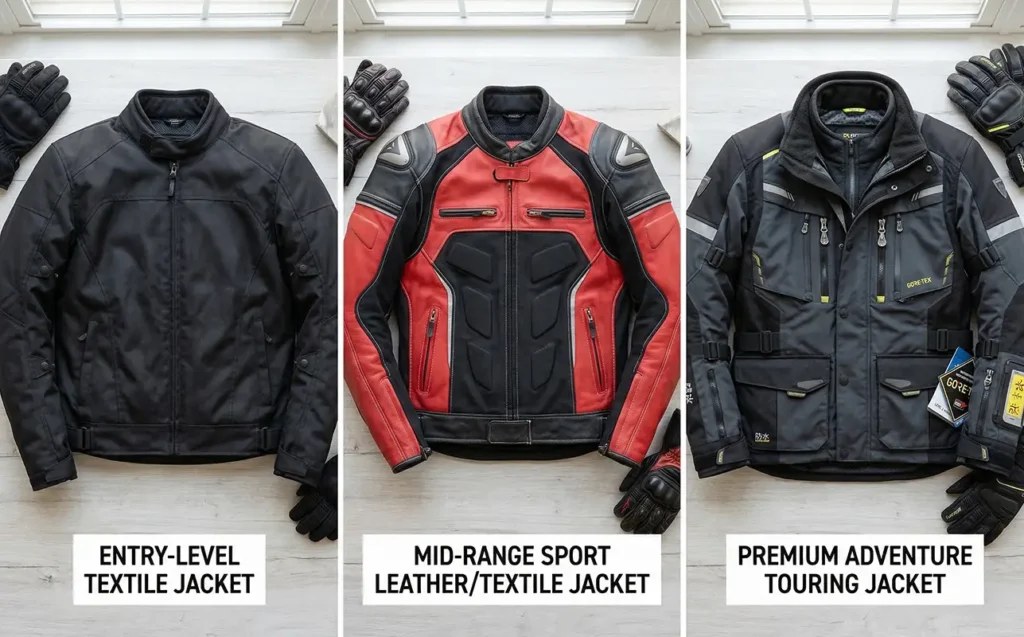
I’m going to give you honest expectations here, without pushing you toward the most expensive option. Great protection is available at multiple price points. You don’t need to spend $1,000 to be well-protected.
Under $150
At this range, you’re looking at fashion-first pieces with minimal real protection. Some have CE Level 1 elbow and shoulder armor, but the base material is often thin enough to compromise the whole system. Fine for very low-speed urban riding if you add a good back protector, but I wouldn’t rely on it for highway miles.
$150–$300
This is where genuine options start appearing. Brands like Icon, Joe Rocket, and Fly Racing offer solid CE-rated armor and reasonable build quality. Textile options in this range can be quite good. Leather tends to be thinner or split rather than full-grain. Still worth supplementing with an aftermarket back protector.
$300–$600 — The Sweet Spot
This is where I point most riders. Brands like Alpinestars, Rev’It, Klim (entry-level), and Dainese start delivering proper CE Level 2 armor, quality base materials, good construction, and features like removable liners. A jacket in this range, properly fitted, will serve most riders for 5+ years of regular riding.
$600–$1,000+
At this level, you’re buying engineering. Gore-Tex membranes, CE Level 2 D3O armor standard, premium full-grain leather or high-denier cordura, excellent fit systems, longer warranties. Brands like Aerostich, Klim, and Rukka live here. If you’re putting in 10,000+ miles a year, the cost-per-mile math starts to favor the investment.
7. Brands Worth Trusting (And Why)
I’m not going to give you a ranked list, because the best brand for you depends on your riding style and body shape.
But here are brands I’ve personally used or watched trusted riding partners use across thousands of miles:
For Sport Riding
- Alpinestars: Consistently excellent armor systems, great fit for sport ergonomics, wide range from entry to elite.
- Dainese: Italian fit (slightly narrow), exceptional leather quality, strong protection focus.
- Rev’It: Dutch brand with outstanding textile engineering, excellent ventilation systems.
For Touring and Adventure
- Klim: Built for serious mileage and serious weather. Expensive, but riders who use them rarely switch.
- Aerostich: American, made-to-order options, legendary durability, quirky but beloved in touring circles.
- Rukka: Finnish brand that makes arguably the best cold/wet weather gear on the market. Not cheap.
For Cruiser and Urban
- Roland Sands Design: Where style meets real protection. Great for cafe-racer and custom aesthetics.
- Biltwell: Budget-friendly, honest about what they are, popular with the scrambler and urban crowd.
- Vanson: American-made premium leather. Heirloom quality. The jacket your grandkids will inherit.
8. How to Actually Try a Jacket (Even Online)
The best jacket is one you’ve tried on in a riding position. If you have a local dealer, use them — even if you end up buying online afterward. Sit on a demo bike in the showroom.
Reach forward. Look for gaps at the wrists and lower back. Check armor placement. This 15 minutes is valuable.
Buying Online
If you’re buying online, use these strategies to reduce sizing mistakes. First, pull the brand’s measurement chart and measure your chest, waist, and arm length. Second, look for brands with free returns — you will likely be exchanging sizes.
Third, read negative reviews specifically for fit complaints; they’re often the most accurate signal. Fourth, check YouTube reviews that show the jacket on a person riding, not just a mannequin.
Breaking In a New Jacket
Leather jackets especially need a break-in period. Don’t judge a leather jacket by how it feels the first time you put it on. Wear it around the house.
Sit in your riding position for 30 minutes. It will conform to your body and feel dramatically different after 10 rides. If it still feels wrong after real break-in, then you have a fit issue.
9. Jacket Care and Longevity
A good jacket, properly maintained, should last you a decade. Here’s how to protect your investment:
Leather Care
- Clean with a dedicated leather cleaner, not soap and water.
- Condition 2–3 times a year with a quality leather conditioner (Leather Honey, Lexol, or similar).
- If it gets wet, let it dry naturally away from direct heat. Hang it; don’t fold.
- Store in a cool, dry place out of direct sunlight.
Textile Care
- Most textile jackets are machine washable — check the label. Remove armor inserts first.
- Re-apply DWR (Durable Water Repellent) treatment annually or when beading stops.
- Check and clean ventilation zippers — they clog with road grime and stop working.
- Inspect seams and stitching annually; small repairs prevent big failures.
When to Replace
If you’ve crashed in a jacket, replace the armor even if the jacket looks fine — armor is designed for single-impact protection and is compromised after a hit. If the jacket material has significant abrasion, tears, or the seams are failing, it’s time. A jacket that has done its job once has done enough — don’t ask it to do it again.
10. My Personal Recommendations by Rider Type
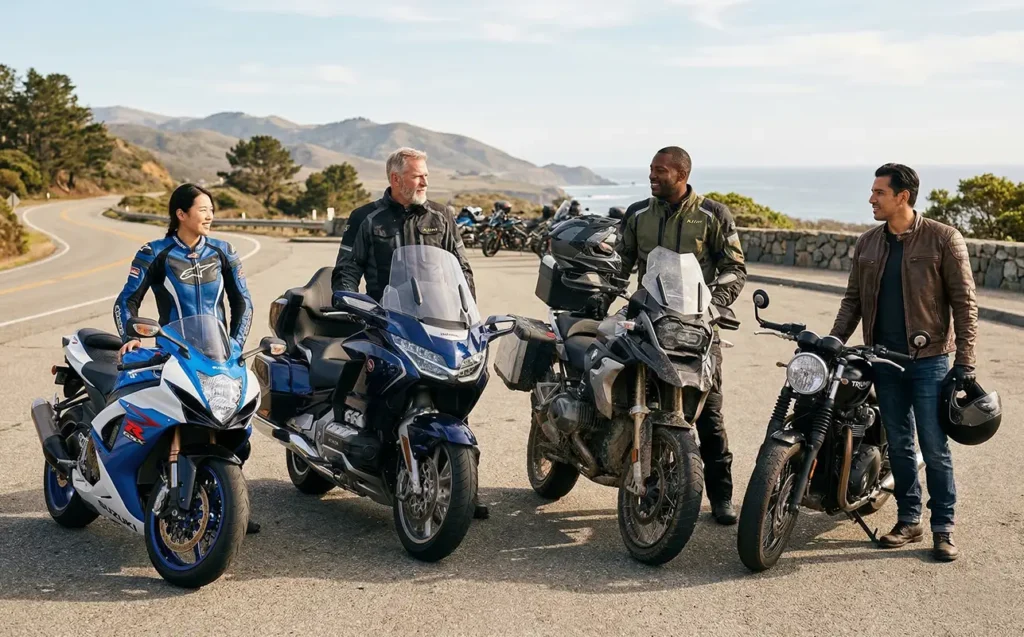
I’ll put my name behind these:
New Sport Rider, Tight Budget
Alpinestars T-GP Plus R Air or Joe Rocket Atomic 5.0 in textile, or Icon Overlord leather if you want hide. Supplement with a Knox CE Level 2 back protector insert.
Weekend Canyon Carver, Mid Budget
Rev’It Ignition 4 or Alpinestars Superfaster leather. Both offer genuine CE Level 2 shoulder and elbow armor, quality construction, and will last years of hard weekend use.
Adventure / ADV Touring, Any Budget
Lower budget: Klim Traverse, Rev’It Sand 4. Mid range: Klim Kodiak or ADV Air. High budget: Aerostich Roadcrafter or Klim Badlands Pro. ADV gear doesn’t compromise — buy the best you can afford.
Daily Commuter, Urban Riding
Roland Sands Ronin (leather, looks great off the bike), Rev’It Caplan (technical, understated), or Knox Urbane Pro if you want CE certification with a slim modern look.
Final Thoughts From the Road
After all the miles, all the jackets, and yes, a few crashes — here’s what I’ve distilled it down to: buy the best protection you can actually wear consistently, in a fit that doesn’t move, for the riding you actually do.
The perfect jacket isn’t the most expensive one in the catalog or the one that looks the best on Instagram. It’s the one you reach for every single time you throw a leg over your bike, because it’s comfortable enough to wear, protective enough to trust, and suited for the conditions you actually face.
If this guide saves even one rider from the mistake I made on that wet October morning — grabbing the cheapest thing on the clearance rack — then it was worth writing. Ride safe, ride often, and for the love of all things holy, zip your jacket collar closed before you leave the parking lot.
| Quick Checklist Before You Buy ✓ Matches your primary riding style (sport / touring / ADV / urban) ✓ CE Level 1 or Level 2 armor in shoulders AND elbows (included, not ‘ready’) ✓ CE Level 2 back protection (or budget for an aftermarket insert) ✓ Shoulder armor aligns with shoulder joint in riding position ✓ No ride-up when reaching forward — wrists stay covered ✓ Material appropriate for your climate (leather / textile / mesh) ✓ Ventilation and weatherproofing matched to your conditions ✓ Free returns available if buying online |
Frequently Asked Questions (FAQs)
Should a motorcycle jacket be tight or loose?
Your jacket should fit snugly, but not be so tight that it restricts your movement or cuts off circulation. The rule of thumb is that the armor needs to stay locked in place over your elbows and shoulders. If the jacket is too loose, the armor will shift out of the way during a slide, leaving you unprotected. Always test the fit in your actual riding position, not just standing in front of a mirror.
Can I just wear a regular fashion leather jacket on my motorcycle?
Absolutely not. Fashion leather is incredibly thin (usually under 1mm), lacks reinforced safety stitching, and has zero impact armor. In a crash, a fashion jacket will shred on the asphalt almost instantly. Real motorcycle jackets use thick cowhide or specialized textiles (1.2mm to 1.4mm thick) and are engineered specifically for abrasion resistance.
Do all motorcycle jackets come with back protectors?
No, and this catches a lot of new riders off guard. Most jackets come with CE Level 1 or Level 2 armor in the shoulders and elbows, but only provide a flimsy foam pad in the back. That foam is just a placeholder. You should almost always budget an extra $40 to $80 to buy a proper CE-rated back protector insert that fits your specific jacket.
Is it better to buy a leather or textile jacket for my first piece of gear?
For a first jacket, textile is usually the smarter choice. Textile jackets are highly versatile, handle a wider range of temperatures, often feature waterproofing, and cost less than quality leather. Once you have a reliable textile “daily driver,” you can save up for a dedicated leather jacket for weekend canyon carving or track days.
How long does a motorcycle jacket usually last?
A high-quality leather jacket can easily last 10 to 15 years if properly conditioned and cared for. Textile jackets generally have a lifespan of 5 to 8 years before the UV rays degrade the synthetic materials and the waterproofing begins to fail. However, if you crash and the jacket takes structural damage or the armor sustains a heavy impact, it needs to be replaced immediately.
Related Reading You Might Find Useful: