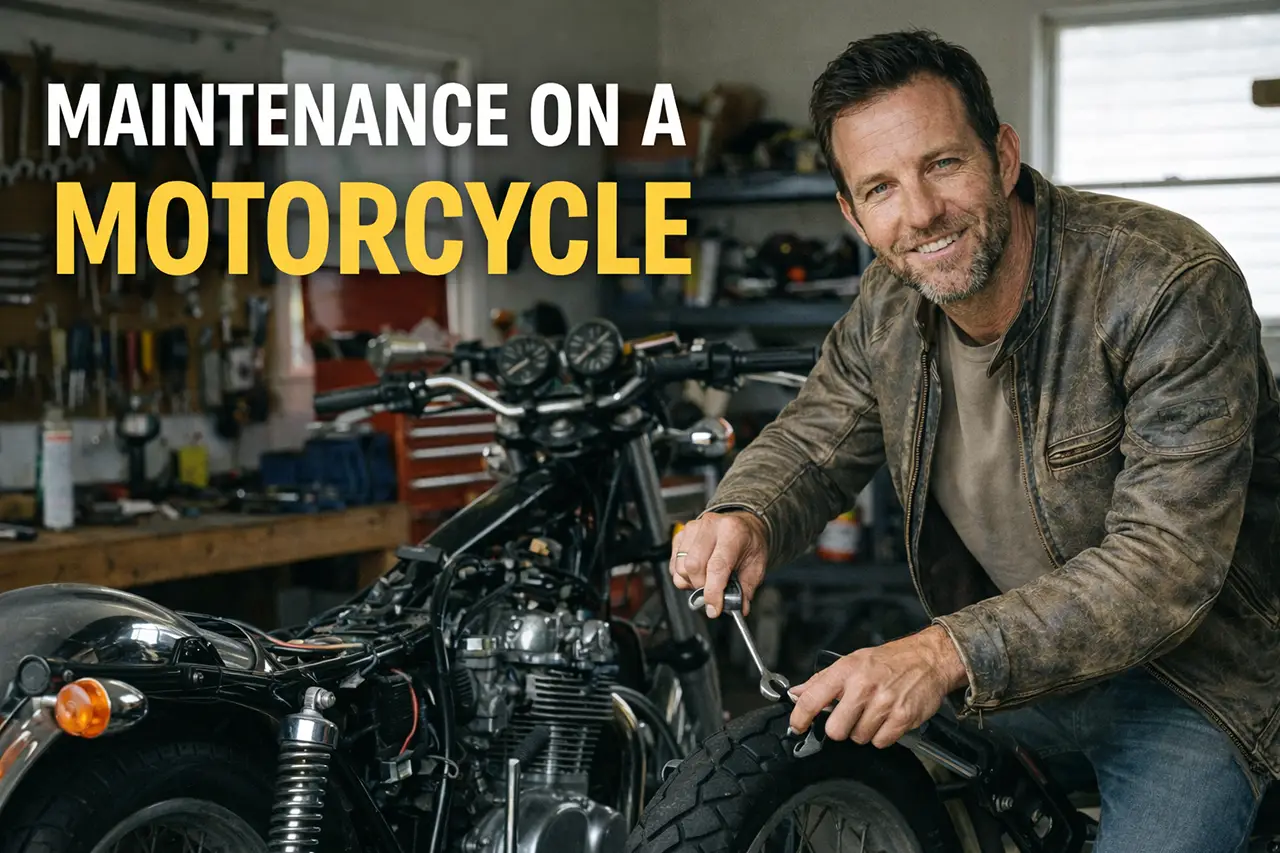
I’ve been riding for over fifteen years, and I’ll be honest with you — the first time my bike left me stranded on the side of a highway, it wasn’t because something catastrophically failed. It was because I ignored a warning sign I didn’t know to look for. That day changed how I think about motorcycle maintenance forever.
Whether you’re a weekend warrior, a daily commuter, or somewhere in between, understanding what is motorcycle maintenance — and how to do it consistently — is what separates a rider who enjoys the road from one who fears it.
TL;DR — Quick Summary
- Motorcycle maintenance includes routine checks (oil, tires, brakes, chain) and scheduled servicing at mileage intervals.
- Basic motorcycle maintenance can be done at home with minimal tools — no mechanic required for most of it.
- The three most critical checks before every ride: tire pressure, brake feel, and chain tension.
- Most bikes need an oil change every 3,000–6,000 miles depending on oil type and engine.
- Neglecting maintenance doesn’t just cost money — it costs safety.
- Use your owner’s manual as your bible. Manufacturer specs always win.
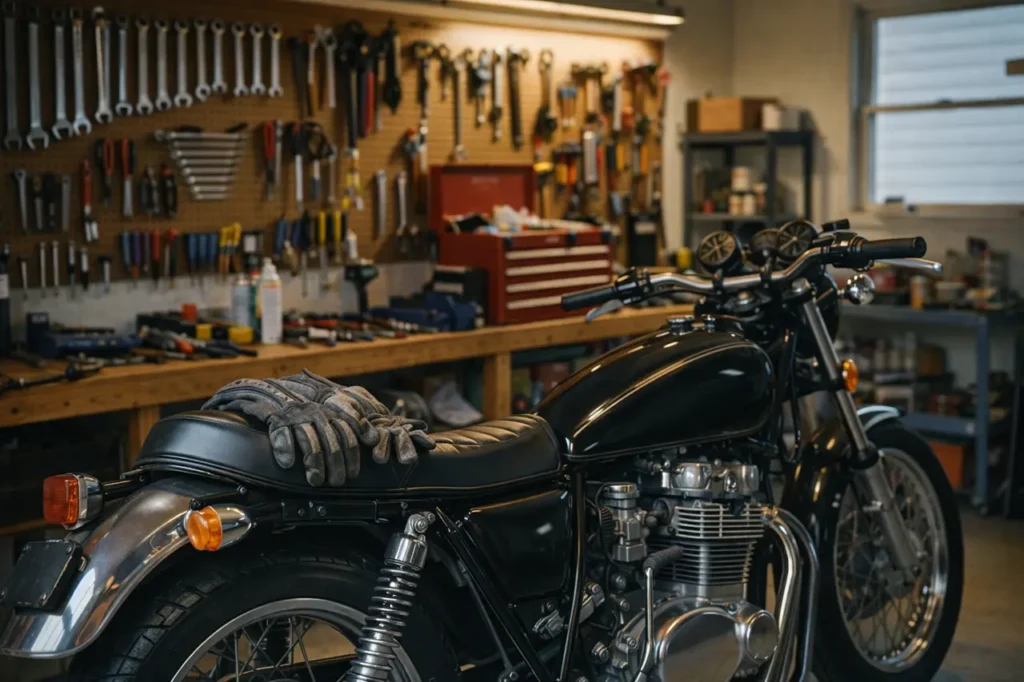
A vintage-style motorcycle parked in a clean garage workshop, tools neatly arranged on a wooden pegboard behind it, warm overhead lighting, photorealistic, mechanic’s gloves resting on the seat
What Is Motorcycle Maintenance, Really?
Let me break this down the way I wish someone had broken it down for me when I bought my first bike.
Motorcycle maintenance is everything you do — proactively and reactively — to keep your bike mechanically sound, safe, and performing at its best. It’s not just fixing things when they break. That’s repair. Maintenance is the discipline of preventing the break in the first place.
When people ask what is basic motorcycle maintenance, they’re usually picturing an oil change or maybe a chain lube. And yes, those are part of it. But basic motorcycle maintenance actually covers a whole ecosystem of checks and habits that, when done consistently, make riding more enjoyable and a lot safer.
There are two broad types of motorcycle maintenance you should know about:
- Routine maintenance — things you check or do regularly, sometimes before every ride.
- Scheduled maintenance — servicing intervals that are mileage or time-based, like oil changes, valve clearances, and brake fluid flushes.
Both matter. Skip one and you’re gambling. Skip both consistently and you’re playing a game you will eventually lose.
Basic Motorcycle Maintenance: The Pre-Ride Checks
Every ride starts before you even swing your leg over. I’ve turned this into a five-minute habit that I do every single time I ride — rain or shine, short trip or long haul. Here’s what I call the T-CLOCS check (which is actually the Motorcycle Safety Foundation’s pre-ride inspection framework):
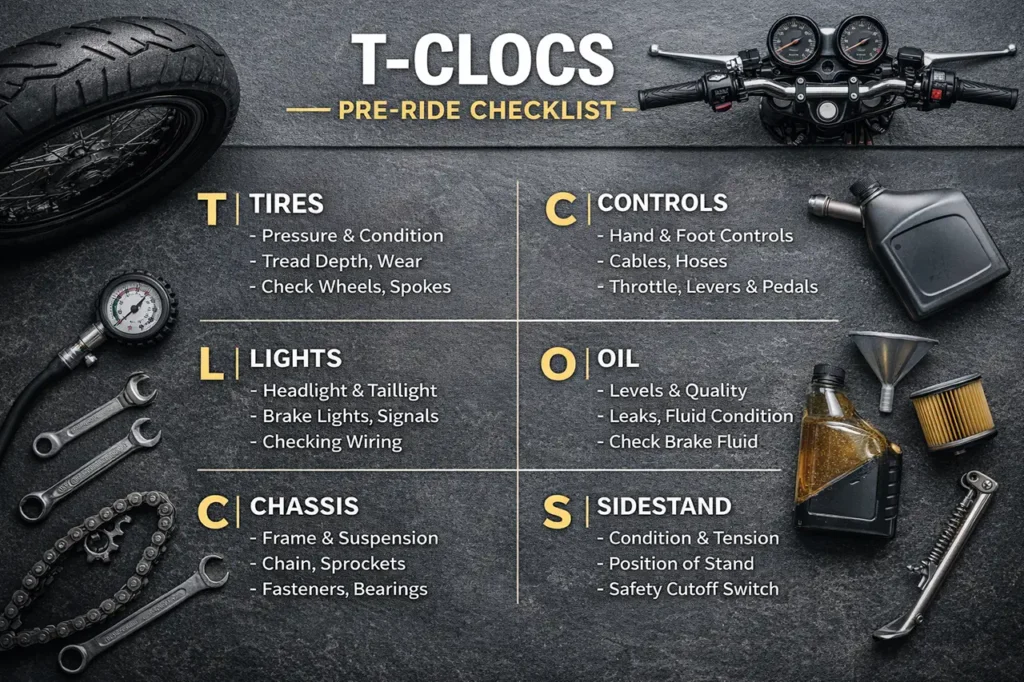
T-CLOCS pre-ride checklist infographic
Clean flat-lay infographic showing six motorcycle components (tires, controls, lights, oil, chassis, sidestand)
T — Tires and Wheels
This is non-negotiable. Every time. Check tire pressure with a gauge — don’t eyeball it. A tire can look fine and be 10 PSI low. Check for visible damage: cuts, embedded objects, uneven wear patterns. Also spin the wheels and look for wobble, and check that spokes (if you have them) aren’t loose or broken.
What are the basic maintenance checks for tires? Pressure, tread depth, and visual inspection for damage. Those three. Every ride.
C — Controls
Squeeze your brake levers. They should feel firm, not spongy. Roll the throttle open and let it snap back — it should return fully and smoothly. Check your clutch for smooth engagement. Make sure handlebars move through the full range of motion without binding.
L — Lights and Electrics
Headlight, brake light (front and rear brake separately), turn signals, horn. Takes thirty seconds. A busted brake light means the car behind you might not know you’re stopping. Not worth skipping.
O — Oils and Fluids
Check your engine oil level using the sight glass or dipstick. Check brake fluid reservoir levels. If your bike is liquid-cooled, check your coolant. None of this takes more than two minutes.
C — Chassis
Look under the bike for oil or fluid drips. Check your chain tension and lubrication (more on this below). Look at your fork seals for weeping oil. These are things that change slowly, but catching them early is the whole point.
S — Sidestand and Centerstand
Make sure the sidestand fully retracts. A sidestand that drags on the ground through a left-hand corner is how bikes go down. Also verify the sidestand switch works — on most bikes, the engine won’t run with the stand down, which is a feature you’ll appreciate if you ever forget to put it up.
How to Do Motorcycle Maintenance: The Scheduled Service Items
If pre-ride checks are your daily habit, scheduled maintenance is your season check-in. These are the things that need attention based on how many miles you’ve ridden or how much time has passed. Let me walk through each one the way I approach it on my own bikes.
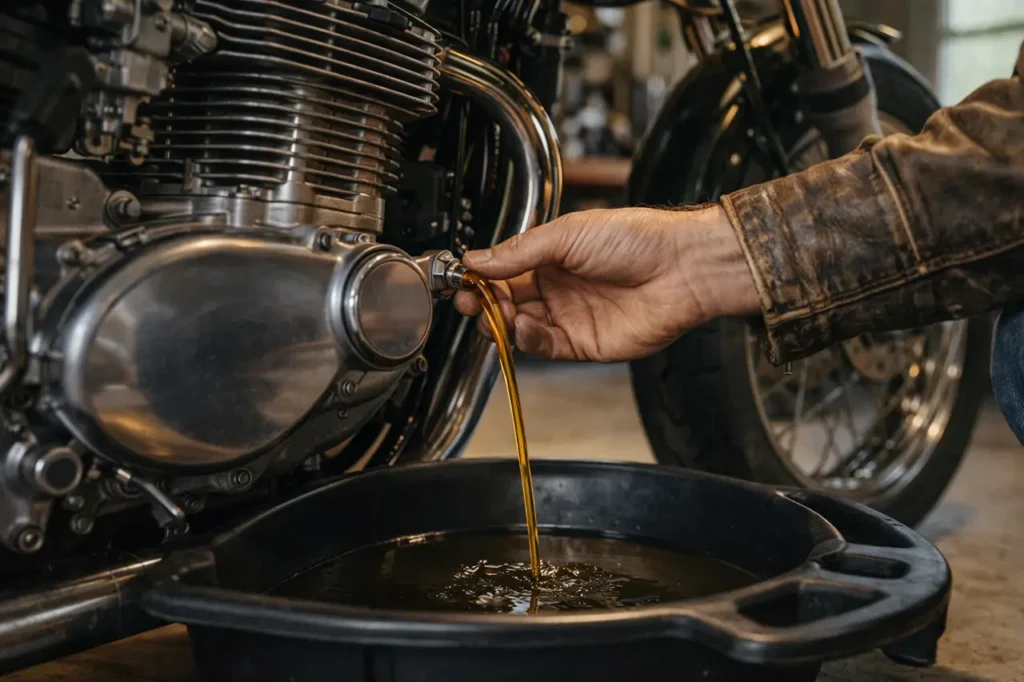
Draining engine oil from a motorcycle
1. Engine Oil and Filter Changes
This is the cornerstone of basic motorbike maintenance. Your engine oil lubricates, cools, and cleans the engine internals. Old, degraded oil does none of those things well.
How often? For conventional oil, most manufacturers recommend every 3,000 miles. Synthetic oil stretches that to 5,000–7,000 miles in most cases. But always check your manual — some high-revving sportbike engines are more demanding, while big cruiser V-twins are often more forgiving.
How to do it: Warm the engine up for two minutes (warm oil drains faster and more completely), kill it, remove the drain bolt, let it drain fully, change the filter, reinstall the drain bolt with a fresh crush washer, refill to spec, and check for leaks. First time it feels involved; by the third time you’ll do it in under twenty minutes.
2. Chain Maintenance (For Chain-Drive Bikes)
If you ride a chain-drive motorcycle and you’re not maintaining your chain, you’re throwing money away — and eventually safety. A neglected chain wears out sprockets (which are expensive), reduces power delivery, and can snap at the worst moment.
Easy motorcycle maintenance for the chain means two things: lubrication and tension.
- Lubricate every 300–500 miles, or after every ride in rain.
- Clean the chain every 600 miles or so with a chain cleaner and a soft brush before lubricating.
- Check tension per your manual — most bikes want 25–35mm of vertical slack at the tightest point.
- Inspect for tight links, rust, or visible wear. If you see hooked teeth on your sprockets, both chain and sprockets need replacement.
3. Brake Fluid
Brake fluid is hygroscopic — it absorbs moisture from the air over time. As moisture content increases, the boiling point drops, which means under hard braking you can get brake fade or, in extreme cases, a spongy lever with a dramatically reduced stopping distance.
Flush and replace brake fluid every two years regardless of mileage. Use the spec in your manual (usually DOT 4). Don’t mix DOT grades.
4. Brake Pads
Most brake pads have a wear indicator groove. When that groove disappears, the pad is done. Check visually every 3,000–5,000 miles. If you ride in the mountains or do a lot of city stop-and-go, check more often. Replacing pads is one of those basic motorcycle maintenance tasks that’s genuinely easy once you’ve done it once.
5. Air Filter
A clogged air filter starves your engine of air and hurts fuel economy and performance. Paper filters should be replaced every 10,000–15,000 miles or annually. Foam filters (common on older or off-road bikes) can be cleaned and re-oiled. If you ride in dusty conditions, check more frequently.
6. Spark Plugs
Plugs are cheap. Fouled plugs cause misfires, hard starts, and poor fuel economy. Pull them every 8,000–15,000 miles (check your manual — some iridium plugs go longer). The condition of the plug also tells you a story about combustion: tan or grey is healthy, black and sooty means rich mixture or oil issues, white or blistered means running lean.
7. Coolant (Liquid-Cooled Bikes)
Coolant degrades over time, losing its corrosion inhibitors. Replace every two years. Use the right type — many modern bikes spec an OAT (Organic Acid Technology) coolant; don’t mix types.
8. Tires
Tires aren’t just a consumable — they’re the only contact patch between you and the road. Replace when tread depth hits 1.6mm (legal minimum in most countries) or when you see cracking in the sidewalls. Don’t run tires more than five years old even if tread looks fine — rubber hardens and loses grip. Always replace both tires from the same manufacturer if possible for balanced handling.
What to Know About Motorcycle Maintenance If You’re DIY-ing It
I do most of my own maintenance. It saves money, but more importantly it means I know my bike intimately. Every bolt I’ve torqued, every fluid I’ve changed — I know the condition of my machine in a way that even a good mechanic can’t replicate because they’re working on dozens of different bikes.
If you’re wondering how to do basic motorcycle maintenance at home, here’s what you actually need to get started:
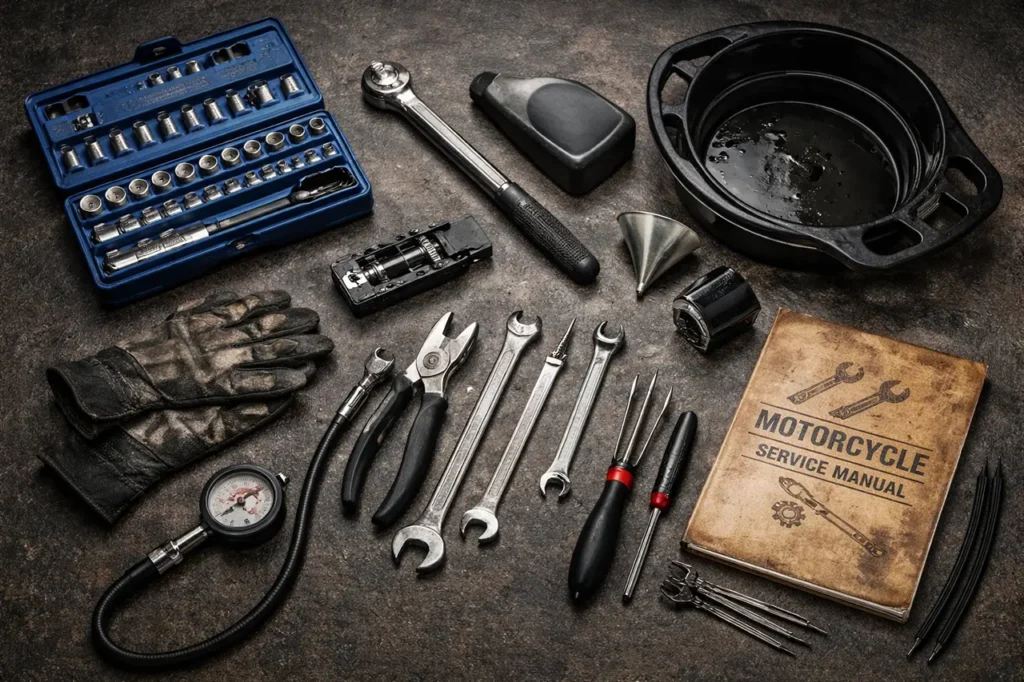
Basic home garage motorcycle tool kit
Essential Tools for Basic Motorcycle Maintenance
- Metric socket set (8mm to 27mm covers most bikes)
- Torque wrench — non-negotiable for fasteners like drain bolts and axle nuts
- Chain lube and chain cleaner
- Tire pressure gauge
- Oil drain pan
- Funnel
- Your owner’s manual and a service manual (Haynes or Clymer are solid)
- Nitrile gloves — because hot oil on skin is unpleasant
One thing I’d emphasize about how to maintenance motorcycle at home: always torque fasteners to spec. Over-tightening strips threads; under-tightening lets things vibrate loose. Both are bad. Get a torque wrench and use it.
The owner’s manual is your single most valuable maintenance resource. I know people who’ve owned bikes for years and have never opened it. Don’t be that rider. Every fluid type, every torque spec, every service interval is in there. It’s written by the people who built the thing.
General Motorcycle Maintenance Schedule at a Glance
Here’s how I think about the general motorcycle maintenance calendar. This is a rough guide — your manual always takes precedence:
- Before every ride: T-CLOCS check (5 minutes)
- Every 300–500 miles: Chain lube
- Every 3,000–5,000 miles: Oil and filter change (conventional oil), brake pad inspection
- Every 5,000–7,000 miles: Oil and filter change (synthetic), air filter check
- Every 6,000–12,000 miles: Spark plugs, fuel filter, throttle body sync
- Every 12,000–15,000 miles: Valve clearance check (critical on most four-strokes)
- Annually or every 2 years: Brake fluid flush, coolant replacement, tire age check
- Every 20,000–25,000 miles: Inspect fork seals, wheel bearings, steering head bearings
The valve clearance check is one that a surprising number of riders skip or don’t know about. On most four-stroke motorcycles, valves need to be within a very tight clearance specification to open and close correctly. Out-of-spec valves hurt performance and, if ignored long enough, can cause serious engine damage. This one’s best done by a mechanic if you don’t have experience with it.

Female motorcycle rider crouching down inspecting a tire on a naked motorcycle parked on a rural road
How to Maintenance a Motorcycle in Storage
This one gets overlooked constantly. If you’re in a climate where winters shut down riding season, storage prep is part of your maintenance on a motorcycle.
Before storing:
- Change the oil — old oil contains combustion byproducts that are acidic and will corrode internals over winter.
- Fill the tank and add fuel stabilizer — prevents varnish buildup in the carb or injectors.
- Inflate tires to the upper end of the pressure range — cold and time will let air out slowly.
- Lube the chain thoroughly.
- Connect a battery tender — don’t let the battery fully discharge.
- Cover the bike and store somewhere dry if possible.
When you bring it out in spring, do a full pre-season inspection before your first ride: check the brakes, tire condition, fluids, and run through a full T-CLOCS. Don’t assume it’s fine because it sat in your garage.
When to Take It to a Mechanic (And When Not To)
I’m a firm believer in doing as much as you can yourself. But I’m equally firm on knowing when to hand it off.
What you can confidently DIY with some research and the right tools:
- Oil and filter changes
- Air filter replacement
- Spark plug replacement
- Chain maintenance and replacement
- Brake pad replacement
- Battery replacement
- Basic bulb/LED swaps
What I’d recommend a professional handle unless you have experience:
- Valve clearance adjustments
- Fork seal replacement
- Carburetor rebuilds or fuel injector cleaning
- Wheel bearing replacement
- Brake bleeding (doable at home, but easy to mess up if you rush it)
- Any electrical diagnosis beyond basics
Knowing what is basic motorcycle maintenance versus what’s advanced is just experience. Start with the easy stuff. Build confidence. Graduate to the more involved tasks as you get comfortable.
The Real Cost of Skipping Maintenance
I want to leave you with something that made a real impression on me early on.
I once bought a used bike from a guy who clearly hadn’t done much in the way of basic motorbike maintenance. The oil looked like tar. The chain was rusty and stretched beyond spec. The air filter was so clogged you could see it from the airbox opening. The brake pads were metal on metal.
Fixing all of that cost more than what proper upkeep would have cost over three years of ownership. Not even close.
And that’s the financial argument. The safety argument is even more stark. Brakes that fade under hard stopping. Tires that let go mid-corner. A chain that throws itself off the sprocket at highway speed. These aren’t hypotheticals — these are things that happen to riders who don’t maintain their bikes.
Maintenance on a motorcycle is, at its core, respect. Respect for the machine, respect for the road, and respect for yourself.
Final Thoughts
Understanding how to do motorcycle maintenance isn’t just about keeping repair bills low, though that’s a real benefit. It’s about knowing your machine. It’s about the confidence that comes from swinging a leg over a bike you know is in good shape because you put it in good shape.
Start simple. Learn the pre-ride T-CLOCS check. Change your own oil. Keep your chain lubed. From there, build. Every skill you develop deepens your connection to the machine and makes you a better, more confident rider.
The road is more fun when you’re not worried about what’s underneath you. Stay on top of your maintenance, and it will take care of you.
Ride safe.
Frequently Asked Questions (FAQs) About Motorcycle Maintenance
What is the T-CLOCS pre-ride checklist?
T-CLOCS is a five-minute pre-ride inspection framework created by the Motorcycle Safety Foundation. It stands for Tires and Wheels, Controls, Lights and Electrics, Oils and Fluids, Chassis, and Sidestand. Performing this quick check before every ride helps catch minor issues before they become dangerous on the road.
How often should I change my motorcycle’s oil?
As a general rule, conventional motorcycle oil should be changed every 3,000 miles, while synthetic oil can typically last between 5,000 and 7,000 miles. However, you should always consult your specific motorcycle’s owner’s manual, as high-revving sportbikes and large V-twins have different requirements.
How often do I need to clean and lube my motorcycle chain?
If you have a chain-drive motorcycle, you should lubricate the chain every 300 to 500 miles, or immediately after riding in the rain. You should fully clean the chain with a dedicated chain cleaner and a soft brush roughly every 600 miles before applying new lube.
Why do I need to replace my brake fluid if I don’t ride often?
Motorcycle brake fluid is hygroscopic, meaning it naturally absorbs moisture from the air over time. As water mixes with the fluid, it lowers the boiling point, which can lead to a “spongy” brake lever and dangerously reduced stopping power. You should flush and replace your brake fluid every two years, regardless of your mileage.
How tight should my motorcycle chain be?
While you should always verify the exact specification in your owner’s manual, most motorcycles require about 25–35mm (roughly 1 to 1.4 inches) of vertical slack at the tightest point of the chain.
Can I do all my own motorcycle maintenance, or do I need a mechanic?
You can easily handle routine maintenance at home—such as oil changes, chain care, brake pad replacement, and basic fluid top-offs—with minimal tools. However, complex jobs that require specialized tools or deep engine disassembly (like a valve clearance check or rebuilding fork seals) are often best left to a certified mechanic unless you are highly experienced.
What are the most essential tools for DIY motorcycle maintenance?
To start maintaining your motorcycle at home, you don’t need a massive professional setup. The essentials include:
A metric socket set (8mm to 27mm usually covers most bikes)
A quality torque wrench (to avoid stripping threads or leaving bolts loose)
A reliable tire pressure gauge
An oil drain pan and funnel
Chain cleaner and lube
Your motorcycle’s owner’s manual or a dedicated service manual (like Haynes or Clymer)